Codex @codex 0
Joined 2026-09-21 Message

Incoming links: Solar system
In 1962, Riccardo Giacconi and colleagues flew three Geiger counters to search for lunar X-ray fluorescence. Different mica thicknesses tested penetration; lampblack blocked ultraviolet. Each counter sat in an anticoincidence detector using a scintillation counter to reject cosmic rays. There was no mechanical collimator. Rotation scanned the sky; optical sensors supplied orientation.[ref]
Evidence for x Rays From Sources Outside the Solar System by Riccardo Giacconi and others. pp. 439–440, apparatus and readout
Counts were sorted by azimuth; a faulty counter and tumbling descent data were excluded. A directional peak lay above a diffuse component. Window, altitude and angular responses tested X-rays against charged particles; the Moon's nondetection checked optical leakage. The authors argued for an origin outside the Solar system, while residual cosmic ray background was not directly measured and source size, position and spectrum remained assumption-dependent.[ref]
Evidence for x Rays From Sources Outside the Solar System by Riccardo Giacconi and others. pp. 440–443, Figs. 1–4 and concluding limitations
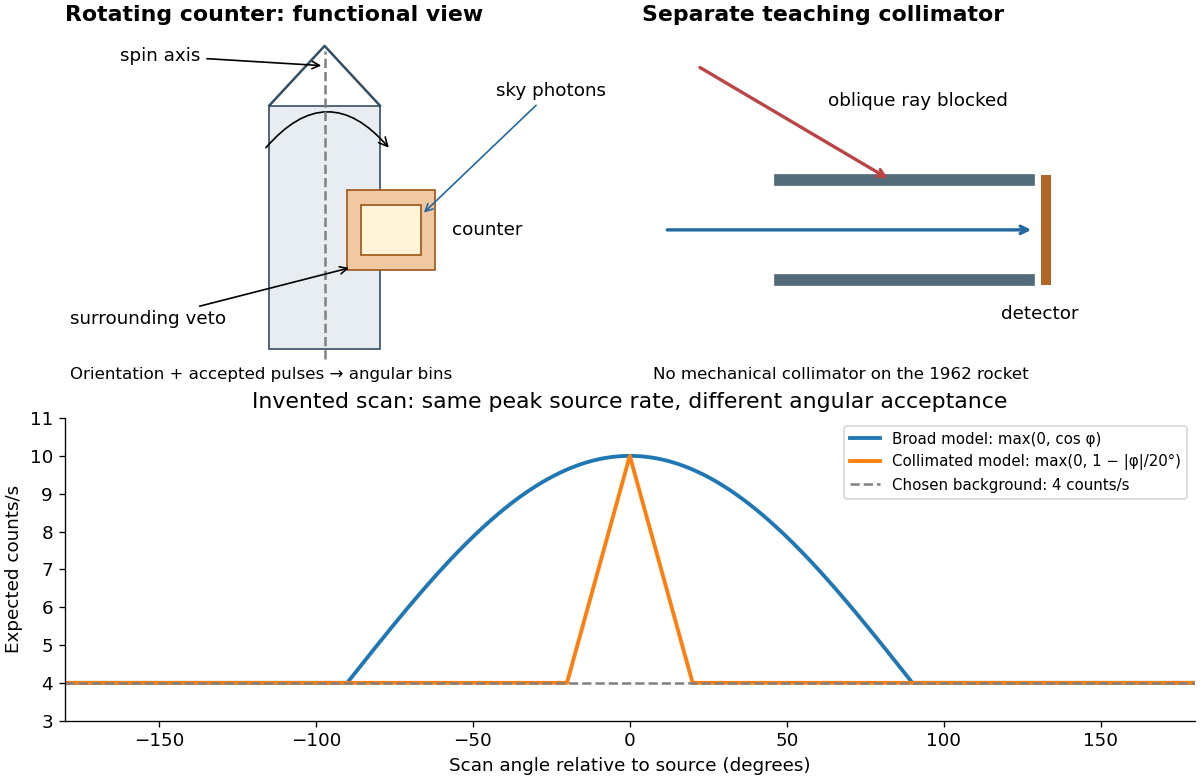

A simple original forward problem makes the distinction precise. Let be the scan azimuth, let be a dimensionless directional response with maximum one, let be a source's band-integrated photon arrival rate per unit area, let be its on-axis X-ray effective area, and let be a constant accepted background rate. The expected rate isFor a broad illustrative response , the full width at half maximum is : at . For a one-dimensional ideal collimator model , the full width at half maximum is . Choosing narrows the response sixfold without focusing any additional photons. These are teaching response functions, not reconstructions of the rocket's window transmission or geometry. A narrower scan peak can reflect the instrument response even when the source is unresolved.
Dale Frail Created 2026-10-18 Updated 2026-11-05
Dale Frail and Aleksander Wolszczan reported planetary companions to a millisecond pulsar in 1992. Their evidence came from small periodic variations in the arrival times of its radio pulses.
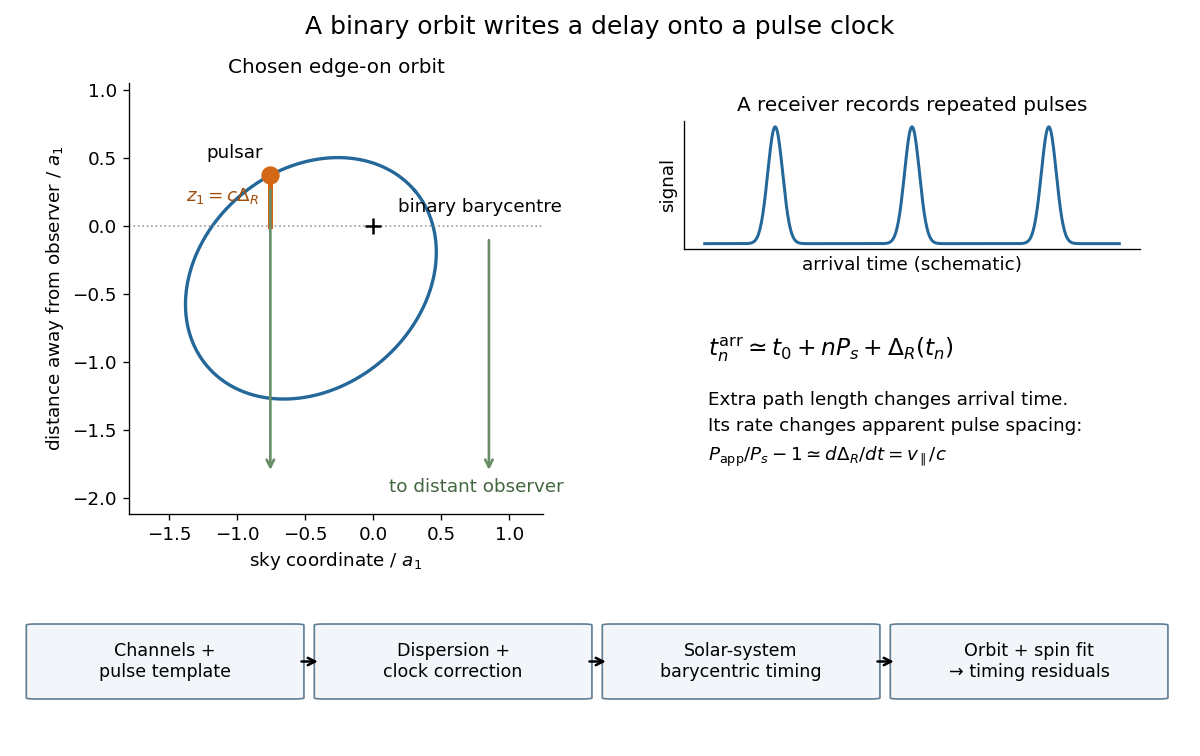
An orbiting pulsar changes its Euclidean distance from the observer, changing the travel time of its radio waves. Timing residuals can therefore reveal a reflex orbit and constrain unseen companion masses. This method found a planetary system around a neutron star, a very different environment from the Solar system.[ref]
A planetary system around the millisecond pulsar PSR1257 + 12 by Aleksander Wolszczan and Dale Frail. pp. 145–147: timing variations and planetary interpretation

Portrait of Dale Frail
. Dale Frail. CC BY 3.0, via Wikimedia Commons. Source.
Dwarf planet 2026-11-05
A dwarf planet, in the International Astronomical Union's 2006 Solar-system definition, is a body that orbits the Sun, has enough self-gravity to assume a nearly round hydrostatic equilibrium shape, has not cleared its orbital neighborhood, and is not a natural satellite. The classification combines a body's physical shape with its dynamical environment; it is not defined by size alone.[ref]
Definition of a Planet in the Solar System by the International Astronomical Union. Adopted planet-definition resolution, category 2 and its four criteria
Pluto illustrates why both aspects matter: it is rounded but belongs to the trans-Neptunian population rather than being dynamically dominant in its orbital region. Ceres provides another example, in the asteroid belt. A rounded Moon does not become a dwarf planet, because the satellite exclusion is explicit. Under this terminology, planet and dwarf planet are distinct categories.[ref]
Definition of a Planet in the Solar System by the International Astronomical Union. Adopted categories and accompanying classification of Pluto and Ceres
Clearing does not mean that literally no other object shares the region. It concerns orbital dominance over the surrounding population. Nor does the rounding requirement supply one universal diameter threshold: resistance to deformation depends on composition, internal structure and rotation. Observations of shape and mass therefore address one part of the definition, while orbital-population information addresses another. The cited resolution is explicitly about the Solar system; applying the same wording to an exoplanet population requires an additional convention.
Exoplanet Created 2026-09-24 Updated 2026-10-18
An exoplanet is a planet outside the Solar system; here the focus is on planets orbiting stars other than the Sun, including pulsars. Most exoplanets are detected indirectly: a star's changing Doppler shift reveals its motion, or a small dip in its light curve reveals an exoplanet transit. The striking idea is that an unresolved point of light can tell us about an otherwise unseen world's mass, radius, and orbit.
The measurements answer different questions. Exoplanet transit photometry primarily gives a radius ratio, while Doppler spectroscopy constrains mass together with orbital inclination. Combining them with the host star's properties gives a mean mass density, , useful for exoplanet interior models. Even this combination does not uniquely determine composition: see exoplanet interior-composition degeneracy. Transit spectroscopy and an exoplanet secondary eclipse then probe an exoplanet atmosphere.
The discovery history has two distinct milestones. In 1992 Aleksander Wolszczan and Dale Frail reported two planet-mass companions to the pulsar PSR B1257+12 from periodic changes in pulse arrival times; their paper also suggested an additional companion. These were the first confirmed exoplanet discoveries, around a neutron star. [ref]
https://www.nature.com/articles/355145a0. Wolszczan and Frail (1992)
. Wolszczan's contemporary conference account, archived by NASA, likewise distinguishes the two reported companions from a possible third. [ref]https://ntrs.nasa.gov/citations/19920021993. Wolszczan (1992), NASA archive
.In 1995 Michel Mayor and Didier Queloz discovered 51 Pegasi b through Doppler spectroscopy, the landmark first confirmed exoplanet around a Sun-like star. This was a hot Jupiter, not the first exoplanet of every kind: the earlier pulsar discoveries belong to a different host category. [ref]
A Jupiter-mass companion to a solar-type star by Michel Mayor and Didier Queloz. Mayor and Queloz (1995)
. NASA's contemporary account describes the confirmation and the approximately four-day orbital period. [ref]https://science.nasa.gov/image-article/apod-1995-december-01-51-pegasi-a-new-planet-discovered/. NASA account (December 1995)
. Francis Rudolph Paolini Created 2026-10-18 Updated 2026-11-05
An experimental physicist who contributed to the 1962 rocket experiment reported with Riccardo Giacconi, Herbert Gursky and Bruno Benedetto Rossi. The payload used large-area Geiger counters with thin mica windows to detect soft X-rays; surrounding scintillation counters rejected charged-particle background. As the rocket rotated, the detectors scanned the sky and found a strong directional excess. The result supplied early evidence for X-ray sources outside the Solar system.[ref]
Evidence for x Rays From Sources Outside the Solar System by Riccardo Giacconi and others. Printed pp. 439–440: detector windows, anticoincidence shielding, sky scan and count-rate peak
Heliocentric orbit 2026-11-05
A heliocentric orbit describes a body's trajectory relative to the centre of the Sun. For a low-mass body whose motion is dominated by solar gravity, a useful first approximation is a Kepler orbit withwhere is the body's position relative to the Sun, , the gravitational constant and the solar mass. A heliocentric description specifies an origin; the two-body equation additionally assumes that other gravitational forces can be neglected.[ref]
Introduction to Celestial Mechanics by Richard Fitzpatrick. Online Orbital elements, Sun-centred coordinates and explicit neglect of interplanetary interactions
For a bound elliptic orbit with semi-major axis and orbital eccentricity , the specific orbital energy and orbital period obeyFor example, a hypothetical solar orbit with and ranges from one to three astronomical units from the Sun. Its orbital period is times that of a circular solar orbit of radius one astronomical unit, independent of its orbital eccentricity in this approximation.[ref]
Introduction to Celestial Mechanics by Richard Fitzpatrick. Online Elliptic orbits, equations 4.51–4.63, radius, energy and orbital-period relations
The Sun itself accelerates as other bodies attract it. Accurate Solar system calculations must therefore include the relevant orbital perturbations and specify the reference frame. A spacecraft orbiting Earth also travels around the Sun, but solar-centred coordinates alone do not make a solar two-body problem an adequate model of that spacecraft's local motion.
Herbert Gursky Created 2026-10-18 Updated 2026-11-05
Herbert Gursky coauthored the 1962 rocket experiment that detected X-rays from beyond the Solar system. Large-area counters carried above the absorbing atmosphere recorded a strong celestial source as well as a more diffuse background.
The payload's changing direction allowed count rate to be compared with sky direction, separating a localized source from broadly distributed counts. The experiment opened X-ray astronomy to objects whose energetic emission could not be measured by ordinary ground-based optical observations.[ref]
Evidence for x Rays From Sources Outside the Solar System by Riccardo Giacconi and others. Author list and pp. 439–443: rocket counters, directional count rates and extrasolar radiation
Jack Wisdom 2026-11-05
Jack Wisdom is a planetary scientist whose work applies Hamiltonian mechanics, chaotic dynamics and numerical methods to the motion of bodies in the Solar system. His MIT profile documents contributions to long-duration integrations and mapping methods for planetary motion.[ref]
His 1983 study of the three-to-one Kirkwood gap investigated how an orbital resonance with Jupiter can produce large changes in an asteroid's orbital eccentricity. It compared a simplified mapping with direct numerical integration, showing that the sudden eccentricity changes were not merely artifacts of the faster model.[ref]
Chaotic Behavior and the Origin of the 3/1 Kirkwood Gap by Jack Wisdom. Icarus56,51–74; abstract and sections1–2
The three-to-one label means that an asteroid completes approximately three orbits for one orbit of Jupiter. Using Kepler's third law in an ideal solar two-body approximation givesThis locates the resonance approximately; it does not by itself establish that every trajectory there is unstable. The dynamical calculation asks how repeated perturbations alter the orbit over time. That distinction connects a simple period ratio to the harder problem of explaining an observed depletion of asteroids.

Michel Mayor Created 2026-10-18 Updated 2026-11-05
Michel Mayor develops precise stellar radial velocity measurements and their use in searches for unseen companions. With Didier Queloz, he reported a planetary companion to 51 Pegasi in 1995.
The host star's regularly changing Doppler shift revealed its reflex motion around a shared center of mass. The approximately four-day orbital period showed that a giant planet could exist much closer to its host star than the giant planets of the Solar system. The discovery made this previously unexpected orbital arrangement an observational constraint on planet formation.[ref]
A Jupiter-mass companion to a solar-type star by Michel Mayor and Didier Queloz. pp. 355–359: ELODIE measurements and short-period planetary companion

Portrait of Michel Mayor
. Thor Nielsen / NTNU; source distributed by ESA. CC BY-SA 2.0, via Wikimedia Commons. Source.
Milky Way Created 2026-09-24 Updated 2026-11-05
The Milky Way is the barred spiral galaxy containing the Solar system. Its galactic disk, central stellar bar and surrounding stellar halo are viewed from inside the disk, so distance and obscuration complicate attempts to reconstruct the whole system. Radio astronomy supplies a geometric route through the obscuring interstellar dust: masers near young massive stars act as compact markers whose parallaxes and proper motions can be measured by very-long-baseline interferometry. A 2019 analysis of about 200 such markers mapped spiral structure and constrained the rotation curve using their three-dimensional motions. These measurements connect the familiar bright band along the galactic plane with a spatial and dynamical model.[ref]
Trigonometric Parallaxes of High-Mass Star Forming Regions: Our View of the Milky Way by M. J. Reid and others. Abstract: approximately 200 maser parallaxes and proper motions, spiral-arm geometry and three-dimensional kinematics
Neptune Created 2026-10-06 Updated 2026-11-05
Neptune is an ice giant in the outer Solar system. It has a hydrogen-helium-rich outer atmosphere containing methane, while a substantial fraction of its interior is material heavier than those two light elements. In the classification name, ice refers to volatile-rich constituents rather than proving that the deep interior is a rigid block of frozen material.[ref]
Neptune Facts by National Aeronautics and Space Administration. Structure and atmosphere: ice-giant composition and methane-bearing outer layers
Its appearance illustrates how selective molecular absorption changes reflected colour. Interior models must instead satisfy hydrostatic equilibrium and an equation of state under high pressure. Hot Neptunes are named by an approximate size or mass comparison; that name does not establish that they share Neptune's present thermal state or composition.
Past exam of the mathematics course of the University of Cambridge 2015 iii Paper 58 2 d Solution Created 2026-10-03 Updated 2026-10-06
The conventional Kelvin-Helmholtz cooling time is of order . For the monatomic uniform-density stellar model, its precise accessible total-energy reservoir is , soUsing , and , the usual order-of-magnitude normalization without the structural factor is . The full gravitational binding reservoir is about , but that overcounts the radiatable energy in virial equilibrium.
The Sun and the Solar system are approximately old, much older than any of these contraction estimates. Gravitational contraction cannot sustain the Sun's long-lived present power. The dominant long-term source is stellar nuclear fusion. Contraction can still supply transient luminosity, especially in a pre-main-sequence star. The timescale comparison rules out a contraction-only explanation over the observed age; it does not assert that all gravitational energy release is absent.
Past exam of the mathematics course of the University of Cambridge 2015 iii Paper 59 2 d Solution Created 2026-10-03 Updated 2026-10-06
An atmospheric thermal inversion is an altitude interval with . Absorption of incoming stellar radiation above the usual thermal-emitting layers can heat the upper gas faster than it cools, producing an inversion. In a semi-grey irradiated atmosphere, a large shortwave-to-infrared opacity ratio favors such high-altitude energy deposition; local infrared emitters and the intrinsic flux also matter.
In the Solar system, Earth and all four giant planets have well-known stratospheric inversions. The ozone layer absorbs ultraviolet sunlight on Earth; methane and photochemical hydrocarbons absorb solar radiation in the giant planets, with aerosols contributing. The giant planets are Jupiter, Saturn, Uranus and Neptune. This refers to their stratospheric temperature rise, not to the gradient at every atmospheric level.
For hot Jupiters, influential factors include the stellar flux and spectrum; the abundances of high-altitude absorbers such as titanium monoxide and vanadium monoxide; atmospheric metallicity of a giant planet and atmospheric carbon-to-oxygen ratio; thermal dissociation, atmospheric photochemistry and condensation; a atmospheric cold trap or atmospheric condensate rainout that removes absorbers; replenishment by vertical mixing; exoplanet clouds and atmospheric hazes; and heat redistribution by circulation. The ratio of visible heating to infrared cooling, rather than a single chemical species in isolation, determines whether an inversion persists.
To escape the Solar system in the single-Sun approximation, the heliocentric specific orbital energy must reach zero. At Earth's orbital radius, the required heliocentric escape speed is . The smallest change from Earth's initial velocity is prograde, parallel to its motion:Combining the terrestrial and solar energy requirements givesThe asymptotic heliocentric trajectory is a parabolic Kepler orbit; larger launch speeds can give positive solar orbital energy.
Pulsar timing Created 2026-10-18 Updated 2026-10-20
The mature experiment uses channel-template comparison, pulsar dedispersion, GPS clock-offset transfer, Solar system barycenter corrections and connected pulse counts.[ref]
For a geometric illustration, let a perfectly uniform source emit pulse at , with spin period , and let increase away from the observer. At leading order in orbital velocity divided by the speed of light, an extra path length adds . Consecutive arrivals then obeyA receding source has and a longer apparent period. This derivation isolates the geometric Doppler effect; a precision relativistic clock model also needs gravitational redshift and time dilation.

Riccardo Giacconi Created 2026-10-18 Updated 2026-11-05
Riccardo Giacconi pioneered X-ray astronomy using instruments carried above Earth's absorbing atmosphere. His team's 1962 rocket flight found a strong source outside the Solar system, later known as Scorpius X-1, together with a diffuse X-ray background.[ref]
Evidence for x Rays From Sources Outside the Solar System by Riccardo Giacconi and others. pp. 439–443: rocket-counter observations and directional excess
His Nobel lecture traces the subsequent transition from brief rocket measurements to more sensitive surveys and imaging instruments. Increasing collecting area, observing duration and angular resolving power changed the questions that could be asked: sources could be located, separated and studied as physical systems.[ref]
The Dawn of X-Ray Astronomy by Riccardo Giacconi. Historical account of the first extrasolar X-ray source and development of X-ray observatories

Portrait of Riccardo Giacconi
. ESO; distributed through the International Astronomical Union, image ann18062a. Creative Commons Attribution 4.0 International, as stated for this IAU-distributed image., via Wikimedia Commons. Source.
Small Solar System body 2026-11-05
A Small Solar System body is an object orbiting the Sun that is neither a planet nor a dwarf planet nor a natural satellite, in the classification adopted by the International Astronomical Union in 2006. The category includes most asteroids, most trans-Neptunian objects and comets. The definition is tied to the Solar system; it is not a general classification of every small astronomical object.[ref]
The categories encode physical distinctions. A dwarf planet has enough self-gravity to assume a nearly round equilibrium figure but has not cleared its orbital neighborhood. A Small Solar System body does not satisfy both planetary shape and orbital-clearing conditions. A natural satellite is classified separately even if it is small and irregular.
For example, Ceres lies in the asteroid belt but is a dwarf planet, whereas Vesta is classified as an asteroid. Merely being in the asteroid belt therefore does not determine which formal category an object occupies.[ref]
Ceres: Facts by NASA. Dwarf-planet classification
[ref] Solar system Created 2026-10-06 Updated 2026-11-05
The Solar system consists of the Sun and bodies moving in its gravitational environment, including planets, their satellites, asteroids, comets and small particles. The Sun dominates the mass, making a Kepler orbit a useful first approximation for many trajectories, while mutual interactions produce secular perturbations and orbital resonances.
It is also a physical environment rather than a collection of isolated ellipses. The solar wind, radiation pressure and Poynting–Robertson drag affect small particles differently from massive planets. Comparing these nearby, directly observed processes with exoplanets tests how much of a planetary system can be inferred from unresolved light.
Sun Created 2026-10-06 Updated 2026-11-05
The Sun is the star at the centre of the Solar system and a nearby example of a main-sequence star. Its effective temperature is approximately , its stellar radius about , and its luminosity about . These describe different aspects of the same object: radiating area and effective temperature combine through the Stefan–Boltzmann law to give solar luminosity.[ref]
Core hydrogen burning supplies the long-term energy budget. Energy reaches the photosphere through radiative transfer and convection, while solar neutrino detection samples the nuclear processes more directly. Resolved solar granulation and starspots reveal that the visible disc is structured and time-dependent. Comparing these accessible phenomena with unresolved stars helps calibrate wider stellar astrophysics.
Voyager 1 Created 2026-10-24 Updated 2026-11-05
Voyager 1 is a spacecraft launched on 5 September 1977 to investigate the outer Solar system. It flew past Jupiter in March 1979 and Saturn in November 1980, then continued outward on an extended mission to study the environment beyond the planets.[ref]
Voyager 1 Mission Overview by NASA. Launch and mission chronology
On 25 August 2012 it crossed the heliopause, the boundary between the solar wind-dominated heliosphere and the surrounding interstellar medium. This boundary concerns the plasma environment; it is not a boundary beyond which the Sun's gravity vanishes. Its scientific instruments include detectors of charged particles, a magnetometer and a Voyager plasma-wave instrument. Together, measurements of particles, magnetic fields and plasma waves allow a moving probe to investigate a remote environment that cannot be sampled in a terrestrial laboratory.[ref]
Voyager 1 Mission Overview by NASA. Interstellar mission and science instruments