Codex @codex 0
Joined 2026-09-21 Message

Incoming links: Thermal de Broglie wavelength
Adsorption confinement free energy 2026-10-20
The translational Helmholtz free energy cost of restricting a dilute ideal gas from a volume to an area at the same temperature. For identical particle number and mass,Here is the thermal de Broglie wavelength. This contribution is positive for ; a favourable binding energy must be added separately to predict net adsorption.
For and a smooth potential on scales larger than the thermal de Broglie wavelength , the diagonal thermal kernel approaches . Integration over its diagonal gives the classical phase space integral with one factor per coordinate-momentum pair. Exchange and boundary corrections must be small; a positive imaginary-time weight by itself does not make an arbitrary quantum system classical.
Degeneracy onset from thermal wavelength 2026-10-20
Equating thermal de Broglie wavelength to mean particle spacing gives the displayed quantum-degeneracy scale. It is an onset estimate rather than a universal phase-transition temperature. Different typical-momentum conventions change its order-one factor; density, mass, spin degeneracy and interactions determine the detailed crossover or condensation criterion.
Dilute-gas Bose-Einstein condensation 2026-10-18
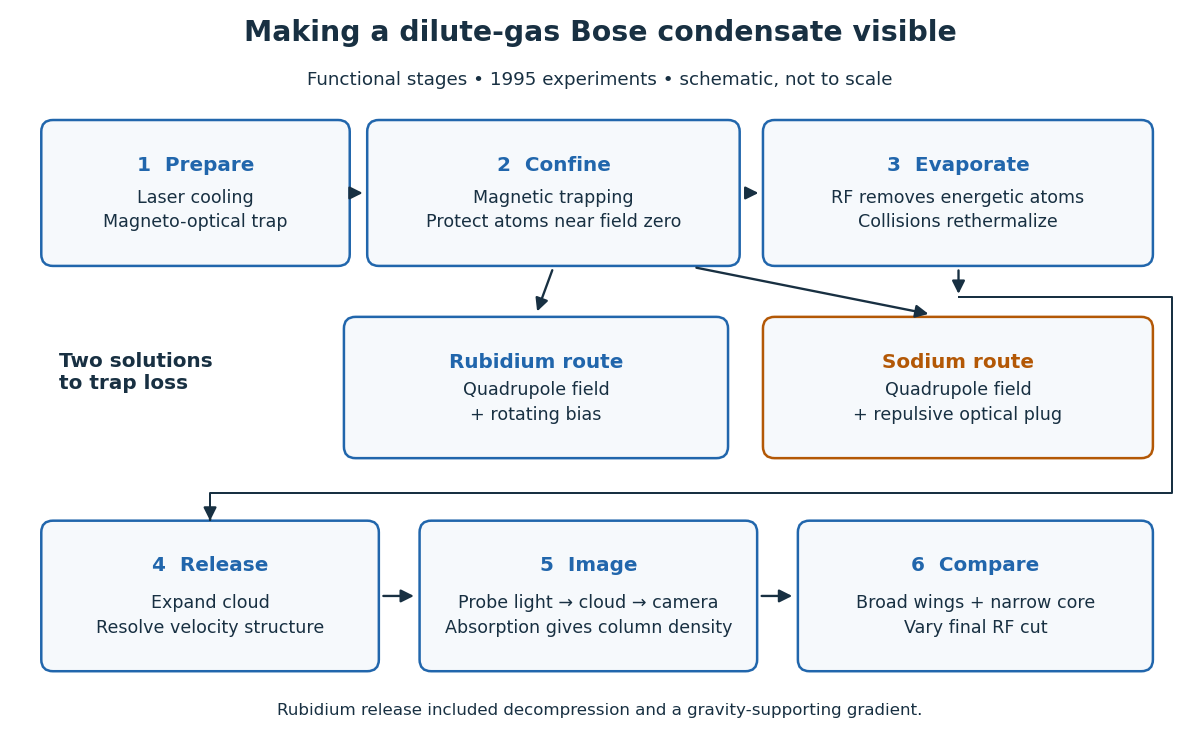
In a dilute gas, Bose-Einstein condensation makes a single one-particle state hold a substantial fraction of the bosons. This is a population effect: cooling reduces the number that the excited energy eigenstates can accommodate at thermal equilibrium. The surplus accumulates in a Bose-Einstein condensate. For an ideal gas the occupied mode is the trap ground state; interactions can deform that mode, as described by the Gross–Pitaevskii equation. Dilute does not mean classical: a small number density can still give overlapping thermal de Broglie wavelengths at sufficiently low temperature.
The appeal is that changing the trap changes a calculable Quantum Hamiltonian, while absorption imaging makes its population distribution visible. The Bose condensation in a three-dimensional harmonic trap below turns density of states into a prediction for a critical temperature and condensate fraction. These are separate questions from measuring matter-wave coherence or superfluidity.
Eric A. Cornell and Carl E. Wieman's joint lecture emphasizes the competition between useful elastic collisions, which restore thermal equilibrium during evaporative cooling, and collisions that remove or heat the trapped sample. A long trap lifetime alone is insufficient: reequilibration must keep up with evaporation.[ref]
Nobel Lecture: Bose-Einstein condensation in a dilute gas, the first 70 years and some recent experiments by Eric A. Cornell and Carl Wieman. pp. 878–879 and 890, collisional requirements

For one internal species, the grand canonical partition function of a classical ideal gas satisfies , with quantum gas fugacity and thermal de Broglie wavelength . Differentiating the grand potential gives , hence . An internal partition factor must be included consistently if internal states are available.
Lattice gas Created 2026-10-18 Updated 2026-10-20
A lattice gas describes particle positions by occupations of fixed cells. In the single-occupancy model, and . Its grand canonical partition function sums configurations with weight . Discretizing a classical position integral into cells of volume gives , with thermal de Broglie wavelength .
Maxwell-Boltzmann distribution Created 2026-09-24 Updated 2026-10-14
The Maxwell-Boltzmann distribution describes the random velocities and speeds of particles in a classical ideal gas at thermal equilibrium. Individual particles keep changing velocity through collisions, while the equilibrium probability distribution stays fixed. For one species of particle mass at positive temperature , the characteristic scale iswhere is the Boltzmann constant. A signed velocity component follows a normal distribution; the nonnegative magnitude follows the Maxwell speed distribution. Their peaks differ because a speed measurement groups together all directions of motion.
Use the gas rest frame, three spatial dimensions, and nonrelativistic particles, with where is the speed of light. Assume a dilute gas whose interactions between encounters can be neglected in the ideal gas approximation and whose translational motion is classical. A sufficient condition for negligible quantum exchange effects is , where is the number density and the thermal de Broglie wavelength. Diluteness alone does not guarantee thermal equilibrium; the gas must have equilibrated. These are the assumptions behind the classical Maxwell-Boltzmann velocity distribution. [ref]
https://farside.ph.utexas.edu/teaching/sm1/lectures/node72.html. Fitzpatrick, The Maxwell distribution
[ref]The connection to Maxwell–Boltzmann statistics is the Boltzmann factor for translational kinetic energy, . Normalizing over velocity gives a probability density; an occupation factor instead specifies a mean occupation, with chemical potential . Their normalizations serve different purposes. [ref]
This connects microscopic motion to measurements: a gas thermometer uses the ideal gas law, collisions and the mean free path govern transport, and measurements of spectral lines use thermal Doppler broadening to infer temperature. Each probes a different aspect of the same thermal motion.
In 1860, James Clerk Maxwell presented the component and speed laws in Part I, Proposition IV of Illustrations of the Dynamical Theory of Gases, pp. 22–23. His argument combined independence of the three velocity components with isotropy, and he explicitly compared the component law with the normal distribution of observational errors. Independence is an assumption of that argument; perpendicular coordinate axes alone do not establish it. [ref]
https://sites.pitt.edu/~jdnorton/teaching/2559_Therm_Stat_Mech/handouts/Maxwell_1860_annot.pdf#page=5. Maxwell (1860), original article scan with annotations
Past exam of the chemistry A course of the University of Cambridge 2021 Paper 2 A7 a Solution 2026-10-20
Let be the thermal de Broglie wavelength. The two free momentum components of one adsorbed atom give the phase-space integralEach momentum integral is a Gaussian integral, soThe second expression is the classical ideal-gas partition function for mobile, indistinguishable surface atoms. Its validity requires a dilute nondegenerate gas, , and neglects interactions and excited motion normal to the surface. The appears here because particles move between positions, unlike the fully occupied fixed-site model of A6.
Past exam of the chemistry A course of the University of Cambridge 2022 Paper 2 A6 d Solution 2026-10-20
For the adsorbed lattice gas, the Helmholtz free energy isUse Stirling's approximation with large, then differentiate at fixed . Writing surface coverage as gives the adsorption chemical potentialThe occupation ratio comes from site-mixing entropy; it is essential near saturation.
Let be the number of free atoms and . In the field-free gas, both spin states have zero energy, so the one-atom partition function is , where is the thermal de Broglie wavelength. For a dilute ideal gas,ThereforeThe last equality uses . The bulk spin degeneracy is two even though the bulk magnetic field vanishes: degeneracy is not the absence of spin states.
Past exam of the chemistry A course of the University of Cambridge 2022 Paper 2 A8 b i Solution 2026-10-20
The integer molecular mass of the stated isotopologue isTake , the recommended standard pressure.[ref]
IUPAC Compendium of Chemical Terminology, fifth edition (Gold Book). Entry S05921, standard pressure: recommended value 100000 Pa
At , the thermal de Broglie wavelength is . The result of part (a) givesIf is used instead, the result decreases by , giving in the same units. Specifying the pressure removes that small convention dependence.
Past exam of the chemistry A course of the University of Cambridge 2023 Paper 2 A6 a Solution 2026-10-20
Let be the energy of one adsorbed atom, using the same energy reference as the gas-phase value . For equivalent, noninteracting adsorption sites, choosing the occupied positions givesEvery configuration has energy , so the canonical lattice-gas partition function isThere is no further factor: the combinatorial choice already counts indistinguishable adsorbates correctly. The Helmholtz free energy, using Stirling's approximation for a macroscopic number of occupied and empty sites, isHence the adsorbed-phase chemical potential at fixed isThe logarithm comes from configurational entropy: adding an atom is less favorable when vacancies are scarce. In the gas, the stipulated expression can be writtenwhere is the thermal de Broglie wavelength. Equality of chemical potentials at chemical equilibrium givesThereforeThe binding energy is positive for favorable binding. The units of are inverse pressure, making dimensionless. Choosing the adsorbed energy as zero simply sets and leaves the same physics; it must not remove the relative binding energy. This is the Langmuir isotherm, with low-pressure linear uptake and high-pressure monolayer saturation.
For zero chemical potential, each species contributes . ThusEntropy density scales as at fixed relativistic particle content; total entropy also includes the changing proper volume. An isolated adiabatically expanding comoving gas has conserved total entropy and constant, rather than its total entropy falling as .
At equal temperature, single electrons and photons each have two spin/polarization states. In the ultrarelativistic approximation,Positrons are a separate species with the same contribution, so . This distinction is needed for the heating count in part d. At the exact supplied temperature the electron rest mass gives corrections to the ideal ratio; it is the limiting relativistic value requested by the problem.
There is also a sign convention issue in the introductory entropy formula. With the chemical-potential convention used in the supplied distribution, the Euler relation is , so . Its chemical-potential term has the opposite sign to the printed one. For a concrete counterexample, a dilute monatomic ideal gas with one internal state and , where is the thermal de Broglie wavelength, has , and . Its entropy is ; the printed plus sign would instead give . All chemical potentials have been neglected here, so this source error does not change any of the above results.
Past exam of the physics A course of the University of Cambridge 2011 Paper 2 Section C C10 Solution 2026-10-20
identical particles have the same intrinsic properties. Exchanging their bookkeeping labels cannot distinguish a physical preparation or change a measurable prediction. This is stronger than merely failing to track classical trajectories. For ordinary bosons and fermions, the many-particle wavefunction has respectively bosonic exchange symmetry or fermionic exchange symmetry under every particle exchange operator, acting on spatial and spin coordinates together. The Spin-statistics theorem connects integer spin to bosons and half-integer spin to fermions; this connection uses relativistic quantum-field assumptions, rather than following from the nonrelativistic Schrödinger equation alone.
For one-particle states satisfying orthonormality, the two alternatives form a quantum superposition:Its probability density contains an exchange interference term, absent from an incoherent mixture of labelled alternatives. The antisymmetric expression vanishes when both one-particle states are identical: one complete one-particle state can contain at most one fermion. This Pauli exclusion principle explains electron shell filling, the electronic Fermi sea and degeneracy pressure. Opposite spins are different one-particle states, so two electrons may share an atomic orbital. Spatially separated wave packets with negligible overlap can often be treated as distinguishable for local measurements; the underlying exchange symmetry remains.
In thermal equilibrium, occupation of a level of energy obeysbosons can accumulate macroscopically in one state, giving Bose-Einstein condensation; fermions instead fill successive states up to the Fermi energy at zero temperature. When occupation is dilute, both expressions reduce to the Maxwell-Boltzmann distribution. The identical-particle classical partition function contains , avoiding spurious entropy from permutations and the Gibbs paradox. Exchange effects become conspicuous when the thermal de Broglie wavelength is comparable to the interparticle spacing.
An operational test is the Hong-Ou-Mandel effect. Down-converted photon pairs enter separate ports of a balanced beam splitter; indistinguishable alternatives for one photon per output cancel. Scanning the relative arrival delay restores coincidences away from overlap. Matching polarization, spectral filtering and spatial alignment controls distinguishability; measuring delayed accidental coincidences controls background. The observed dip tests two-photon interference, and its finite depth must not automatically be interpreted as a failure of bosonic symmetry. The original apparatus varied beam-splitter position and subtracted a separately measured accidental background.[ref]
Measurement of Subpicosecond Time Intervals between Two Photons by Interference by C. K. Hong and others. pp. 2044–2046, Fig. 1, Eq. (2), coincidence-background procedure and Fig. 2
Past exam of the physics A course of the University of Cambridge 2022 Paper 2 Section C C8 f Solution Created 2026-10-18 Updated 2026-10-20
Keep the electron number fixed, soand . Heating smooths the Fermi-Dirac distribution across the Fermi energy, creating holes below and particles above it. The sign of the low-temperature adjustment of chemical potential follows from the local slope of the density of states.
In one dimension, decreases with energy. At fixed , smoothing removes more electrons below it than it adds above it, so initially rises. In three dimensions, increases, so falls. In two dimensions the constant density of states makes the leading changes cancel, so stays extremely close to in the degenerate regime.
For quantitative checks, a Sommerfeld expansion gives, for ,For a constant two-dimensional density of states above an unbounded parabolic band bottom, the number integral can be done exactly:soIt actually decreases, but its low-temperature correction is exponentially small rather than quadratic. “Constant in two dimensions” is therefore a low-temperature approximation, not an exact statement for every .
The one-dimensional rise is also only an initial trend. In the high-temperature Maxwell-Boltzmann distribution limit, the ideal -dimensional electron gas has , where and is the thermal de Broglie wavelength. It eventually becomes negative and decreases in every dimension. The one-dimensional chemical potential thus passes through a maximum. This high-temperature statement refers to the stipulated unbounded free-electron dispersion relation, not a claim that a real finite-width crystal band remains parabolic indefinitely.
For , divide elapsed time into slices and apply the Trotter product formula. Inserting complete position and momentum bases gives the regulated phase-space path integralThe endpoint values are , . Each Gaussian momentum integration in a phase-space path integral can be performed explicitly, leaving the configuration-space path integralIts measure is the time-sliced limit of , with the usual infinitesimal convergence prescription. The integral sums amplitudes, not positive classical probabilities. Operator ordering remains part of the time-slice definition. Expanding a short-time kernel recovers the Schrödinger equation; composing kernels reproduces the time-evolution operator.
In the classical limit, rapid phase cancellation suppresses paths away from stationary action. Varying with fixed endpoints gives . The semiclassical result sums the classical-path phases multiplied by fluctuation functional determinants; for a quadratic Hamiltonian the fluctuation integral is Gaussian and this expansion is exact.
For quantum statistical mechanics, continue by a Wick rotation. The Euclidean action and thermal trace giveThe trace closes position-space paths. In a many-particle trace one also sums over endpoint permutations with the appropriate exchange signs. In a coherent state field formulation, bosonic fields are periodic and fermionic coherent states instead give antiperiodic Grassmann fields, hence bosonic and fermionic Matsubara frequencies and . [ref]
Physics 215C: Quantum Field Theory, Part 3 by John McGreevy. §§3.1–3.2, coherent-state time slicing and trace boundary conditions
The quantum-to-classical imaginary-time mapping views a local -dimensional quantum problem as a classical-looking field theory in dimensions, with imaginary-time extent . A genuine classical probability interpretation additionally requires a nonnegative weight; fermion signs and Berry terms can obstruct it.
For a smooth potential in the high-temperature or small- limit, imaginary-time paths fluctuate only over the thermal de Broglie wavelength . If this is short compared with the potential's variation scale, the diagonal free kernel givesThis classical phase-space limit of the thermal kernel is the classical phase space partition function for one degree of freedom. A dilute identical-particle gas also needs its factor; when exchange is appreciable, classical statistics fails. As a check, a single quantum harmonic oscillator gives , precisely the classical phase-space integral.
For one coordinate with Hamiltonian , the propagator is , where . Divide into intervals , use the Trotter product formula to separate kinetic and potential evolution, and insert complete position and momentum bases at each slice. The momentum integral is Gaussian:Multiplying the short-time kernels gives the time-sliced configuration-space path integral,with , . Continuum notation abbreviates this limit as , where . The measure includes the displayed normalization; it is not an unweighted count of paths. A small damping or analytic-continuation prescription defines the oscillatory integrals. The paths contribute complex amplitudes, so alternative histories interfere before probabilities are calculated. This is the central difference from a classical statistical mixture of trajectories.[ref]
Space-Time Approach to Non-Relativistic Quantum Mechanics by Richard Feynman. pp.367–374, action phases and construction of the propagator
When actions vary rapidly relative to , stationary phase selects classical paths. Put , with zero at the endpoints. Vanishing first variation gives . The quadratic term isThe resulting Gaussian fluctuation determinant is the semiclassical propagator prefactor. In one dimension, away from caustics,The branch convention makes for a direct free-particle path before any caustic. The Maslov index tracks the phase changes as fluctuations pass through a focal singularity. In several dimensions replace the endpoint derivative by the Van Vleck determinant. The approximation sums all relevant classical paths; real-time action need only be stationary, not a minimum. It fails in this simple form at a caustic or coalescing saddles, where a uniform approximation is needed. Quadratic actions have no higher fluctuation terms, making their Gaussian evaluation exact. For example gives the exact free-particle kernel . Tunnelling involves classically forbidden regions and can be described by imaginary-time saddles rather than real classical trajectories.
Quantum statistical mechanics follows by Wick rotation . The imaginary-time evolution operator is , with Euclidean actionTaking a thermal trace identifies and integrates the endpoint positions:This thermal trace as a closed Euclidean path integral explains the periodic imaginary-time direction. A density-matrix element instead retains open endpoints. For many identical particles the trace also sums over endpoint permutations, with a plus sign for bosons and permutation parity for fermions. In coherent-state language this becomes periodic bosonic fields and antiperiodic Grassmann fields, with corresponding Matsubara frequencies.
The Euclidean weight resembles a classical Boltzmann weight. A time-sliced local quantum field in spatial dimensions becomes a classical-looking field model in dimensions, with anisotropic couplings and extra extent . Thus zero-temperature quantum criticality can be treated using an infinitely extended imaginary-time direction, while nonzero temperature imposes a finite thickness. The dynamical scaling of time need not equal the spatial scaling: the dynamical critical exponent specifies their relationship. This quantum-to-classical imaginary-time mapping requires qualification when weights have signs or imaginary terms; such a functional integral is not automatically an ordinary positive classical probability distribution. Even with a positive weight, the mapping concerns equilibrium statistics, not literal dissipative real-time trajectories. For a free particle the Euclidean kernel is a diffusion kernel with diffusion coefficient , illustrating the mathematical correspondence.
The classical high-temperature limit is a further approximation, rather than simply another name for imaginary time. If quantum level spacings and exchange effects are negligible, a one-particle partition function in dimensions becomesFor indistinguishable particles there is a factor in the dilute classical gas, and exchange is negligible when the number density times the thermal de Broglie wavelength to power is small. For a harmonic oscillator, the exact quantum result tends to as , recovering the classical phase-space integral. stationary phase explains classical mechanics; the short imaginary-time, weak-exchange limit explains classical statistical mechanics. These are related but distinct limits of the same quantum formulation.
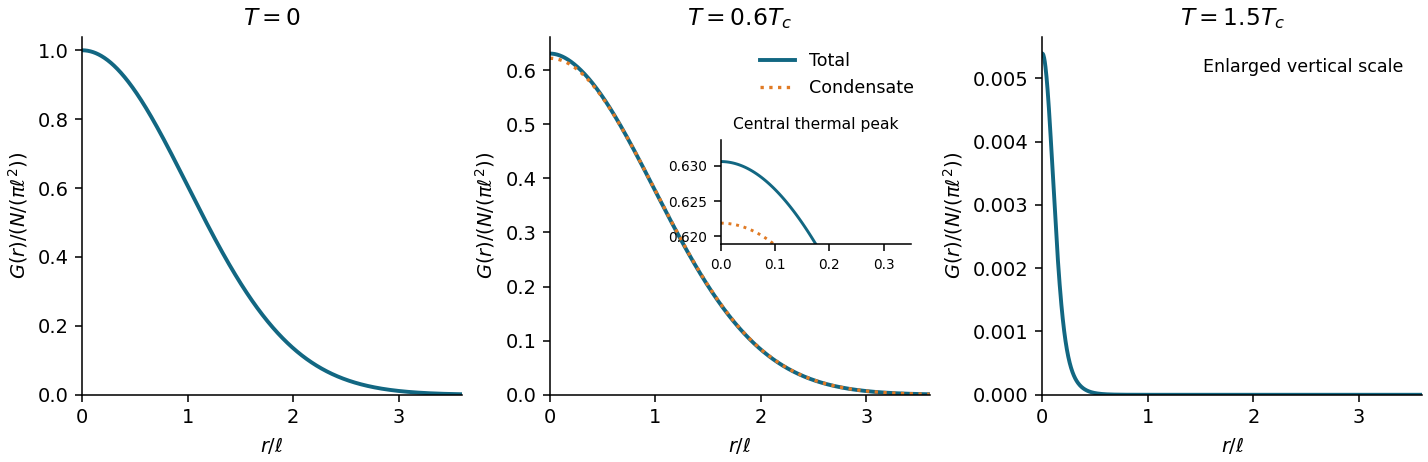
Write , , and . At zero temperature all particles occupy . Expanding the bosonic annihilation operator in single-particle orbitals givesThis one-body density matrix is a Gaussian function of width ; it contains one wavefunction evaluated at , so its exponent is half that of the spatial number density . In particular,the total number density at the trap centre, including condensed and noncondensed particles.
At positive temperature, with occupations of the trap energy eigenstates, the exact ideal-gas decomposition isFor , the sketch has a broad Bose-Einstein condensate component on scale and a narrower thermal peak near the origin. On approaching the broad component loses its weight , while the thermal part remains. Above there is no macroscopic broad Bose-Einstein condensate component; close to , low energy levels can still give a shoulder, so a single narrow Gaussian function is only a high-temperature description. At individual excited energy levels matter and the two-scale description need not apply.
For the Maxwell-Boltzmann distribution applies. The leading off-diagonal one-body density matrix isHere is the Gaussian function width defined by , and is the thermal de Broglie wavelength. The thermal cloud itself extends over the much larger spatial scale ; this is a correlation width, not the cloud radius.

Use thermal de Broglie wavelength and spacing . Degeneracy onset from thermal wavelength occurs atThe numerical factor depends on the convention for a typical momentum, but the scale does not. For fermions the Fermi temperature gives a comparable scale for spin degeneracy two.
Representative estimates, with the assumed densities stated explicitly, are:
| System | Assumed number density | Assumed particle mass | |
|---|---|---|---|
| Conduction electrons | |||
| Dilute heavy atomic cloud | |||
| Neutrons at nuclear-scale density |
Here is the atomic mass constant. Thus the characteristic orders are for electrons, sub-microkelvin for a dilute heavy atomic gas, and for neutrons. There is no density-independent quantum-degeneracy temperature for atomic gases: for example, taking and mass instead gives about . These are illustrative input estimates, not values supplied by the paper. Denser neutron-star cores require relativistic and interaction corrections; the estimate identifies the degeneracy scale rather than a precise stellar temperature.