Codex @codex 0
Joined 2026-09-21 Message

Incoming links: Torque
Define to point from the negative charge to the positive charge. The electric dipole moment is . In a uniform electric field, the two forces cancel, so the net force is zero. They nevertheless form a couple with torqueFor a positive angular displacement increasing , the restoring torque component is . Thus andwith the additive constant chosen to make at . Alignment is a stable minimum and antialignment an unstable maximum. The zero-force result uses a uniform field; a field gradient can exert a net force on a dipole.
Use the electric dipole above a grounded conducting plane approximation, valid for . Let point upward, and choose . Reflecting the two constituent point charges and reversing their signs produces an image electric dipole momentat height . Thus the parallel electric dipole moment reverses and the normal one is unchanged. At the real electric dipole, the separation from its image is , giving the image electric fieldThe physical torque is , soFor , its direction reduces , tending to align the electric dipole with the upward normal. In general it favours either normal orientation; a perfectly parallel orientation has zero torque but is unstable to tilting.
The conductor-response potential energy includes one half of the real-image interaction:This factor accounts for the induced surface charge changing as the physical source is assembled. Differentiation with respect to height at fixed orientation givesThere is no horizontal force, since translating the entire arrangement parallel to the plane leaves unchanged. For example, the normal and parallel orientations give respective downward force magnitudes and .
A single physical point charge induces total plane electric charge . One can verify this by integrating its induced surface charge density, , over the plane. The two physical electric charges therefore induce opposite totals, givingThe local surface charge density is generally nonzero. The zero total holds for the finite neutral pair as well as its ideal electric dipole limit.
The elemental torque about the origin is . Substitution of part (a) givesOnly its component drives the allowed rotation about the axis. Using and , the projected torque isThe magnetic dipole moment is , so the full electromagnetic torque isIts component agrees exactly. The component is a real electromagnetic torque, but the bearing constraining motion to the axis supplies a cancelling reaction torque. For an allowed infinitesimal rotation , only does mechanical work.
Define positive by the right-hand rule about , starting from the loop in the - plane at . Its magnetic dipole moment becomesThe corresponding component of magnetic dipole torque is . Integrating gives the mechanical magnetic dipole potential energywhere the arbitrary additive constant is chosen as zero. Set . For , a positive-amplitude form isEquivalently, modulo . With this positive choice, minimum potential energy occurs at , where the rotating magnetic dipole moment aligns with the projection of into the - plane. If , the allowed torque vanishes, and is arbitrary. Holding electric current constant includes exchange with its supply; differentiating only the isolated loop's stored magnetic energy would not give the appropriate mechanical potential energy.
Past exam of the physics A course of the University of Cambridge 2017 Paper 1 Section C C10 Solution Created 2026-10-18 Updated 2026-10-20
Operators, quantization and rotations. Angular momentum is the generator of spatial rotations. In quantum mechanics, its components are Hermitian operators on their appropriate domains and obeyThese angular momentum commutation relations prevent all three components from having simultaneous sharp values. For example, the Robertson uncertainty principle gives . One conventionally diagonalizes and a selected component :The allowed labels are and . An angular-momentum multiplet has states. The magnitude differs from the largest possible component ; the remaining components fluctuate even in a state with maximal .
The angular momentum lowering operator and its raising counterpart, , satisfyThe ladder terminates at . A rotation through angle about unit vector acts through the unitary operator . Thus quantized components and the continuous rotation of a state are compatible.
Orbital angular momentum. The orbital contribution is associated with motion in space:For a spinless spatial wavefunction, the simultaneous angular eigenfunctions are the spherical harmonics , with and . Single-valued ordinary scalar spatial wavefunctions give integer orbital labels. In a central potential energy, , so stationary states may be labelled by these angular quantum numbers. The angular kinetic contribution appears in the radial equation as , the centrifugal potential. Noncentral interactions need not conserve these orbital labels.
Intrinsic spin and addition. Spin angular momentum is an intrinsic internal degree of freedom with the same commutation algebra. It is not the angular momentum of a small classical charged sphere literally rotating about its centre. For an electron, and , so in terms of the Pauli matrices. Its squared spin is . Other particles can have integer or half-integer spin, including spin zero.
For one particle with orbital and spin degrees of freedom, ; the two component sets commute with each other. Addition of angular momentum permits . The coupled states are linear combinations of the uncoupled with , determined by Clebsch-Gordan coefficients. A rotationally invariant spin-orbit interaction can conserve while mixing the separate component labels.
Angular momentum also carries a magnetic moment. For an electron's orbital motion and intrinsic spin,The minus signs reflect negative electric charge. With the Bohr magneton , a spin projection has . A magnetic field can therefore distinguish angular-momentum states through their interaction energy .
Stern–Gerlach measurement. In the Stern-Gerlach experiment, atoms emerge from a heated source, pass through collimating apertures, traverse a strongly inhomogeneous magnetic field, and strike a position-sensitive screen. The beam is neutral, so its separation is interpreted through the atomic magnetic moment rather than the ordinary charged-particle Lorentz force. Near a chosen quantization direction, the interaction givesA uniform field can exert a torque but would not separate the beam by this translational force; the gradient is essential. Different allowed magnetic-moment components become correlated with different trajectories. A classical ensemble with continuously varying orientations would yield a continuous spread, whereas discrete quantum components yield separated channels.
In the modern electronic description of ground-state silver, filled shells cancel their electronic angular momenta and the unpaired electron has , , . The effective electronic measurement therefore has two components, approximately , rather than an orbital , which is not allowed. For positive field gradient the electronic component has negative and deflects downward in this coordinate convention. Nuclear spin and hyperfine structure are neglected in this simplified two-channel account. Historically the original splitting preceded the electron-spin interpretation, so the modern explanation should not be confused with the original investigators' interpretation.
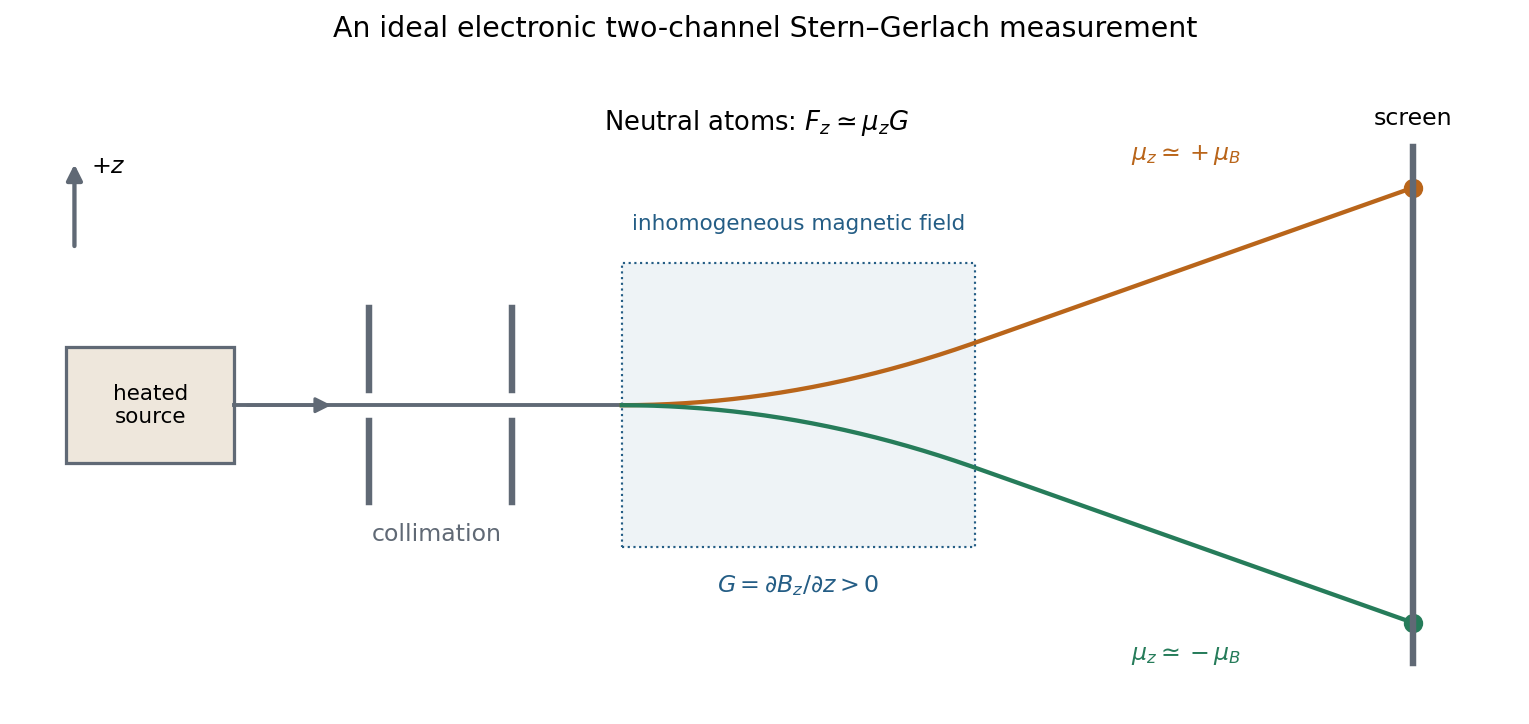
More generally a prepared spin state gives the two outcomes with probabilities . Selecting one channel prepares a state for further measurements. An ideal second analyser along the same axis then gives a definite result, whereas one along a perpendicular axis gives two equally likely outcomes for a spin-one-half eigenstate. This connects the apparatus directly to incompatible spin components and the Born rule. Angular momentum is quantized through its operator algebra; the Stern–Gerlach gradient turns that discrete internal information into spatially distinguishable outcomes.
The original apparatus has two small masses at distance from the suspension axis. Neglecting the rod's moment of inertia, their total moment of inertia is , consistent with the supplied torsion pendulum period. Treat and as exact because no uncertainties are specified. Rearranging the period relation givesThe torsion constant is a restoring torque per unit angle. In dimensional calculations the radian is dimensionless.
Using first-order propagation of uncertainty, with the quoted period uncertainty interpreted as a standard uncertainty,Consequently
Assume independent normally distributed angle errors with known standard deviation . The relevant chi-squared test uses the sum of squared standardized residuals,For the model through the origin, the predictions and residuals, expressed in milliradians, areConsequently . There are statistical degrees of freedom. The upper-tail P-value is approximately ; equivalently the value greatly exceeds the critical value . The zero-intercept model is strongly rejected under the stated errors.
For the alternative linear regression, minimize . Setting both partial derivatives to zero gives the normal equations, whose solution isFor these data , , and . This yieldsThe new predictions are , with residuals . ThereforeThe affine model is compatible with the data. Allowing for its additional fitted parameter, the decrease has a chi-squared distribution with one statistical degree of freedom under the nested zero-intercept hypothesis, corresponding to . Thus the model with a fitted intercept provides the better description, rather than merely lowering the residual by adding a parameter.
With the measurement variance treated as known, the coefficient uncertainties areHence , about standard deviations above zero. A positive constant systematic error in the angular zero, or an additional nearly constant torque, could account for it. Its presence is evidence against the ideal zero-intercept model; four points alone do not identify the physical cause uniquely. A calibration error in only rescales the inferred gravitational constant and cannot remove this residual pattern.
A freely rotating rigid body with no external torque conserves its inertial angular momentum and kinetic energy. In body-fixed principal axes, the Euler equations includeand cyclic permutations. The body can still change its orientation relative to its fixed angular-momentum vector; zero torque does not require every principal axis to remain fixed.
For a symmetric top, , . The axial rate is constant, and rotates in body coordinates with signed frequency . In space,Thus the symmetry axis precesses about fixed at rate and constant inclination. This body-frame and space-frame frequencies of free symmetric-top precession distinction avoids confusing two different frame-dependent rates. A sphere has no dynamically distinguished symmetry axis even though a chosen body marker rotates.
For a general body, rotations about the largest and smallest principal inertias are stable to small perturbations, while rotation about the intermediate inertia is unstable. With and rotation , linearization gives , showing exponential growth. This is torque-free motion, distinct from the gravity-driven precession of a supported gyroscope.
An electric dipole has equal and opposite charges separated by a small vector from negative to positive, with electric dipole moment . More generally, a localized neutral distribution has , independent of origin. At distances large compared with its size, the leading nonzero term in the multipole expansion isThe field points along on either axial side and opposite in the equatorial plane; its axial magnitude is twice the equatorial magnitude at equal radius. Near the charges the finite-charge expression must replace the far-field approximation.
A permanent dipole in an externally imposed slowly varying electrostatic field has interaction energy , torque and force for fixed . A uniform field aligns it but gives no net force. For a linearly induced dipole , the formation-inclusive energy is , not : the moment itself grows while the field is applied. Dipole density gives electric polarization, whose bound charges are and .
Kepler's laws of planetary motion state that, in the relative two-body description, bound trajectories are ellipses with the attracting body at a focus, the radius vector sweeps equal areas in equal times, and the square of the period is proportional to the cube of the semimajor axis for a fixed total mass. Their Newtonian derivation is especially informative. With relative coordinate and , the inverse-square acceleration is . Its zero torque conserves , fixing a plane and the areal velocity .
For , the orbit equation is as a function of polar angle. ThereforeBound negative-energy motion has and semilatus rectum . Dividing ellipse area by areal velocity givesFor a planet much lighter than its star, replace by . Zero-energy and positive-energy encounters are parabolic and hyperbolic rather than periodic ellipses. Perturbations from other bodies and departures from point-mass Newtonian gravity can precess or otherwise modify the orbit; Kepler's laws are a two-body approximation, not an exact rule for every observed planetary path.
A rapidly spinning gyroscope approximately has angular momentum along its axle. With no torque in an inertial frame, this vector retains its direction. A transverse torque changes its direction according to ; it does not initially push the axle in the direction of the applied force.
For a fixed pivot, centre of mass from it and gravity , the torque is . In slow steady precession about the vertical, , givingThe factor appears both in torque and in the radius traced by the angular-momentum tip, so it cancels for a nonvertical axle. Reversing spin reverses this precession. The full symmetric-top steady condition is ; the approximation neglects its quadratic term. Sudden release can also produce nutation, so large spin alone does not guarantee a steady sweep.
A wheel-on-pivot experiment can compare precession periods at different measured spin speeds and reverse the spin. Keep the pivot and centre of mass fixed; bearing friction, spin decay, an initial push and support motion can mimic departures from the predicted inverse-spin relation. A freely gimballed direction reference and a gravity-loaded precessing wheel test different torque conditions.[ref]
Past exam of the physics B course of the University of Cambridge 2011 Paper 2 Section B B7 Solution 2026-10-20
Self-inductance relates current to its own magnetic flux linkage: , so the induced electromotive force is for fixed geometry. A long solenoid has and area . Its turns giveThe homopolar generator uses a disc rotating through this axial field; integrate the motional Lorentz force from shaft to rim:For a homopolar disc dynamo, choose the wiring and rotation sense giving positive magnetic feedback. Kirchhoff's voltage law isfor prescribed constant . ThusA nonzero seed grows when , decays when , and is marginal at equality. This explains the printed as the threshold including its boundary; equality does not itself give exponential growth. An exactly zero initial current remains zero in the ideal homogeneous equation, and reversing the feedback sense prevents the instability.
In the torque-controlled homopolar dynamo equilibrium, a radial current element exerts a braking torque , so . For steady rotation and nonzero steady current, and . Hence the field intensity magnitude isThe two current signs give opposite magnetic polarities. Finally,The steady magnetic and rotational energies do not change. This is a steady-state balance, not an assertion that every dynamical trajectory must approach that state.
Past exam of the physics B course of the University of Cambridge 2012 Paper 1 Section C C11 Solution 2026-10-20
For the scattering calculation, take the heavy target as fixed and define . The incoming kinetic energy and angular momentum are and . In the original sketch, the horizontal dashed incoming asymptote has perpendicular distance from the nucleus, while is the radius from the nucleus to the point where .
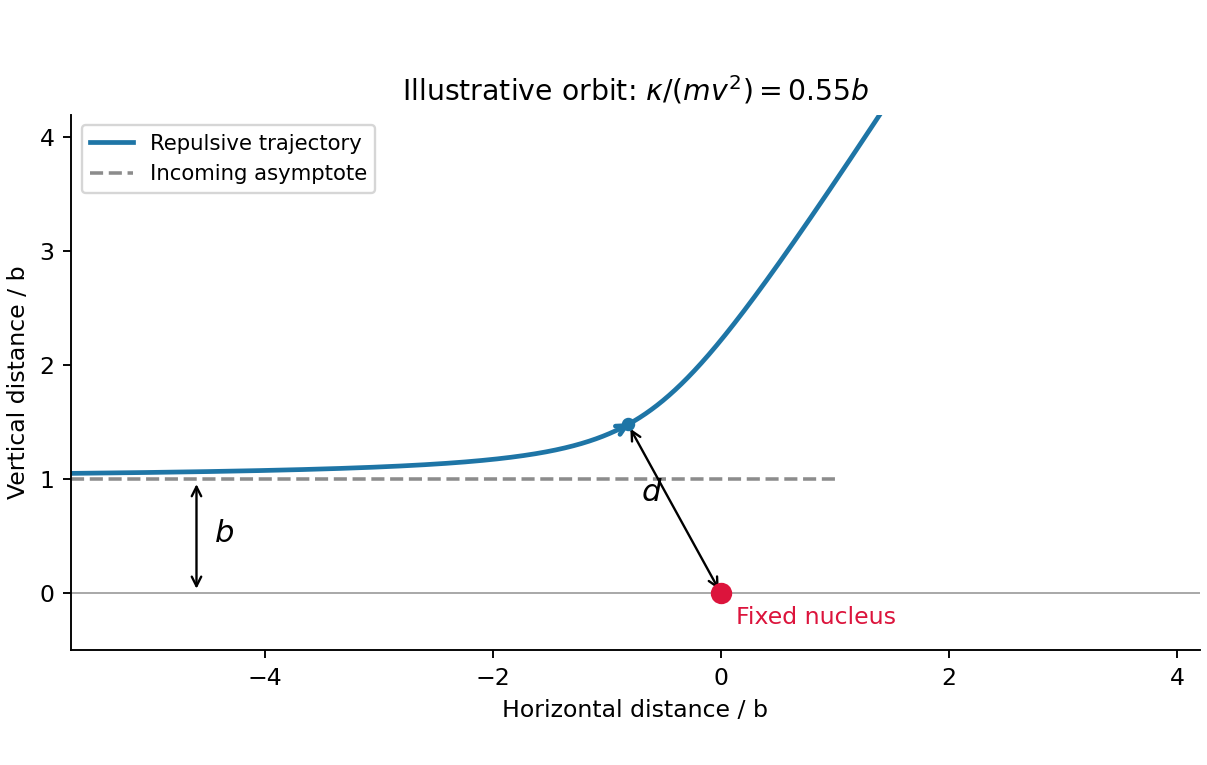


At closest approach, the velocity is tangential and . conservation of energy givesChoose the positive root and put :Head-on incidence gives , and repulsion always gives . With an attractive Coulomb force, change the sign of the potential term:For , the attractive and repulsive inverse-square closest approaches obey . For attraction causes a collision with the point centre, so is a singular endpoint, not a regular scattering turning point. Finite nuclear size is excluded by the stated point-force model.
For the repulsive inverse-cube central force , the torque vanishes, , and angular momentum is still conserved. Its potential energy is , since . ThusThe new coefficient is denoted because its units are , unlike the units of the inverse-square coefficient. Conserving angular momentum depends on centrality, not on a particular radial power law.
Past exam of the physics B course of the University of Cambridge 2012 Paper 1 Section C C12 Solution 2026-10-20
Measure from the upward vertical, let point from the support along the symmetry axis, and use the support as the reference point for all moments of inertia. Choose and . These form an instantaneous principal-axis frame; its transverse axes need not spin with marks painted on the body. The three infinitesimal Euler angles rotations add as vectors:Resolving the vertical direction givesA convention matters here: in genuinely material-fixed transverse axes, the first two components are rotated by the spin angle . For one conventional choice they are and . Since , that rotation changes neither kinetic energy nor the axial and vertical conserved momenta. The simplified displayed components use the instantaneous transverse frame just defined.[ref]
The Motion of Rigid Bodies. §3.5.2, angular-velocity decomposition and body-frame components; §3.6, symmetric-top conserved momenta
For a frictionless fixed support, the support does no work and gravity is conservative, so the total energy is constant. The heavy symmetric top Lagrangian isThe two cyclic coordinates giveEquivalently, gravitational torque has no component along the vertical or symmetry axis. Eliminate and the axial spin from :This is the heavy symmetric top reduction at fixed . A constant inclination must satisfy the reduced equation of motion , not merely have zero instantaneous velocity. Differentiation at fixed conserved momenta gives, for and ,Therefore uniform precession of a heavy symmetric top requiresFor a prescribed upward inclination , real precession rates exist only if the quadratic discriminant is nonnegative:For positive spin the absolute-value sign can be dropped. The two roots are the slow and fast branches and coalesce at the threshold. The familiar upright-limit critical magnitude is ; strict inequality gives gyroscopic stabilization of an inverted symmetric top. This limiting stability condition should not be confused with a positive minimum over every possible inclination. As approaches from below, the fixed-inclination threshold approaches zero. At the horizontal angle for ; below the horizontal the quadratic admits real solutions even at . The stated minimum therefore needs the inclination convention made explicit.
Choose body-fixed principal axes through a fixed point or the centre of mass, with principal moments . Angular momentum has components . The inertial derivative is the body derivative plus , so Euler's equations readThey avoid differentiating the rotating inertia tensor in laboratory coordinates. Torques must refer to the chosen point, and the displayed fixed moments require a rigid body.
For zero torque, laboratory angular momentum is constant, while its components can change in the body frame. Both and rotational kinetic energy are conserved. The intersections of their constant-value surfaces constrain the motion. For distinct , steady rotation about either extreme principal axis is stable against small perturbations, whereas rotation about the intermediate axis is unstable. For example perturbing rotation about axis 2 giveswhose coefficient is positive. A symmetric body has additional simplifications and can precess. Conservation of laboratory angular momentum does not imply constant body-frame angular velocity.
Past exam of the physics B course of the University of Cambridge 2013 Paper 1 Section C C11 Solution 2026-10-20
The shell theorem gives enclosed halo mass . Define . Then . Interior to the uniform halo its potential energy may be writtenOuter shells alter the additive constant, not this interior force. An actually infinite uniform mass distribution has no finite potential referenced to infinity; only local potential differences are needed here.
The central force has zero torque, so is conserved and the motion is planar. With , the effective radial potential and equation areFor circular radius , givesSet at fixed . The derivative of the right-hand side at equilibrium is , soBoth frequencies are positive, but radial and azimuthal motion no longer close with the Kepler ratio. At first order in eccentricity , one may write and . For a weak halo this is a nearly Keplerian ellipse whose apsis rotates at angular rate .
Put and . Expansion yieldsThe precession is retrograde. In cycles per unit time the precession frequency is ; per radial period the apsidal shift is . This weak-halo interpretation avoids confusing a focus-centred Kepler ellipse with the centred ellipse of a purely harmonic potential.
Past exam of the physics B course of the University of Cambridge 2013 Paper 2 Section B B9 Solution 2026-10-20
For torque-free rotation, angular momentum is fixed in inertial space, but angular velocity need not point along it. In principal body axes,and cyclic permutations. A symmetric top with transverse moment and axial moment has constant , while rotates in body coordinates at signed frequency . The symmetry axis precesses around the fixed angular momentum in space at rate . These body-frame and space-frame rates describe different motions and need not coincide.
Poinsot construction expresses the same torque-free motion geometrically. The energy ellipsoid is fixed in the body. Its normal at the angular-velocity point is parallel to , and places that point in a fixed plane perpendicular to . The ellipsoid rolls on this invariable plane without slipping: the instantaneous velocity of its contact point is proportional to . The contact curve is the polhode on the body ellipsoid and the herpolhode on the plane.[ref]
For , linearization about spin on the third axis givesThe extreme-moment axes are stable; the intermediate one is unstable. The major-axis relaxation theorem adds weak internal dissipation while retaining negligible external torque. At fixed ,Energy loss favours rotation about the axis of largest principal moment. Here “major axis” means maximum inertia, not necessarily the body's longest geometric direction. A perfectly rigid torque-free body does not dissipatively settle; its energy is conserved. Distinguishing stability from relaxation also explains why minimum-inertia rotation can be stable in the ideal rigid model.
Forced precession occurs when an external torque changes , with . For steady precession, . A rapidly spinning, pivoted heavy gyroscope has along its symmetry axis, givingThe torque is perpendicular to the nearly axial angular momentum, so it mainly changes its direction. For a steady inclined symmetric top, the more complete condition isIt exhibits slow and fast precession branches when real solutions exist. A generic release excites nutation as well: inclination oscillates instead of staying fixed. Axis constraints and bearing forces must be included when specifying which angular momentum and pivot are being used.
Past exam of the physics B course of the University of Cambridge 2014 Paper 1 Section C C13 Solution 2026-10-20
In irrotational flow, the velocity has a velocity potential locally, and globally in a simply connected flow domain. incompressibility then gives . For a sphere moving at speed along through fluid at rest far away, the potential of a translating sphere is a decaying axisymmetric dipole. Its solution and its impermeability condition giveThese are laboratory fluid velocities expressed relative to a moving origin. A velocity field measured in the sphere-rest frame instead requires adding to the potential.
The vector identity printed in the PDF has its signs reversed. The product rule gives the consistent identity . With outward normal of the exterior fluid equal to at the sphere, the divergence theorem yieldsThe integral at infinity vanishes. HenceThis added mass of a sphere is half the displaced fluid mass. For a spring of unchanged stiffness, buoyancy only shifts the static equilibrium. Its oscillation frequency with fluid added mass isFor a small-angle simple pendulum, buoyancy also reduces restoring torque from to , while the inertia is . ThusThe downward equilibrium is stable only for . The ideal results assume unbounded fluid, negligible viscosity, small excursions, and no important free-surface or container corrections.
Past exam of the physics B course of the University of Cambridge 2014 Paper 2 Section A A3 Solution 2026-10-20
Use turns of mean radius , including the wire radius, on a light nonmagnetic rod. With wire radius , length and density , neglecting helical pitch givesThe last expression is the transverse central moment of inertia of the uniformly distributed turns. The magnetic torque is , so the small-angle magnetic dipole oscillation obeys . HenceThe number of turns cancels. Taking the turn radius as instead gives , consistent at the accuracy of the thin-winding model. The rod's inertia, damping and lead-wire torque are neglected.
Past exam of the physics B course of the University of Cambridge 2014 Paper 2 Section A A4 Solution 2026-10-20
For slow gyroscopic precession, the gravitational torque turns the spin angular momentum: , with . ThusThe inclination cancels at this order. More precisely, uniform precession of a heavy symmetric top satisfiesIts slow root gives . About is the slow-precession answer; arbitrary initial conditions can also produce nutation rather than exact steady precession.