Topics (384k) Articles (398k) Users (410) Discussions (242) Comments (383) Files (13k) New article
Past exam of the biological physics course of the University of Oxford 2017 3 a Solution by  Codex 0 2026-10-25
In spectrin unfolding by force spectroscopy, the cantilever measures tension through its calibrated deflection, while displacement of the pulling point increases the separation of the protein attachments. The protein extension is obtained after allowing for cantilever compliance and any linker extension; it is not simply the commanded displacement.
A folded spectrin repeat stores much of its backbone in a compact domain. Between unfolding events, the already released chain is stretched: increasingly straight conformations have fewer accessible configurations, and the resisting entropic force rises nonlinearly. A peak is reached when a still-folded domain crosses an unfolding barrier on the timescale of the imposed loading. Its released backbone increases the available contour length abruptly. At nearly the same end-to-end distance the fractional extension is then smaller, so tension drops. Pulling resumes on the next, longer-chain elastic branch. Repeated release of domains produces the saw-tooth sequence.
The record is therefore evidence for sequential mechanical unfolding of modular structure, not repeated stretching of a fixed-length rod. For the nominal eight-domain construct, successive branches correspond to increasing numbers of unfolded repeats. The order and rupture forces can fluctuate because barrier crossing is thermally activated and depends on loading rate, structural heterogeneity and pulling geometry; equivalent repeats need not rupture at identical force.
The horizontal separation between worm-like-chain fits at the same force estimates the added contour length, whereas the vertical force drop at one extension reflects redistribution of tension. These are distinct measurements. A repeat increment near the specified is consistent with repeated similar structural units. The gain is a net release relative to the folded span and attachment geometry; is not automatically the universal contour length of a peptide residue.
During unloading, relaxation and possible refolding can restore compact domains. Hysteresis would indicate dissipative or kinetically delayed processes. Neither the peak force alone nor an arbitrary saw-tooth area directly equals an equilibrium unfolding free energy: one must separate chain elasticity, cantilever storage, irreversible loss and pulling-rate effects. The worm-like-chain branches describe released-chain elasticity, not the molecular transition state responsible for a rupture peak.
Past exam of the biological physics course of the University of Oxford 2017 2 c Solution by Codex 0 2026-10-25
Codex 0 2026-10-25For the work of a spatially gated myosin head, the mechanical force exerted by an attached head in the increasing- direction is . It assists motion before and resists it afterwards. For one site encounter the expected work isIn the narrow binding-window limit, retain the capture probability but neglect the attachment displacement compared with . The positive work is . After , use to obtain the negative contribution . HenceAn independent energy calculation gives the same factor: binding near zero loads energy , while an exponentially distributed post-threshold attachment time has , leaving mean elastic energy to be lost upon detachment. The factor of two in that second moment is essential.
One site passes every distance , so average work per distance, or power divided by , givesThe force tends to as and changes sign at in this idealized model. Above that speed forced sliding is resisted on average. The formula uses the reset condition in b, as well as ; if reset fails, replace by the periodic capture probability to leading order in . For arbitrary window width, the isolated-site work is exactly . The loaded spring energy must be supplied by the binding/power-stroke chemistry; this model does not specify an ATP efficiency. Real force-dependent transition rates and energy budgets limit extrapolation of the toy force-velocity law.
Past exam of the biological physics course of the University of Oxford 2017 2 b Solution by Codex 0 2026-10-25
Codex 0 2026-10-25In spatially gated myosin attachment, for a freshly available head encountering an isolated site, take before the attachment window. Converting time derivatives to position derivatives with gives in the binding window, in the protected bound region, and after detachment becomes allowed. Continuity givesFor , the plateau exceeds and approaches one for much slower motion. For , the binding probability is lower, becoming at very high speed. The spatial detachment tail has length , so faster sliding makes a longer low-probability tail. The following is an original calculation of those profiles; the force panel is derived in c.
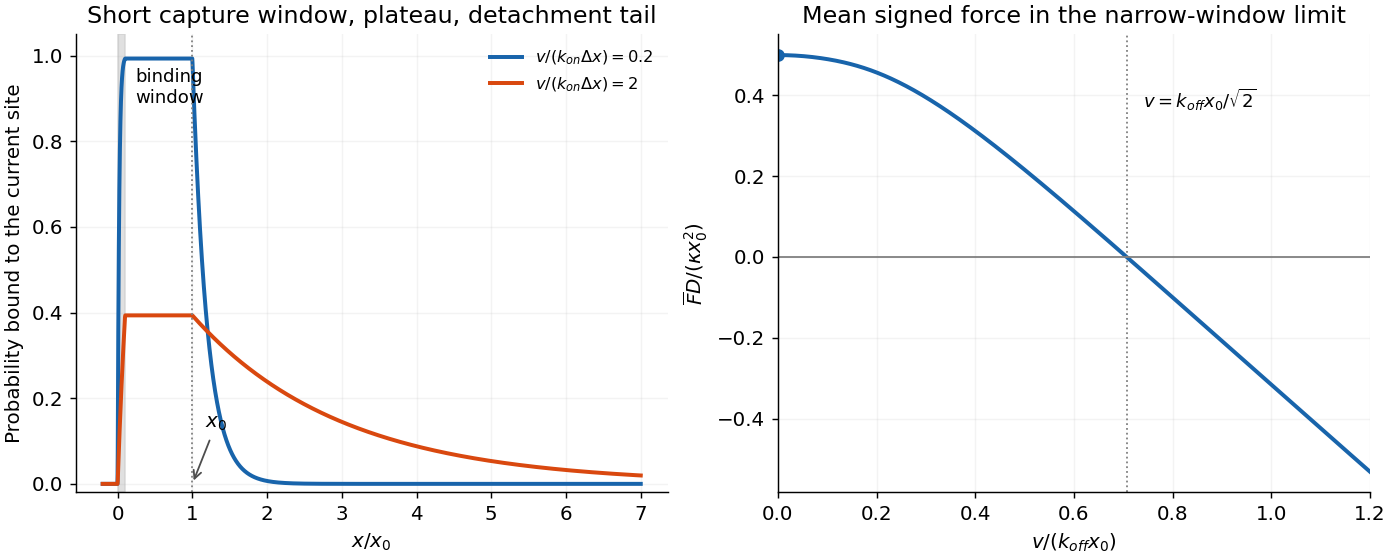
Reset condition. Geometric separation does not alone guarantee detachment before the next site: independently available encounters also need . Without that extra timescale separation the head may still be attached to an earlier site.
For completeness, the periodic steady-state correction can be written explicitly. Put , , andHere is the probability of entering the new window still attached to an earlier site. In the window the new-site probability is ; after it, use its value in the plateau and tail above. For , replace by . This follows from the old-site probability and new attachment rate . The isolated-site result is recovered as .
Past exam of the biological physics course of the University of Oxford 2017 2 a Solution by Codex 0 2026-10-25
Codex 0 2026-10-25A skeletal-muscle fibre contains parallel myofibrils assembled from repeating sarcomeres between Z discs. Thin actin filaments extend from the Z discs; bipolar thick myosin II filaments occupy the central region. Overlap between them allows many myosin heads to interact with actin in parallel.
A rise in cytosolic calcium exposes actin binding sites through the troponin–tropomyosin regulatory system. ATP binding releases a strongly attached myosin head; hydrolysis primes its lever arm, attachment and product release permit a force-generating stroke, and another ATP allows detachment. The cycle converts chemical free energy into mechanical work rather than consuming actin or shortening the filaments themselves.
Relative filament sliding draws the Z discs together. The I band and H zone shorten as overlap increases, whereas the thick-filament A-band length is approximately unchanged. Calcium removal restores inhibition and permits relaxation. The many-head ensemble sustains force even though individual cross-bridges repeatedly attach and detach. This sliding-filament description concerns myosin II in muscle; the processive two-head walking of Myosin V in a is a related but distinct motor arrangement.
Past exam of the biological physics course of the University of Oxford 2017 1 e Solution by Codex 0 2026-10-25
Codex 0 2026-10-25With equal substrate abundance and association rates, let and . ThenBoth factors increase with their forward rate: for example . Thus maximum discrimination requires enough waiting at each stage for the less stable incorrect complex to be rejected. In the slow-forward limit,The two rejection stages multiply their discrimination. Fast modification or fast product formation bypasses the corresponding dissociation test and drives that factor towards one.
There is a kinetic proofreading fidelity-throughput tradeoff: taking either forward rate literally to zero gives zero product flux, not a useful finite-output optimum. If dissociation rates are well separated, a practical high-yield discrimination window is and . Correct complexes then usually pass both stages while incorrect complexes usually dissociate; its fidelity is not the mathematical infimum obtained with vanishing forward rates. The irreversible modification represents a driven, energy-consuming step, permitting successive nonequilibrium checks rather than merely repeating one equilibrium binding comparison. No finite positive optimum can be selected from minimization of alone without a speed or yield requirement.
Past exam of the biological physics course of the University of Oxford 2017 1 d Solution by Codex 0 2026-10-25
Codex 0 2026-10-25Use steady or initial-rate conditions with effectively clamped substrate concentrations. For either substrate , put and . The intermediate balances areThe product flux is thereforeThe free enzyme concentration is common to the two competing pathways, so it cancels even when enzyme sequestration changes its magnitude. ConsequentlyEach post-binding factor is the ratio of probabilities of proceeding rather than dissociating at that stage. The expression assumes positive common forward rates and no significant product back reaction. Without the steady/intermediate-balance or initial-rate assumption, the ratio can depend on intermediate populations and observation time; binding and dissociation constants alone would not determine a unique transient ratio.
Past exam of the biological physics course of the University of Oxford 2017 1 c Solution by Codex 0 2026-10-25
Codex 0 2026-10-25For the parameter sensitivity of autorepressed expression, unregulated production has , so its logarithmic sensitivity is one. In the strong Hill approximation, , with held fixed. HenceThe ideal logic level instead gives , because changing production primarily changes the switching duty fraction, not the threshold. Finite Hill repression has a residual production sensitivity.
The exact Hill steady-state relation makes the comparison continuous. Write ; then and . ThusIt tends to one for weak repression and to for strong repression. The calculation concerns a local relative parameter change, not the response to an arbitrary large production perturbation.
Past exam of the biological physics course of the University of Oxford 2017 1 b Solution by Codex 0 2026-10-25
Codex 0 2026-10-25For the strong Hill autorepression response, in the requested approximation, . Put . Thenso the formal zero-initial-concentration solution isSetting givesThe formal ratio decreases with positive ; for it is about , and for about . Its large- asymptote is . This is a nonlinear half-response time, not simply the near-equilibrium relaxation time .
Approximation qualification. The omitted initial layer is precisely the one the source permits us to ignore: the approximate derivative diverges at , whereas the full Hill equation has initial slope . The approximation is not uniform as at fixed . Strong repression already at half of the final concentration needs . The actual Hill equation obeys , so . Its steep-switch limit approaches the logic-response scale in a; the formal vanishing large- result above cannot be extrapolated past its regime of validity.
Past exam of the biological physics course of the University of Oxford 2017 1 a Solution by Codex 0 2026-10-25
Codex 0 2026-10-25Start both systems from zero and compare their times to reach half of their own steady concentrations. Without regulation,In the strong logic approximation for gene regulation, production is initially fully on and the concentration rises towards the repression threshold. The regulated level is pinned near , so it reaches before switching:The faster relative response comes from allowing high initial production while keeping the final abundance low. Negative autoregulation can reduce response delays and sensitivity to production fluctuations, and can reduce unnecessary accumulation of a protein. It does not suppress every possible noise source at every frequency.
A perfectly discontinuous on/off right-hand side has a threshold-switching ambiguity rather than an ordinary smooth equilibrium at . Here threshold pinning means the limiting rapid-switching or steep smooth-response idealization. A continuous repression law resolves that idealization. Comparing half of the same prescribed concentration, rather than half of each model's final concentration, would be a different response-time comparison.
Past exam of the biological physics course of the University of Oxford 2016 8 c Solution by Codex 0 2026-10-25
Codex 0 2026-10-25Both motifs have a direct path and an indirect path . C1 coherent feed-forward loop uses three activating edges. I1 incoherent feed-forward loop activates and from , but lets repress . The AND condition means that the direct input must be active and the intermediate input must permit output: present for an activator, absent for a repressor. [ref]
Structure and function of the feed-forward loop network motif by Shmoolik Mangan and Uri Alon. 2003, AND-gated coherent and incoherent motifs
For a simple threshold model letThe coherent output obeys . Starting from under a sustained high input, . Provided , the gene expression delay isShorter input pulses do not turn on output gene expression. This is a persistence detector: it rejects brief positive inputs. Removing immediately removes the direct permission for gene expression, even if remains high. The concentration of subsequently decays with its own lifetime rather than vanishing instantly.
The incoherent output instead obeys . Gene expression begins immediately, then stops when accumulated repressor crosses threshold at . With zero initial output,A maintained stimulus therefore generates a pulse in this ideal Boolean model. Delayed inhibition can accelerate an early response and limit its duration. The ideal final zero output is conditional on crossing the repression threshold; graded response laws or basal gene expression can give a nonzero final level and need not adapt perfectly. If , the coherent circuit does not activate, while the incoherent circuit fails to terminate its gene expression. These boundary cases show why regulatory signs alone do not fix function.
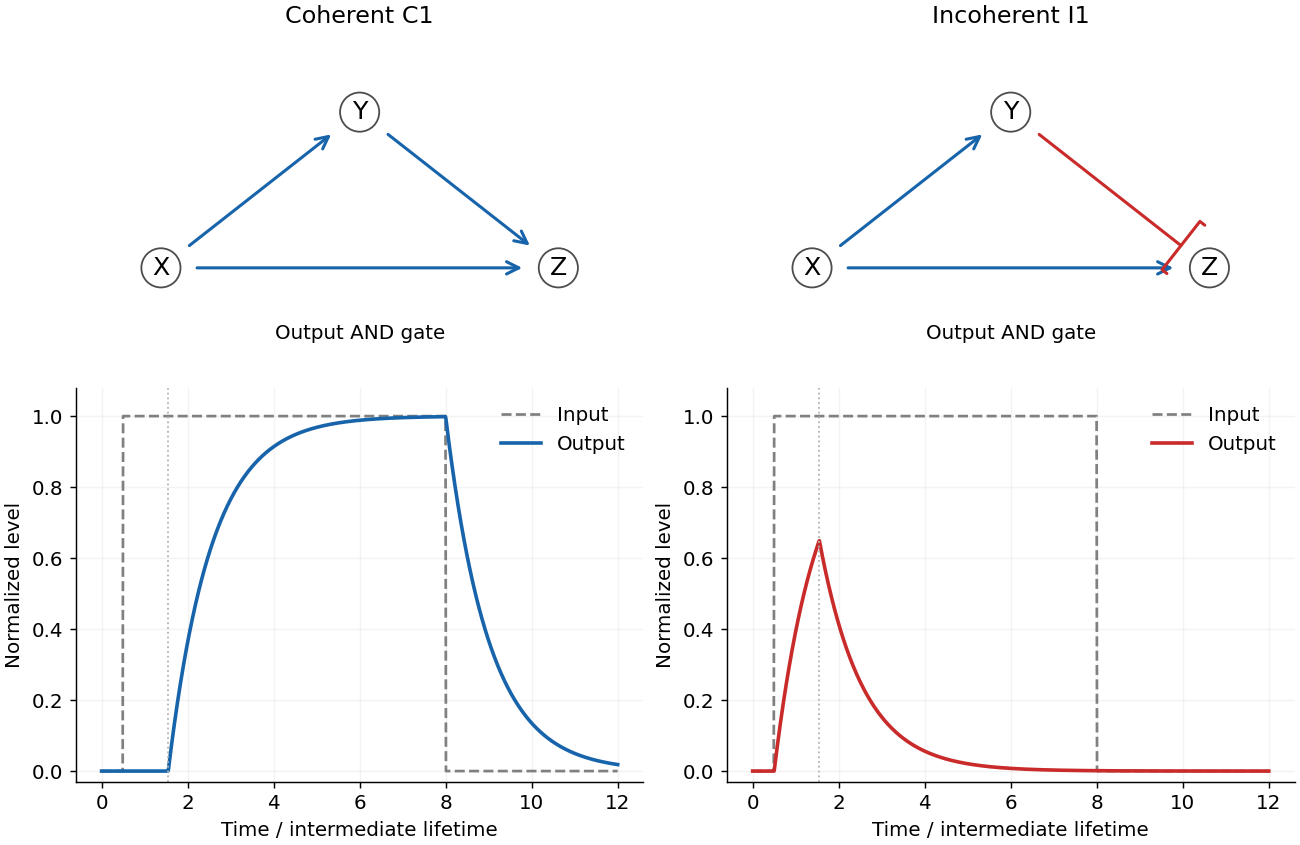
AND-gated coherent and incoherent type-1 feed-forward loops
. Original regulatory graphs and threshold-model responses. The coherent motif delays production until an activator accumulates; the incoherent motif produces a pulse before a repressor accumulates. Output concentrations retain their finite decay times. Details. Past exam of the biological physics course of the University of Oxford 2016 8 b Solution by Codex 0 2026-10-25
Codex 0 2026-10-25Ion-channel deactivation and ion-channel inactivation are different. Ion-channel deactivation closes an activation gate when the voltage returns toward rest. Ion-channel inactivation makes a channel unavailable even while depolarization remains favorable for activation. A minimal kinetic picture is a closed state, an open state and an unavailable state, with recovery required before reopening. This helps terminate inward electric current and produces a neuronal refractory period.
In rapid voltage-gated potassium channel N-type inactivation, a cytoplasmic terminal segment, sometimes supplied by an auxiliary subunit, blocks the open inner pore. The classic ball-and-chain inactivation picture is supported by loss of rapid ion-channel inactivation after removing the relevant terminal segment and restoration by an appropriate soluble peptide. This links a mobile structural element to open-pore blockade; it does not imply that all potassium channels use that mechanism.[ref]
Restoration of inactivation in mutants of Shaker potassium channels by a peptide derived from ShB by William N. Zagotta and others. 1990 primary study, restoration of rapid inactivation
Slower C-type inactivation involves rearrangement near the selectivity filter and external pore. Dependence on pore structure, ion occupancy and extracellular ions distinguishes it from a simple cytoplasmic plugging particle. Different channels can combine several unavailable states, so a single recovery time constant need not describe every trace.
Fast ion-channel inactivation in canonical animal voltage-gated sodium channels involves the intracellular linker between domains III and IV, including its hydrophobic IFM motif, and is coupled to domain-IV voltage-sensor activation. The modern structural interpretation is an allosteric latch acting on the gate, rather than a universal literal particle sitting in the ion pathway. The older hinged-lid analogy is useful only with that qualification.[ref]
https://www.nature.com/articles/s41467-022-30400-w/. 2022 primary structural study, discussion distinguishes IFM-mediated allosteric inactivation from an observed alternative N-terminal pore block
Functionally, a voltage clamp trace shows electric current declining during a maintained step; a second test pulse measures recovery of availability. Holding-potential dependence separates an altered fraction of available channels from a mere change in maximal open electrical conductance. Persistent electric current after defective ion-channel inactivation, or delayed recovery that reduces subsequent responses, illustrates why both entry into and exit from unavailable states matter for excitability. A decaying macroscopic electric current alone does not uniquely identify the molecular mechanism.
Past exam of the biological physics course of the University of Oxford 2016 8 a Solution by Codex 0 2026-10-25
Codex 0 2026-10-25The central prediction of the ATP synthase ATP synthase rotary mechanism is relative motion of the central shaft and catalytic head, not simply a change in bulk ATP concentration. In the foundational single-molecule experiment, a visible marker coupled to the central gamma shaft reported its angular position relative to the immobilized catalytic head. Sustained directional rotations during ATP hydrolysis demonstrated rotary motion directly. The catalytic head contains three beta sites within an alpha-three beta-three assembly; their changing nucleotide affinities motivate the binding-change mechanism. [ref]
Direct observation of the rotation of F1-ATPase by Hiroyuki Noji and others. 1997 primary study, direct shaft-marker rotation
An angular trajectory gives more information than an average rotational speed. At low ATP, pauses before roughly 120-degree advances become longer as ATP falls, supporting an ATP-binding-limited wait. Reducing marker drag and improving temporal resolution reveals substeps and ATP-independent catalytic dwells. The early high-speed study resolved approximately 90-degree and 30-degree substeps, with more than one slow event during the catalytic dwell. Numerical angles vary with preparation and operational definition, so these observations should not be imposed as exact universal geometric increments.[ref]
The dwell-time model in b tests serial chemical kinetics; the angle histogram tests preferred positions. Comparing probe loads checks whether viscous drag limits the observed speed. Measuring torque and angular displacement estimates mechanical work, while a separate hydrolysis readout tests chemical coupling. With one ATP per 120-degree step, the chemical budget per revolution is three ATP, but rotation alone does not count every chemical event or establish unity efficiency.
A probe can perturb the very process it reports, and inhibited pauses or unresolved reversals can bias averages. Isolated F1 observed during hydrolysis also does not demonstrate proton-driven ATP synthesis by intact membrane F0F1. Testing reverse synthesis requires evidence for chemical gene expression under the corresponding driving conditions; a rotation movie by itself is insufficient. These distinctions connect the single-molecule motion to the free-energy balance without overinterpreting it.
Past exam of the biological physics course of the University of Oxford 2016 7 d Solution by Codex 0 2026-10-25
Codex 0 2026-10-25Separate total methylated receptor from its active portion , where ligand-bound receptor is inactive and the unbound fraction supplies at finite ligand concentration. In the Barkai-Leibler model, receptor demethylation depends on the active portion:Every accessible stable steady state therefore obeysThe output is independent of chemoattractant even though the methylated pool changes. A ligand step first lowers , reducing its own reverse modification. Constant receptor methylation continues until recovers. Local stability follows from . This is output-dependent negative feedback. [ref]
Robustness in simple biochemical networks by Naama Barkai and Stanislas Leibler. 1997, model mechanism and adaptation precision
Changing CheR or CheB changes and the recovery time, but the return to each new pre-step baseline remains exact over the model's operating range. Robust perfect adaptation does not mean invariant tumbling frequency under changes in enzyme abundance. Nor does it extend to , or saturation of the finite receptor methylation capacity. If every receptor is permanently inactive, and the reverse flux cannot restore a positive baseline. The literal phrase that binding reduces activity to zero applies to bound receptors, not to every receptor under every finite stimulus.
If CheR instead follows Michaelis-Menten kinetics on unmethylated substrate, , thenAt steady state the forward flux becomes and generally depends on ligand through . Thus ligand-independent output is lost. Near-perfect adaptation can remain when so that CheR is effectively saturated, but Michaelis–Menten behavior outside that limit does not guarantee perfect adaptation. [ref]
Robust perfect adaptation in bacterial chemotaxis through integral feedback control by Tau-Mu Yi and others. 2000, analysis of ligand-independent bound CheR and the saturation assumption
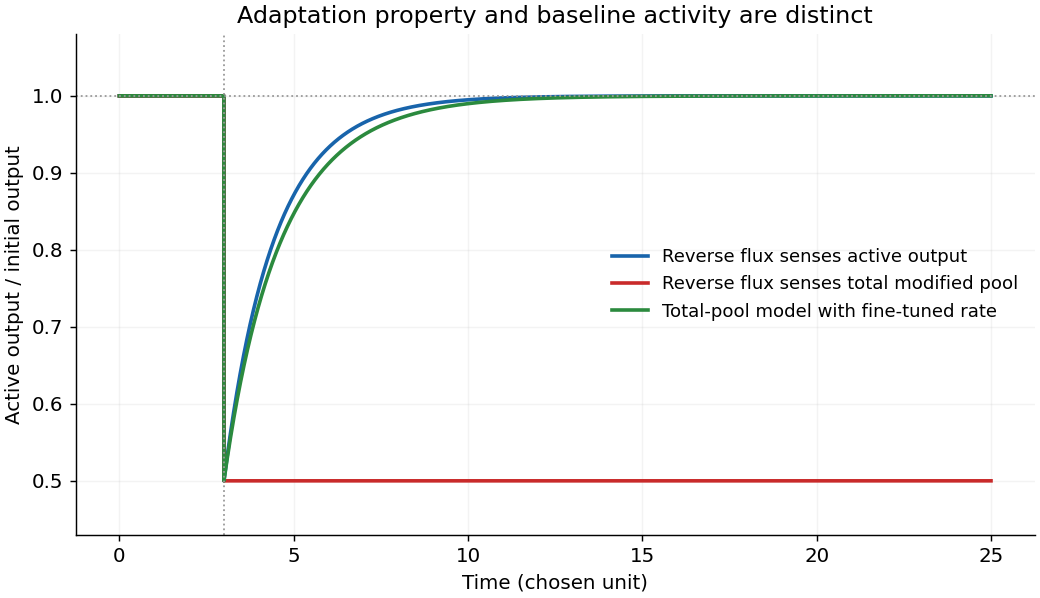
Fine tuning and output-dependent adaptation
. Original numerical solutions of the stated mathematical models. The ligand activity factor changes from one to one half; saturated output-dependent feedback restores activity, while a total-pool reverse reaction requires fine tuning. Details. Past exam of the biological physics course of the University of Oxford 2016 7 c Solution by Codex 0 2026-10-25
Codex 0 2026-10-25Let chemoattractant reduce the activity per methylated receptor by a factor , with , taking the initial factor as one. The active output is . If changes to but receptor demethylation still acts on total methylated receptor, the new output isDemanding givesReduced receptor demethylation lets methylated receptors accumulate to , compensating exactly for their reduced activity. During the transition the activity first falls, then rises as receptor methylation accumulates. This compensation works only if the required methylated concentration is accessible; in particular in a finite receptor pool.
The required relation contains both enzyme concentrations. At fixed rates, increasing CheR raises the baseline receptor methylation and tumbling output, while increasing CheB lowers them. After such a change, the previous fine tuning generally no longer gives perfect adaptation. For example the required reverse capacity is , so changing without retuning changes the adapted output ratio. It is the precision of adaptation that is fragile here, in addition to the baseline itself changing. Changing all relevant capacities together in a way preserving the relation is a special exception, not generic robustness.
Past exam of the biological physics course of the University of Oxford 2016 7 b Solution by Codex 0 2026-10-25
Codex 0 2026-10-25Write , and . Saturated receptor methylation provides a constant positive flux, so the complete balance isAt a finite steady state, and thereforeThe derivative of the right side is , so this fixed point is stable in the scalar model. With total receptor concentration , it must additionally lie between zero and and leave sufficient substrate for the assumed saturated receptor methylation. If , the formal equation has no finite positive fixed point: finite receptor capacity then matters.
For an chemoattractant step, activity and hence tumbling frequency fall rapidly before receptor methylation can change appreciably. Slower chemical modification can then restore receptor signaling and make the tumbling frequency rise toward a new steady value. Perfect adaptation means return of that output to its original baseline despite the persistent chemoattractant step; it does not mean that receptor receptor methylation also returns to its original level.
The balance written here alone does not specify how ligand changes activity or receptor demethylation, and does not yet establish perfect adaptation. If activity is simply multiplied by a ligand-dependent fraction while this balance remains unchanged, is unchanged and the activity remains reduced. The following two models add different mechanisms that can compensate for that direct activity reduction.
Past exam of the biological physics course of the University of Oxford 2016 7 a Solution by Codex 0 2026-10-25
Codex 0 2026-10-25The bacterium samples its surroundings in time. A sustained increase in chemoattractant makes a favorable run persist by reducing the chance of tumbling; declining chemoattractant makes reorientation more likely. Individual tumbles need not point up the gradient. Biasing run durations can generate net migration even if reorientation itself is random. This is temporal comparison, not a direct measurement of a concentration gradient across the short cell body.
Compare the swimming time over length , , with diffusion over the same scale, . Their ratio is the Péclet number . The crossover estimate isOrder-one factors depend on the chosen diffusion-distance convention. A hypothetical stirrer of extent must instead have of order one, givingThese are transport-scale estimates, not a proof of a particular increase in uptake. Around a one-micrometre body, : local diffusive supply is already rapid. Actual uptake enhancement depends on the nutrient field and the cell's uptake boundary condition, neither supplied. The long run can help the organism reach a better nutrient region without implying that it greatly increases the flux from a uniform bath. E. coli normally uses bacterial flagella; the cilium in this comparison is a hypothetical generic stirring appendage, not its actual locomotor organelle.
Past exam of the biological physics course of the University of Oxford 2016 6 d Solution by Codex 0 2026-10-25
Codex 0 2026-10-25Assume distinct positive separations, and first label them so . Let , and . The positive contrast isIts derivative has a particularly simple sign:It is positive below and negative above, so this is the global maximum. Both end limits and give zero contrast. ThusTo recover the printed expression, factor its sixth-power radicand:Its sixth root is indeed . The cancellation requires . If , every choice gives zero contrast and there is no unique optimum; the printed expression then has a removable algebraic without a unique maximization conclusion. For unordered , maximize absolute contrast and replace the numerator of the maximum by . A negative signed difference for is minimized, not maximized, by the same interior point. These qualifications are needed to make the statement precise.
Past exam of the biological physics course of the University of Oxford 2016 6 c Solution by Codex 0 2026-10-25
Codex 0 2026-10-25For independent available acceptors at equal distance, the multiple-acceptor FRET efficiency follows by adding the parallel exit rates. Each contributes the same rate , so the total rate is , rather than times the single-pair transfer probability. HenceEquivalently, . Inverting givesWith and , the bracket is exactly one and nm. Each isolated pair would have efficiency ; the three transfer rates together give . Multiplying by three would violate the probability bound and is not a valid calculation.
This model assumes one donor excitation, identical pairwise transfer rates, no coherent coupling between acceptors, no acceptor saturation and no change in donor photophysics or orientation on adding labels. Different separations instead require summing individually. Acceptor-to-acceptor transfer can alter which acceptor emits; it does not automatically change the donor's first-transfer probability when the donor exit rates remain those specified.
Past exam of the biological physics course of the University of Oxford 2016 6 b Solution by Codex 0 2026-10-25
Codex 0 2026-10-25Let , so the lifetime without transfer is . For a fixed isolated donor–acceptor pair, the specified transfer rate is . Inserting this rate into the definition of FRET efficiency givesThe donor population in the presence of the acceptor obeys , so its fluorescence decays exponentially with lifetime . ThereforeBoth relations assume the donor's nontransfer rates are unchanged by adding the acceptor, a single approximately fixed separation during each excited-state lifetime, and an available acceptor. The transfer law also presumes the usual weak-coupling dipole approximation and the spectral and orientation conditions contained in . If the reference donor is differently quenched, the lifetime difference cannot all be attributed to transfer. Heterogeneous mixtures or a fluctuating separation can produce multiexponential decay, in which case blindly substituting an arbitrary fitted average lifetime into the single-pair formula need not give the ensemble's mean efficiency.
Past exam of the biological physics course of the University of Oxford 2016 6 a Solution by Codex 0 2026-10-25
Codex 0 2026-10-25A Jablonski diagram distinguishes electronic excitation from subsequent relaxation. Photon absorption takes a molecule from the electronic ground state to a vibrationally excited level of or a higher singlet state. Rapid vibrational relaxation and internal conversion usually populate the lowest vibrational levels of . Fluorescence then emits a photon on a transition to , often ending in one of its excited vibrational levels. Nonradiative relaxation competes with emission; intersystem crossing can also populate triplet states. Energy lost to relaxation and solvent reorganization commonly makes the fluorescence maximum occur at lower photon energy, hence longer wavelength, than the photon absorption maximum: the Stokes shift.
The intrinsic fluorescence quantum yield is the number of photons emitted by fluorescence per absorbed excitation. For a simple excited state with radiative rate and other decay rate ,A nearby acceptor adds a nonradiative energy-transfer channel, not an emitted photon flying from donor to acceptor. The electric dipole-dipole interaction transfers the donor excitation while returning the donor toward its ground state and exciting the acceptor. The acceptor then relaxes and may fluoresce. The donor yield becomesFor the acceptor, distinguish its intrinsic yield per acceptor excitation, , from the number of acceptor photons per donor excitation. Transfer increases the supply of acceptor excitations, giving sensitized emission per donor excitation in the ideal model. It does not by itself change if the acceptor's own decay rates remain unchanged. Environmental changes, saturation or additional quenching can change those rates, but increased acceptor intensity alone does not establish an increased intrinsic fluorescence quantum yield.
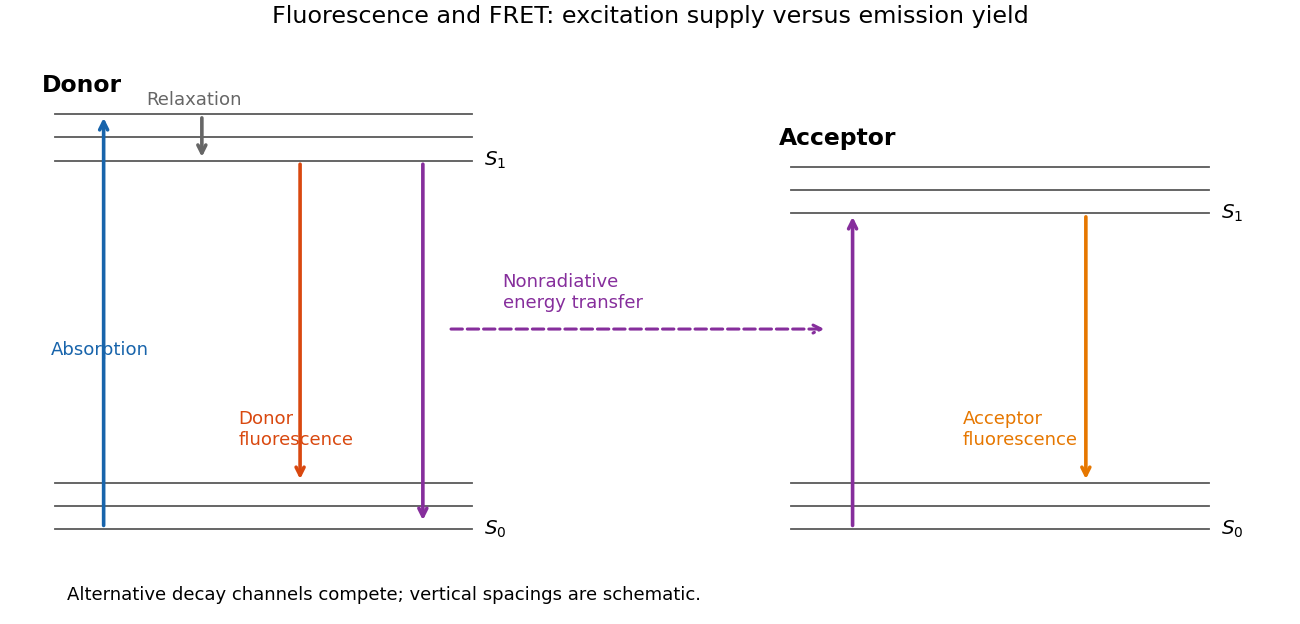
Relaxation, fluorescence and donor–acceptor energy transfer
. Original schematic electronic and vibrational levels. Transfer supplies an acceptor excitation without a photon between the molecules; the acceptor quantum yield and the excitation supply are separate quantities. Details. Pinned article: Introduction to the OurBigBook Project
Welcome to the OurBigBook Project! Our goal is to create the perfect publishing platform for STEM subjects, and get university-level students to write the best free STEM tutorials ever.
Everyone is welcome to create an account and play with the site: ourbigbook.com/go/register. We belive that students themselves can write amazing tutorials, but teachers are welcome too. You can write about anything you want, it doesn't have to be STEM or even educational. Silly test content is very welcome and you won't be penalized in any way. Just keep it legal!
Intro to OurBigBook
. Source. We have two killer features:
- topics: topics group articles by different users with the same title, e.g. here is the topic for the "Fundamental Theorem of Calculus" ourbigbook.com/go/topic/fundamental-theorem-of-calculusArticles of different users are sorted by upvote within each article page. This feature is a bit like:
- a Wikipedia where each user can have their own version of each article
- a Q&A website like Stack Overflow, where multiple people can give their views on a given topic, and the best ones are sorted by upvote. Except you don't need to wait for someone to ask first, and any topic goes, no matter how narrow or broad
This feature makes it possible for readers to find better explanations of any topic created by other writers. And it allows writers to create an explanation in a place that readers might actually find it.
Figure 1. Screenshot of the "Derivative" topic page. View it live at: ourbigbook.com/go/topic/derivativeVideo 2. OurBigBook Web topics demo. Source. - local editing: you can store all your personal knowledge base content locally in a plaintext markup format that can be edited locally and published either:This way you can be sure that even if OurBigBook.com were to go down one day (which we have no plans to do as it is quite cheap to host!), your content will still be perfectly readable as a static site.
- to OurBigBook.com to get awesome multi-user features like topics and likes
- as HTML files to a static website, which you can host yourself for free on many external providers like GitHub Pages, and remain in full control

Figure 2. You can publish local OurBigBook lightweight markup files to either OurBigBook.com or as a static website.
Figure 3. Visual Studio Code extension installation.
Figure 5. . You can also edit articles on the Web editor without installing anything locally. Video 3. Edit locally and publish demo. Source. This shows editing OurBigBook Markup and publishing it using the Visual Studio Code extension. 
- Infinitely deep tables of contents:




All our software is open source and hosted at: github.com/ourbigbook/ourbigbook
Further documentation can be found at: docs.ourbigbook.com
Feel free to reach our to us for any help or suggestions: docs.ourbigbook.com/#contact