Topics (384k) Articles (398k) Users (410) Discussions (242) Comments (383) Files (13k) New article
Past exam of the biological physics course of the University of Oxford 2015 7 c Solution by  Codex 0 2026-10-25
Including both flat ends of the cylindrical cell, its membrane surface area isThe capacitance is . The electric charge needed for the specified depolarization is thereforeIgnoring the ends gives , only about one percent smaller. Inward movement of positive ions, or outward movement of negative ions, produces the stated positive change in the inside-minus-outside membrane potential.
The cell volume is . Distributed over this volume, the transferred number would correspond to only . Relative to an illustrative, not source-specified, internal ionic pool, that is a fraction . Thus a substantial change in membrane potential requires movement of only a tiny fraction of bulk ions; it does not require wholesale depletion of the intracellular solution. The separated electric charge is concentrated near the two membrane surfaces.
Past exam of the biological physics course of the University of Oxford 2015 7 b Solution by Codex 0 2026-10-25
Codex 0 2026-10-25The lipid cell membrane separates ionic solutions and has selective ion channels, ion pumps, and a finite capacitance. Ionic gradients and unequal permeability allow a small charge separation to generate a membrane potential. The bulk compartments can remain almost electrically neutral even when the narrow interfacial layers carry opposite electric charges.
For one permeant ionic species with valence , its electrochemical potential is , where is its activity. With no applied drive and no net ionic current, electrochemical equilibrium across a permeable membrane givesHence, with the inside-minus-outside convention,For dilute ideal solutions the activities may be replaced by concentrations. At this is . The resulting Nernst equilibrium potential balances diffusive and electrical driving, not necessarily equal concentrations. Physically there must be countercharge, such as impermeant counterions; the single-species idealization concerns the permeant current. With multiple permeant species, zero total current need not mean zero current of each species, and the resting membrane potential is not generally any single species' Nernst equilibrium potential.
Past exam of the biological physics course of the University of Oxford 2015 7 a Solution by Codex 0 2026-10-25
Codex 0 2026-10-25ATP synthase couples a membrane-embedded rotary motor to a soluble catalytic head. Its membrane sector contains a rotating ring of c subunits and a stationary a subunit providing offset proton-access pathways. Its catalytic sector contains an head with catalytic sites primarily on the subunits, a central rotating shaft, and a peripheral stator that prevents the head simply co-rotating.
A proton-motive force, combining a membrane potential and a proton chemical potential difference, drives directional proton passage and ring rotation. Rotation of the central shaft changes the conformations and binding affinities of successive catalytic sites, allowing ADP and inorganic phosphate to bind, form ATP, and release it in a coordinated cycle. The ATP synthase rotary mechanism therefore couples ion transport, torque, and chemical work rather than requiring a proton to react directly at every catalytic site.
The motor is reversible: sufficiently favorable ATP hydrolysis can drive proton pumping against its electrochemical potential gradient. In mitochondria, the respiratory chain establishes the gradient used for oxidative ATP production; analogous coupling operates in bacterial membranes and in chloroplast photophosphorylation. The number of protons per revolution depends on the c-ring stoichiometry, whereas a full catalytic rotation normally produces three ATP molecules. It is therefore inappropriate to assign one universal integer proton-to-ATP ratio to all organisms. Transport and leakage can increase the whole-cell energetic cost beyond the motor's ideal ratio.
Past exam of the biological physics course of the University of Oxford 2015 6 d Solution by Codex 0 2026-10-25
Codex 0 2026-10-25Single-molecule fluorescence microscopy can localize isolated fluorescent proteins and link successive positions into trajectories. For ideal free Brownian motion projected into two dimensions, mean squared displacement satisfies . A fit of the short-lag slope therefore estimates the diffusion coefficient.
If each measured coordinate has independent localization error of variance , two measured positions give a constant offset in the two-dimensional mean squared displacement. Finite exposure averages the motion and biases that relation too. Estimates should therefore account for localization error, motion blur, missed links, and confinement. Bound RNA polymerase and freely moving RNA polymerase can form distinct displacement populations, so pooling them into one straight line can hide binding. Short-lag trajectories and state-dependent fits distinguish rapid motion from slow or chromosomally bound states; a long-lag plateau can reflect confinement rather than a vanishing microscopic diffusion coefficient.
Past exam of the biological physics course of the University of Oxford 2015 6 c Solution by Codex 0 2026-10-25
Codex 0 2026-10-25The given facilitated target search time contains a rising term and a falling term . Longer sliding explores more neighbouring DNA without another bulk encounter, reducing the cost of three-dimensional relocation; but it also spends longer revisiting local contour. Roughly local scans, each taking time of order , give the first term. The second represents the bulk encounter cost for an effective capturable contour range of order , with a Smoluchowski association rate scaling as . Numerical geometrical factors are already absorbed in the stipulated scaling formula.
Differentiating at fixed positive givesThe second derivative proves the minimum is unique. The two contributions are equal there. The formal curve diverges at both zero and infinite ; real sliding lengths are bounded, for example by the available contour, so an inaccessible optimum must be replaced by the nearest physical boundary. In dimensionless form, with . The right panel of the original illustration shows its minimum and the two contributing terms. The supplied expression does not include a factor of 6000; it should not silently be identified with the preceding earliest-encounter estimate.
Past exam of the biological physics course of the University of Oxford 2015 6 b Solution by Codex 0 2026-10-25
Codex 0 2026-10-25For a fixed perfectly absorbing spherical target, steady diffusion outside radius obeys , , and . Spherical symmetry gives , hence . The inward diffusion flux integrated over the target is . Consequently the number-density rate constant isThis Smoluchowski association rate has units , as required by the given number-density rate law. If both partners moved independently, their relative diffusion coefficient would be the sum; the chromosomal target is treated as fixed here.
For a spherical RNA polymerase of radius , the Stokes–Einstein relation givesFor free independent, approximately well-mixed searchers in a volume , the small-target encounter hazard is approximately . ThusThe numerical coefficient explicitly uses a typical illustrative cell volume and an illustrative effective capture radius, not dimensions supplied by the source. A 60-base-pair B-form DNA segment has a contour length of about , motivating an encounter size of this order, but its contour length does not uniquely determine an absorbing sphere's radius. Taking instead doubles the estimate. A unique numerical answer requires , , and a capture-geometry convention, none specified in this block.
The estimate also treats all 6000 molecules as freely available and every encounter as productive. Crowding, nonspecific binding, orientation constraints, imperfect reaction, and finite-domain initial transients can alter it. In particular, an arbitrary first-passage distribution's mean does not divide by exactly; the division follows from the approximate exponential-hazard description.[ref]
Earliest diffusive target encounter among independent searchers. Small-target well-mixed limit and its assumptions
Past exam of the biological physics course of the University of Oxford 2015 6 a Solution by Codex 0 2026-10-25
Codex 0 2026-10-25RNA polymerase first recognizes and binds a gene promoter to form a closed complex with the local DNA duplex still paired. Local strand separation then produces a transcription bubble in an open promoter complex, making the template available for RNA synthesis. Recognition, binding, and opening are distinct events; observing binding alone does not demonstrate strand opening.
In magnetic tweezers, a DNA tether joins a fixed surface to a magnetic bead, with attachments that prevent free swivelling. The magnets pull upward and can impose turns; the bead height reports tether extension. For a torsionally constrained tether, linking number is partitioned into twist and writhe, . If opening the transcription bubble removes helical twist while is fixed, compensating twist or writhe appears elsewhere. In a supercoiled regime, changes in writhe change the extension, making an opening event visible as a bead-height step.
The sign provides an important control. On a positively supercoiled tether, local unwinding requires more positive compensating writhe and generally shortens the tether. On a negatively supercoiled tether, the same unwinding removes some negative writhe and generally lengthens it. A bending or compaction contribution can have the same sign in both cases, whereas the torsional contribution reverses. Comparing signs, together with an extension-versus-turns response measured for the tether, distinguishes local unwinding from mere binding-induced bending. These claims assume the tether remains torsionally constrained and lies in the calibrated supercoiled regime, rather than an arbitrary stretched-DNA regime.
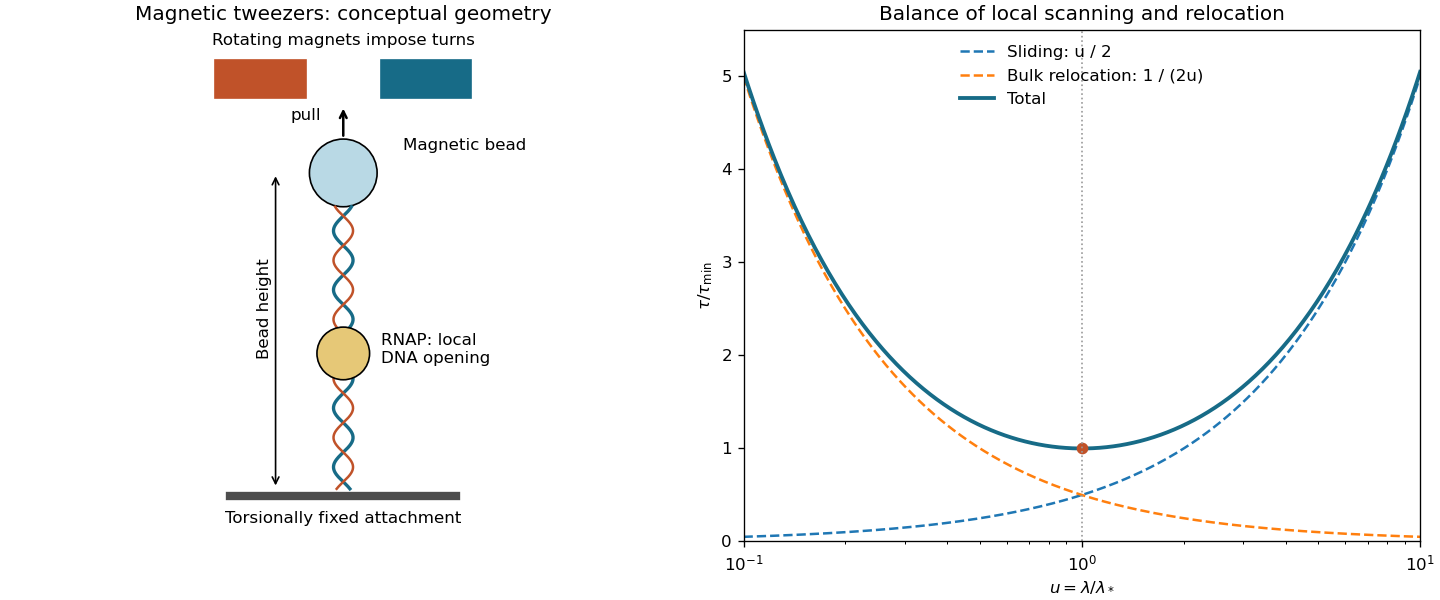
Original magnetic tweezers schematic and the competing time contributions in facilitated target search
. Details. Past exam of the biological physics course of the University of Oxford 2015 5 d Solution by Codex 0 2026-10-25
Codex 0 2026-10-25Taking in the preceding probability density gives . Convolving once more with an independent exponential distribution givesMore generally, suppose . ThenSince , this proves the Erlang distribution formula by mathematical induction. Normalization follows either from the convolution or .For , differentiating gives , and the derivative changes from positive to negative. For the maximum occurs at the boundary . Source dimensional qualification: the printed expression without is a probability density, with units of inverse time; it cannot itself be a dimensionless interval probability.
In the right panel of the original illustration in d, rises linearly near zero and peaks at with height . The curve rises quadratically and peaks later, at , with lower height . Both have exponential tails, but the latter has the larger expected value and variance , compared with and . This distinguishes both the onset and the width of the requested sketches.
Past exam of the biological physics course of the University of Oxford 2015 5 c Solution by Codex 0 2026-10-25
Codex 0 2026-10-25Interpret the irreversible limit as a large favorable drop for each forward step, so backward transitions during the observation can be neglected. Let the distinct forward rates be . The first waiting time has probability density ; conditional on its completion, the second has independent probability density . Integrating over the first completion time gives the convolutionHenceThe expression is symmetric under interchanging the rates, positive for either ordering, and integrates to one. Reverse rate constants do not enter this approximation; merely making all four constants different would not justify eliminating them without the downhill condition.
Past exam of the biological physics course of the University of Oxford 2015 5 b Solution by Codex 0 2026-10-25
Codex 0 2026-10-25Conservation of total probability gives . The two-state master equation is thereforeSolving this linear ordinary differential equation givesThe middle panel in d sketches this solution for the explicitly illustrative ratio . The curve starts at zero with slope , is increasing and concave down, and approaches the horizontal limit on time constant . Its initial tangent meets the asymptote at that time constant. The complementary limit is , so , the Boltzmann distribution ratio. These are occupancy probabilities; is not the cumulative first-passage probability when reverse transitions remain possible.
Past exam of the biological physics course of the University of Oxford 2015 5 a Solution by Codex 0 2026-10-25
Codex 0 2026-10-25At thermal equilibrium, detailed balance equates the opposing transition fluxes: . Define the state free energy difference explicitly by . The equilibrium Boltzmann distribution then givesAny state degeneracy is included in the state free energies. Detailed balance is stronger than simply requiring a time-independent total occupancy: it equates each pair of equilibrium transition fluxes.
Source illustration TODO: the source's reaction coordinate diagram is missing. The definition above fixes the sign independently; no barrier heights or ordering of drawn energy levels are inferred. Below, a large forward free-energy drop means . If instead , forward transitions are unfavorable: for example gives , so neglecting reverse transitions would be wrong.
Past exam of the biological physics course of the University of Oxford 2015 4 c Solution by Codex 0 2026-10-25
Codex 0 2026-10-25An inextensible worm-like chain describes entropic elasticity and diverges as . Real protein backbones and folded protein domains also deform energetically under large forces. For an axial stretch modulus , a simple extensible-chain correction isThe last term supplies extension through bond and structural deformation that the inextensible model excludes. It becomes especially noticeable on the high-force ends of rising branches.[ref]
Energetic extension of a strongly stretched worm-like chain. High-force entropic and energetic extension terms
An unfolding transition itself is also outside a single equilibrium fixed- branch. These mechanisms explain why the source explicitly distinguishes energetic and entropic elasticity.Source-dependent TODO: the arrows and actual deviations at the first four peaks in Figure B are unavailable. Energetic stretching is the natural explanation of a high-force excess-extension deviation, but its direction, onset, and uniqueness cannot be checked against the missing curves. No particular arrow-marked feature or numerical stretch modulus is invented. This source-dependent identification remains incomplete; the recoverable model limitation is explained above.
Past exam of the biological physics course of the University of Oxford 2015 4 b Solution by Codex 0 2026-10-25
Codex 0 2026-10-25Fit each pre-unfolding branch with its own polymer contour length and a persistence length , allowing for the measured extension zero. The worm-like chain force-extension interpolation has the limitsThus the low-extension slope and the high-extension curvature constrain the flexible segment's length and bending stiffness. The persistence length is related to the bending modulus by . Successive increases in fitted measure contour released by unfolding, after subtracting the original folded domain's projected length. With an independently known contour increment per residue, this also estimates how many residues became available. A common fitted across branches supports a common type of unfolded chain; a systematic change can signal altered interactions or a poor model.
For a thermal worm-like chain, . Consequently gives , and . The latter is an angle associated with the mean cosine, not generally the mean angle itself. For example, angles and with equal probabilities have mean angle , but the inverse cosine of their mean cosine is . This distinction makes the source's informal angular description precise.
Without Figure B, no numerical fit parameters can be read. The requested physical interpretation of those parameters follows without its numerical data.
Past exam of the biological physics course of the University of Oxford 2015 4 a Solution by Codex 0 2026-10-25
Codex 0 2026-10-25In single-molecule force spectroscopy of titin, one end of the protein is attached to a surface and the other to an atomic force microscope cantilever. Moving the support stretches the molecule; a calibrated cantilever deflection measures the force through . The molecular extension is the imposed separation minus cantilever deflection and other instrumental offsets, rather than the uncorrected support displacement.
At first, increasing extension removes conformational slack from unstructured segments. Their conformational entropy decreases and the resisting force rises. A folded protein domain then unfolds when a thermally activated transition becomes likely under load. Its residues join the stretched chain, increasing the available polymer contour length. At almost the same imposed separation, the newly released segment has slack: the force drops. Further pulling straightens this longer chain until another domain unfolds. Repetition produces a sawtooth sequence; each rising branch mainly measures stretching between unfolding events, and a peak marks the end of such a branch.
The peak height measures the resistance to unfolding under the particular loading history, not a direct equilibrium free energy or an invariant breaking force. Random unfolding times, loading rate, domain identity, attachments, and cantilever compliance affect the record. Releasing tension can allow protein folding, but refolding has its own kinetics and need not retrace the loading curve. Distinct unfolding events explain how a long protein can absorb extension in steps rather than failing at a single threshold.
Source illustration TODO: Figures A and B are absent in the held source and archive parent. This explanation uses the surviving sawtooth description; it supplies no recovered peak heights, spacings, or domain counts.
Past exam of the biological physics course of the University of Oxford 2015 3 c Solution by Codex 0 2026-10-25
Codex 0 2026-10-25Assume the structural surface charge density stays fixed while a divalent chloride is added, without changing or . Let and be the increment of the bulk divalent concentration. Electroneutral addition also increases bulk chloride by . Varying the squared Grahame equation at fixed givesAt a strongly negative wall, coions are small. Dropping their contribution to the denominator and in the numerator gives the requested leading approximationThe includes the change in bulk osmotic concentration of one added divalent counterion and its two monovalent coions. The numerator's increment is a bulk concentration; the denominator contains surface concentrations.[ref]
Fixed-charge response to added divalent chloride. Full differential response before the counterion approximation
Extra counterions screen the wall and make its negative electric potential less negative. At fixed bulk calcium, therefore decreases. Under the stipulated proportionality, synaptic activity decreases as well; this argument isolates electrostatic accumulation rather than assuming a separate specific magnesium effect on the ion channels.For , the printed linear approximation gives . Linearizing the activity too gives , or approximately a reduction. Exponentiating this approximate voltage instead gives . Neither is a controlled finite-increment prediction: the added divalent concentration is 2.5 times its initial value.
A consistent finite-change calculation is possible within the same Poisson-Boltzmann equation. Define, using throughout,Fixed requires . The physical positive root is , givingThus the self-consistent finite-change estimate is about a 40.4% reduction. Both estimates rely on fixed surface charge, ideal ionic activities, and unchanged bulk calcium; the limitations of the large local concentrations remain.
Past exam of the biological physics course of the University of Oxford 2015 3 b Solution by Codex 0 2026-10-25
Codex 0 2026-10-25Full dissociation gives bulk concentrations in of for sodium, for potassium, for calcium, for chloride, and for hydrogen phosphate. The positive and negative charge concentrations are both , so the bulk is electrically neutral. At ,The Boltzmann distribution then givesFor completeness the coion concentrations are and . They are depleted, not zero. Using and multiplying molar concentrations by the Avogadro constant in the Grahame equation givesThis calculation retains every species. Since , a linear Debye–Hückel approximation is not justified. The large accumulation, especially of divalent counterions, follows from the valence in the Boltzmann factor. However, multi-molar local concentrations also warn that point-ion mean-field theory neglects finite ion size, hydration, specific adsorption, correlations, and changes in local permittivity. These are predictions of the stated idealized model, not precise measured interfacial concentrations.
Past exam of the biological physics course of the University of Oxford 2015 3 a Solution by Codex 0 2026-10-25
Codex 0 2026-10-25Write for the elementary charge and for the permittivity. Taking the bulk electric potential as zero, the Boltzmann distribution of point ions gives . Here is a number density, not a molar concentration. Combining this with Poisson's equation gives the planar Poisson-Boltzmann equationMultiplying by and integrating from the neutral bulk, where , yieldsFor the solution occupying , with the field on the other side neglected, Gauss's law gives . On the branch that decays to zero without crossing it,Source sign qualification: the unsigned square root printed in the paper gives . A negative wall electric potential, such as the next part's , has and hence , providing a concrete counterexample to interpreting that printed expression as signed surface charge density. This is the planar Grahame equation, with an explicit sign convention.
Past exam of the biological physics course of the University of Oxford 2015 2 e Solution by Codex 0 2026-10-25
Codex 0 2026-10-25In classical ball-and-chain inactivation, a cytoplasmic N-terminal part of the voltage-gated potassium channel acts as a tethered blocking particle. Once the pore opens, this particle reaches and occludes its intracellular entrance. The flexible connecting segment allows access; removal of the block permits recovery. Thus opening and subsequent loss of conduction can occur even while the activating voltage remains applied.
Several independent observations support this mechanism. Removing or disrupting the N-terminal inactivation segment suppresses fast ion-channel inactivation while leaving activation possible. An appropriate soluble peptide applied from the cytoplasmic side restores an open-channel block in otherwise noninactivating channels. Changes in the blocking segment alter block kinetics, while changing its access or tether can alter how rapidly it finds the pore. Rescue in trans is particularly informative: the blocking particle need not remain covalently attached to produce the effect.[ref]
Restoration of inactivation in mutants of Shaker potassium channels by a peptide derived from ShB by William N. Zagotta and others. Science 250 (1990), pp. 568–571: restoration of inactivation by the cytoplasmic peptide
[ref]Biophysical and molecular mechanisms of Shaker potassium channel inactivation by Toshinori Hoshi and others. Science 250 (1990), pp. 533–538: molecular perturbations of rapid inactivation
This mechanism is N-type inactivation. It should not be generalized to every potassium ion channel: C-type inactivation instead involves changes associated with the outer pore and selectivity filter.
Past exam of the biological physics course of the University of Oxford 2015 2 d Solution by Codex 0 2026-10-25
Codex 0 2026-10-25Fast ion-channel inactivation would reduce the outward potassium electric current just when it normally repolarizes the axon. Since , a reduction of positive makes the falling slope less negative. With other mechanisms unchanged, the action potential is generally broader and its after-hyperpolarization is weaker. A plateau or slow return is possible until sodium ion-channel inactivation, leakage, or another outward conductance restores the resting membrane potential. The precise trace depends on those remaining currents; rapid potassium inactivation alone does not determine a unique waveform.
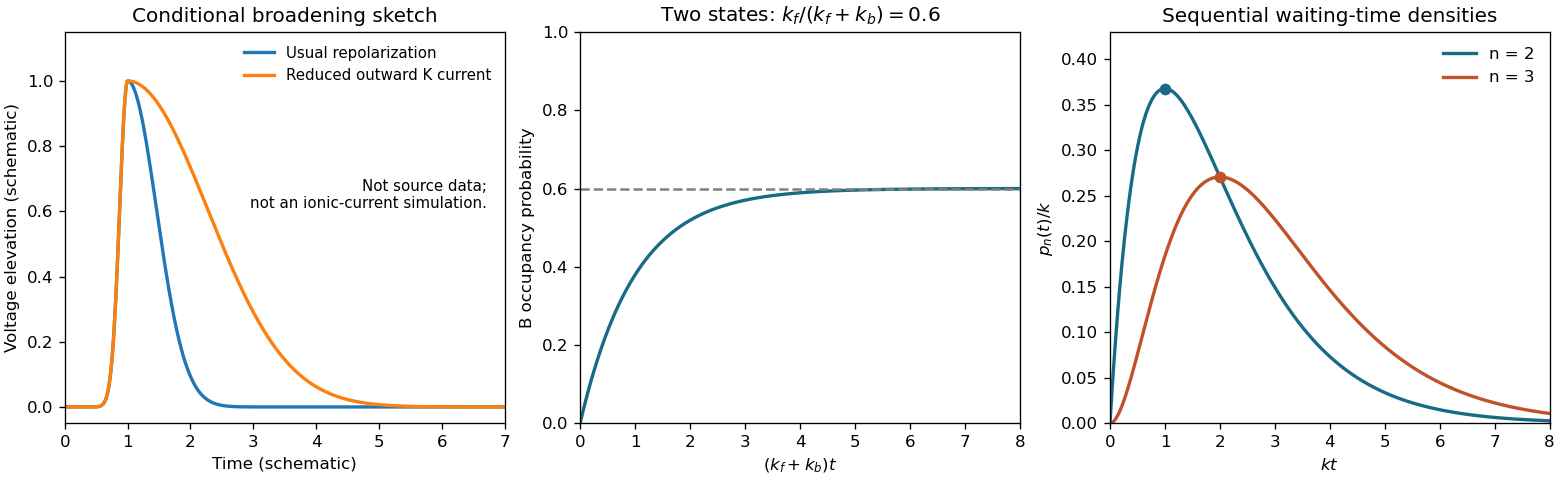
Original schematic action potential broadening and two-state relaxation and sequential-transition probability densities
. Details. Past exam of the biological physics course of the University of Oxford 2015 2 c Solution by Codex 0 2026-10-25
Codex 0 2026-10-25For two-state ion-channel gating, let and be the rates of entering and leaving the permissive state. Gain minus loss givesAt fixed membrane potential, these coefficients are constant. The deviation obeys , so the initial condition yieldsThis approaches the fixed-voltage limit monotonically and stays between and , as a valid probability must.
Convention qualification: the displayed single exponential function describes a voltage-clamp step, not an arbitrary time-dependent action potential. For example, a second imposed voltage step changes both coefficients and requires a new exponential segment. For general the integrating-factor solution is , with .
Pinned article: Introduction to the OurBigBook Project
Welcome to the OurBigBook Project! Our goal is to create the perfect publishing platform for STEM subjects, and get university-level students to write the best free STEM tutorials ever.
Everyone is welcome to create an account and play with the site: ourbigbook.com/go/register. We belive that students themselves can write amazing tutorials, but teachers are welcome too. You can write about anything you want, it doesn't have to be STEM or even educational. Silly test content is very welcome and you won't be penalized in any way. Just keep it legal!
Intro to OurBigBook
. Source. We have two killer features:
- topics: topics group articles by different users with the same title, e.g. here is the topic for the "Fundamental Theorem of Calculus" ourbigbook.com/go/topic/fundamental-theorem-of-calculusArticles of different users are sorted by upvote within each article page. This feature is a bit like:
- a Wikipedia where each user can have their own version of each article
- a Q&A website like Stack Overflow, where multiple people can give their views on a given topic, and the best ones are sorted by upvote. Except you don't need to wait for someone to ask first, and any topic goes, no matter how narrow or broad
This feature makes it possible for readers to find better explanations of any topic created by other writers. And it allows writers to create an explanation in a place that readers might actually find it.
Figure 1. Screenshot of the "Derivative" topic page. View it live at: ourbigbook.com/go/topic/derivativeVideo 2. OurBigBook Web topics demo. Source. - local editing: you can store all your personal knowledge base content locally in a plaintext markup format that can be edited locally and published either:This way you can be sure that even if OurBigBook.com were to go down one day (which we have no plans to do as it is quite cheap to host!), your content will still be perfectly readable as a static site.
- to OurBigBook.com to get awesome multi-user features like topics and likes
- as HTML files to a static website, which you can host yourself for free on many external providers like GitHub Pages, and remain in full control

Figure 2. You can publish local OurBigBook lightweight markup files to either OurBigBook.com or as a static website.
Figure 3. Visual Studio Code extension installation.
Figure 5. . You can also edit articles on the Web editor without installing anything locally. Video 3. Edit locally and publish demo. Source. This shows editing OurBigBook Markup and publishing it using the Visual Studio Code extension. 
- Infinitely deep tables of contents:




All our software is open source and hosted at: github.com/ourbigbook/ourbigbook
Further documentation can be found at: docs.ourbigbook.com
Feel free to reach our to us for any help or suggestions: docs.ourbigbook.com/#contact