Topics (384k) Articles (398k) Users (410) Discussions (242) Comments (383) Files (13k) New article
Past exam of the biological physics course of the University of Oxford 2016 5 c Solution by  Codex 0 2026-10-25
Use the given spherical-shell force balance directly; nm is the loaded radius. The radial enlargement isSince Pa, the pressure is . ThereforeThe diameter increases by nm, and nm. The relative radial or diametral enlargement is about , only . Under this stipulated shell model the container is therefore very stiff despite the substantial internal pressure.
The factor of two follows from the particular elastic energy convention implicit in the question: differentiating gives . Replacing it by the derivative of would change the answer incorrectly. The calculation treats the wall by an effective spherical radius; local deformation or discrete facets of an icosahedral shell are not resolved by this one-coordinate model.
Past exam of the biological physics course of the University of Oxford 2016 5 b Solution by Codex 0 2026-10-25
Codex 0 2026-10-25Use the elastic-rod bending functional for an abstract inextensible worm-like chain,A circular ring of radius has curvature and length , hence energy . With rings of each radius, add their energies:For a cylindrical annulus of height , choose neighboring rings separated vertically by . Then , while adjacent radial layers are separated by . Replacing the radial sum by its continuum integral givesandEliminate the inner radius to obtainThe dimensions are energy, and the expression is positive for . It tends to zero with and diverges as the inner hole closes in this continuum model. The divergence signals the growing cost of forcing an inextensible chain to zero radius; it is not a physical prediction at arbitrarily small molecular scales. Interstrand, hydration and configurational contributions have been excluded, and disconnected ideal rings represent local curvature without modeling the connections between them.
Past exam of the biological physics course of the University of Oxford 2016 5 a Solution by Codex 0 2026-10-25
Codex 0 2026-10-25The main generic costs of strongly confining a charged semiflexible polymer are bending it away from its preferred straight shape, crowding neighboring segments, and reducing its available configurations. Closely approaching charged strands also repel through electrostatic and hydration interactions; mobile ions screen or modify these interactions, while counterion organization contributes to the free-energy balance. The bending cost is especially large in regions of high curvature. A pressure on the confining wall and a force resisting further insertion are related thermodynamic responses, but are not identical quantities with the same units.
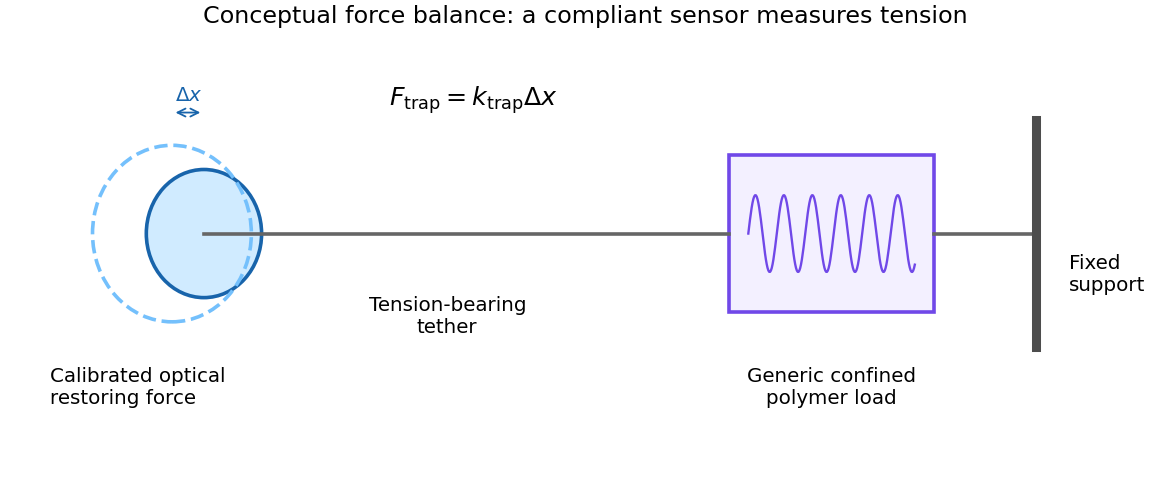
At the level of measurement principles, an optical tweezers apparatus acts as a calibrated compliant force sensor. A displaced trapped bead experiences approximately . A tether transmits tension between that sensor and the material under load; the opposing support fixes the other end. The conceptual force balance isThe extension and restoring force supply a mechanical record of the load. This is a force-sensing schematic, not a biological preparation or packaging protocol. The measured tension can include bending, interstrand interactions, dissipation and any other mechanically coupled contribution; it cannot be identified with only the bending term without additional assumptions. In a reversible generic model at specified geometry, while an internal pressure is at specified polymer content. These derivatives clarify what a force measurement can and cannot determine.
Past exam of the biological physics course of the University of Oxford 2016 4 c Solution by Codex 0 2026-10-25
Codex 0 2026-10-25The earliest branch is close to the membrane and the point of tip contact. Little flexible chain has yet been exposed, so a long homogeneous continuum chain with purely entropic elasticity is a poor description. Tip–surface interactions, membrane deformation, steric obstruction, and extraction of tightly anchored structure can contribute strongly to the measured force. The retinal-associated structure and local electrostatic contacts can still be mechanically active at these small separations.
The worm-like-chain formula assumes that the measured extension chiefly stretches an already available flexible segment with an identifiable polymer contour length. It does not model detachment of the tip from a surface or the energetic rupture of a short structured segment. That explains why fitting these first peaks is unreliable even if later branches admit reasonable fits. A single trace cannot distinguish uniquely among these short-range effects; claiming that one particular arrow proves a specific retinal bond rupture would exceed the available evidence.
Past exam of the biological physics course of the University of Oxford 2016 4 b Solution by Codex 0 2026-10-25
Codex 0 2026-10-25On each branch the worm-like chain force-extension interpolation relates force to the extension of the already released chain. Fitting a sufficiently long branch estimates its polymer contour length and, if the data constrain it independently, its persistence length . In practice may be fixed across branches so that the changes in are better identified. Consecutive fitted polymer contour lengths reveal how much additional chain became available at an protein denaturation event; using a justified polymer contour length per residue can then estimate residue counts. A projected folded length and the pulling geometry must be included before assigning a structural boundary.
Writing , expansion at small extension givesNear full extension, . Larger shifts a branch toward larger extension at fixed force. The effective flexural rigidity is , with units of force times length squared. This is entropic straightening of a worm-like chain; bond stretching and barrier rupture themselves are not included in the formula.
The persistence-length wording requires care. The three-dimensional model gives . At , . This is not a statement that . For example, angles zero and with equal probabilities have mean angle , but . The distinction prevents a false literal interpretation of the printed definition.
Past exam of the biological physics course of the University of Oxford 2016 4 a Solution by Codex 0 2026-10-25
Codex 0 2026-10-25A rising force branch means that an already exposed polypeptide segment is being stretched while the remaining structure resists further extraction. At a force peak a structural barrier is crossed; protein denaturation or release of additional chain increases the available polymer contour length, so the force falls at almost the same imposed separation. Stretching then loads the next remaining barrier. The sawtooth pattern therefore reports a sequence of mechanically resistant intermediates, not a regular spring oscillation. The cantilever deflection gives force, while its own deformation must be removed from the imposed separation to infer molecular extension.
A membrane protein also requires work to disrupt membrane anchoring, helix packing and contacts with lipids or neighboring molecules. The retinal-containing interior contributes a bulky, specifically packed scaffold; exposing chain must overcome these steric hindrance as well as hydrogen bond and electrostatic interactions. A force peak need not correspond one-to-one to one complete helix, and its height depends on loading rate and pathway, not just an equilibrium folding Gibbs free energy.
Salt changes electrostatic screening and specific ion binding. Screening can reduce either repulsion or attraction, so “more salt always weakens the protein” is false. The primary study underlying these kinds of traces identifies relatively salt-insensitive steric hindrance around the retinal and additional salt-sensitive barriers. Its interpretation associates some added barriers with screening of destabilizing electrostatic repulsion. The supplied traces likewise show a changed set of intermediate peaks, rather than a uniform rescaling of one curve.[ref]
https://pmc.ncbi.nlm.nih.gov/articles/PMC1959538/. 2007 primary study, Results: Unfolding bR from PM cytoplasmic side; Discussion: steric and electrostatic contributions
Exact assignment of every arrow to a residue requires structural and statistical information beyond one representative trace. No such assignment is inferred here. The printed reference to titin in the following paragraph is inconsistent with the stated specimen and the membrane-protein traces; the physical interpretation here concerns bacteriorhodopsin, while the worm-like-chain expression is a generic polymer approximation.
Past exam of the biological physics course of the University of Oxford 2016 3 d Solution by Codex 0 2026-10-25
Codex 0 2026-10-25At a common membrane voltage, an ion is in electrochemical equilibrium only if its own Nernst potential equals that voltage. The four independently calculated equilibrium voltages areThus at mV only chloride is at its listed equilibrium voltage. Potassium has an outward positive-current driving voltage mV. Sodium and calcium have negative driving voltages, and mV respectively, favoring inward positive-ion movement when their channels are open. Chloride has zero net electrochemical drive under these ideal conditions.
A resting potential is not a claim that every permeant chemical species is in thermodynamic equilibrium. A membrane with several electrical conductances can have zero total electric current even though individual ionic electric currents flow and cancel. Pumps maintain the concentration differences by consuming Gibbs free energy. Conversely, a closed channel can prevent substantial ion flux even when the ion's electrochemical potential difference is nonzero: absence of flux due to impermeability is not the same as electrochemical equilibrium. The listed concentrations could not all be passive equilibrium distributions at one voltage because their Nernst potentials differ.
Past exam of the biological physics course of the University of Oxford 2016 3 c Solution by Codex 0 2026-10-25
Codex 0 2026-10-25At K, mV. Always retain the valence sign. For the two monovalent positive ions,For calcium, and the specified voltage is positive:For chloride, reverses the sign in the Nernst equation:These values use thermodynamic activities approximated by the given concentrations. Calcium is the free concentration relevant to its electrochemical potential, rather than total bound plus free intracellular calcium. Ratios use matching concentration units, so a ratio of millimolar values is already dimensionless. Failure to include the factor of two for calcium or the negative charge of chloride would change the answer substantially.
Past exam of the biological physics course of the University of Oxford 2016 3 b Solution by Codex 0 2026-10-25
Codex 0 2026-10-25Suppose initially . Positive ions initially move by diffusion from side 1 to side 2. Since negative counterions cannot cross, side 1 acquires a negative interfacial charge and side 2 a positive one. The resulting electrical force opposes further positive-ion transfer. The two contributions balance when the electrochemical potentials are equal; individual ions still cross in both directions, but there is no net electric current of the permeant chemical species.
A simple capacitor model makes the feedback quantitative. If moles of monovalent positive ions move from initially neutral side 1 to side 2, the charge on side 1 is , hence . The free-energy stationarity condition isAs increases, both the concentration imbalance and the voltage drive toward reversal diminish the original diffusion tendency. The equilibrium lies before the bulk concentrations become equal. This demonstrates why a nonzero Nernst potential can coexist with very little change in bulk composition and approximate bulk electroneutrality. A concentration difference alone does not maintain an electrical voltage if both counterions can freely follow each other; selective permeability is essential to this model.
Past exam of the biological physics course of the University of Oxford 2016 3 a Solution by Codex 0 2026-10-25
Codex 0 2026-10-25Use signed ion valence and define . The molar electrochemical potential in side of an ideal dilute solution isTransfer of an infinitesimal amount from side 1 to side 2 changes the total Gibbs free energy by . At equilibrium this derivative is zero, soFor a cell with side 1 inside, this is . The concentrations are equilibrium free-ion concentrations, not automatically their exact initial values. For nonideal solutions the ratio must be a ratio of thermodynamic activities. The temperature and solvent must be common to both reservoirs, and an ion must actually be able to exchange for this equilibrium condition to be dynamically established.
Equal compartment volumes are unnecessary for deriving the voltage law, but help specify number conservation if concentration changes are appreciable. For equal volume and a monovalent cation transfer from side 1 to 2, , . Combined with the membrane capacitance, this gives an implicit finite-reservoir equilibrium rather than treating both concentrations as externally clamped.
Past exam of the biological physics course of the University of Oxford 2016 2 c Solution by Codex 0 2026-10-25
Codex 0 2026-10-25Let and use a one-molar standard state, so the inorganic phosphate activity is approximately . With the source's stated standard hydrolysis value,The downhill proton-transfer Gibbs free energy is for the signed driving force V. Ideal reversible balance of one complete turn requiresSolving yieldsAt 298.15 K the estimate is . Temperature is not specified in this paragraph; the first value explicitly adopts physiological temperature rather than pretending it is supplied. The unexpectedly large ADP/ATP ratio follows from using the printed standard value kJ/mol with the stated dilute inorganic phosphate. One must not silently replace that value by another convention or treat it as the already concentration-corrected cellular hydrolysis Gibbs free energy.
This estimate assumes ideal thermodynamic activities, consistent pH and magnesium conventions, tight coupling of ten protons to three ATP, no leak or transport overhead, and operation close to reversible balance. A working cell is not in global equilibrium. Net synthesis at this fixed driving force requires , hence above this reversible-balance threshold; finite chemical kinetics and dissipation prevent the stoichiometry alone from determining an exact physiological ratio.
Past exam of the biological physics course of the University of Oxford 2016 2 b Solution by Codex 0 2026-10-25
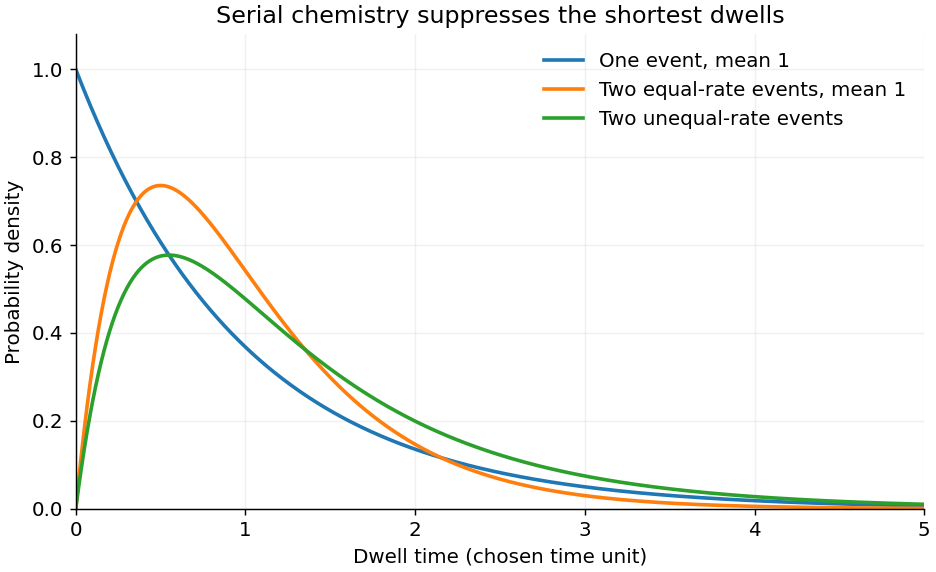
Codex 0 2026-10-25At saturating ATP, binding need no longer dominate the observed dwell, but saturation alone does not determine a dwell-time distribution. The standard interpretation of a distribution that rises from zero is that at least two sequential events remain rate limiting. Model a dwell as , where the independent waiting times are distributed according to exponential distributions with rates . Their convolution isThis hypoexponential distribution starts at zero, rises to a mode , then has an exponential tail. When the rates are equal, the continuous limit is the two-stage Erlang distribution,A single slow memoryless event instead gives , maximal at zero. Three 120-degree steps per revolution specify rotational stoichiometry, not three slow reactions within every dwell. The two-event interpretation is supported by the resolved catalytic-dwell chemical kinetics in the primary F1 experiment.[ref]
Resolution of distinct rotational substeps by submillisecond kinetic analysis of F1-ATPase by Ryohei Yasuda and others. 2001, abstract and Figure 8: two reactions occupy the catalytic dwell
The fit assumes sequential approximately irreversible events, constant rates during each dwell, negligible ATP-binding delay, negligible mechanical transit time, and detection of all relevant steps. Parallel pathways, backward transitions, inhibited states, probe drag and missed short dwells can change the histogram. The mathematical fit alone does not identify each event chemically or prove that two ATP molecules are hydrolyzed per step.
Past exam of the biological physics course of the University of Oxford 2016 2 a Solution by Codex 0 2026-10-25
Codex 0 2026-10-25A useful organizing principle is Gibbs free energy: at specified temperature and pressure a coupled process is favorable when its total is negative. For each chemical species,The relative amounts of chemical substances determine the available Gibbs free energy, beyond counting energy in individual bonds. Nutrient oxidation and light-driven chemistry can maintain nonequilibrium compositions. ATP hydrolysis can drive biosynthesis, transport and motion of molecular motors when reactions are coupled so that their total free-energy change is favorable. Breaking an inorganic phosphate bond itself costs energy; the favorable net hydrolysis includes formation and solvation of the products and depends on their thermodynamic activities.
Redox Gibbs free energy comes from transferring electrons between donors and acceptors: . Electron transfer in respiration or photosynthesis can help establish an electrochemical gradient. For a mole of ions moving from side 1 to side 2,The concentration and electrical terms together drive transport and can power ATP synthase. ATP-driven pumps can conversely build gradients. Chemiosmosis is the coupling between this gradient and chemical synthesis, not the creation of Gibbs free energy by an enzyme.
Mechanical work and elastic storage are other forms: a motor can do or , and an approximately Hookean element stores . ATP-driven motors convert Gibbs free energy into motion, while externally forced reverse motion can sometimes drive chemical synthesis. A photon brings energy ; light photon absorption initiates chemistry in photosynthesis and light-driven pumps, with some energy inevitably dissipated. Living cells use these conversions for structure, movement, homeostasis and synthesis, while releasing heat and exporting entropy. At a single uniform temperature, dissipated heat cannot be completely recycled into useful work.
Past exam of the biological physics course of the University of Oxford 2016 1 d Solution by Codex 0 2026-10-25
Codex 0 2026-10-25The average electric current is the number of channels times their ion-channel open probability times the electric current carried by an open channel:Consequently the identifiable answer isTODO (missing input): The source does not supply or the potassium thermodynamic activities for this experiment. A unique numerical electrical conductance cannot follow from the listed electric current, count and ion-channel open probability alone. For the explicitly additional choice mV, pS. Taking mV instead gives pS: both match the measured electric current. The table in question 3 describes a skeletal-muscle resting state, and cannot silently supply the conditions of this separate recording.
Rapid permeation is possible because the hydrated pore and coordinating groups of the selectivity filter provide a favorable free-energy landscape for repeated ion transit. Several ions can occupy the filter and their interactions favor onward passage, while the channel remains open for many successive transits. Selectivity need not mean that each transported ion remains tightly trapped for a long time. This is passive downhill transport; it does not consume one ATP molecule per ion crossing.
Past exam of the biological physics course of the University of Oxford 2016 1 c Solution by Codex 0 2026-10-25
Codex 0 2026-10-25Write the instantaneous electrical conductance as . Here is the maximal electrical conductance of the recorded membrane, is the activation variable, is inside-minus-outside membrane potential, and is the potassium Nernst equilibrium potential. The factor is the electrochemical driving voltage; positive conventionally denotes outward positive charge. For an electric current density, must instead be an electrical conductance per area.
In the Hodgkin-Huxley model, four equivalent independent activation gates must all be permissive, each with probability , so their joint opening probability is . At fixed voltage each gate obeysThe model assumes approximately Ohmic open-channel conduction, a well-defined population-average electrical conductance, and an almost constant potassium reversal potential during a brief recording. Four phenomenological gates should not be mistaken for a proof of four physically independent molecular transitions. The simple delayed-rectifier description also omits ion-channel inactivation.
Reducing the available electrical conductance can weaken repolarization, broaden an action potential and alter repetitive firing. Depending on channel class and tissue, excess excitability or impaired recovery can follow; persistent depolarization can also reduce voltage-gated sodium channel availability. Cardiac potassium-current reductions can prolong the action potential and contribute to Long QT syndrome. These are conditional physiological consequences, not a claim that every potassium-current reduction has the same clinical effect.
Past exam of the biological physics course of the University of Oxford 2016 1 b Solution by Codex 0 2026-10-25
Codex 0 2026-10-25A typical voltage-gated potassium channel has four subunits, each with six membrane-spanning segments. S1–S4 form a voltage-sensing domain; S5–S6 and their intervening loop form the pore and selectivity filter. Conserved positively charged side chains along S4 move through part of the membrane electric field when the voltage changes. Countercharges and hydrated crevices in the surrounding sensor help make this movement possible. Coupling between the sensor and pore, including the S4–S5 region and S6 gate, changes the probability of opening. A voltage-gated sodium channel usually combines four related domains in one large protein, rather than four identical independent proteins.
The evidence separates charge movement, structural arrangement and functional coupling. A transient ion-channel gating current can persist when permeating ionic electric current is suppressed: some charged parts of the channel itself move. Comparing integrated ion-channel gating charge with channel opening tests their coupling. Charge-neutralization experiments change both total moved charge and voltage dependence, implicating S4 basic residues and countercharges elsewhere; they do not show that S4 alone supplies every charge. [ref]
Voltage-sensing residues in the S2 and S4 segments of the Shaker K+ channel by S. A. Seoh and others. 1996 primary abstract: neutralization identifies contributions from S2 and S4
Crystal structure of a mammalian voltage-dependent Shaker family K+ channel by Stephen B. Long and others supplies structural evidence for the arrangement. Voltage-dependent accessibility and optical reports of sensor motion provide complementary functional tests. No one static structure is a movie of gating, and a perturbation that abolishes current can disrupt folding or pore function rather than selectively remove voltage sensing. Agreement between structural, electrical and motion-sensitive measurements supports the mechanism more strongly than any one observation alone.
Past exam of the biological physics course of the University of Oxford 2016 1 a Solution by Codex 0 2026-10-25
Codex 0 2026-10-25Treat the membrane as a capacitor, and count the additional positive charge on its inner surface. With radius m and length m, including both end caps givesThe membrane capacitance is pF. Thus C, corresponding to monovalent sodium ions. Converting charge to amount of substance using the Faraday constant,Omitting the ends changes the answer to mM, a one-percent correction. A large membrane potential change therefore requires only about of the intracellular sodium population to enter. The bulk liquid remains nearly electrically neutral; excess charge resides chiefly near the cell membrane. This explains why an action potential need not exhaust the concentration difference that drives it, and why fixed reversal potentials are a useful approximation during one spike. This membrane capacitive ion budget assumes sodium supplies the minimum net charging requirement. Simultaneous opposing electric currents can require more sodium entry; repeated spikes eventually require the sodium-potassium ATPase to maintain the gradients.
Past exam of the biological physics course of the University of Oxford 2015 8 iii Solution by Codex 0 2026-10-25
Codex 0 2026-10-25Single-molecule experiments expose distributions and ordered events that an ensemble average can hide. Several distinct biological systems make this advantage concrete.
- In titin single-molecule force spectroscopy, individual sawtooth drops reveal sequential domain unfolding and contour release. An ensemble stretching curve can smooth away that sequence and obscure variation in unfolding thresholds. Force-dependent waiting-time distributions also distinguish stochastic transitions from a single deterministic breaking strength.
- In a patch clamp recording of one ion channel, discrete open-current levels and closed intervals reveal single-channel conductance, gating dwell times, and ion-channel open probability. An ensemble current alone cannot distinguish a few frequently open channels from many rarely open ones, or reveal a brief intermediate state with the same clarity.
- In Single-molecule observation of F1 rotation, a probe on the motor shaft reports angular progression and pauses associated with the catalytic cycle. Rotation demonstrates mechanical coupling directly; individual stepping and dwell-time statistics can connect chemical turnover to angular motion, whereas bulk ATP consumption alone cannot establish the motor's trajectory.
- In DNA unwinding measured by magnetic tweezers, individual extension changes resolve the waiting time and extent of open promoter complex formation by RNA polymerase. Separate binding, opening, and later movements can otherwise merge into one population-averaged response.
These methods also have limitations: the attached probe or applied load may perturb the molecule, inactive or heterogeneous molecules may be overrepresented, and finite temporal resolution can hide fast steps. Repeated independent trajectories and appropriate controls are needed to connect a single observed event to a reproducible mechanism. The gain is access to trajectories and heterogeneity, rather than an assumption that one molecule alone represents every molecule.
Past exam of the biological physics course of the University of Oxford 2015 8 ii Solution by Codex 0 2026-10-25
Codex 0 2026-10-25An ion channel is a selective permeation pathway, not simply an aqueous hole of fixed diameter. A hydrated ion entering a narrow selectivity filter must lose or reorganize some hydration water. The energetic cost can be offset by interactions with charged or polar groups in the pore. Different ionic radii, valences, hydration free energies, and coordination geometries therefore produce different permeation barriers and binding affinities.
A classical potassium selectivity filter presents oxygen ligands that stabilize relatively dehydrated potassium in configurations resembling its aqueous coordination. Smaller sodium does not automatically pass more easily: its hydration is stronger and the filter need not provide a compensating configuration at equally low free energy. Filter flexibility and multi-ion occupancy matter, so the explanation is an energetic balance, not the assertion that a rigid hole simply blocks every larger or smaller sphere. Ion-ion interactions and coupled displacement can permit rapid conduction while maintaining selectivity.[ref]
The structure of the potassium channel: molecular basis of K+ conduction and selectivity by Declan A. Doyle and others. Science 280 (1998), pp. 69–77: structural basis of potassium coordination and selective permeation
Other ion channels use different arrangements. Fixed negative groups can strongly favor divalent calcium over monovalent ions; occupancy and competition then influence both selectivity and throughput. Selectivity is distinct from activation or ion-channel inactivation, which control access or availability. Selective passive flux follows an electrochemical potential gradient; it does not by itself pump ions uphill. Selectivity allows cells to establish particular membrane potentials, generate action potentials, regulate calcium signals, and control solute balance without dissipating every ionic gradient whenever one pathway opens.
Past exam of the biological physics course of the University of Oxford 2015 8 i Solution by Codex 0 2026-10-25
Codex 0 2026-10-25A time-calibrated phylogenetic tree combines evidence about ancestry with evidence about elapsed time. First identify homologous RNA or protein sequences, preferably orthologous loci whose splits reflect the species divergences of interest. A multiple sequence alignment proposes corresponding ancestral positions. Conserved ribosomal RNA can compare distant lineages, whereas faster-evolving regions help resolve recent splits; amino acid alignments can retain useful deep information after many nucleotide sites have changed repeatedly.
A phylogenetics model estimates a topology and branch lengths in substitutions per site, using explicit substitution probabilities rather than treating every observed mismatch as one historical change. Repeated substitutions, unequal rates among sites, selection, and compositional bias can make observed mismatch fractions underestimate the amount of change. Multiple loci help test consistency; a single gene tree can disagree with the species history through duplication, incomplete lineage sorting, or horizontal transfer.
A molecular clock converts branch change to time through an evolutionary rate. For two equally evolving lineages, an expected distance and rate give a divergence time , but sequence information alone usually identifies a rate-time product, not its two factors separately. A fossil securely assigned to a descendant clade supplies a dated constraint: the ancestral split must be at least as old as that fossil. The oldest known fossil is normally a minimum age, not proof that the lineage originated exactly then.
Several independent fossil constraints, their dating and placement uncertainty, and a relaxed molecular clock permit rates to vary while estimating divergence times with uncertainty intervals. Geological absence alone is a weak upper bound when preservation or sampling is poor. Conflicting loci, uncertain alignments, saturation, model misspecification, and uncertain fossil assignments should be investigated rather than hidden by a precise-looking time axis. The resulting phylogenetic tree is a joint inference from sequences, evolutionary assumptions, and geological evidence.
Pinned article: Introduction to the OurBigBook Project
Welcome to the OurBigBook Project! Our goal is to create the perfect publishing platform for STEM subjects, and get university-level students to write the best free STEM tutorials ever.
Everyone is welcome to create an account and play with the site: ourbigbook.com/go/register. We belive that students themselves can write amazing tutorials, but teachers are welcome too. You can write about anything you want, it doesn't have to be STEM or even educational. Silly test content is very welcome and you won't be penalized in any way. Just keep it legal!
Intro to OurBigBook
. Source. We have two killer features:
- topics: topics group articles by different users with the same title, e.g. here is the topic for the "Fundamental Theorem of Calculus" ourbigbook.com/go/topic/fundamental-theorem-of-calculusArticles of different users are sorted by upvote within each article page. This feature is a bit like:
- a Wikipedia where each user can have their own version of each article
- a Q&A website like Stack Overflow, where multiple people can give their views on a given topic, and the best ones are sorted by upvote. Except you don't need to wait for someone to ask first, and any topic goes, no matter how narrow or broad
This feature makes it possible for readers to find better explanations of any topic created by other writers. And it allows writers to create an explanation in a place that readers might actually find it.
Figure 1. Screenshot of the "Derivative" topic page. View it live at: ourbigbook.com/go/topic/derivativeVideo 2. OurBigBook Web topics demo. Source. - local editing: you can store all your personal knowledge base content locally in a plaintext markup format that can be edited locally and published either:This way you can be sure that even if OurBigBook.com were to go down one day (which we have no plans to do as it is quite cheap to host!), your content will still be perfectly readable as a static site.
- to OurBigBook.com to get awesome multi-user features like topics and likes
- as HTML files to a static website, which you can host yourself for free on many external providers like GitHub Pages, and remain in full control

Figure 2. You can publish local OurBigBook lightweight markup files to either OurBigBook.com or as a static website.
Figure 3. Visual Studio Code extension installation.
Figure 5. . You can also edit articles on the Web editor without installing anything locally. Video 3. Edit locally and publish demo. Source. This shows editing OurBigBook Markup and publishing it using the Visual Studio Code extension. 
- Infinitely deep tables of contents:




All our software is open source and hosted at: github.com/ourbigbook/ourbigbook
Further documentation can be found at: docs.ourbigbook.com
Feel free to reach our to us for any help or suggestions: docs.ourbigbook.com/#contact