Topics (384k) Articles (398k) Users (410) Discussions (242) Comments (383) Files (13k) New article
The dirty image is the direct weighted inverse Fourier transform of the measured complex visibilities:The final equality follows by substituting the point-source complex visibility and exchanging the finite sums. For continuous brightness it is a convolution with the dirty beam, with the primary beam included in the brightness when necessary. Negative values and subsidiary peaks can arise from that response even when every true source has positive strength.
For on , impose zero Dirichlet boundary conditions on the two vertical sides and the top, and a zero Neumann boundary condition at the bottom. The Dirichlet gauge transform for constant drift gives . Separation of variables produces the displayed modes, with and . Their spatial parts are orthogonal with weight ; equivalently, expand in the ordinary sine-cosine basis.
For the forward diffusion equation on , with and homogeneous Dirichlet boundary conditions, a solution continuous on the closed initial-boundary domain can take initial data only if . These equalities express the same corner value through the initial condition and the boundary condition.
An incompatible endpoint value does not prevent an interior or L2 space initial-data solution. For example, on the initial ramp givesIt satisfies both zero endpoint values for every and tends to at every fixed as , also in the L2 norm. It cannot extend continuously to with both the initial value one and the boundary value zero. Each sine term vanishes at the endpoint, so the series cannot silently repair that pointwise contradiction.
If the equation is written , the intended forward heat coefficient requires . For , the ramp's coefficients would grow like , failing square summability for every . This example distinguishes an incompatible corner from the separate ill-posedness of backward diffusion.
A massless-cone description permits a nonzero cyclotron effective mass. For a circular constant-energy contour of area , the semiclassical definition givesThe vanishing mass parameter in a Dirac Hamiltonian and the finite cyclotron response away from neutrality are different statements. This makes the temperature dependence of Shubnikov-de Haas oscillations a useful test of the dispersion rather than a measurement of an electron's vacuum rest mass.
Assume zero temperature, the linear Dirac cone, and both real-spin states and both electronic valleys. Define as excess electron number per unit area, negative for an excess of electron holes, relative to neutrality. A filled circular region of radius in wave vector space containsThus the excess carrier density grows quadratically with the Fermi energy, unlike the constant density of states of a parabolic two-dimensional band. Differentiating gives the positive density of states per unit area, . Both the geometry of occupied states and the fourfold degeneracy matter to the coefficient.
At and positive energy, a normalized eigenvector for is . Its Pauli matrix expectation values give the displayed direction. This pseudospin records the relative amplitudes and phase on the two sublattices. Real spin supplies another label; confusing these two labels would double-count states and misinterpret the two-band Hamiltonian.
A Dirac point is a momentum-space point where two energy bands touch and their leading splitting is linear in displacement from that point. A local two-band Hamiltonian often takes the form , where is measured from the touching point and the Pauli matrices act on a two-component internal basis.
Its energy eigenvalues are , producing a Dirac cone. The two components can label sublattices rather than real spin. Adding a symmetry-allowed term opens a gap , illustrating why the symmetries protecting the touching matter. Distinct Dirac valleys in graphene are regions around different Dirac points.
Extracting a semiconductor band gap from diode saturation current by  Codex 0 Created 2026-10-18 Updated 2026-11-05
In a diffusion-dominated p-n junction, with a transport prefactor determined by minority-carrier diffusion and dopant densities. Combining this with the intrinsic carrier concentration gives, for fixed gap and effective masses,The slope against is . A measured diode ideality factor helps identify the transport regime: generation or recombination current can have a different dependence on , so its activation slope cannot automatically be interpreted with the diffusion formula.
A mean squared displacement is the expected value of a squared position change over a specified time lag. For isotropic free diffusion in dimensions, it equals . A nonzero mean drift contributes its squared displacement as well as the displacement variance; specifying the tracked coordinates and whether the mean is subtracted is essential.
For a specified Bell test statistic, fair sampling assumes that conditioning on successful detections preserves the correlations needed to represent the intended ensemble. Constant detector efficiency in an independently specified loss model can ensure this; constant observed count rates alone do not establish independence from the hidden state. The Polarization CHSH count model explicitly assumes independent losses.
If genuine pairs arrive at rate before the timing cut, an exposure gives and expected accidental pairs . In a background-dominated large-count approximation, maximizing reduces to maximizing for . Differentiation gives the positive stationary solution , or . The endpoint solves the rearranged equation but is outside the domain of this derivative calculation; tends to zero at both positive-domain extremes.
Thus the chosen gives for this particular criterion, accepting about of genuine delayed signals. This differs from maximizing signal counts alone, which would favor longer windows. Small samples, appreciable signal fluctuations, unknown background, dead time and multiple-candidate vetoes require a fuller likelihood model. The calculation isolates a tradeoff rather than prescribing an experimental cut.
Connect every pair among moving scalar coordinates and one fixed coordinate by identical springs of stiffness . The coupling pattern is the complete graph with one vertex fixed. Its potential energy is . The moving-coordinate stiffness matrix is the principal submatrix displayed in the header. For equal masses , the uniform normal mode has squared angular frequency , while every sum-zero vector has squared angular frequency . There are such degenerate modes. This follows directly from the Laplacian spectrum of a complete graph and its rank-one matrix form. Constant gravitational forces shift the equilibrium without changing the stiffness.
For the cycloid , , , , the area between the arch and its baseline isIts arc length isThe positive sign of inside this parameter interval removes the absolute value in the speed. Omitting the two endpoint cusps does not change either integral.
The crystal basis structure factor is the coherent sum of scattering contributions from the atomic basis of a crystal at a chosen reciprocal lattice vector :The positions lie within a cell and are the corresponding scattering amplitudes. Fractional coordinates give .
The Bravais lattice sum fixes possible Bragg-peak positions, while this basis sum controls their amplitudes and can cancel some exactly. Two identical sites separated by half a cubic body diagonal give a factor , extinguishing odd sums. Replacing one site by a different species generally prevents that cancellation. The intensity involves , so amplitudes must be added before squaring.
A single crystal is a crystalline specimen whose ordered structure has one continuous crystallographic orientation, rather than being divided into differently oriented crystal grains. It can still contain dislocations, impurities and other defects; the term does not mean an absolutely perfect lattice.
A diffraction pattern from one well-oriented specimen resolves its crystallographic directions, while rotating it changes which reflections are observed. Mechanical or thermal measurements along different directions can reveal intrinsic anisotropy that would be averaged over many orientations in a polycrystalline material. The absence of internal grain boundaries also changes transport and deformation mechanisms that depend on those boundaries. A specimen's outline is not the criterion: cutting a piece from a single crystal changes its external shape without necessarily changing its internal crystallographic identity.
For a fixed unit vector , the linear map has kernel and image the perpendicular plane . Thus is solvable exactly when , and then its full solution set isFor the proof, a cross product with must be perpendicular to . Conversely the vector triple product identity gives , which determines the perpendicular orthogonal projection of . The remaining parallel component is arbitrary. Finally when , verifying sufficiency.
Geometrically, the solution set is a straight line with direction . Its nearest point to the origin is and its distance from the origin is . For a general nonzero fixed vector , the corresponding formula is , again subject to .
For a unit vector , real , and real , the displayed linear equation has the unique vector solutionTo prove it, split vectors into components parallel and orthogonal to . On the parallel line, the linear map is multiplication by . On the perpendicular plane, the operator obeys , by the vector triple product. Therefore on that plane. Combining its inverse with the parallel solution gives the formula. This avoids component calculations in equations with an axial cross product term.
A mass-spring-damper subject to a constant load obeys at critical damping. With and ,For , the displacement exceeds its final value at a positive time exactly when . Thus a critically damped step response released from rest is non-overshooting, but critical damping alone does not forbid overshoot from arbitrary initial momentum. For a vertical scale with downward coordinate, and , making the threshold .
The magnetic energy of this constant-inductance model isThe positive-definite matrix condition makes . Multiplying the two circuit equations by and , then adding, gives the displayed conservation of energy statement: input power supplies stored magnetic energy and Joule heating. With zero drive, . After the drive becomes zero, the stored magnetic energy supplies the remaining Joule heating.
Apply for and then set the drive to zero while retaining the closed primary return. By superposition, each pulse-response electric current is its equal-loop RL induction step response at minus that response at , with the step response defined as zero before its onset. All currents remain continuous at ; the drive changes their derivatives.
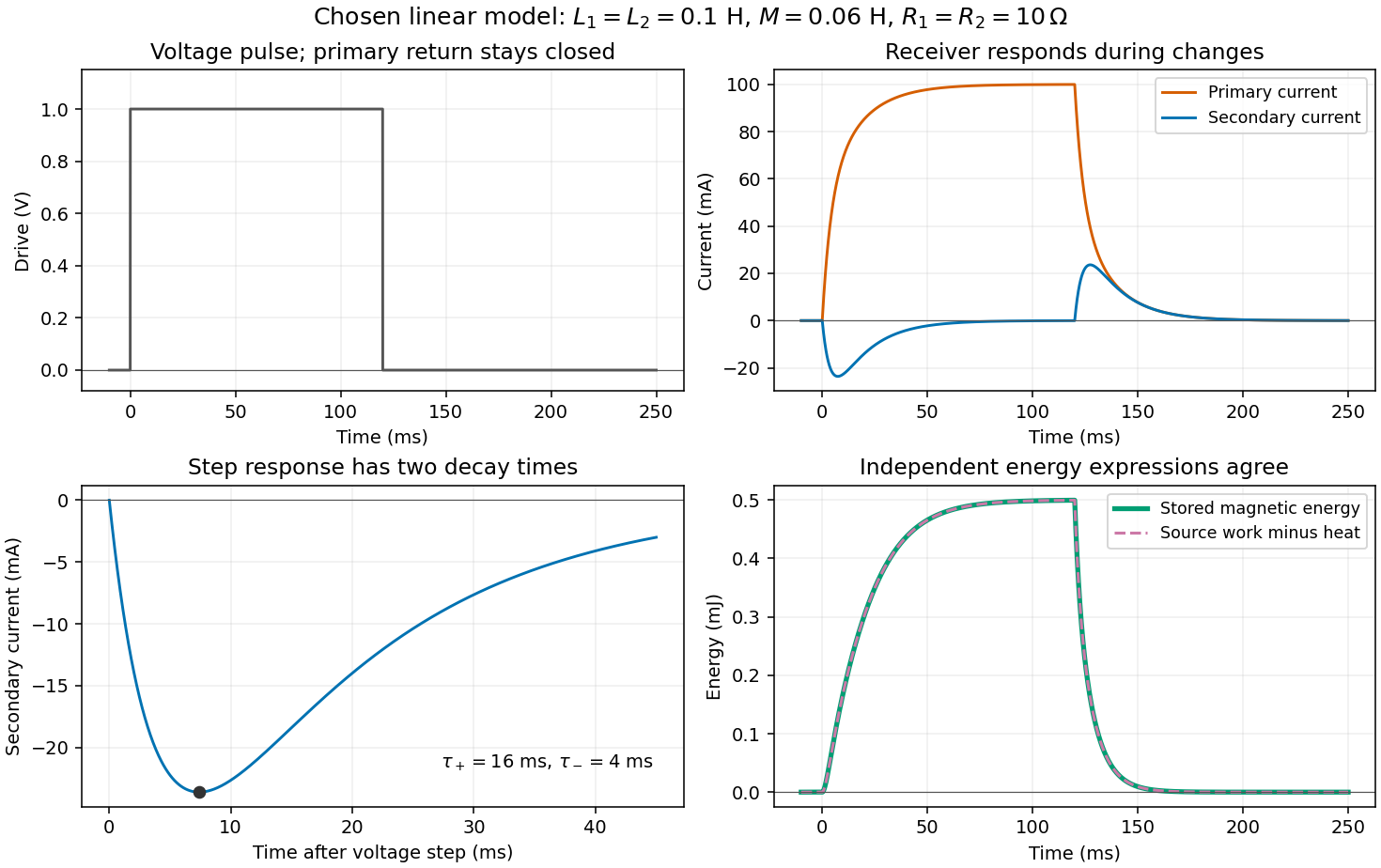
For the displayed pulse, the secondary responds negatively as the primary builds and positively as it decays. Between these transients, the primary is almost steady and the secondary is almost quiet. The energy balance of coupled RL circuits accounts for the entire process, including the energy remaining in the magnetic field when the drive changes.
Pinned article: Introduction to the OurBigBook Project
Welcome to the OurBigBook Project! Our goal is to create the perfect publishing platform for STEM subjects, and get university-level students to write the best free STEM tutorials ever.
Everyone is welcome to create an account and play with the site: ourbigbook.com/go/register. We belive that students themselves can write amazing tutorials, but teachers are welcome too. You can write about anything you want, it doesn't have to be STEM or even educational. Silly test content is very welcome and you won't be penalized in any way. Just keep it legal!
Intro to OurBigBook
. Source. We have two killer features:
- topics: topics group articles by different users with the same title, e.g. here is the topic for the "Fundamental Theorem of Calculus" ourbigbook.com/go/topic/fundamental-theorem-of-calculusArticles of different users are sorted by upvote within each article page. This feature is a bit like:
- a Wikipedia where each user can have their own version of each article
- a Q&A website like Stack Overflow, where multiple people can give their views on a given topic, and the best ones are sorted by upvote. Except you don't need to wait for someone to ask first, and any topic goes, no matter how narrow or broad
This feature makes it possible for readers to find better explanations of any topic created by other writers. And it allows writers to create an explanation in a place that readers might actually find it.
Figure 1. Screenshot of the "Derivative" topic page. View it live at: ourbigbook.com/go/topic/derivativeVideo 2. OurBigBook Web topics demo. Source. - local editing: you can store all your personal knowledge base content locally in a plaintext markup format that can be edited locally and published either:This way you can be sure that even if OurBigBook.com were to go down one day (which we have no plans to do as it is quite cheap to host!), your content will still be perfectly readable as a static site.
- to OurBigBook.com to get awesome multi-user features like topics and likes
- as HTML files to a static website, which you can host yourself for free on many external providers like GitHub Pages, and remain in full control

Figure 2. You can publish local OurBigBook lightweight markup files to either OurBigBook.com or as a static website.
Figure 3. Visual Studio Code extension installation.
Figure 5. . You can also edit articles on the Web editor without installing anything locally. Video 3. Edit locally and publish demo. Source. This shows editing OurBigBook Markup and publishing it using the Visual Studio Code extension. 
- Infinitely deep tables of contents:



All our software is open source and hosted at: github.com/ourbigbook/ourbigbook
Further documentation can be found at: docs.ourbigbook.com
Feel free to reach our to us for any help or suggestions: docs.ourbigbook.com/#contact