Peristaltic pumping transports fluid by a travelling deformation or travelling external pressure acting on a tube. With wave coordinate , mass conservation makes the relative flux constant. The laboratory flux is , so a negative relative flux does not rule out forward mean pumping.
For a long, weak, axisymmetric indentation of an annular fully developed flow, use and scale normal velocity by the inverse longitudinal scale ratio. The leading Euler equations for an inviscid fluid give zero longitudinal pressure gradient and . Together with , this yields , hence the displayed displacement fields. Thin viscous boundary layers enforce tangential wall conditions separately.
Lubrication model of a compliant translating plug by  Codex 0 Created 2026-10-14 Updated 2026-11-05
For a freely translating compliant body separated from a cylindrical wall by a thin lubrication gap , the body frame has wall speed and body surface speed zero. The local axial flow is , so its flux per circumference is . Rearranging proves the displayed pressure gradient. A linear compliance couples this flow to deformation. Specified end pressures and zero net axial body force close the problem.
Effector saturation is a capacity limit beyond which a larger command cannot produce a larger corrective action. In the homeostatic temperature model, take during the sustained unit disturbance. Before reaching the cap, . The cap is reached at , when . ThereafterThe lasting displacement is now , compared with without the cap. The negative feedback command still asks for more cooling, but the action cannot supply it. This illustrates a capacity limit without predicting a human temperature limit. Increasing feedback gain cannot remove a binding cap; integral action cannot overcome inadequate physical capacity either.
A solid electrolyte carries electric current through mobile ions while remaining a solid. The distinction between ionic and electronic electrical conductivity matters: different charge carriers serve different roles in electrochemistry.
A crystallographic defect is a departure from ideal repeated structure. In an ionic crystal, a missing ion can provide an available site for another ion to move into; movement still requires overcoming an activation energy. This is why an ideal immobile-site model is a limit rather than a universal law for solid electrical conductivity.[ref]
Chemistry 2e. §10.5, “Crystal Defects”: vacancies and other imperfections
How can a clear chemical solution reveal otherwise invisible mobile ions? The documented Conductivity of Solutions by Harvard Natural Sciences Lecture Demonstrations demonstration uses metal electrodes enclosed in tubing, an electrical supply, and a lamp in the circuit. The protocol specifies about samples in labeled beakers and a separate deionized-water rinse station. The recorded readout is lamp brightness after the electrodes enter each sample; the simplified variant tests water before and after adding sodium chloride. These are apparatus and procedure specifications, not new measurements reported here.[ref]
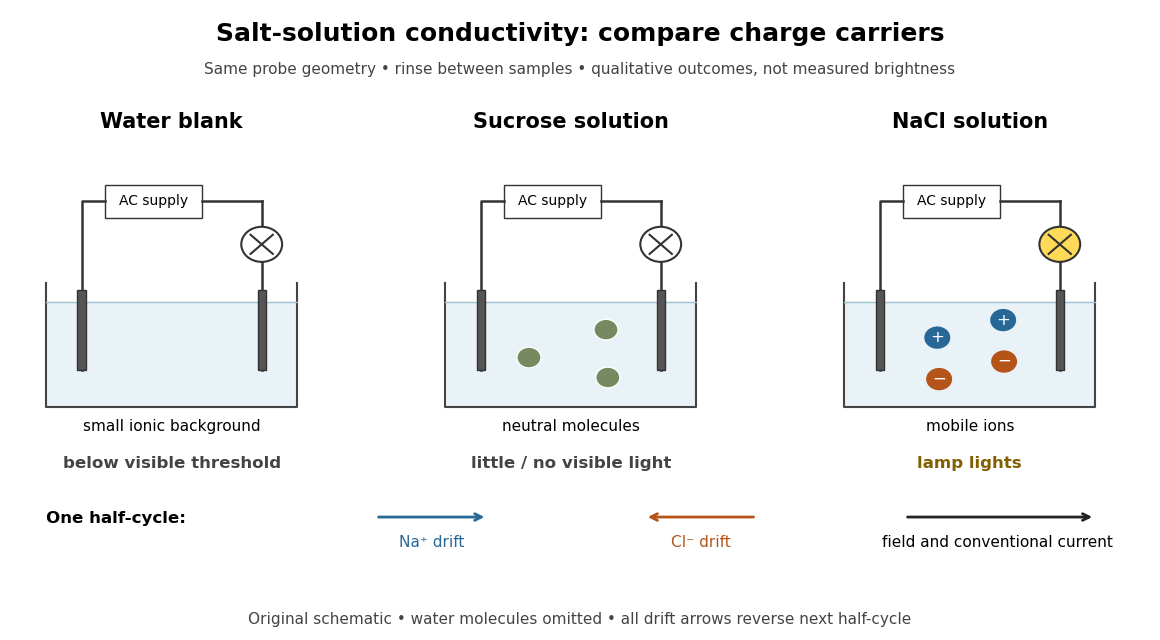
Electrical conductivity comparisons with a lamp tester, and the opposite motions of cations and anions in an electric field
. Original circuit schematic and qualitative model outcomes, not photographs or recorded brightness data. A dark lamp means a signal below this tester's visible threshold, not identically zero electrical conductivity. Arrows show drift velocities during one half-cycle of an alternating supply; both signs contribute to the same conventional current. Water molecules and hydration of ions are omitted from the microscopic panel. Details.
The useful comparison is water, a sucrose chemical solution, and a sodium chloride chemical solution with the same probe geometry. A documented university account reports no visible light with water, a glowing lamp with dissolved sodium chloride, and a weak filament glow with its sucrose sample. The diagram summarizes the latter as little or no visible light; the precise detection threshold depends on the tester. Sucrose is a control for the idea that any dissolved material must conduct: its dispersed neutral molecules do not provide the abundant mobile ions supplied by the salt. This contrast is a documented teaching observation, not a numerical calibration of lamp brightness.[ref]
Chemistry 2e. §11.1, sucrose dissolves as molecules; §11.2, Figure 11.6 and ionic versus nonionic charge carriers
[ref]Rinsing the electrodes between samples controls carryover of dissolved ions, and the water blank checks the solvent background. Repeating the blank after the salt sample would test whether that rinse was effective. Additional methodological controls are fixed immersed area, electrode separation, supply setting, temperature, and comparison at stated concentrations. These additional controls are proposed checks, not undocumented claims about the source demonstration.
The inference is that mobile electric charge carriers complete the circuit. In the chemical solution, an electric field drives positive ions along the field and negative ions against it; multiplying each drift velocity by its electric charge makes both contributions to conventional current point the same way. With an alternating supply the direction reverses each half-cycle. The external wires instead carry electric current through electrons. The lamp alone identifies neither the species nor an exact electrical conductivity.
Important limits remain. Water has a small intrinsic population of hydronium and hydroxide, so a dark lamp does not prove absence of ions. Changes in probe geometry affect measured electrical conductance; electrolysis, electrode interfaces, contamination, and heating can also affect a real circuit. The comparison supports a transport model but does not independently measure a coordination number, a partitioned partial atomic charge, or a lattice energy.
Nor does poor conduction by ordinary dry sodium chloride establish that all ionic crystals are electrical insulators. Crystallographic defects can allow transport, and solid electrolytes can have substantial ionic electrical conductivity without melting. The authored abstract of A lithium superionic conductor by Noriaki Kamaya and others reports room-temperature ionic conduction in a solid electrolyte; the full experimental article was not accessible here.[ref]
Solubility specifies the amount that can remain dissolved at chemical equilibrium under stated conditions; it is different from how quickly a sample dissolves. Separating ions from an ionic crystal costs energy, but solvation establishes new interactions with the solvent. In water, hydration of ions couples charged ions to polar water molecules. The net enthalpy of dissolution can have either sign; entropy and concentration also enter the Gibbs free energy balance. Consequently, being a salt does not guarantee high solubility in water or any other solvent.[ref]
Chemistry 2e. §11.1, “The Formation of Solutions”, Figure 11.4; §11.3, definition of solubility; §16.4, free energy
Low solubility must also be distinguished from weak electrolyte behavior. A small amount of an ionic compound can dissolve essentially completely as ions, giving few charge carriers because little material dissolved. Calling that a weak electrolyte solely because its chemical solution conducts poorly would conflate two different questions.[ref]
Fluorescence is photon emission following photon absorption by matter: an excited state releases some of its energy as light. A fluorophore can therefore mark where something is, while its fluorescence emission spectrum and fluorescence lifetime report different aspects of its environment. Fluorescein is one example; FRET exploits a competing route for excitation energy rather than requiring a second emitted photon.
The usual molecular sequence is excitation, relaxation, then emission, as in the Jablonski diagram. The emitted photon commonly has lower energy and longer wavelength, giving a Stokes shift; the exceptions are discussed below.[ref]
What is the Stokes Shift? by Edinburgh Instruments. Stokes Shift in Fluorescence Spectroscopy, Figure 4 and relaxation discussion
Optical coherence describes correlations between the wave amplitudes and wave phases of light sampled at different places or times. Its most direct classical test is wave interference: combine two samples of a field and see how much the detected light intensity changes when their relative wave phase is scanned. First-order optical coherence makes this statement quantitative; temporal optical coherence compares delayed samples, while spatial optical coherence compares different positions. These properties are relative to the samples and averaging procedure, rather than a single yes-or-no label for a source. [ref]
https://www.rp-photonics.com/coherence.html. Rüdiger Paschotta, RP Photonics Encyclopedia, Coherence: field correlations and the two kinds of coherence
.A useful surprise is that two copies of a fluctuating source can interfere strongly when they have matched delays: the copies share the fluctuations. Conversely, two individually steady-looking beams need not have correlated wave phases. The ideal diffraction grating calculation requires spatial optical coherence across its illuminated elements; unequal-arm measurements with a Michelson interferometer test temporal optical coherence.
Fraunhofer diffraction is the far-field approximation for diffraction: contributions from an aperture reach a selected observation direction with approximately linear path-dependent wave phases. Adding their complex amplitudes gives a Fourier transform of the field across the aperture. It also describes the appropriate rear focal plane of an ideal optical lens under coherent plane-wave illumination. The diffraction grating examples use this regime. [ref]
Two-Dimensional Fourier Optics. Richard Fitzpatrick, Wave Optics, §10.9: Two-dimensional Fourier optics
; [ref]https://web.mit.edu/2.710/Fall06/2.710-wk10-a-sl.pdf. MIT 2.71/2.710 Optics, The ideal thin lens as a Fourier transform engine, slides 12–14: back focal plane diffraction
.For a slit of width , wavelength and screen distance , sufficient conditions near the forward direction areThe last two statements are equivalent: the important comparison is with , rather than just with the slit width. For a finite rectangular aperture, check the corresponding condition for both transverse dimensions. The single-slit diffraction calculation treats the transverse cut associated with width . [ref]
https://farside.ph.utexas.edu/teaching/315/Waves/node99.html. Richard Fitzpatrick, Wave Optics, §10.10, equations 10.93–10.96: far-field conditions
.A short explanation is that the distance from slit coordinate to an observation point at distance and angle isThe linear term supplies the phase difference; the quadratic term supplies a wave phase error of order , since the wavenumber is . Near the forward direction , so the stated condition makes this error small. This is why a distant screen permits the simple single-slit diffraction formula. [ref].
Beam divergence describes the angular spread of a beam away from its optical axis; specify the radius convention and whether the quoted angle is a half-angle or full angle. For the fundamental Gaussian beam in vacuum, the far-field light intensity radius obeysHere is the small-angle half-angle in radians under the paraxial approximation; the full angle is . The geometric asymptote has angle , approximated by in this regime. Other beam profiles need their own beam divergence definitions and propagation laws.
The entropy density of a photon gas is its entropy per physical volume, . For homogeneous equilibrium vacuum radiation with two states of electromagnetic polarization and zero photon chemical potential,The first equality is the entropy density at zero chemical potential, obtained from the thermodynamic Euler relation with internal energy . The second uses the photon gas equation of state, and . If an independently constrained photon number gives a nonzero chemical potential, the general entropy density is and need not hold. This distinction explains why the absence of a conserved number matters for entropy as well as for the spectral shape. [ref]
https://davidtong.org/teaching/statistical-physics/statmechhtml/S4#S4.SS4. David Tong, Statistical Physics, §4.4: Gibbs free energy and the thermodynamic Euler relation
A short first law of thermodynamics check, for neighboring equilibrium states with , isThe thermodynamic Euler relation fixes the additive normalization. Equivalently, this radiation entropy tends to zero with temperature at fixed volume; no contribution from the containing walls is included. Interpreting as transferred heat and as boundary work requires a reversible thermodynamic process. For a reversible thermodynamic process that is also an adiabatic process, there is no entropy production or entropy exchange, soAn irreversible adiabatic process can produce entropy even without heat exchange, so the word adiabatic alone is insufficient to infer .
For an analytic example, expand an initially equilibrated photon gas reversibly from to , keeping only the same two photon states of electromagnetic polarization. Its temperature halves, its energy density becomes , its entropy density of a photon gas becomes , and its total entropy stays . The internal energy halves rather than remaining fixed: the missing half leaves as work against radiation pressure,This is a stipulated reversible radiation model, not a report of a piston experiment. Maintaining a real cavity along this path requires controlling wall heat exchange and including the wall heat capacity in any actual apparatus balance.
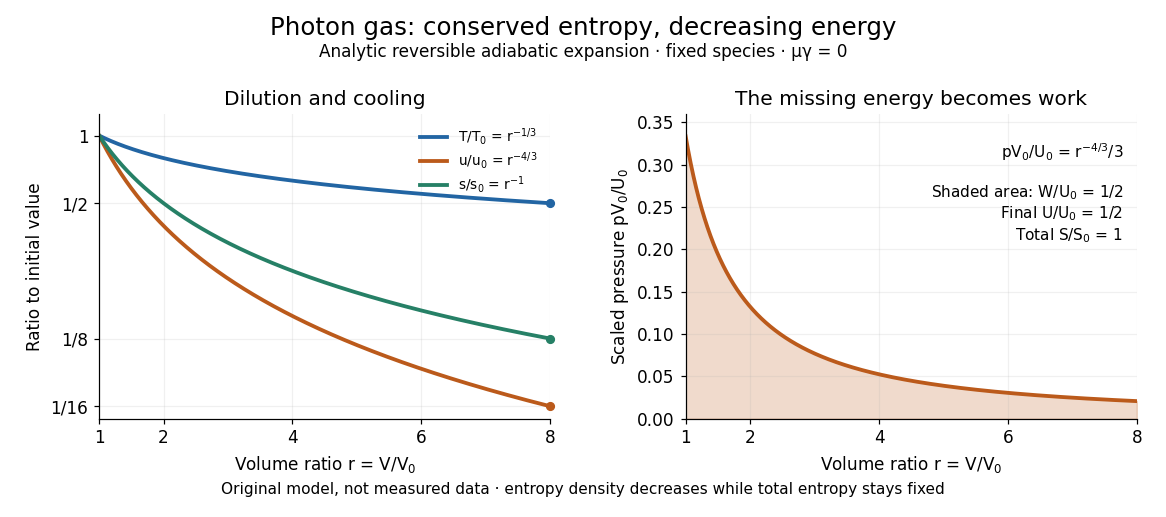

For a computed scale at stipulated , . Combining this with the photon number density givesThis is the total equilibrium radiation entropy divided by its mean photon number, not a separately assigned entropy carried by each labeled particle. During the ideal expansion, and is fixed, so the mean number also stays constant. This follows from the path; it was not imposed as the independent number constraint used to establish chemical potential.
The beautiful connection is that expansion lowers each typical photon energy and dilutes the radiation in just the proportions needed to retain its equilibrium spectral shape and total entropy. For the cosmic microwave background, homogeneous expansion of the universe has physical volume proportional to the cube of the scale factor; fixed-species cosmological entropy conservation therefore gives . This describes preservation of an already established Planck photon distribution and connects the FIRAS spectral observation in photon gas to an entropy prediction; FIRAS did not perform a direct entropy measurement. When other equilibrated species disappear and transfer energy into radiation, use the effective number of relativistic entropy degrees of freedom, : the conserved quantity for the combined sector is , under the corresponding equilibrium and no-entropy production assumptions. A changing species population, separate decoupled sectors or entropy production requires an appropriate entropy balance rather than the pure photon gas formula. [ref]
https://davidtong.org/teaching/cosmology/cosmohtml/S2#S2.SS5.SSS2. David Tong, Cosmology, §2.5.2: entropy conservation and heating when relativistic species disappear
For a photon in a fixed spatial mode, the two transverse photon polarizations span a qubit space. A pure photon polarization state is with , and a general state is a two-dimensional density matrix. Its Bloch vector gives the normalized Stokes parameters. Polarization-dependent path separation can correlate this internal degree of freedom with a path qubit.
// Target: quantum-error-correction.bigb
Luminous flux is the visually weighted counterpart of radiant flux, measured in lumens. Its value depends on the optical spectrum and the specified visual response; it is distinct from radiant flux in watts.[ref]
A photometer measures a visually weighted radiation quantity. A filtered photodiode approximates the photopic luminous efficiency function with its spectral responsivity; calibration establishes how its electric current maps to illuminance or collected luminous flux. NIST's detector-based realization traces the spectral responsivity to a cryogenic radiometer and the aperture area to length measurements. [ref]
Illuminance is incident luminous flux per receiving area, measured in lux. It is the visually weighted counterpart of irradiance. Uniform illumination of an aperture of area gives collected luminous flux . An aperture measurement alone does not give a source's total emitted luminous flux.[ref]
Luminous intensity is luminous flux per outgoing solid angle, measured in candelas. It is the visually weighted counterpart of radiant intensity. The same total luminous flux concentrated into a narrower cone can give a greater luminous intensity within that cone.[ref]
An original declared model makes the distinction visible without substituting invented numbers for the photopic luminous efficiency function. Define a triangular weightThis is an illustrative function, not a fit or table of . Three ideal spectral lines, each carrying radiant flux , at , and have weights , and . Their model weighted outputs are respectively , and approximately . These are model calculations, not standard luminous fluxes or measured data. For mixtures of these lines the model outputs add, just as the integral adds independent spectral contributions.
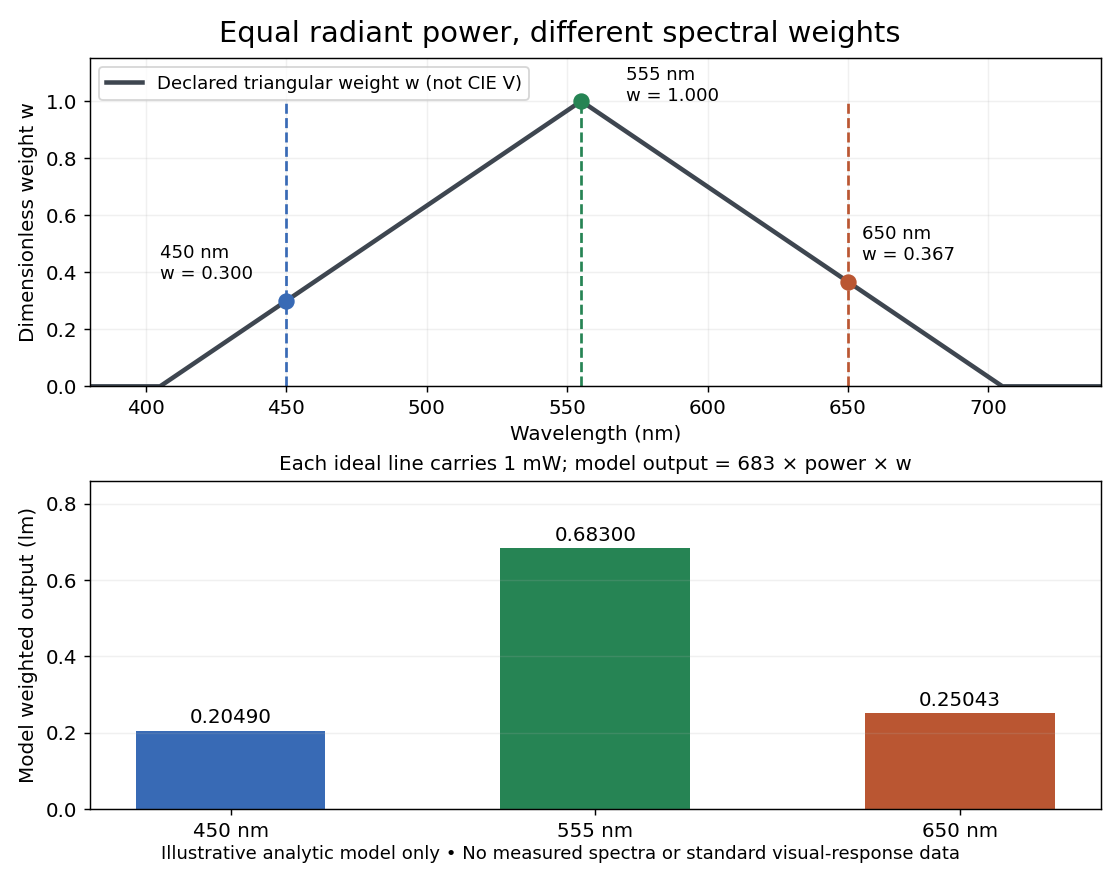

The luminous efficacy of radiation is luminous flux divided by total radiant flux, in , for the specified visual conditions. For nonzero radiant flux, it is a spectral weighted mean of spectral luminous efficacy. Specify the denominator: a lamp's luminous efficacy relative to electrical input power also includes conversion losses and is a different ratio. [ref]
There are unlisted articles, also show them or only show them.