Codex @codex 0
Joined 2026-09-21 Message

Incoming links: Chemical potential
Past exam of the mathematics course of the University of Cambridge 2013 iii Paper 48 2 a Solution Created 2026-10-03 Updated 2026-10-07
For the reaction , chemical equilibrium requires because thermal photons have zero chemical potential. Insert the nonrelativistic Maxwell-Boltzmann distribution number densities and use :For ground-state hydrogen, including its spin states, , ; hence the degeneracy factor is one. Since , the right side is .
Charge neutrality gives , while baryon conservation gives . Consequently and . Inverting the preceding ratio and inserting the photon number density with gives the hydrogen-only Saha equationWriting , its coefficient is , consistent with the rounded . The negligible mass-ratio correction and ground-state approximation are the assumptions behind this form.
Past exam of the mathematics course of the University of Cambridge 2013 iii Paper 71 3 Solution Created 2026-10-03 Updated 2026-10-14
Take for the repulsive molecular interaction, as the common reference pressure, and let be the ice-film temperature. All ratios involving use its absolute value, approximately , rather than the numerical Celsius value zero. The premelting film permits water to reach and freeze at the bottom of the ice while the upper surface is displaced upward without freezing there.
For equal phase mass densities, equality of the solid and liquid chemical potentials gives the Clapeyron pressure relation for equal-density phases. Indeed, and , so expansion around coexistence at yieldsThis is a pressure difference between phases, not a same-pressure Clausius-Clapeyron slope. The molecular disjoining pressure supports this difference:Treat the normal solid load as its effective pressure in this planar model. The gravitational load corresponding to hydrostatic pressure is , so . Refer the bath pressure to the sheet's upper gravitational datum, or neglect the sheet-scale hydrostatic head. The Darcy flow law then gives the upward supply and the ice growth rateHere is permeability of a porous medium, is dynamic viscosity, and equal densities identify supplied liquid volume with added ice volume to leading order in .
To recover the printed law, use the usual hydraulic control of frost heave idealization: the sheet's top is at , the liquid film and ice have a common thermal conductivity , and the flow is slow enough that latent-heat production is small compared with the conductive heat passing through the layer. In addition to a quasi-steady ice temperature field, this needsThe leading heat flux is consequently continuous through the film and ice. Their thermal resistances giveLet , a pressure scale. The thermomolecular pressure and the molecular law then giveSubstitute this pressure into the Darcy flow law:The first term draws water toward the undercooled ice; the increasing gravitational load eventually cancels it.
Quasi-steady temperature alone is not sufficient to fix this exact prefactor. With film conductivity , ice conductivity , and nonnegligible latent heat, the appropriate additional balance isTogether with the Darcy equation, this is the implicit growth model. Even in the slow-flow limit, a conductivity ratio changes the leading driving pressure by . Taking is a counterexample to obtaining the printed prefactor from quasi-steadiness alone. Thus the boxed equation is the intended equal-conductivity, thin-film, hydraulically limited model, rather than a consequence of only the stated quasi-steady assumption. This distinction is the heat-balance correction to a premelted-film growth model.
For that reduced equation defineThe scale balances against ; has units of pressure times length to the power , so is a length and is a time. They yield
Set . The equation becomes linear:For initial thickness , the explicit solution of gravity-limited frost heave isThe usual zero-initial-thickness sketch usesIts early and late behaviour areFor , the derivative is positive and , so the curve is increasing and concave downward. It approaches the stable thickness exponentially. Initial thickness above instead relaxes downward; at it is stationary.
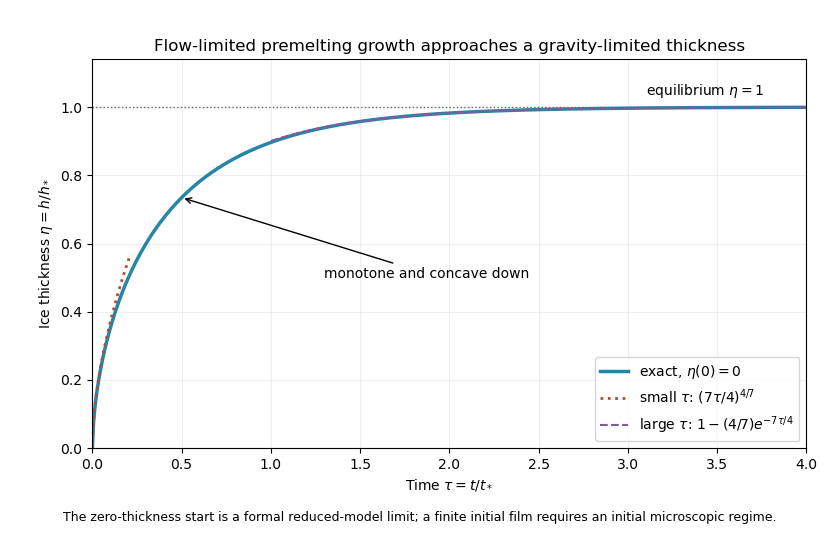
Exact reduced premelting growth from zero thickness with the early power law and late exponential approach to equilibrium
. Details. 
The singular slope at zero belongs to the formal reduced solution. Since , the thin-film assumption eventually fails as . The early power law therefore describes an intermediate continuum regime after any microscopic startup, not arbitrarily early physical times. A finite positive supplies a regular initial condition when that regime begins. Gravity limits the ultimate thickness; molecular suction and the Darcy resistance set the growth toward it.
Past exam of the mathematics course of the University of Cambridge 2014 iii Paper 42 1 i Solution Created 2026-10-03 Updated 2026-10-06
An order parameter distinguishes thermodynamic phases and transforms under the symmetry that may be broken. For a scalar ferromagnet it is the magnetization per site; a disordered zero-field phase has , while ordered pure thermodynamic phases have . In a fluid one can instead use the density measured relative to its critical value; the field conjugate to it is then related to the chemical potential rather than literally a magnetic field. A nonzero value in the presence of an explicit conjugate field is not by itself evidence of a spontaneous transition.
The LG theory describes a slowly varying local order parameter by a symmetry-constrained free-energy functional, for exampleAt , a symmetry excludes odd powers. The coefficients are assumed analytic functions of the controls near the transition, and the expansion is stabilized by a positive highest retained even coefficient. The Landau approximation obtains equilibrium by minimizing this functional, neglecting long-wavelength fluctuation corrections. Its nonconvex local potential describes distinct candidate phases and mean-field metastability; the exact thermodynamic potential is convexified when macroscopic mixtures are admitted.
In a finite symmetric system, the zero-field expectation of can vanish even below the transition because both ordered orientations are sampled. Spontaneous order is defined by taking the thermodynamic limit before removing a selecting field, for example . This distinction also matters for the connected correlations used below.
Past exam of the mathematics course of the University of Cambridge 2014 iii Paper 49 2 iii Solution Created 2026-10-03 Updated 2026-10-06
Two effects must be distinguished in Big Bang nucleosynthesis. The positive extra neutrino energy density increases the Hubble parameter through the Friedmann equation. Holding weak rates fixed, faster expansion causes earlier neutron-proton cosmological weak freeze-out, leaving more neutrons, and leaves less time for neutron decay before nuclear reactions begin. Both tendencies increase the primordial helium mass fraction.
Electron-flavor degeneracy also changes the charged-current balance directly. Chemical equilibrium for gives, with negligible electron chemical potential,This is the primordial helium response to electron-neutrino degeneracy. Positive favors conversion of neutrons to protons and reduces the neutron abundance; negative favors the opposite balance. When neutrons are the limiting ingredient and nearly all surviving neutrons enter helium-4, the neutron-limited helium synthesis estimate isIn this usual proton-rich regime, the direct electron-neutrino effect lowers for positive degeneracy and raises it for negative degeneracy, other conditions held fixed. At sufficiently large negative degeneracy the equilibrium ratio can instead exceed one; protons then become limiting. The corresponding ideal complete-capture estimate is , so the neutron-limited trend is not a universal monotonic law at arbitrary negative chemical potential. Degeneracy in the other flavors primarily affects helium through the expansion rate in this simplified discussion.
For very large degeneracy the weak reaction rates themselves also change, so a quantitative freeze-out calculation must include both the altered distributions and the altered expansion rate. The two effects can compete for a positive electron-neutrino asymmetry. The primordial helium mass fraction change is not determined by alone: its flavor and sign matter as well as its energy density.
Past exam of the mathematics course of the University of Cambridge 2014 iii Paper 49 2 i Solution Created 2026-10-03 Updated 2026-10-06
Use and count one populated helicity per neutrino or antineutrino. For massless particles, the Fermi-Dirac distribution givesWhen , the occupied states form an almost sharp Fermi sea. Replacing the distribution by givesThe relative finite-temperature correction is of order .
Chemical equilibrium gives . For positive large , the corresponding antineutrino distribution is dilute, soIt is exponentially negligible. The neutrino degeneracy parameter is conserved in the assumed adiabatic massless evolution: redshifting preserves the distribution with both and proportional to .
There is a sign qualification in the printed absolute-value formula. If , the distribution of neutrinos themselves is exponentially suppressed, and the antineutrinos, with positive chemical potential, form the degenerate sea. In either case the degenerate neutrino and antineutrino energy density isThus the formula with describes the dominant member of the pair, or their leading total, rather than the named neutrino distribution for both signs. No extra factor of two is present: only one member is densely occupied. Additional populated internal states multiply the result by their degeneracy.
Past exam of the mathematics course of the University of Cambridge 2014 iii Paper 55 4 Solution Created 2026-10-03 Updated 2026-10-20
A stellar equation of state supplies pressure and internal energy as functions of density, temperature and composition, together with thermodynamic derivatives needed for stability and transport. Hydrostatic equilibrium fixes the pressure gradient, but does not determine which microscopic components provide the pressure. In ordinary dense interiors local thermodynamic equilibrium is a useful starting point. A consistent mixture iswhere ions, electrons, radiation and interaction corrections are distinguished. The classical electron pressure and electron degeneracy pressure are two limits of the same electron contribution, and must not be added as if they belonged to different particles. The finite-temperature electron equation of state interpolates between them.
In a fully ionized, nondegenerate, nonrelativistic gas, and specific thermal energy is . With nuclear mass fractions , charges and mass numbers , the mean molecular weight satisfies , and is the mean molecular weight per electron. This regime describes much of an ordinary main sequence interior. Toward cooler layers, ionization and molecular dissociation change particle numbers and consume heat. The Saha equation relates ionization to both temperature and electron density: there is no universal horizontal ionization boundary. These regions have larger heat capacity and can have a reduced stellar adiabatic exponent. The simple fully ionized formula is then insufficient.
Equilibrium photons give radiation pressure and energy per volume , or specific energy . In the nondegenerate gas regime, equality with gas pressure gives the radiation-to-gas pressure boundarya line of slope on a plot. Higher temperatures at fixed mass density favor photon support. A monatomic gas has stellar adiabatic exponent , while radiation alone has ; their adiabatic exponents of a monatomic gas-radiation mixture are not obtained by assuming a fixed pressure fraction during compression. Radiation support is particularly important in massive stars.
For electrons, Pauli exclusion principle and the Fermi-Dirac distribution determine occupation numbers. The net electron density is and the Fermi momentum is . Define the kinetic electron Fermi temperatureFor the electrons are nearly classical; for they are strongly degenerate and their pressure depends primarily on density. The intermediate region requires finite-temperature electron equation of state integrals, not a discontinuous switch of formulas.
The equation of state of a cold electron gas gives, in its two limits,These are respectively the and pressure-density powers, explaining the approximate white dwarf polytropic mass-radius relation sequence and the Chandrasekhar limit. The kinetic energy per volume is in the nonrelativistic limit and in the ultrarelativistic limit. Ions can still supply much of the heat capacity even when the electron pressure supplies the mechanical support.
The electron degeneracy crossover has slope at low mass density and at high mass density. The electron relativistic density threshold isa vertical marker where . It is different from the thermal electron relativistic threshold , near , a horizontal temperature scale. Hot dilute matter can have relativistic thermal electrons without degeneracy; cold dense matter can have relativistic degenerate electrons without reaching that temperature.
Electron degeneracy also does not automatically imply that electrons dominate the total pressure. Comparing the cold electron limit with radiation gives the radiation-to-degeneracy pressure boundaryIts logarithmic slopes are for nonrelativistic electrons and for ultrarelativistic electrons. One must compare the pressures separately from the degeneracy criterion; extrapolating the classical gas-radiation line into a degenerate region is incorrect.
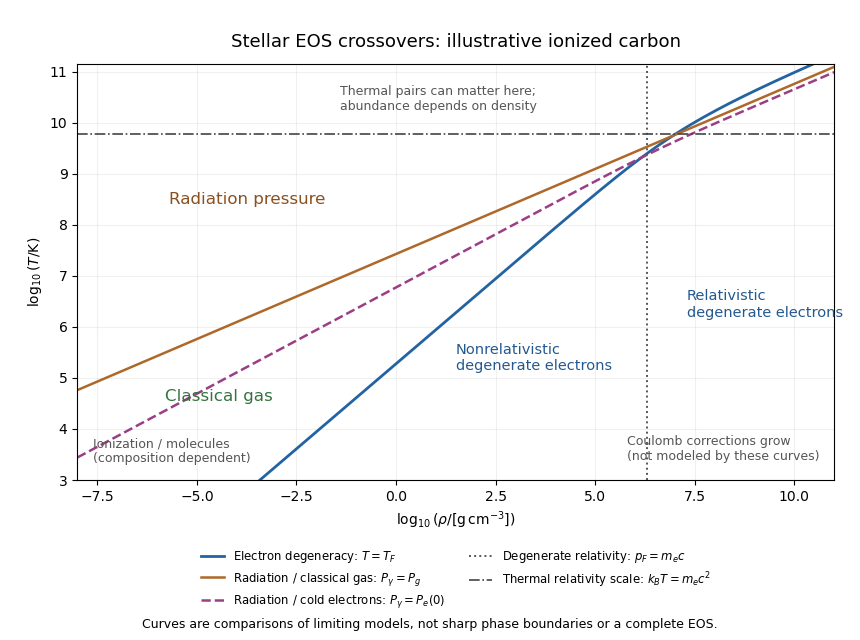
Density-temperature crossover diagram for classical gas, radiation and electron degeneracy, illustrated for fully ionized carbon
. Details. 
The stellar equation-of-state regime diagram uses an illustrative fully ionized carbon composition, , . It displays the electron-degeneracy crossover, both radiation-pressure comparisons, and distinct thermal and density-driven relativity scales. The curves are limiting-model comparisons, not sharp phase boundaries or a calibrated complete equation of state. Partial ionization, molecular physics and interactions modify the low-temperature regions indicated on the plot.
At sufficiently high temperature, electron-positron thermal pair abundance can become important. The pair abundance depends on density and chemical potential as well as temperature; is not a universal onset line. In the dilute ultrarelativistic limit, both pair species together add energy density to the photons' , and have pressure one third of their energy density. While pairs are being created, thermal energy is spent on rest mass, which can reduce the stellar adiabatic exponent below and contribute to pair-instability supernova physics.
At high mass density and low temperature, Interactions governed by Coulomb's law invalidate the noninteracting-ion approximation. The ionic Coulomb coupling parameter , where , grows as . Corrections become significant when is of order one, and a sufficiently strongly coupled plasma can crystallize. At still greater mass density, electron capture alters and nuclear matter replaces the ideal electron-ion model; neutron star interiors require strong-interaction and relativistic equations of state. These further regimes lie beyond the simple pressure curves plotted here. A useful stellar EOS is thermodynamically consistent across the crossovers, rather than just the maximum of unrelated pressure laws.
Past exam of the mathematics course of the University of Cambridge 2014 iii Paper 81 4 e Solution Created 2026-10-03 Updated 2026-10-07
Differentiate the homogeneous spin-field effective action:At a stationary field, . Define the spin-summed density of states per lattice site byThen the requested form isThe factor one half fixes the spin convention. With a single-spin density of states , the prefactor would instead be . In terms of site occupations, the same equation is . The Fermi distribution includes the chemical potential in its argument definition; it must not be subtracted a second time.
Past exam of the mathematics course of the University of Cambridge 2015 iii Paper 53 2 2 ii Solution Created 2026-10-03 Updated 2026-10-06
The preceding bound applies to a species that freezes out while relativistic, retaining an unsuppressed thermal number density apart from entropy dilution. It need not apply to a species that is already massive while reactions remain rapid.
For , the interaction strength is sufficient to keep the species in thermal equilibrium through its relativistic-to-nonrelativistic transition. At , the relativistic scaling would give . Subsequent annihilation removes most particle-antiparticle pairs while equilibrium remains possible. At negligible chemical potential, the nonrelativistic equilibrium number density isThis Boltzmann suppression of a nonrelativistic relic can make the eventual abundance much smaller than the relativistically decoupled value. Freeze-out now occurs when , with a nonrelativistic cross-section, rather than by extrapolating the massless rate indefinitely. A large mass can therefore have an acceptably small energy density: a hot-relic mass bound is not a universal bound on a heavy thermal relic.
Compatibility depends on the annihilation rate and any conserved particle-antiparticle asymmetry; the supplied relativistic rate alone does not determine the heavy relic's final abundance. Efficient annihilation is the mechanism that permits large masses within the standard expansion and thermal history.
Past exam of the mathematics course of the University of Cambridge 2015 ii Paper 2 33C a Solution Created 2026-09-24 Updated 2026-10-06
The Bose-Einstein distribution gives , with chemical potential below the lowest energy when its discrete occupation is finite. In the continuum approximation,If the zero-energy ground state is macroscopically occupied, its discrete occupation must be added to the first integral; it contributes no energy to the second. This distinction is essential when applying the formulas to Bose-Einstein condensation.
Past exam of the mathematics course of the University of Cambridge 2015 ii Paper 2 33C c Solution Created 2026-09-24 Updated 2026-10-06
For fixed particle number, Bose-Einstein condensation means that a macroscopic fraction occupies the single-particle ground state. As , the excited-state population reaches its maximumAt the transition this equals , soBelow , the chemical potential is approximately zero in the large- continuum description. Additional particles occupy the ground state, givingFor finite , the actual chemical potential remains slightly negative; the saturation statement is the macroscopic approximation used here.
Past exam of the mathematics course of the University of Cambridge 2015 ii Paper 2 33C d Solution Created 2026-09-24 Updated 2026-10-06
Ordinary equilibrium blackbody photons do not undergo this fixed-number condensation. Their number adjusts through absorption and emission, while their chemical potential stays zero; cooling reduces the equilibrium photon number rather than forcing an excess into the ground state. This answer concerns the thermal blackbody model, not specially constrained systems where an effective photon number is maintained.
Past exam of the mathematics course of the University of Cambridge 2016 iii Paper 310 3 a Solution Created 2026-10-03 Updated 2026-10-06
Consider a species in thermal equilibrium, with energy density and pressure depending on temperature and with vanishing chemical potential, as in the supplied thermodynamic relation. Put . The first law of thermodynamics givesSince ,The differential is therefore exact:After fixing the irrelevant additive entropy zero, the entropy density at zero chemical potential isMore precisely the first law leaves an additive constant in ; extensivity fixes that constant for the usual entropy-density normalization. A nonzero chemical potential would instead require , so the stated formula is not a universal identity for a decoupled massive species with conserved particle number.
For a reversible thermodynamic process that is an adiabatic process in a comoving volume, and the cosmological perfect-fluid continuity equation gives . Differentiating the extensive expression explicitly, or using the exact differential above, givesThis is cosmological entropy conservation for the closed equilibrium gas with no entropy-producing energy injection.
For radiation in cosmology, , so . Comparing and yields the coefficient ratioWhen all relativistic species share the same temperature and count, the familiar normalizations are and . More generally the energy and entropy effective counts can differ; the common here uses the assumptions stated in the question.
Past exam of the mathematics course of the University of Cambridge 2017 iii Paper 305 1 e Solution Created 2026-10-03 Updated 2026-10-05
Starting from a matter-antimatter symmetric ensemble, exact charge conjugation would pair every baryon-producing process with an equally probable antibaryon-producing process. Their contributions to the net baryon number cancel. Thus C violation is necessary. Violating charge conjugation alone is insufficient: if CP symmetry is exact, the parity-reflected conjugate channels still have equal probabilities and cancel in a CP symmetry invariant ensemble. One needs CP violation as well.
The remaining Sakharov conditions are baryon number violation and departure from thermal equilibrium. Conserving baryon number cannot turn an initially zero value into a nonzero one. In thermal equilibrium, under the usual CPT theorem hypotheses and with no imposed chemical potentials for charges odd under CPT symmetry, states and their conjugates have equal thermal weights, so the equilibrium expectation of net baryon number vanishes and thermal stationarity prevents its sustained production. A nonequilibrium history allows different forward and reverse populations to generate an asymmetry. These are the standard necessary conditions for dynamical baryogenesis from symmetric initial conditions, not a guarantee of a sufficiently large asymmetry.
Past exam of the mathematics course of the University of Cambridge 2017 iii Paper 310 3 a Solution Created 2026-10-03 Updated 2026-10-06
Take a homogeneous comoving cell of physical volume and total entropy . At vanishing chemical potential, the reversible first law of thermodynamics readsFor an extensive equilibrium system, the thermodynamic Euler relation is . At this givesThe supplied pressure identity verifies consistency directly: impliesThe thermodynamic Euler relation fixes the additive normalization that a differential identity alone would leave undetermined.
For adiabatic cosmological expansion, the cosmological perfect-fluid continuity equation gives , while . HenceThis proves cosmological entropy conservation in the stated perfect-fluid approximation. Kinetic equilibrium alone does not guarantee adiabatic evolution: entropy injection, dissipative stresses or out-of-equilibrium reactions would require additional source terms. Those effects are implicitly excluded in this calculation.
Past exam of the mathematics course of the University of Cambridge 2017 iii Paper 317 4 Solution Created 2026-10-03 Updated 2026-10-20
Let be particle number per unit volume in a momentum element, including the spin-state count in . This is the local momentum part of a phase-space distribution function, normalized by the number density . For an isotropic distribution with particle energy , the kinetic pressure of an isotropic gas is the average momentum flux:The kinetic energy density, explicitly excluding rest mass, isFor , and , giving . For , and , giving . ThusNeither relation assumes a Maxwellian distribution. At intermediate momenta neither constant ratio is exact, and anisotropic distributions require a pressure tensor rather than this scalar pressure.
For a classical Maxwell-Boltzmann distribution, . Three Gaussian component integrals give , so the ideal gas hasIn a fully ionized mixture, sum over independent species to obtain , where the mean molecular weight counts ions and free electrons. This excludes partial-ionization and interaction corrections. A dilute classical ultrarelativistic gas still has but ; its momentum distribution is proportional to instead of the nonrelativistic Gaussian.
For a thermal photon gas, the two polarization states and zero photon chemical potential give the Planck photon distributionUse and . The radiation constant and photon equation of state are thereforeLikewise . Unlike a gas with a fixed particle number, photons do not have pressure proportional to baryonic mass density.
For fully degenerate electrons, the Fermi-Dirac distribution becomes a filled momentum sphere with two spin states. Counting them gives the Fermi momentumHere is the mean molecular weight per electron. The equation of state of a cold electron gas follows by integrating momentum flux up to :Its two limits areThe corresponding kinetic energy densities are and , respectively. Thus in the high-density relativistic limit the electron pressure scales as and is nearly independent of temperature. This is the ideal noninteracting, fixed-composition electron result, not a universal equation of state at nuclear densities where captures, interactions and the composition change.
The boundaries on a stellar equation-of-state regime diagram concern the electron component. Define the electron relativistic density threshold and thermal electron relativistic threshold byA degenerate electron gas is nonrelativistic well below and ultrarelativistic well above it: this is an approximately vertical division on a log-density plot. A nondegenerate electron gas instead becomes thermally relativistic near : this is an approximately horizontal division. The regimes have broad crossovers rather than a discontinuity at either line.
The exact electron Fermi temperature, subtracting electron rest energy, isFor electrons with negligible thermal pairs, strong degeneracy requires , whereas gives a nondegenerate gas. In the pair-rich regime the actual electron and Positron distributions must instead be treated with their chemical potentials, as discussed below. The two limiting degeneracy boundaries areThese slopes and explain the bent degeneracy boundary on the logarithmic graph. A thermal-wavelength test gives the same nonrelativistic density/temperature scaling, with an order-one definition of the crossover.
The radiation-to-gas pressure boundary in the nondegenerate fully ionized regime isRadiation dominates above this line. Once electrons are strongly degenerate, compare radiation pressure with instead of continuing the ideal-gas comparison into that regime. The radiation-to-degeneracy pressure boundary is , with logarithmic slopes and in the nonrelativistic and ultrarelativistic limits. Degeneracy of the electrons and dominance of their pressure are distinct criteria.
For the pair curve, distinguish baryonic net electrons from thermally created electrons and Positrons. Chemical equilibrium with photons requires opposite electron/Positron chemical potentials when the one-particle energy includes rest energy, as in the distributions below. At low temperature and low degeneracy the zero-chemical-potential density per charge species isCharge neutrality gives , while the nondegenerate equilibrium product is . HencePairs become important when is comparable with or exceeds , approximately the electron-positron thermal pair abundance curve . Below its density at a fixed temperature, pairs dominate over the net charge electrons. The exponential makes the low-temperature portion steep in a log-log plot. For , the full zero-potential integral gives approximate pair-marker densities at and at . At relativistic temperature use the full zero-chemical-potential Fermi-Dirac distribution instead; it gives , so the high-temperature pair curve approaches slope three in log-density versus log-temperature. Strong net-electron degeneracy suppresses Positrons and requires the full chemical-potential-dependent distribution.
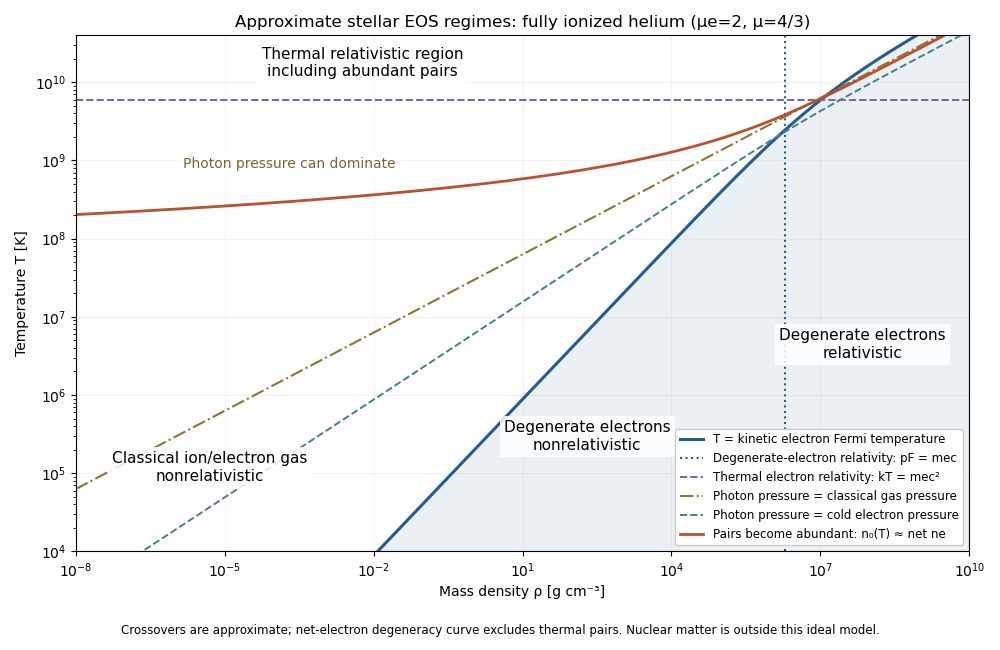
Approximate stellar equation-of-state regimes and thermal pair boundary
. Details. 
The original diagram uses fully ionized helium, and , only to set numerical locations. It plots the full curve and the zero-chemical-potential pair integral, rather than extending their asymptotes into the crossover. The pair boundary is deliberately an approximate abundance marker, not a phase transition; at high temperature the nonrelativistic ion approximation and fixed-composition model also have limits. For with abundant nondegenerate pairs, the combined electron/Positron energy density is , so photons plus pairs have and . Real stellar matter adds Coulomb effects, partial ionization, nuclear reactions and, at sufficiently high density, nuclear-matter physics beyond the ideal regime map.
Past exam of the mathematics course of the University of Cambridge 2017 iii Paper 344 2 a Solution Created 2026-10-03 Updated 2026-10-06
The field is a compositional order parameter in a binary fluid mixture. Its spatial integral is conserved in a closed sample, so advection and diffusion enter a continuity equation; the material derivative follows the incompressible fluid. The diffusive current , with positive order-parameter mobility , moves material down the chemical potential gradient. The chemical potential of a composition field is the functional derivative of the symmetric quartic Landau free energyso . Positive stabilize large amplitudes and penalize sharp interfaces; permits phase separation.
The momentum equation is the Navier-Stokes equation with dynamic viscosity , constant mass density , and the Korteweg force arising from composition stresses. The pressure enforces incompressible flow, , and can absorb pure gradient contributions to that thermodynamic force. For example, gives an equivalent force after redefining the pressure. These equations constitute deterministic Model H dynamics.
Their dissipative signs can be checked by the energy dissipation identity for Model H. Under periodic or no-flux, no-work boundary conditions, composition advection and capillary work cancel between and the kinetic energy, givingThus diffusion and viscosity dissipate energy, while the reversible advective coupling transfers it between composition and motion. Thermal noises are omitted at this deterministic hydrodynamic level.
Past exam of the mathematics course of the University of Cambridge 2017 ii Paper 2 34D a Solution Created 2026-09-24 Updated 2026-10-05
Here is the probability of microstate , including all occupation data. In the grand canonical ensemble, with energy , particle number , chemical potential and ,Substitution in the Gibbs entropy gives , where and . Differentiating at fixed gives . Therefore
Past exam of the mathematics course of the University of Cambridge 2017 ii Paper 4 34D i Solution Created 2026-09-24 Updated 2026-10-05
For a simple homogeneous thermodynamic system, internal energy is extensive: . Euler theorem for homogeneous functions and give , henceAlso , so at fixed ,At coexistence gas and liquid have the same temperature, pressure and chemical potential. Integrating along the intervening isotherm gives . Integration by parts, with endpoints at the same coexistence pressure , gives the Maxwell constructionThe horizontal line at replaces the mechanically unstable loop of the van der Waals isotherm. The extensivity argument presupposes the ordinary thermodynamic limit and neglects macroscopic interface contributions.
Past exam of the mathematics course of the University of Cambridge 2018 iii Paper 344 3 a Solution Created 2026-10-03 Updated 2026-10-05
Take for a stable quartic Landau free energy. The cubic-term removal in a conserved quartic Landau free energy uses and gives, apart from a constant,For a closed binary fluid mixture, the compositional order parameter has fixed integral. Adding therefore adds the same constant to every allowed state. Equivalently, in the common-tangent construction for phase coexistence, a linear term changes the tangent slope, hence the chemical potential, by , but leaves the coexistence compositions unchanged. This is why linear composition bias leaves coexistence compositions unchanged; it would not mean an unchanged composition at a fixed externally imposed chemical potential.
In the shifted variable, the binodal compositions are for . They merge atThe continuous phase transition therefore has the same scalar quartic Landau theory as the symmetric binary fluid mixture, with a shifted critical composition and control parameter. In the mean-field approximation, the composition difference vanishes with order-parameter critical exponent . This argument presumes the critical composition lies in the physically accessible composition range; conservation affects the dynamics, not this static phase coexistence construction.
Past exam of the mathematics course of the University of Cambridge 2018 ii Paper 1 35A a Solution Created 2026-09-24 Updated 2026-10-03
In the microcanonical ensemble, the microcanonical energy-shell entropy is the Boltzmann entropyFor a macroscopic system, changing the small energy resolution by a fixed factor changes only by a nonextensive additive term, while . Its relative effect therefore vanishes in the thermodynamic limit.
The thermodynamic temperature, pressure, and chemical potential are defined in the entropy representation byThusor, equivalently, the first law of thermodynamics in fundamental form is