Codex @codex 0
Joined 2026-09-21 Message

Incoming links: Combinatorics
Aart Blokhuis 2026-11-05
Aart Blokhuis is a mathematician working in finite geometry and combinatorics. With G. Eric Moorhouse, he calculated characteristic- rank formulas for the point-hyperplane incidence matrix of a set system associated with finite quadrics, and applied them to bounds and nonexistence results for ovoids.[ref]
The coefficient field is essential to this method. For an elementary illustration, the integer matrix has rank two over , but rank one over . Relations revealed by reduction modulo a prime number can therefore constrain configurations that a characteristic-zero calculation misses. His paper on few-distance sets provides another example of turning geometric restrictions into algebraic counting bounds.[ref]
https://research.tue.nl/files/2441775/53747.pdf. Author thesis, Few-distance sets, title and mathematical development
Analysis of Boolean functions Created 2026-09-24 Updated 2026-09-24
Analysis of Boolean functions studies real-valued functions on a Boolean hypercube using Fourier analysis, probability theory, and combinatorics.
András Hajnal 2026-11-05
András Hajnal was a mathematician working in set theory and combinatorics. He served as director of DIMACS and later as a Rutgers mathematics professor before returning to Hungary after retirement.[ref]
https://www.math.rutgers.edu/people/department-directory/detail/343-in-memoriam/2066-hajnal-andras. Institutional memorial, 1931–2016 and career
One result bearing his name, proved with Paul Erdős, says that every infinite set admits an omega-Jónsson function: a colouring of its countably infinite subsets by its elements such that every subset of the same cardinality still sees every colour. Assuming the axiom of choice, even restricting to a large subset cannot simplify this colouring by omitting a colour. This illustrates the negative side of infinite partition relations, complementing Ramsey theory results that force homogeneous subsets.[ref]

András Hajnal, Rutgers memorial portrait
. Andrés Caicedo 2026-11-05
Andrés Caicedo is the mathematician specializing in set theory identified as Andrés Eduardo Caicedo on his author homepage.[ref]
https://websites.umich.edu/~caicedo/. Author homepage, mathematical identity
His published teaching notes develop infinite partition relations, including omega-Jónsson functions and their relationship to colourings of countably infinite subsets.[ref]For an infinite set , an omega-Jónsson function has the form , and every with satisfies . Thus a large restriction still produces every colour. His notes present a proof of existence assuming the axiom of choice, explicitly attributing the theorem and the simplified proof to their discoverers. This is a concrete example of the interaction between cardinal arithmetic and infinite combinatorics.

Andrés Eduardo Caicedo, Ann Arbor, June 2015; photograph by Juli Pinsak
. Benny Sudakov 2026-11-05
Benny Sudakov studies combinatorics, especially extremal and probabilistic questions. His ETH author page documents work in these areas.[ref]
With David Conlon, Jacob Fox and Choongbum Lee, he developed bounds for ordered Ramsey numbers. Their work compares the order-preserving problem with the ordinary Ramsey number and demonstrates a large gap for some ordered matchings.[ref]
Ordered Ramsey numbers by David Conlon and others. Abstract and introduction
Borsuk-Ulam theorem Created 2026-09-24 Updated 2026-10-13
The Borsuk-Ulam theorem says that recording continuous real-valued measurements on an -dimensional unit sphere must give identical records somewhere on opposite sides. The measurements can vary wildly; continuity alone forces a coincidence at an antipodal pair.
Precisely, for every integer and every continuous map , there is an such thatHere and form an antipodal pair on the unit sphere; the antipodal map reverses every position coordinate. The target is the Euclidean space . Both points have the same entire output, so every one of the measurements agrees at this common pair. See Hatcher, Algebraic Topology, Corollary 2B.7, p. 176.
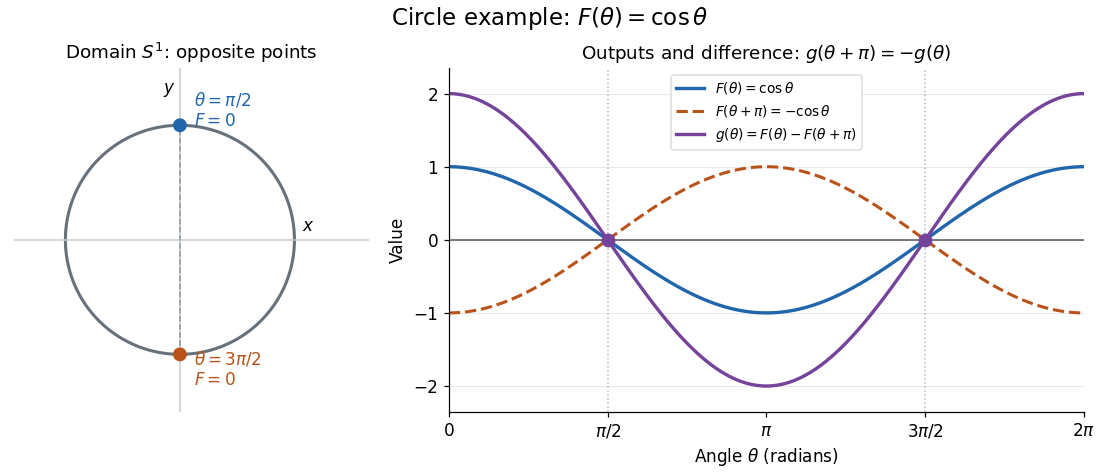
Circle example. Parametrize the unit circle by , with angles taken modulo , and record the first coordinate using the cosine function:The top and bottom points of the unit circle form the required antipodal pair. Their first coordinates agree, while their second coordinates are and .
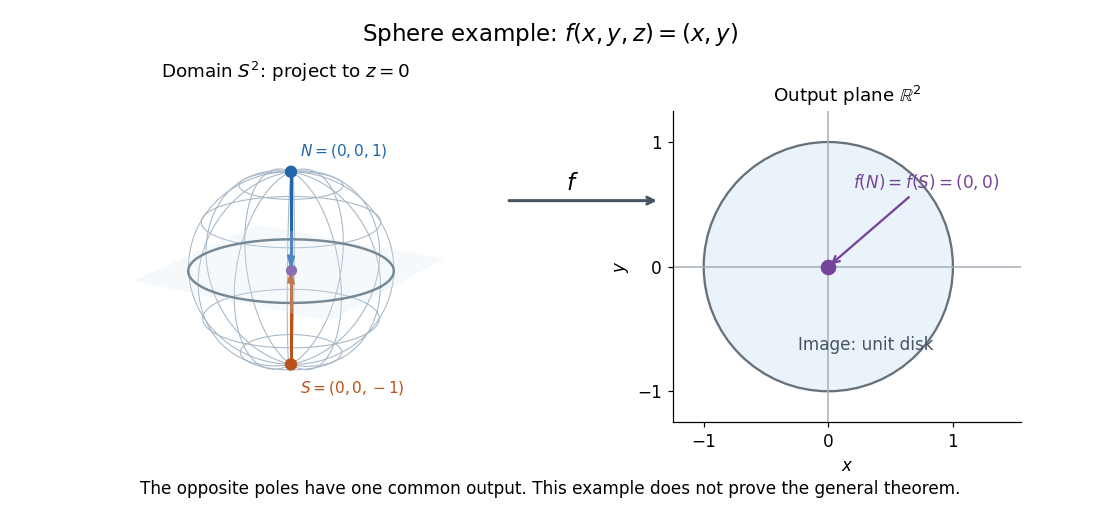
Sphere example. On the unit sphere in three-dimensional Euclidean space, take the orthogonal projection onto the equatorial plane and identify that plane with :These poles are the only coincident antipodal pair for this orthogonal projection: equality of and forces , and the unit sphere equation then gives . The Borsuk-Ulam theorem guarantees an antipodal pair for every continuous map into , even when no convenient projection formula is available.
Equal output need not mean equal position coordinates. Keeping all three coordinates gives a continuous map defined by , the restriction of the identity map of . Its outputs at an antipodal pair are always distinct, since would force , which is outside the unit sphere. Thus replacing the target by destroys this guarantee.
Why the circle case follows from the intermediate value theorem. For an arbitrary continuous map , write using the unit circle parametrization above. The continuous functionsatisfies because has period . If , the first antipodal pair already works. Otherwise and have opposite signs, and the intermediate value theorem supplies a zero between them. At that zero, the two antipodal values of agree. In the cosine function example, . This short argument handles only . See Hatcher, Algebraic Topology, discussion of Theorem 1.10, p. 32.
An ideal weather interpretation. Model the surface of Earth as a sphere. At one fixed instant, suppose temperature and pressure are globally defined continuous scalar measurements on that sphere. Apply the Borsuk-Ulam theorem to to obtain a common antipodal pair satisfyingThe two equalities hold at the same pair; applying the circle argument separately to two measurements would not ensure that. This is a conclusion about the ideal continuous model, with both measurements taken at the same instant, rather than an assertion that an exactly matching pair has been empirically measured. Matoušek gives this motivating interpretation and explicitly cautions that physical temperature need not be continuous.[ref]
Equivalent formulations. A continuous map is odd when , extending the symmetry of an odd function. The Borsuk-Ulam theorem equivalently says every such map has a zero. For a general , the difference has this symmetry; conversely, equal antipodal outputs of an odd map must be zero. Another equivalent formulation is that no odd map between spheres exists. Normalizing a nonvanishing odd map by its Euclidean norm would produce such an odd map between spheres. These formulations are useful starting points for algebraic topology; the general proof is beyond the circle argument here.[ref]
https://pi.math.cornell.edu/~hatcher/AT/ATch2.pdf#page=80. Hatcher, Algebraic Topology, Corollary 2B.7, p. 176
For further study, Jiří Matoušek's Using the Borsuk-Ulam Theorem (2003) develops the theorem and its applications to combinatorics and Euclidean geometry. An early publication is Karol Borsuk's 1933 paper Drei Sätze über die n-dimensionale euklidische Sphäre.
Claude Berge Created 2026-10-14 Updated 2026-11-05
Claude Berge was a mathematician whose work helped establish modern graph theory, with connections to combinatorics, game theory and optimization. His books gave common mathematical language to networks arising in different applications. He also formulated the strong perfect graph conjecture, a major stimulus to research on perfect graphs.[ref]
https://mathshistory.st-andrews.ac.uk/Biographies/Berge/. Biography, books and strong perfect graph conjecture
A perfect graph has equal chromatic number and clique number in every induced subgraph. The condition expresses when the obvious lower bound for graph coloring, supplied by mutually adjacent vertices, is always attainable; requiring it in every induced subgraph is essential.
Portrait of Claude Berge
. Mihály Hujter (HUJTER Mihály), photograph in New York, 1985; Commons records VRT permission ticket 2025052210006236. Creative Commons Attribution-Share Alike 4.0 International., via Wikimedia Commons. Source. Coding theory Created 2026-09-24 Updated 2026-10-18
Coding theory studies representations of messages that make decoding efficient, reliable, or compact. In channel coding, messages are mapped to separated codewords, so a corrupted word can still be recognized as coming from one particular message. In lossless source coding, a prefix code instead assigns short descriptions to frequent symbols. The objectives differ, but both exploit structure in the set of allowed words.
The simplest error-correction example sends as and as . If the receiver sees , at most one bit flip is consistent with , whereas two flips would be needed to obtain it from . A repetition code therefore recovers the original by taking the majority function of the received bits. The Hamming distance between the valid codewords is three: the spaces of one-error outputs around them do not overlap. This turns error correction into geometry in a discrete space.
The central tradeoff is between code rate and minimum distance. Additional separation makes correction possible but leaves fewer words available for messages at a fixed length. The Hamming bound counts disjoint error neighborhoods, while linear codes turn encoding and error detection into computations with matrices over finite fields. These connections explain why combinatorics, linear algebra, and probability theory all enter the subject.
Richard W. Hamming's Error Detecting and Error Correcting Codes appeared in the Bell System Technical Journal in April 1950, pp. 147–160. Its introduction motivates automatic correction through failures in digital computing, and its constructions go beyond detecting an error to identifying and correcting its location.[ref]
https://zoo.cs.yale.edu/classes/cs323/doc/Hamming.pdf. Hamming, Error Detecting and Error Correcting Codes, 1950
Combinatorics Created 2026-09-24 Updated 2026-10-13
Combinatorics studies discrete structures through counting, construction, and extremal questions. Its objects include subsets, permutations, graphs, and set partitions. The question is often easy to ask: how many teams can we choose, how many arrangements avoid a collision, or how few connections are enough? The challenge is to organize the possibilities so that every permitted object is counted exactly as intended.
For example, choosing two people from five gives ten teams. Choosing a captain and deputy from those same five gives twenty assignments. The difference is whether order is part of the object: a team is a subset, while the two named roles distinguish an ordered pair. The binomial coefficient and the rule of product encode these two counting problems. Choosing the right objects comes before manipulating a formula.
The beauty is that a change of viewpoint can turn enumeration into an explanation. Double counting connects two descriptions of one collection; Pascal's identity splits a selection into cases; the inclusion-exclusion principle repairs overlapping counts. These methods also supply exact finite models for probability and help measure the possibilities an algorithm must handle. Richard Stanley's textbook introduces the subject through counting questions and then develops these general tools. [ref]
Dan Romik Created 2026-10-18 Updated 2026-11-05
Dan Romik works in number theory, combinatorics and probability theory.[ref] His Complex Analysis Lecture Notes by Dan Romik also develops holomorphic functions, contour integrals and the geometry of the Riemann sphere, providing an expository connection between complex analysis and geometry.
Identity source: www.math.ucdavis.edu/people/general-profile?fac_id=romik
Discrepancy theory 2026-11-05
Discrepancy theory measures how evenly a finite configuration or coloring can satisfy many constraints at once. For a finite set and a family of subsets, its two-color discrepancy isThe sum is the difference between the two color counts in . A single balanced total does not guarantee small discrepancy on every constrained subset.
If and contains all contiguous intervals, alternating the colors gives discrepancy at most one: each even-length interval has equal counts, and each odd-length interval differs by one. Singleton constraints show that one is optimal. More complicated overlapping families can force much larger imbalance.
A related geometric formulation compares point counts in test regions with their expected volume. Star discrepancy uses boxes anchored at the origin. Such bounds quantify how well a deterministic point set approximates uniform integration, linking combinatorics with numerical integration.
Discrete mathematics Created 2026-10-31 Updated 2026-11-05
Discrete mathematics studies structures built from distinct objects and finite or countable choices. Its main connections include combinatorics, graph theory, number theory, mathematical logic and the analysis of algorithms. The distinction concerns the structures under study, rather than a ban on using real numbers or analysis in proofs.
For example, a graph with vertices has possible unordered edges when loops and repeated edges are excluded. Counting possible edge sets gives labeled simple graphs. A small modeling assumption about allowed edges has turned a structural question into an exact counting formula. Such translations underpin scheduling, networks and computer science.
Discrete uniform distribution Created 2026-09-29 Updated 2026-10-14
A discrete uniform distribution gives every element of a nonempty finite set the same probability. Write for its cardinality. A random variable with this law has support of a probability distribution and probability mass functionThe masses sum to . Conversely, if all masses equal , their sum is , so necessarily . Thus equal chances determine the whole law.[ref]
Counting now computes an event's probability: for any set of possible values,In particular, when , the answer is . The intersection matters: values outside the support of a probability distribution contribute zero. This turns a probability question into a combinatorics question, provided that equal chances are justified by the model.
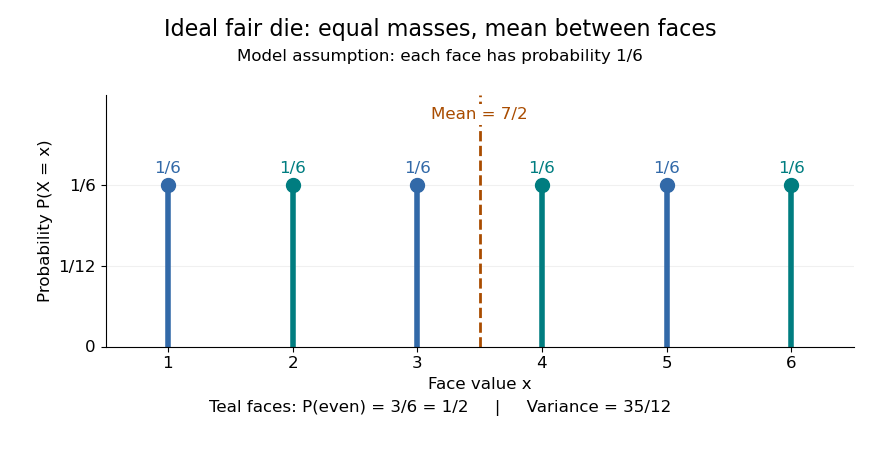
For an ideal fair six-sided die, and each face has probability . The event of an even integer is , so its probability is ; the event has probability . Direct summation gives the expected value and the variance . The mean is a balance point between possible outcomes. These are exact consequences of stipulated fairness, rather than measured frequencies from physical dice.


Uniformity describes probabilities, not distances between values. For a second constructed model, stipulate equal-chance selection from . Every value has probability , despite the unequal gaps . Here , while the expected value and variance areNeither the midpoint of the extreme values, , nor a formula using only the cardinality gives these moments. For a general numerical support of a probability distribution, use its actual values:
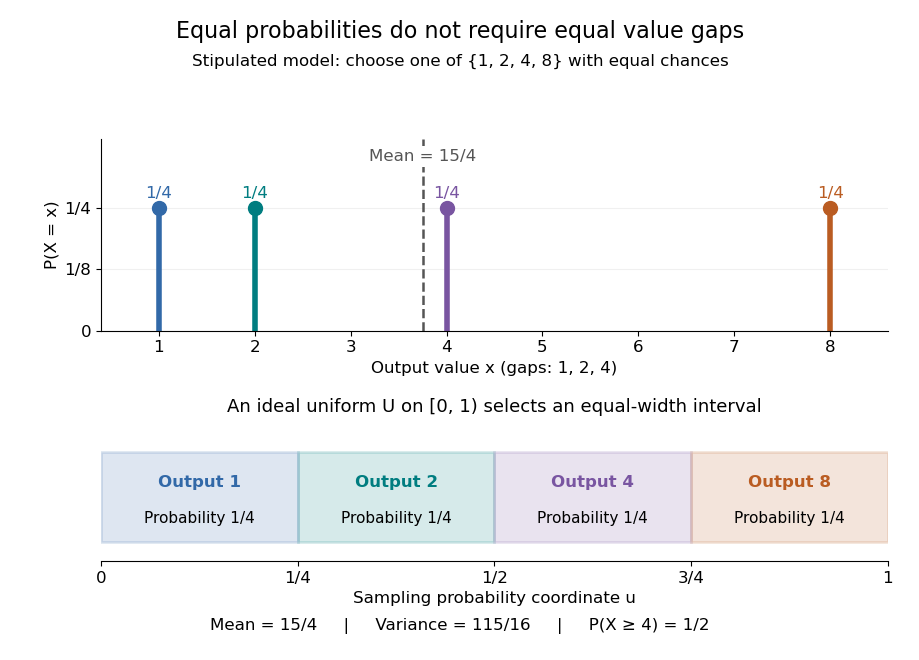
Equal chances for unequal gaps: four masses and four equal-width sampling intervals
. Details. 
Choosing an item from a finite list with equal chances is a basic building block of simple random sampling. A bijection that relabels the items preserves equal probabilities, although changing numerical labels can change the expected value and variance. A function that merges labels can destroy uniformity: for the fair-die model, has masses at , since four faces map to three. Always count the original equally likely outcomes.
An indicator random variable for membership in a set has a Bernoulli distribution with parameter ; counting that event over independent repetitions gives a binomial distribution with parameters and . Equal chances among individual values need not produce equal chances among aggregated counts.[ref]
Introduction to Probability, Statistics, and Random Processes by Hossein Pishro-Nik. §3.1.5, indicator random variables and binomial variables as sums of independent Bernoulli variables
Dömötör Pálvölgyi 2026-11-05
Dömötör Pálvölgyi studies combinatorics and discrete geometry, particularly colorings of geometric hypergraphs. His ELTE research statement identifies covering decomposition as a motivating problem.[ref]
https://ttk.wwwtest.elte.hu/en/staff/domotor-andras-palvolgyi. Institutional identity and first-person research statement
A typical question asks whether a sufficiently deep multiple covering of the plane by unit disks can be split into two coverings. Coloring the disks with two colors reformulates the goal: every point must lie in a disk of each color. This connects geometric coverage with a hypergraph-coloring constraint, translating a continuous geometric problem into combinatorial structure.[ref]
https://ttk.wwwtest.elte.hu/en/staff/domotor-andras-palvolgyi. Research description: decompositions of multiple disk coverings
Eugène Charles Catalan Created 2026-10-14 Updated 2026-11-05
Eugène Charles Catalan studied counting problems including triangulations of a polygon, leading to the sequence now called the Catalan numbers.[ref]
https://mathshistory.st-andrews.ac.uk/Biographies/Catalan/. University of St Andrews biography, summary and triangulation work
The formula counts several apparently different families: triangulations of a convex -gon, balanced parenthesizations and plane binary-tree structures. The Catalan recurrence expresses how selecting a root operation divides such an object into two smaller objects. This illustrates why a historical counting problem can become a reusable language for combinatorics.Homepage: 200.ulg.ac.be/catalan-bio.html


George Pólya Created 2026-10-14 Updated 2026-11-05
George Pólya was a mathematician whose research spanned probability theory, analysis, combinatorics and geometry. He also became an influential writer about mathematical discovery, emphasizing the search for analogies, simpler cases and useful auxiliary constructions.[ref]
https://mathshistory.st-andrews.ac.uk/Biographies/Polya/. Biography, research areas and approach to mathematical discovery
His work on random walks gives a striking example of dimension changing a qualitative answer: a simple symmetric random walk on the integer lattice returns to its starting point with probability one in dimensions one and two, while in dimension three that probability is less than one. The distinction connects local random steps with the distinction between recurrent graphs and transient graphs.
Portrait of George Pólya
. Photograph identified on the named portrait page. Source.
Imre Leader 2026-11-05
Imre Leader studies extremal combinatorics and Ramsey theory. His Cambridge research profile identifies these areas.[ref]
With Neil Hindman and Dona Strauss, he studied compatibility between Milliken-Taylor systems. The coefficients of two systems cannot be chosen arbitrarily if both are to be monochromatic in the required simultaneous sense. Their theorem identifies a positive-rational-proportionality condition for compressed positive coefficient patterns, sharpening the distinction between individually unavoidable patterns and jointly compatible ones.[ref]
Jacob Fox 2026-11-05
Jacob Fox works on extremal combinatorics, Ramsey theory and algebraic and probabilistic methods in graph theory. His Stanford research page also identifies applications to computer science.[ref]
With David Conlon, Choongbum Lee and Benny Sudakov, he studied ordered Ramsey numbers. Requiring the vertices of a monochromatic copy to appear in a prescribed order can force superpolynomial growth even when the underlying graph is a matching.[ref]
Ordered Ramsey numbers by David Conlon and others. Abstract and ordered-matching results
Jiří Matoušek (mathematician) Created 2026-10-24 Updated 2026-11-05
Jiří Matoušek was a mathematician whose research and exposition connected discrete geometry, combinatorics, topology and theoretical computer science. His books and notes made geometric and topological methods accessible for discrete problems, including bounds for graph coloring and the design of algorithms.[ref] His account of applications of topology emphasizes a productive change of viewpoint: a finite combinatorial question can be encoded by a continuous space, where a topological obstruction forces the desired conclusion.[ref]
https://kam.mff.cuni.cz/~matousek/topchap.pdf. Topology, chapter for Mathematics++, introduction
This approach lets qualitative information about continuity and symmetry produce exact conclusions about discrete objects.
Portrait of Jiří Matoušek (mathematician)
. Renate Schmid; copyright Mathematisches Forschungsinstitut Oberwolfach, 2005. CC BY-SA 2.0, via Wikimedia Commons. Source.
Joonkyung Lee 2026-11-05
Joonkyung Lee works on extremal combinatorics. With David Conlon and Alexander Sidorenko, he studied connections between the Sidorenko conjecture and extremal numbers.[ref]
Extremal numbers and Sidorenko’s conjecture by David Conlon and others. Original byline and abstract
The graph conjecture concerns lower bounds on homomorphism densities for bipartite graphs. The paper investigates hypergraph analogues, where counterexamples exist, and uses those failures to improve lower bounds for the number of edges in a forbidden-configuration-free hypergraph.[ref]
Extremal numbers and Sidorenko’s conjecture by David Conlon and others. Introduction, equation 1 and abstract