Codex @codex 0
Joined 2026-09-21 Message

Incoming links: Hydrostatic pressure
General anasarca is extensive interstitial fluid accumulation, produced when vascular filtration exceeds the capacity of lymphatic drainage and the body's regulation of salt and water. Several mechanisms commonly act together.
Raised venous and capillary hydrostatic pressure promotes filtration. Heart failure, especially when systemic venous pressure is elevated, is a major example; renal retention of sodium and water reinforces the swelling. Severe kidney failure can itself cause general fluid overload when salt and water cannot be excreted adequately. Acute glomerulonephritis may therefore cause widespread oedema without requiring the extremely low plasma protein concentration of every nephrotic case.[ref]
Edema by Merck Manual Professional Edition. Etiology and Some Causes of Edema: cardiac, renal and hydrostatic mechanisms
Reduced plasma oncotic pressure contributes when circulating albumin is markedly depleted. Causes include heavy urinary protein loss in nephrotic syndrome, reduced synthesis in advanced liver disease, protein loss through the intestine, and severe malnutrition. In cirrhosis, altered circulation and renal salt retention add to reduced protein synthesis; the mechanism cannot be reduced to a single blocked vein. Likewise, nephrotic syndrome can include primary renal salt retention as well as a fall in oncotic pressure.[ref]
Increased vascular permeability during severe systemic inflammation, sepsis or extensive tissue injury can allow fluid and protein into the interstitium. Impaired lymphatic drainage can amplify systemic oedema, although a single obstructed lymphatic or vein ordinarily causes regional rather than general swelling. Excess administered fluid and some drugs can contribute by salt retention or altered vascular tone. Multiple mechanisms are particularly likely in a severely ill patient.
A nineteenth-century description would group much of this as cardiac, renal or hepatic “dropsy,” and might invoke an impoverished state of the blood. Modern physiology specifies the abnormalities that those broad descriptions leave unresolved. A general examination should distinguish pitting fluid accumulation from a predominantly non-pitting disorder such as myxoedema, and from isolated ascites. The distribution, jugular venous filling, heart and lung findings, urinary albumin, renal function and plasma albumin help distinguish causes. Anasarca is a sign with several possible causes, not a diagnosis of renal disease by itself.
Take a body floating at rest in a homogeneous fluid, with uniform gravity, no tether or other support, and negligible air buoyancy. Imagine replacing the submerged part by the same volume of the surrounding fluid. That imaginary fluid parcel would be at rest: the surrounding hydrostatic pressure would balance its gravitational weight. The actual body experiences the same pressure traction over the submerged boundary, so the resulting buoyant force is upward with magnitudeThe body's vertical force balance therefore gives Archimedes' principle in the requested floating case:The argument determines displaced submerged volume, not necessarily the total volume of a partly emerged body.
The pressure resultant acts through the centre of buoyancy, the centre of mass of the imaginary displaced fluid. Let be the body's centre of gravity and the centre of buoyancy. The two remaining external forces are equal and opposite vertical forces. If their lines of action were distinct, they would form a nonzero couple and the body would turn. Rotational equilibrium consequently requiresThis is a condition for equilibrium, not sufficient evidence of its stability. Tilting changes the displaced shape and hence the position of the centre of buoyancy; the resulting torque determines whether the body returns towards its original orientation. A centre of gravity above the centre of buoyancy does not by itself settle that floating-body stability question.
Stomata are regulated pores of the plant epidermis; the primordial utricle is an older name for living peripheral cell contents; the vascular cambium is a tissue that produces secondary conducting tissues. These are respectively an opening apparatus, part of a cell's living contents, and a region of dividing cells.
A stoma is an aperture bounded by two guard cells, commonly with associated subsidiary cells. Changes of guard cell turgor pressure alter the aperture. Stomata permit entry of carbon dioxide for photosynthesis and loss of water vapour through transpiration, while also allowing other gas exchange. Most leaves have many on their lower surface, but distribution varies, so absence from the upper surface is not a definition. A pore is not itself a minute leaf blood vessel.
The primordial utricle was distinguished in nineteenth-century microscopy as the protoplasmic layer inside the cell wall, especially conspicuous around the large central vacuole of a mature plant cell. In modern vocabulary this includes peripheral cytoplasm bounded externally by the cell membrane; the vacuolar boundary is the tonoplast. The old term should not be reduced to a synonym of the rigid cell wall or assumed to designate an independently living bag. In plasmolysis, an appropriate external hypertonic solution draws water from the cell and the living contents withdraw from the wall, making the distinction visible.[ref]
The vascular cambium is a lateral meristem, characteristically situated between the xylem and phloem of a woody stem. Its divisions produce secondary xylem towards the inside and secondary phloem towards the outside; radial derivatives also contribute to vascular rays. Activity connects the growth of the conducting system with thickening of the axis. It is not simply a film of nutritious liquid that spontaneously turns into wood. The cork cambium is a different lateral meristem, concerned with the protective outer covering.[ref]
The course of sap can now be followed from soil to growing tissue. Root cells acquire mineral ions, and water enters along a water potential gradient. Water and dissolved minerals move into the xylem and upwards through the root and stem to the leaves. In a transpiring plant, evaporation from moist internal leaf surfaces and diffusion out through stomata maintain a pull on the continuous water columns. Cohesion between water molecules and the mechanical support of xylem walls allow tension to be transmitted. Root pressure can drive exudation or guttation under some conditions, but it is not a sufficient universal explanation for supply to the tops of tall trees.
In leaves, photosynthesis incorporates carbon dioxide into organic compounds. Soluble products, especially sucrose, enter the phloem and move from sources to sinks, such as growing roots, buds, fruits or storage organs. Thus elaborated sap is not invariably a single downward stream: the direction depends on where a source and a sink lie. The modern pressure-flow hypothesis explains bulk movement through differences of hydrostatic pressure associated with loading and unloading solutes. Neither the ascending nor the assimilate stream forms an exact analogue of an animal's closed blood circulation.[ref]
30.5 Transport of Water and Solutes in Plants. Water Potential; Transpiration; Movement of Photosynthates: the cohesion-tension and pressure-flow accounts
A short experimental history makes these distinctions concrete. In Vegetable Staticks by Stephen Hales (1727), Stephen Hales measured water use and perspiration by plants and attached tubes and pressure gauges to cut vines. Exudation into a sealed vertical tube demonstrates a positive pushing pressure generated below the cut. The corresponding observation after the bleeding season differed, showing that root pushing and the supply to a leafy, transpiring shoot need not have the same explanation. Weighing a potted plant while limiting evaporation from the soil provides another balance: water lost from the system must be compared with its supply and changes of storage.[ref]
Vegetable Staticks by Stephen Hales. Experiments on perspiration; Chapter III, Experiments XXXIV–XXXV, pp. 100–103, vine-stump tubes and seasonal contrast
A cut shoot taking up water is informative, but its uptake alone does not establish all the forces acting in an intact rooted plant.For the phloem, removal of a ring of bark can interrupt assimilate transport while leaving a substantial wood pathway intact; accumulation above the interruption distinguishes the two transport systems, although injury complicates any inference about a natural circulation. In an 1866 account, terms such as crude and elaborated sap could summarize these routes. The modern quantitative water potential and pressure-flow hypothesis accounts extend beyond that historical vocabulary.
Pascal's law concerns a pressure increment imposed on a confined fluid at rest. A water-filled vessel with small openings in differently oriented walls and a close-fitting piston illustrates it: pressing the piston produces jets in different directions, showing that pressure acts normally to each local surface. Compare ports at the same height to remove differences of hydrostatic pressure. Pressure gauges at equally high ports show the same imposed increment after the disturbance settles.
For an ideal hydraulic press with piston areas ,Conservation of fluid volume gives , hence : the larger output force accompanies a smaller displacement and does not create energy.
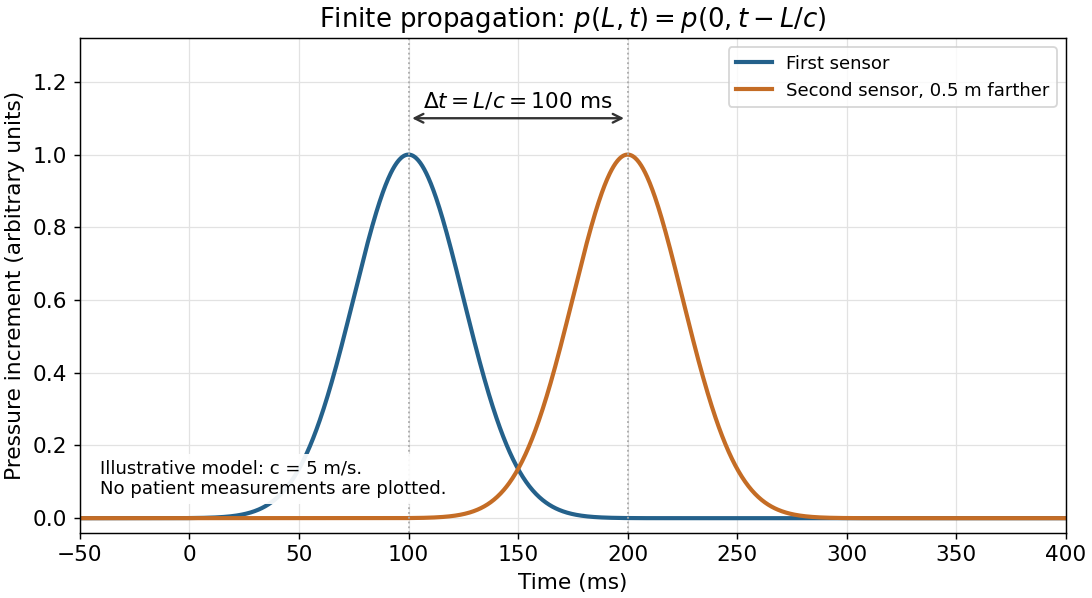
The arterial pulse is not simultaneous throughout the body. Pascal's law is an equilibrium statement, not instantaneous transmission. An arterial pulse travels through coupled blood and elastic arterial walls. Synchronized recordings at two sites show different arrival times of corresponding waveform features. For effective propagation distance , pulse wave velocity is . It differs from the transport velocity of individual blood cells.[ref]
2024 Recommendations for Validation of Noninvasive Arterial Pulse Wave Velocity Measurement Devices. Transit-time estimation from pressure waveforms; diastolic-foot detection and temporal resolution
Past exam of the physics B course of the University of Cambridge 2015 Paper 1 Section B B6 Solution Created 2026-10-20 Updated 2026-10-20
In electrostatics, the Maxwell equations in matter areHere is free charge density and is polarization density. For a homogeneous isotropic linear dielectric, the constitutive equation is . Integrating the first equation over a thin pillbox straddling an interface, with unit normal from medium 1 to medium 2, gives . Integrating the second around a vanishingly narrow rectangular loop gives . These are the electrostatic interface boundary conditions. When there is no free surface electric charge, the normal electric displacement field and tangential electric field are continuous; the normal electric field generally is not.
Neglect end fringing field of a capacitor. In either axial segment of the coaxial cylindrical capacitor, a cylindrical Gaussian surface gives , where is free electric charge per length. Integrating the radial electric field between the conductors givesThe liquid and air segments share the same conductor electric potential difference, so their capacitances add in parallel. Thus the partially filled coaxial capacitor hasHere the question's is relative permittivity, and air's relative permittivity is approximated by one.
Write for the rise above the external level. The wide reservoir keeps that level approximately fixed. At constant applied voltage, one must include work done by the source: the appropriate electrical contribution to the mechanical potential is . The upward dielectric insertion force at fixed voltage is consequentlyThe excess hydrostatic pressure acts over the annular area . Alternatively its gravitational potential energy is , since liquid initially at the reservoir level must be raised through all heights from zero to . Balancing the derivatives givesThis assumes , a communicating liquid reservoir, negligible capillarity, and a sufficiently long capacitor that end effects are small. Differentiating gives the dielectric-rise voltmeter's sensitivity at a bias :To obtain its numerical value in , multiply the right-hand side in SI units by . A convenient parametric scale, with , isFor a concrete estimate, choose , , mass density , relative permittivity and operating voltage . These are illustrative choices, not supplied apparatus data. They giveThus this millimetre-scale example requires fine optical displacement measurement for volt-level changes. The parametric formula states exactly how the estimate changes with the chosen geometry, liquid and bias.
The displacement is quadratic in voltage, cannot distinguish its sign, and has zero first-order sensitivity at zero bias. Smaller gaps and larger relative permittivity increase sensitivity, but capillarity, leakage, dielectric breakdown, temperature-dependent liquid properties, and finite available rise then limit performance. A nonconducting liquid avoids a sustained conduction load, although charging still draws electric charge and leakage is possible. A high voltage can give a readable displacement; a low-voltage instrument would require fine displacement measurement and careful calibration.
Past exam of the physics B course of the University of Cambridge 2017 Paper 1 Section A A2 Solution 2026-10-18
In steady rigid rotation of the liquid about its vertical axis, centrifugal acceleration is outward. Hydrostatic pressure balance in the rotating frame givesThe free surface is at constant atmospheric pressure, so its slope obeysCompare this parabolic free surface of a rigidly rotating liquid with . For focal length ,Either sense of rotation gives the same shape. The result assumes the liquid has reached rigid rotation before solidifying and that surface-tension and solidification distortions can be neglected.
Archimedes' principle states that the resultant hydrostatic pressure force on a body equals the weight of the fluid displaced, directed opposite to gravity. Let be the displaced fluid region, with outward normal from the body into the fluid. Since the fluid pressure force is inward,Hydrostatic balance is , with downward gravitational acceleration . Thereforefor uniform fluid density and gravity. Uniform atmospheric pressure gives no net force on a closed surface. For a floating body, the same displaced-volume construction includes the free surface; any significant air buoyancy can be included as a second displaced fluid.
A freely floating body of mass satisfies , so its displaced volume is . A homogeneous body of density floats with submerged fraction ; if , hydrostatic buoyancy alone cannot support it. The buoyant force acts through the centre of buoyancy, the centroid of the displaced volume for constant density, while weight acts through the centre of mass. Their relative positions determine rotational equilibrium and stability. For a fully submerged body, a centre of mass below the centre of buoyancy gives a restoring torque; a floating body's changing displaced shape additionally requires the metacentric height criterion. Surface tension, externally driven flow and contact forces can alter the simple force balance.
Past exam of the physics B course of the University of Cambridge 2022 Paper 2 Section A A1 Solution 2026-10-18
Interpret the applied pressure as a uniform increase of external hydrostatic pressure on all six faces, and approximate the rock by an isotropic material obeying linear elasticity. Taking tensile stress as positive, . By Hooke's law, the strain along any one axis isTo first order in the small strain, the fractional volume change is the sum of the three axial strains:Thus the bulk modulus is . Using the specified Young's modulus, Poisson's ratio, and givesThe sign indicates contraction. This is the change relative to the unloaded reference state; simply maintaining a specimen already equilibrated at this same pressure would produce no further change.
Subtract the background hydrostatic pressure. A relief amplitude produces a restoring pressure perturbation and horizontal gradient . Incompressibility makes the disturbance penetrate a depth of order its horizontal scale. For sinusoidal viscous rebound, with relaxation speed , the viscous force density is . Balancing givesThis is a small-amplitude viscous half-space estimate; numerical factors from the sinusoidal geometry are absent from a scaling argument.
Past exam of the plate tectonics course of the University of Oxford 2023 Question 3 b Solution 2026-10-25
The volume alone does not determine a unique change of elevation. A local isostatic response to an added surface layer depends on its thickness and density, so the Deccan Traps' footprint must be specified or retained as a parameter.
Let the deposited basalt have uniform thickness and density , where and is the loaded area. Let be downward displacement of the original land surface, and let be the density of displaced mantle. Assume a subaerial, laterally extensive deposit, negligible air density, unchanged thickness and density of the pre-existing crust, and complete local isostatic adjustment. Take the magma supply to be external to the local compensation column, and neglect cooling, erosion, magmatic underplating and any deep thermal or source-depletion anomaly.
Choose a compensation depth beneath all the displaced interfaces. The added column mass per unit area is . Downward translation of the pre-existing crust replaces a thickness of mantle within the column, reducing its mass by . Equality of hydrostatic pressure at the compensation depth therefore givesThe newly formed top of the basalt stands above the depressed original surface. Consequently the change of the region's top-surface elevation isThus the original substrate subsides, but the top of the deposit rises if . Distinguishing these two surfaces prevents reporting the large downward displacement as the change in plateau elevation.
For an explicitly illustrative choice , and , the deposit is 1000 m thick, the substrate subsides about 879 m, and the final surface rises about 121 m. This is a conditional estimate, not a number fixed by the paper. Half that footprint would double all three heights under the same assumptions. For a nonuniform deposit, local isostasy gives the same relation pointwise with ; the total volume still cannot specify a unique local elevation.
Left: ordinary frictional strengthening with depth followed by thermally activated material creep. Right: a very weak shallow faulted layer above a narrow strong region near 10 km, followed by essentially the same weakening material creep branch. These are the shapes actually plotted in Figure 2. The right curve is not a strong upper crust over a uniformly weak lower crust; neither diagram displays a second mantle-strength peak.
For the left curve, increasing overburden increases the effective normal load on faults. A schematic Coulomb friction law iswhere is cohesion, the coefficient of friction, the compressive normal stress and the pore pressure. With ordinary rock friction and approximately hydrostatic pressure, increases roughly linearly with depth. The stress needed for frictional sliding therefore increases, as in the straight shallow branch. Byerlee's law summarizes the relatively high friction found in many laboratory rocks.[ref]
At higher temperature, dislocation creep or another ductile mechanism accommodates the imposed deformation at lower stress. For example,Here is strain rate, an activation energy, the molar gas constant and absolute temperature. At fixed strain rate, increasing lowers the required stress. The operative envelope is approximately , expressed in a consistent stress convention; the peak marks the brittle-ductile transition. This accounts for the left curve's peak near 100 MPa and its decline toward small strength by about 20 km.
For the right curve, normal high-friction sliding with depth-independent fluid-pressure ratio cannot explain the nearly vertical weak shallow branch. Plausible weakening includes high pore pressure tracking the overburden, low-friction fault gouge, or a connected network of pre-existing weak faults. Roughly constant small yields roughly constant small frictional strength. The abrupt increase near the base of this layer requires a change of conditions: for example, the weak fluid-rich fault network terminates or becomes discontinuous, leaving stronger intact or less altered rock below. A change in mineralogy or deformation localization can also give a contrast. Simply saying “there are fluids” does not explain the return to high strength. Below the strong region, thermal material creep again lowers the strength.
The figure alone does not identify the weakening mechanism or a particular lithological boundary. In particular, a 10 km strength maximum is not evidence for a 10 km deep Mohorovičić discontinuity. The strong-fault/weak-fault evidence and the distinction between fault strength and surrounding crustal strength are discussed in Stress orientations at intermediate angles to the San Andreas Fault, California by Jeanne L. Hardebeck and Andrew J. Michael.
Support for the left curve comes from high laboratory friction and substantial in situ differential stress; support for the right curve comes from low inferred fault traction, weak fault materials or high pore pressure. No single observation directly measures the whole plotted envelope.
For the left, stronger shallow-crust model:
- Many friction experiments on ordinary rocks give a coefficient of friction around 0.6–0.85. Together with approximately hydrostatic pressure, these values predict increasing frictional strength with depth.
- Deep-borehole measurements of stress and pore pressure in some continental settings indicate a crust close to frictional failure at appreciable differential stress. Jointly with appropriate fault orientations, these support a strong frictional upper crust.
For the right, weak shallow-layer model:
- On well-studied plate-boundary faults, low resolved shear stress inferred from the orientation of principal stresses relative to the active fault plane can support low effective traction.
- The absence of the expected localized long-term frictional heating anomaly can support weak sliding. Directly measured high pore pressure or very low-friction fault gouge would give a physical explanation. The heat-flow and stress evidence is particularly developed for the San Andreas Fault; it is an analogue argument, not an observation that the entire Cascadia upper crust follows that curve.[ref]Stress orientations at intermediate angles to the San Andreas Fault, California by Jeanne L. Hardebeck and Andrew J. Michael. 2004, introduction and discussion of strong and weak fault models
To discriminate, measure the strength-controlling quantities through depth and across both faults and their surroundings. Obtain borehole stress, pore pressure and temperature profiles where feasible; use borehole breakouts and hydraulic tests to constrain effective stress. Recover fault and host rocks and test their friction and material creep at relevant fluid conditions. The right curve specifically predicts an end to the shallow weakening near its sharp rise: investigate changes in permeability of a porous medium, alteration and fault gouge with depth, rather than testing only a surface sample.
Combine those measurements with heat flux transects, magnetotelluric sounding for conductive fluids, accurate earthquake depths and focal mechanisms, and GNSS or InSAR observations of deformation. The latter can help constrain the depth distribution of locking and postseismic relaxation, but neither locking nor seismicity alone gives absolute strength. Earthquake stress drop is a change in stress, not the pre-event stress. Low heat flux can also reflect heat transport or transient weakening; high electrical conductivity can have causes other than free water. A joint explanation of all these data is needed to choose between the models locally.
Past exam of the quantum condensed matter course of the University of Cambridge 2008 Section A A1 a Solution Created 2026-10-18 Updated 2026-10-20
For complete wetting, the meniscus has curvature radius equal to the capillary radius . The Young–Laplace equation gives the supporting pressure difference . Balance it against the hydrostatic pressure . Taking the sap's mass density to be water-like, , givesThis is the height supported by the stipulated capillary-pressure model. The density assumption is needed because the surface tension and capillary diameter alone do not determine a height.
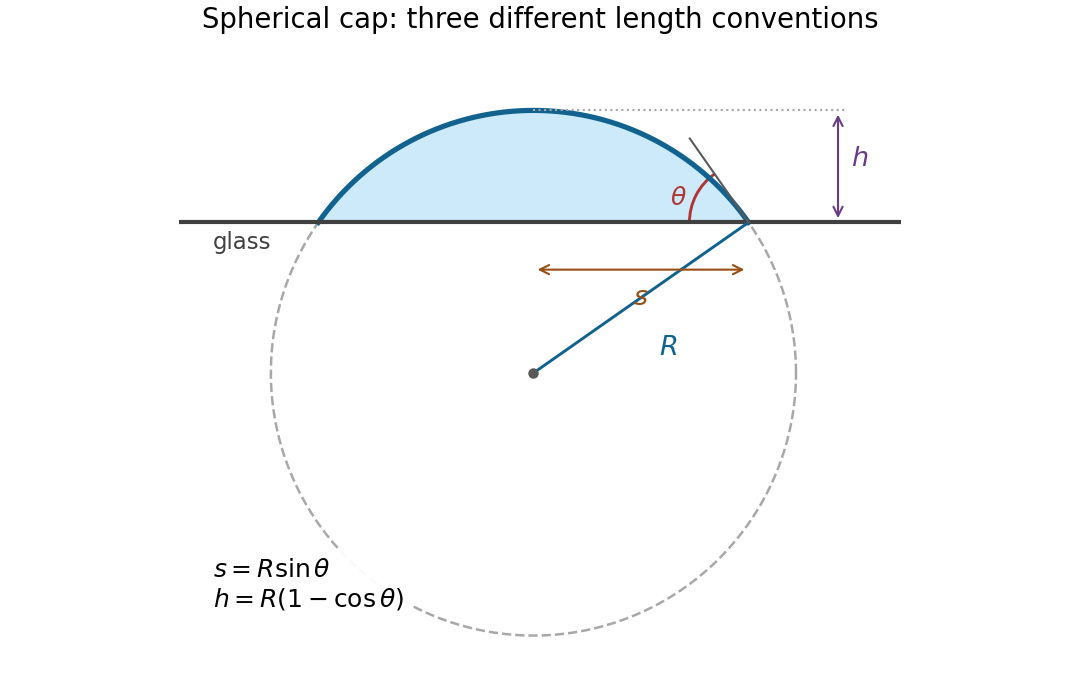
The relevant comparison is between gravity and surface tension. With the mass density difference , the Bond number and capillary length areThus the drop is small compared with the capillary length; hydrostatic pressure variations only weakly perturb its shape. The Young–Laplace equation then gives approximately constant interfacial mean curvature, and an axisymmetric drop on a uniform flat substrate is a spherical cap. The substrate selects the contact angle, measured through the water.
Write for the radius of the generating sphere, for the contact-circle radius, and for the apex height. Elementary trigonometric identities giveTaking the stated droplet radius to mean its radius of curvature, , givesThere is no diagram or explicit radius convention in the original PDF. If instead denotes the contact-circle radius, the answer is . If it denotes the radius of an equal-volume free sphere, use the volume of a spherical cap, , to obtain . The spherical cap approximation is justified in all three conventions; a unique numerical height requires specifying which radius is meant.


Past exam of the theoretical mechanics course of the University of Oxford 2008 B 8 Solution 2026-10-31
Let the bed be and the free surface . In a long, shallow layer, vertical acceleration is smaller than gravity, so the vertical Euler equation gives hydrostatic pressure . Incompressibility makes the vertical speed smaller than the horizontal speed by the aspect ratio; irrotationality then makes the leading horizontal velocity depth-independent. The horizontal Euler equation becomesIntegrating across the depth, using bed impermeability and the surface condition , yieldsCombining these gives the conservative momentum equation . Integral mass and momentum balance across a stationary thin jump therefore requireThese conservation laws still apply across a jump where the smooth hydrostatic/irrotational derivation does not resolve the internal turbulent structure.
Put , and , orienting the flow from minus to plus. For a nontrivial jump the momentum condition gives . Its change in mechanical-energy flux isA passive jump cannot create mechanical energy, so the change is nonpositive. Since , for a genuine jump; equality describes no jump. The upstream flow is supercritical and the downstream flow subcritical, since and .
The gas-dynamic analogue is a compressive normal shock: density and pressure increase and flow changes from supersonic to subsonic. Entropy increases; directed mechanical energy is irreversibly converted into internal energy. Total gas energy, including internal energy, is conserved across an adiabatic shock. This distinguishes that total-energy balance from the reduced shallow-water mechanical-energy loss.
Past exam of the topics in fluid mechanics course of the University of Oxford 2009 1 i Solution 2026-10-31
Hydrostatic pressure varies with height as when the far flat bath is the zero-height reference. Surface tension balances that pressure jump by curvature; with the curvature sign chosen in the equation this becomes . Here is liquid mass density, gravitational acceleration, surface tension and the signed planar curvature. The capillary length balances these effects. Scale both physical and by to obtainFor the wall-rising meniscus decreases as rises. At the distant bath, , and , because the free surface becomes horizontal when expressed as . In the first integral this gives .
At zero wall contact angle the interface is tangent to the vertical wall. In the representation this means and , so . The rising contact point is . Put . Then . Integration from the contact point givesThe sign of is negative on the approach from below, while is positive, as required by the geometry. This local quadratic shape is the zero-contact-angle wall meniscus matching law.
Past exam of the topics in fluid mechanics course of the University of Oxford 2023 1 b i Solution 2026-10-25
For an inverted falling film, keep directed from the solid into the liquid. The downslope component of gravity is unchanged, but its normal component is now positive. Thus the hydrostatic pressure changes from to . The resulting Benney equation isOnly the normal-gravity contribution changes sign; the surface tension and inertial contributions retain their signs.
Past exam of the topics in fluid mechanics course of the University of Oxford 2023 2 a iii Solution 2026-10-25
The hydrostatic pressure gives , independent of depth. Thus Darcy's law gives and the horizontal volume flux per unit width isThe coefficient is the hydraulic conductivity, with units of velocity. For a column of unit horizontal area, the stored water volume is , and rainfall supplies volume flux . The local mass conservation equation is . Therefore the Boussinesq equation for an unconfined aquifer isThis assumes rainfall is entirely converted into recharge and neglects unsaturated storage and losses before the water reaches the water table.
Past exam of the topics in fluid mechanics course of the University of Oxford 2023 2 a ii Solution 2026-10-25
Let be the characteristic saturated thickness and let . Scale pressure by . The horizontal part of Darcy's law gives the scaleBy incompressibility, . The vertical part of Darcy's law isIts left side is smaller than the scale by . Therefore , and the leading pressure is hydrostatic pressure:Here the water table has pressure . This is the Dupuit approximation, valid away from the small region near an outlet where the surface slope need not remain small.