With normal vector , a plane through has equation . As , its plane equation isThe distance from a point to a plane is the absolute signed offset divided by the Euclidean norm of its normal vector. Hence the Euclidean distance from the origin is , since . The closest point is , whose Euclidean distance from the origin is and which satisfies the plane equation.
The displacement vectors are and . Their cross product is , with Euclidean norm three. Thus either sign ofis a unit normal vector to the second plane, whose equation is . A direction vector for the intersection is the cross product of the two normal vectors:It is orthogonal to each normal vector. Since both planes contain , the whole intersection line is , .
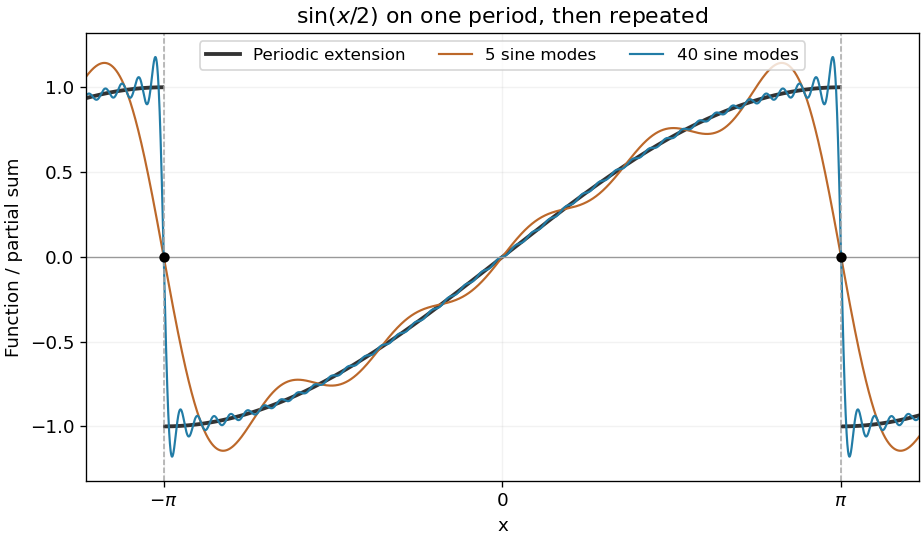
For an odd integrable function, both and are odd. Their integrals over therefore vanish, so the constant and cosine Fourier coefficients are zero. For , the remaining Fourier sine coefficients areThe product-to-sum identity in the first step reduces the integral to two cosines. Here is real and noninteger, so no denominator vanishes. Consequently the Fourier series of a noninteger-frequency sine isAt every term is zero. The Fourier series converges there to the average of the two limits of the periodic extension, namely zero, rather than to the nonzero endpoint values .
The unique symmetric and antisymmetric parts of a matrix are and , givingTheir matrix products with their transposes are and . Each is an orthogonal matrix precisely when the corresponding factor is one. Thus and , with independent sign choices, and the simultaneous possibilities are
The characteristic polynomial is . For , the eigenvector equation gives ; for , it gives . The normalized eigenvectors can therefore be chosen asBoth have unit Euclidean norm, and their dot product is , explicitly verifying orthogonality. This also follows from the spectral theorem for a real symmetric matrix with distinct eigenvalues.
For a bounded volume with piecewise smooth closed boundary , oriented by the outward unit normal vector, and a continuously differentiable vector field on a neighborhood of , the divergence theorem statesFor an oriented piecewise smooth surface with piecewise smooth boundary , and a continuously differentiable vector field on a neighborhood of , Stokes theorem statesThe boundary orientation follows the right-hand rule relative to the chosen normal vector. Reversing that orientation reverses both sides of the latter identity.
The divergence is . With outward orientation, the divergence theorem converts the surface flux into a volume integral:Directly, the three faces lying in coordinate planes contribute zero, and each opposite face contributes , confirming the sign and normalization.
Take the outward orientation on the upper hemisphere; its boundary circle is then counterclockwise viewed from above. Parametrize that circle by , . Then , so Stokes theorem givesEquivalently , and the upward projected area of the hemisphere is . The opposite orientation gives the negative of this answer.
Let denote having the disease and a positive result. Assume I am sampled uniformly from the stated population, so . By the law of total probability, . Thus Bayes' theorem givesThe denominator must be positive; otherwise the observed event has zero probability in this model and the conditional probability is undefined. The answer depends on disease prevalence as well as the test's two error rates.
An integrable nonnegative probability density of this form requires . Normalization gives , so . This is the exponential distribution with rate .
The survival function of this exponential distribution is for . Since , the conditional probability isThis is the memoryless property: after surviving the first unit, surviving two additional units has the same probability as it did initially.
Use Gaussian elimination. The last equation gives , and the second then gives . Substitute these into the first equation to obtain . Back-substitution yieldsThe linear system has matrix formThe coefficients of the arbitrary right-hand side in the solved expressions are the rows of the matrix inverse. ThereforeMultiplying the original matrix by this candidate gives the identity matrix; its determinant is , so the solution is unique for every .
For , the gradient is a normal vector to the ellipsoid. The outward unit normal vector is . The conditions ensure that everywhere on the rectangular projection.
The dot product vanishes pointwise when . In that case has no normal component, so the surface flux is zero. For unequal axes, the given vector surface element givesPut , . Then , andTwo elementary integrations now giveThis is the rotational flux through an ellipsoidal graph patch with unit vertical semiaxis and unit projection lengths. It also tends continuously to zero when , agreeing with the pointwise argument.
The trace sums the diagonal entries, so . The two unit vectors have squared Euclidean norms one, giving .
Write with . The orthonormality conditions and giveConsequently . It is the orthogonal projection matrix onto the orthogonal complement of the linear span of .
The matrix product is . Thus , and the nonzero vector is in its kernel. Hence is singular and . This includes , when span the whole space and .
Apply trace orthogonality of symmetric and antisymmetric matrices. In detail, invariance of the trace under transpose and its cyclic property giveTherefore . The negative sign comes from , while .
At fixed particle number, the differential of the internal energy identifies and . Equality of continuous mixed partial derivatives gives the first Maxwell relation:For the enthalpy, . Thus , , and the same argument gives the enthalpy Maxwell relationThe smoothness and independent thermodynamic coordinates are understood within a single phase.
Differentiate at fixed pressure and subtract the heat capacity at constant volume:Now use and the multivariable chain rule along a constant-pressure path:Substitution cancels the fixed-volume derivative and gives the volume derivative form of the heat-capacity difference,For the ideal gas, the first term in brackets vanishes and , so . Consequently for the entire gas, with fixed particle number . The extra heat capacity accounts for expansion work at constant pressure.
Away from the origin, the chain rule gives and . Differentiating once more yields the two-dimensional case of the Hessian of the Euclidean norm:These partial derivatives are smooth wherever , so Clairaut's theorem gives . None of these formulas supplies a derivative at the origin: even the restriction has no two-sided derivative there.
Write , . Since is constant, the multivariable chain rule gives and . Applying these operators twice to a twice continuously differentiable function givesThe mixed terms cancel and , soThis is rotational invariance of the Laplacian: an orthogonal change of coordinates preserves the trace of the Hessian matrix. A nonconstant angle would introduce additional derivatives and is not covered by this constant rotation calculation.
Use the method of undetermined coefficients. Substitution of givesEquating the coefficients of , , , and to the forcing gives , , , . ThusThe characteristic equation of the homogeneous equation is , with a repeated root. Its complementary function is . Since and , the initial conditions give and . ThereforeDirect differentiation verifies both zero initial data and the original forcing.
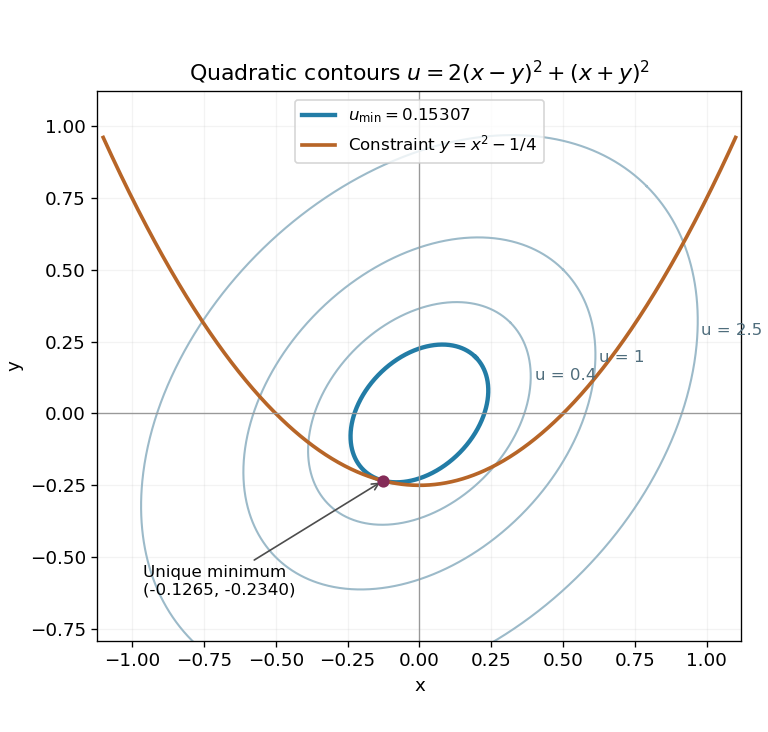
Expand . The Lagrange multiplier equations for are and , together with the constraint . The first two imply and . The value would make the latter equation inconsistent, so division is allowed:Insert these into and multiply by . Simplification gives , henceThe gradient of the constraint is never zero, so the Lagrange multiplier condition is necessary at every constrained extremum. To establish a global minimum, parametrize the whole parabola by . The restricted function becomesIt is coercive: as , so it attains a global minimum. Moreover , making it strictly convex and ensuring that this minimum is unique. This proves more than the permitted assumption of one real multiplier root.
The level sets of are nested ellipses centered at the origin. In the rotated coordinates , , they have equation , with the longer axis along . The smallest one meeting the parabola is tangent to it at the unique minimizing point, approximately , where and .


Articles by others on the same topic
There are currently no matching articles.