Substituting , into the circle equation gives . Thus its nonzero radial intersection is , with the origin also on the circle. The tangent to a circle at the rightmost point is , or .
Take rays with . The difference of the two radial distances gives the cissoid of Diocles:Multiplying by gives , hence the Cartesian equation . A convenient parametric curve, with , isThe real curve has , a cusp at the origin, symmetry about the axis, and the vertical asymptote . Near the origin, and , so its cusp has horizontal tangent direction. As , while . The circle and curve meet away from the origin at .
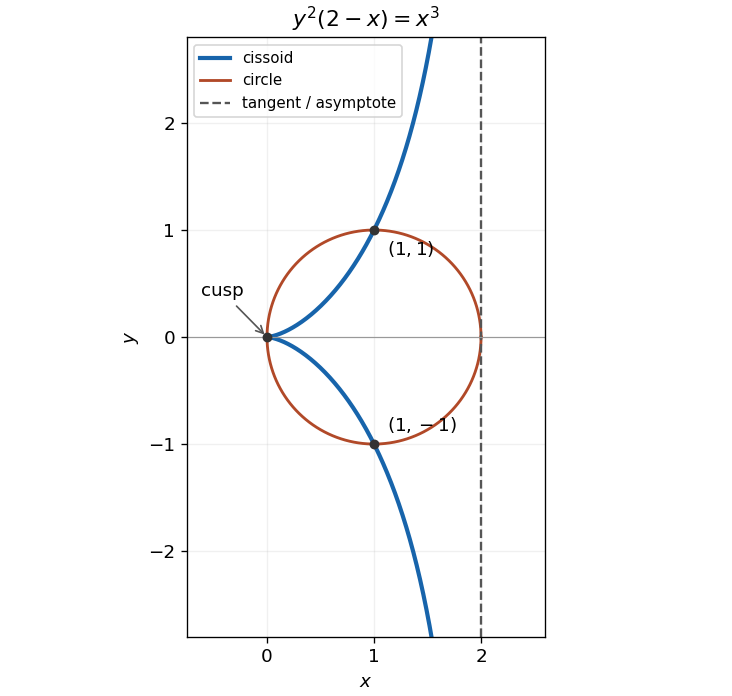

The tangent half-angle substitution gives and . The endpoints become , respectively. HenceCompleting the square, , then gives
Normalization of a probability distribution and the geometric series give , so . For a nonnegative integer , the strict tail starts at :For nonnegative integers , the event is contained in . ThereforeThis is the memorylessness of the geometric distribution with the zero-based counting convention. Keeping strict versus non-strict inequalities explicit is essential: , conditional on , has the original distribution of .
Write . The probability density function normalizes when , so . Its survival function is for ; hence, for ,Differentiating this conditional tail givesThe value assigned at the single endpoint does not affect any probability. The memorylessness of the exponential distribution says that , conditional on , is again an exponential distribution of rate . Its first two moments are and , found by integration by parts, so translation leaves the variance unchanged:
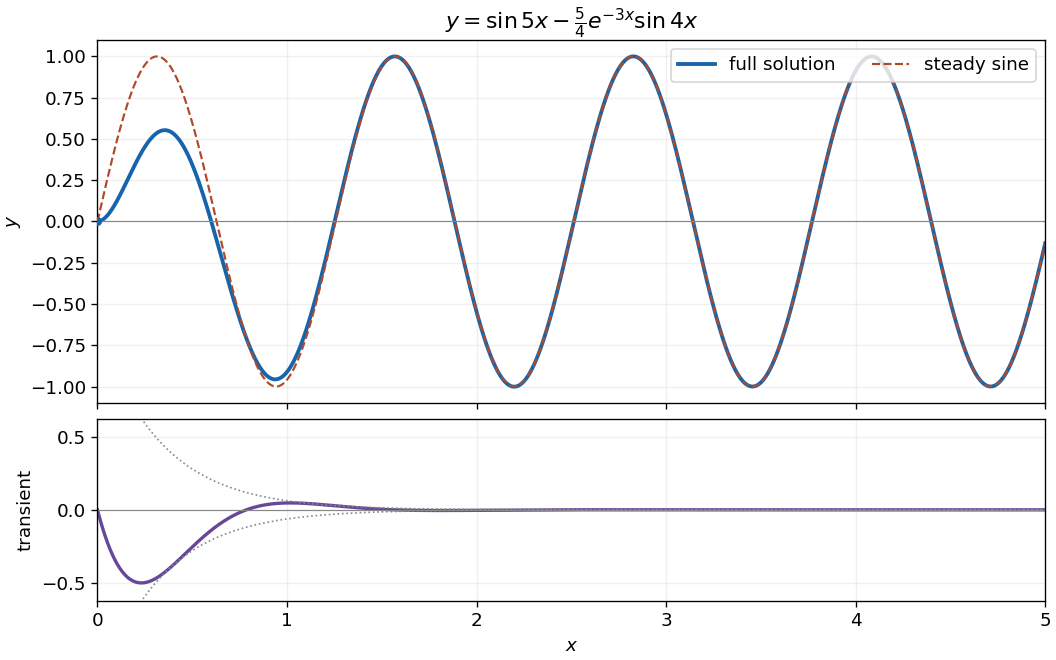
The characteristic equation for the homogeneous solution is , giving . For a particular solution, substitute : the left side becomes , so . The general solution is
The characteristic equation has roots , giving the homogeneous solution . For the sinusoidal forcing term, is a particular solution, since its second derivative cancels and . The zero initial displacement gives ; zero initial derivative gives . ThusThe transient response decays as , leaving the steady-state response . Near zero, and , so the sketch starts with and a horizontal tangent line.

If with continuous second partial derivatives of , then and . The symmetry of second derivatives gives the necessary condition for an exact differential form:This condition is also locally sufficient on a small rectangle for continuously differentiable coefficients; global sufficiency additionally needs suitable topology of the domain.
For the internal energy , its exact differential identifies and . The Maxwell relation from equality of mixed partial derivatives is . At fixed volume, the constant-volume heat capacity satisfiesso , assuming nonzero and a locally invertible relation. Applying the chain rule to gives the isentropic temperature-volume derivativeFor the stated one-mole ideal gas, the equation of state gives and , so the right side is . Along an isentropic process, and , giving the same left side:
Integrating with respect to gives . Matching requires , and matching requires constant. A scalar potential with the requested sign isThus the force field is a conservative vector field on all of .
Parametrize the straight line by , . The line integral isThe change in scalar potential is , so the answer is , as required by the fundamental theorem for line integrals for .
For positive semiaxes , the cross product of the two parametric tangent vectors gives the outward oriented surface element of an ellipsoid of revolution:Substituting the parametrization into the vector field and taking its dot product with this element givesThe middle term has zero integral over . In the other terms, , , and . The directly evaluated flux is therefore
True. Multiplicativity of the determinant and the identity give . This is invariance under matrix similarity.
False. The cyclic property of the trace permits , but not an arbitrary interchange. Even with and both invertible matrices, takeThen and , providing a counterexample.
True. Distribute the matrix product while retaining its order:Only addition is commuted; no commutation of and is assumed.
The permutation matrix cycles the three coordinate vectors, so three applications give . Consequently , proving . Since ,
For , the adjugate matrix formula, or elimination on the three unit right-hand sides, givesMultiplication by gives the identity matrix, checking all signs and coefficients.
Subtracting the first and third equations gives . Since , , and the second equation gives . The first then gives , so the unique solution of the system of linear equations is
At , the first and third equations both reduce to , while the second gives . All solutions form the straight lineThe limit of the nonzero- solution selects only the point on this whole line; setting a parameter to its singular value can enlarge the solution set.
Use the real Fourier series convention for period two. The Fourier coefficients areThe last two integrals follow by integration by parts. Thus the Fourier series of a half-wave rectified ramp isOn , . Its even part is and its odd part is , so the cosine and sine terms separate:At a jump, the Fourier series converges to the average of the one-sided limits. Thus the first series for takes the value at odd integers, while the Fourier series of a periodic sawtooth for takes the value there. The even function has a continuous periodic extension.
Set . The gradient of never vanishes, so the Lagrange multiplier equations apply at a constrained stationary point. They are , , and . Eliminating givesWith , this becomes . The quadratic factor is , so the only real possibility is . ThereforeThe level curve through this point is the ellipse , meeting the coordinate axes at and . Its tangent line at has slope , equal to the derivative of the constraint parabola there. The two curves are tangent.
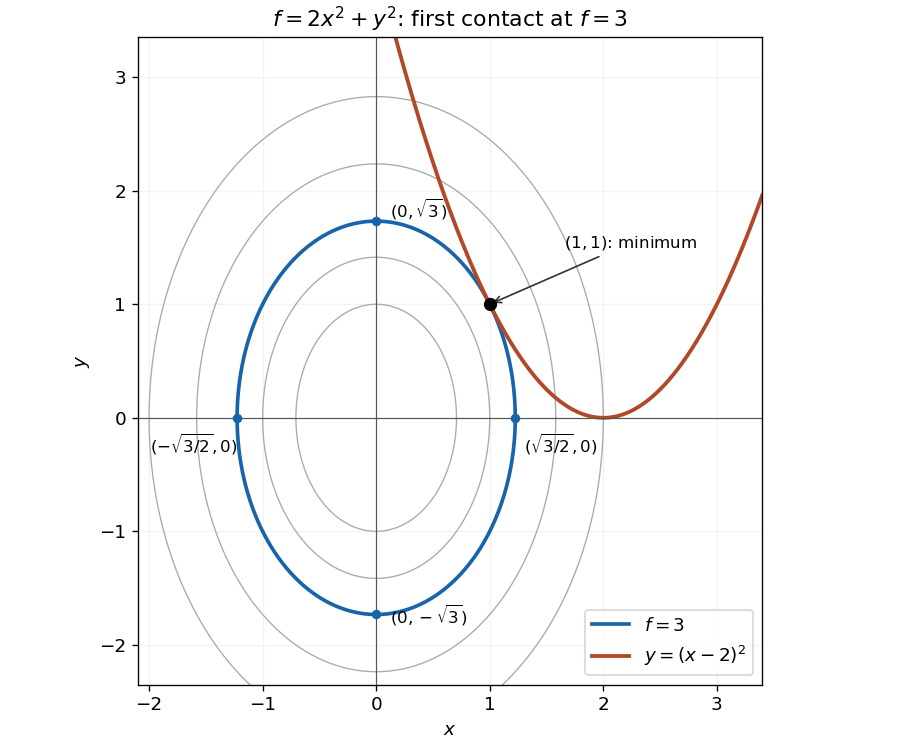
The smallest elliptical contour meeting the constraint is tangent at the minimum
. The highlighted contour is and the constraint is . Its four axis intercepts and the unique contact point are marked. Details.
The parabola touches this ellipse from outside; every other point on the constraint lies on a larger contour. An exact check of this geometric argument iswith equality only at . Thus the point is the unique constrained global minimum.
Substitute into the diffusion equation and divide on a region where both factors are nonzero. This gives . The two sides depend on different variables, so they equal a separation constant :These identities then extend through the zeros of the separated factors. The zero Dirichlet boundary conditions require . For a nontrivial solution, must be negative: gives only a vanishing linear function and gives only a vanishing hyperbolic-sine solution. Writing gives , and , . Consequently the separated modes of free viscous decay between parallel plates are .
The first initial condition selects the lowest mode:The superposition principle for a homogeneous linear differential equation states that any linear combination of solutions is again a solution, with the same combination of homogeneous boundary conditions and initial data. It therefore givesThe higher spatial mode decays nine times as fast, so the velocity profile approaches a multiple of the first sine mode before vanishing altogether.
Articles by others on the same topic
There are currently no matching articles.