For a spherical star in Newtonian hydrostatic equilibrium, the total supporting pressure satisfies
where zero external pressure is the idealized vacuum boundary condition. Substitute the enclosed mass from a, set , and integrate inwards:
The supplied integral follows directly by differentiating . It yields
Thus , about for the Sun's parameters. This is precisely the equation of state of a polytrope of index one.
For nonrelativistic fully ionized hydrogen with electrons and protons at a common temperature, the gas pressure is . If gas pressure dominates, the resulting temperature profile is
Numerically for the Sun's parameters, and tends to zero at the idealized outer edge.
If the photons are additionally assumed to be in local thermodynamic equilibrium with this gas, their radiation pressure is , with . The consistent temperature is instead the unique nonnegative root of
The left side is strictly increasing in for , so the root is unique. Evaluating the radiation pressure at gives at most for the Sun's parameters, at the centre; the ratio decreases approximately as outwards. The gas-only profile is consequently an excellent approximation within this imposed stellar model.
Hydrostatic equilibrium by itself fixes total pressure, not how it is divided between gas and radiation. Thomson scattering alone does not enforce a common gas–radiation temperature or a Planck photon distribution. Without either neglecting radiation pressure or specifying the radiation field and its thermodynamic closure, a unique gas temperature cannot be inferred from the given mass density alone.
photon orbit and the Newtonian limit. Write and . For a timelike circular Schwarzschild geodesic,
The denominator tends to zero at , so the energy per unit rest mass diverges as a massive circular orbit approaches that radius. The corresponding local orbital speed measured by a static observer satisfies and tends to one. This suggests a null circular orbit, but one must not simply insert into a massive-particle formula. For a photon, the radial effective potential is proportional to ; its derivative vanishes at and its second derivative there is negative. Thus the photon sphere is at , and its circular null orbits are unstable.
At , expansion gives
The second term is the total Newtonian circular-orbit energy, kinetic plus potential; the relativistic energy also includes rest energy. Here is the conserved energy referred to a stationary observer at infinity, not the local kinetic energy.
The stable inner edge. At fixed angular momentum, write . The timelike radial geodesic equation can be written
The circular condition gives . Substituting into the second derivative taken at fixed gives
Timelike circular orbits exist for ; they are stable against radial perturbations for and unstable for . Therefore
The boundary orbit is marginally stable. Differentiating also gives a minimum there, consistently with this fixed-angular-momentum stability calculation.
accretion efficiency and black-hole spin. Matter supplied slowly from far away initially brings rest energy . A radiatively efficient, zero-inner-torque thin disk releases the binding energy down to the innermost stable circular orbit; the remaining energy is carried into the hole during the plunge. Thus
Here denotes the efficiency called in this question. The ideal relation assumes negligible additional dissipation during plunge and neglects photon capture and advection. A hot radiatively inefficient flow need not have this efficiency.
For a Kerr black hole, an equatorial prograde disk has a smaller innermost stable circular orbit and greater binding-energy efficiency than the Schwarzschild value; a retrograde disk has the opposite trend. The formal extremal prograde limits are and . These are ideal limiting values, not a universal realized efficiency. photon capture and the accretion geometry affect the achievable black-hole spin and escaping radiation.
radiation force and the limiting luminosity. For isotropic luminosity , the outward radiation momentum flux at radius is . In fully ionized hydrogen, Thomson scattering acts mainly on the electron, while electrostatic coupling makes the electron and proton move together. Neglecting the electron mass, one electron–proton pair experiences
Equating them yields
This Eddington luminosity uses electron-scattering opacity, spherical or isotropic force balance and negligible relativistic corrections at the force-comparison radius. Composition, other opacity, anisotropy and photon trapping can change the relevant limit.
Exponential growth and doubling. Distinguish rest-mass supply from black-hole mass growth :
At the Eddington limit,
Using the printed scattering cross section gives . The Salpeter time is an e-folding time; the Eddington-limited doubling time is
for the Schwarzschild thin-disk efficiency. If one approximates , the factor is dropped and the estimate is about . The retained-energy version is the mass-conserving expression.
The efficiency bound. A growth factor requires e-folds. Eddington-limited accretion is the fastest growth allowed by the adopted luminosity bound at fixed efficiency, so growth within a time requires
This efficiency upper bound from Eddington-limited growth is an upper bound: higher efficiency radiates more of each supplied rest mass, and the luminosity ceiling therefore allows less mass to enter per unit time. A duty cycle below unity or sub-Eddington luminosity tightens it. The approximate convention would instead give ; both figures refer to the same effect, with different treatment of the radiated mass deficit. Mergers, super-Eddington growth or a different seed history would change the premises.
Coherent prograde accretion spins up the hole, moves the inner edge inward and increases . For fixed the mass-growth e-folding time then grows, so the logarithmic growth curve becomes less steep; one cannot simply retain the initial Schwarzschild efficiency throughout. Episodic misaligned accretion can have a different black-hole spin history. In general,
energy available to affect the galaxy. Let denote galaxy mass, keeping it distinct from black-hole mass. At constant efficiency, negligible seed mass and no merger contribution, the emitted energy in building is
For and the nonspinning efficiency this is approximately . The common small-efficiency approximation gives , and a fiducial would give about with retained mass included. These differences do not alter the conclusion: the available accretion energy substantially exceeds the stated galactic binding-energy estimate.
Only a coupling fraction of order one percent would then be energetically sufficient to affect the gas strongly. radiation, winds or jets can heat gas, drive outflows and suppress further cooling and star formation, providing active-galactic-nucleus feedback and possible self-regulation of black-hole growth. energy availability alone does not prove that the whole galaxy is expelled: most radiation can escape, jets can be collimated, heated gas can cool, and collisionless stars couple differently from gas.
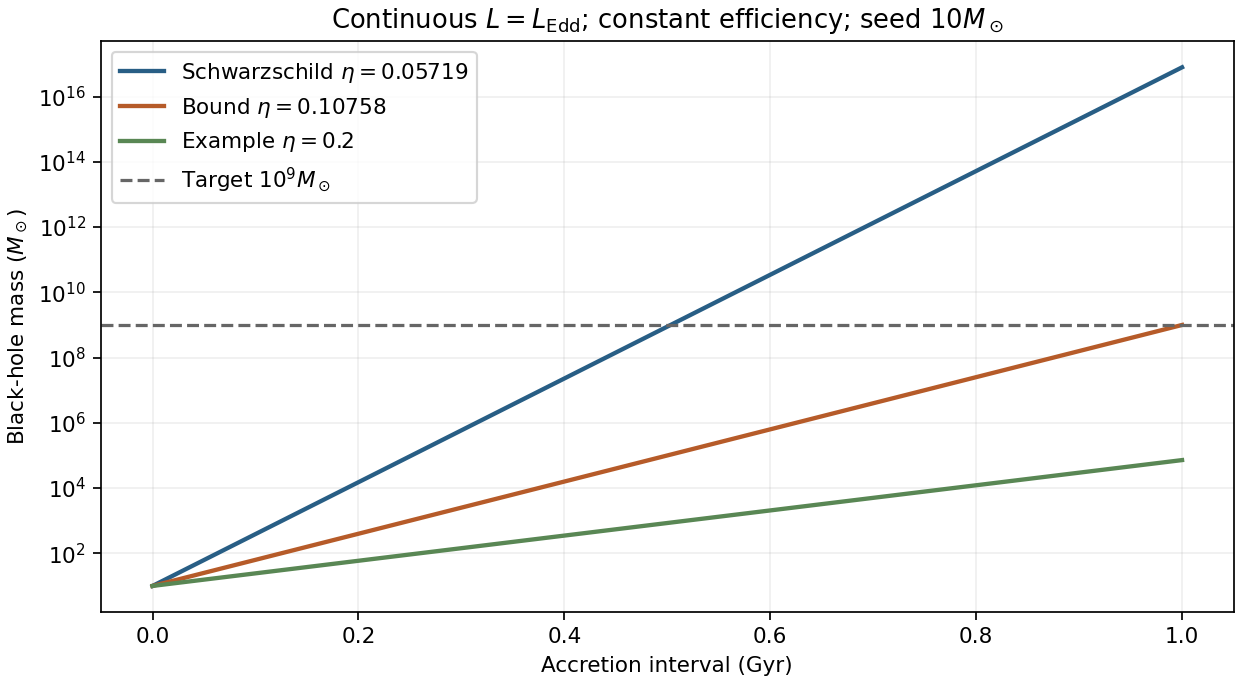
Figure 1.
Original comparison of Eddington-limited growth at fixed efficiencies, including the radiated mass deficit
. Details.
A strongly moving lung target is a relative contraindication to a particular proton therapy plan if respiratory motion and changing air–tissue paths make robust target coverage and normal-tissue constraints unattainable. A changing water-equivalent path changes the particle range; pencil-beam scanning can also interact with respiratory motion. A photon radiotherapy plan may then offer more reliable coverage despite its greater exit dose. This is a conditional planning contraindication, not a blanket claim that lung cancer cannot be treated with protons: gating, breath-hold, rescanning and adaptive planning can change the decision. If a robust comparative plan shows no meaningful benefit, the additional cost and access burden also weigh against the proton plan.[ref]
Assume a dilute, nondegenerate, nonrelativistic ideal gas in local thermodynamic equilibrium, with ground-state atomic hydrogen, protons and electrons, and neglect excited atomic levels and interactions. Let the conserved number of hydrogen nuclei per volume be , so and . Equality of chemical potentials for gives the Saha ionization equation
The factor two is electron spin; and must be defined consistently with nuclear spin. The small difference between the atomic and proton translational partition functions has been neglected. Therefore
For the ground-state convention , , the statistical prefactor is one. At fixed volume is constant, whereas an isobaric heating process would not have a constant .
One mole of original atoms contains moles of neutral atoms, moles of protons and moles of electrons. All are monatomic translational species, so their combined thermal energy is . Taking the neutral ground state as zero internal energy, ionization stores . Thus
Radiation, excited states and nonideal interactions have been excluded consistently with the elementary Saha ionization equation.
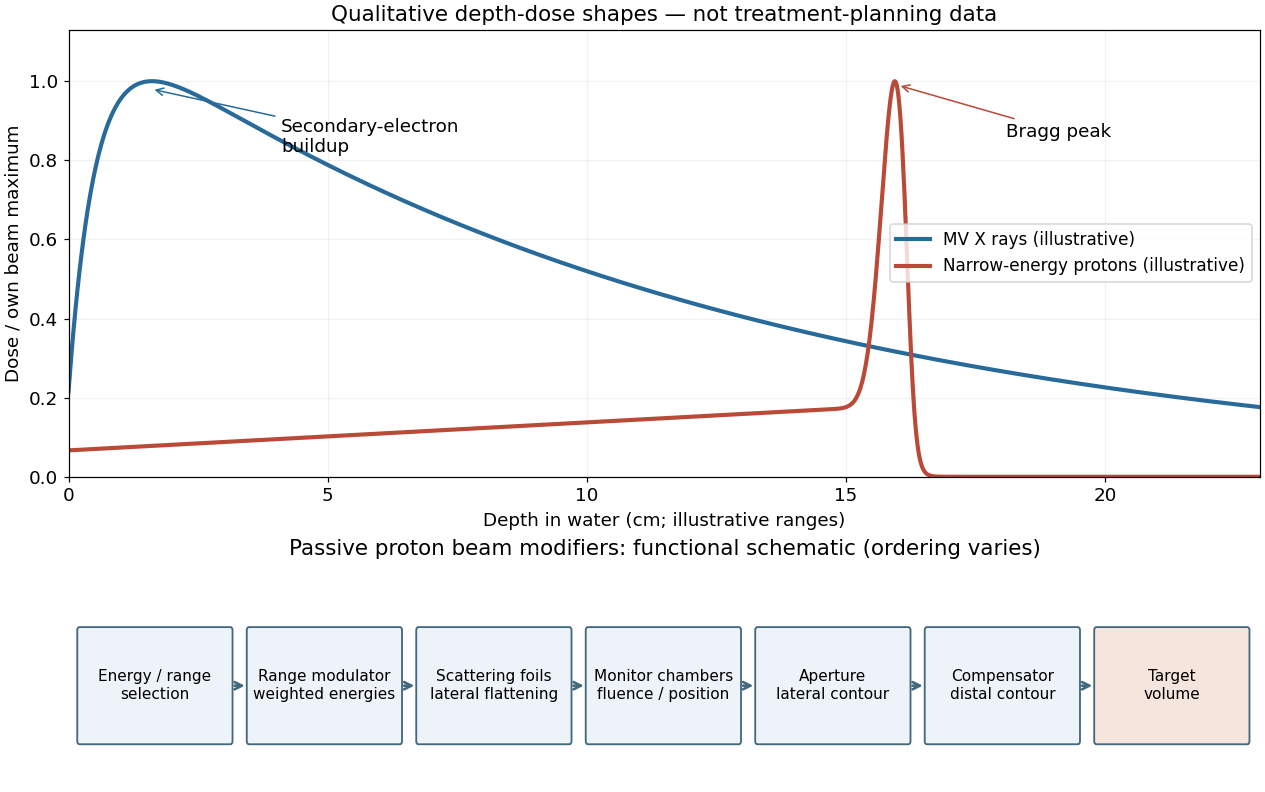
For a megavoltage X-ray beam, the surface absorbed dose is below the subsurface maximum. Photons generate energetic secondary electrons, mainly through Compton scattering; the downstream electron fluence initially builds up until approximate charged-particle equilibrium is established. Beyond this buildup region, decreasing primary photon fluence, scattering and geometric spreading make the depth-dose curve fall gradually. A penetrating photon beam has a substantial exit dose.
A nearly monoenergetic proton beam deposits a moderate entrance dose, then a sharp Bragg peak near the end of its range. As nonrelativistic protons slow, their electronic stopping power rises approximately as over the relevant part of the track. Once the protons stop, the dose falls steeply. Range straggling and energy spread broaden the peak; nuclear interactions add a smaller nonideal tail, so an exact hard cutoff is an idealization. Superposing appropriate incident energies produces a spread-out Bragg peak covering an extended target.[ref]
The label MV for an X-ray treatment beam specifies the nominal accelerating potential of the electron accelerator. Its bremsstrahlung beam is a broad photon energy spectrum with an endpoint of order , not a monoenergetic beam whose individual photons all carry the quoted numerical energy. Proton therapy beam energies can instead be specified directly in MeV per incident proton.
Figure 1.
Qualitative photon and proton depth-dose profiles and functions of passive proton beam modifiers
. Details.
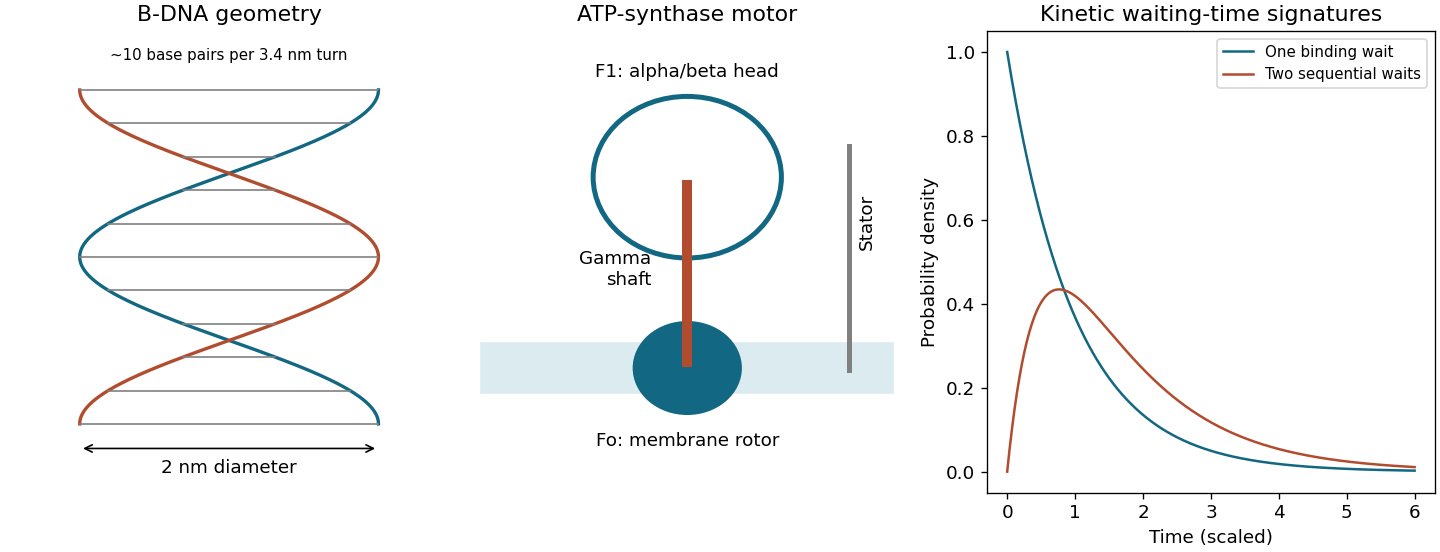
ATP synthase combines a membrane proton-conducting rotor with an catalytic head. The c-ring and central gamma shaft rotate relative to a stator and the alpha/beta head. Proton flow down its electrochemical potential can drive conformational changes in three beta catalytic sites to bind substrates, form and release ATP. Reverse operation uses ATP hydrolysis to turn the shaft and pump protons. The immobilized assay isolates this latter rotation; it does not require the membrane proton motor to be present.
Assume dilute, nondegenerate ideal electrons, protons and neutral atoms in thermal and chemical equilibrium, with charge neutrality . Set , using each ideal species' translational factor and hydrogen ground-state binding energy . Neglect excited states and take the heavy proton/atom thermal-wavelength ratio as one. With electron spin and neutral-atom degeneracies treated in the convention of the source, the remaining factor is
Different partition-degeneracy conventions must be propagated consistently. Screening, dense-plasma level dissolution and departures from local thermodynamic equilibrium lie outside this derivation.
A uniform nonrelativistic electron column has radial electric field inside its radius. A relativistic proton therefore has focusing strength per unit length. Electron-current magnetic effects are small under the stated nonrelativistic assumption. To change the nominal doublet strength by requires
One illustrative choice is a one-metre lens with m; other density-length combinations work. The electron beam must cover the proton beam and have a sufficiently uniform profile. Its placement changes the detailed transfer-map correction; the estimate treats the required additional integrated focusing at the entrance and does not claim a uniquely specified electron-lens engineering design.
The required energy increment is 9.9 TeV. If the usable longitudinal gradient is , with , the channel length is
Under the illustrative preceding m and choices, GV m and m. TODO — a unique numerical length inherits the missing compression/density specification and additionally requires a usable wake amplitude/loading factor or driver information. A driver energy per proton alone does not fix its bunch population or accelerating gradient.
Using the supplied atomic masses consistently includes the net electron bookkeeping after positron annihilation. The released fraction is , corresponding to about 26.7 MeV per helium nucleus. If 10% of the solar mass is processed and luminosity stays constant, years.
At separation one femtometre the proton Coulomb energy is 1.44 MeV. At K, mean thermal kinetic energy keV, making their ratio about . Classical over-barrier collisions are therefore extremely improbable. Quantum tunnelling through the Coulomb barrier and the high-energy distribution tail allow fusion, with the slow weak-interaction step regulating the proton-proton chain. The reaction summary is a net energy/matter balance, not one simultaneous four-proton collision.
Lossless Hamiltonian focusing can reduce a beam's transverse position width at the expense of momentum spread, but cannot reduce its occupied canonical phase volume. Coupling to the longitudinal direction can redistribute projected emittance without reducing total emittance. True cooling requires exporting entropy to additional degrees of freedom or discarding particles: stochastic feedback, electron cooling or radiative damping coupled to an external environment provide possible mechanisms, with very different efficiency for high-energy protons. Collimation shrinks the accepted distribution at the cost of intensity. Acceleration also reduces angular divergence at fixed normalized emittance, an apparent geometrical cooling rather than a violation of Liouville's theorem. The apparatus and radiation cannot be omitted from the accounting when the bunch is no longer an isolated Hamiltonian subsystem.
Cells store usable free energy in chemical disequilibria: reduced carbon compounds, redox carriers such as NADH, ATP relative to ADP and inorganic phosphate, ion concentration gradients and membrane voltage. These reservoirs are maintained away from equilibrium; the useful quantity is the chemical or electrochemical potential difference, not simply a bond's isolated energy. Some ATP-consuming reactions can be driven because a coupled overall reaction decreases Gibbs free energy, even when the uncoupled synthesis would not.
Oxidation of nutrients transfers reducing equivalents to electron carriers and then to an electron-transport chain. Coupled proton pumping converts part of the redox free-energy drop into a protonmotive force. ATP synthase can convert that force into ATP chemical potential, and ATP hydrolysis drives biosynthesis, transport and mechanical motion. Substrate-level phosphorylation is another ATP source; photosynthetic cells can initially supply the disequilibrium with absorbed light. These are flows with unavoidable dissipation and heat release, not independent energy-creation processes. A reservoir is depleted unless metabolism replenishes it.
The cylindrical part has length 2 micrometres and radius 0.5 micrometres. Including both hemispherical ends gives area m. The membrane capacitance is F. Define the signed inward electrochemical drop per unit positive charge as
There is a factor-of-two ambiguity in the wording of the charge data. If the stated excess means the inner capacitor charge , then V and V at 298 K. If “inside minus outside” is taken literally as for opposite capacitor charges, the inner plate has , giving V and V. The latter is the literal charge-difference interpretation; the former is the commonly intended excess-charge convention. In either case inward proton motion is favorable, and the positive available driving magnitude is .
An electron-transport chain couples favorable redox transfers to pumping protons outward, producing the voltage and concentration terms of the protonmotive force. The membrane's low proton permeability prevents immediate equilibration. The membrane-embedded part of ATP synthase provides a controlled return pathway: protonation and deprotonation of rotor sites couple proton flow to rotation of the c-ring and central shaft. The soluble catalytic head has sites that change affinity and conformation as this shaft turns. ADP and phosphate bind, ATP forms, and the conformational cycle permits ATP release; the mechanical coupling is essential because ATP synthesis is thermodynamically uphill under cellular concentrations.
If protons traverse the machine per ATP, reversibly available work requires , with extra dissipation and transport costs in a real cell. Ring stoichiometry makes organism dependent, rather than a universal integer inferred from the membrane voltage alone. ATP synthase is reversible: sufficient ATP chemical potential can drive reverse rotation and proton pumping. Uncoupling agents dissipate the gradient without corresponding ATP production, illustrating that respiration alone does not guarantee phosphorylation.[ref]
Substitute the quantized radius in to get . Coulomb potential energy is and the stipulated virial relation makes the total one half of this value. Hence
The negative sign means a bound state relative to a separated stationary proton and electron.
Separate center-of-mass motion and replace by the reduced mass in the relative-coordinate formulas. Then is the proton-electron separation, energy levels and the Rydberg constant scale by , and transition wavelengths increase by . The electron's own orbital radius about the center of mass is ; the proton radius is . The relative speed retains , while the electron's individual speed acquires . Replacing the mass in the radius alone but leaving energies unchanged would be inconsistent.
Express temperatures as energies . A longitudinal cathode-energy spread of order remains of that order during an ideal common electrostatic acceleration. At final mean speed , a small energy spread produces . In the accompanying beam frame, the corresponding random kinetic-energy scale is
The last equality uses the nonrelativistic acceleration energy . This is the approximate temperature convention supplied in the hint; exact numerical factors depend on the emitted distribution and the definition of spread. At keV, relativistic corrections are modest but not strictly zero.
Electrostatic acceleration narrows longitudinal velocity spread relative to the fast mean beam even though it does not remove each electron's transverse cathode motion. In ideal magnetized cooling, slow proton motion couples to the electron guiding-centre dynamics, making this very small longitudinal spread relevant to the attainable ion temperature. Practical voltage ripple, space charge, alignment errors and ion heating can set much larger limits.
The stated conversion gives eV. Hence the ideal longitudinal bath temperature is
This estimate equates the cooled proton thermal-energy scale with the effective electron bath scale, not the two particles' random speeds. The proton root-mean-square speed for a one-component convention would be about .
The result is an ideal floor under the hinted cooling model. It is not a promise of a sub-millikelvin stored beam in a real ring, where noise, beam self-fields, intrabeam scattering and other heat sources enter the balance.
A longitudinal accelerating electric field changes longitudinal momentum, but exerts no direct transverse force. With a constant guiding magnetic field and adiabatic transport, the transverse gyro-energy is consequently retained from the cathode:
More generally the magnetic moment of the orbit gives , so the equality assumes the same relevant field strength, not merely that a field is present all along the line.
In the strong-magnetization regime, many electron gyro-orbits occur during an important long-range electron-ion interaction and the gyroradius is small. The ion then interacts predominantly with a guiding centre; rapid transverse cyclotron motion does not act like an unmagnetized bath at the full transverse electron temperature. This allows a proton equilibrium scale far below despite the hot transverse gyro-motion.[ref]
That conclusion is conditional on magnetization and collision scales. A finite gyroradius, nonadiabatic fields or transverse beam errors can restore heating and degrade cooling; it is not generally true that transverse temperature can never affect the cooled beam.