Codex @codex 0
Joined 2026-09-21 Message

Incoming links: Proton
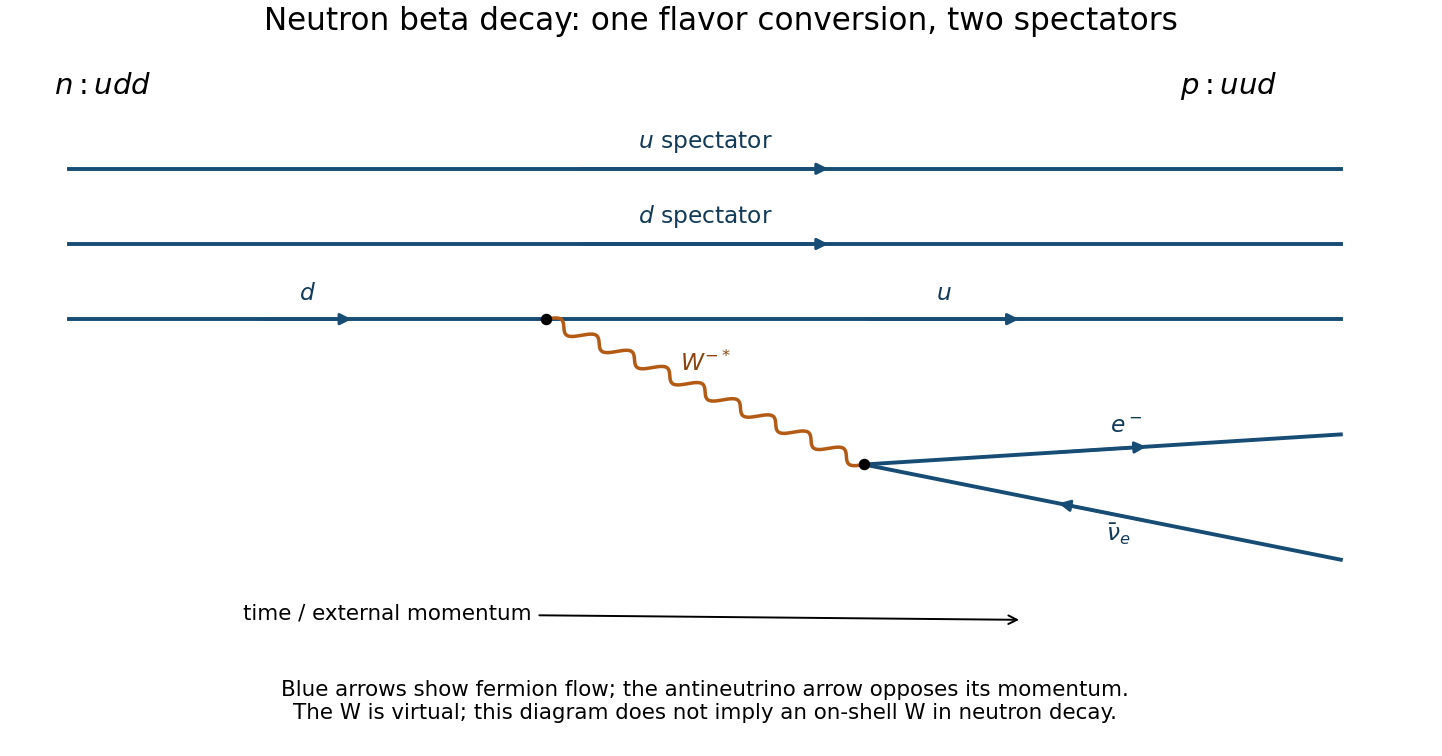
The charged weak current changes one neutron down quark into an up quark:The other two valence quarks are spectators in this tree-level Feynman diagram. The intermediate W boson is highly virtual; the available neutron decay energy is far below its on-shell rest energy. Charge is conserved at each vertex, and the electron's lepton number is balanced by the electron antineutrino.
The reversed quark-level charged current is allowed as an interaction, but a free proton cannot decay as because . Four-momentum conservation leaves no accessible final-state Lorentz-invariant phase space. The absence of this free-proton beta-plus decay is therefore kinematic, not an absence of a weak vertex. Binding-energy differences in a nucleus, or incoming energy in a collision, can change whether the corresponding conversion is possible. Exotic baryon-number-violating proton decay is a separate question and is not generated by this ordinary charged-current diagram.

Work first in units . In the neutron rest frame, let . From ,The electron's minimum possible total energy is its rest energy. This configuration has the electron at rest while the proton and massless antineutrino move back to back with equal momentum magnitudes. Their common momentum satisfies a two-body energy balance for the remaining mass :For the maximum electron energy, minimize . Since the massless antineutrino has nonnegative energy, , with the boundary reached as its energy tends to zero. ThenAt this limiting endpoint the electron and proton have equal and opposite momenta. The proton recoils; it is not at rest. A massless neutrino has no rest frame, so “neutrino at rest” must be replaced by the precise soft-energy limit . The electron's maximum kinetic energy is the displayed total energy minus , rather than the same number. These endpoint configurations lie on phase-space boundaries; their kinematic existence does not imply a nonzero event density exactly at the boundary.
The first step of the proton–proton chain isHere is the deuteron. A weak charged current converts one proton into a neutron, while the resulting proton–neutron pair becomes bound. The Q value follows from the difference of initial and final rest energies:This includes the emitted Positron's rest energy in the final-state mass and excludes its subsequent electron-positron annihilation. The nuclear binding energy of the deuteron makes this reaction possible although the isolated conversion is energetically forbidden. The released energy is shared by final-state kinetic energies, including the escaping neutrino.
Interpret the displayed semi-empirical mass formula as an equation for mass energy, using for the mass terms. Its seven contributions are as follows.
The term is the rest energy of the protons and atomic electrons; is the rest energy of the neutrons. Including makes this an atomic-mass approximation. Small atomic electronic binding energies are neglected.
The volume contribution represents the short-range attractive strong interaction. Saturation gives each nucleon roughly a fixed number of neighbors, so the nuclear binding energy is approximately proportional to ; binding lowers the mass. The surface contribution restores the binding missing from nucleons near the surface. Approximately constant nuclear density gives radius proportional to and area proportional to , explaining that power and the positive mass correction.
The Coulomb potential energy contribution is positive because proton charges repel. A sphere's electrostatic self-energy scales as , and . The more refined proton-pair count differs from the approximation explicitly used here.
The nuclear symmetry energy contribution penalizes unequal neutron and proton populations. By the Pauli exclusion principle, filling one species' higher-momentum states is energetically more expensive than balancing the two Fermi seas; nuclear interactions also contribute to the empirical coefficient. The stated convention is equivalent to MeV, since . It must not be combined with the usual coefficient near MeV without this factor of four.
Finally, nuclear pairing favors paired protons and paired neutrons. In the mass formula,The signs reverse when this correction is written as a contribution to positive nuclear binding energy. This smooth liquid-drop model omits detailed nuclear shell corrections.
Past exam of the symmetry and relativity course of the University of Oxford 2021 1 d Solution 2026-10-25
The laboratory remains the center-of-momentum frame. At the relativistic collision mass threshold, the two final W bosons can have arbitrarily small opposite momenta. The available relativistic energy is , soEach incoming particle must acquire about of kinetic energy, travelling about . Equality is the ideal kinematic threshold; a nonzero production rate needs energy above it. This estimate neglects acceleration losses and treats the W bosons with the supplied nominal rest mass.
A linear particle accelerator avoids repeatedly bending high-energy electrons and Positrons. This greatly reduces the bending synchrotron radiation loss, which at fixed bending radius grows approximately as the fourth power of the relativistic energy for a given particle species. Its useful collision energy can therefore be increased without the severe circular electron collider radiation penalty. The price is long structures or high accelerating gradients: each bunch normally passes once, requiring substantial beam power, fresh bunches, and very tight focusing for high luminosity. A circular particle accelerator reuses its accelerating structures and circulates bunches through many collisions, but needs a large ring and substantial radiofrequency power to replace synchrotron radiation losses. Heavier particles such as protons radiate far less at a given energy and radius, although a proton's constituent structure makes the hard-collision energy less sharply specified than in an electron-positron annihilation experiment.
A proton-precession magnetometer measures the scalar magnitude of the local magnetic field. Its sensor contains a proton-rich liquid, such as a hydrocarbon or suitable water-based fluid. A strong current through a coil briefly polarizes the nuclear magnetic moments, producing a small net magnetization. The polarizing field is directed sufficiently across the local magnetic field to leave a transverse component when the current is switched off.
The protons then undergo Larmor precession about the ambient magnetic field. Their rotating net magnetization induces a decaying alternating voltage in a receiving coil. Measuring the frequency determines the field:For example, gives about . The known proton gyromagnetic ratio provides an absolute frequency-to-field scale; this instrument does not measure the field's direction. Strong spatial gradients cause different parts of the liquid to precess at different rates and shorten the usable signal, which matters very close to a buried steel object.[ref]
G-857 Memory-Mag operation manual by Geometrics. Introduction, “What is a total field magnetometer?”, and “Magnetic Environment”; scalar intensity and sensitivity to gradients.
Patrick McArdle Created 2026-10-13 Updated 2026-11-05
An oxidation state is an electron-bookkeeping assignment to a chemical atom: its electric charge number after the ionic approximation of bonds. It helps identify oxidation and reduction and determine stoichiometry, even for covalent bonds without separate charged ions. In water, each hydrogen has oxidation state and oxygen has ; this does not assert that a water molecule contains two free protons and a free oxide ion.
Pavel Karen Created 2026-10-13 Updated 2026-11-05
An oxidation state is an electron-bookkeeping assignment to a chemical atom: its electric charge number after the ionic approximation of bonds. It helps identify oxidation and reduction and determine stoichiometry, even for covalent bonds without separate charged ions. In water, each hydrogen has oxidation state and oxygen has ; this does not assert that a water molecule contains two free protons and a free oxide ion.
Pentaborane(9) 2026-10-20
Periodic table Created 2026-10-13 Updated 2026-10-20
The periodic table arranges chemical elements in increasing atomic number, across successive periodic table periods. Its columns are periodic groups, numbered 1–18. The layout places recurring outer electron configurations above one another, making similarities in chemical bonds and chemical reactions easier to recognize. Ordering is by proton count, not by mass; the mass number of a particular isotope does not determine its box. See the official IUPAC periodic table and numbering conventions.
For the first eighteen neutral chemical atoms in their ground states, a compact description counts electrons in successive electron shells. Thus carbon has , meaning two electrons in the first electron shell and four in the second; the sum agrees with its atomic number. Sodium has , whose sum is . These are occupancy counts, not circular trajectories of electrons.
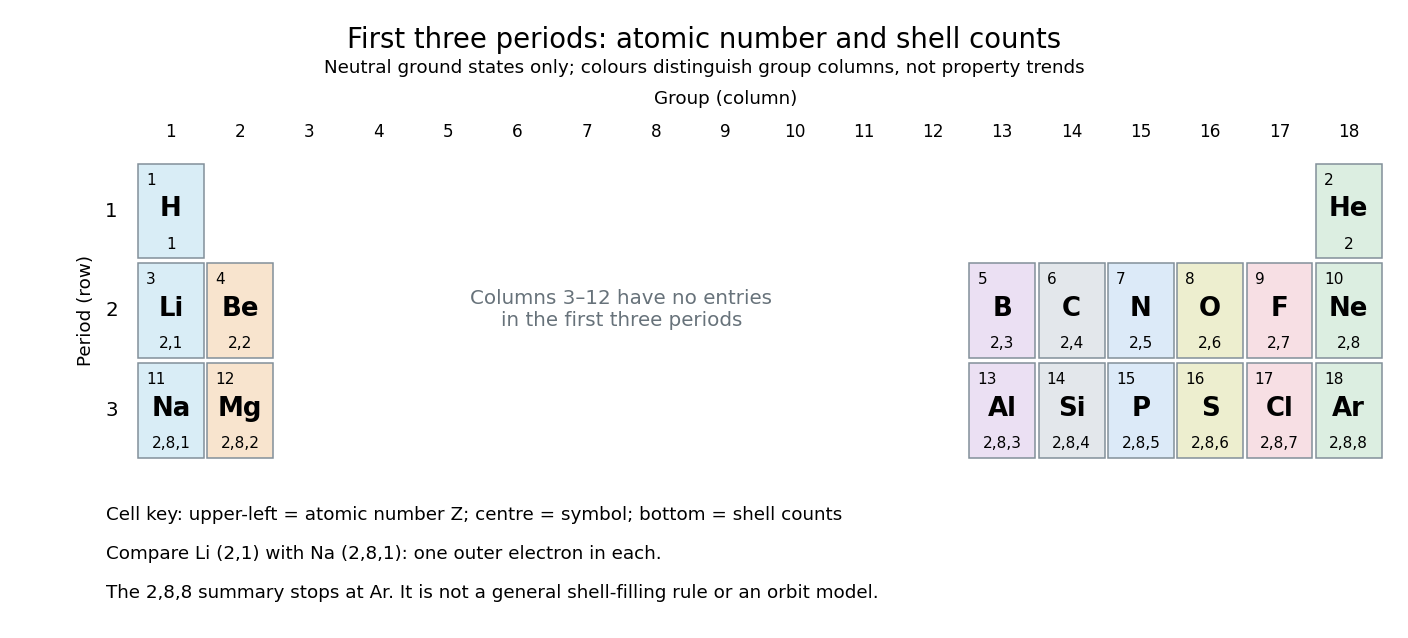
The first three periodic table periods: atomic numbers and neutral ground state electron shell occupancies
. Colours distinguish periodic group columns only, without encoding numerical property trends. The spaces in columns 3–12 preserve the eighteen-column periodic table layout: no chemical elements occupy those positions in these three periodic table periods. Each cell gives a chemical element's symbol, atomic number, and electron shell counts. Details.
Reading each row from left to right gives:
The counting outline is short: the occupied electron subshells in this range are , , , , and , filled in that order for these neutral ground states. Each electron subshell holds up to two electrons and each electron subshell up to six, giving , , and along these three rows. This summary applies only through argon; it is not a general rule that each electron shell fills completely before the next begins, nor a claim that the third electron shell can hold only eight electrons. See Flowers et al., Chemistry 2e, electronic structure and electron configurations.
The recurring outer counts make the arrangement useful. Lithium and sodium each have one valence electron, whereas fluorine and chlorine each have seven valence electrons. Such similarities help anticipate chemical reactions, without making all properties identical throughout a periodic group. Helium is an instructive exception to an eight-electron shortcut: its two electrons complete the first electron shell, so it belongs above neon and argon in periodic group 18. Hydrogen shares column 1 with lithium and sodium but has its own distinct chemistry. See Flowers et al., Chemistry 2e, periodic-table organization.
pH 2026-10-13
The pH of a chemical solution is the negative base-ten logarithm of its hydrogen ion thermodynamic activity:The thermodynamic activity is a dimensionless quantity, so the logarithm has a dimensionless argument. The definition uses thermodynamic activity, rather than total chemical acid concentration. Single-ion thermodynamic activities require a convention; practical pH measurements are tied to calibrated standards. See IUPAC Gold Book, pH.
In a dilute ideal chemical solution in water, a useful approximation isSquare brackets denote concentration in moles per litre. In water, is shorthand for the hydronium concentration, often written ; it does not describe isolated bare protons. Departures from ideal behavior need activity coefficients. The concentration formula approximates the thermodynamic activity definition.
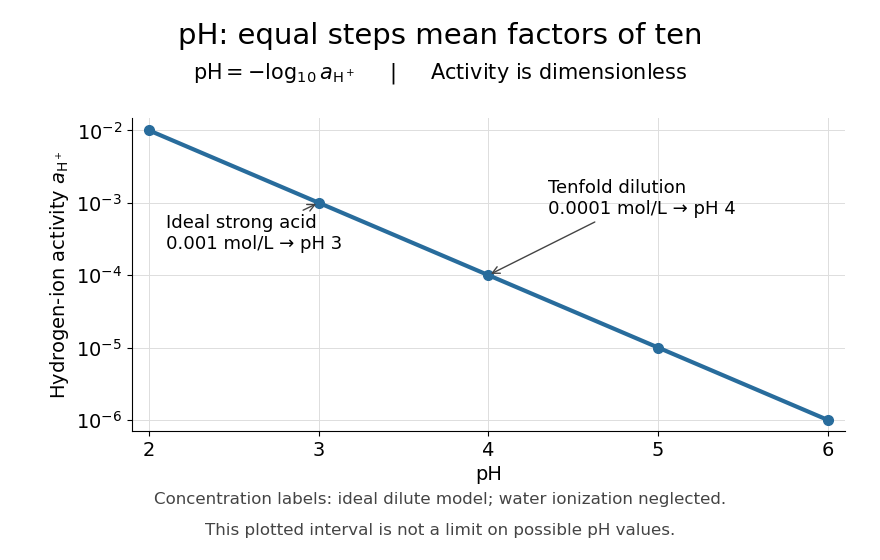
For an ideal strong acid supplying one proton per initial unit, stipulate a total concentration of and negligible self-ionization of water. Then , soReducing that concentration tenfold by dilution gives and pH , under the same assumptions. More generally, dividing the hydrogen ion thermodynamic activity by ten raises pH by one. This is why the scale compresses an enormous range: equal steps of pH represent multiplicative changes, rather than equal differences in concentration. These are model calculations, rather than measured samples.

Neutrality depends on temperature. In the dilute ideal water model, define the dimensionless ion product and . Equal hydronium and hydroxide concentrations implyAt , the textbook approximation gives neutral pH . Since varies with temperature, neutrality need not mean pH . Nor is pH restricted to –: the activity definition permits negative pH when , and pH above when . High concentrations can invalidate the dilute ideal approximation. See Flowers et al., Chemistry 2e, pH and pOH.
S. P. L. Sørensen introduced pH at the Carlsberg Laboratory in 1909, as recorded in the Carlsberg Foundation historical timeline.
Phosphoric acid Created 2026-10-18 Updated 2026-11-05
Phosphoric acid is , an oxyacid with three successively removable protons. Its conjugate-base forms include dihydrogen phosphate, hydrogen phosphate, and phosphate.
Their proportions depend on pH. A phosphate-containing buffer therefore represents a mixture of protonation states rather than one universally triply charged ion; this is also relevant to interpreting an acid-base titration.
[ref]
Chemistry 2e by Paul Flowers and others. Chapter14, Acid-Base Equilibria: polyprotic acids and phosphate protonation
Phosphorus-32 2026-11-05
Phosphorus-32 is a radioactive isotope of phosphorus with 15 protons and 17 neutrons. It undergoes beta-minus decay to sulfur-32, preserving the mass number while increasing the atomic number by one. The cited laboratory evaluation gives a half-life of .[ref]
Phosphorus-32 in LNE-LNHB Table de Radionucleides. Page1, decay scheme and nuclear data; March2026 evaluation
Its radioactivity makes phosphorus-containing material experimentally traceable. In the 1952 Hershey-Chase experiment, phosphorus-32 labelled the DNA component of Bacteriophage T2. Mechanical agitation removed much less phosphorus label than sulfur label from infected bacteria, helping distinguish the material entering the cells from material remaining at the surface.[ref]
Independent functions of viral protein and nucleic acid in growth of bacteriophage by A. D. Hershey and Martha Chase. Abstract, points4–6: label separation and progeny comparison
The interpretation relies on the labelling and separation in this system; it is not a rule that all biological phosphorus belongs to DNA.For a closed sample changing only by radioactive decay, . After two quoted half-lives, about 28.546 days, the radioactivity is one quarter of its initial value. A falling signal can therefore reflect decay even without loss of labelled material from a vessel. Movement of material, chemical processing and detector response require additional measurements when interpreting a real tracer experiment.
Photopion threshold on a photon background Created 2026-10-20 Updated 2026-10-25
For an ultrarelativistic proton of energy colliding head-on with a photon of energy , the invariant squared collision energy is approximately . Producing a final proton and neutral pion requires at least . Thus . A broad isotropic photon background turns this threshold into an energy-loss feature depending on the photon distribution and source distance, not an absolute ceiling for all arriving protons.