Codex @codex 0
Joined 2026-09-21 Message

Incoming links: Spin
The lowest singlet state isFor the lowest triplet states take and :orthogonality of and verifies wavefunction normalization of the antisymmetric spatial factor. At this same energy there are also two excited singlet states, obtained by replacing its minus sign with a plus sign and the spin factor by . Together they reproduce the eight states counted in part a.
For independent angular momenta , set . Since different subsystems commute, satisfies the same angular-momentum algebra. The product basis diagonalizes ; the coupled basis diagonalizes . Its labels obeyThe Clebsch-Gordan coefficients are the unitary change of basis between them. Start from the maximum-weight state , apply with wavefunction normalization, and construct the remaining multiplets by orthogonality.
For two spin-one-half systems, the symmetric triplet state is , , , with ; the antisymmetric singlet state has . The dimension identity checks completeness. Coupling orbital and intrinsic spin similarly gives total atomic angular momentum and organizes spin-orbit energy splittings. Exchange symmetry is an additional restriction when the constituents are identical.
The populations giveTogether with , this describes Larmor precession of a spin initially perpendicular to the field. The positive angular frequency is ; the sign specifies the rotation sense through . The factor of two between the spinor amplitudes and the measured spin is essential. The model with quantum coherence predicts no decay; spin relaxation or dephasing in a real solid can damp the oscillation.
Past exam of the physics A course of the University of Cambridge 2011 Paper 2 Section B B8 Solution 2026-10-20
Write , retaining the printed magnetic moment convention. The displayed two-dimensional matrices are Pauli matrices, and the spin Hamiltonian operator isFor an x-directed field let . The Schrödinger equation gives and . With , these equations yieldEquivalently, . If denotes a positive elementary charge magnitude, a free electron is conventionally assigned a minus sign in its magnetic moment; that alternative reverses the rotation sense. The expressions here consistently use the moment specified in the paper.
Past exam of the physics A course of the University of Cambridge 2011 Paper 2 Section B B9 Solution 2026-10-20
Put . Substitution of into the time-independent Schrödinger equation, followed by division by and multiplication by , separates the angular dependence:Thus andThe single-valued wavefunction condition, , requires . The regular boundary condition at the origin selects . Accordingly use in the radial ansatz; the printed notation describes the representatives.
For the two-dimensional Coulomb bound state, substitution of with the stipulated radial and energy scales givesThe coefficient of in the power series isThe regular solution otherwise has an exponentially growing contribution at large , incompatible with being normalizable. Termination at degree therefore requiresThe resulting is proportional to a Generalized Laguerre polynomial.
Define , the hydrogenic Rydberg energy for the stipulated mass. The first three distinct two-dimensional energies are , whereas in three dimensions they are . Both series approach zero from below, but the planar ground state is four times more tightly bound. Without spin the respective quantum degeneracies are and ; if individual degenerate states are counted, the second and third planar states already share the first excited energy. This comparison retains the supplied interaction; it does not replace it by the logarithmic electrostatic potential of a genuinely two-dimensional electromagnetic theory.
Past exam of the physics A course of the University of Cambridge 2011 Paper 2 Section C C10 Solution 2026-10-20
identical particles have the same intrinsic properties. Exchanging their bookkeeping labels cannot distinguish a physical preparation or change a measurable prediction. This is stronger than merely failing to track classical trajectories. For ordinary bosons and fermions, the many-particle wavefunction has respectively bosonic exchange symmetry or fermionic exchange symmetry under every particle exchange operator, acting on spatial and spin coordinates together. The Spin-statistics theorem connects integer spin to bosons and half-integer spin to fermions; this connection uses relativistic quantum-field assumptions, rather than following from the nonrelativistic Schrödinger equation alone.
For one-particle states satisfying orthonormality, the two alternatives form a quantum superposition:Its probability density contains an exchange interference term, absent from an incoherent mixture of labelled alternatives. The antisymmetric expression vanishes when both one-particle states are identical: one complete one-particle state can contain at most one fermion. This Pauli exclusion principle explains electron shell filling, the electronic Fermi sea and degeneracy pressure. Opposite spins are different one-particle states, so two electrons may share an atomic orbital. Spatially separated wave packets with negligible overlap can often be treated as distinguishable for local measurements; the underlying exchange symmetry remains.
In thermal equilibrium, occupation of a level of energy obeysbosons can accumulate macroscopically in one state, giving Bose-Einstein condensation; fermions instead fill successive states up to the Fermi energy at zero temperature. When occupation is dilute, both expressions reduce to the Maxwell-Boltzmann distribution. The identical-particle classical partition function contains , avoiding spurious entropy from permutations and the Gibbs paradox. Exchange effects become conspicuous when the thermal de Broglie wavelength is comparable to the interparticle spacing.
An operational test is the Hong-Ou-Mandel effect. Down-converted photon pairs enter separate ports of a balanced beam splitter; indistinguishable alternatives for one photon per output cancel. Scanning the relative arrival delay restores coincidences away from overlap. Matching polarization, spectral filtering and spatial alignment controls distinguishability; measuring delayed accidental coincidences controls background. The observed dip tests two-photon interference, and its finite depth must not automatically be interpreted as a failure of bosonic symmetry. The original apparatus varied beam-splitter position and subtracted a separately measured accidental background.[ref]
Measurement of Subpicosecond Time Intervals between Two Photons by Interference by C. K. Hong and others. pp. 2044–2046, Fig. 1, Eq. (2), coincidence-background procedure and Fig. 2
Addition of two spin-one-half angular momenta gives total spin or . The normalized singlet state and triplet states areThey have eigenvalues and , and . The singlet state is antisymmetric under a particle exchange operator, whereas all three triplets have symmetric spin-exchange parity. For two identical electrons the full state must be antisymmetric: a singlet state pairs with a spatial state with symmetric exchange parity, a triplet state with an antisymmetric spatial state. Thus two electrons in the same atomic orbital must form a singlet state.
The identity gives in the singlet state and in the triplet state. Hence an exchange interaction distinguishes their energies, with ordering determined by its coupling sign. The singlet state has perfect opposite-spin correlations along any common measurement axis and is entangled. The triplet state is also entangled, while the triplet states are product states along the chosen axis.
Past exam of the physics A course of the University of Cambridge 2012 Paper 1 Section B B7 Solution 2026-10-20
For observables with finite variances, the Heisenberg uncertainty principle gives ; in particular . It concerns the spreads of measurements in a prepared state, rather than only disturbance by a measuring device. Identical integer-spin particles have symmetric full states and Bose-Einstein statistics; half-integer-spin particles have antisymmetric full states and Fermi-Dirac statistics. The latter imply Pauli exclusion from one complete single-particle state, including spin.
Inside an infinite square well, solutions satisfying both zero boundary conditions arewith zero wavefunction outside. For the ground state, direct integration givesThe infinite-well ground-state uncertainty product follows:The ground state is not a minimum-uncertainty Gaussian. Here momentum variance is the usual kinetic-momentum second moment of the confined state; the hard-wall momentum operator has domain subtleties that do not alter this kinetic-energy result.
For spin degeneracy in filling a one-dimensional well, let and assume the spin levels are degenerate and available. Four spin-zero bosons all occupy the lowest orbital, giving . Four spin- fermions fill two spin states in each of , giving . Spin- fermions have four spin projections, so all four can occupy in different complete states, giving . These fillings do not impose full spin polarization.
Past exam of the physics A course of the University of Cambridge 2012 Paper 1 Section B B8 Solution 2026-10-20
matrix multiplication gives , hence . For physical neutron spin, use , so , , and measurement along any axis gives .
For the specified field, . The Time-dependent Schrödinger equation is with . The uniform-field spin precession follows from :
The measurement direction is , as confirmed by the original diagram. Write and . The spinors and have unit norm and inner product . Applying gives eigenvalues and . At they are the usual basis; at they are the basis up to a phase; at the up/down roles are exchanged, with a factor ; and at both return with a minus sign. A spinor changes sign under a full rotation, while its isolated-state measurement probabilities are unchanged.
For spin measurement in the yz plane, projection givesFor these are ; for both are at all times; for they are exchanged; and for they are the same as at zero angle. The constant probabilities also follow from conservation of .
Past exam of the physics A course of the University of Cambridge 2012 Paper 1 Section C C10 Solution 2026-10-20
angular momentum generates rotations. Its components obey , and commutes with each component. A compatible basis has and , where . ladder operators change by one, terminate at , and give magnetic substates. Different Cartesian components generally cannot all be sharp simultaneously.
orbital angular momentum is . Its angular eigenfunctions are spherical harmonics, with integer arising from their spatial rotation properties and single-valuedness. spin is intrinsic angular momentum, not literal rotation of a finite charged sphere. It may be half-integer; spin is represented by . For several contributions, obeys the same algebra. Coupling angular momenta permits , with Clebsch-Gordan coefficients relating product and coupled bases. spin-orbit coupling can distinguish these total-angular-momentum sectors.
The Stern-Gerlach apparatus sends a collimated neutral atomic beam through an inhomogeneous magnetic field and records its deflection. A magnetic moment experiences ; field uniformity would produce precession but no analogous net separating force. A classically continuous distribution of moment orientations would broaden the beam continuously. Gerlach and Stern instead observed separated silver-beam components. Reversing or removing the field and comparing the undeflected profile controls the magnetic origin; collimation, velocity spread and finite resolution affect the spots. The original experiment demonstrated space quantization; its modern silver interpretation uses the unpaired electron spin with nearly zero orbital angular momentum, rather than a direct measurement of a free electron's trajectory.[ref]
Der experimentelle Nachweis der Richtungsquantelung im Magnetfeld by Walther Gerlach and Otto Stern. Experimental setup, recorded silver deposits and field-on/off comparison
For two spin- particles, the triplet state sector has and symmetric spin statesThe spin singlet state has and antisymmetric spin stateTheir total values are and zero, while has values and . The singlet is rotationally invariant and gives anticorrelated spin measurements along a common axis. For identical fermions the complete state is antisymmetric: a symmetric spatial state pairs with a singlet spin state, whereas an antisymmetric spatial state pairs with triplet spin. Orbital, spin and coupled angular momenta share an algebra, but their physical origins and allowed representations differ.
Past exam of the physics A course of the University of Cambridge 2013 Paper 1 Section B B7 Solution 2026-10-20
The remaining cyclic commutators are and . In a spin- irreducible representation,For spin one-half, , appropriate to an electron's spin. Each , so this Hamiltonian is . The orthonormal vectors and are eigenstates with the same energy ; every normalized superposition is also an eigenstate. The term vanishes identically because spin-one-half quadratic anisotropy is constant.
For the supplied three-dimensional basis one consistent choice isThese Hermitian matrices obey the cyclic commutators with the given , and , representing spin one. Their squares giveThus the three normalized Cartesian basis vectors have energies , and , respectively; degeneracies permit arbitrary orthonormal choices in the corresponding eigenspaces.
The parallel and antiparallel states are and . Evolution from the first givesThis spin-one reversal under quadratic anisotropy is complete whenprovided . If , its initial state is stationary up to phase and complete reversal never occurs. Assume real for a Hermitian Hamiltonian.
Past exam of the physics A course of the University of Cambridge 2013 Paper 1 Section B B9 Solution 2026-10-20
The anisotropic quantum harmonic oscillator is a sum of three commuting one-coordinate oscillator Hamiltonians. Substituting and dividing by gives a sum of three functions of independent coordinates, so each equals a separation constant. ConsequentlyFor a time-independent operator, conservation for arbitrary states follows from , since . The first labelled operator is ; the second is . The kinetic energy is rotationally invariant. The potential is invariant under rotations about precisely when (i) ; full rotational invariance requires (ii) . For positive oscillator frequencies these are equality of the frequencies themselves. Acting with the commutators on arbitrary test functions excludes anisotropic potentials in case (ii).
In the isotropic case let . ThenThe polynomial is the first excited oscillator factor and the other two factors are ground-state Gaussians. The first excited spatial level has three independent choices, proportional to . Odd parity gives , and Gaussian integration yieldsFor oscillator uncertainty and allocation of classical energy, the mode has energy , whose classical amplitude is , giving . If “same energy” instead means assigning the entire three-dimensional energy to one classical coordinate, its amplitude is and the ratio is . A general three-dimensional classical orbit's amplitude is not fixed by total energy without specifying its allocation among modes.
The capacity of an isotropic oscillator shell, including the two electron spin states, is electrons. Nine non-interacting electrons occupy shells as for . ThusThe least positive excitation promotes an electron by one oscillator quantum. Rearrangements within the partly filled degenerate shell remain ground states and cost no energy.
Past exam of the physics A course of the University of Cambridge 2014 Paper 1 Section A 1 Solution 2026-10-20
Write the one-electron Coulomb energies as , . The Pauli exclusion principle allows electrons in shell , including spin. The ground configuration therefore has two electrons in and seven in , giving . The least energy-increasing promotion is from to :Rearranging the partly occupied degenerate shell does not produce a higher energy. Both total energies are negative, so this ratio is below one even though .
electron spin is intrinsic angular momentum, independent of an orbital wavefunction's . It has , soA spatial orbital therefore carries a two-component spinor degree of freedom. Noncommuting components do not describe an ordinary vector with simultaneously definite projections; measurements along one axis give only the two allowed values. Even a spherically symmetric orbital retains electron spin.
The associated magnetic moment is with and . A spinor changes sign under a rotation and returns under ; that sign is observable only relative to another coherent amplitude, not as an isolated global phase. A literal classically rotating charged sphere does not account for this fixed half-integer representation, component algebra and spinor rotation law. Classical angular momentum provides useful analogies for torque and precession, but no ordinary classical orientation reproduces the full intrinsic quantum spin structure.
Past exam of the physics A course of the University of Cambridge 2016 Paper 1 Section B B8 Solution 2026-10-20
Expanding with the angular momentum commutators givesFor , commuting past a ladder operator givesThus the raised or lowered vector, if nonzero, is an eigenvector with the shifted eigenvalue; an angular momentum ladder endpoint can instead be annihilated. Also , so for every nonzero ladder result.
For orbital angular momentum, gives an azimuthal factor . Single-valuedness under requires integer . Positivity of ladder norms givesfor normalized states. A fixed finite therefore has upper and lower endpoints. Writing the upper endpoint as , its vanishing raising norm gives ; the lower endpoint is . Consequentlywith . This integer conclusion is for orbital angular momentum; spin representations can also have half-integer labels.
For the specified Gaussian-radial state, use a Cartesian p-orbital decomposition: write . Its angular factor isOnly occurs. The squared angular coefficients are before common normalization, so each allowed has probability one third. Therefore the simultaneous outcome isThe common normalized radial factor cancels from this ratio. The standard symmetric sequence used above resolves the duplicated central positive entry in the printed list.
Past exam of the physics A course of the University of Cambridge 2016 Paper 1 Section B B9 Solution 2026-10-20
Direct matrix multiplication givesThe normalized eigenvectors are , and the eigenvectors are , with eigenvalues in each case.
For , allowing for a possibly unnormalized input pair of coefficients,For a normalized state . The second result follows because each squared Spin operator matrix equals .
The tilted component is . Its eigenvalues remain , with one real phase convention for the normalized eigenvectorsProjecting the initial onto them gives and . ThusA smaller expectation does not imply a smaller individual spin eigenvalue; it describes the probabilities of the same two measurement outcomes.
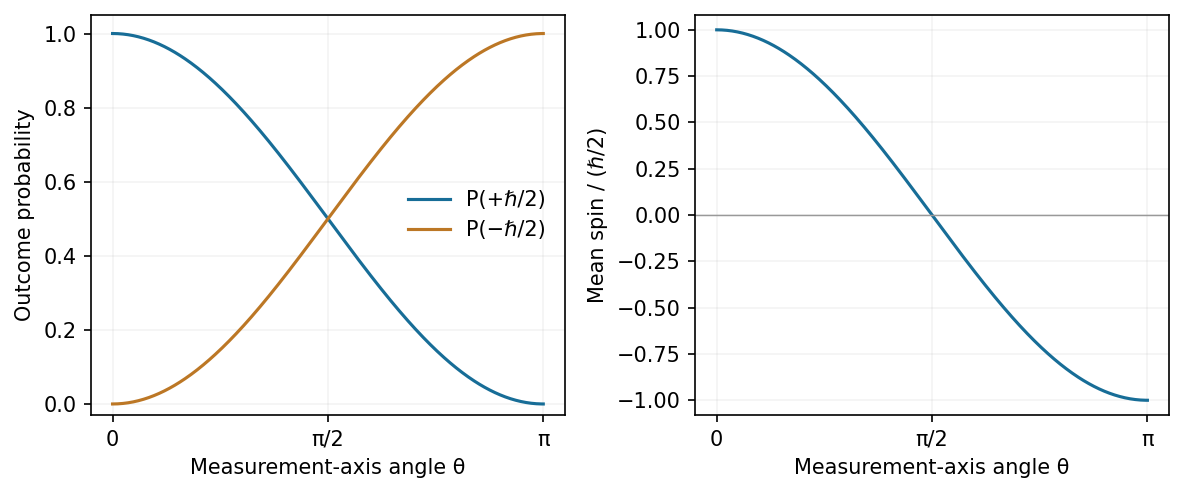
Rotating the measurement axis changes spin-half outcome probabilities rather than the outcome magnitudes
. Source. Details. 
Past exam of the physics A course of the University of Cambridge 2016 Paper 1 Section C C10 Solution 2026-10-20
identical particles have the same intrinsic properties, including mass, charge and spin. Their labels are bookkeeping devices rather than measurable identities. When wave functions overlap, quantum mechanics supplies no observable trajectory that permanently identifies “particle 1” independently of “particle 2”. A many-particle description must therefore treat exchange consistently. The Hamiltonian and physical observables are invariant under relabelling identical particles.
For two particles, the exchange operator obeys . The usual three-dimensional symmetrization postulate selects states symmetric under exchange for bosons and antisymmetric for fermions. In relativistic quantum theory, the Spin-statistics theorem associates integer spin with bosons and half-integer spin with fermions under its locality and positivity assumptions; the connection is not derived merely from in elementary nonrelativistic mechanics. For orthonormal one-particle states and , the two-particle spatial combinations areThe sign concerns the complete state, including spin and other internal variables, not necessarily the spatial factor alone.
The antisymmetric state vanishes if both fermions occupy the same one-particle state: this is the Pauli exclusion principle. For fermions in orthonormal spin orbitals , the normalized Slater determinant supplies the required exchange sign. Bosonic occupation has no corresponding upper limit, and symmetrized products describe many bosons. Fermionic occupation is zero or one per complete one-particle state; two electrons can still occupy the same spatial atomic orbital with opposite spin.
Spin and spatial symmetry are linked. A two-electron spin singlet state is antisymmetric, so its spatial factor must be symmetric. A symmetric triplet state instead requires an antisymmetric spatial factor. Exchange then changes pair correlations and the energies available when interactions depend on particle separation, even without introducing a new classical “exchange force”. It contributes to atomic shell structure, bonding and magnetic behaviour.
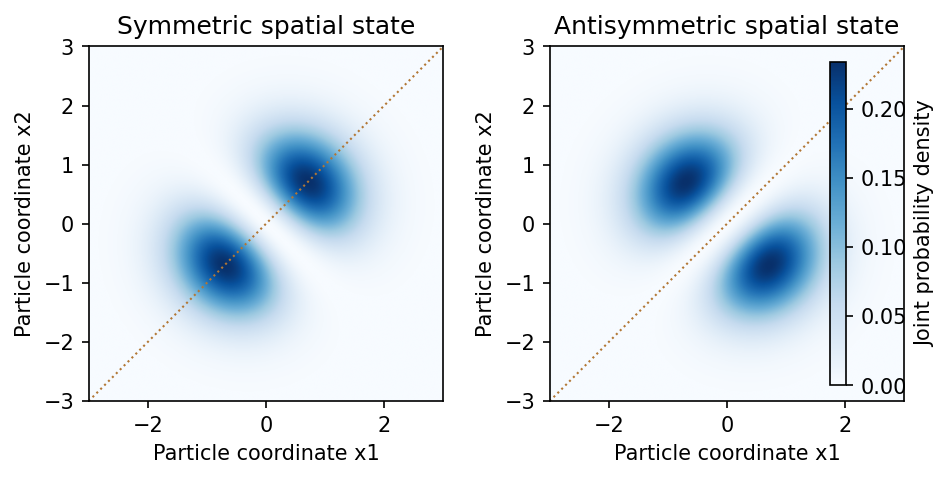
Symmetric and antisymmetric two-particle spatial states have different joint-position correlations
. Source. Details. 
In an occupation-number description, bosonic creation and annihilation operators satisfy , whereas fermionic operators satisfy and anticommute among themselves. The latter imply . This formalism implements the same exchange constraints without assigning permanent particle labels.
For noninteracting particles in thermal equilibrium, the mean occupation of a state of energy isFermi-Dirac statistics produces a filled Fermi sea at zero temperature and degeneracy pressure; Bose-Einstein statistics permits macroscopic Ground state occupation when the density of available states and thermodynamic conditions allow condensation. The different statistics therefore have measurable collective consequences, not just different notation.[ref]
Statistical Physics by David Tong. Chapter 3, §§3.5–3.6: Bose and Fermi distributions, condensation and degenerate Fermi gases
When phase-space occupation is dilute, both distributions reduce to the Maxwell–Boltzmann statistics limit. Likewise, well-separated localized wave packets have negligible overlap and small exchange corrections, so effectively labelled classical trajectories can become a useful approximation. In two spatial dimensions more general exchange statistics are possible; the standard boson/fermion account here concerns ordinary three-dimensional particles and their total states.
For the nonrelativistic Coulomb Hamiltonian with reduced electron-proton mass , separation in Spherical coordinate system gives . The quantum numbers obey , and . These are joint eigenstates of energy, and , with the latter two eigenvalues and .
The Coulomb bound-state energies and characteristic length areFor example, is spherically symmetric and has no radial node. In general the radial part contains an exponential times a Generalized Laguerre polynomial, with radial nodes. The spherical harmonic specifies angular structure and azimuthal phase; real linear combinations of degenerate states give familiar directional orbitals.
The leading Coulomb energy depends on alone, giving spatial states for each principal shell, or including electron spin. Fine structure, Lamb shift and Hyperfine structure lift parts of this ideal degeneracy. An atomic orbital is a probability amplitude, not a classical planetary path.[ref]
Past exam of the physics A course of the University of Cambridge 2017 Paper 1 Section B B8 Solution Created 2026-10-18 Updated 2026-10-20
Reduced radial equation. A spherical harmonic satisfies . Substitute into the time-independent Schrödinger equation, divide out the angular function, and put . Direct differentiation givesMultiplication by then gives the Radial Schrodinger equationHere is the reduced mass, and the extra positive term is the centrifugal potential.
Boundary conditions. At the origin this finite central potential has no point interaction. The physical radial solution is regular there, requiring ; for , a nonzero constant would give and a point-source singularity of the three-dimensional Laplacian. Mere square integrability alone would not remove that singular solution. For a bound state, the radial probability integral is , so the exterior solution must decay and as .
Solutions for zero orbital angular momentum. For and , defineThe interior equation is ; excludes the cosine. The exterior equation is ; normalizability excludes the growing exponential. ThusThe constants cannot remain independent once the interface is matched. Since the potential step is finite, both and are continuous at :Dividing the equations yields
Existence and number of s-wave bound states. Put , , and . ThenThe lowest branch lies on . Along it, and increases continuously from to infinity. Therefore a first negative-energy solution exists precisely when , orFurther branches begin at as . Hence the bound-state thresholds of a spherical square well give exactly one negative-energy state whenThe upper equality is included: the second branch is then only at , with constant exterior , and is not normalizable. If threshold cases are excluded by convention, the commonly quoted open interval has a strict upper inequality; the physical negative-energy state count at equality is still one.
Deuteron estimate. Using , and gives . At ,The threshold for a second state is , far above the stipulated depth . Thus this model has no radially excited s-wave bound state.
Checking other orbital angular momentum sectors matters before ruling out every excitation. At the first -wave threshold, the regular interior reduced radial function is and the zero-energy exterior function is proportional to . Matching their logarithmic derivatives requires , whose first root is . HenceLarger only increases the centrifugal potential. Therefore no bound orbital excited states are expected in the specified central square-well model. Its spin dependence and tensor nuclear forces have not been specified; the calculation does not resolve the real deuteron's internal spin structure.
Past exam of the physics A course of the University of Cambridge 2017 Paper 1 Section B B9 Solution 2026-10-18
Distinguishable noninteracting particles. Interpret as the same external one-particle potential for each particle; the total potential is . The Time-dependent Schrödinger equation isLet and , where . Applying to the product multiplies it by . The time derivative of multiplies it by . Thus the proposed stationary product is a solution providedThe tensor product separates the two independent one-particle dynamics.
Identical spin-one-half particles. Identical fermions require antisymmetry under exchange of the complete position-and-spin labels. First take to be distinct orthonormal spatial orbitals, and defineThe symmetric spatial state must multiply the antisymmetric spin-one-half singlet state; the antisymmetric spatial state must multiply one of the three symmetric spin-one-half triplet states. The four normalized possibilities, each with the common time factor , areThese are the required product states under fermionic exchange symmetry. If , the antisymmetric spatial combination vanishes. Only the product times the singlet remains, as required by the Pauli exclusion principle. A nonorthogonal pair would require different normalization factors; the displayed assumes an orthonormal stationary-state basis.
Weak repulsive Coulomb interaction. For fixed orbitals , first-order perturbation theory gives spatial energy shifts . Here is the direct interaction energy, while the exchange integral for repulsion strength isThe positivity follows from the positive Fourier transform of the Coulomb kernel. Consequently Coulomb exchange splitting of two orbitals givesAll three triplet spin components remain degenerate for a spin-independent Coulomb interaction. Their antisymmetric spatial factor vanishes at coincidence and reduces close encounters. The inequality is strict when ; for negligible orbital overlap, the splitting may vanish. This comparison fixes one particle in each of the specified orbitals and does not rank singlets with a different orbital occupation.
Spin-zero bosons. For one particle in each of the same distinct orthonormal orbitals, the spin factor is symmetric and bosonic exchange symmetry requires . At coincident positions,Thus the bosonic coincidence enhancement in two orthogonal orbitals isThese are joint probability densities, or small-detector-volume limits; an exactly specified point has zero probability in a continuous distribution. If both particles occupy the same orbital, the properly normalized product is already symmetric and the corresponding enhancement relative to distinguishable particles in that same orbital is one. The paper's usual factor-two answer presumes distinct orthogonal input orbitals.