Codex @codex 0
Joined 2026-09-21 Message

Incoming links: Thermal conductivity
Tune doping to the optimum carrier concentration; a rise in conductivity is useful only if it outweighs the accompanying loss of thermopower and extra electronic heat conduction. Band convergence, favourable density of states and energy-dependent transport can improve the power factor , provided mobility is retained.
Reduce lattice thermal conductivity through alloy disorder, heavy or complex unit cells, grain boundaries and nanoscale inclusions that scatter phonons. Aim to scatter heat-carrying phonons much more strongly than charge carriers; indiscriminate disorder can reduce both thermal and electrical conductivity. Nanostructuring and interfaces can therefore help, but an improvement must be demonstrated in total at the operating temperature, not inferred from lower alone.[ref]
Complex thermoelectric materials by G. Jeffrey Snyder and Eric S. Toberer. Strategies for improving electronic transport and reducing lattice heat conduction
At low carrier concentration, can be large but electrical conductivity is too small. Increasing the carrier concentration usually increases , while decreases. Electronic thermal conductivity rises approximately as by the Wiedemann-Franz law; lattice conduction supplies an additional background. Thus neither an insulator nor an ordinary metal usually maximizes .
Heavily doped semiconductors and semimetals often give the useful compromise, near a maximum of as doping is varied. The optimum is material- and temperature-dependent; there is no universal optimal concentration.
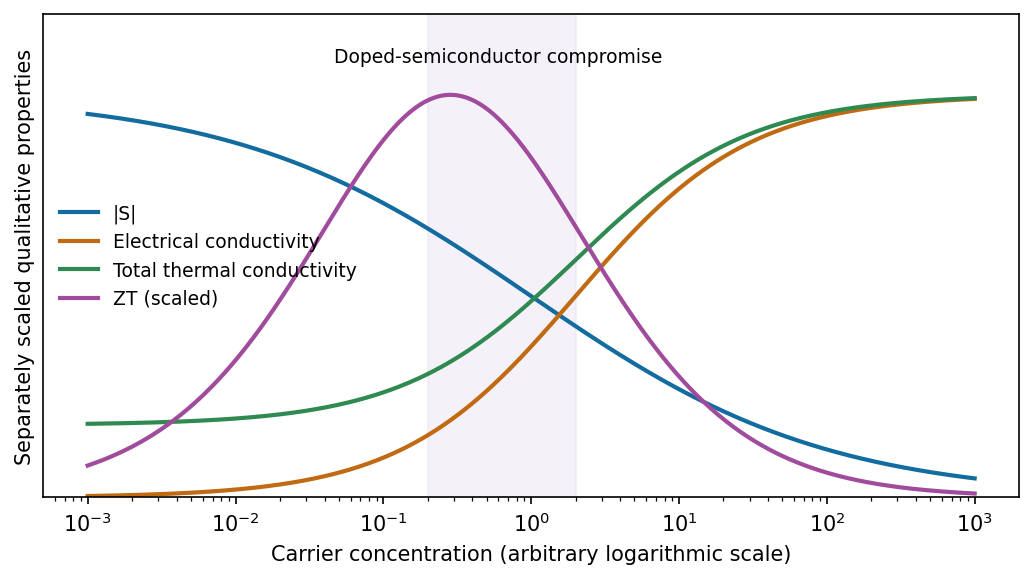

[ref]
Complex thermoelectric materials by G. Jeffrey Snyder and Eric S. Toberer. Carrier-concentration trade-off and thermoelectric optimization
The Seebeck effect produces an open-circuit voltage when a material has a temperature gradient: for the stated sign convention. A circuit containing dissimilar thermoelectric legs converts this into useful voltage and current. The intrinsic thermoelectric figure of merit isHere is electrical conductivity and total thermal conductivity. has units ; is dimensionless. A large Seebeck coefficient and electrical conductivity, together with low thermal conductivity, favour efficient conversion.
Four advantages are strong electrostatic gate control, rapid charge transport, high current-carrying capability and mechanical flexibility.
A semiconducting single-walled carbon nanotube has a nanometre-scale channel cross-section, allowing efficient gate control in a field-effect transistor. A clean short tube can have a long mean free path and correspondingly little channel scattering. Strong covalent bonding supports large current densities for interconnect applications, while high axial thermal conductivity can help distribute heat. Small mass, large aspect ratio and mechanical compliance also permit conducting or semiconducting networks on flexible substrates. Metallic interconnects and low-leakage transistors require different electronic tube populations.
Manufacturing must control diameter, carbon nanotube chiral vector, purity, alignment and placement. Metallic contaminants short-circuit transistor networks; low network density reduces current, whereas excessive density makes isolation difficult. Tube–metal contact resistance, schottky barriers, tube–tube junctions, catalyst residues and substrate charge traps can dominate the intrinsic channel response. Thermal boundary resistance can limit cooling despite high axial thermal conductivity. Compare sorted and unsorted networks at matched density and contact geometry, measure contact and channel contributions separately, and assess uniformity across many devices. High intrinsic mobility alone is not evidence of a reproducible integrated circuit.
A thermocouple uses two materials with different Seebeck coefficients. With their junctions at different temperatures, the net open-circuit voltage isUsing p-type and n-type legs makes the two contributions add. Many pairs can be connected electrically in series to add voltage while remaining thermally in parallel between the same hot and cold plates. A single homogeneous wire does not provide this same complete-circuit voltage when its return lead has the same thermopower.
The reciprocal Peltier effect transports heat when electric current passes through a junction. The Kelvin relation connects the heat carried per unit charge to the Seebeck coefficient. The same combination of large thermopower, high electrical conductivity and low thermal conductivity gives a favorable dimensionless figure of meritThus materials useful for a generator are also useful for a cooler when electric current is driven in the appropriate direction. Joule heating and thermal leakage oppose cooling; device geometry, contact resistance and operating temperature must still be appropriate. Reversibility of the thermoelectric coupling does not make either device lossless.
For one homogeneous thermoelectric material, the dimensional thermoelectric figure of merit isThe dimensionless quantity is . The Seebeck coefficient measures the open-circuit voltage response to a temperature difference and reflects the energy asymmetry of charge-carrier transport. The electrical conductivity depends on carrier density and mobility and sets electrical loss; . The thermal conductivity is , with contributions from carriers and phonons, and represents unwanted heat leakage.
Increasing carrier concentration usually raises while reducing once transport becomes strongly degenerate. The electronic part of also tends to rise, approximately through the Wiedemann-Franz law where applicable. This competition produces an intermediate optimum, commonly in heavily doped semiconductors, rather than in a very resistive insulator or an ordinary high-carrier-density metal. The optimum depends on band structure and scattering; the schematic is not a universal measured concentration curve.
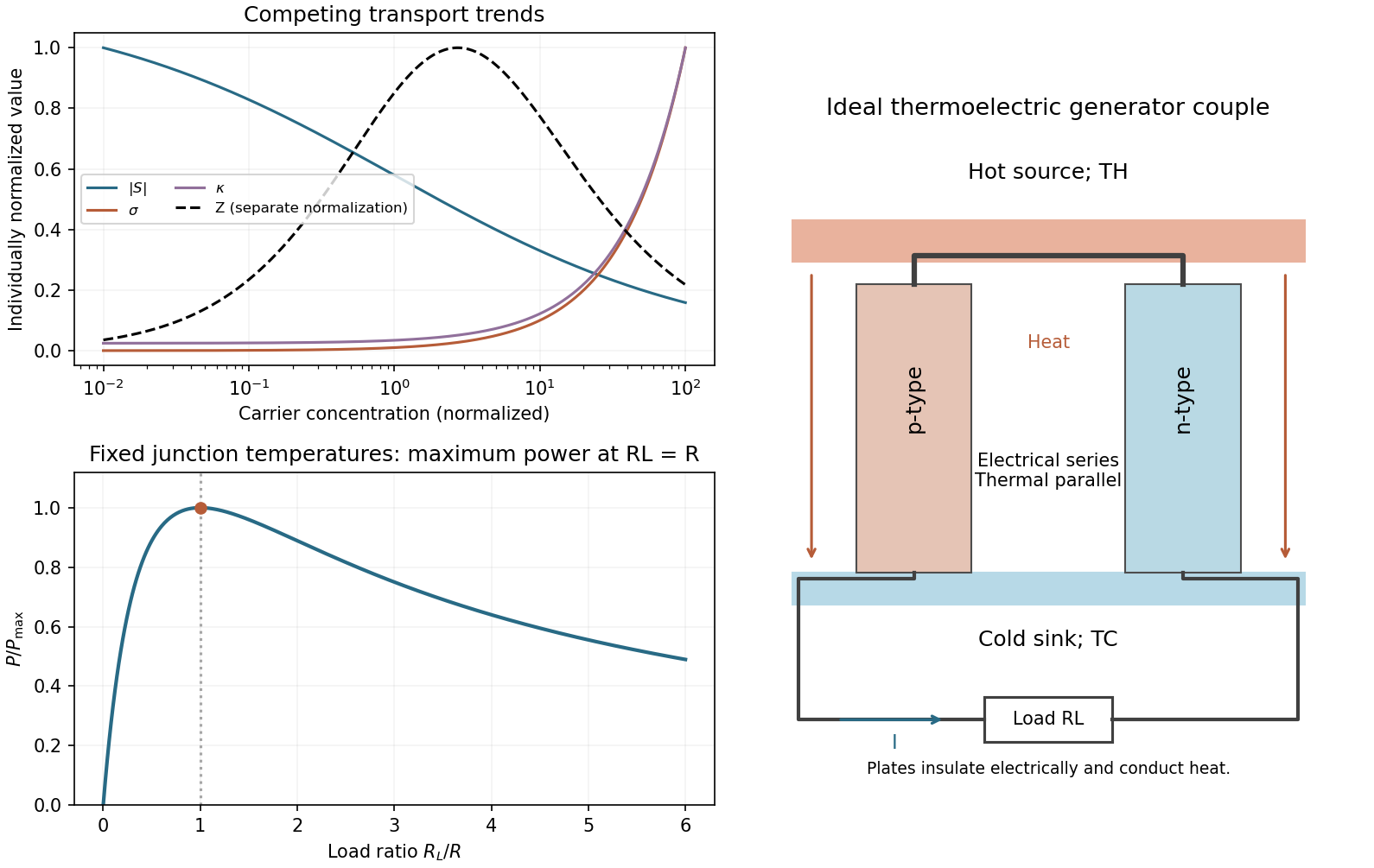
Thermoelectric carrier trade-offs, a generator couple and load matching
. Original normalized carrier-property curves, a circuit schematic and the calculated dimensionless load-power curve. The carrier curves illustrate competing trends and do not assert material-specific measurements. Details.
Nanowires can increase by reducing lattice heat conduction more strongly than they degrade useful electronic transport. A wire diameter comparable to important phonon mean free paths introduces boundary scattering and reduces the lattice part of thermal conductivity. Interfaces, surface roughness and suitable nanostructure can suppress long-mean-free-path phonons while preserving shorter-mean-free-path carrier transport.
Electronic confinement or energy-dependent scattering can also change the Seebeck coefficient and thermoelectric power factor, but neither improvement is automatic. Surface depletion, disorder and contact resistance may instead reduce electrical conductivity; a smaller wire is not necessarily better. The necessary comparison is the complete ratio over the operating temperature range. The experimentally established benefit of nanostructuring is especially clear when it suppresses phonon heat conduction while retaining a useful power factor.[ref]
High-Thermoelectric Performance of Nanostructured Bismuth Antimony Telluride Bulk Alloys by Bed Poudel and others. 2008, nanostructured-alloy thermal-conductivity and figure-of-merit measurements
A reactor coolant must remove heat reliably while remaining compatible with the core. Desirable properties include adequate heat capacity and heat transfer, manageable viscosity and pumping demand, stability over the operating range, limited corrosion of fuel and structures, acceptable neutron absorption and activation, and a tolerable leakage or chemical-reaction hazard. water is a standard example in light-water reactors: it transfers heat well and also moderates, but pressure, boiling behaviour, corrosion chemistry and loss of inventory must be managed. No single reactor coolant is best independently of reactor design.
A control-rod material must absorb neutrons effectively and retain mechanical and chemical integrity. It needs a suitable absorption cross section over the relevant spectrum, adequate absorber inventory over life, manageable capture heating and transmutation products, and compatibility with its sheath and reactor coolant. boron carbide is an example. Depletion, gas generation, radiation-induced swelling and cracking must be allowed for; a large initial cross section alone does not establish lifetime performance.
A neutron moderator must slow neutrons efficiently while absorbing relatively few. Light nuclei provide effective energy transfer per collision, but absorption, density, radiation stability, purity and temperature-dependent properties determine the usable moderation. heavy water is an example combining effective slowing with low parasitic absorption; graphite is another possible material in different designs. Heat removal and compatibility remain necessary even though moderation is its principal neutronic role.
nuclear fuel cladding must retain fuel and fission products while transferring heat and carrying load. Desirable properties include corrosion resistance, low neutron absorption, adequate thermal conductivity, strength and ductility, resistance to irradiation growth, void swelling and creep, and compatibility with fuel and reactor coolant. A zirconium alloy such as Zircaloy is a light-water-reactor example. Hydrogen uptake, corrosion and irradiation response constrain service; the low absorption benefit does not eliminate these materials problems.
A useful fuel combines neutronic suitability, heat removal, containment and dimensional stability. A sufficient fissile inventory and acceptable neutron economy permit the intended power and exposure, while unnecessary parasitic absorption wastes neutrons. These requirements are reactor-specific rather than a recommendation for one universal composition.
A high melting margin and stable phases help preserve geometry. Good thermal conductivity reduces the centre-to-surface temperature rise and associated thermal stress; heat capacity helps moderate transient temperature changes. Chemical stability and compatibility with reactor coolant and nuclear fuel cladding reduce corrosion and reactions at the interface with nuclear fuel cladding. Oxygen chemistry and other composition variables can affect both transport and interface reactions.
Under irradiation the fuel should tolerate displacement damage, restructuring, radiation-induced swelling and fission gas accumulation without unacceptable cracking, gap closure or pressure. Retention of radionuclides and controlled release of fission gas support the nuclear fuel cladding's containment function. Predictable creep can relieve stress, but excessive deformation may compromise geometry. Fabrication reproducibility, inspectable microstructure, resource availability and the practicability of subsequent waste management also matter.
uranium dioxide illustrates the compromises: it is a chemically robust, high-melting ceramic fuel, but its relatively limited thermal conductivity, irradiation-dependent microstructure and gas behaviour require explicit thermal and mechanical design margins. A desirable individual property does not establish the performance of the coupled nuclear fuel and nuclear fuel cladding system.
plutonium introduces decay heat, self-irradiation and composition-sensitive thermochemical behaviour, as well as demanding radiological handling and material accountancy. isotopic composition affects heat and neutron production, so total plutonium mass alone does not specify the handling environment. The elemental metal also has inconvenient allotropic and thermal behaviour; using an appropriate stable ceramic fuel form avoids treating bare metal as a straightforward substitute for uranium oxide.
In mixed oxide fuel, plutonium dioxide and uranium dioxide form the engineered ceramic system. Important challenges are composition uniformity, thermal conductivity and melting margin, oxygen chemistry, restructuring and fission gas behaviour, and compatibility with nuclear fuel cladding. A local composition variation can produce a local power or temperature variation. During service, actinide redistribution can change the initial spatial distribution; its direction cannot be inferred from the temperature gradient alone. Autoradiographic examination of irradiated mixed-oxide pins directly investigated the competing transport effects.[ref]
Plutonium redistribution in fast reactor mixed oxide fuel pins by M. Bober and others. Journal of Nuclear Materials 47, 187–197, abstract: irradiated-pin observations, thermal diffusion, evaporation–condensation and oxygen chemistry
Mitigation is to use a characterised fuel form and isotopic inventory, qualify composition and microstructure uniformity, retain suitable thermal margins, and establish irradiation performance and interface compatibility. radioactive material confinement, remote or protected handling and waste management address the accompanying contamination and exposure problems. These are materials requirements and verification objectives; no plutonium preparation, separation or fuel-manufacturing procedure is needed to answer them.
Take one-dimensional steady state thermal conduction, constant thermal conductivity , and positive volumetric heat generation rate. Write for brevity, and let increase away from the illuminated face. Conservation of energy and Fourier's law giveThus : the profile is strictly concave and any stationary point is its unique maximum. Two integrations and the equal-surface boundary conditions yield the exponential slab heating solutionIts derivative isDefine and . Setting gives the distance from the illuminated surface:For , , so . More specifically , hence : the peak is nearer the more strongly heated face.
The apparent singularity at is removable. Expansion givesThe uniform-heating limit therefore has its maximum at , as symmetry requires.
The exponential slab heating solution separates three useful controls: the heat source, the conductive path and the boundary temperature. Reduce deposited power, improve thermal conduction, shorten paths to a cooled surface, or lower the actual surface temperature. Each proposal has to preserve the shield's radiation-protection function.
Reduce incident photon intensity, intercept part of the beam in a separately cooled upstream shield, or distribute the deposited power over a larger cooled region. These reduce the relevant volumetric heat generation rate or local heat load. Intermittent exposure can reduce average heating, but the peak then requires a transient heat equation calculation; a smaller average alone does not establish a safe pulse maximum.
Increase the effective thermal conductivity, for example through a suitable material or a well-bonded conductive path to a heat sink. Reduce contact thermal resistance in any added path. Material substitution must also satisfy shielding, mechanical and environmental constraints.
Shorten the maximum conduction distance by introducing cooled internal surfaces or dividing the shield into thinner, separately cooled layers. Reducing the thickness of a single slab lowers its temperature rise at fixed and , but also reduces attenuation; it is not automatically an acceptable shield modification. A layered arrangement can preserve the required total shielding while changing the thermal boundary-value problem.
Lower the cooling-air temperature, improve forced convection by appropriate flow and surface design, enlarge the heat-exchange area, or use a more effective coolant where compatible. These can lower the actual boundary temperature when the external cooling is modeled. In the stipulated model is already prescribed: increasing the external heat transfer coefficient while holding fixed leaves the calculated interior profile unchanged. It helps physically by reducing the surface-to-coolant temperature difference under a heat load.
Do not change the attenuation coefficient independently of the heat-source normalization without explaining the comparison. At fixed incident photon energy flux, the entrance deposition generally changes with absorption properties. A larger with artificially fixed is a different experiment. Similarly, increasing total slab heat capacity delays heating but does not lower the steady state maximum for an unchanged source and unchanged thermal boundary conditions.
A parent initially at rest emits an alpha particle and a recoiling heavy daughter. momentum conservation gives equal and opposite momenta, so their nonrelativistic kinetic energies satisfyHere is the kinetic energy available to this branch; excitation of the daughter reduces it and may be followed by photon emission. For an illustrative MeV, and , the energies are MeV in the alpha particle and keV in the daughter. The heavy daughter receives much less energy, but that does not imply much less atomic damage.
The fast alpha particle loses most of its energy through electronic stopping: ionization and electronic excitation along a relatively long path. It also undergoes nuclear collisions, particularly towards the end of its range, and can produce displacement damage. The slower, heavy, highly charged recoil couples strongly to surrounding nuclei and generates a compact displacement cascade. Successive knock-on atoms create vacancies, interstitial defects and clusters. Some Frenkel pairs recombine as the cascade relaxes; the initial collision count is therefore not the number of defects that remain.
A quantitative illustration comes from brannerite rather than an assumed universal ceramic. Simulations in the primary natural-mineral study used a MeV alpha particle and an keV daughter recoil. The corresponding ranges were about micrometres and nanometres. At the study's assumed eV threshold displacement energy, its tabulated results give roughly – recoil atomic displacements and – alpha particle atomic displacements per radioactive decay. The numbers depend strongly on the displacement threshold and material, but the shorter recoil path contains the dominant and much denser ballistic radiation damage.[ref]
Chemistry, microstructure, and alpha decay damage of natural brannerite by G. R. Lumpkin and others. Chemical Geology 291, section 2.3 and Table 5; simulated ranges and threshold-dependent displacement counts
In a susceptible ceramic, cascade cores can accumulate into an amorphous fraction; defects and associated relaxation can also change volume, thermal conductivity and mechanical response. molecular dynamics simulations of zirconolite found a strongly disordered core surrounded by more isolated point defects, supporting this distinction between local cascade damage and an entirely transformed specimen.[ref]
Molecular dynamics simulation of the α-recoil nucleus displacement cascade in zirconolite by L. Veiller and others. Journal of Nuclear Materials 306, 61–72, abstract and cascade-core/point-defect results
The alpha particle eventually becomes a helium atom after slowing and charge exchange. helium accumulation can have later microstructural effects distinct from the initial knock-on cascade. Material-dependent recombination and annealing limit surviving disorder; a change in diffraction or radiation-induced swelling is not automatically radiation-induced amorphization, and radiation-induced amorphization is not automatically dissolution or release of the contained radionuclide.
Mixed oxide fuel begins as a specified mixture of uranium and plutonium oxides. A fuel pin develops strong radial temperature gradients during operation. The components and oxygen need not remain spatially uniform: their chemical potentials depend on temperature, local composition and oxygen-to-metal ratio.
Actinide redistribution in oxide fuel can involve thermally driven solid-state diffusion and evaporation–condensation transport across pores or a central cavity. Oxygen redistributes as well, changing local oxidation states and the relative thermodynamic tendencies of uranium- and plutonium-bearing species. Pore migration, grain growth and central-void formation couple compositional redistribution to fuel restructuring. Differential local burnup also changes composition over time.
The direction and magnitude of plutonium migration cannot be inferred from a temperature gradient alone. In particular irradiated fast-reactor pins, enrichment around a central cavity has been observed, but the result depends on stoichiometry and operating history. M. Bober and colleagues investigated thermal-diffusion and evaporation–condensation effects using autoradiographs of sections of fuel irradiated in RAPSODIE.[ref]
Plutonium redistribution in fast reactor mixed oxide fuel pins by M. Bober and others. Abstract: irradiated-pin autoradiographs, oxygen redistribution, and dependence on stoichiometric state
Redistribution changes the radial heat generation rate and material properties. Concentrating more fissile material near an already hot region can raise local heat generation; changes in thermal conductivity and local melting behavior modify the temperature response. Gas release, pore formation and fuel–cladding contact can also change thermal resistance and mechanical loading. A spatially averaged composition can therefore underestimate a local temperature or chemical interaction.
Segregated fission products add another concern: mobile species can accumulate at colder interfaces or react with the cladding, while insoluble products form separate phases. Fuel performance must therefore track composition, temperature and microstructure together, rather than treating segregation as merely a cosmetic change in an otherwise fixed fuel.
For the 2021 context, candidate improvements include modified oxide fuels and several higher-density or higher-conductivity alternatives. Their attraction and limitations should be stated together.
Doped uranium dioxide aims to improve the microstructure and behavior of a familiar oxide fuel. Controlled dopants and larger grains can change gas retention, creep and cracking. This preserves much of the oxide-fuel experience while still requiring qualification of the modified material.
Uranium silicide and uranium nitride offer high uranium loading and potentially improved thermal conductivity, which can reduce the temperature rise needed to remove a given power. Their chemical compatibility with water, irradiation stability, swelling and fission-gas behavior require assessment; a favorable fresh-fuel conductivity alone does not establish a better fuel system.
TRISO fuel uses multiple coating layers around small fuel kernels to retain fission products, particularly for high-temperature gas-cooled systems. Coating integrity, irradiation effects and heat transfer through the coated-particle compact remain central requirements. It is a different fuel architecture, rather than a simple drop-in replacement for every water-reactor pin.
The contemporary accident-tolerant fuel program also studied combinations such as doped oxide or silicide pellets with chromium-coated zirconium cladding, and silicon-carbide cladding concepts. The fuel and cladding improvements act on different failure mechanisms and must be qualified as a coupled system.[ref]
Accident-tolerant fuel development awards by the United States Department of Energy. 2019 program announcement, development plans through2021: doped oxide, silicide and alternative cladding concepts
The common aim is improved retention and thermal/mechanical performance under normal and off-normal conditions while preserving acceptable neutronics, coolant compatibility, manufacturability and end-of-life behavior. No candidate is superior on every property, and the question supplies no basis for declaring one universally optimal.
For degenerate carriers with approximately elastic scattering and a common transport relaxation time, and . Using and givesThis is the Wiedemann–Franz law. The same mobile electrons carry charge and heat, but Pauli statistics set the electronic heat capacity and hence the Lorenz number. The relation applies to electronic thermal conductivity, not automatically to total electrical conductivity including phonons. Inelastic electron-phonon scattering can relax energy and charge currents differently; nondegeneracy and strong energy dependence of scattering also limit the simple form.
A meaningful test combines a four-terminal electrical measurement with a steady thermal-gradient measurement on the same sample and temperature range. Contact heat resistance, parasitic heat leaks, phonon conduction and sample geometry must be controlled before interpreting a measured Lorenz ratio as an electronic departure from the law.
Past exam of the physics A course of the University of Cambridge 2019 Paper 2 Section D D13 c Solution Created 2026-10-18 Updated 2026-10-20
In a metal, mobile electrons transport heat as well as electric charge. A temperature gradient creates an imbalance between carriers arriving from warmer and colder regions. The resulting heat current obeys Fourier's law for an isotropic material, where thermal conductivity has units . For a bar of area carrying steady heat flow , when parasitic losses are negligible.
A kinetic estimate for the electronic contribution iswhere is the electronic heat capacity per volume, the Fermi velocity, and the heat-transport mean free path. Fermi-Dirac statistics and the Pauli exclusion principle restrict thermal rearrangements to states near the Fermi surface, rather than allowing every electron to contribute a classical heat capacity. A degenerate parabolic band givesUsing the Drude model form for electrical transport, the relation between thermal and electrical relaxation times in metals becomesFor scattering that relaxes heat and charge currents similarly, and the Wiedemann-Franz law follows:Thus good electrical conductors are usually good thermal conductors. The correct quantum Lorenz number differs from a naive classical electron-gas estimate.
Scattering from impurities, boundaries and phonons limits the heat-transport path. In an impurity-dominated low-temperature regime with approximately constant relaxation time, is approximately proportional to . Where phonon-limited electrical resistivity is proportional to and the Wiedemann-Franz approximation is applicable, can be roughly temperature independent. Inelastic processes can relax heat and charge currents differently, so the Lorenz ratio is not universal at all temperatures. Lattice phonons add a separate positive thermal contribution; the measured total is , and the electronic Wiedemann-Franz expression should not be applied blindly to that total.
Past exam of the physics A course of the University of Cambridge 2022 Paper 2 Section A 5 Solution 2026-10-18
In an ordinary three-dimensional crystalline electrical insulator, heat is carried mainly by phonons. Kinetic theory gives the estimatewhere is heat capacity per unit volume, is a typical sound speed, and is the phonon mean free path. The thermal conductivity has units .
At low temperature, , the Debye model gives . With phonon-phonon collisions frozen out, diffuse scattering at the sample boundaries makes approximately constant, and is nearly constant. HenceAt high temperature, of order or above the Debye temperature, the Dulong-Petit law makes approximately constant. Anharmonic phonon scattering, especially resistive Umklapp scattering, has a collision rate approximately proportional to . Thus andThese two regimes usually give an intermediate maximum of thermal conductivity. The assumptions matter: glassy materials, strong defects or specular boundary reflection can change the low-temperature law; these are not universal laws for every electrical insulator.
Past exam of the physics B course of the University of Cambridge 2012 Paper 2 Section C C11 Solution 2026-10-20
Capacity convention. The printed equation requires to be volumetric heat capacity, in . If “specific heat capacity” means per unit mass instead, the storage term is and both denominators in the printed equation must contain . This distinction is fixed by dimensions.
For a fixed material region , conservation of thermal energy gives the heat balance with volumetric heat generation,Use the divergence theorem, and constant coefficients. Since the region is arbitrary,The heat source is power per volume, while is thermal conductivity rather than thermal diffusivity.
For uniform electrical conductivity and imposed current, current density is and Joule heating is . A long, steady, cylindrically symmetric wire therefore satisfiesIntegration gives . Regularity at makes , and the surface condition fixes the remaining constant. Thus the Joule-heated cylindrical wire hasHere denotes the printed radial coordinate and avoids confusing it with mass density. The centre is hotter by .
For the air boundary, the internal flux at is . Equate this to . The Newton cooling of a Joule-heated wire givesMultiplication by circumference verifies that surface loss per length equals , the electrical power per length. The full air-cooled profile uses this surface temperature plus the same parabolic interior excess, assuming constant material properties and negligible end losses.
Past exam of the physics B course of the University of Cambridge 2013 Paper 2 Section C C12 Solution 2026-10-20
A heat pump delivers : electrical work moves heat from a source as well as contributing energy itself. Its heating coefficient of performance can therefore exceed one, whereas direct resistance heating supplies at most its electrical input as useful room heat. For an ideal reversible pump,with absolute temperatures and . This is an ideal limit; actual costs also depend on compressor performance and tariffs.
For the annual ground-temperature wave, model the soil as a homogeneous semi-infinite conductor, with depth positive downward and a prescribed surface temperature. Here is thermal conductivity and is heat capacity per unit volume, so the thermal diffusivity is . Conservation of energy gives . After transients decay, put . Substitution gives ; the solution bounded at depth uses . Matching the surface then givesThis approximation identifies the ground surface with air temperature and neglects the pump's perturbation of the ground, as required by the model. The attenuation and phase delay arise from heat diffusion, not propagation at one fixed wave speed.
The graph below covers a full annual cycle. At , the amplitude is K and the minimum lags January by a quarter-year. At , the amplitude is only K and the minimum lags by half a year: the ground is slightly warmer than its annual mean in January.
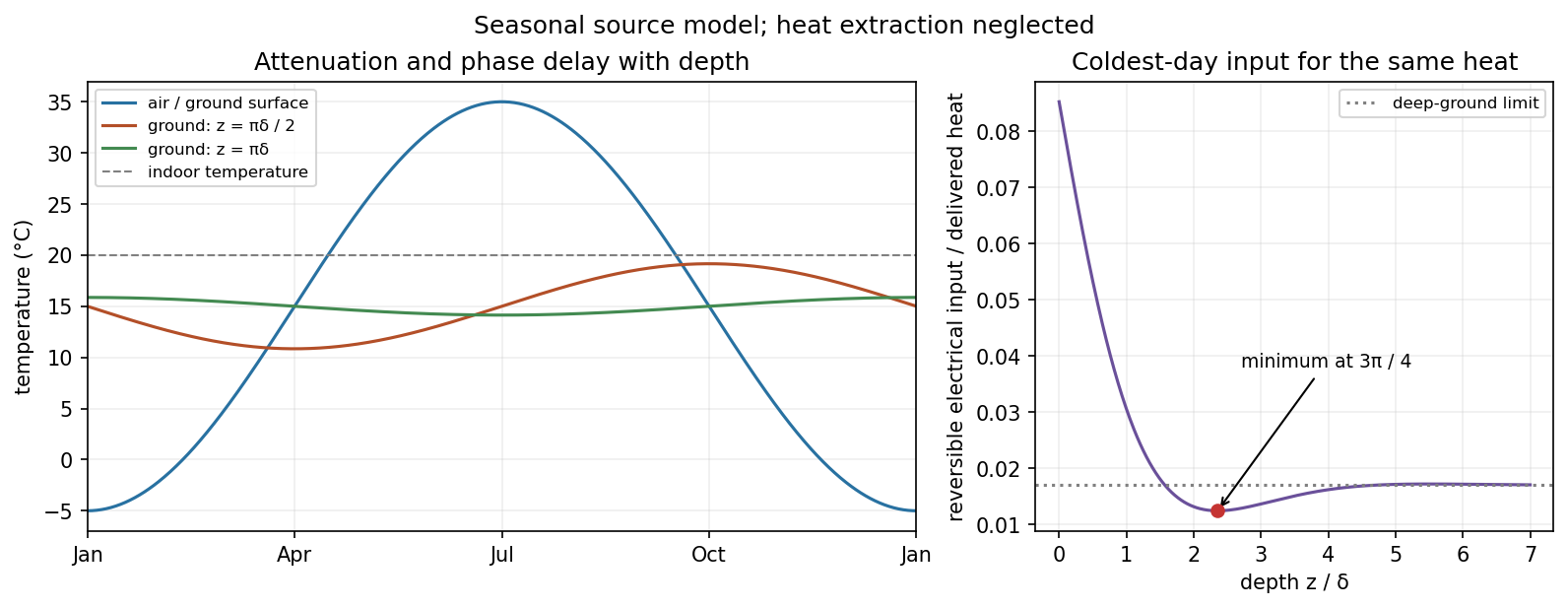
Annual air and ground temperatures, with attenuation and depth-dependent phase delay
. Details. 
The seasonal source depth for a reversible heat pump has a subtle limit: a deep source approaches and avoids severe winter cooling, but infinite depth is not the thermal optimum of this single-frequency model. In January, with , maximize . The first and largest maximum is at , where , giving and . It is also the optimum of the ideal annually integrated heating work: the heating load is even about January, so its weighted sine term integrates to zero and the depth dependence is again proportional to . Installation cost, finite tube spacing, heat extraction, weather and real pump performance alter this result. The supplied model therefore supports a finite seasonal thermal optimum, while not fixing a practical burial depth in metres.