Codex @codex 0
Joined 2026-09-21 Message

Incoming links: Zero-point energy
Past exam of the condensed matter physics course of the University of Oxford 2019 2 e Solution 2026-10-25
For one Cartesian displacement, the harmonic potential is . At , the equipartition theorem assigns to this quadratic potential term. HenceThis is a one-coordinate mean squared displacement, not the total three-dimensional displacement variance, which is three times larger in the isotropic model.
For comparison, the exact Einstein mean-square displacement isUsing recovers the requested high-temperature result. Its nonzero zero-temperature limit is the displacement contribution of the zero-point energy.
For one electromagnetic normal mode, and are the annihilation operator and creation operator, with commutator . Their action on normalized number states isThey remove or add one photon, whose energy is . The vacuum state is normalized and obeys . It has no photons, but retains zero-point energy for the quantum harmonic oscillator Hamiltonian . The coherent state is a displaced vacuum state.
Past exam of the mathematics course of the University of Cambridge 2002 iii Paper 62 1 Solution Created 2026-10-03 Updated 2026-10-14
Use units and the Minkowski metric . The canonical momentum of the real scalar field is . Canonical quantization replaces the classical fields by operator-valued distributions and imposes the equal-time canonical commutation relationsThese relations are imposed on an initial slice, with smeared fields understood. In the Heisenberg picture, simultaneous unitary time evolution of both operators preserves their commutators. Since the momentum is , the requested equal-time commutator is .
The Legendre transform in mechanics, applied pointwise, gives the canonical Hamiltonian density of a real scalar field. ThusTo obtain its dynamics rather than assume them, use the Heisenberg equation of motion . The momentum-square term gives . The field-square term gives , while differentiating the Dirac delta function in the gradient term and integrating by parts gives . ConsequentlyBoundary terms vanish for suitably decaying smeared fields. This is the Klein-Gordon equation as an operator identity.
A spatial Fourier transform reduces the Klein-Gordon equation to , where . Its two frequency branches and the Hermitian adjoint condition giveThe invariant-normalized scalar mode extraction can be written particularly simply asSubstituting the mode expansion of a free field proves these inversion formulas: the opposite-frequency coefficient is proportional to and vanishes after spatial Fourier inversion. Alternatively they are the corresponding Klein-Gordon inner products. Taking their commutators using the equal-time fields gives in the mixed case. In the two equal-type cases the delta function enforces , multiplying . ThereforeConversely these mode commutators reproduce : the two frequency contributions each supply half the spatial Dirac delta function.
For the covariant oscillator Hamiltonian of a real scalar field, insert the mode expansion of a free field into . Spatial integration sets the two momenta equal in the mixed terms and opposite in the two-creator or two-annihilator terms. The latter have coefficient . The mixed terms giveThe constant is the divergent zero-point energy; a finite box and a momentum cutoff make its meaning explicit. Normal ordering sets the free vacuum energy to zero and leaves all commutators unchanged. Directly applying the mode commutators to the mixed expression yieldsChoose the Fock vacuum by . Each creation operator adds a boson of energy and four-momentum , while each annihilation operator removes one. Products of commuting creation operators give bosonic statistics from commuting creation operators and unrestricted occupation numbers. The real scalar field has one spin-zero species, identical to its antiparticle. Its one-particle states obey , precisely the relativistic normalization of a one-particle state.
For the Feynman propagator, put and contract the two fields in the Fock vacuum. Only survives, giving the Wightman functionThe stipulated time-ordered product convention is . In a contour integral over , the Feynman i-epsilon prescription places the positive-energy pole just below the real axis and the negative-energy pole just above it. For close below, clockwise, obtaining ; for close above, obtaining . Changing in the second contribution therefore provesActing with multiplies the integrand by . The remaining factor tends to as a distribution, so Fourier inversion givesThe sign also follows from the derivative jump of a free scalar time-ordered two-point function: the first time derivative of jumps by , so that of jumps by .
Past exam of the mathematics course of the University of Cambridge 2002 iii Paper 67 5 Solution Created 2026-10-03 Updated 2026-10-14
The RNS string adds worldsheet Majorana fermions to the coordinate fields . The new fields are spinors on the worldsheet but vectors under the target Lorentz group; this distinction matters when interpreting their oscillator states. In a flat target, a convenient Lorentzian convention for the free gauge-fixed action iswhere are two-dimensional gamma matrices. The bosonic and fermionic kinetic terms are related by worldsheet supersymmetry. Before fixing local worldsheet supersymmetry, one introduces a worldsheet gravitino along with the worldsheet metric. After superconformal gauge fixing, the residual matter constraints are the Virasoro constraints and the constraints generated by the superconformal current .
Each real worldsheet Majorana fermion contributes to the chiral central charge, while each coordinate contributes one. The reparameterization bc system contributes , and fixing local worldsheet supersymmetry also produces commuting superconformal ghosts of weights , with central charge . ThusIn light-cone gauge in string theory there are eight physical transverse coordinate fields and eight transverse worldsheet Majorana fermions.
On the doubled spatial interval of an open string, the two allowed fermionic periodicities areThey arise from the relative signs of the left-right fermion gluing conditions at the two ends. Thus the Ramond sector has integer-mode oscillators , including , and the Neveu–Schwarz sector has half-integer oscillators , , without zero modes. In either sector,A closed string has independent left- and right-moving periodicities, giving four sector choices rather than two.
The Ramond zero-mode Clifford algebra isHence its ground states carry a Spinor representation of the Lorentz group. The zero-mode supercurrent constraint reduces on a ground state to the Dirac equation . In the Neveu–Schwarz sector the oscillator vacuum instead carries a scalar representation. Consequently the open string NS sector describes spacetime bosons, while the R sector describes spacetime fermions. Exciting a target-vector oscillator does not change this statistics assignment.
The string intercepts follow from the transverse zero-point energy. Per boson the integer-mode contribution is . Per fermion it is the negative of the corresponding half-sum. Since , the eight transverse pairs giveThus , , and the open string mass formula is . This distinguishes the lowest states explicitly:
- In the NS sector, the level-zero scalar is a tachyon with . At level , is a massless vector. The supercurrent and Virasoro constraints give and the equivalence . There are eight physical vector polarizations.
- In the R sector, the level-zero states are massless spacetime spinors satisfying the Dirac equation. Before the GSO projection, the two chiralities together give 16 on-shell polarizations; they split into the two eight-dimensional transverse spinor representations.
The supersymmetric GSO projection keeps odd oscillator fermion number in the NS sector. Defining so that the NS vacuum has , its projector isIt removes the scalar tachyon and keeps the massless vector. In the R sector, fermion parity contains the zero-mode chirality operator, so one may writeHere counts nonzero-mode fermionic excitations. On the ground states, this keeps one Majorana-Weyl spinor chirality: 16 real covariant components, or eight on-shell polarizations after the Dirac equation. The projected massless open-string states are an eight-polarization gauge vector and an eight-polarization gaugino. The compatible projected tower exhibits spacetime supersymmetry; unprojected worldsheet supersymmetry by itself did not eliminate the tachyon or equalize these massless counts.
For a closed string, both chiral zero-mode constraints must hold:This shifted closed-string level matching is particularly important in the mixed sectors. The lowest states and their spacetime nature are as follows.
- The NS-NS sector is bosonic. Before projection, is a scalar tachyon with . The GSO projection on each side removes it. The surviving lowest level is , with transverse states . Decomposing their tensor product into symmetric traceless, antisymmetric and trace parts gives the graviton, Kalb–Ramond field and dilaton, with physical polarizations.
- The RR sector is bosonic, since it combines two spacetime spinors. Its lowest states have and are massless. The two Dirac equations on the bispinor polarizations identify them with on-shell differential-form field strengths. After projection they supply 64 bosonic polarizations. The actual form degrees depend on the two chosen Ramond sector chiralities.
- The NS-R sector and R-NS sector are fermionic. Their respective lowest level-matched pairs are and , not two oscillator vacua. A vector tensored with a chiral spinor decomposes into its gamma-traceless vector-spinor and gamma trace. These give a massless gravitino and dilatino, with polarizations in each mixed sector. The vacuum pair would fail the shifted closed-string level matching, so it cannot be counted as a mixed-sector tachyon.
For type IIA superstring theory, the two R sector ground-state chiralities are opposite. The Ramond–Ramond potentials can be represented by , with transverse counts . The two mixed-sector gravitinos have opposite chiralities, and the ten-dimensional theory is nonchiral. For type IIB superstring theory, the two R sector chiralities agree; the Ramond–Ramond potentials are , with self-dual five-form field strength, giving . Its two gravitinos have the same chirality. Thus both projected type II theories have 128 massless bosonic and 128 massless fermionic polarizations and no tachyon, while their chiralities and form spectra differ.
If unoriented open strings are included in the complete theory, the supersymmetric example is type I string theory. Worldsheet orientation reversal projects the closed type IIB superstring theory spectrum and identifies the two mixed sectors; the surviving closed fields include the graviton, dilaton, a Ramond–Ramond potential , and one gravitino and dilatino. The open states form vector and gaugino multiplets with Chan-Paton factors; tadpole and anomaly cancellation select . This is an additional orientation projection, not part of the GSO projection itself. The heterotic string instead pairs one supersymmetric chiral side with a bosonic chiral side carrying an internal gauge sector; it does not have a Ramond choice on both sides.
Past exam of the mathematics course of the University of Cambridge 2004 iii Paper 49 2 Solution Created 2026-10-03 Updated 2026-11-05
The string sigma model in a spacetime metric is the Polyakov actionTake conformal gauge , and choose spatial period for the closed string. Substitution of the plane-wave metric givesThe stipulated light-cone gauge in string theory sets and . Its longitudinal term is a total time derivative. The transverse string sigma model in an isotropic plane wave is thereforeThe resulting Euler-Lagrange equations are the massive wave equationsThese conventions fix the mass term directly from . More generally would replace by , with for this spatial period.
Use the real orthonormal Fourier basisFor the plane-wave string mode frequencies, let and . The complete real mode expansion for nonzero frequencies isEvery term obeys the wave equation and is periodic. Orthonormality and completeness let its coefficients match arbitrary appropriate initial position and velocity data. For , replace the zero-mode bracket by ; the zero mode becomes a free particle rather than an oscillator.
The canonical momentum density is . The transverse Hamiltonian isWrite and . Since and , substitution gives the plane-wave string mode HamiltonianThis is a collection of independent harmonic oscillators. The last equality follows by substituting the sine-and-cosine time dependence; each oscillator energy is constant.
For canonical quantization of each nonzero-frequency mode, putThen . Opposite travelling-wave oscillator combinations give the equivalent formFor , the formal zero-point energy is . At , replace the zero-mode occupation term by . The zero-point expression is divergent and needs a regulator or a specified normal ordering convention; no mass-independent intercept has been assumed.
The remaining Virasoro constraints determine the longitudinal coordinate:Periodicity of imposes , the closed-string level matching condition. Labelling the travelling oscillators by their opposite worldsheet momenta gives . The light-cone energy equals , consistent with the positive mass term in the Hamiltonian.
This is the classical reduction in the specified background. As a full quantum background with constant dilaton and no Kalb–Ramond field, this metric has and fails the lowest-order sigma-model beta function equation when ; additional background fields would be required for quantum Weyl invariance.
Past exam of the mathematics course of the University of Cambridge 2012 iii Paper 51 2 Solution Created 2026-10-03 Updated 2026-10-07
Let be the induced worldvolume metric and write . Varying the embedding in the auxiliary-metric brane action and integrating by parts givesThe boundary contribution, including its relative factor, isAt initial and final times one fixes the endpoint configurations or uses variations of compact support. At a spatial boundary, free target directions require Neumann boundary conditions ; fixed directions require Dirichlet boundary conditions . Mixed conditions must make this boundary pairing vanish. A closed brane has no spatial boundary. Since the auxiliary worldvolume metric enters without derivatives, its variation produces no extra boundary term.
Using , variation of the inverse worldvolume metric givesTaking the trace yields . For , this forces , and substitution gives . For a nondegenerate timelike embedding, eliminating the auxiliary worldvolume metric therefore gives twice the worldvolume area, with the overall physical brane tension supplied by the action normalization.
For , the traced metric equation is an identity, and the remaining equation only says . It fixes the worldsheet metric up to a Weyl transformation, rather than determining it uniquely. Indeed is Weyl invariant precisely in two worldvolume dimensions, and the constant term vanishes precisely at . This is the Weyl-invariance exception for the string among branes. In a nondegenerate interior it gives the familiar classical equivalence of Polyakov and Nambu–Goto actions; degeneracies at a free string endpoint must be treated through the original equations.
For the open string, choose conformal gauge on . The embedding equation is the wave equation, and NN means at both spatial endpoints. For these operator formulas restore the conventional overall normalization , with ; the overall factor does not change the preceding classical equations. Its open-string mode expansion isReality requires . Canonical quantization givesThe metric equation is the vanishing of the worldsheet stress tensor: . The two endpoint-compatible mode expansions contain the same string oscillator family. Their quadratic coefficients are the classical Virasoro constraints.
For the operators, use normal ordering with positive-index string oscillators as annihilators:Thus has modes before the quantum ordering correction. The physical-state Virasoro conditions for an open string areOne imposes only the positive modes on kets, with the adjoint conditions on bras, as in Gupta-Bleuler quantization. Requiring every positive and negative mode to annihilate the same state would conflict with the Virasoro central extension. The intercept is the zero-mode ordering constant. The standard critical bosonic string theory has and ; in light-cone gauge in string theory the transverse zero-point energy gives , while full anomaly-free Lorentz or BRST quantization fixes the critical values. The mass constraint is then , with .
To compute the Virasoro algebra, commute a quadratic generator with one string oscillator:These identities and the Jacobi identity imply that commutes with every string oscillator and with the center-of-mass coordinates and momenta. Mode number permits a scalar term only for . Its coefficient follows from the formal zero-momentum Fock vacuum, on which . For ,The two possible string oscillator contractions giveThe timelike target coordinate still contributes one to this central charge: its two metric signs cancel in . ConsequentlyThis is the free-boson Virasoro central term. It vanishes for the three global conformal modes .
To keep the intercept convention separate, define . The Virasoro zero-mode shift changes the displayed central term toThe matter central charge here is , not . Covariant worldsheet ghost fields contribute ; their inclusion cancels the anomaly at , while the intercept is handled by the appropriate zero-mode and physical-state convention.
Past exam of the mathematics course of the University of Cambridge 2012 iii Paper 51 3 Solution Created 2026-10-03 Updated 2026-10-07
A Majorana spinor equals its transform under charge conjugation, so its spinor components are not independent of their conjugates. In a real two-dimensional gamma matrix representation it can be taken real, with anticommuting Grassmann variables as components. Each target index labels a separate worldsheet Majorana fermion; it is not itself a target-space spinor.
Use worldsheet signature and the real gamma matricesTake with . Define the chirality matrix with the chosen worldsheet orientation byIt squares to one and anticommutes with each gamma matrix. Chirality is its eigenvalue, selected by the chiral projectors. Its overall sign is conventional.
Writing , the fermion equation of motion becomesHenceThe first profile travels toward increasing , and the second toward decreasing . Thus the choice of chirality orientation realizes the requested worldsheet chirality and propagation direction correspondence; reversing the orientation interchanges the labels.
For the rigid worldsheet supersymmetry variation, let be a constant Grassmann-odd Majorana spinor. With the displayed conventions,The minus sign follows from . A second identity from the Majorana Grassmann bilinear interchange is . Keeping these Grassmann signs is essential.
The bosonic kinetic variation is . The two fermionic kinetic variations, using the two identities above, give the full resultFor the second equality use and symmetry of the second embedding derivative. No field equation has been used. Thus the variation is an off-shell total derivative:This is the rigid worldsheet supersymmetry boundary term. It vanishes when the boundary flux vanishes, for example on a closed worldsheet with compatible fields and variations. On a spatial circle, a constant supersymmetry parameter must also respect the chosen spin structure. Periodic fermions allow this rigid transformation; antiperiodic fermions and a constant parameter would give an antiperiodic and fail to preserve a periodic bosonic embedding. The local action identity remains valid, but global symmetry requires compatible boundary data. This is the spin-structure obstruction to constant worldsheet supersymmetry.
For the spectrum, assume the usual critical RNS string, physical-state constraints, a nonzero null target momentum, and the supersymmetric GSO projection. Analyze just one chiral sector. Its matter central charge is ; the bc system and superconformal ghosts contribute . Therefore gives the critical dimension of the RNS superstring . Light-cone gauge in string theory leaves eight transverse bosonic and eight transverse fermionic string oscillator directions.
In the Neveu–Schwarz sector, the normal-ordering intercept is . The massless level is and has statesThe GSO projection retains these eight transverse vector polarizations while removing the tachyonic ground state. They are spacetime bosons, although the creating string oscillator is a worldsheet fermion. In covariant language transversality and the longitudinal null-state quotient leave polarizations.
In the Ramond sector, bosonic and fermionic zero-point energies cancel, so and the ground states are massless. The eight transverse fermion zero modes obeyThis Ramond zero-mode Clifford algebra acts on a sixteen-dimensional ground-state space. Its two chirality subspaces each have dimension eight. The GSO projection keeps one, an or spinor of , the rotation subgroup of the massless little group. These are spacetime fermions. Equivalently a ten-dimensional Majorana-Weyl spinor has sixteen real components before the massless Dirac equation reduces the physical polarization count to eight.
Consequently the massless chiral RNS spectrum after GSO projection satisfiesThe GSO projection is essential: without it, the transverse Ramond sector would retain both eight-dimensional spinor chiralities. These are counts for one chiral sector, not the tensor-product counts of the full closed-string spectrum.
Past exam of the mathematics course of the University of Cambridge 2013 iii Paper 41 1 Solution Created 2026-10-03 Updated 2026-10-14
Use natural units and the Minkowski metric . For the real scalar field, choose . The conjugate momentum is . Under an active translation , the density changes by . The Noether theorem therefore gives the canonical stress-energy tensorIts divergence is , which vanishes on the Klein-Gordon equation. With vanishing flux at spatial infinity, the charges are conserved. In particular,The minus sign is required because and . These are the four-momentum of a free real scalar field.
For canonical quantization, impose , with both equal-time field-field commutators zero. Inverting the mode expansion givesThe equal-time canonical commutation relation then yieldsFor example, the two mixed field-momentum terms in the first commutator have coefficients and ; the delta function sets their sum to one.
Insert the mode expansion into the quadratic energy. Spatial integration supplies . In the and terms, the coefficient is proportional to . The remaining terms giveHere is the divergent zero-point energy, formally . Thus the vacuum-free energy formula requires normal ordering, or equivalently subtraction of this constant. In a finite box with a cutoff this is the ordinary sum , so the subtraction is explicit before passing to the continuum.
Likewise, use the Hermitian momentum expression . Terms containing two annihilators or two creators vanish by antisymmetry under , leaving the symmetric number-operator expression. Its vacuum term is zero with an inversion-symmetric regulator. Therefore the normal-ordered free scalar four-momentum isThe creation operator commutators follow directly from :Starting from a vacuum annihilated by every , each creation adds a particle of mass , energy and momentum . The real scalar field has one spin-zero species: its antiparticle is the same species. Products of creation operators commute, so multiparticle states are invariant under exchange of their labels. In a normalized discrete mode, exists for every ; there is no exclusion restriction. These are bosonic statistics from commuting creation operators and prove Bose-Einstein statistics. For completeness, the single-mode thermal sum gives , the Bose-Einstein distribution at zero chemical potential.
Past exam of the mathematics course of the University of Cambridge 2013 iii Paper 47 2 Solution Created 2026-10-03 Updated 2026-10-07
To keep the paper's coupling convention explicit, write and use physical coordinates , . Assume and weak coupling . The canonical real scalar field is , and the physical potential isThe symbol is the coupling usually appearing in canonical Sine-Gordon theory; the paper's is its square. The vacua have . A static Sine-Gordon kink has and satisfies . Since , its classical mass isThe topological sector is important: this energy is measured relative to a vacuum, and the kink joins distinct vacua at the two spatial ends. Expanding around a spatially constant vacuum cannot construct this state by any finite-order perturbation in .
For the general one-loop soliton mass correction, start with a canonical scalar field potential and a stable static soliton . Write . The term linear in vanishes by the classical Euler-Lagrange field equation. The quadratic fluctuation Hamiltonian isChoose a common large box and a common finite-mode regularization in quantum field theory. Expand the nonzero normal modes as , with and normalized eigenfunctions. Each pair is a quantum harmonic oscillator contributing ground-state energy . In the vacuum, replace by . Subtract the two ground-state energies and add the local counterterms evaluated on the soliton relative to the vacuum. This derives the general formulaThe prime excludes exact zero modes in field theory from oscillator quantization; their zero frequencies contribute no zero-point energy, but their role in mode counting must not be forgotten. The two sums mean a paired finite regulator, not separate subtractions of divergent answers. Equivalently the nonzero-mode term is the regulated difference of the square-root traces of the two fluctuation operators. Discrete bound states and continuum modes both contribute. This is a vacuum-subtracted soliton mass and the first term in the semiclassical soliton mass expansion.
Translation gives a zero mode in field theory because differentiating the static equation yields . A Gaussian oscillator or an unprimed functional determinant is inappropriate along this flat direction. Replace its amplitude by the position collective coordinate and require the residual fluctuation to obey , preventing double counting. The associated change-of-variables Jacobian supplies the zero-mode normalization. At low speed the collective-coordinate effective Lagrangian for a soliton is ; quantizing the position gives the soliton momentum and its translational states, not an extra oscillator rest energy. More generally, every physical continuous modulus needs a collective coordinate; gauge directions require gauge fixing rather than additional physical states.
The Sine-Gordon kink fluctuation operator is particularly simple:while . This supersymmetric factorization of the one-soliton potential shows stability and generates all nonzero eigenfunctions from vacuum plane waves. The sole normalizable bound state is the translational zero mode of a sine-Gordon kink, proportional to ; there is no positive-frequency internal bound oscillator. The continuum has and no reflection. Applying to gives a transmission amplitudeThis scattering phase shift changes the density of continuum modes. The high-frequency vacuum subtraction cancels the extensive vacuum contribution but still leaves a logarithmic ultraviolet divergence.
The finite part also requires consistent mode-number regularization of soliton masses. The periodic-box phase-shift quantization condition is . Match modes: the kink has its translation mode plus the two continuum modes at each , while the vacuum has the oscillator of frequency and the corresponding continuum pairs. With and , expanding givesIntegration by parts uses and yieldsThe cutoff surface term for a Sine-Gordon kink tends to . It cannot be dropped merely because : grows at the same time.
A renormalization condition must specify which mass and coupling are held fixed. For vacuum normal ordering, or cancellation of the vacuum tadpole diagram with the elementary mass fixed at , the quartic interaction gives the mass countertermEvaluating this Sine-Gordon vacuum tadpole counterterm on the kink givesThe logarithmic ultraviolet divergence cancels, leaving the renormalized one-loop Sine-Gordon kink mass in the stated vacuum scheme:This example illustrates why a zero mode in field theory must be treated as a collective coordinate, why vacuum subtraction alone need not remove ultraviolet divergences, and why the finite relation between the two regulators matters. Different finite counterterms amount to different definitions of the renormalized parameters; an unregulated frequency difference without a renormalization condition is not a physical mass prediction.
Past exam of the mathematics course of the University of Cambridge 2015 iii Paper 50 2 Solution Created 2026-10-03 Updated 2026-10-14
Choose boundary states with nonzero overlap with the lowest-energy state in the vacuum sector and in the one-kink topological sector . In a finite spatial box, a fixed scalar field configuration eigenstate may be used formally, with temporal endpoints equal to the chosen configuration. More generally, smear the endpoints with wavefunctionals . Their unitary time evolution kernels areThe inner scalar field path integral remains in the chosen topological sector, with . A zero-total-momentum projection can be included to select the rest state; alternatively, the translational prefactor does not change the large-time exponential. After a Wick rotation to physical Euclidean time , the energy eigenstate expansion gives . Thus the exact vacuum-subtracted soliton mass isEquivalently it is at large time with a damping prescription. The ratio subtracts the vacuum energy; the Hamiltonian operator and action here are the fully regulated and renormalized ones, not merely their classical approximations.
With the dimensionless coordinates of this paper, the correctly normalized classical action isFor the static Sine-Gordon kink, and , so . Write . Expanding and integrating by parts givesThe first variation is , plus boundary terms. It vanishes because the kink satisfies the Euler-Lagrange field equation and the fluctuations have the prescribed temporal endpoints and admissible spatial boundary behavior. This is the principle of stationary action, not a symmetry assumption about .
The printed expansion omits despite the stated Lagrangian density. Its displayed form is the expansion of ; it is not the physical at arbitrary coupling. Alternatively, writing puts the quadratic term in canonical normalization, while leaving the classical term unchanged. This normalization repair does not change or the physical fluctuation frequencies.
The Sine-Gordon kink fluctuation operator has the useful factorizationIt is nonnegative, and gives the normalized translational zero mode of a sine-Gordon kink:A displacement changes by . Thus the zero mode in field theory is the position collective coordinate of the kink, reflecting translation invariance. It has no restoring force and no oscillator zero-point energy. Integrate that collective coordinate separately rather than inserting a zero factor into the Gaussian functional determinant.
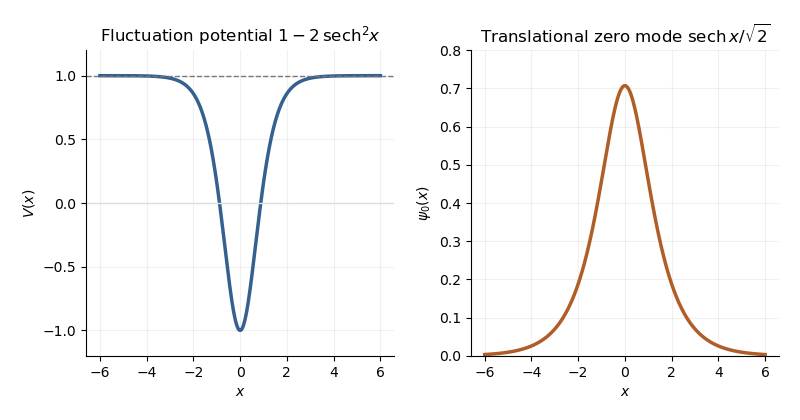
Sine-Gordon kink fluctuation potential and normalized translational zero mode
. Details. In the Gaussian fluctuation approximation, the formal oscillator contribution to the one-loop soliton mass correction, before adding any counterterm, isUse a common regulator for the two sums, include all discrete modes, and treat the translation mode as above. The vacuum sum is essential: subtracting only classical vacuum energy would leave an extensive oscillator energy. A periodic fluctuation and its derivative are matched at the two ends of the large box; the one-kink background lies in the twisted topological sector, and its infinite-line profile is accurate up to exponentially small boundary corrections.
For a continuum scattering wavefunction, equality of its two asymptotic values gives the periodic-box phase-shift quantizationAway from the threshold, expand at a matched mode number:Since consecutive free wave numbers are separated by , replacing the continuum-mode sum by an integral proves the displayed continuum contribution:The ultraviolet cutoff is retained until the counterterm is added.
There is a finite threshold issue if this expression is identified with the complete oscillator correction. It can be settled directly using the factorization: a continuum eigenfunction is . Its transmission phase obeyswith the odd phase branch that tends to zero at large . For , the continuum roots have labels ; there is no periodic continuum root at , since the limiting eigenfunction has opposite signs at the two ends. The bound state at replaces the free oscillator with . Consequently, in mode-number regularization of soliton masses,The PDF's continuum-only formula misses this finite under this standard phase and mode-counting convention. It has the correct logarithmic ultraviolet divergence, but the missing term is not suppressed by large . Changing the phase branch requires changing the mode labels and endpoint terms consistently; it cannot erase a physical mode from the formal spectrum sum.
At high momentum, , so both expressions have divergent part . The canonical field has a quartic interaction with coupling . Its vacuum tadpole diagram shifts the squared mass by , whereThe Sine-Gordon vacuum tadpole counterterm has and adds potential energy density . Since , its vacuum-subtracted kink energy iswhich cancels the logarithmic ultraviolet divergence. Finite parts require a specified renormalization condition. As a consistency check, with this tadpole subtraction and matched mode-number cutoff, integration by parts yieldsThe complete semiclassical soliton mass is then in that convention. This last finite result uses the bound-mode term and is additional to the requested ultraviolet cancellation.
Past exam of the mathematics course of the University of Cambridge 2017 iii Paper 304 1 i Solution Created 2026-10-03 Updated 2026-10-05
For , the quantum harmonic oscillator has energies , , in units . For positive inverse temperature , taking the trace in the energy basis and summing a geometric series givesThis is the thermal partition function of a quantum harmonic oscillator, including its zero-point energy. The assumptions ensure convergence; at the free particle on the noncompact line instead has an infinite spatial-volume factor.
Past exam of the mathematics course of the University of Cambridge 2018 iii Paper 306 2 ii Solution Created 2026-10-03 Updated 2026-10-05
In the displayed version of light-cone gauge in string theory, the oscillators have transverse components andThe center-of-mass Poisson brackets remain , and the transverse oscillator Poisson brackets are . Other independent brackets vanish. With , canonical quantization gives the canonical commutation relationsThe oscillator Fock vacuum at momentum is defined by for . It is the ground state of one string, rather than the empty spacetime vacuum. Set for . The normal ordering prescription gives the string level operatorA Fock state basis is obtained by applying to , with string level operator eigenvalue . In particular, its level-one states areThey transform as the transverse vector of the little group rotation subgroup , precisely the vector-particle polarizations of a massless vector. A massive vector would instead require vector-particle polarizations. This conclusion uses a quantization compatible with the Lorentz group of the bosonic string theory.
The classical mass constraint alone has no quantum zero-point energy shift. Its quantum version includes the normal-ordering constant of a string :Masslessness at level one fixes , soThus the ground state is a tachyon. Without the quantum ordering shift, the displayed classical constraint would give and would not support the stated massless interpretation. In the usual transverse vacuum regularization, ; consistency with also gives the critical dimension of string theory .
Past exam of the mathematics course of the University of Cambridge 2020 ii Paper 3 35A i Solution Created 2026-09-24 Updated 2026-09-29
In a box of volume , the electromagnetic mode density in a box, including the two transverse polarizations, isEach photon has energy , and the given mean occupation number is . Omitting the temperature-independent zero-point energy, the total energy is thereforeWith the change of variables ,
Past exam of the mathematics course of the University of Cambridge 2024 iii Paper 306 2 i Solution Created 2026-09-24 Updated 2026-09-25
The term is the target-space zero-mode kinetic energy. The constant is the zero-point energy of the left- and right-moving oscillators: each chiral boson contributes . Finally,count the energies of the two independent sets of string oscillators; one excitation of mode has energy .
Past exam of the particle Astrophysics course of the University of Cambridge 2014 Paper 1 2 Solution 2026-10-20
For successive radial null rays from a comoving source, equals the same spatial integral. Subtracting two nearby wavecrests gives , hence the cosmological redshiftFor transparent propagation, photon energies are reduced by and arrival intervals increased by . The observer-area sphere is , so the observed bolometric flux isThus the requested uses , the present transverse proper/area distance. In a curved metric this is not the radial proper distance ; the two coincide for . The source's unqualified “proper distance” needs this distinction.
Type Ia supernovae are standardizable candles: light-curve shape and colour calibrate their luminosity. Distant events are fainter, hence have larger inferred luminosity distances, than appropriate matter-only decelerating models predict. Their redshift–distance relation favours recent accelerated expansion. In general relativity, sufficiently negative pressure, , drives acceleration. Dust, evolution, calibration and selection are checked as possible systematics; a single faint supernova is not the argument.[ref]
An independent complementary test combines the cosmic microwave background acoustic distance/near-flat geometry with matter-density and baryon acoustic oscillation constraints. Matter alone does not supply the required late-time expansion history; a dark-energy component fits the joint data. CMB geometry alone has curvature/expansion degeneracies and is not an assumption-free detection of a cosmological constant.[ref]
Planck 2013 results. XVI. Cosmological parameters by Planck Collaboration. CMB,BAO and expansion-model constraints
In natural units , a regulated zero-point energy estimate isThe integral is ultraviolet divergent and requires renormalization; it is not a finite prediction from counting “virtual pairs.” An electroweak scale estimate gives , or somewhat smaller with loop factors. Compared with this is roughly too large.
The source's units are inconsistent: is a vacuum energy density, whereas has units . The comparison above consistently uses densities. Bare and quantum contributions must cancel to extraordinary accuracy if this naive scale estimate is representative: the cosmological constant problem. Its severity is not a measured value of an individual cutoff integral.
In the harmonic approximation, sum over wavevector and phonon branch :The occupation factor is the Bose-Einstein distribution with zero phonon chemical potential; is the zero-point energy. A temperature-independent zero-point term does not contribute to the heat capacity in this fixed-frequency approximation.
For a dilute linear diatomic gas with fixed molecular number, translation contributes molar . Rotational levels are with degeneracy :At rotational excitation is frozen out; at the partition function is proportional to , giving and . Nuclear-spin populations and molecular symmetry modify detailed low-temperature behaviour. The high-temperature result corresponds to two quadratic rotational degrees of freedom; a nonlinear molecule has three and contributes .
For each independent harmonic vibration, write . Its energy and heat capacity areThe contribution is exponentially small at low temperature and approaches per mode at high temperature. zero-point energy does not contribute to . Typically rotations activate before bond stretching, producing diatomic plateaus as temperature increases within the molecular regime; ideal-gas . Dissociation, electronic excitation and nonideal interactions eventually invalidate this simple sequence. Polyatomic gases sum over their distinct vibrational frequencies; no single activation temperature describes all modes.
Past exam of the physics A course of the University of Cambridge 2015 Paper 1 Section A 2 Solution 2026-10-20
For the quantum harmonic oscillator, put and . The normalized energy eigenstates arewhere is a Hermite polynomial. Successive energies are equally spaced; the ground state retains zero-point energy . The th wavefunction has nodes of a wavefunction and parity . In particular, the first three shapes are proportional to , , and . The classical turning points satisfy ; the wavefunctions extend beyond them and decay, rather than ending abruptly.
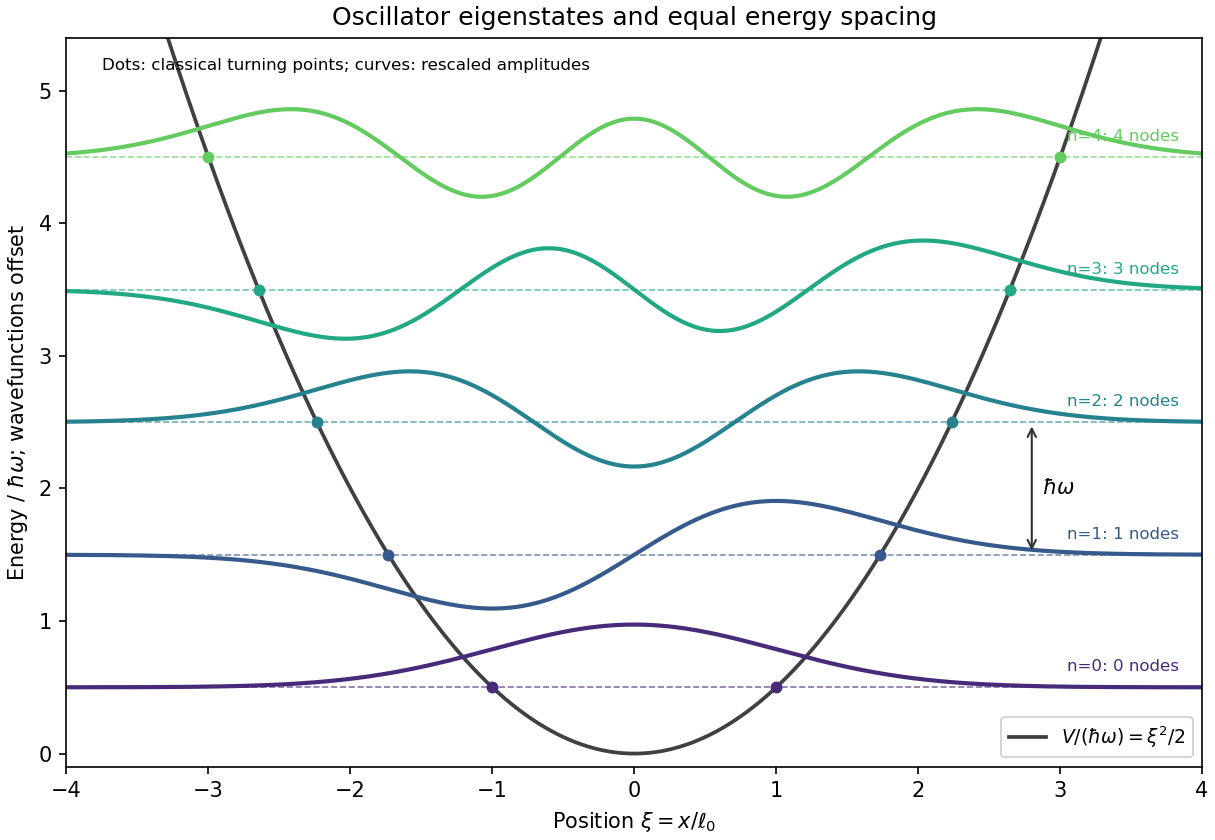


The wavefunctions are plotted with arbitrary vertical scale about their energy levels. Their signed excursions are amplitudes, not additional energies or probability densities.
Past exam of the physics A course of the University of Cambridge 2015 Paper 1 Section B B8 Solution 2026-10-20
Factorization. Put and use the canonical commutation relation :It follows thatThe arises from quantum operator ordering; treating and as commuting would lose the zero-point energy.
Raising the energy. If , thenThus the creation operator produces an energy eigenstate with energy . It is nonzero: for a normalized physical oscillator eigenstate, . Normalize by this norm if a normalized state is wanted.
Lowest wavefunctions and orthogonality. In the position representation in quantum mechanics,The annihilation condition therefore gives . Applying to its solution givesTheir inner product is proportional to , since the integrand is odd. These are the even and odd lowest wavefunctions shown in A2, with energies and .
For the Quantum harmonic oscillator defineThe Canonical commutation relation gives , andThus the creation operator and annihilation operator raise or lower the energy by one quantum. Positivity of and termination of downward stepping give , . Normalized actions are and . The annihilated ground state obeysThe nonzero Ground state energy is the zero-point energy, consistent with position-momentum quantum uncertainty. Since , a perturbation linear in position connects only neighbouring number states. The algebra is especially useful for matrix elements and selection rules.[ref]
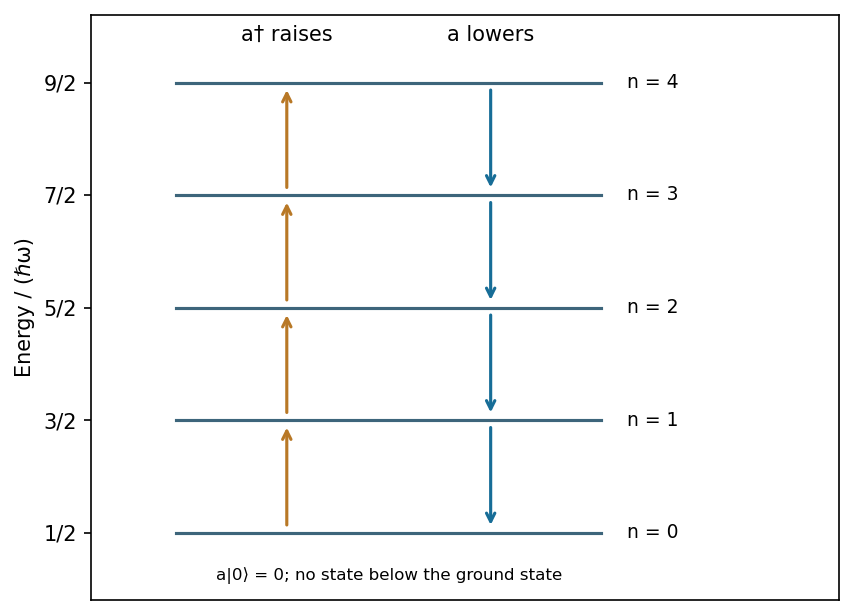
Creation and annihilation connect equally spaced oscillator levels while the ground-state lowering action vanishes
. Source. Details. 