Topics (384k) Articles (398k) Users (410) Discussions (242) Comments (383) Files (13k) New article

A pulmonologist is a physician specializing in diseases of the lungs, conducting airways and related respiratory function. The work connects clinical observations with respiratory mechanics, ventilation and gas exchange. The American Board of Internal Medicine's primary specialty standards include supervision and interpretation of pulmonary-function testing, ventilator-related skills and bronchoscopy.[ref]
Pulmonary Disease by the American Board of Internal Medicine. Training and Procedure Requirements, pulmonary-function testing and bronchoscopy competencies
The scientific question determines the measurement. Spirometry records gas moved at the mouth. Lung compliance relates volume to an internal pressure difference. Gas exchange also depends on the exchange surface and blood flow, so an expired-volume trace does not by itself measure every part of respiratory performance. A pulmonologist interprets these complementary observations alongside the clinical context rather than treating all breathing measurements as interchangeable.
An original ventilation example illustrates why this distinction matters. Let tidal volume be , respiratory rate be , and non-exchanging conducting-airway volume be , representing anatomical dead space. In a simplified model where the remaining inspired gas reaches functioning exchange regions,The first is total ventilation per minute; the second is the model's alveolar ventilation. OpenStax distinguishes conducting-airway dead space from gas available to alveolar exchange.[ref]
Anatomy and Physiology 2e by J. Gordon Betts and others. §22.3, Respiratory Volumes and Capacities, anatomical and alveolar dead space
With stipulated L, twelve breaths per minute at L give total ventilation 6 L/min and alveolar ventilation 4.2 L/min. Thirty breaths per minute at L still move 6 L/min in total, but give only 1.5 L/min in this model. Equal total movement can therefore supply quite different amounts of fresh gas to exchange regions. These chosen numbers explain the quantities; they are not a breathing recommendation or a patient assessment.
Measurement quality is part of the specialty's scientific reasoning. The primary spirometry statement separately evaluates instrument response, maneuver acceptability and repeatability.[ref]
Standardization of Spirometry 2019 Update by Brian L. Graham and others. Device Quality Assurance and FVC Maneuver
A precise measurement of one function can be informative while leaving the cause of an abnormal result unresolved. Combining anatomy, mechanics and exchange measurements makes those remaining questions explicit.An ocean current is organized water motion that transports mass, heat, salt and other properties through the ocean. Surface winds, pressure gradients, buoyancy changes, Earth's rotation and friction all contribute, with their relative importance depending on scale and depth.
A steady large-scale interior flow can approximately balance a horizontal pressure gradient against the Coriolis force, while boundary currents require additional dynamics. Henry Stommel showed that the latitude dependence of rotation, combined with friction in a wind-driven basin, can concentrate the return flow on the western side. The circulation is therefore not simply water moving in the direction of the local wind.[ref]
The westward intensification of wind-driven ocean currents by Henry Stommel. 1948 rotating-basin model with wind stress and linear bottom friction
The Labrador Sea is a North Atlantic basin between Greenland and northeastern North America, studied as a site of deep ocean convection. Winter surface heat loss can increase near-surface water density until mixing reaches much deeper layers, forming Labrador Sea Water.
Repeated temperature and salinity profiles distinguish deepening convection from ordinary seasonal surface changes. The resulting water spreads into the wider circulation and helps ventilate the ocean interior. The depth of mixing varies between years; a single winter or one observing station cannot characterize the entire overturning circulation.[ref]
2024 and 2025 Oceanographic Conditions in the Labrador Sea by Igor Yashayaev. Abstract and seasonal-to-multidecadal hydrographic observations
Phylogenetic analysis uses observations of phylogenetic characters to infer or test hypotheses about relationships produced by evolution. Its inputs, character definitions and inference rule matter: a phylogenetic tree is a proposed history supported to some extent by the data and model, rather than a direct photograph of ancestry.
For an illustrative four-organism example, suppose a binary phylogenetic character is 1 in A and B and 0 in C and D. On a phylogenetic tree separating A and B from C and D, one change explains the pattern; on a tree grouping A with C and B with D, at least two changes are needed. Maximum parsimony favors the first explanation for this character. Additional characters can conflict, and repeated changes can obscure ancestry.
An approach based on maximum likelihood estimation instead compares probabilities. With observed data , tree and model parameters , the likelihood function isA nucleotide substitution model assigns probabilities to sequence changes; unknown ancestral states are summed over using the phylogenetic pruning algorithm. Joseph Felsenstein's 1981 paper developed this approach for DNA sequences and discussed testing equal-rate hypotheses. Model choice and uncertainty therefore belong to the analysis alongside the displayed phylogenetic tree.[ref]
Evolutionary trees from DNA sequences: a maximum likelihood approach by Joseph Felsenstein. Journal of Molecular Evolution 17 (1981), pp. 368–376: likelihood calculation and tests of evolutionary-rate hypotheses.
A photomask is a patterned optical component used to define the illumination reaching a photosensitive layer in photolithography. Its pattern controls transmission, reflection or optical phase, depending on the imaging system. In projection lithography, optics form a reduced image of the mask on the substrate.[ref]
Glossary of Lithography Terms by Chris A. Mack. Mask, Photolithography and Projection Printing
The printed boundary depends on diffraction, illumination and photoresist response as well as the drawn mask edge. Optical proximity correction deliberately changes mask geometry to compensate for those effects. A mask feature is therefore part of an imaging-and-material process, rather than a guarantee that an identical outline will appear on the wafer.
Aerial-image modulation measures the variation of optical intensity in the image delivered to a photoresist before its chemical and development response. A common contrast measure is , for nonnegative intensities with nonzero denominator. Equal bright and dark intensities give ; a dark minimum with a positive maximum gives .
For example, intensities and give . Multiplying both by the same exposure factor leaves unchanged, although it changes the deposited dose and can change the printed pattern. Image modulation and photoresist contrast therefore describe different stages of photolithography: the optical signal and the material's conversion of that signal into a developed profile.[ref]
The photochemical quantum yield measures the number of specified chemical events per excitation photon absorbed by the system. For an integrated product measurement,Counts or amounts of substance must be used consistently. State the product or reactant-change event, excitation wavelength and experimental conditions. A wavelength-specific yield strictly refers to monochromatic excitation.[ref]
IUPAC Compendium of Chemical Terminology, fifth edition (Gold Book) by International Union of Pure and Applied Chemistry. Entry Q04991: definition, integral/differential quantum yield and monochromatic-excitation note; goldbook.iupac.org/terms/view/Q04991/plain .
Absorbed and incident light are different denominators. Under the simple transmission model, the fraction absorbed at absorbance is . If of photons arrive at a sample with , then are absorbed, neglecting reflection and scattering. Formation of of the chosen product gives ; dividing by incident exposure instead gives . These are invented bookkeeping values, not a measured reaction yield.[ref]
IUPAC Compendium of Chemical Terminology, fifth edition (Gold Book) by International Union of Pure and Applied Chemistry. Entry Q04991: absorbed-flux correction in the differential expression.
A measurement therefore combines two calibrations: quantify the chemical change and determine absorbed photon exposure. A differential yield uses the reaction rate divided by absorbed photon flux; an integrated yield averages the specified change over an exposure. Changing absorption as products accumulate can make those quantities differ.
Photoisomerization supplies one application, but the definition requires the chosen event rather than an assumption that every absorbed photon makes one permanent product. A yield for chemical conversion also differs from a fluorescence quantum yield, which counts emitted photons. The numerical example does not impose a universal upper bound on every possible definition of a photochemical event.
Excited-state intramolecular proton transfer, abbreviated ESIPT, is transfer of a proton between sites within the same molecule after electronic excitation. A hydrogen bond can connect donor and acceptor sites, while excitation changes the energetic preference along the proton transfer coordinate. The resulting excited tautomer may emit at a different energy from the initially excited form.
The classic 3-Hydroxyflavone study by Pradeep K. Sengupta and Michael Kasha compared absorption, green emission in room-temperature solution, violet emission in a rigid matrix, excitation spectra and deuteration effects.[ref]
Excited state proton-transfer spectroscopy of 3-hydroxyflavone and quercetin by Pradeep K. Sengupta and Michael Kasha. Printed pp.382–384, Figures1–4
The change of emission did not require a change in elemental composition: it concerned different arrangements and electronic states of the same molecular system.A large Stokes shift is informative but is not a direct measurement of a reaction barrier. For an original example, absorbing a photon and emitting at corresponds to energies near and , using . Their difference, about , includes the overall relaxation and emission energy balance; it is not automatically the activation energy of the transfer step.
An original pulsed-excitation model makes a kinetic prediction. Let and denote populations of the normal and transferred excited forms, with and . Neglect reverse transfer and writewhere includes transfer and all other normal-state decay, is total transferred-state decay and . For ,If , the limiting expression is . The initially absent transferred form rises and then decays; its maximum occurs at for positive unequal decay rates.
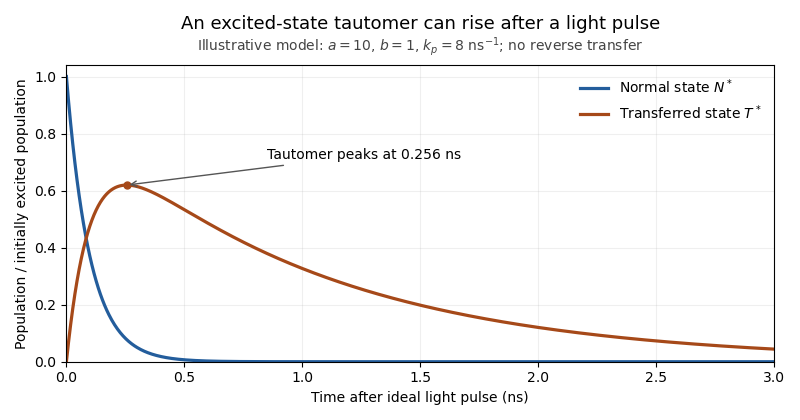
For chosen , and , the transferred population peaks at approximately . These are model values, not rate measurements from the historical experiment. Detected emission instead weights each population by its radiative rate and instrument response. Fluorescence lifetime and fluorescence instrument response must therefore be considered alongside spectral band ratios when testing a transfer mechanism.
Kasha's rule states that appreciable luminescence normally originates from the lowest excited electronic state of a given spin multiplicity. In the familiar molecular notation, fluorescence is usually associated with and phosphorescence with , even when absorption initially prepares a higher state. The rule is a spectroscopic regularity, rather than a guarantee that all excited molecules emit.
Michael Kasha presented the underlying classification of electronic transitions in 1950, discussing the connection between radiationless conversion and the lowest emitting level.[ref]
Characterization of electronic transitions in complex molecules by Michael Kasha. Discussions of the Faraday Society 9, 14–19; printed pp. 14–15
Molecular internal conversion provides a route from a higher electronic state to a lower state of the same multiplicity before appreciable higher-state emission occurs.An original rate-competition model makes the condition quantitative. For an initially populated state, let be conversion to , upper-state radiative decay and other loss. The fraction emitting directly from isWith stipulated , and no other loss, this fraction is about . Fast conversion suppresses upper-state emission even though the molecule absorbs into that state. If conversion is slowed until it competes with radiation, appreciable higher-state emission becomes possible. These values illustrate kinetics, not universal molecular constants.
The rule concerns the emitting electronic state. It does not by itself assert an excitation-wavelength-independent fluorescence quantum yield; that is the separate Kasha-Vavilov rule. Competing photochemistry, intersystem crossing and state preparation can affect the number of emitted photons even when the eventual fluorescence band comes from .
A proposed experimental test compares emission spectra after excitation into different absorption bands, correcting for absorbed photon counts and detector response. Similar emission-band shapes support a common emitting state, while time-resolved measurements test whether a fast relaxation precedes emission. A different band requires checking sample purity, distinct species and instrumental artifacts before assigning emission from a higher electronic state.
The rate argument also explains why a rigid drawing of one downward arrow is insufficient evidence. Measure which states are populated, how fast they exchange population and which transitions radiate. This connects an empirical rule with a falsifiable kinetic model, while preserving the distinction between a common behaviour and an exception-free law.
Molecular internal conversion is a radiationless transition between electronic states of the same spin multiplicity. Electronic and vibrational energy are redistributed without emission of a photon in the transition itself. IUPAC describes the step as isoenergetic: a lower electronic state can be reached with increased vibrational excitation, followed by subsequent relaxation.[ref]
This is distinct from intersystem crossing, which connects states of different multiplicity, and from vibrational relaxation within an electronic state. It is also distinct from nuclear internal conversion. A molecular singlet-to-singlet transition such as fits the molecular definition; the energy need not be immediately transferred as heat to a surrounding solvent.
An original population model separates internal conversion from later decay. Suppose an impulsive excitation places population in , transfer to occurs at rate , and loses population at total rate :For ,The lower-state population first rises and later decays. If only part of is radiative, fluorescence intensity is proportional to that radiative rate times , not simply to the loss rate of .
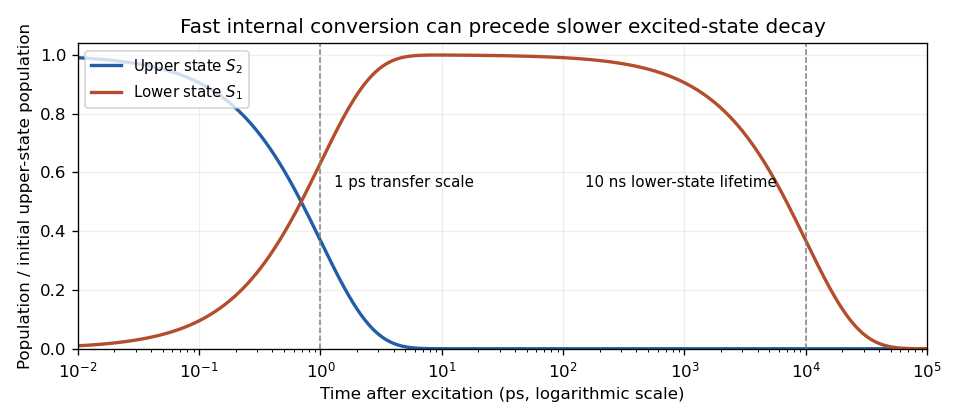
Original sequential-population model with a 1 ps upper-state transfer scale and a 10 ns lower-state lifetime; no measured molecular rates are implied
. Details. For stipulated and , the transfer time scale is 1 ps while the lower-state lifetime is 10 ns. A fast population transfer can therefore precede much slower emission. These are model constants, not measured values assigned to every molecule.
An informative experiment resolves the time dependence of upper- and lower-state signals after a pulse and tests whether the proposed transfer accounts for both. A decay trace alone can have several explanations; spectral assignment and competing channels matter. Sequential excited-state population kinetics is one model to test against those measurements.
Michael Kasha's 1950 analysis linked radiationless transitions among like-multiplicity states to emission from the lowest excited level of a given multiplicity.[ref]
Characterization of electronic transitions in complex molecules by Michael Kasha. printed pp. 14–15, abstract and Internal Conversion
The rate competition supplies a physical motivation for Kasha's rule, while leaving room for molecules whose competing pathways behave differently.Tyrosine phosphorylation is addition of a phosphate group to the hydroxyl group of a tyrosine residue in a protein, producing a phosphotyrosine residue. A protein kinase commonly transfers the phosphate from ATP; a protein tyrosine phosphatase can remove it. This modifies a side chain without changing the underlying order of amino acid residues.
The modification can change binding interactions or enzyme behavior. It is not intrinsically an “on” instruction: the consequence depends on which tyrosine residue is modified and what molecular partners recognize that state. Nor does detecting phosphate somewhere in a protein identify tyrosine as the modified amino acid.
The discovery was sharpened by experiments on the transforming Src protein of Rous sarcoma virus. Analysis of phosphorylated reaction products identified phosphotyrosine, establishing a phosphorylation target beyond the familiar serine/threonine cases. Later work on JAK2 and the erythropoietin receptor connected stimulus-dependent tyrosine phosphorylation with a receptor-associated signaling enzyme.[ref]
Transforming gene product of Rous sarcoma virus phosphorylates tyrosine by Tony Hunter and others. PNAS 77 (1980), 1311–1315: identification of phosphotyrosine in kinase products.
[ref]A simple occupancy model distinguishes modification from total protein amount. If is the fraction carrying one specified phosphate site, assume fixed first-order effective rates for modification and for removal:For and , the model gives . The protein population can remain constant while phosphate occupancy changes. Real signaling may require additional sites, enzyme saturation and interactions beyond this deliberately simple example.
Diphosphate, also called inorganic pyrophosphate in biochemical reactions, contains two phosphorus centres connected through an oxygen bridge. The fully deprotonated ion is . Other protonation states retain the connected phosphorus–oxygen framework but differ in hydrogen count and electric charge.[ref]
Diphosphate tetraanion in ChEBI. CHEBI:18361, Formula, charge, structure and conjugate-acid relation
Counting atoms reveals the bridge. Two separate orthophosphate tetrahedra contain eight oxygens in total; sharing one bridging oxygen gives seven distinct oxygens. This connectivity differs from merely having two independent phosphate ions in one solution.
Guanylate cyclase releases diphosphate while converting GTP to cyclic guanosine monophosphate. A second enzyme, inorganic diphosphatase, hydrolyses diphosphate to two phosphate products.[ref]
An ideal coupled assay producing diphosphate can therefore yield phosphate after complete hydrolysis. Forgetting the factor of two would misinterpret a phosphate-based readout. Existing phosphate and other phosphate-releasing reactions require controls if that signal is to be attributed to the intended reaction.
Pyrophosphate is the two-phosphorus member of the condensed phosphate family, with a phosphorus–oxygen–phosphorus bridge joining its two phosphate units. The fully deprotonated anion is ; its acid is . The name also occurs in salts and partially protonated forms, so an actual chemical solution must be described with its pH and protonation state.
Cleaving the bridge by hydrolysis produces two separate phosphate units. One balanced representation isBoth the atoms and the total charge balance: the two products together carry charge . The equation distinguishes chemical cleavage from merely releasing an intact pyrophosphate ion from a larger molecule.
A classic experiment isolated crystalline inorganic pyrophosphatase from yeast and tested its activity on pyrophosphate. The enzyme accelerated hydrolysis and required activating metal ions, including magnesium. Its failure to hydrolyze the tested organic compounds containing related phosphate linkages demonstrated reaction substrate specificity: recognizing free pyrophosphate is not equivalent to attacking every phosphorus–oxygen–phosphorus linkage.[ref]
Crystalline inorganic pyrophosphatase isolated from baker's yeast by M. Kunitz. abstract, catalytic specificity and activating ions
Orthophosphate denotes the uncondensed, single-phosphorus phosphate unit. Its fully deprotonated anion is : one phosphorus surrounded by four oxygen atoms. In aqueous biochemical usage, inorganic phosphate, , can include protonated forms such as hydrogenphosphate, , and dihydrogenphosphate, . Their proportions depend on pH; the name alone does not specify a unique protonation state.[ref]
Phosphate ions in ChEBI. CHEBI:18367, orthophosphate synonym and formula; CHEBI:35780, 43474 and 39745, phosphate-ion family and conjugate-acid/base relations
The contrast with pyrophosphate is connectivity. Pyrophosphate joins two phosphorus centres through an oxygen bridge; hydrolysis breaks that bridge to yield two separate orthophosphate units. One charge-balanced representation isThe exact proton balance changes with the chosen chemical species, but two phosphorus atoms remain two phosphorus atoms. M. Kunitz's 1952 isolation of inorganic pyrophosphatase from Saccharomyces cerevisiae provided a purified enzyme that specifically catalysed conversion of inorganic pyrophosphate to orthophosphate, making this distinction experimentally measurable.[ref]
Crystalline inorganic pyrophosphatase isolated from baker's yeast by M. Kunitz. Journal of General Physiology 35, pp. 423–450; abstract, specific hydrolysis of pyrophosphate into orthophosphate
A phosphate monoester is a phosphate ester with one organic group joined to phosphorus through an oxygen atom. [ref]
Nomenclature of Phosphorus-Containing Compounds of Biochemical Importance by IUPAC and IUBMB. §1, phosphoric esters, and §4, phosphodiesters
A neutral-acid representation is . Ionization changes the O–H groups and charge without changing the count of ester linkages. “Mono” counts the one esterified group at that phosphate unit, not the number of carbon atoms in .For example, an ethyl group in contains two carbons, but the compound is still a phosphate monoester. A phosphate diester instead has two organic groups linked through oxygen to the same phosphorus, represented as . This structural counting distinguishes the classes without requiring a particular pH.
Hydrolysis of a phosphate monoester releases the corresponding hydroxyl-containing compound and inorganic phosphate. Alkaline phosphatase is an enzyme activity classified by that reaction, with broad substrate specificity.[ref]
An experimentally useful example is 4-Nitrophenyl phosphate. Its hydrolysis releases 4-Nitrophenol, whose colored anionic form permits an optical assay. That readout follows cleavage of the ester linkage; it does not count every possible phosphorus-containing compound in the sample.[ref]
A phosphoric ester is an ester of phosphoric acid: an organic group is joined through oxygen to phosphorus. Replacing one, two or three of the acid's O–H hydrogens by organic groups gives a phosphate monoester, phosphate diester or phosphate triester. A phosphoric anhydride instead contains an acid-derived linkage, such as P–O–P, rather than an additional P–O–C ester linkage.[ref]
For a structural counting example, compareThe first has one organic O–P attachment; the second has two. Removing an O–H proton changes the charge but leaves that attachment count unchanged. Conversely, adding a second separate monoester group elsewhere on a large molecule does not turn the first phosphorus center into a diester.
This distinction matters in biochemical measurements. 4-Nitrophenyl phosphate is a phosphate monoester whose cleavage can be followed optically; the released inorganic phosphate is a different chemical species. An alkaline phosphatase assay detects a specified conversion under specified conditions, rather than counting all phosphorus-containing material indiscriminately.[ref]
Diethanolamine Assay for the Enzymatic Assay of Alkaline Phosphatase by MilliporeSigma. §4, hydrolysis reaction; §§7.4–7.5, optical rate measurement
A phosphoric anhydride contains an acid-anhydride linkage involving phosphoric acid. One type joins two phosphoric groups through oxygen, giving P–O–P connectivity. A mixed anhydride joins a phosphoric group to a different acid-derived group, such as one derived from a carboxylic acid. These are distinct from the P–O–C connectivity of a phosphoric ester.[ref]
Nomenclature of Phosphorus-Containing Compounds of Biochemical Importance by IUPAC and IUBMB. §3, phosphoric anhydrides, types(a) and(b)
A formal neutral-molecule balance illustrates the first type:Two phosphorus centers remain, but one oxygen now bridges them. Both sides contain six hydrogens, two phosphorus atoms and eight oxygens. This is an atom balance, not a claim that dilute aqueous phosphoric acid spontaneously undergoes substantial condensation. Actual speciation and reaction direction depend on conditions.
The P–O–P connections between phosphoric groups in ATP illustrate anhydride connectivity, whereas the connection from its sugar to the first phosphoric group is an ester linkage.[ref]
Nomenclature of Phosphorus-Containing Compounds of Biochemical Importance by IUPAC and IUBMB. §3 and Table2, ATP and other oligophosphoric esters
One molecule can therefore contain more than one linkage class. Identifying the atoms on either side of a bridging oxygen is more informative than merely counting its phosphorus atoms.Alkaline phosphatase, EC3.1.3.1, is a phosphatase activity that hydrolyzes a phosphate monoester to an alcohol and inorganic phosphate. “Alkaline” refers to the activity's alkaline pH optimum under suitable assay conditions; it does not specify one universal optimum for every enzyme preparation or substrate. The accepted activity has broad substrate specificity.[ref]
A useful optical assay follows hydrolysis of 4-Nitrophenyl phosphate. The resulting 4-Nitrophenol is present mainly in its colored anionic form in the alkaline measurement mixture, so increasing absorbance reports product formation. The manufacturer's method measures the change at405nm and subtracts an enzyme-free blank.[ref]
Diethanolamine Assay for the Enzymatic Assay of Alkaline Phosphatase by MilliporeSigma. §4 reaction; §§7.4–7.5 rate measurement and blank subtraction
Using the Beer-Lambert law, , a constant optical path and calibrated coefficient giveFor an illustrative blank-corrected slope , path length and the method's coefficient , product appears at , or10micromolar per minute. The coefficient is assay-dependent, not a universal constant for every pH and wavelength.[ref]
Diethanolamine Assay for the Enzymatic Assay of Alkaline Phosphatase by MilliporeSigma. §7.5, coefficient18.5 and absorbance-rate conversion; slope independently chosen
A syllable organizes speech sounds around a syllable nucleus, often a vowel. A preceding syllable onset and a following syllable coda can surround that nucleus. These components describe the organization of speech, rather than a requirement to pause between successive units.[ref]
Essentials of Linguistics (2nd edition) by Catherine Anderson and others. Section3.10, Syllables: nucleus, onset, coda and the limits of physical boundary intuitions
For example, in a simple pronunciation of “cat”,
[k] occupies the onset, [æ] the nucleus and [t] the coda. A syllable can have an empty onset or coda, so the example's three-part form is not a mandatory template for every word. A syllabic consonant can also serve as a nucleus.The distinction matters in speech rhythm: counting letters, counting phonemes and identifying syllables are different operations. Physical measurements of duration and pitch contours can be related to syllable organization, but they do not imply a silent gap at every proposed boundary.
A consonant cluster is a sequence of multiple consonants without an intervening vowel, considered within the chosen phonological representation. Its possible position and composition depend on a language's phonotactics. The written number of consonant letters is insufficient to identify a spoken cluster.
In an ordinary pronunciation of “stay”,
[st] forms a syllable onset cluster; the final [ts] in “cats” forms a syllable coda cluster. By contrast, the English spelling ch can represent one affricate, transcribed [t͡ʃ], rather than two independently combined consonants. This comparison distinguishes spelling, phonetic detail and phonological grouping.[ref]Essentials of Linguistics (2nd edition) by Catherine Anderson and others. §3.4, affricates; §3.10, onset/coda clusters; §4.2, phonotactic restrictions
A recording and explicit transcription make the analysis inspectable; rapid articulation need not insert a silence between the cluster's members. Pinned article: Introduction to the OurBigBook Project
Welcome to the OurBigBook Project! Our goal is to create the perfect publishing platform for STEM subjects, and get university-level students to write the best free STEM tutorials ever.
Everyone is welcome to create an account and play with the site: ourbigbook.com/go/register. We belive that students themselves can write amazing tutorials, but teachers are welcome too. You can write about anything you want, it doesn't have to be STEM or even educational. Silly test content is very welcome and you won't be penalized in any way. Just keep it legal!
Intro to OurBigBook
. Source. We have two killer features:
- topics: topics group articles by different users with the same title, e.g. here is the topic for the "Fundamental Theorem of Calculus" ourbigbook.com/go/topic/fundamental-theorem-of-calculusArticles of different users are sorted by upvote within each article page. This feature is a bit like:
- a Wikipedia where each user can have their own version of each article
- a Q&A website like Stack Overflow, where multiple people can give their views on a given topic, and the best ones are sorted by upvote. Except you don't need to wait for someone to ask first, and any topic goes, no matter how narrow or broad
This feature makes it possible for readers to find better explanations of any topic created by other writers. And it allows writers to create an explanation in a place that readers might actually find it.
Figure 1. Screenshot of the "Derivative" topic page. View it live at: ourbigbook.com/go/topic/derivativeVideo 2. OurBigBook Web topics demo. Source. - local editing: you can store all your personal knowledge base content locally in a plaintext markup format that can be edited locally and published either:This way you can be sure that even if OurBigBook.com were to go down one day (which we have no plans to do as it is quite cheap to host!), your content will still be perfectly readable as a static site.
- to OurBigBook.com to get awesome multi-user features like topics and likes
- as HTML files to a static website, which you can host yourself for free on many external providers like GitHub Pages, and remain in full control

Figure 2. You can publish local OurBigBook lightweight markup files to either OurBigBook.com or as a static website.
Figure 3. Visual Studio Code extension installation.
Figure 5. . You can also edit articles on the Web editor without installing anything locally. Video 3. Edit locally and publish demo. Source. This shows editing OurBigBook Markup and publishing it using the Visual Studio Code extension. 
- Infinitely deep tables of contents:




All our software is open source and hosted at: github.com/ourbigbook/ourbigbook
Further documentation can be found at: docs.ourbigbook.com
Feel free to reach our to us for any help or suggestions: docs.ourbigbook.com/#contact