Topics (384k) Articles (398k) Users (410) Discussions (242) Comments (383) Files (13k) New article

A predictable mark-dependent integrand gives a true martingale whenever on every finite horizon. Local versions follow when this expected integrability holds after localization. The compensator identity applied to predictable indicators from the past proves that every increment has conditional expectation zero. Choosing gives the generator martingale under the same local integrability conditions.
The predictable random measure matching the expected integrals of the jump measure against every nonnegative predictable integrand. For displacement marks of a Markov jump process, . Multiplying the integrand by an event known before an interval proves that the compensated integral has conditionally centered increments; expected absolute integrability makes it a true martingale. With the compensator absolutely continuous in time, squared-integrand integrability gives the square-integrable compensation isometry.
An electrical calorimetry experiment asks whether a measured electrical work input accounts for a measured warming. The University of Iowa's demonstration uses an insulated flask containing water, an immersed heater, a thermometer, electrical meters and a timer. Its procedure compares the duration, electrical readings and temperature rise. The following low-power measurement design and synthetic readout develop that idea; they are not measurements reported by the demonstration. [ref]
5F15.10 - Electrical Equivalent of Heat by University of Iowa Department of Physics and Astronomy. Equipment and Procedure: insulated flask, immersed heater, thermometry, electrical meters and timed warming
Use a covered calorimeter with weighed water, an immersed resistor, a calibrated thermometer and gentle stirring. Put an ammeter in series with the heater branch and a high-input-electrical resistance voltmeter across the immersed resistor's terminals. Record , , temperature and room temperature before, during and after switching the heater on. Measure the electric potential difference at the heater, rather than at the supply: lead and contact electrical resistance outside the receiving boundary can consume power that never reaches the water. Account for voltmeter loading if the ammeter also includes the sensing branch's electric current.[ref]
The electrical readout gives operating electrical resistance when , and power . To test Ohm's law, obtain several pairs at the same temperature; one ratio alone cannot establish a linear response. For small electrical resistance, use four-terminal sensing to exclude lead drops and reverse electric current to test stable offsets from the thermoelectric effect. Use brief low-power resistance measurements if the intended result is the unheated value: the test itself causes Joule heating.
For a covered assembly at approximately constant pressure, with negligible evaporation, negligible endpoint mechanical energy changes and no phase transition, takeHere is the water's specific heat capacity at constant pressure, is the participating vessel, heater and sensor heat capacity, is signed outward heat leakage, and is stirring work entering the assembly. The storage term approximates its enthalpy change; for a rigid fixed-volume receiver use the corresponding heat capacity at constant volume. Calibrate independently if the purpose is to test electrical input against thermal storage. Using the same heating run to define and then claiming it verifies the equality would be circular.
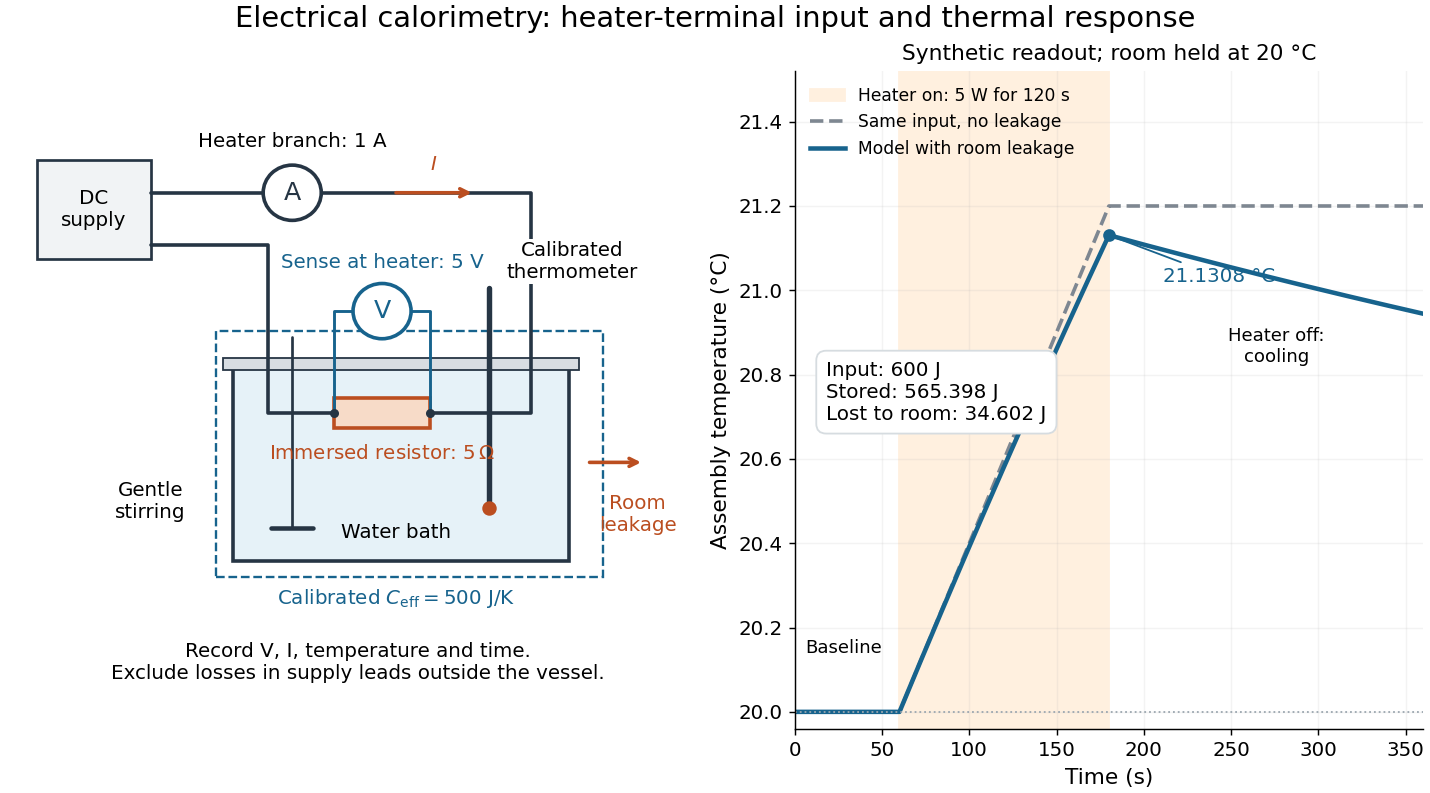
For the synthetic trace, stipulate , , , , room temperature , and loss coefficient , with negligible stirring input. The heater runs for , beginning at room temperature. The calorimeter heat-loss correction model isIt predicts , , storage and outward loss . Neglecting leakage undercounts deposited energy by about ; assuming no loss predicts . After switching off, the excess temperature undergoes exponential decay with time constant . A cooling slope can estimate only with known and a credible single-temperature model.
Controls separate causes of a temperature rise. Check the electrical meters' zeros and thermometer calibration; keep water mass, immersion, lid and stirring fixed between runs. Record a heater-off stirred baseline to estimate sensor drift and stirring input. Repeat cooling runs over the same temperature range to estimate environmental heat transfer; a baseline taken only at room temperature cannot measure warming-dependent leakage. Vary electric current while keeping and initial thermal conditions comparable: corrected deposited energy should scale as for equal durations. An independent calorimeter calibration or known reference heat capacity makes this a quantitative test rather than a qualitative observation.
Finite sensor response, incomplete thermal equilibrium, changing or heat capacity, evaporation, and imperfect loss corrections limit the inference. A final temperature alone cannot distinguish smaller electrical input from larger heat leakage or a larger participating heat capacity. Agreement tests the stated assembly and its energy accounting; it does not show that all electrical work in arbitrary devices becomes heat.
Historically, the Royal Society's archive description of James Prescott Joule's manuscript dated 13 October 1840 records a coil of wire in a jar of water, a thermometer and a galvanometer, and summarizes his inference that warming depends on electrical resistance and the square of electric current intensity. This electrical experiment precedes Joule's paddle-wheel experiment; the input here is electrical work, whereas the paddle supplies mechanical work. The catalogue, rather than the inaccessible manuscript images, supports this account. [ref]
Archive catalogue record AP-23-34: On the production of heat by voltaic electricity by The Royal Society Archives. Royal Society Archives, AP/23/34, Description and Date: apparatus, resistance dependence and duplicate-ratio conclusion; manuscript dated 13 October 1840
The electric field does work on matter at local power per volumeHere is current density and the dot product includes the relative direction. Positive means energy passes from the field to matter; negative means matter supplies energy to the field. In general this is a work rate, not automatically an irreversible heating rate.[ref]
For a stationary isotropic Ohmic conductor with real scalar electrical conductivity , local Ohm's law gives . Thus the local Joule heating rate isThe electrical resistivity has units , and electrical conductivity has units . These formulas use the material's rest frame and dissipative conduction current density. Moving media, complex conductivity, and additional storage or transport processes require their appropriate energy balance rather than this scalar substitution.
For uniform current in a straight homogeneous wire of length , wire cross-sectional area and constant electrical conductivity, , and . The volume integral recovers terminal power:As a numerical check, the wire already used in electrical resistance has , , and . It gives , and , agreeing with and . Concentrating the same electric current in a smaller wire cross-sectional area therefore raises the local heating rate if electrical resistivity stays fixed.
Whether increasing electrical resistance increases Joule heating depends on what the supply holds fixed. Consider separate ideal resistor experiments with and , each maintained at its specified temperature. At fixed electric current , doubling changes the required electric potential difference from to and doubles power from to . At fixed electric potential difference , doubling halves electric current from to and halves power from to . These are stipulated model values, not measured data.
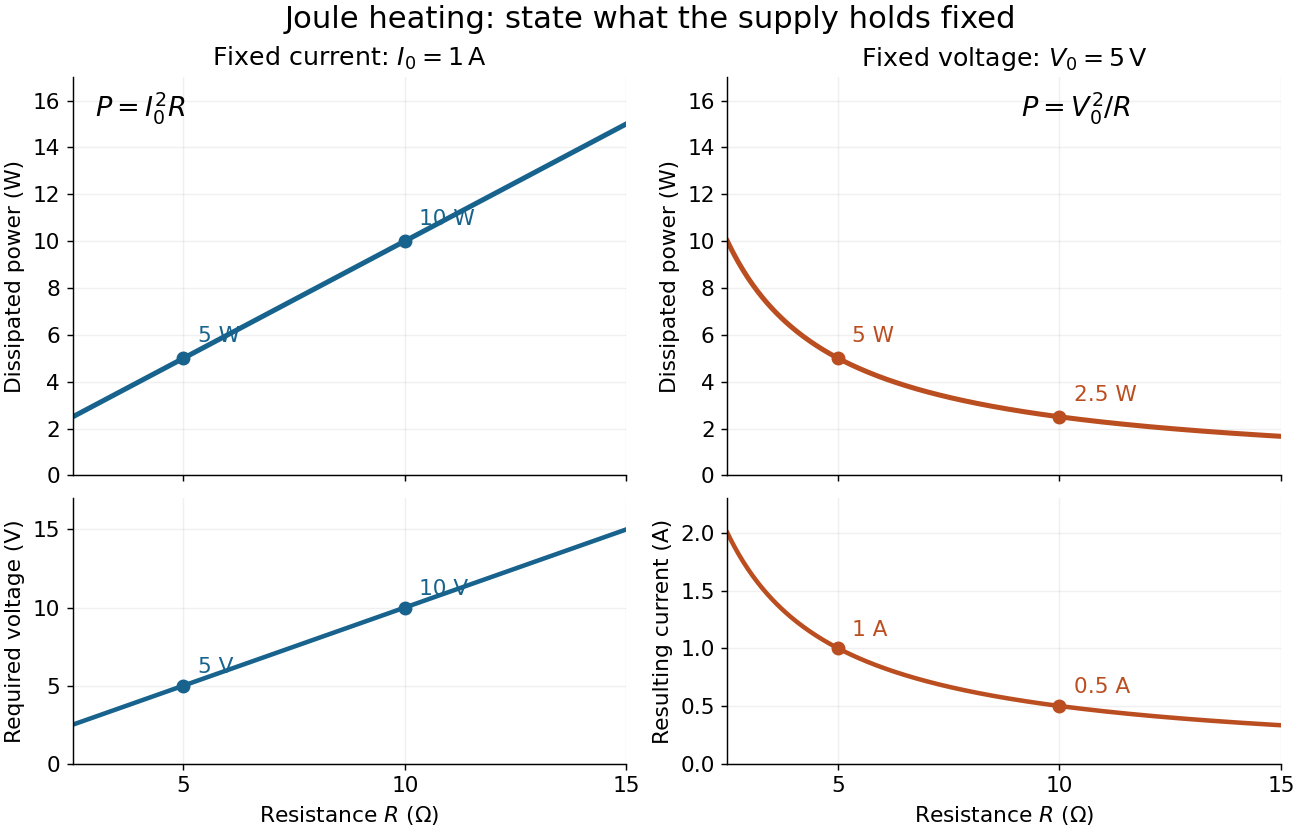
Increasing electrical resistance has opposite effects on Joule heating under fixed electric current and fixed electric potential difference
. Original calculated comparisons, with on the left and on the right. The marked and cases are separate ideal experiments. Each lower panel shows the companion quantity that changes when the supply holds the other quantity fixed. Details.The comparison also predicts feedback when a particular resistor's electrical resistance rises with temperature: a supply maintaining electric current increases its heating power, whereas one maintaining terminal electric potential difference reduces it. Predicting the actual temperature still needs the material response and its heat transfer to the surroundings; a nominal supply setting does not establish which drive is actually constant at the resistor.
A positive framing twist on an n-strand Jones-Wenzl cable has n positive individual curls and braid crossings. Each curl contributes , and each braid crossing contributes because its turnback term annihilates the Jones-Wenzl idempotent. Their product is the displayed scalar. This is the colored framing factor used in surgery invariants.
At , , the projector exists but its closed trace is zero. Quotient by the skein ideal generated by this projector. The surviving simple colors are , with nonzero quantum dimensions . This truncation prevents zero-trace channels from interfering with nondegenerate fusion and surgery normalization.
Close the last strand of the projector recursion. Closing gives , while closing its cap-cup correction gives . The coefficient is . Iteration proves and supplies the normalization needed to split the two fusion of Jones-Wenzl colors channels in .
For and , Cauchy-Schwarz inequality applied to the integral of gives . Integrating against the symmetric two-point kernel measure and taking the energy limit proves the displayed inequality.
// Target: analysis.bigb
If an orthogonal matrix satisfies for the spin tensor , the Jaumann derivative becomes an ordinary derivative in that frame:This follows by differentiating all three factors and using . It converts a tensor relaxation law using the Jaumann derivative into a componentwise ordinary differential equation.
For and , this estimator preserves the sample mean and applies James–Stein shrinkage in its orthogonal -dimensional contrast subspace. Its risk under quadratic loss is . The noncentrality is , so the reciprocal moment of a noncentral chi-squared variable makes the risk minimal exactly when all true components coincide; the minimum is . A negative realized shrinkage factor reverses contrast signs, and its magnitude can exceed one for sufficiently small contrast norm.
For the finite layers of a Zp-extension of a number field, the p-primary ideal class groups eventually satisfy the displayed formula with integer invariants and . The first two are the Iwasawa invariants of the unramified Iwasawa module. The Iwasawa module structure theorem and control of the finite-layer norm and ramification terms give the result. For a cyclotomic extension of an abelian field, the Ferrero-Washington theorem gives . This growth theorem records two invariants; it is weaker than identifying the full characteristic ideal in the Iwasawa main conjecture.
A gas syringe makes the distinction between a constant-temperature path and equal-temperature endpoints observable. The Ideal Gas Law Apparatus (TD-8596A), Instruction Manual 012-08420B by PASCO scientific specifies a TD-8596A gas syringe with a mechanical stop, an internal thermistor, an attached pressure sensor and data acquisition. Record the stop volume with the coupling disconnected, then set and seal the coupling. Record pressure and temperature, compress quickly to the stop near , and hold until both readouts settle. The manual gives roughly for settling and about for the thermistor response. Releasing the plunger gives a second transient and a final volume to record.[ref]
Ideal Gas Law Apparatus (TD-8596A), Instruction Manual 012-08420B by PASCO scientific. pp. 2–4: Introduction, Equipment Setup and Experiment 1 procedure
The manual describes a pressure overshoot and temperature rise during rapid compression, followed by cooling at the held volume; the settled pressure remains higher than initially. This illustrates approximately adiabatic compression followed by heat rejection, rather than an isothermal compression throughout. Use the settled initial and compressed readings to test Boyle's law, correcting both syringe readings by the unmarked tubing volume :Use absolute pressure, not gauge pressure. A transient comparison of must pair simultaneous pressure and temperature readings: the sensor lag can separate their peaks.[ref]
Ideal Gas Law Apparatus (TD-8596A), Instruction Manual 012-08420B by PASCO scientific. pp. 4–5: Constant Temperature and Varying Temperature analyses; p. 8: answers 1–3
For an additional test of the path, repeat with small compression steps, wait for stable temperature and pressure at every step, and repeat in reverse. Keep the sealed amount of substance, connecting tubing and ambient temperature fixed; prevent hand warming of the barrel and check for leaks by watching for continued pressure drift at held volume after thermal equilibrium. These are proposed controls, rather than reported measurements. Agreement of equilibrated points with Boyle's law supports the fixed-temperature ideal gas law approximation, but does not prove that the rapid segments between them were isothermal processes. A single local temperature sensor can miss temperature gradients; plunger friction can produce direction-dependent readings. The pressure and volume data estimate reversible work only insofar as the path approaches a reversible thermodynamic process; they do not directly measure heat. After motion stops, cooling at fixed volume has zero boundary work and , even though the complete equal-endpoint-temperature ideal gas run has .
The group consists of morphisms of elliptic curves defined over that preserve the group operation, with pointwise addition. Its zero element is the constant map to the identity. Every nonzero element is an isogeny of elliptic curves: its image is a closed connected subgroup of the target, so nonconstancy makes it the whole curve, and a nonconstant morphism of smooth projective curves is finite. The degree of an isogeny extends to this group by assigning degree zero to the zero homomorphism.
A division point above is a point over an algebraic closure satisfying , for a specified nonzero integer . Two such points differ by an -torsion point of an elliptic curve. If the characteristic of a field does not divide , there are distinct division points; in other characteristics the scheme fibre still has length , but its geometric points can be fewer. The unramified division torsors at good primes control their coordinate fields over local fields.
An interior reference point defines the utility of a continuous strictly decreasing demand function without requiring integrability of its inverse at zero. The inverse demand is decreasing, so the utility is strictly concave. For example has inverse , whose integral from zero diverges. The interior-reference utility still has the required derivative and is finite at every interior demand.
With the binary Brownian drift filter, a stock of observed excess drift is driven by the same Brownian motion as its information state . The Hamilton-Jacobi-Bellman equation for portfolio wealth , dollar stock holding and value includes . Consequently . For CRRA utility, homogeneity gives and hence the displayed stock fraction. The second term is intertemporal hedging demand; replacing the unknown drift by its posterior mean while omitting this term does not generally give the optimal policy.
If two simple base geodesics meet once, their lift components correspond to the cycles of their monodromy permutations. A lifted crossing belongs to the sheet labels common to both cycles, giving the displayed geometric intersection count. When their relevant lifted lengths identify these components independently of the covering map, different multisets of intersection counts obstruct an isometry between the covering surfaces.
In a finite hyperbolic covering, primitive lifts of a primitive closed geodesic correspond to cycles of its monodromy permutation; an -cycle gives length . In a real-analytic family of compact hyperbolic surfaces or hyperbolic cone orbifolds, a prescribed multiple of a simple curve's length can be isolated generically from unrelated lifted lengths. To exclude an identity of length functions, pinch the simple curve: only its peripheral powers can have length tending to zero, while intersecting curves are long by the collar lemma. The countably many remaining length equalities have empty interior, so the Baire category theorem supplies a parameter avoiding them. Only finitely many closed geodesics lie below a fixed local length bound; thus the isolation persists in an open parameter neighbourhood. This makes cycle-intersection information an intrinsic obstruction to an isometry, rather than an invariant of a chosen covering map alone.
Pinned article: Introduction to the OurBigBook Project
Welcome to the OurBigBook Project! Our goal is to create the perfect publishing platform for STEM subjects, and get university-level students to write the best free STEM tutorials ever.
Everyone is welcome to create an account and play with the site: ourbigbook.com/go/register. We belive that students themselves can write amazing tutorials, but teachers are welcome too. You can write about anything you want, it doesn't have to be STEM or even educational. Silly test content is very welcome and you won't be penalized in any way. Just keep it legal!
Intro to OurBigBook
. Source. We have two killer features:
- topics: topics group articles by different users with the same title, e.g. here is the topic for the "Fundamental Theorem of Calculus" ourbigbook.com/go/topic/fundamental-theorem-of-calculusArticles of different users are sorted by upvote within each article page. This feature is a bit like:
- a Wikipedia where each user can have their own version of each article
- a Q&A website like Stack Overflow, where multiple people can give their views on a given topic, and the best ones are sorted by upvote. Except you don't need to wait for someone to ask first, and any topic goes, no matter how narrow or broad
This feature makes it possible for readers to find better explanations of any topic created by other writers. And it allows writers to create an explanation in a place that readers might actually find it.
Figure 1. Screenshot of the "Derivative" topic page. View it live at: ourbigbook.com/go/topic/derivativeVideo 2. OurBigBook Web topics demo. Source. - local editing: you can store all your personal knowledge base content locally in a plaintext markup format that can be edited locally and published either:This way you can be sure that even if OurBigBook.com were to go down one day (which we have no plans to do as it is quite cheap to host!), your content will still be perfectly readable as a static site.
- to OurBigBook.com to get awesome multi-user features like topics and likes
- as HTML files to a static website, which you can host yourself for free on many external providers like GitHub Pages, and remain in full control

Figure 2. You can publish local OurBigBook lightweight markup files to either OurBigBook.com or as a static website.
Figure 3. Visual Studio Code extension installation.
Figure 5. . You can also edit articles on the Web editor without installing anything locally. Video 3. Edit locally and publish demo. Source. This shows editing OurBigBook Markup and publishing it using the Visual Studio Code extension. 
- Infinitely deep tables of contents:




All our software is open source and hosted at: github.com/ourbigbook/ourbigbook
Further documentation can be found at: docs.ourbigbook.com
Feel free to reach our to us for any help or suggestions: docs.ourbigbook.com/#contact