Topics (384k) Articles (398k) Users (410) Discussions (242) Comments (383) Files (13k) New article
For an energy-conserving strong spherical shock wave expanding into mass density , , dimensional analysis gives the displayed radius law. Neglect ambient pressure, radiation losses and gravity in this blast-dominated approximation. Write , and , with . The radial continuity equation, momentum equation and adiabatic pressure equation reduce toThe Strong-shock Rankine-Hugoniot conditions give and . The explosion energy fixes the radius coefficient through .
Thin-shell approximation for a spherical blast wave by  Codex 0 Created 2026-10-14 Updated 2026-10-18
Let a strong shock wave of radius and speed sweep a uniform mass density into a shell of mass and speed . If the cavity pressure is times the immediate post-shock pressure, shell momentum balance gives . Constant total energy gives and hence . Including shell internal and kinetic energy, and treating the cavity volume as to thin-shell accuracy, yields with . This coefficient is approximate; resolving the shell's finite volume changes it.
An inductor is an electrical circuit component designed to provide self-inductance, often a coil such as a solenoid. An ideal linear inductor has constant and zero electrical resistance. Its stored magnetic energy, with zero chosen at zero electric current, isFor self-inductance and electric current , this gives . Unlike Joule heating, ideal storage is recoverable: the inductor can return energy to an electrical circuit when its electric current decreases. [ref].
The short derivation uses the terminal convention in self-inductance. The power absorbed by an ideal inductor isStarting from zero electric current, the integral of this power givesPositive increases stored magnetic energy; negative returns energy. At constant electric current in the example, and induced electromotive force is zero, but still resides in the magnetic field. The battery in the steady RL circuit supplies Joule heating in the electrical resistance, rather than further increasing the inductor's magnetic energy.
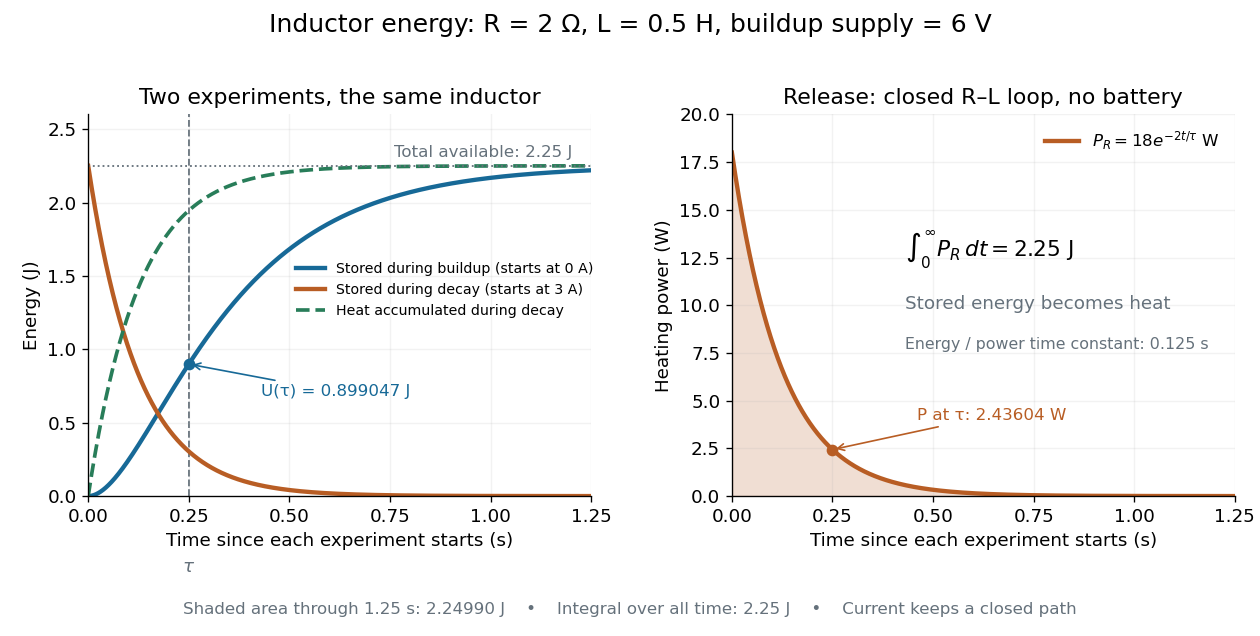
During the closed-loop release in RL circuit, stored magnetic energy plus accumulated Joule heating stays . A real coil also has electrical resistance, so its Joule heating must be included separately from ideal inductor storage. The constant- formulas assume a fixed linear magnetic response.
Formal verification uses machine-checked formal proofs to establish functional correctness: the C implementation of verified seL4 configurations conforms to its formal specification. Binary correctness connects compiled machine code to that C behaviour where supported. Separate security formal proofs cover integrity, resource-access availability and confidentiality under their configuration requirements; these properties are not all available in every configuration. For example, the documented confidentiality theorem separates scheduler security domains rather than arbitrary pairs of software threads. [ref]
seL4 Proofs by seL4 Project. seL4 Proofs, High-level Proof Statements: Functional correctness; Binary correctness; Security; System initialisation; platform/configuration qualification
The documented assumptions include correct hardware, selected handwritten machine-interface code, correct boot state, translation lookaside buffer and memory cache management, and noninterfering or trusted DMA. The confidentiality result covers information channels in its model; the assumptions page explicitly excludes timing channels from that coverage. [ref]
What the Proofs Assume by seL4 Project. What the Proofs Assume, The Assumptions: Assembly, Hardware, Hardware management, Boot code, DMA, Information side-channels
Return to
READ(7, 9, 0, 4). Correct IPC delivery does not establish that the service looked up the right file, returned LIME, or ever replied. A service can produce an incorrect payload while the operating-system kernel exactly follows its formal specification. The formal proofs therefore do not automatically prove all user-space services, nor turn the resource-access availability theorem into a guarantee that this file read completes. The verified foundation supports further algorithm correctness and system reasoning; the service protocol and its recovery obligations still need their own justification.// Destination: computer-science.bigb
The exterior of an unknot is a solid torus. Inclusion of its boundary kills exactly the primitive Seifert longitude, so every essential simple closed curve bounding a disk in that exterior is isotopic, as an unoriented curve, to that longitude. The bounding disk need not avoid other link components.
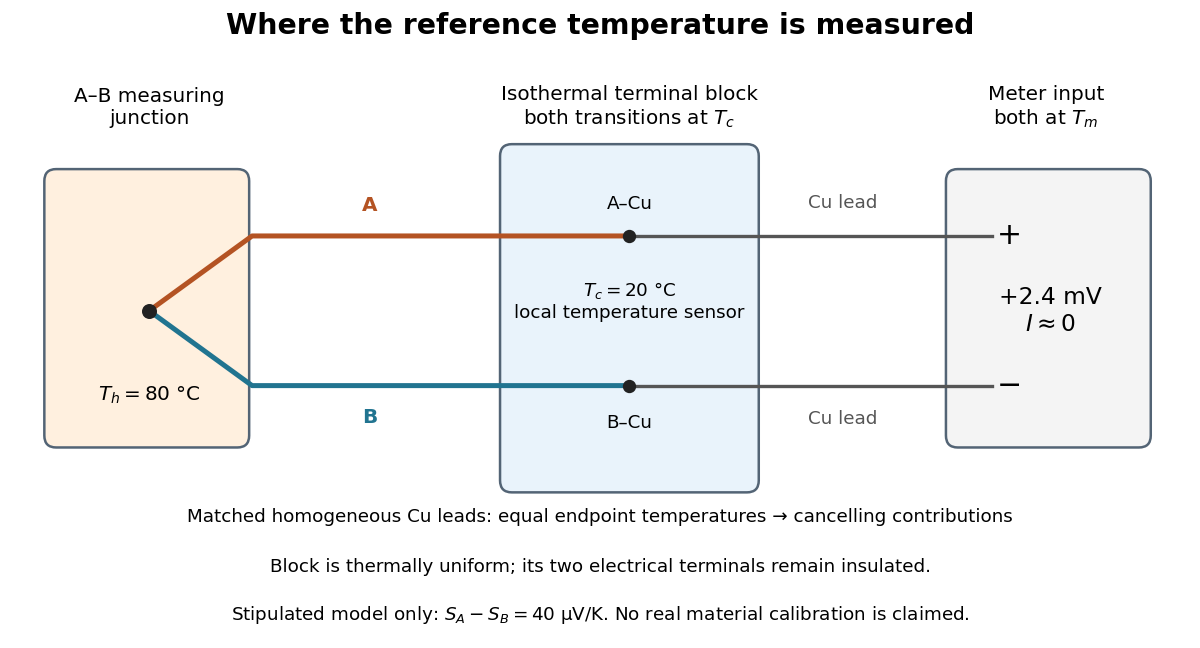
A thermocouple uses two different electrical conductors and the Seebeck effect to infer a measuring-junction temperature from a voltage and a known reference temperature. The reference material and the reference temperature are distinct choices: B specifies the comparison Seebeck coefficient, while specifies the lower limit of the integral. The two-material experiment in Seebeck effect gives the geometry, sign convention, and calibration limitations.
The useful measurement is a pair: the raw terminal electric potential difference and the thermocouple reference junction temperature. For the A-positive terminal order and homogeneous-wire assumptions of Seebeck effect, write the open-circuit electromotive force asHere is the thermocouple measuring junction temperature and is the common temperature of the reference connections. The subscript names the measuring end; it need not be hotter. A voltmeter senses the complete connected thermoelectric path through the wires and its leads, in the electrochemical potential convention already described under Seebeck effect. It does not measure an absolute temperature, the individual Seebeck coefficient of A, or an isolated contact electric potential.
The Seebeck coefficient quantifies the thermoelectric voltage response per small temperature difference at zero electric current. Use along a homogeneous material, with voltage understood through electrochemical potential. Its units are volts per kelvin, commonly . The word thermopower is also used, despite this being a voltage response rather than power; some authors use that word for , so check their convention. [ref]
https://thermoelectrics.matsci.northwestern.edu/thermoelectrics/. Northwestern thermoelectrics research group: Seebeck coefficient and thermopower convention
.For the A-minus-B terminal order in the Seebeck effect experiment,Thus a small temperature difference around gives . The finite-interval ratio is an average of the coefficient difference, not necessarily its value at either endpoint. Ordinary two-material measurements determine a relative Seebeck coefficient: to recover from the measured difference, add a separately known . Neither the choice of a zero for voltage nor the use of a familiar reference material makes identically zero.
A concrete research example is Martin and colleagues' 2021 certification experiment. They measured small temperature differences and voltages on six silicon–germanium specimens at 13 base temperatures between and . At each setting they acquired 40 voltage-and-temperature-difference pairs and used linear regression with a free intercept, so a constant voltage offset did not become part of the slope. Platinum voltage leads required a reference-material correction; their terminal order gave , hence . This is an actual measurement protocol, unlike the toy plot above. [ref]
https://tsapps.nist.gov/publication/get_pdf.cfm?pub_id=932592. Martin et al., Development of a high-temperature (295–900 K) Seebeck coefficient Standard Reference Material (2021), certification measurements and Eq. (1)
.Microscopically, a temperature gradient changes charge carrier transport until an opposing electrical response balances it at zero net electric current. In the usual simple semiconductor picture, electrons and electron holes give opposite Seebeck coefficient signs, and their contributions are weighted by their electrical conductivities. The Seebeck coefficient is a transport property: density of states alone does not determine it, since carrier motion and scattering also matter. Its usefulness extends beyond temperature sensing to diagnosing which carriers transport electric charge. [ref]
https://thermoelectrics.matsci.northwestern.edu/thermoelectrics/. Northwestern thermoelectrics research group: Seebeck coefficient, scattering contributions, and bipolar transport
.For downward settling velocity magnitude and eddy diffusivity , the total upward particle flux is . A stationary profile tending to zero at infinity has , giving the displayed power law. The exponent compares settling with turbulent mixing. It describes a region above the bed; entrainment from the bed and viscous near-wall effects determine the reference concentration separately.
Second-order comprehension is a scheme asserting the existence of a second-order relation variable whose members are exactly the tuples satisfying a permitted formula:Here is not free in , and the displayed individual and relation parameters are universally closed in each instance. Under full semantics for second-order logic, the selected external subset of is always available. Under Henkin semantics, the selected subset must lie in for every allowed assignment of parameters. Different systems permit different formula classes: for example, arithmetical comprehension theory restricts comprehension to formulas without bound set variables, while still permitting set parameters. Consequently, the exact formula and parameter policy must accompany any claim that a restricted range satisfies second-order comprehension.
An existential second-order logic sentence has the formwhere each is a second-order relation variable of fixed finite arity and is a first-order sentence over the input first-order signature expanded by the . The first-order sentence may contain both universal quantification and existential quantification over individuals; only the outer quantification over second-order relation variables is required to be existential. Under full semantics for second-order logic, truth means that some expansion by witness relations satisfies .
For a fixed existential second-order logic sentence on a domain of cardinality , the witnesses need membership bits. The arities and the number of witnesses are constants because the sentence is fixed. After guessing those bits, a verifier evaluates the fixed first-order sentence by enumerating assignments to its finitely many individual variables, taking polynomial time. In the second-order encoding of three-colorability, the three witnesses require bits, and the edge constraints can be checked over at most ordered vertex pairs. This is the logical form of the NP principle that a positive answer has a short complexity certificate.
The fixed-sentence qualification matters: it is the input first-order structure that varies, rather than an arbitrarily large formula supplied with each input. Fagin's theorem states the converse as well: every isomorphism-invariant NP property of finite relational first-order structures has such a description. The coloring example uses only unary second-order relation variables; the general theorem allows any fixed finite arities.
A second-order relation variable of arity can be assigned a subset of the -fold Cartesian product ; its application is true exactly when the tuple belongs to that subset. Arity is the number of arguments, so a unary second-order relation variable is a predicate on individual objects. For a finite set of cardinality , there are possible tuples and possible relations under full semantics for second-order logic. A relation is encoded by membership bits once the objects have been numbered; the number of possible witnesses can be exponential even when each witness has a short encoding.
For in the second-order cone, the Cauchy-Schwarz inequality gives . Thus the cone is contained in its dual cone. Conversely, if and , pairing with is negative. If and , use . Every point outside the cone therefore lies outside its dual, proving that it is a self-dual cone.
No cyclic heat engine exchanging heat only with two fixed thermal reservoirs at positive absolute temperatures can exceed the thermal efficiency of an engine whose cycle is a reversible thermodynamic process between them. All such reversible engines have the same thermal efficiency, regardless of their working substance. Let be heat absorbed from the hot thermal reservoir and the magnitude rejected to the cold one. ThenThe work convention is the one in the first law of thermodynamics: is net output by the engine. Use absolute thermodynamic temperatures, such as values in kelvin; ratios of readings in degree Celsius are invalid because their zero is shifted.
For , and , the maximum thermal efficiency is . A reversible engine delivers and rejects . The thermal reservoirs have entropy changes and , which cancel. The engine's own entropy change is zero over its thermodynamic cycle.
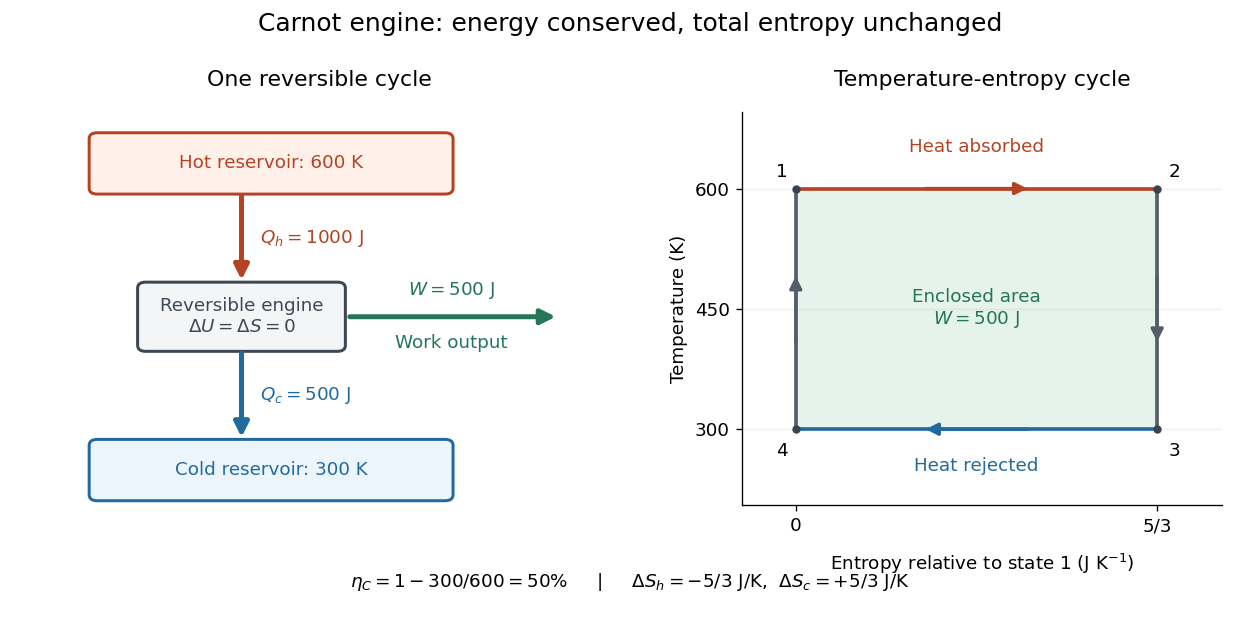
A short derivation now becomes transparent: the Second law of thermodynamics gives , and the first law of thermodynamics gives . Together they yield the bound and, more precisely,At fixed , every extra unit of total entropy production reduces output by units of energy. [ref]
Fixed thermal reservoirs are essential. Finite bodies cool and warm, so their initial temperature ratio cannot be used throughout an entire extraction process. As a computed contrast, the bodies with equal constant heat capacity in the entropy example would reach if a reversible engine extracted work until their temperatures matched. Zero total entropy change gives this geometric mean; the first law of thermodynamics then gives . Direct contact reaches and extracts no work.
Carnot's 1824 book asked whether the useful output of machines driven by heat was fundamentally limited and whether changing the working substance could improve that limit. Its reversible comparisons are the historical setting of Carnot's theorem. Carnot used the then-current caloric picture, treating heat as conserved in its passage through an engine; the modern balance should not be read back into that text.[ref]
Rotate an ellipse with positive semiaxes about an axis a distance from its centre. For the parametrized surface , put and . An outward unit normal is . Direct differentiation gives the first fundamental form and second fundamental form, with the convention :Reversing the unit normal reverses , but the Gaussian curvature is unchanged.
Differentiate the orthogonality of the unit normal to the two independent coordinate tangent vectors. If the second fundamental form vanishes, each derivative of the normal is orthogonal to both tangent vectors; differentiating its unit length also makes it orthogonal to the normal. Thus both normal derivatives vanish. On a connected parameter domain the normal is constant, and differentiating the position's scalar product with that constant normal proves the surface lies in a plane.
At every point its second fundamental form is a scalar multiple of its induced metric. Equivalently its shape operator is scalar, so all principal normal curvatures agree. For a three-dimensional hypersurface, and . The sign of its intrinsic scalar in a vacuum Lorentzian ambient space then follows from the Gauss equation for a nonnull hypersurface.
For an additive time series with period- seasonal component and , a centred average spanning one complete period removes the seasonal component while estimating the slowly varying trend. When is even, average two adjacent length- averages to centre the filter on an observation; the endpoints receive half the usual weights. Estimate each seasonal phase by averaging the corresponding detrended residuals across cycles, then subtract the mean of those phase averages to enforce the zero-sum convention. Multiplicative seasonality instead uses ratios and a mean-one convention. Repeated averaging is filter composition and induces serial dependence even from white noise.
Steric sea level change results from changes of seawater mass density at fixed ocean mass. To first order, thermal expansion gives ; changes in salinity give a halosteric contribution. The reference column, pressure and equation of state must be specified.
Eustatic sea level change is a change in global sea level associated with changes of ocean water amount or ocean-basin capacity. For contemporary climate budgets the relevant contribution is principally transfer of water between land and ocean, including melting grounded ice and changes in terrestrial water storage. It is distinct from steric sea level change.
With positive freshwater runoff , net sea ice melt and precipitation , and evaporation loss , the ocean water-mass budget is . With salt-free ice and fixed total dissolved salt mass, mean salinity satisfies . Gross regional ice melt must not be substituted for net global melt without accounting for ice formation elsewhere and the averaging period.
Pinned article: Introduction to the OurBigBook Project
Welcome to the OurBigBook Project! Our goal is to create the perfect publishing platform for STEM subjects, and get university-level students to write the best free STEM tutorials ever.
Everyone is welcome to create an account and play with the site: ourbigbook.com/go/register. We belive that students themselves can write amazing tutorials, but teachers are welcome too. You can write about anything you want, it doesn't have to be STEM or even educational. Silly test content is very welcome and you won't be penalized in any way. Just keep it legal!
Intro to OurBigBook
. Source. We have two killer features:
- topics: topics group articles by different users with the same title, e.g. here is the topic for the "Fundamental Theorem of Calculus" ourbigbook.com/go/topic/fundamental-theorem-of-calculusArticles of different users are sorted by upvote within each article page. This feature is a bit like:
- a Wikipedia where each user can have their own version of each article
- a Q&A website like Stack Overflow, where multiple people can give their views on a given topic, and the best ones are sorted by upvote. Except you don't need to wait for someone to ask first, and any topic goes, no matter how narrow or broad
This feature makes it possible for readers to find better explanations of any topic created by other writers. And it allows writers to create an explanation in a place that readers might actually find it.
Figure 1. Screenshot of the "Derivative" topic page. View it live at: ourbigbook.com/go/topic/derivativeVideo 2. OurBigBook Web topics demo. Source. - local editing: you can store all your personal knowledge base content locally in a plaintext markup format that can be edited locally and published either:This way you can be sure that even if OurBigBook.com were to go down one day (which we have no plans to do as it is quite cheap to host!), your content will still be perfectly readable as a static site.
- to OurBigBook.com to get awesome multi-user features like topics and likes
- as HTML files to a static website, which you can host yourself for free on many external providers like GitHub Pages, and remain in full control

Figure 2. You can publish local OurBigBook lightweight markup files to either OurBigBook.com or as a static website.
Figure 3. Visual Studio Code extension installation.
Figure 5. . You can also edit articles on the Web editor without installing anything locally. Video 3. Edit locally and publish demo. Source. This shows editing OurBigBook Markup and publishing it using the Visual Studio Code extension. 
- Infinitely deep tables of contents:




All our software is open source and hosted at: github.com/ourbigbook/ourbigbook
Further documentation can be found at: docs.ourbigbook.com
Feel free to reach our to us for any help or suggestions: docs.ourbigbook.com/#contact