
Virial theorem Created 2026-09-24 Updated 2026-10-13
The virial theorem relates the average value of a function along a trajectory to the forces that bind it. For an isolated system of particles interacting through Newtonian gravitational potential energy, it gives : the average kinetic energy is half the magnitude of the average negative potential energy. An eccentric Kepler orbit makes the distinction vivid: kinetic energy and potential energy vary throughout the orbit, although their sum is constant. The relation concerns their time averages, rather than their values at every instant. It underlies the virial mass estimate and the negative heat capacity of a virialized gravitational system.
Use constant positive particle masses , positions , mechanical momenta , and total kinetic energy . The auxiliary quantity is a sum of dot products, not the gravitational constant, which we denote here by :This finite- identity is exact wherever Newton's second law holds along a regular trajectory; must include every force. The endpoint term is what a finite observation window leaves behind. For the infinite-time theorem, suppose the averages on the left exist and . A sufficient condition is uniformly bounded positions and velocities for finitely many particles. More generally suffices, even without those individual bounds. Bounded positions alone do not supply a bound on momenta, especially near a singular potential energy; nor does a small endpoint term prove thermodynamic equilibrium. Periodic motion with gives the identity without an endpoint term at that finite . For an isolated system, use an inertial centre of mass frame so translational drift does not contribute bulk kinetic energy.[ref]
1 The Expanding Universe. Cosmology by David Tong, §1.4.3, “The Virial Theorem and Galaxy Clusters”: bounded positions and velocities, existence of averages, equation (1.74) and endpoint limit
For a differentiable potential energy that is a homogeneous function of degree , choose its additive constant so that the scaling law really holds. With conservative forces, the Euler theorem for homogeneous functions givesThus a harmonic oscillator has and . An isolated system with Newtonian gravitational potential energy hasEach interacting pair occurs once, and at infinite separation. Here the total energy is conserved. An external field or a mixture of different scaling powers requires its own force term; one cannot assign the whole potential energy a single degree . The virial theorem for a homogeneous pair potential states the corresponding general energy relation.
Hamiltonian of a charged particle Created 2026-09-24 Updated 2026-09-24
For , and .
Legendre transform in mechanics Created 2026-09-24 Updated 2026-10-03
Angular momentum about the centre of mass Created 2026-09-24 Updated 2026-09-24
The derivative of angular momentum about the moving centre of mass equals the total external torque about that centre, because total relative momentum vanishes and internal central torques cancel.
Rolling acceleration with rotational inertia Created 2026-09-24 Updated 2026-09-24
Mass Created 2026-09-24 Updated 2026-11-05
Mass measures a body's resistance to a change of velocity and its coupling to gravity. In Newton's second law for a body of fixed mass, , the inertial mass relates a known net force to the resulting acceleration. Applying the same force to two carts and comparing their accelerations measures their mass ratio.
A balance instead compares gravitational forces in a common gravitational field, probing gravitational mass. The proportionality of inertial mass and gravitational mass explains why freely falling bodies have the same acceleration when other forces can be neglected. Gravitational weight changes with the local gravitational field, while a body's mass need not change. In special relativity, mass-energy equivalence relates rest energy to mass through .
Displacement Created 2026-09-24 Updated 2026-11-05
Displacement is the vector change of position between two events in a chosen reference frame:It depends on the endpoints, whereas the distance travelled depends on the entire path. A runner who completes one lap of a circular track has zero displacement and a nonzero distance travelled.
Dividing displacement by elapsed time gives average velocity. A sequence of short displacements adds vectorially to the overall displacement, even when the individual steps point in different directions. This distinction matters when reading motion data: adding the lengths of individual steps estimates path length, while adding their vector components gives the final change of position.
Inverse-square force Created 2026-09-24 Updated 2026-11-05
An inverse-square force is a central force whose magnitude varies as , where is separation from the force centre. Both the gravitational force between point masses and the electrostatic Coulomb force between point charges have this dependence. The sign of the coupling determines whether the force is attractive or repulsive.
For an attractive force with , a corresponding potential energy is , choosing zero at infinite separation. Moving twice as far from the centre reduces the force to one quarter, while halving the magnitude of this potential energy. The radial direction makes the torque about the centre vanish, so angular momentum is conserved. This reduces the orbital problem to planar motion and underlies the Kepler orbit.
Circular motion Created 2026-09-24 Updated 2026-11-05
In circular motion, a particle remains at a fixed distance from a centre. For uniform angular velocity , its speed is and its acceleration points toward the centre, with magnitudeThe speed can remain constant while the velocity changes continuously because its direction changes. A net inward force is therefore required even for uniform circular motion.
A small object attached to a string illustrates the mechanism: the string's tension supplies the inward force. If the string breaks, the object's initial unconstrained motion is along the tangent, in accordance with its instantaneous velocity. When the speed also changes, there is an additional tangential acceleration; the inward component remains present.
Force Created 2026-09-24 Updated 2026-11-05
A force describes an interaction's contribution to the rate of change of momentum. In an inertial frame, Newton's second law relates the vector sum of external forces on a particle to . For constant Newtonian mass, this becomes .
A cart pulled along a nearly frictionless track illustrates the distinction between one applied force and the resultant. A spring scale measures the pull, while video tracking measures acceleration; friction and track slope must also enter the balance. Opposing pulls can cancel, leaving zero acceleration even though each pull is nonzero.
A force's point or line of application also matters for an extended body, because it determines the torque. The same resultant force can produce different rotational motion when applied at different locations. A free-body diagram makes both the chosen body and its external interactions explicit.
Period of an oscillation Created 2026-09-24 Updated 2026-11-05
The period of an oscillation is the smallest positive time after which a periodic motion repeats its complete state. For with nonzero amplitude, it is . The frequency is , while the angular frequency is .
Returning to the same position is not sufficient: a swinging simple pendulum passes through its lowest point twice per cycle with opposite velocities. Timing successive passages in the same direction measures a full period of an oscillation. Timing many cycles and dividing by their number reduces the relative effect of starting and stopping a stopwatch. The period of an oscillation can depend on amplitude in a nonlinear system, even when a small-amplitude approximation gives a constant value.
Energy Created 2026-09-24 Updated 2026-11-05
Energy is a scalar quantity used to account for the capacity of a physical system to exchange work and heat and to change its state. Kinetic energy, potential energy and internal energy describe different contributions to one balance. Lifting a weight stores gravitational potential energy; allowing it to descend can turn that energy into motion, electrical output or heating.
Conservation of energy applies to the total accounting of an isolated system. A subsystem's energy can change because energy crosses its boundary, so a warming object or an accelerating cart does not violate conservation. For example, friction can reduce a sliding body's mechanical energy while increasing the internal energy of the contacting materials. In a closed dynamical description with time-translation symmetry, energy conservation is connected with that symmetry by Noether's theorem.
Momentum Created 2026-09-24 Updated 2026-10-14
For a nonrelativistic point mass of fixed mass , measured in an inertial frame, its momentum isMomentum is a vector pointing along the velocity, with International System of Units unit . Doubling either mass or velocity doubles momentum. In one dimension, a chosen positive direction makes a signed quantity: a body moving right at has ; moving left at the same speed gives . [ref]
For a collection, total momentum is the vector sum . Two equal masses moving with opposite velocities can have zero total momentum while both have positive kinetic energy. Direction is therefore essential when using momentum conservation; adding speeds instead of signed velocities gives the wrong balance.
Newton's second law connects the net force on one fixed-mass point mass to its momentum through . Integrating that change gives impulse. Here denotes mechanical momentum; when canonical momentum differs from mass times velocity, the distinction in mechanical momentum below applies. The nonrelativistic formula also has a limited regime: special relativity is needed at speeds comparable with the speed of light.
Position Created 2026-09-24 Updated 2026-11-05
Position specifies where an object is relative to an origin and a coordinate system. In a Cartesian laboratory frame a tracked bead might have coordinates ; in polar coordinates the same location can be described by distances and angles. Changing the coordinate labels does not move the bead.
A position vector joins the chosen origin to the object. Subtracting two such vectors gives its displacement, and differentiating its position vector with respect to time gives its velocity. These operations require a consistent reference frame: a camera fixed to a moving trolley and a camera fixed to the laboratory assign different coordinate histories to the same bead. Stating the origin, axes, units and measurement times makes a record of position reproducible.
Degree of freedom Created 2026-09-24 Updated 2026-11-05
A mechanical degree of freedom is an independent coordinate needed to specify a system's configuration locally. A point particle moving freely in three-dimensional space has three such coordinates. If it is constrained to a sphere of fixed radius, two angles suffice; a simple pendulum confined to a vertical plane requires only its angle.
Counting coordinates requires identifying independent mechanical constraints. For particles subject to independent regular holonomic constraints, the configuration has degrees of freedom locally. Repeating a dependent condition does not remove another coordinate. A second-order equation of motion usually also requires an initial velocity for each coordinate, so the dimension of the corresponding phase space is twice the number of configuration degrees of freedom. Nonholonomic constraints require a separate analysis of allowed velocities.
Newtonian gravitational field Created 2026-09-24 Updated 2026-10-14
The Newtonian gravitational field is the gravitational force per unit mass of a test particle. For a point mass at the origin,The test particle's mass cancels: different small masses have the same gravitational acceleration at the same position. In SI, the Newtonian gravitational field has units . The same exterior expression holds for a spherically symmetric source, by the spherical shell theorem.
Choose a reference radius , set , and use nondimensionalization with . Then : at , the magnitudes are . This makes the spatial variation visible without specifying a planet. [ref]
https://openstax.org/books/university-physics-volume-1/pages/13-1-newtons-law-of-universal-gravitation. OpenStax: inverse-square attraction and spherical sources
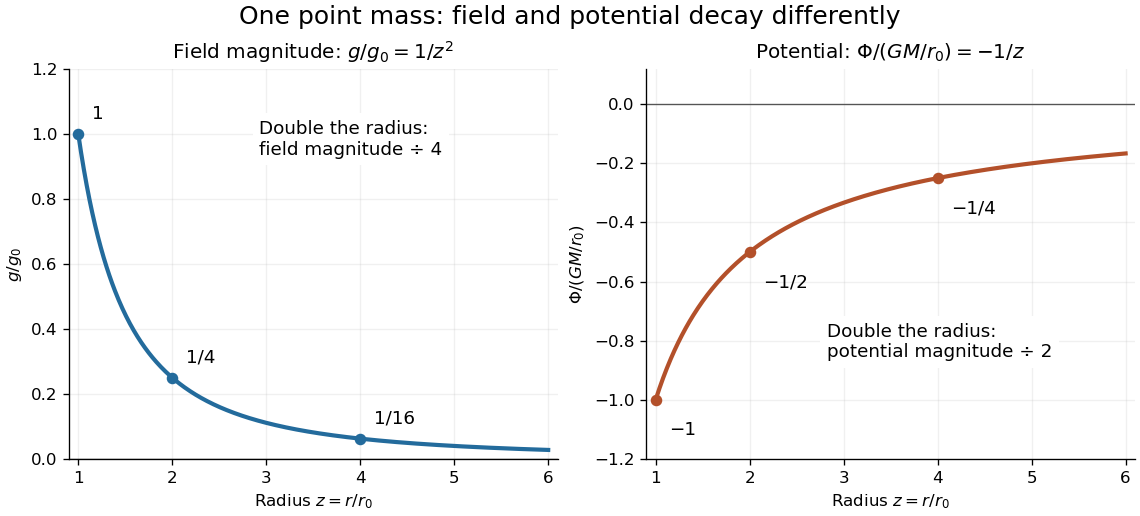
Normalized Newtonian gravitational field and point-mass potential
. Doubling the radius quarters the magnitude of the Newtonian gravitational field, but halves the magnitude of the negative Newtonian gravitational potential. Both curves approach zero as radius increases; the inward gravitational acceleration is minus the gradient of the Newtonian gravitational potential. Details.
Multiplicative order under the Chinese remainder theorem Created 2026-09-24 Updated 2026-09-24
The order of a unit modulo a product of coprime moduli is the least common multiple of the orders of its components.
Astrophysical black hole Created 2026-09-24 Updated 2026-11-05
An astrophysical black hole is an astronomical object interpreted as a black hole through evidence about its mass, compactness and interaction with surrounding matter or gravitational waves. A black hole of stellar mass can form after stellar core collapse; a supermassive black hole can grow through black-hole accretion and mergers. The event horizon prevents light from escaping from within, but matter outside can radiate and reveal the central gravity. For Sagittarius A*, astrometry and radial velocities of nearby stars constrain a very large mass inside their small orbits. Such dynamical evidence complements observations of accretion and of binary black holes, which probe different aspects of the black-hole interpretation.[ref]
Measuring Distance and Properties of the Milky Way's Central Supermassive Black Hole with Stellar Orbits by Andrea M. Ghez and others. Abstract: stellar-orbit constraints on the central compact mass and on extended dark matter
Galaxy Created 2026-09-24 Updated 2026-11-05
A galaxy is a gravitationally bound system of stars, stellar remnants and usually gas, interstellar dust and a substantial dark matter component. Its appearance reflects both its contents and their motion: a spiral galaxy has a rotating galactic disk, whereas an elliptical galaxy is largely supported by disordered stellar motion. Star formation makes luminous young populations from gas, while stellar feedback returns material and energy to the interstellar medium. A photograph therefore samples only part of the system: galaxy dynamics uses motions to constrain the underlying mass, including matter that emits little light. Spiral arms also redistribute angular momentum and changes the galactic disk over time.[ref]
Spirals in Galaxies by Jerry A. Sellwood and Karen L. Masters. Abstract and discussion of disk dynamics: spiral activity, stellar random motion and the dissipative gas component
Astrophysical disk Created 2026-09-24 Updated 2026-11-05
An astrophysical disk is a flattened, rotating distribution of matter. Examples include a young star's protoplanetary disk, an accretion disk around a compact object and a stellar galactic disk. For gas that can radiate away random-motion energy while retaining angular momentum, settling into a disk is easier than falling directly toward the center. Ordered orbital motion supplies radial support; pressure, random motions or magnetic forces determine the thickness. The same geometry therefore contains systems with very different heating and transport mechanisms.
There are unlisted articles, also show them or only show them.