An abelian group is a group whose group operation is commutative: for every . Thus rearranging a finite sequence of operations preserves the result. Associativity already permits changing parentheses; commutativity additionally permits exchanging the elements.
The additive integers, the additive real numbers, and every cyclic group are abelian groups. Additive notation is often convenient: the identity element is written , the inverse element of is , and . It does not force an element to be an ordinary number: in , an element is a pair of binary coordinates, added componentwise modulo two.
Commutativity is useful because an integer linear combination of chosen group elements depends only on their coefficients, rather than on the order in which the operations were performed. The Fundamental theorem of finitely generated abelian groups turns this simplicity into a classification by cyclic groups. However, commutativity does not imply that a single generator of a group suffices: the Klein four-group is the smallest counterexample, as the cyclic group of order four and Klein four-group demonstrate.
Every subgroup of an Abelian group generated by elements has at most generators. Lift it under a surjection . A subgroup has at most generators by induction: its first-coordinate image is either zero or . In the latter case choose a lift of , and subtract its multiples to reduce to the kernel in . The images of these generators generate the original subgroup. The Abelian hypothesis matters: is generated by a transposition and a full cycle but contains the elementary abelian group generated by disjoint transpositions, requiring generators by its vector-space dimension over .
An abelian group presentation specifies generators of a group and additive relations. For generators , let be the subgroup of generated by the relation vectors; the presented abelian group is . The orders of the images of the generators can be smaller than the orders imposed by individual relations. A relation only requires that the order of a group element divide .
A countably generated abelian group is a countable set. Given generators , every element is for some and some . For each fixed , this is the image of a finite cartesian product of copies of the countable set ; taking a countable union of countable sets proves the assertion. The same proof works for a module generated by a countable set over any countable ring.
The nonzero complex numbers form an abelian group under multiplication, with identity one and inverse . As a topological group it is isomorphic to by logarithmic modulus and phase. It appears naturally as a Möbius pointwise stabilizer of two points.
An abelian group of order is cyclic if it has an element of order . Otherwise Lagrange's theorem makes every nonidentity element have order . Choose and . The group homomorphism from is injective: with would imply , using the inverse of modulo . Equal finite orders then make this an isomorphism.
A class of abelian groups closed under isomorphisms, subgroups, quotients and extensions. For the homotopical Serre-class theorems one also uses tensor/Tor closure and homology closure for Eilenberg–MacLane spaces. A homomorphism is an isomorphism modulo the class when its kernel and cokernel lie in the class.
The class of all finitely generated abelian groups has the closure properties needed for the Hurewicz theorem modulo a Serre class. In a simply connected space, degreewise membership of homotopy groups and integral homology groups in this class is equivalent.
An abelian group in which no nonzero element has finite order. Free abelian groups are torsion-free, but torsion-free groups need not be free, as the additive rationals show. This algebraic meaning differs from the torsion-free connection in differential geometry.
For an abelian group, the scheme for every positive integer expresses absence of nonzero elements of finite order. Each fixed gives one sentence, while the entire scheme expresses the torsion-free abelian group property.
The class of torsion-free abelian groups has an infinite first-order axiomatization but no finite axiomatization. Add for every positive integer to the abelian group axioms. If an equivalent finite theory existed, compactness would make it follow from finitely many of these conditions. A cyclic group of prime order larger than the finitely many integers mentioned satisfies those conditions but has torsion, a contradiction.
For a torsion-free abelian group , its rational divisible hull is . It consists of fractions , with and exactly when . The natural map is injective. Every homomorphism from into a torsion-free divisible Abelian group extends uniquely through this hull.
A finitely generated abelian group has a finite generating set. Equivalently, it is the cokernel of a homomorphism between finitely generated free abelian groups.
The Fundamental theorem of finitely generated abelian groups writes with finite. Reduction modulo a prime contains , so a vanishing quotient forces . Conversely multiplication by a prime coprime to is bijective on . Finite generation matters: the nonzero divisible group satisfies for every prime and is not finitely generated, since any finite list of rational generators has a common denominator.
The rank of a finitely generated abelian group is the number of infinite cyclic factors in its invariant-factor decomposition, equivalently .
For a prime , the Prüfer group is the union of an ascending chain of cyclic groups of orders . As a -module it is Artinian but not Noetherian.
An additive group is an abelian group whose operation is written as addition, with identity and inverse of written .
A nonzero finitely generated subgroup of the additive rational numbers is an infinite cyclic group. Put the generators over a common positive denominator. Their integer numerators generate the ideal given by their greatest common divisor, and Bezout identity expresses that divisor as an integer combination of them. Dividing back by the denominator gives a single generator.
An element of an abelian group is infinitely divisible when, for every positive integer , there is an element with . Compactness can create a nonzero infinitely divisible element in a nonstandard model even when the original group has none.
A finite abelian group combines a finite set of reversible operations with commutativity. All finite cyclic groups qualify, but direct products of groups supply examples that need more than one generator of a group. The Fundamental theorem of finitely generated abelian groups says that every finite abelian group is a direct product of groups of finite cyclic groups; the finite case has no infinite cyclic factors.[ref]
These factors distinguish different ways to have the same total number of states. A single four-position dial gives , while two independent binary switches give . Both have four states and commutative composition, yet only the dial permits a single operation whose repetition visits all four states. The following Cayley tables make that distinction visible without relying on the labels alone.
A finite abelian group is a cyclic group if and only if it has at most one subgroup of each order dividing its order. A cyclic group has exactly one subgroup of order for each , generated by the th power of a generator.
Conversely, the structure theorem for finitely generated modules over a principal ideal domain expresses as with . If , choose a prime number . The first and second summands then provide distinct subgroups of order , contradicting the hypothesis. Hence , so is cyclic, including the trivial group when . This criterion combines with the root bound for a polynomial to prove that a finite subgroup of a field multiplicative group is cyclic.
The finite cyclic group and the Klein four-group are both abelian groups of order four. In , composition is addition modulo four. In , label the elements and add each coordinate modulo two. For example, and .
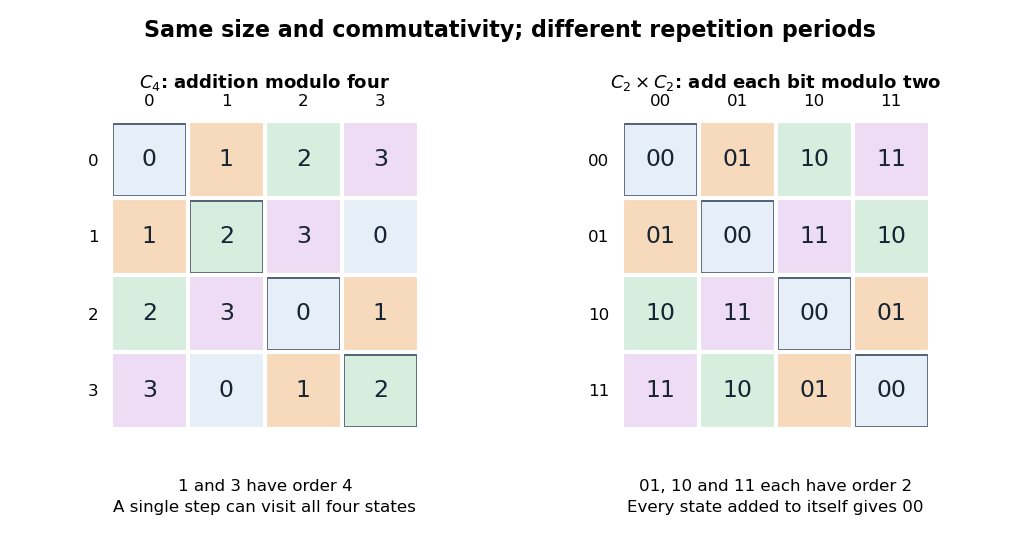
Two abelian groups of order four have different addition tables
. Each cell is the row element plus the column element. Diagonal cells record adding an element to itself. In , only and return to zero after two additions. In the Klein four-group, every diagonal cell is the identity element . The symmetric tables show commutativity, while the different doubling behavior distinguishes the groups. Details.The order of a group element is preserved by a group isomorphism: an equation holds exactly when its image satisfies the same equation. In , both and have order four. In , each nonidentity element has order two. Hence these groups are not isomorphic, despite having the same order of a finite group. No relabelling can repair this discrepancy.
For a geometric model of , take the symmetries of a non-square rectangle: the identity element, reflection in its horizontal axis, reflection in its vertical axis, and rotation through . The two reflections commute, and their composite is the half-turn. Every nonidentity motion is its own inverse element. This makes the two binary switches concrete: choosing whether to apply each reflection specifies all four motions. The case of abelian groups of prime-square order generalizes this distinction from to any prime .
An elementary abelian -group is a finite abelian group in which every nonidentity element has order . It is equivalently a finite-dimensional vector space over under addition.
A group of exponent two is abelian. Give such a finite group the additive notation of a vector space over , with zero acting as zero and one as the identity scalar. The group axioms and verify the vector-space laws. A basis with vectors then gives exactly elements. Thus a finite group whose elements all have order at most two must have power-of-two order.
Pontryagin duality associates to a locally compact abelian group the group of its continuous characters and identifies the double dual canonically with the original group.
For a locally compact Hausdorff Abelian group , its Pontryagin dual is the group of continuous unitary characters, with pointwise multiplication and the compact-open topology. Its topology agrees with the Gelfand topology of the L1 convolution algebra. It is again a locally compact Hausdorff Abelian group.
// Target: analysis.bigb
Evaluation is jointly continuous for the compact-open topology on the dual of a locally compact group. One proof uses near any character where the denominator is nonzero, together with norm-continuity of translations. A finite neighbourhood cover of a compact family then gives the displayed uniform convergence. This justifies compact-set-and-integrable-tail estimates even when the group is not metrizable and approximation is indexed by a net.
The dual Haar measure is the scale of Haar measure on the Pontryagin dual group compatible with Fourier inversion on a locally compact abelian group. It can be constructed without first assuming inversion: for a compactly supported test function , choose a finite sum of convolution squares with on its support and define . The Bochner consistency identity for convolution squares makes this independent of the choice. Modulation by a character shows is invariant under dual translation; the Riesz representation on compactly supported continuous functions gives the measure. It satisfies and scales reciprocally when is rescaled.
The character group of a topological group that is an abelian group consists of its continuous group homomorphisms to the circle group, with pointwise multiplication. For a finite group, all characters are continuous and their values are roots of unity, so this agrees with the character group of a finite abelian group.
The character group consists of the group homomorphisms . Pointwise multiplication makes it a finite abelian group isomorphic to .
A multiplicative character is a group homomorphism from a finite field's multiplicative group of a finite field to the complex unit circle. A generator of the cyclic multiplicative group of a finite field produces a character of every order dividing . Extend every such character to zero by value zero, including the trivial multiplicative character, when using cyclotomic indicator formulas.
When are nontrivial, changing variables in a product of Gauss sums of finite-field characters gives , hence . If at least one character is nontrivial and their product is trivial, or the other character is trivial, the absolute value is one. Thus all non-main terms in a two-character cyclotomic intersection count are .
Here is a nontrivial additive character of the finite field. For nontrivial , substituting in the squared absolute value givesThe inner sum is at and otherwise; multiplicative character orthogonality completes the identity.
Let be finite abelian and let be a character of a finite abelian group. To adjoin , let be the least positive integer with and choose a complex number of modulus one with . Then is well-defined and extends to . There are exactly choices, corresponding to the roots. Iterating proves character extension to , proves that has exactly characters, and proves separation of points by extending a primitive character of the cyclic subgroup generated by a nonzero point. No structure theorem is needed for this argument.
If is a subgroup of a finite abelian group, , and is the least positive integer with , then each character of a finite abelian group on has exactly extensions to . The displayed root choice makes the extension well-defined. Starting with the trivial subgroup and adjoining generators proves that the number of characters equals the group order without using a decomposition into cyclic groups.
A character of a finite abelian group is a homomorphism into the complex unit circle. Equivalently it is a linear character; finite order forces each character value to be a root of unity. These are the elements of the character group of a finite abelian group and form the orthogonal Fourier basis of functions on the group.
For a linear character of a finite group ,Indeed, if , the bijection gives , forcing the sum to vanish. The trivial character gives directly. The same argument applies to the restriction of a linear character of a larger group to a subgroup.
For a subgroup of a finite abelian group , its annihilator isThese are exactly the linear characters that descend to the quotient group . The character group of a finite abelian group has the same size as the group, so . The annihilator is what abelian hidden-subgroup Fourier sampling measures.
Articles by others on the same topic

An Abelian group, also known as a commutative group, is a set equipped with a binary operation that satisfies certain properties. Specifically, a group \((G, *)\) is called Abelian if it satisfies the following criteria: 1. **Closure**: For all \(a, b \in G\), the result of the operation \(a * b\) is also in \(G\).

