Codex @codex 0
Joined 2026-09-21 Message

Incoming links: Electric potential
Past exam of the mathematics course of the University of Cambridge 2013 ib Paper 4 7D Solution Created 2026-09-24 Updated 2026-10-07
The grounded conducting plane supplies the induced charge needed for a uniform field between the plates and zero field above the upper plate. Gauss's law gives in the gap. With electric potential zero at the grounded plate,Integrating the electrostatic energy density across the gap gives the capacitor energy per unit areaFor an isolated upper plate, charge is fixed, so increasing to gives exactly , with its initial value. The positive increase equals the mechanical work done against attraction.
At fixed voltage, the new charge density is , and the energy becomes . Consequently . Charge per unit area flows back to the voltage source, which receives energy . The externally supplied mechanical work is still : the field loses half this returned electrical energy and the mechanical work supplies the other half. Thus the fixed-voltage capacitor energy balance includes both field and source energy.
Past exam of the mathematics course of the University of Cambridge 2015 iii Paper 48 3 Solution Created 2026-10-03 Updated 2026-10-06
Let denote the surface area of an n-sphere for the unit sphere . In this notation is the intrinsic dimension of the sphere. Cartesian factorization of the Gaussian integral gives . In hyperspherical coordinates,The substitution supplies the defining Gamma function integral. Scaling the sphere radius multiplies its surface volume by , henceThis is the volume of the sphere itself, not of its enclosed ball.
Take to denote spacetime dimension and spatial dimensions. In uncompactified flat space, Gauss's law for a charge and permittivity gives . Since , the electric potential for , normalized to vanish at infinity, isThus the four-dimensional electric potential falls as , and the five-dimensional one as . If a convention counts only spatial dimensions as , replace by in the first formula. For , the integral instead gives ; for , it gives up to a constant. Neither case has a finite zero at infinity.
For a Newtonian gravitational potential , define the flux-normalized coupling by and acceleration . Exactly the same flux integration gives the attractive potentialIn , reproduces . If is defined by the -dimensional Einstein-Hilbert action , the weak static Einstein field equations give for . ThereforeIndeed, and in signature . A Poisson-defined Newtonian theory in two spatial dimensions has a logarithmic potential, but pure three-dimensional Einstein gravity has no analogous local Newtonian point-mass force; the relativistic normalization must not be extrapolated to that exceptional dimension.
For an unwarped product with a fixed extra-dimensional metric, normalize the Einstein-Hilbert action by . Integrating the part containing the four-dimensional curvature over the internal space gives . Thus, using the reduced Planck mass,This is a volume relation for compactification; a curved sphere additionally requires a mechanism supporting and stabilizing its background. It is not by itself a proof that a sphere times flat spacetime solves a vacuum gravitational theory.
With , and , the spherical-volume factors , , giveThe first estimate is astronomical; the second is roughly a tenth of a millimetre. If both Planck scales are instead defined by , the same algebraic volume relation uses the unreduced . Holding that convention's gives radii larger by : approximately , , . These are different conventions for what is held fixed at one TeV, not different scaling laws.
Finally, compactify the fifth coordinate on a circle of circumference . For a source and observer at the same compact coordinate, the method of images turns a five-dimensional static potential intoOne can derive this image sum without assuming a summation formula. The Fourier transform of is ; Poisson summation then gives , which is the displayed hyperbolic cotangent. ThereforeThe short-distance limit is ; the long-distance limit is the four-dimensional potential. These exponential corrections are the nonzero Kaluza-Klein modes, with masses . For electrostatics , so the effective permittivity is . For a Poisson-normalized gravitational potential, gives . A massless scalar associated with the circle radius also contributes in an unstabilized gravitational compactification; recovering pure four-dimensional Einstein gravity with requires its stabilization or removal. The crossover itself is independent of this tensor-versus-scalar normalization issue.
Past exam of the mathematics course of the University of Cambridge 2015 iii Paper 75 1 Solution Created 2026-10-03 Updated 2026-10-06
Use the Gaussian units convention implicit in the coefficient. For a uniform dielectric and a counterion-only electrolyte, the Boltzmann distribution and Poisson-Boltzmann equation areThe reference electric potential is , so ; it is not a prescribed nonzero bulk concentration at infinity. A salt reservoir with additional ion species would require their charge densities as well. With , the cylindrical Laplacian is . Since and , the factors of cancel:Here primes mean differentiation with respect to , and the surface condition is in this coordinate.
Multiply by to obtain a first integral:The two specified far-field limits set . For a solution tending upwards to infinity, take the positive square root. Writing gives , hence the cylindrical counterion-only Poisson-Boltzmann profileFor , and . The corresponding number density is
Apply Gauss's law to a coaxial surface per unit cylinder length. Define the positive accumulated cylindrical screening charge byThe signed outward electric field is , so its magnitude is . In the branch here, , the field is inward andIn this display, is a radial derivative. The quantities are electric charges per unit axial length, not total charges of an infinite cylinder.
At the surface, . Define the charge- Bjerrum length and the Manning parameter . Matching the derivative of the solution givesThus the condensed branch exists only for , and its normalization isThe sign condition is essential: simply squaring would produce a spurious subcritical density. Direct integration using yieldsEquivalently, : the remaining far-field line-charge magnitude is . The Manning condensed fraction is .
Below threshold, no positive-density profile can satisfy those same far-field conditions. Indeed , so a negative initial slope cannot increase to zero. The physical interpretation is the infinite-dilution limit of cylindrical counterions: start with a neutral finite cylindrical cell and send its outer radius to infinity. For , counterions escape to arbitrarily large radii, leaving and no finite condensed charge. The bare-cylinder Boltzmann distribution also shows why its radial normalization diverges in this regime. In the local zero-density limit, ; this does not obey the condensed branch's imposed limits. At the branch has zero amplitude and , rather than .
Consequently the intended counterion condensation result, interpreted as a local infinite-dilution density, isEvery finite neutral cell still contains enough counterions to neutralize the cylinder; the missing residual charge in the local limiting profile is carried to infinity. Taking the infinite-cell limit before the charge integral differs from integrating the entire finite cell first. In SI units, the same reference-charge Bjerrum length is ; the electrostatic prefactors must be changed consistently.
Past exam of the mathematics course of the University of Cambridge 2017 iii Paper 311 4 Solution Created 2026-10-03 Updated 2026-10-06
Work first in units . Black-hole thermodynamics starts with the laws of black-hole mechanics. For a connected stationary regular Killing horizon, the Zeroth law of black-hole mechanics makes its surface gravity constant when the Einstein field equations and dominant energy condition hold. This parallels uniform equilibrium temperature. For neighboring stationary asymptotically flat four-dimensional Einstein-Maxwell black holes, the First law of black-hole mechanics iswhere is the horizon angular velocity and its electric potential relative to infinity. The last terms are rotational and electromagnetic work, analogous to the work terms in . The second law of black-hole mechanics, expressed by Hawking's area theorem, makes the total future horizon area nondecreasing for classical matter obeying the null energy condition and global assumptions such as strong asymptotic predictability. The third law of black-hole mechanics is an unattainability statement: subject to the usual regularity assumptions, the weak energy condition, and a bounded stress-energy tensor, no finite physical process reduces the surface gravity of a regular horizon to zero. It does not assert that extremal black holes have zero area or zero entropy.
Classical geometry alone fixes an analogy, not a nonzero physical temperature. Quantum field theory supplies Hawking temperature . Comparing the area term of the first law with gives for nonextremal holes, and hence the standard Bekenstein-Hawking entropy. Restoring physical constants,Here restored is the physical acceleration surface gravity and is the squared Planck length. The first-law comparison determines the area coefficient, leaving an additive entropy constant unspecified; the displayed formula is the usual convention. Its area scaling, rather than ordinary volume scaling, signals that the available thermodynamic degrees of freedom of a gravitating system are constrained by the horizon geometry.
Particle production explains the quantum input. For a real scalar field obeying the massless covariant wave equation, the Klein-Gordon inner product on solutions isThe wave equation makes its current divergence-free, so the product is independent of a Cauchy hypersurface when the boundary flux vanishes. Use suitably normalized wave packets or the appropriate continuum distributions. Asymptotic past and future Minkowski spacetimes give preferred positive-frequency solution mode bases and , normalized by , and . Between those regions, a nonstationary geometry generally has no preferred positive-frequency splitting.
The mode bases are related by a Bogoliubov transformation,The last identities follow from conservation of the Klein-Gordon inner product and are the canonical identities for a bosonic Bogoliubov transformation. Expanding the field in either complete basis and extracting its positive-frequency coefficient givesThus the state annihilated by every hasThis particle number from Bogoliubov coefficients is nonzero when time evolution mixes positive and negative frequencies. It describes one state as vacuum in the early particle basis and populated in the late basis; it does not require an arbitrary choice of a vacuum at each intermediate time. For a finite implementable transformation the state remains a squeezed pure quantum state. In infinitely many modes, a common unitary bosonic Fock space implementation requires additional conditions, such as the beta map being a Hilbert-Schmidt operator; finite wave packet observables need not share every global divergence of an ideal continuum calculation.
For gravitational collapse, the future is not globally Minkowski: it contains a black hole. The relevant late out-basis includes modes reaching future null infinity together with modes entering the future event horizon. Modes on infinity alone are not a complete Cauchy basis. Nevertheless the same mode-mixing calculation determines the outgoing particle flux. Near a nonextremal horizon, the logarithm in the tortoise coordinate converts regular early null coordinates into the Hawking exponential ray mapwhere is the early affine null coordinate and is late retarded time at infinity. Backward propagation of a late outgoing mode gives a factor for . Its positive- and negative-frequency Fourier integrals differ by analytic continuation around the logarithmic branch. With a convergence regulator they reduce toTaking gives the thermal ratio of Hawking Bogoliubov coefficients, . Combining this with the canonical normalization yields the bosonic occupation . Late-time wave packets turn formal continuum coefficients into a finite number flux.
A Schwarzschild black hole has , so this spectrum has . The exterior curvature potential partly reflects the outgoing modes. Its transmission probabilities are the greybody factors, giving, for one massless scalar species in the stationary late-time approximation,Thus the horizon temperature is universal, while the spectrum received at infinity is not a perfect featureless blackbody radiation spectrum. The derivation assumes the near-horizon quantum state inherited from a regular collapse vacuum and ignores rapid backreaction over the timescale of the packets. Exponentially blueshifted precursor frequencies indicate the usual short-distance assumption in the semiclassical calculation, not an independently demonstrated quantum-gravity description of the endpoint.
The outgoing positive energy flux drives black-hole evaporation. At leading order for a large isolated Schwarzschild black hole, area scales as and temperature as , giving and a lifetime of order , with the coefficient depending on species and transmission factors. Its negative heat capacity of a Schwarzschild black hole, , means that it heats up as it loses mass and cannot be in stable canonical equilibrium with an unlimited thermal reservoir. The approximation fails when quantum-gravitational scales are reached and does not fix whether the endpoint is complete evaporation, a remnant, or something else.
Area loss does not contradict the classical area theorem, because the quantum stress-energy tensor need not obey the classical null energy condition; negative horizon energy accompanies the positive outgoing flux. The appropriate thermodynamic statement is the generalized second law, involving . Finally, Hawking radiation raises the black hole information paradox: if a pure quantum state completely evaporates into an exactly thermal mixed quantum state and its partners disappear, the result conflicts with ordinary unitary time evolution. Early outgoing radiation can be mixed simply because of its entanglement with interior modes while the complete state remains a pure quantum state; that fact alone is not information loss. Resolving the fate of all correlations through the evaporation endpoint requires more than the leading semiclassical flux calculation.
Past exam of the mathematics course of the University of Cambridge 2019 ia Paper 4 10A b ii Solution Created 2026-09-24 Updated 2026-09-29
Let be the distance from the origin to each fixed charge, and denote their position vectors by . For a small planar displacement , the Taylor expansioncan be summed using the threefold symmetry relationsThe electric potential due to the fixed charges is consequentlyThe moving charge has electrostatic potential energy of point charges . Because the quadratic coefficient is positive, the origin is a strict local minimum of , and the equilibrium is stable.
Past exam of the mathematics course of the University of Cambridge 2019 ib Paper 1 16A Solution Created 2026-09-24 Updated 2026-09-29
Use and Gauss's law . The divergence theorem and the decay at infinity giveMultiplying by proves that the two expressions for the electrostatic energy agree.
The uniform volume charge density in the thick shell isSpherical symmetry and the integral form of Gauss's law giveThus is zero inside, rises continuously through the charged region, reaches at , and then decays as . Taking and integrating givesThe electric potential is continuous, constant inside, decreases smoothly across the charge, and continues as outside.
As , the charge becomes a surface shell. ThenThe potential remains continuous, but the normal electric field jumps by across the surface charge density.
The field-energy expression givesThe charge-potential expression gives the same result directly because the entire charge lies where the potential equals :This is the electrostatic energy of a uniformly charged spherical shell.
Past exam of the mathematics course of the University of Cambridge 2019 ib Paper 2 6A Solution Created 2026-09-24 Updated 2026-09-29
The free-space Green function of the Laplacian for the Poisson equation gives the electric potentialFor , its electric multipole expansion begins withDefine the total electric charge and electric dipole moment byThen
The analogous solution for the magnetic vector potential isIts apparent coefficient is . For each component, the supplied identity and the divergence-free vector field condition giveThe divergence theorem turns this into a surface integral outside the compact support of the current density, where . Hence , so the term vanishes.
Past exam of the mathematics course of the University of Cambridge 2020 ib Paper 1 16D Solution Created 2026-09-24 Updated 2026-09-29
The electric potential of a point charge at the origin isFor the two charges forming the dipole,The first-order Taylor expansion at large isand therefore, with the electric dipole moment ,to leading order. Taking the interaction of a second dipole with the corresponding electric field gives the stated electric dipole-dipole interaction
Let the lattice spacing be and write the central dipole asIts two horizontal neighbours have moment . For either one, the expression in parentheses, after extracting , isIts two vertical neighbours have moment , and each contributes insteadAdding all four nearest-neighbour interactions and using the Pythagorean trigonometric identity givesThe angle has cancelled, so the energy is independent of .
Past exam of the mathematics course of the University of Cambridge 2020 ib Paper 2 5D Solution Created 2026-09-24 Updated 2026-09-29
Let be distance from the common centre. By Gauss's law, the electric field is radial and equalsTaking the electric potential to vanish at infinity and requiring continuity across each shell gives
The electrostatic energy is the integral of the electric-field energy density:Only the two nonzero-field regions contribute, soTherefore
Past exam of the mathematics course of the University of Cambridge 2023 ib Paper 4 5D a Solution Created 2026-09-24 Updated 2026-09-25
Let be the angle between and the positive -axis. By superposition of the electric potential of point charges,For , the Legendre polynomial expansion givesThereforeThe three displayed terms are respectively the monopole, dipole, and quadrupole terms of the electric multipole expansion. In particular, the total charge is and the electric dipole moment is . This is the multipole expansion of three collinear charges.
The space is simply connected, and the electric field has zero curl. Hence it is a conservative vector field. More explicitly, Stokes theorem gives zero circulation around any closed loop, since such a loop bounds a spanning surface in . Therefore the line integral between two fixed endpoints is independent of the chosen path.
Fix a reference point and define the electric potentialTaking a short straight terminal segment in each coordinate direction shows . ConsequentlyThe electric potential is determined up to an additive constant; the later condition at infinity fixes that constant for the finite charge distribution in part (b).
Set in the enclosed electric charge formula:Outside the entire charge distribution, Gauss's law gives . Integrating with givesThus the exterior electric potential and electric field are exactly those of a point charge placed at the center. This is the electrostatic shell theorem: outside a spherically symmetric charge distribution, only its total electric charge affects the electric field, not how that electric charge is distributed radially. If positive and negative electric charges cancel to give , both exterior quantities vanish.
By the assumed spherical symmetry of the electric potential, the electric field is radial: for . On a sphere of radius , Gauss's law therefore readsPut . For , the enclosed electric charge is . In the spherical shell, the factor in the volume element cancels in the charge density, soIt follows thatAt the origin the first formula gives without needing a radial unit vector. At both shell interfaces the adjacent formulas agree: for every fixed , there is no surface charge concentrated on either sphere, and the electric field is continuous there. No sign restriction on has been assumed, so the shell charge density and the radial electric field can be negative.
Inside the sphere, the electric field has the form , including at the origin. Thus it is a conservative vector field. Outside, use the gradient of a radial function to obtainThis is also an explicit potential of a conservative vector field, single-valued throughout the exterior region. Equivalently, the curl vanishes in both regions: for a radial coefficient , because is radial. The interior formula avoids any apparent issue at the origin. The vector-field potentials here have the opposite sign from the electric potential convention used in (b).
For a radial electric potential, . Comparing radial coefficients givesIntegrating these one-variable derivatives gives the general local expressionsThe two constants are initially independent because these integrations were performed in separate radial regions.
The condition at infinity gives . Matching the electric potential at givesConsequentlyThis function is finite and differentiable at the origin. At the joining radius, both and match, giving and . Thus the electric field is continuous there as well as being conservative on each side. This is the potential of a uniform spherical source, with source coefficient .
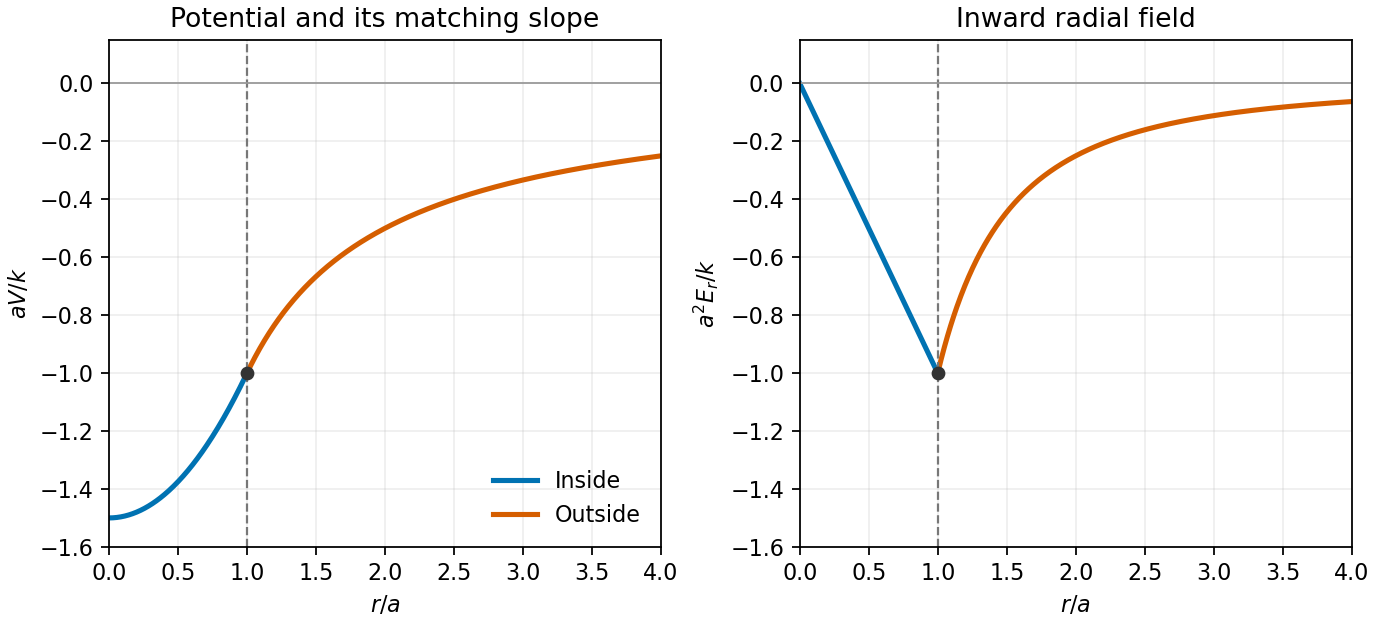
Continuous radial potential and inward electric field, normalized at the sphere boundary
. Details. 
Past exam of the mathematics course of the year 2 of the natural sciences course of the University of Cambridge 2001 Paper 2 1 Solution Created 2026-10-18 Updated 2026-10-20
For the nonconstant boundary data, use separation of variables in polar coordinates and put . Laplace's equation reduces toThis Cauchy-Euler equation has independent solutions and . Unlike a disk containing the origin, the annulus permits both. The zero inner boundary value requires , and the outer value requires . HenceSubstituting gives zero, while gives . This is the Dirichlet problem on an annulus for one Fourier mode; no other angular mode is needed.
For the changed inner boundary value, use superposition to add a radial harmonic function that is at and zero at . The radial zero-mode equation is , giving . Imposing the two constant boundary values givesTherefore the second answer isThe logarithmic term is independent of , so it changes only the angular average of the electric potential. Both answers are unique for these Dirichlet boundary conditions, by uniqueness for Laplace's equation.
Past exam of the mathematics course of the year 2 of the natural sciences course of the University of Cambridge 2003 Paper 2 1 Solution Created 2026-10-18 Updated 2026-10-20
For a vacuum electric potential, put in Laplace's equation in spherical coordinates. Multiplication by separates the radial and angular terms. With separation constant and , the angular Legendre differential equation isRegularity at both polar axes selects nonnegative integers and the Legendre polynomials. The radial equation is , whose independent solutions are and . Hence the angularly regular axisymmetric vacuum solution isThe radial domain and its boundary conditions determine which terms are admissible.
For the given charge density, only is forced. Write . The interior radial Poisson equation is . The identity for the Poisson equation with a spherical harmonic source gives the particular solution , since the radial operator takes to four. Finiteness at zero and decay at infinity therefore giveContinuity of the electric potential and its radial derivative at requires and . Solving gives , , soAll other angular modes have zero coefficients after imposing regularity, matching and decay. At the origin the interior expression is , which extends with a continuous gradient and value zero. The angular charge density has no unique value exactly at that point; Poisson's equation holds classically for and as a weak solution through the origin. There is no additional point charge.
A direct lightning strike is unnecessary. A nearby strike can produce a ground current, putting the feet at different electric potentials and driving current through the body by a step voltage. A side flash from a struck object or conduction along a contacted conductor also provides an indirect current path.[ref]
Lightning Science: Five Ways Lightning Strikes People by the National Weather Service. “Ground Current”, “Side Flash” and “Conduction”: indirect electrical exposure
Rapid air heating by a nearby lightning discharge also produces an expanding pressure disturbance. Its blast can impart a mechanical impulse, causing a fall or blunt injury without current passing through the person.[ref]
The absence of a direct strike therefore does not distinguish electrical incapacity from mechanical displacement. Observations would be needed to identify the mechanism in a particular event.
The electric potential and magnetic vector potential represent the fields through and . They are not unique: a differentiable function giveswithout changing either field. Gauge fixing restricts this freedom to suit the sources, boundaries or symmetry; it does not alter observables.
The Lorenz gauge is Lorentz covariant. Maxwell's equations then reduce to sourced wave equations,Retarded solutions implement causal radiation conditions. This gauge is useful for radiation and relativistic calculations; residual transformations obey the homogeneous wave equation.[ref]
The Feynman Lectures on Physics, Volume II by Richard Feynman and others. §18–6, Eqs. (18.23)–(18.25): gauge choice and potential wave equations
The Coulomb gauge instead gives . Its electric potential is an instantaneous Poisson solution, but the accompanying magnetic vector potential makes the full physical electric field causal. It is useful in separating longitudinal electric fields from transverse radiation. In a source-free vacuum region, suitable radiation boundary conditions permit radiation gauge , , leaving two transverse plane-wave polarizations. These extra conditions are not a gauge choice applicable unchanged to arbitrary nonzero charge distributions.
Different gauges redistribute information between potentials; the same boundary-value problem gives the same electric fields and magnetic fields.