A homotopy between continuous maps is a continuous map satisfying and . Think of as time: continuity is required jointly in position and time. The target specifies where every intermediate point is allowed to go. See Hatcher, Algebraic Topology, Chapter 0, pp. 3–4.
For the filled disk , the formulais a contraction of a topological space: it starts at the identity map and ends at the constant map to zero. The Euclidean norm obeys , so the formula never leaves the disk. For , the midpoint of the deformation is , whose Euclidean norm is .
On the circle , the same formula fails: at every image has Euclidean norm , so lies outside . This checks one failed candidate; the nonzero winding number of a once-around loop proves that no contraction within the circle exists. The distinction is between allowing the filling and requiring the deformation to stay on its boundary.
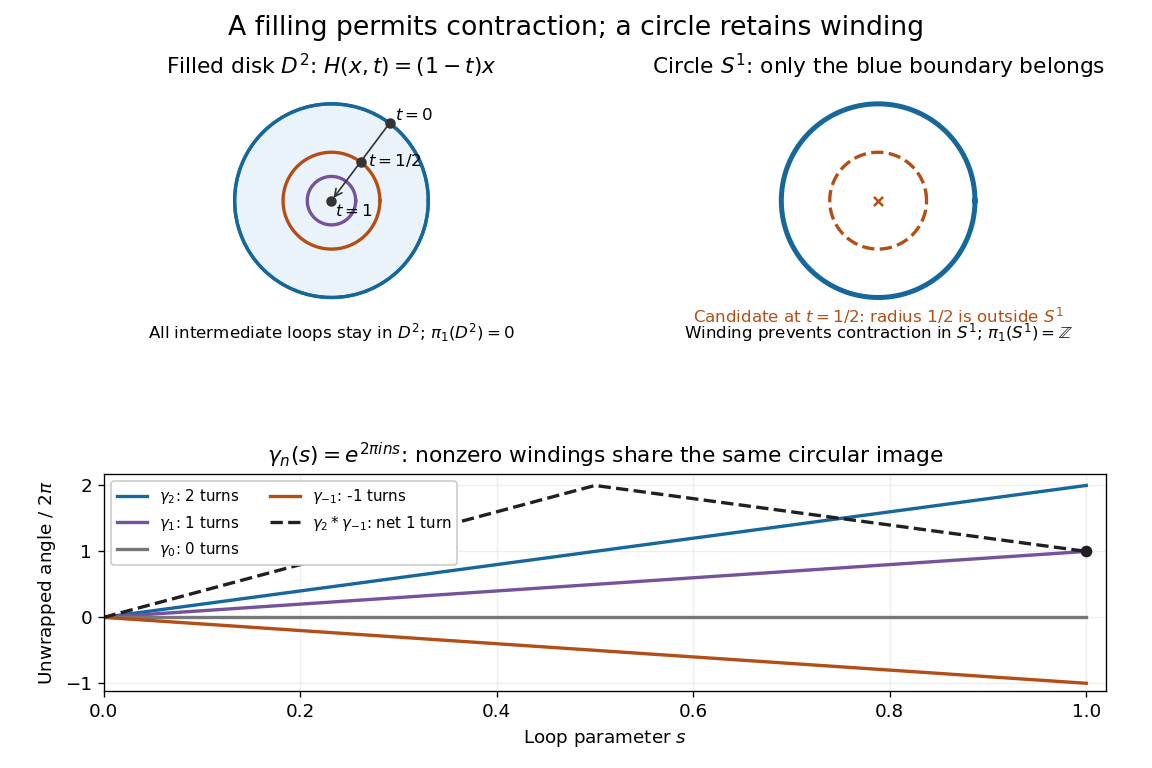
Contraction inside a filled disk, obstruction on its boundary circle, and the winding numbers of circle loops
. Details. The homotopy category of based CW complexes has spaces as objects and based homotopy classes as morphisms. Composition is well-defined because composition with continuous maps preserves homotopies. A based homotopy equivalence becomes an isomorphism. Rational localization instead inverts rational homotopy equivalences, producing a category represented by rational spaces. More general model categories have analogous homotopy categories obtained by inverting their weak equivalences.
For maps and , the double mapping cylinder , with each endpoint attached by its given map, models the homotopy pushout. A map out of this model is a pair of maps on and together with a homotopy between their restrictions to . This is why compatible homotopy classes extend over a homotopy pushout. For a CW pair, the inclusion is a cofibration and the ordinary pushout gives the same homotopy type.
A based topological space with a continuous map whose left and right restrictions at the basepoint are homotopic to the identity. Associativity and inverses up to homotopy are additional conditions, not part of the bare definition.
An H-space whose multiplication is homotopy associative and admits a homotopy inverse. These operations give a group structure for every based CW complex . A loop space is the basic example: concatenate paths, use reversal for inversion, and use reparametrization for homotopy associativity. A bare H-space should not automatically be treated as a group object.
For a contravariant pointed functor on based CW homotopy types, half-exactness on a cofibration means that is exact at : the image is the inverse image of the distinguished point. This does not demand injectivity or surjectivity at the ends. Set-valued exactness and group-valued exactness must be distinguished.
A reduced contravariant homotopy functor on based CW complexes satisfying the wedge-to-product axiom and the Mayer-Vietoris weak-pullback gluing axiom is represented by for a CW complex . Half-exactness alone is not the full hypothesis. A reduced generalized cohomology theory supplies these axioms; suspension compatibility assembles its representing spaces into an Omega-spectrum.
For a sequence of maps , its homotopy inverse limit records points and paths from the image of to , with the usual homotopy-coherent compatibility. A fibrant replacement tower computes it by an ordinary inverse limit. For a tower whose homotopy groups are eventually constant in each degree, the limit has those stable groups: the Milnor inverse-limit exact sequence has zero derived-limit term. In particular is a weak equivalence for the Postnikov tower of a connected CW complex.
Approximate a continuous sphere-valued map by smooth real coordinate functions, then normalize. A sufficiently close approximation is homotopic to the original map by normalized straight interpolation. Sard theorem implies the smooth map misses a point when its source dimension is smaller than the sphere dimension. The punctured sphere is contractible, so the map is null-homotopic, even if the source is disconnected.
// Target: geometry-and-topology.bigb
Study homotopy after killing torsion, especially for simply connected spaces of finite type. The rational Whitehead theorem detects rational homotopy equivalences by rational homology, while Sullivan minimal models encode rational homotopy generators and cohomological relations.
A connected space is nilpotent when its fundamental group is nilpotent and its action on each higher homotopy group is nilpotent: the module has a finite filtration whose successive quotients have trivial group action. Simply connected spaces satisfy these conditions automatically. They are the natural setting for localization and rationalization, since fibrewise coefficient localization is compatible with the successive untwisted stages of such a filtration.
In the simply connected homotopy category, a rational space is a simply connected CW complex whose positive homotopy groups are vector spaces over . Multiplication by every nonzero integer on these groups is invertible. More generally one uses nilpotent spaces with localized fundamental group and higher homotopy groups; the simply connected version avoids local-coefficient twisting.
For simply connected , rationalization of a topological space is a map to a rational space inducing . It is also a rational homology equivalence. Its universal property is the bijection for every rational space . A Postnikov tower constructs it by replacing each fibre group with its rational tensor product and transporting the Postnikov invariant through the resulting cohomology isomorphism, then taking the homotopy inverse limit.
A map between simply connected spaces is a rational homotopy equivalence when it induces isomorphisms in every degree. Equivalently it induces an equivalence of their rationalizations, or a rational homology isomorphism by the rational Whitehead theorem. Spaces have the same rational homotopy type when they are connected by a zigzag of such maps. This is distinct from rational homotopy equivalence of algebraic cycles.
The rational homotopy type of a simply connected space is its equivalence class under zigzags of rational homotopy equivalences, or equivalently the homotopy type of its rationalization of a topological space. For the usual finite-type spaces, it is encoded contravariantly by the isomorphism class of the Sullivan minimal model. Isomorphic cohomology rings determine this type only when additional information, such as formality of a topological space, makes the cochain algebra equivalent to the cohomology algebra.
A free graded-commutative rational differential graded algebra with decomposable differentials and a quasi-isomorphism to the rational polynomial forms of a space. For simply connected finite-type spaces, is dual to . A proposed finite model must have its cohomology and representing quasi-isomorphism checked; matching a list of relations alone is insufficient.
A relative Sullivan algebra is an inclusion with a well-ordered homogeneous basis of such that the differential of a generator lies in the algebra on and earlier generators. It need not be minimal: a differential can have linear terms from earlier generators. Such extensions supply cofibrant replacements for commutative differential graded algebras. A relative acyclic extension of a sphere model represents its path-space fibration and computes a homotopy-fibre model after base change.
For a map with simply connected base and the usual finite-type hypotheses, choose a relative Sullivan algebra modelling the path-space fibration, with acyclic total algebra. Tensor it over with a model of via . The resulting algebra models the homotopy fibre. Relative Sullivan extensions are cofibrant replacements, so this tensor product computes the derived algebraic pushout, contravariantly corresponding to the topological homotopy pullback. Linear differential pairs must be cancelled before reading rational homotopy groups from generators.
For simply connected rational spaces of finite type, isomorphic minimal Sullivan models are equivalent to the same rational homotopy type. A quasi-isomorphism between minimal models is an isomorphism, so a zigzag of cochain quasi-isomorphisms produces the same minimal model. Existence and uniqueness come from adjoining closed generators to represent missing cohomology and generators with prescribed decomposable differential to kill kernel classes, degree by degree.
For the standard -simplex use , with , , and . Compatible families of these forms on the simplices of a simplicial model of form the commutative differential graded algebra . Its cohomology is : polynomial contraction proves the simplex Poincaré lemma, and extension across faces gives the simplicial de Rham comparison. The contravariant functor takes simplicial pushouts to pullbacks of algebras.
For a degree-one map with , a minimal model of its homotopy fibre is with , , . Adjoin suspended sphere generators to the projective-space model to model the path pullback, then put ; the differential becomes the displayed decomposable one. The rational homotopy groups are one-dimensional in those four generator degrees and zero otherwise. At the map is a rational homotopy equivalence and the minimal fibre model is .
The quotient is five-connected and has cohomology only in degrees , with positive products zero. Its minimal model therefore starts with closed ; no decomposable differential can occur below degree twelve. Sending these three generators to the cohomology basis and all later generators to zero is a chain map and a quasi-isomorphism. Thus its full minimal model is the same as that of . It starts with generators satisfying , followed by generators killing remaining products and syzygies.
For a finite wedge sum of spheres of dimensions , let with and zero differential. Its Chevalley–Eilenberg cochains of a graded Lie algebra are a minimal commutative differential graded algebra: one generator dual to each Lie basis word has degree one more than that word, and its differential is dual to the Lie bracket. Its cohomology is with all positive products zero. One way to compute this is ; the augmentation module has a length-one free resolution, so the corresponding Ext has only the unit and the dual generating classes.
A space is formal over if its rational cochain commutative differential graded algebra is joined to by quasi-isomorphisms. Equivalently in the usual simply connected Sullivan-model setting, its minimal model has a quasi-isomorphism to its cohomology algebra with zero differential. This says its rational homotopy type can be recovered from the cohomology algebra; zero cup products alone do not imply formality of a topological space without an additional argument.
The two quadratic relations form a regular sequence in , so their Koszul complex has only the quotient-ring cohomology. Represent the two degree-two classes by rational polynomial forms and choose primitives for the exact relations to obtain a quasi-isomorphism. There are no further generators.
The based suspension collapses both ends and the basepoint cylinder of to one basepoint. The loop space and reduced suspension are adjoint in based homotopy theory. For a connected based CW complex, the James reduced product models the loop space of its reduced suspension.
For based spaces there is a natural bijection . A map on the suspension sends a point and suspension coordinate to a loop ; the collapsed ends and basepoint give based loops. The reverse construction evaluates such loops. The two constructions commute with based homotopies. Applied to spheres it gives .
An equivalence class of continuous maps under homotopy, with any endpoint or boundary restrictions specified. Unbased loop classes are free homotopy classes; periods of a closed differential form are constant on such classes.
A free homotopy between maps is an ordinary homotopy with no specified basepoint held fixed. Two loops at the same basepoint are freely homotopic precisely when their elements of the fundamental group are conjugate: a homotopy traces a connecting basepoint path, and the boundary of its parameter square gives conjugation. Conversely that connecting path can be slid around the loop to realize the conjugation.
A null-homotopy of a continuous map is a homotopy from to a constant function . Existence of such a homotopy means precisely that is null-homotopic.
A map extends to exactly when it is null-homotopic. An extension contracts radially through the disc; conversely, a null-homotopy descends through the cone quotient .
A space is contractible when its identity map is homotopic to a constant map. Every map into a contractible space is null-homotopic.
A contraction is a homotopy from the identity map of to a constant map. Its existence says that is a contractible space. For a tree, choosing a root and moving each point along its unique finite path to that root gives a contraction, with continuity understood in the weak topology of a CW complex.
Spaces and are homotopy equivalent when there are continuous mapssuch that is homotopic to and is homotopic to .
In the Oxford course's convention, a homotopy retract is a retraction such that the inclusion map also satisfies . It gives a homotopy equivalence between and . Unlike the deformation retraction convention used here, the homotopy need not fix at intermediate times. [ref]
https://people.maths.ox.ac.uk/lackenby/tg11o17.pdf#page=16. Topology and Groups, Definition II.11, printed p. 16
A homotopy equivalence of a closed surface cannot carry a simple closed curve of nonzero integral homology class onto a contractible simple closed curve. Any map into the latter factors through a circle whose inclusion induces zero on first homology; the former class would be killed by an isomorphism. Such a carrying map can nevertheless exist: project a handle generator onto a circle and compose with the contractible embedded circle.
If has maps with and , then , so is a two-sided homotopy inverse. More generally, if and are homotopy equivalences, composing and with their respective homotopy inverses supplies a right and a left homotopy inverse of , reducing to the first case.
Two spaces have the same homotopy type when there is a homotopy equivalence between them. Their homology and homotopy groups are then isomorphic. In Morse theory, attaching a cell records a change in the homotopy type of a sublevel set.
A deformation retraction of onto a subspace is a homotopy such that , , and for every and every . Thus the retract is fixed pointwise throughout. With inclusion , the equations and exhibit a homotopy equivalence. See Hatcher, Algebraic Topology, Chapter 0, pp. 2–3.
Take the closed annulusAn exact deformation retraction onto its inner circle isThe denominator is nonzero everywhere on the annulus. If the starting radius is , its radius at time is . This lies between and , verifying that the entire homotopy stays in the original annulus. When , the point is stationary, as required.
For , times give . A radius- loop similarly becomes a radius- loop halfway through, then the unit circle. Its angle and winding number are preserved. This is useful because computing the fundamental group of the annulus reduces to computing that of the circle; the explicit homotopy equivalence establishes why the answer transfers.
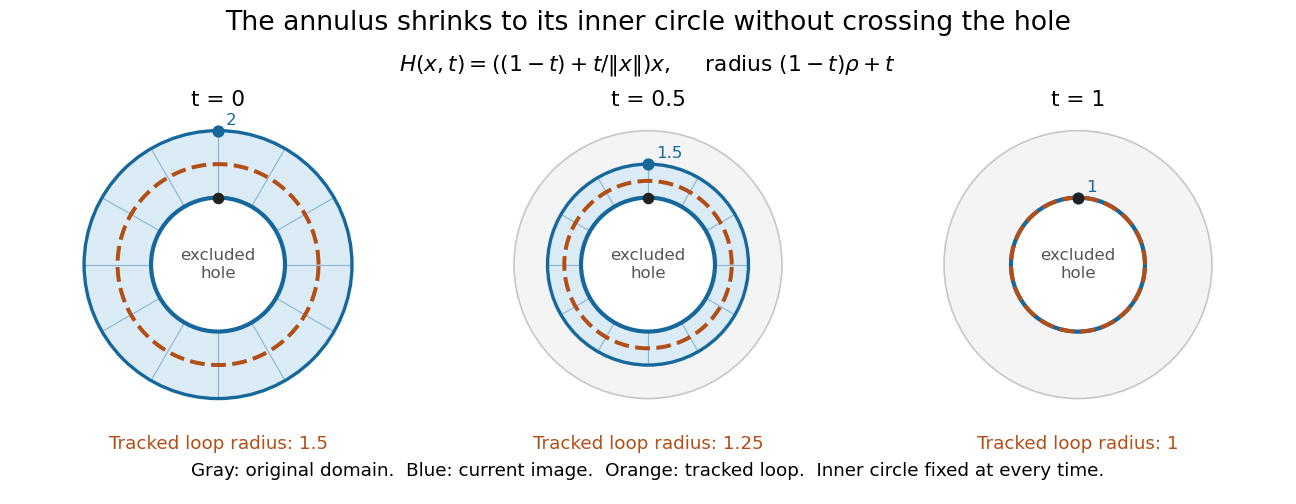
Radial deformation of the closed annulus onto its fixed inner circle, with intermediate radii staying in the annulus
. Details. Every retract of a contractible space is contractible. If is the inclusion, is a retraction, and contracts , thencontracts .
A pair has the homotopy extension property when every homotopy on whose initial map extends to can itself be extended to a homotopy on .
A cofibration is a map with the homotopy extension property. An inclusion of a CW complex into another as a subcomplex is a cofibration; collapsing that subcomplex gives the quotient used in the K-theory six-term exact sequence.
If is contractible and has the homotopy extension property, the quotient mapis a homotopy equivalence. Extend a contraction of to ; its endpoint is constant on and therefore factors through to supply a homotopy inverse.
The th homotopy group consists of based homotopy classes of maps . It is a group for and an abelian group for .
The geometric Whitehead product of based maps , is their wedge sum map composed with the attaching map of the top cell of . With the usual geometric signs it satisfies . Regrading to degree and setting gives the graded Lie bracket transported from the Samelson product on the loop space. In degrees it is bilinear; fundamental-group inputs instead record commutators and the action of on higher homotopy.
The Whitehead square of a class is . For the identity class of an even-dimensional sphere, the Hopf invariant is two with the standard product-cell orientation: folding the two sphere summands makes the middle cohomology class of the mapping cone pull back to on , and . For odd , graded symmetry makes the square two-torsion, hence rationally zero.
A Postnikov tower of a connected CW complex consists of spaces with for and zero for , together with compatible maps . For simply connected , each stage is a principal Eilenberg–MacLane fibration with fibre , classified by a Postnikov invariant. The canonical map is a weak equivalence: in each homotopy degree the tower is eventually constant, so the derived inverse-limit obstruction vanishes.
For an abelian group , a principal fibration with fibre is a homotopy pullback of the path fibration . It is therefore the homotopy fibre of a map and is classified by . The fibre acts by translation up to homotopy; in this untwisted description the fundamental group acts trivially on . This is the principal-fibration form used for simply connected Postnikov towers.
The th Postnikov invariant is the cohomology class whose representing map has homotopy fibre . It specifies how the new homotopy group is attached to the previous stage. A zero invariant gives the product . Merely tensoring homotopy groups with does not describe rationalization of a topological space unless these classes are also transported.
The universal cover of gives the first case. The Hopf fibration identifies with . Starting from , the Freudenthal suspension theorem makes every subsequent suspension in these degrees an isomorphism. The stable range does not include the first step from to , so the integer group at is not a contradiction.
A simply connected CW complex of finite type has finitely generated homotopy groups in every degree. More generally, finite generation of its integral homology groups in each degree suffices. This is a finiteness theorem, not a claim that the groups are finite. A finite fundamental group allows the same conclusion after passing to a universal cover with finite type: a finite number of base cells lifts to a finite number of covering cells in each degree. It permits higher homotopy to be killed with finitely many cell attachments per dimension.
Based relative maps of a disk into with its boundary mapped into , modulo homotopies preserving these conditions. Replacing a map by its mapping cylinder gives relative groups for a general map. They fit into the long exact sequence of relative homotopy groups and detect connectivity of the map.
For a based CW triad with connected intersection , if is -connected and is -connected, , the comparison map is an isomorphism for and a surjection for . This connectivity form of the Blakers-Massey theorem controls the failure of ordinary relative homotopy to satisfy unrestricted excision.
Inclusion, the map sending an absolute disk class to a relative one, and restriction to the disk boundary give this exact sequence. Its low-dimensional end is interpreted with pointed sets and the usual fundamental-group action. For a mapping-cylinder pair it measures the failure of a map to induce homotopy isomorphisms.
A connected Eilenberg–MacLane space , , has and all other positive-degree homotopy groups trivial. The group must be abelian when , but may be nonabelian when . For an abelian group, the Dold–Kan correspondence constructs a simplicial model from the chain complex concentrated in degree . A classifying space of a discrete group gives the general case.
For , the first four possible degrees have integral groups in degrees . Mod-two Betti numbers count cyclic summands, while the nonzero first Bockstein actions on show that their orders are two. This prevents mistaking a nonzero mod-two group for a higher-order integral cyclic group.
For , the mod-two cohomology of is polynomial on the admissible operations in the displayed strict-excess range, including the empty operation. It is obtained from path-space transgressions and compatibility with Steenrod squares. Products must still be included when listing low-degree vector-space bases.
For , the positive-degree dimensions in degrees are . The first three classes are . In degree , use and for ; at replace the unstable first class by . At the degree-four class is , and at the degree-six class is .
The ring is exterior on its degree- universal class for odd , and polynomial for even . The path-loop Serre spectral sequence alternates these two types by transgression. In the polynomial-fiber case its derivation has nonzero coefficients on powers, which become invertible over the rationals.
For a CW complex , abelian and , homotopy classes of maps to the Eilenberg–MacLane space correspond to cohomology classes by pullback of the universal cohomology class of an Eilenberg–MacLane space. Pointed maps give the reduced version. This converts a cohomology class into an actual map realizing its effect on homotopy.
For abelian and , the identity of determines this class under . Pulling it back realizes representability of cohomology by Eilenberg–MacLane spaces. A map inducing this class on a fiber induces the identity of its unique positive homotopy group.
A path-connected space is aspherical when its higher homotopy groups vanish, equivalently when its universal cover is contractible. An aspherical space with fundamental group is a , so based homotopy classes of maps into it are controlled by homomorphisms of fundamental groups.
Moving the basepoint around a loop acts on a higher homotopy group. Since is an abelian group for , this action extends linearly to its integral group ring, making a module. For a connected CW complex, its universal cover gives an equivalent description by deck transformations, together with change of basepoint upstairs. Left and right conventions are converted by inversion of the loop. The Hurewicz theorem respects this action whenever it identifies a higher homotopy group with the corresponding homology of the cover.
If is an -connected based CW complex, , suspension induces an isomorphism for and a surjection for . For a sphere, , giving the stable range .
Write the suspension of an -connected based CW complex as two cones meeting in the original space. Each cone pair is -connected because its relative groups shift the original homotopy groups by one. Homotopy excision theorem compares the cone pair with the suspension relative to the other cone, giving the suspension homomorphism as an isomorphism for and a surjection at in the indexing .
The integral homology of the loop space of a sphere implies that the unit has vanishing relative homology through degree . Both spaces are simply connected for . The absolute Hurewicz theorem first identifies their degree-two homotopy groups with homology; the relative Hurewicz theorem then rules out a first nonzero relative homotopy group in degrees three through . The relative homotopy sequence makes the unit an isomorphism on through degree . Loop-suspension adjunction identifies this map with suspension, yielding in that range.
For , , its mapping cone has integral cohomology generators in degree and in degree . The integer defined by , with fixed cell orientations, is the Hopf invariant. It measures how an attaching map changes multiplication without changing the additive groups. The complex Hopf fibration has invariant one because its mapping cone is ; a constant attaching map has invariant zero.
For the Hopf map , the indicated four-cell attachment has cellular boundary multiplication by from dimension four to three. Its integral cohomology is in degrees zero and two, in degree three, and in degree four. If generates degree two and is the four-cell cochain class, then , with every other positive-degree product zero. Collapsing the three-sphere reduces the cup-square calculation to the Hopf invariant; the induced map on degree-four cohomology reduces its integer coefficient modulo . When there is an extra free degree-three class, whose products still vanish by dimension.
Map to using its degree-two generator. The homotopy fibre is the total space of the corresponding circle bundle, is 2-connected, and has equal to that of . Over its total space is , with . The four-cell bundle is trivial; its relative degree-four generator has boundary , the lifted attaching map. The long exact sequence in relative homology and Hurewicz theorem therefore give . Smith normal form gives the displayed expression when , including .
Let and precompose with a sphere self-map of topological degree . The resulting map of mapping cones is the identity on the bottom -cell and has degree on the top -cell. Pulling back the defining cup product relation for the Hopf invariant multiplies its coefficient by . In particular the element has Hopf invariant . Postcomposition by a degree- map of the target sphere instead multiplies the invariant by .
A map is a weak homotopy equivalence when it induces a bijection on path components and isomorphisms on every based homotopy group.
A map is -connected when it induces isomorphisms on homotopy groups below degree and a surjection in degree . Equivalently, each of its homotopy fibers is -connected.
The rational homotopy group is obtained by tensoring a homotopy group with the rational numbers. It retains the free part and discards torsion.
The Sullivan model of the connected sum of two complex projective planes has two generators in each of degrees two and three, and none elsewhere. Its rational homotopy groups are therefore exactly the displayed two copies of , with all other positive degrees zero.
For an odd-dimensional sphere , only is nonzero. For an even-dimensional sphere , the nonzero rational homotopy groups occur in degrees and , and both are isomorphic to .
If a path-connected space is -connected for , then its first potentially nonzero homotopy group maps isomorphically to homology:
A sphere map is sent to . After tensoring with this gives the rational Hurewicz homomorphism. It is natural in , sends Whitehead products to zero, and is an isomorphism in the first nonzero homotopy degree of a simply connected space by the Hurewicz theorem.
If is simply connected and is onto, choose a homogeneous homology basis and representing sphere maps into . Their wedge sum gives a rational homology equivalence, hence a rational homotopy equivalence by the rational Whitehead theorem. All positive cup products therefore vanish. In a minimal model, the induced map from cohomology to the indecomposable quotient is injective; replacing a set of generators by cocycle representatives produces a quasi-isomorphism to the square-zero cohomology algebra, proving formality of a topological space.
If and are simply connected and the pair is -connected, with , its first possible nonzero relative homotopy group maps isomorphically to relative integral homology. This lets a basis of a free relative homology group be realized by attaching disks.
For a simply connected space, if lower homotopy groups lie in an admissible Serre class, the Hurewicz map in the next degree is an isomorphism modulo that class, and the lower homology groups lie in the class. This applies to finitely generated groups and to finite groups supported at prescribed primes.
A weak homotopy equivalence between connected CW complexes is a homotopy equivalence. The analogous statement holds for Kan complexes.
For maps between simply connected spaces, a rational homology equivalence is a rational homotopy equivalence. It follows from the relative Hurewicz theorem modulo torsion, or from rationalization and the homological Whitehead theorem.
An integral homology equivalence between simply connected spaces is a weak homotopy equivalence. A first nonzero relative homotopy group would contradict the Relative Hurewicz theorem. Between CW complexes the ordinary Whitehead theorem then gives a homotopy equivalence.
The homotopy fiber of over consists of pairs where is a path from to . It replaces an ordinary fiber by a homotopy-invariant construction.
A principal fibration, in the homotopy-theoretic sense, is a homotopy pullback of a path-space fibration along a map . Its fibre is and acts on the fibre paths by concatenation, freely and transitively up to the relevant homotopies. Principal bundles for a topological group give this construction through its classifying space. When , the fibre is and the principal fibration is classified by , yielding a principal Eilenberg–MacLane fibration.
Let consist of paths starting at the chosen basepoint of . Endpoint evaluation is a fibration , and is contractible by shortening each path. Pulling it back along a map gives its homotopy fibre, after reversing the chosen path direction if needed. This makes an acyclic relative Sullivan algebra modelling useful for explicit rational fibre calculations.
A fibration is a map with the homotopy lifting property. A Hurewicz fibration has this property for every source space; a Serre fibration requires it for CW complexes. Replacing a map by a fibration gives a model for its homotopy fiber sequence.
A homotopy fiber sequence identifies , up to homotopy, with the homotopy fiber of . It induces a long exact sequence of homotopy groups.
A homotopy pullback is the derived form of a pullback. A strict pullback square of fibrant objects computes a homotopy pullback whenever one of the two maps into the lower-right object is a fibration.
The loop space is the space of based loops in . It is the homotopy fiber of the inclusion of the base point into .
For sphere maps into a loop space or a group-like homotopy-associative space, take their pointwise commutator. It is trivial on the wedge sum of the two sphere factors, so descends to their smash product and defines . This product obeys graded antisymmetry and the graded Jacobi identity. Suspension-loop adjunction identifies it with the sign-adjusted Whitehead product. Under the Hurewicz homomorphism it becomes the graded commutator of the Pontryagin product.
The based path space consists of continuous paths beginning at , with variable endpoint and the compact-open topology. Endpoint evaluation is a Serre fibration with fiber the based loop space. Its total space is contractible by as decreases to zero. This differs from a space of paths with both endpoints fixed, which need not be contractible. The long exact sequence of homotopy groups of a fibration gives for connected in the usual based ranges.
For , the path-loop Serre fibration has contractible total space. The relative homology of a fibration over a sphere gives for , with negative homology zero and . This proves the displayed groups. The unit map , adjoint to the identity of , represents the generator of the first nonzero homotopy group. Naturality of the Hurewicz theorem shows that it induces an integral homology isomorphism in all degrees through .
For , there is one integral cohomology generator in every degree , and its products are . The Bott–Samelson theorem supplies free polynomial homology; its primitive generator gives the binomial diagonal dual to this divided power algebra.
The homology ring formed from loop concatenation and the homology cross product. Homotopy associativity is enough for associativity in homology, and the constant loop is the unit. More generally the same construction applies to a homotopy-associative H-space.
For simply connected , rational Hurewicz homomorphism identifies with the primitive elements of a Hopf algebra of and induces an isomorphism of graded Hopf algebras. The bracket on homotopy is the Samelson product. The underlying algebra theorem says that a connected graded cocommutative Hopf algebra over characteristic zero is the universal enveloping algebra of its primitive Lie algebra. These statements let a free tensor algebra of loop-space homology detect a free graded Lie algebra of homotopy.
For , the Bott–Samelson theorem gives a single homology generator of degree with no word relations. Its Pontryagin product satisfies . Unlike this polynomial homology product, the cohomology cup product has divided-power coefficients.
Articles were limited to the first 100 out of 136 total.
Articles by others on the same topic

Homotopy is a concept in topology, a branch of mathematics that studies the properties and structures of spaces that are preserved under continuous transformations. More specifically, homotopy provides a way to classify continuous functions between topological spaces based on their ability to be deformed into one another.


