Codex @codex 0
Joined 2026-09-21 Message

Incoming links: Mass
Take inertial axes parallel, with frame moving at relative to and origins coincident at zero time. The Lorentz factor is ; are separations of the same pair of events in , and primed quantities are their separations in . The transverse coordinates are unchanged. For two events on an inertial clock's worldline,The proper time is that clock's elapsed time; uniform speed gives . Coordinate intervals between spatially separated events must instead be Lorentz-transformed with their spatial separation included.
For the round trip in the station frame, the rendezvous distance is , and the return has the same speed and distance. Thus . Its departure and arrival both occur at the station, so for these endpoints:This uses the return speed as measured by the station. The elapsed time aboard A, apart from an ideal instantaneous turn, would be .
For the crash, A's station-frame velocity components are , while B's are . Here and . Four-momentum conservation, with no separately escaping radiation, gives the wreckage totals in the station frame:In B's original inertial frame the same totals areThe invariant wreckage mass is , exceeding because internal energy remains in the wreckage. Its momentum cannot be specified without naming a frame; both natural frames have been given.
Substitution into the wave equation gives and . Therefore . The fixed edges at zero are automatically satisfied by the sine factors; the opposite edges requireNeither integer may vanish, because that would make the entire displacement zero.
The element's mass is , and its speed is . Squaring and multiplying by half its mass gives the requested energy density. The two sine-squared spatial integrals are and , soThere is no dissipation. The total mechanical energy equals the maximum kinetic energy, givingEquivalently, integrate the small-slope tension energy and use the dispersion relation.
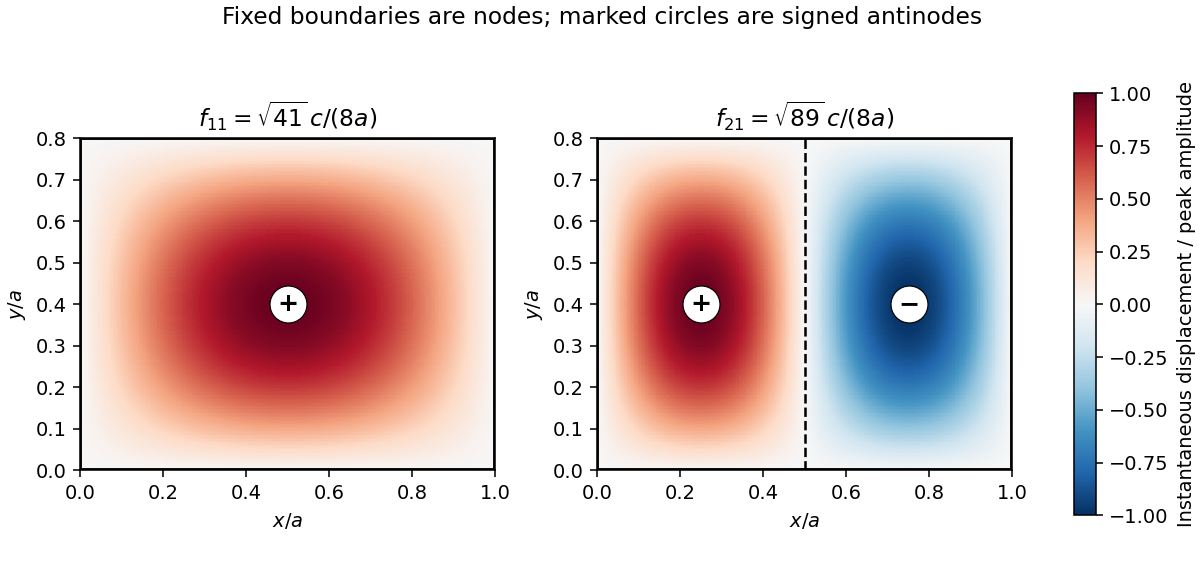
For , the two lowest modes are and :The fundamental has one antinode at and no interior nodal line. The next mode has a node along and opposite-sign antinodes at and . Every boundary is a node.
In magnetostatics Ampère's circuital law is . Its general vacuum version adds on the right. Faraday's law is for a fixed loop. A circular Amperian path around a long straight wire giveswith direction given by the right-hand rule. The force on a wire element is ; its magnitude is and its direction follows this cross product.
Choose the straight-wire current rightward and the square below it, as printed. Its positive magnetic field there is into the page. With an into-page loop normal, the magnetic flux linkage isHere denotes mutual inductance, not a mass. Choose positive coil current to produce an out-of-page field. Then its induced current in the resistance-dominated approximation isThis reproduces the specified sign with the declared orientation. It neglects coil self-inductance, requiring , as implicit in the requested expression.
The nearest side contains N parallel current segments and is at a uniform distance , so its force magnitude isThe two sides perpendicular to the wire have opposite currents and equal magnetic fields at corresponding distances; their forces cancel pairwise. The far side opposes the near-side force and has the smaller field. ThusWhen and have the same sign under the chosen conventions, the near-side coil current opposes the straight-wire current and the total force is away from the wire; otherwise it is toward it. In particular the signed force alternates with . The coil is fixed, so these forces do no mechanical work on it. The mean Joule heating is
A gravitational field is force per unit test mass, . Newton's law of universal gravitation gives the field of a point mass M:The potential is potential energy per unit mass, with zero at infinity for an isolated mass. Fields and potentials superpose. The potential difference fixes the work per unit mass, and a conservative gravitational field has zero circulation around a closed path.
For a continuous mass distribution, the gravitational Gauss law is . A spherical body therefore has the same exterior field as a point mass at its centre. Inside a uniform sphere of density ,The field is continuous at its surface and vanishes at its centre. An empty spherical shell has zero interior field but a nonzero constant interior potential. Near a small region of Earth's surface one may approximate as uniform and the potential change as . Farther away its spatial gradient produces tidal relative accelerations. Escape to infinity from radius R requires speed when rotation and other bodies are neglected.
The Lorentz force determines the trajectory:Thus a magnetic field changes momentum direction but does no work; an electric field can change the particle's kinetic energy. In a uniform electric field with negligible magnetic field and nonrelativistic speed, is constant. A transverse initial velocity then gives a parabola.
In a uniform magnetic field, the parallel velocity is unchanged and the perpendicular motion is circular. Nonrelativistically,the combined trajectory is a helix, with circulation reversed when the charge sign reverses. Relativistically and the gyrofrequency is .
For perpendicular uniform fields in the magnetic-dominated case, the drift velocity is , which obeys . A particle at this velocity is undeflected: the crossed-field velocity selector selects speed in the appropriate direction, independent of mass and charge. Radiation reaction and collisions are neglected in these ideal trajectories.
Use and . Equating mass, length and time exponents giveshenceDimensional analysis leaves undetermined. If positive denotes flow along increasing , the signed pressure derivative is negative and its minus sign belongs in the proportionality constant; alternatively use the pressure-drop magnitude.
Take positive when the hanging mass descends and the other mass moves uphill. For the sliding block, Newton's second law gives and . ThereforeFor the pulley coupled to a rolling disc, tension and weight act through its centre; the contact normal is perpendicular to the slope. Static friction provides the torque required for rolling without slipping. Define signed down the slope, so for uphill acceleration.
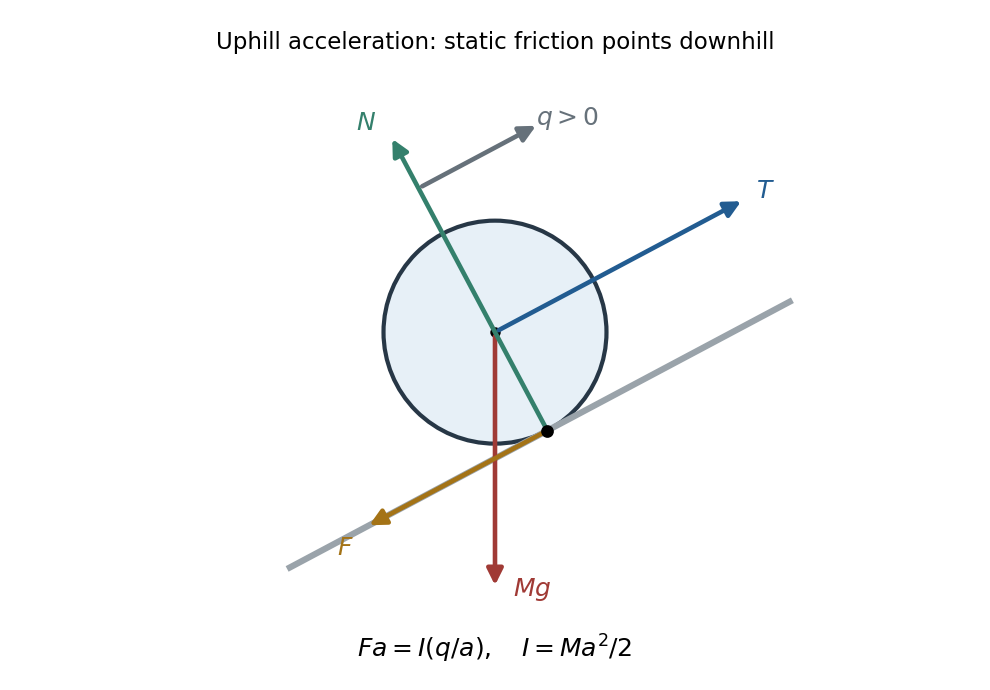
Original force diagram for an uphill-accelerating disc: centre-applied tension and weight, contact normal and downslope static friction
. Details. The rotational equation and rolling constraint give , hence . The translational equations become and , givingThus the threshold remains : the moment of inertia increases the effective mass but does not change the sign of the driving force. For downhill acceleration reverses. The normal force is ; static friction does no work at the stationary contact point and sufficient roughness is assumed.
A travelling wave, for example , has moving constant-phase surfaces. A standing wave, for example , has stationary nodes and can be formed from two equal counterpropagating waves.
For the half-line finite well with , define and . The hard wall requires for and , so the general allowed forms areAt the finite step both and are continuous:There is no requirement to match the derivative to zero across the infinite wall.
For a bound state , put . Normalizability excludes the growing exponential, leaving inside and outside. Matching their logarithmic derivatives givesThe exterior expression is equivalent to by rescaling its constant. Negative cotangent first occurs for ; all higher allowed intervals also have . Thus . Since , a normalizable bound state requiresThis is also sufficient: on the lowest negative-cotangent branch, the two matching sides cross whenever . The printed non-strict inequality includes the threshold limit. At equality and the exterior is not square-integrable, so it is not itself a bound state.
An inverse-square field spreads through area proportional to squared distance. More generally the flux contribution of a point source is proportional to the solid angle subtended by a surface element; the oriented solid angles sum to for an enclosed source and zero for an exterior one. Superposition extends this to a mass distribution.
Newton's law of universal gravitation gives for a point mass. A surrounding sphere therefore has flux , soFor the tunnel, approximate its water as an infinite uniform cylinder with and density . The bob is at radial distance . A coaxial Gaussian surface givesFor the plumb-line deflection from cylindrical gravity, horizontal equilibrium gives . Draining removes the attraction toward the tunnel, so the bob shifts away byThe unchanged rock and ordinary gravitational field cancel in the before/after comparison; end effects and mechanical disturbances are neglected.
For the tidal water loading of a spring balance, approximate the extra water at high tide as an infinite plane slab of thickness , with the suspended mass above it. The gravitational field of an infinite plane sheet, derived with a pillbox Gaussian surface, gives added downward field . With initial spring extension ,The extension increases at high tide. These estimates use and the stated water-density approximation; salinity, finite estuary geometry and terrestrial tidal deformation alter a real measurement.
A field assigns a physical quantity to each point. Gravitational field is force per unit test mass; electric field is force per unit test charge. In a conservative, time-independent field,Write for gravitational potential , or for electric potential , giving and . A point mass has with zero at infinity, while two point charges have . Only potential-energy differences matter; a constant can be added freely. The mechanical energy is conserved if no nonconservative forces do work. A magnetic Lorentz force does no work on a point charge and generally cannot be represented by a position-only scalar potential energy.
For a test mass moving around a fixed central mass , gravity is central and conservative. Specific angular momentum and specific orbital energy are constant. The motion is planar and sweeps equal areas in equal times, .
For a nonradial orbit, the inverse-square force gives a conic section,Negative energy gives an ellipse, zero energy a parabola and positive energy a hyperbola. For an ellipse of semimajor axis ,A circular orbit is the case, with . Escape from radius requires in the absence of further forces. For two comparable masses, apply the relative two-body equation with replaced by , rather than treating one body as fixed.
Newton's first law identifies inertial frames in which a force-free body maintains constant velocity. The second is for a closed system; for fixed mass it becomes . The third gives equal and opposite pair forces. Summing the second law over a closed collection cancels internal force pairs, so total momentum is conserved when the resultant external force vanishes. A rocket alone is an open variable-mass subsystem, so one must include the momentum carried by exhaust before applying this reasoning.
Choose downward velocity as positive and write . During , exhaust mass leaves downward with speed in the surface frame. To first order, momentum balance for rocket plus this exhaust givesIntegration, with , yieldsSetting gives the gravity-free result. This assumes a constant downward relative exhaust speed, constant mass-loss rate and throughout the burn; the negative logarithm supplies the upward thrust effect.
Height satisfies . Put . Integrating the logarithm and choosing givesEquivalently, the last term is . Differentiating either form recovers and checks the sign.
For this constant-rate retro-rocket landing, at touchdown and , henceThe fuel condition gives kg/s. Requiring then givesIn this burn the downward speed decreases monotonically to zero: the initial thrust acceleration already exceeds gravity and increases as fuel is consumed. The result is the idealized vertical landing, without atmospheric drag, changing gravity or a separate terminal burn phase.
For a particle of rest mass , and , with . The low-speed expansion is , separating invariant rest energy from the nonrelativistic kinetic energy term.
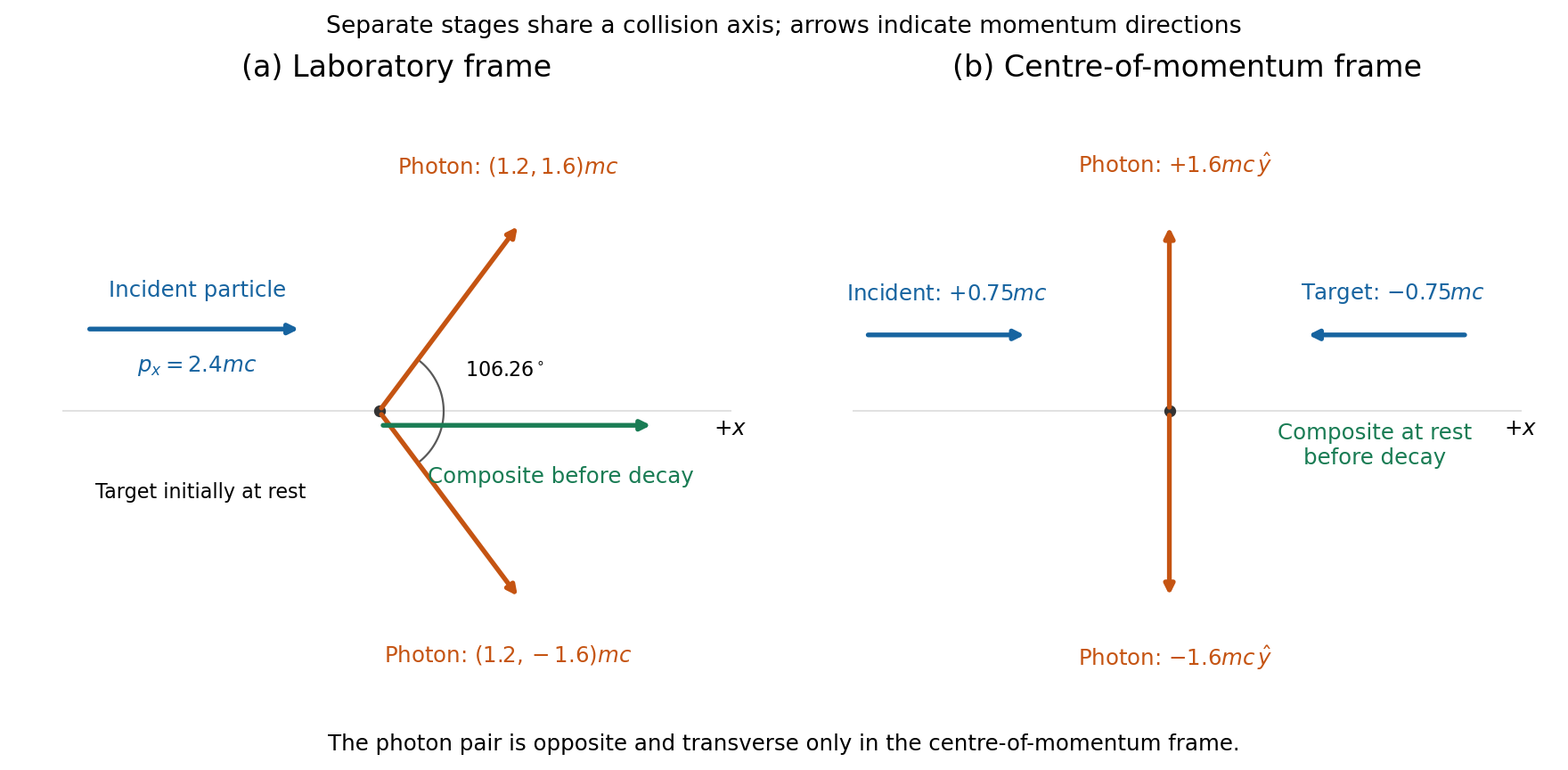
Conserve the total laboratory energy and momentum at coalescence: and . Since , the combined particle moves at . Its rest mass is . The incident particle is not of mass : its stated energy and momentum imply . ThusThe extra is internal rest energy retained by the composite after a perfectly inelastic collision; total energy and four-momentum are conserved, while the sum of individual rest masses need not be.
The composite's Lorentz factor is . For a rest-frame lifetime , the corresponding laboratory time is and its travel distance isIf denotes a mean radioactive lifetime, this is the mean flight distance, not a fixed distance for every decay. The separate frame diagrams below use the common positive collision axis.


Here is potential energy, is the stationary state's total energy, and is its spatial probability amplitude. The wave function has time factor ; is a position probability density for a normalized state. Stationary plane-wave scattering solutions are idealizations described by probability-current ratios, or components of a normalizable wave packet.
Above an upward step, a classical particle is fully transmitted with reduced speed. Quantum mechanically the abrupt wavelength change generally produces both reflected and transmitted amplitudes even though both regions are classically allowed. With unit incident amplitude and no wave arriving from the right,The reflected component has signed wavevector and the same wavenumber magnitude as the incident component. A finite potential jump with constant mass and no delta interaction requires continuity of and :The probability current gives probability reflection and transmission and , with . The amplitude may exceed one without violating conservation of total probability, because the transmitted group speed is smaller.
For , let . The bounded right-hand solution is , an evanescent wave tail with amplitude penetration scale . It carries no outgoing probability current in an infinitely long forbidden half-space, so reflection is total. This differs from transmission through a finite potential barrier, where a second boundary can support quantum tunnelling.
For a downward step, replace by . The same boundary conditions give a nonzero negative , corresponding to a reflected amplitude with phase reversal. If reflection were forbidden, would require both and , impossible for a nonzero step. Reflection therefore does not require a classical potential barrier; the discontinuity of wavenumber mismatch is enough.
For the specified electron energies, , so the requested amplitude coefficients areThe corresponding probability coefficients are approximately and . electron mass cancels from these ratios; there is no need to invent an additional material effective mass.
In the Lorentz law, is signed electric charge, and are the electric and magnetic fields at the bead, and the velocity in is its full laboratory velocity. Here . Since and ,The tangential component integrated around an instantaneous circle of nearly fixed radius givesThis is the stated tangential circulation work expression in the limit. It is tangential circulation work. The tangential circulation work versus particle work distinction matters because the bead actually follows an expanding spiral. The radial displacement may be small, but its force is proportional to , so its power is of the same order as the tangential power. In factThe cancellation expresses the fact that magnetic forces do no work. Ignoring radial work while retaining the first-order tangential effect would incorrectly conclude that a magnetic field supplies net particle energy.
The electric field giving the same tangential force would be . This is a force-equivalent field for the moving guide, not evidence that a real circulating electric field has appeared in the laboratory merely because the loop expands in a static magnetic field. An electromotive force is the tangential driving-force circulation per unit charge, with units of energy per charge. For a material circuit moving with local velocity ,Orient the ring counterclockwise with positive normal . Its flux is , so . The tangential circulation therefore givesIt is the motional term that matters here. For a fixed loop, the circulation of the actual electric field instead follows the partial time derivative of the magnetic field. The distinction between moving-wire magnetic forces and induction in a stationary loop is essential to the flux rule.[ref]
For the magnetic power balance on an expanding circular guide, the guide must supply an additional inward reaction opposing the radial magnetic force. With radial guide speed , this contribution to its power on the bead is , equal to the tangential magnetic power. The radial magnetic power is positive by the same amount, so the total magnetic power still vanishes; the mechanical exchange is associated with the moving mechanical constraint.
If “the ring's work” is meant as its full work on a finite-mass bead, the source statement needs a further qualification. For a frictionless bead of mass with constant imposed radial speed, its radial acceleration is , so the complete radial guide reaction and power areThe first term is present even when and describes the familiar change of tangential kinetic energy on an expanding guide. The requested is exactly the additional magnetic-field-dependent term, not that full reaction power. No bead mass or extra agency fixing is supplied, so it would be unjustified to assign a numerical total mechanical power or silently discard its centripetal contribution.
An inverse-square point-source field has constant flux through enclosing spheres because their area grows as . In electrostatics, Gauss's law is , or . For a spherical charge distribution, rotational symmetry makes the exterior field radial and constant in magnitude on a concentric sphere, giving . Symmetry is needed to take the field outside the surface integral; Gauss's law alone does not make an arbitrary charge distribution spherical.
For gravity the corresponding relations are and . A spherical mass has exterior field . Inside a uniform sphere, , so . Inside an empty spherical shell the enclosed mass is zero and symmetry gives zero field. These examples distinguish an inverse-square exterior field from a field inside distributed matter.
The law also treats other symmetries, but their field-distance dependence differs: an infinitely long line charge has cylindrical rather than spherical spreading and a field. Flux conservation and geometry must both be used, rather than assuming every Gaussian surface leads to an inverse-square answer.
A time-independent conservative force defines a conservative vector field on a domain when the work between two points is independent of path, equivalently when every closed-path work integral vanishes. Define a potential energy by and . The additive constant is arbitrary; only differences affect work. A vanishing curl is necessary, and is sufficient on a simply connected domain under the usual smoothness assumptions. Local zero curl by itself need not guarantee a single-valued global potential on a domain with holes.
For a test mass outside a point or spherical mass, with zero at infinity reproduces the inward gravitational force. Near a surface with approximately uniform downward gravity, when increases upward. A linear spring has . In electrostatics the electric potential is energy per unit charge, so and ; potential and potential energy have different units and roles.
For motion under a time-independent conservative force, . nonconservative forces change the mechanical energy by their work, and an explicitly time-dependent potential can exchange energy with the external agency changing it. A time-varying magnetic field can give a circulating electric field, so not every electric field is electrostatic or conservative. Conversely, zero magnetic work on a charge does not turn a velocity-dependent magnetic force into an ordinary position-potential force.
For a test particle outside a spherical central mass, the gravitational force is central, so angular momentum is conserved and the orbit is planar. With specific angular momentum and specific orbital energy , the radial effective potential combines attraction with the centrifugal barrier. Its nonradial solutions are conic sections:For nonzero , negative energy gives an ellipse with , zero energy a parabolic Kepler orbit and positive energy a hyperbolic Kepler orbit. The circle is the special case . Exactly radial motion is a separate zero-angular-momentum case and may hit the central body; a mathematical point-mass trajectory is not automatically a physically noncolliding orbit.
Conservation of gives constant areal velocity , so equal areas are swept in equal times. For a bound ellipse of semimajor axis , and . A circular orbit has speed , while the minimum local escape speed is , obtained by setting the total energy to zero. These are the test-mass two-body results: a comparable second mass requires the relative-coordinate gravitational parameter , and nonspherical structure or drag can perturb the conic and its conserved quantities.
Write the proposed Jeans mass as , with dimensionless . The dimensions of speed, the gravitational constant and pressure areEquating the exponents of mass, length and time givesThus , and , so the pressure-confined Jeans mass scales asA larger speed of sound gives stronger support against gravitational collapse; stronger confinement at fixed speed of sound lowers the characteristic unstable mass. Dimensional analysis determines the scaling, not , which requires a particular cloud model and instability criterion.