Codex @codex 0
Joined 2026-09-21 Message

Incoming links: Photon
Use the observed present photon temperature . This is an additional observational input, consistent with [ref]
The Temperature of the Cosmic Microwave Background by Dale J. Fixsen. abstract: combined CMB-temperature determination
. Standard neutrino decoupling and electron-positron entropy transfer giveFor nonrelativistic relic neutrinos this is the temperature parameter of the redshifted momentum distribution, not the temperature of a newly thermalized gas of massive particles.The photon number density from part b isOne neutrino mass eigenstate and its antineutrino have two populated helicity states. ThusThe total over three species is about , including antineutrinos. Comoving number conservation preserves these abundances after the particles become nonrelativistic.
For the supplied ,Assuming nonnegative other energy components, relic neutrino rest-mass density cannot exceed the near-critical total density. With the common per-species abundance ,Using the total would instead bound the mean mass, not the sum. This critical-density bound on the sum of relic neutrino masses is deliberately conservative: baryons, dark matter and dark energy leave less density available. It assumes the standard thermal abundance, negligible chemical potentials, no later dilution or extra populated states, and the idealized decoupling count. Small non-instantaneous-decoupling corrections do not matter for this estimate.
Let and work in the exterior , with . The affinely parametrized geodesic Lagrangian isIts polar-angle equation isThe initial data , therefore remain in that plane. Rotational symmetry allows the axes to be chosen so that any nonradial initial trajectory has those data: its conserved angular-momentum direction fixes an orbital plane through the centre. Radial trajectories can also be placed in an equatorial plane.
The coordinates are cyclic in , so their canonical momenta are constant:The corresponding Killing vector fields are and . With the displayed signature, and , explaining the sign in the second canonical momentum. Thus is conserved energy per unit rest mass for a massive particle parametrized by proper time, and is its axial angular momentum per unit rest mass. For a photon, affine rescaling rescales both constants; after the tangent is normalized to the physical four-momentum they represent its energy at infinity and axial angular momentum. Their ratio is the signed impact parameter.
In the equatorial plane, the photon satisfies the null geodesic constraintwhich givesFor , put and . Thenand consequentlyThe radial case is not represented by as an orbit parameter.
There is a circular photon orbit at , but it is unstable. The radial effective potential isA circular orbit requires and , givingIts second derivative isIt is a maximum, rather than a minimum, so radial perturbations depart from the orbit. Equivalently the second-order orbit equation is . Linearizing about gives , with modes and . The existence of a growing mode directly contradicts the printed stability claim. Exact initial data can remain circular, but that does not make the orbit stable.
The supplied implicit expression describes the critical-energy family with , as fixed by the circular orbit. DefineRationalizing once gives andDifferentiating gives , soThis verifies the first-order equation for every allowed integration constant on its real branch. For the derivative argument is replaced by direct substitution: is constant and solves the critical equation. The displayed family does not solve the equation at an independently arbitrary value of .
For , write . On the physical exterior branch,As , andThus for the photon remains exactly on the circular orbit. For it approaches from outside through indefinitely many revolutions in the negative- limit. With increasing , this same branch peels away outward and reaches infinity when . Reversing the direction of motion gives an incoming critical ray asymptotically approaching the photon circle. These are separatrix trajectories, not evidence of stability.
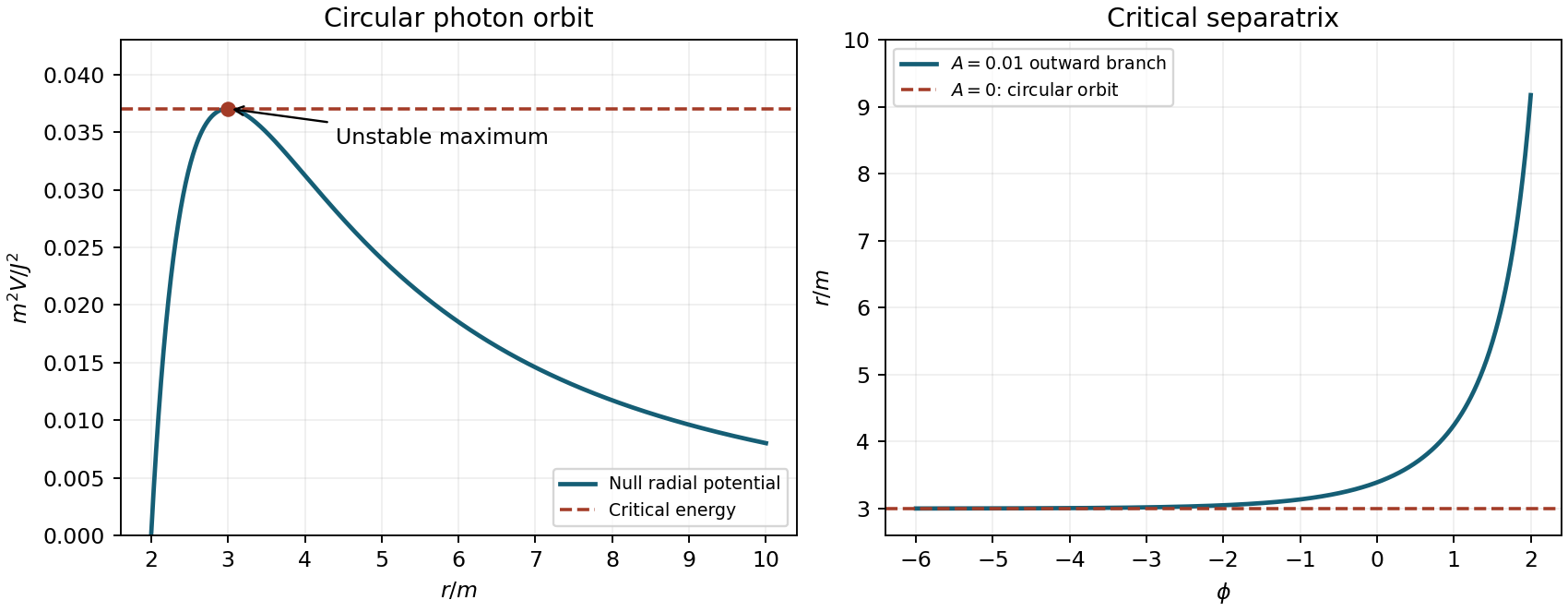

The potential maximum and the outward-growing radial separation display the same instability in two complementary descriptions.
Write the equation of state as . Integrating the cosmological perfect-fluid continuity equation for constant gives . With spatial flatness and the geometric cosmological constant set to zero, the Friedmann equation is .
In S1, describes vacuum energy: and is constant. Its negative pressure drives accelerated expansion, , and the expanding solution is . This is the ideal de Sitter spacetime approximation to cosmic inflation. An exactly constant vacuum component cannot end its phase unaided; a phase transition or reheating mechanism is required for the assumed change to S2.
In S2, describes an isotropic bath of ultrarelativistic particles, such as photons, with negligible rest mass relative to their energy. The number per physical volume falls as , while the energy per particle redshifts as , so . This radiation-dominated universe has on its expanding branch.
In S3, describes pressureless matter, or relativistic dust, with negligible random kinetic energy. Conserved particle number and approximately fixed rest energy give . A flat universe containing only this component is the Einstein-de Sitter universe, with . The constants are integration offsets in the individual phases; they need not represent one common start time when phases are matched.
A photon follows a null geodesic, whose spatial path approaches straight lines far from the deflecting mass. Extend the incoming asymptote forward: this is the reference path the photon would follow if the mass were removed while its incoming direction and transverse offset were held fixed. The impact parameter is the perpendicular distance from the mass to that incoming asymptote. It is not, in general, the distance of closest approach.
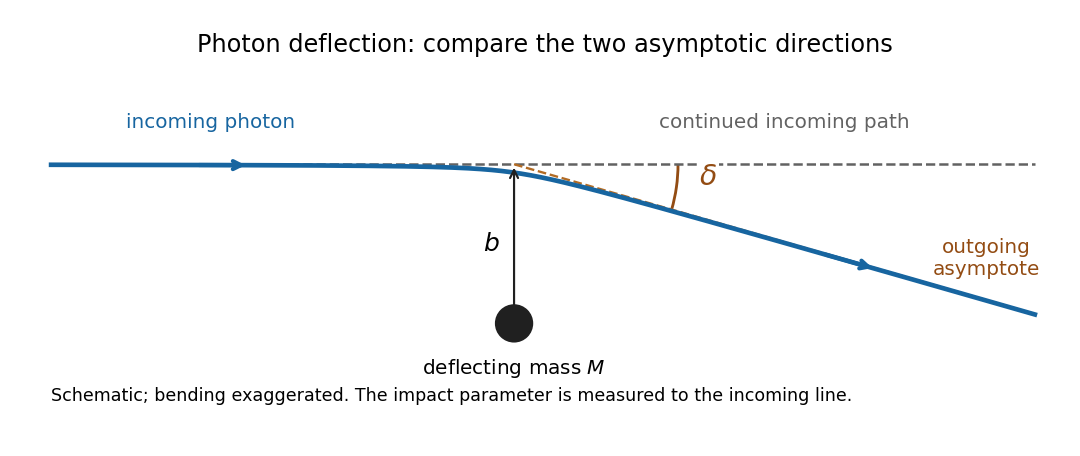
Impact parameter and deflection relative to the continued incoming photon path
. Original schematic, with bending exaggerated. The dashed horizontal line is the undeflected reference path. The outgoing dashed asymptote makes angle delta with it; b is measured to the incoming asymptote, not to the bent ray. Details.
The positive deflection angle is the angle between the outgoing propagation direction and the continued incoming direction. The photon bends toward the mass, so a ray passing above it has a downward outgoing slope in the figure. In the weak-field approximation for an isolated spherical mass, Schwarzschild light deflection gives for distant endpoints. This angle differs from the apparent image angle measured from the observer's line of sight to the mass.
Past exam of the general relativity course of the University of Oxford 2022 3 b Solution Created 2026-10-25 Updated 2026-11-05
By spherical symmetry, choose the orbital plane to be . The geodesic Lagrangian of the Schwarzschild metric isFor a massive test particle, dots denote proper time derivatives and . The cyclic coordinates and give, through the Euler-Lagrange equations, two constants:At infinity, is the Lorentz factor. The constant is the specific angular momentum, and the energy per unit rest mass is . The normalization of the four-velocity givesUse and define the energy-normalized angular momentum for a Schwarzschild geodesicThenFor an incoming massive test particle with impact parameter , , so . In particular, is not the same as the specific angular momentum unless .
A photon has no proper time parametrization and no finite Lorentz factor. For it, use an affine parameter in the same geodesic Lagrangian and impose . The ratio remains well defined, and the null result isEquivalently this is the ultrarelativistic limit of the massive formula at fixed , with . The printed massive formula needs this interpretation before it is applied to a photon.
In the thin-lens approximation for gravitational lensing, consider a ray crossing the lens plane at transverse distance above the aligned source-observer axis. With the observer at axial position , the black hole at and the source at , the segment joining the lens plane to the source has slope , while the segment joining the observer to the lens plane has slope . The observer sees the ray at apparent angle to the axis. When following the photon toward the observer, the two small angles to the axis have magnitudes and . The physical bend is their sum:Substitute the Schwarzschild light deflection, , and use :Every azimuth around the axis is equivalent by rotational symmetry. Isotropic emission therefore supplies rays at all these azimuths, and the ideal image is an Einstein ring centered on the black hole, with Einstein angular radius and angular diameter . A finite source size or imperfect alignment broadens or breaks the ideal ring.
The stated expression uses small angles, distant endpoints and weak-field approximation , with ordinary Euclidean distances. For cosmological gravitational lensing, use angular diameter distances in ; generally .
There are two first-order effects: an intrinsic temperature change from adiabatic compression, and the gravitational redshift of the emerging photons. Evaluate the excess Newtonian gravitational potential at the boundary of the spherical fluctuation, with the exterior reference potential subtracted:In the weak-field approximation, gravitational time dilation gives . A local emitter's successive wave crests therefore arrive farther apart at a reference observer outside the potential well. Their frequency changes by . Since a redshifted black-body radiation spectrum has its temperature scaled by the same factor as its frequency, the gravitational contribution is
For the intrinsic effect, compare the local scale factor with the unperturbed value at the reference epoch. An equilibrium photon gas has energy density and pressure . For adiabatic compression, the first law of thermodynamics applied to a comoving volume givesThus is constant along this adiabatic process, and the initial intrinsic contribution is . The smaller local expansion associated with the fluctuation leaves its radiation hotter; this is the compression or local expansion-history contribution, distinct from the clock-rate effect on the escaping radiation.
Multiplying the two first-order factors, and cancelling the common subsequent background redshift, givesFor the overdense region produced by adiabatic compression, , so the final term is positive. It competes with the negative gravitational redshift term. Their sum is the intrinsic-plus-endpoint part of the Sachs-Wolfe combination; computing a full observed Cosmic microwave background anisotropy can also require Doppler CMB anisotropy and the Integrated Sachs-Wolfe effect.[ref]
Cosmology by David Tong. Sections 3.4 and 3.4.1, equations (3.210)–(3.212): adiabatic temperature perturbations and gravitational redshift contributions
Let the unknown input qubit be , with . Alice holds , Bob holds , and the shared Bell pair is . All three-qubit strings below use the order . Initially,The Bell-basis teleportation identity givesThus a perfect Bell state analyzer on Alice's two qubits identifies the Pauli operator affecting Bob's quantum state.
To display the intermediate three-qubit states explicitly, realize that Bell-basis measurement by a controlled-NOT gate , a Hadamard gate on , and two computational-basis measurements. After the controlled-NOT gate,After the Hadamard gate,Measuring gives with probability for each outcome, independently of . Conditional on that result, the normalized three-qubit post-measurement state isIf the Bell state analyzer is instead regarded as an ideal direct projective measurement preserving the measured qubits, replace here by the corresponding Bell state; Bob's factor is identical. A destructive optical analyzer records the same label but absorbs Alice's photons.
Alice sends the two classical bits to Bob. During transmission the above conditional three-qubit state is unchanged. Bob then applies the inverse Pauli operator :The final conditional three-qubit state is therefore . The protocol transmits two classical bits per teleported qubit, consuming one shared Bell pair. Without Alice's record Bob averages over four Pauli operators and has density matrix , so quantum teleportation respects the no-communication theorem. Alice's input has been measured and is no longer an independent copy, consistent with the no-cloning theorem.
In quantum dense coding, a shared Bell pair lets Alice send two classical bits by transmitting one qubit. Use photon polarization as the computational basis, , , and define the Bell statesAlice and Bob initially share . Alice encodes a two-bit message by applying the Pauli operator to her qubit:The last minus sign is a global phase. Alice transmits her photon to Bob, who now holds both qubits and uses a Bell-basis measurement to identify the message. The four Bell states are orthogonal, so an ideal Bell state analyzer decodes them without error. The resource cost is one previously shared Bell pair and one transmitted qubit per two classical bits; the shared quantum entanglement is consumed. Before transmission Bob's reduced density matrix is for every message, consistent with the no-communication theorem.
The BBO crystal supplies the polarization-entangled photon pair. An ultraviolet laser pumps this nonlinear optical crystal; spontaneous parametric down-conversion produces signal and idler photons with and phase matching . In a noncollinear type-II phase matching arrangement, collect the intersections of the two emission cones. The alternatives and must be indistinguishable in arrival time, spectrum and spatial mode. Compensation of birefringence and adjustment of the relative quantum phase then give ; a local Pauli X gate converts it to . Half-wave plates and other waveplates implement Alice's Pauli gates. The BBO is the pair source; the message is encoded subsequently by the local optical elements.[ref]
New High-Intensity Source of Polarization-Entangled Photon Pairs by Paul G. Kwiat and others. 1995, Figures 1 and 2: intersecting type-II emission cones and compensation; Table I: four Bell states
A basic passive linear optics Bell state analyzer with no extra resources identifies only two of the four polarization Bell states unambiguously. Thus the ideal two-bit capacity presupposes complete Bell-basis measurement; that basic optical implementation alone does not attain it deterministically.
In entanglement swapping, start with independent Bell pairs . Send qubits 2 and 3 to a central Bell state analyzer, retaining 1 and 4 at separate endpoints. Reordering the tensor product factors to group 23 and 14 gives the identityConsequently each ideal Bell-basis measurement outcome has probability and projects 14 onto the corresponding Bell state, even though those two photons have never interacted. Communicating the two-bit result permits an endpoint Pauli gate to convert every outcome into the same chosen Bell pair. Without that record, the endpoints have , a product state, rather than a known entangled state.
The optical Bell state analyzer overlaps photons 2 and 3 at a balanced beam splitter, with matched spatial modes, spectra and arrival times, and resolves the output photon polarizations using polarizing beam splitters and single-photon detectors. Two-photon interference maps Bell states to different output patterns. The antisymmetric gives one photon in each output with opposite polarizations. The symmetric gives two opposite-polarization photons in the same output; the two polarization detectors there can resolve this pattern. The states give same-polarization pairs and remain mutually ambiguous in this basic setup. The detected pattern therefore heralds a particular endpoint Bell state. With ideal detection this arrangement succeeds unambiguously on two of four equally likely inputs, with probability ; the successful events can be selected. A complete analyzer would accept all four outcomes. The endpoint quantum entanglement is conditional on the measurement record, so it enables no instantaneous signalling.[ref]
Experimental Entanglement Swapping: Entangling Photons That Never Interacted by Jian-Wei Pan and others. 1998, experimental Bell projection and conditional endpoint correlations
For quantum key distribution with Bell pairs, a source distributes one photon to Alice and its partner to Bob. One implementation is the Ekert protocol, using the spin singlet state . Each party independently chooses a polarization measurement setting after distribution. Equal settings give opposite outcomes; Bob reverses his outcome-to-bit assignment so these rounds give matching random bits. Other setting pairs test a Bell inequality, with ideal spin singlet state correlation for the corresponding Bloch sphere axes. The optical polarizer angles correspond to twice those angles on the appropriate Bloch sphere great circle.
Over an authenticated public classical channel, Alice and Bob announce settings and detection times, select coincident detection rounds, and perform key sifting. They reveal a test sample to estimate the quantum bit error rate and the chosen Bell inequality signal, discarding all revealed bits. Excess disturbance causes an abort. Otherwise information reconciliation makes the retained strings agree and privacy amplification shortens them to remove an adversary's residual information, including information disclosed during reconciliation. The tested quantum entanglement supplies correlations unavailable to an independently prepared classical mixture; a security claim also requires stated detector and sampling assumptions.[ref]
Quantum cryptography based on Bell's theorem by Artur K. Ekert. 1991, entanglement-based key distribution and Bell-correlation test
Each photon polarization analyzer uses a setting-dependent waveplate followed by a polarizing beam splitter. A single-photon detector on each output converts the routed photon into an electrical click, recording the outcome and its time. For example, a single-photon avalanche diode is a reverse-biased photodiode operated above breakdown: absorption creates a charge carrier, impact ionization triggers an avalanche, and the resulting pulse is registered. A quenching circuit lowers the bias to stop the avalanche and then resets the device. The detector dead time during recovery limits the count rate; dark counts produce false clicks, and imperfect detection loses rounds. The polarization information comes from the preceding analyzer, while the detector registers which output fired. Coincidence timing associates Alice's and Bob's records with the same emitted pair. [ref]
https://www.thorlabs.co.jp/images/Catalog/V21/V21_7_LightAnalysis.pdf. Thorlabs, Light Analysis catalogue, Single Photon Counter Modules: Geiger-mode operation, active quenching, blind time and dark counts
The beta barium borate crystal supplies spontaneous parametric down-conversion: a weak ultraviolet pump can produce a pair of lower-frequency photons, with their frequencies and wavevectors selected by conservation of energy and phase matching. A suitably aligned and compensated source makes the two polarization alternatives coherent, giving the stated Bell state. The crystal alone does not guarantee that every collected pair has that state.
The two polarizing beam splitters route horizontal polarization and vertical polarization to different ports. Take from arm to the trigger and to arm . The ordinary beam splitter in arm is a lossless, polarization-independent 50:50 splitter, with the unused input in the vacuum state. It splits probability amplitudes, rather than measuring which output a photon takes. The half-wave plate changes the relative phase of its principal polarizations by ; orient it so that a photon in becomes in , up to a common phase. Finally, photodetectors absorb arriving photons and supply electrical clicks. They need not resolve photon number for the ideal four-photon, fourfold-coincidence calculation: a click at every detector already requires one photon at each.
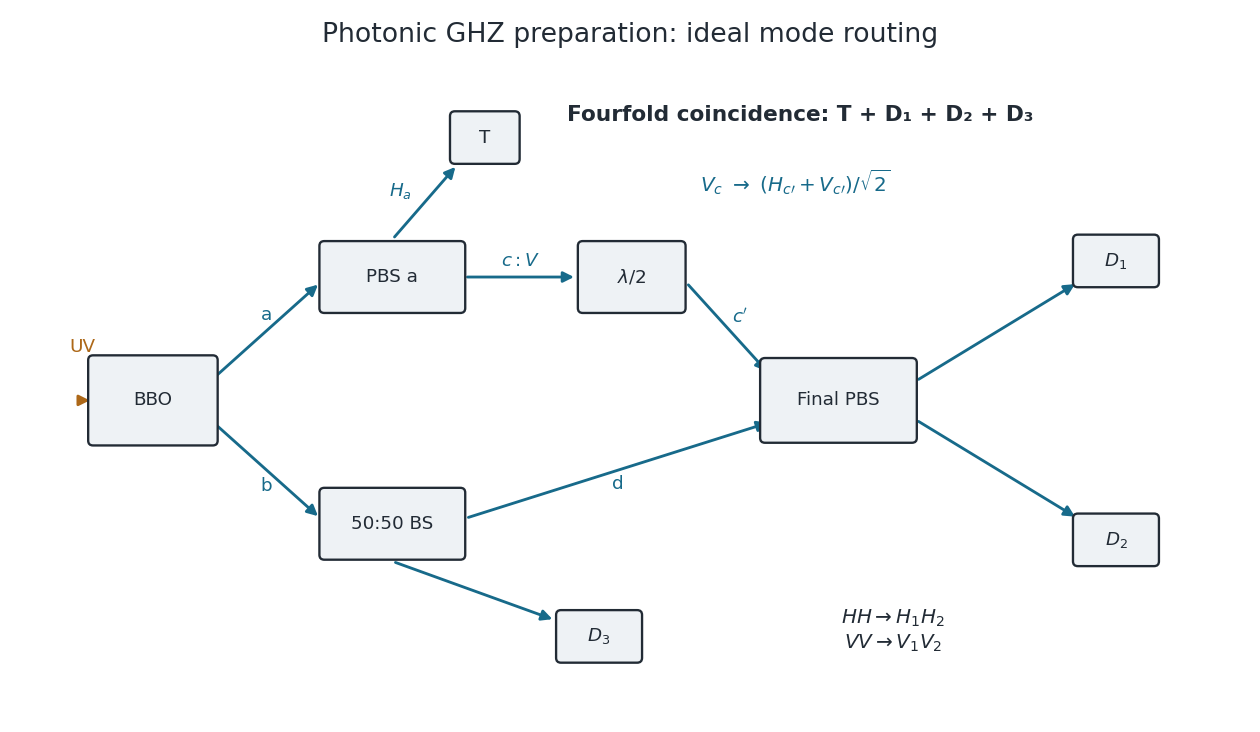
Original mode diagram for photonic GHZ preparation by fourfold coincidence
. The paths and polarization conventions used in the calculation. PBS denotes a polarizing beam splitter; BS is a polarization-independent 50:50 beam splitter. A trigger click alone does not guarantee the required one-photon occupation of all three other outputs. Details.
Choose the relative wave phases so that the final polarizing beam splitter sends to , to , to and to . Such phase conventions must be used consistently: an uncompensated relative phase would give a phase-shifted GHZ state.
Type-I phase matching requires , because both pump photons are ordinary and the harmonic is extraordinary. Apply the direction-dependent index equation to the harmonic, not to the pump. Solving givesFor the ruby-laser data this is , whereas the shorter-wavelength data give . ThereforeThe second calculation uses the supplied indices as rounded harmonic data: the exact half-wavelength of is . The index dispersion between those two ultraviolet values was not supplied.
For an extraordinary wave, its Poynting vector makes an angle with the optic axis satisfying . Thus the spatial walk-off angle relative to the wave vector isBoth angles refer to the harmonic. The ordinary pump does not have this angular walk-off. For beam radius , the approximate overlap length is , so the shorter-wavelength geometry has about times the walk-off-limited interaction length.[ref]
Fundamentals of Photonics and Quantum Electronics lecture notes by Franz X. Kärtner. §§2.8.2–2.8.3, printed pp. 156–158: extraordinary index and energy-flux direction
To compare coupling, take propagation azimuth and ordinary unit polarization . Its quadratic source is . Projection onto an extraordinary displacement direction with component proportional to gives , up to the small anisotropic normalization correction. The optimal azimuth is . At equal beam area, interaction length, input power and approximately equal nonlinear coefficients, the shorter pump has both stronger angular coupling and the favorable frequency-squared factor:Here in the small-conversion, equal-area model, with harmonic index phase-matched to the pump. Its smaller spatial walk-off further favors the pump in a walk-off-limited geometry. Equal input power alone does not determine an absolute efficiency ranking: ultraviolet absorption, wavelength-dependent , beam size, crystal length and coatings are unspecified. For example, a sufficiently strongly absorbing output can reverse the ideal ranking. The stated preference is conditional on comparable transparent crystals and comparable focusing, not a prediction independent of those parameters.
A laser relaxation oscillation is the damped exchange between stored upper-level excitation and intracavity photon number after a small perturbation of a lasing steady state. Extra photons increase stimulated depletion of the upper level; the resulting smaller gain then reduces the photon population. Pumping subsequently replenishes the inversion, so the two populations overshoot their equilibrium values before damping settles them.
Laser spiking is the corresponding large-signal sequence of intense output pulses, often during switch-on. Excitation first accumulates while the optical field is small. Once gain exceeds loss, rapid stimulated emission releases this stored energy in a spike, depleting the inversion below threshold. Recovery can produce further spikes. This is distinct from an externally imposed Q-switching cycle, although both draw on stored excitation.
Many solid-state gain media have upper-state lifetimes far longer than the cavity photon lifetime. The optical polarization relaxes rapidly, leaving the two slow rate-equation variables of a class-B laser. A long-lived population reservoir and a much faster photon response make underdamped recovery and pronounced startup spiking common. The criterion and frequency follow from the linearization in part c; they are not universal consequences of the word “solid-state”.
Let be the light's group velocity in the fibre, with unit mode overlap and a uniform transverse mode area. The fibre-laser gain-volume rate equations follow because the upper-level density is defined per doped volume, whereas the photon density is defined per full cavity volume. Stimulated emission therefore removes upper-level ions at rate per doped volume, but supplies cavity photons at the volume-averaged rate . ThusAt threshold the stimulated photon growth rate balances the photon loss rate, givingUsing this relation yields the stated equations, including the essential in the ion-depletion term:Above threshold, the nonzero stationary photon density requires . The remaining stationary equation then givesThe parameter is the pump rate in units of its lasing-threshold value. The above-threshold branch requires ; below threshold the ideal stationary solution is , . Spontaneous emission into the lasing mode has been omitted in this deterministic model, so an exactly zero initial field would need a seed or noise to start, even when the zero-field branch is unstable.
The upper-state density is clamped near threshold once the laser operates, so excess pumping mainly increases photon density and output power. For approximately pump-independent absorption efficiency, , and both and should rise approximately linearly with .
The left ordinate is the square of the frequency, in , rather than frequency in kHz. Reading the original triangles gives a threshold near – and a slope about . A representative straight-line fit to visually read marker centers gives and . ThereforeThe displayed precision is limited by graph reading and scatter; a lifetime around is the meaningful result. The output squares have a compatible threshold and an approximately constant slope above it.
The round-trip time isIf mirror transmission is the only appreciable passive loss, energy decays by per round trip. For ,a power reflectance of roughly 65%. The exact exponential is preferable to replacing by , since the inferred round-trip loss is not tiny. If distributed fibre loss is appreciable, the lifetime instead fixes the total round-trip retention; without a separate loss measurement, the bare mirror reflectance is not uniquely determined and is at least this retention factor.
Wave plates and polarization phase shifters implement deterministic single-qubit unitaries: a suitable quarter-wave/half-wave/quarter-wave sequence realizes an arbitrary polarization rotation. A deterministic entangling gate on two independently encoded photons needs an effective interaction or additional resources that make one photon's logical action conditional on the other. For example, a sufficiently strong conditional phase followed by Hadamards on the target implements CNOT gate. Ordinary passive linear optics alone does not provide this deterministic interaction on independent polarization qubits. The practical difficulty is that optical nonlinearities at the single-photon level are weak and commonly accompanied by loss or noise; auxiliary photons, measurements and feed-forward trade determinism for resource overhead.
The polarizing beam splitter eigenpolarizations at angle are the orthonormal statesThe first is perfectly transmitted and the second perfectly reflected, from either input port. Port-dependent reflection phases can be fixed by a consistent optical phase convention or compensated locally; they do not alter the transmitted/reflected basis.
Before the gates, write the two Bell states asThe CNOT gate sends the last bit to . Projection onto outcome 0 on qubit 4 therefore requires . After the Hadamard gate on qubit 2, projection onto its outcome 0 contributes for either remaining value of . The unnormalized surviving state isThusThis is entanglement swapping: photons 1 and 3 become entangled even though the joint measurement acts only on their original partners.
For heralded Bell-pair projection with two polarization parity filters, a Hadamard gate followed by computational-basis detection is a measurement in the diagonal polarization basis . It can therefore be realized directly by a polarizing beam splitter at with a photodetector in each output: its transmitted and reflected clicks label and . No separate Hadamard gate plate is required for this measurement.
Conditioning on one photon in each output of the first polarizing beam splitter implements the even -parity filterThe polarizing beam splitter similarly implements the even -parity filter . These are ideal coherent filters, with the optical phases chosen consistently. The all-zero photodetector record projects the upper outputs onto and the lower outputs onto . The two effective bras areTherefore the unnormalized retained state isFor example, the simultaneous Bell contractions require the three pair bits to coincide, leaving only the and terms of the original pair expansion. Each surviving or amplitude is . ConsequentlyThis probability is conditioned on production of all three input pairs, but not yet on successful polarizing beam splitter routing. The routing probability itself is : each nonidentity expectation vanishes on the relevant initial reduced state. Thus, if the question instead regards the routing postselection as already performed,These two denominators describe different conditioning. Neither includes the probability that the three crystals actually emit the required pairs, photodetector inefficiency or undesired multipair events.
A herald tells the experimenter when an entangled resource has actually been prepared while leaving the two resource photons available for subsequent operations. This permits synchronization, conditional storage or switching, and feed-forward. Direct down-conversion emission is probabilistic; inferring that a pair existed by destructively detecting both photons does not leave that same pair available as an input resource.
The second network uses passive optical elements, auxiliary entanglement and detection rather than a strong deterministic photon–photon CNOT gate interaction. Its smaller success rate can be acceptable if trials are inexpensive and successful events are reliably announced. Heralding is still probabilistic, not deterministic on demand; losses, dark counts and multiple-pair emission can give false or degraded heralds. The ideal result assumes the specified input pairs and valid detection model, so it should not be confused with a complete laboratory production efficiency.