A point spread function is an imaging system's response to an optical point source. Here it means the distribution of image light intensity: an ideal point object becomes a finite spot, often with faint rings, because of diffraction. An unresolved star and a sufficiently small bead emitting fluorescence are practical approximations to an optical point source. Their image tells us how nearby object details will overlap, and reveals blurring from optical aberrations, defocus, and, for an optical telescope, astronomical seeing.
A useful convention separates shape from throughput. At a fixed image plane, let be the point spread function with . Its units are inverse area. A point delivering detected radiant flux at image position produces light intensity ; this point spread function normalization makes the integral over the image equal to . A profile divided by its own peak is convenient for comparing widths, but is a different point spread function normalization and does not by itself compare total radiant flux.
In incoherent imaging, different object points have negligible mutual spatial optical coherence over the measurement, so their image light intensities add. If the response also obeys translation invariance over the chosen field of view, the expected continuous image is the convolutionHere is the object brightness distribution expressed in image-scaled coordinates, with magnification already included, and is constant transmission. For , where is the two-dimensional Dirac delta function, this gives . A changing response across the field of view instead requires a position-dependent integral kernel ; one measured point spread function is then only a local calibration.
In coherent imaging, the superposition principle applies to the complex wave amplitudes. With amplitude spread function , the corresponding ideal model isThus generally differs from : coherent contributions produce wave interference terms that depend on their relative wave phases. Their time average vanishes for mutually incoherent emitters, which explains the intensity convolution. Partial optical coherence requires the correlations between object points as well.[ref]
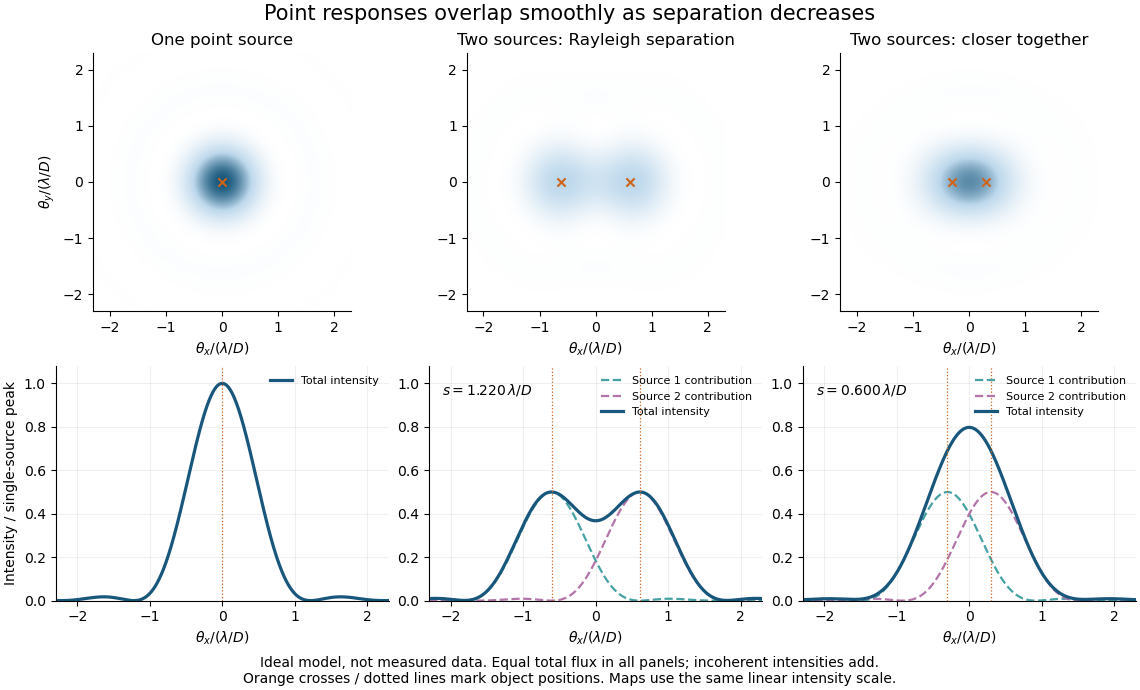
Ideal circular-pupil point responses and the overlap of two mutually incoherent sources
. Details. The figure is an original diffraction model, not measured data. All panels have the same total radiant flux: each member of a pair contributes half the single-source radiant flux. Dashed curves show the separate light intensity contributions; the solid curve is their sum. The point spread functions have tails, so even sources satisfying the Rayleigh criterion overlap. As separation decreases, the image changes continuously; there is no abrupt disappearance of all information at one separation.
A motivating measured example is Measurement of point-spread function (PSF) for confocal fluorescence microscopy by InCheon Song and others (2005). A laser, delivered through an optical fiber, excited fluorescent beads on a slide through a , numerical aperture oil-immersion objective. A moving stage scanned the bead; emitted light returned through the objective, an emission filter and a pinhole to a photodiode. The readout was fluorescence light intensity against scanned position. Under the same setup, nominal bead diameters , , and produced progressively broader measured spots. The size comparison controls for the finite object: the measured response is the convolution of bead emission with the effective point spread function, rather than a pure point response. Inverting this convolution model gave a response compared with the theoretical one. The smaller bead gave a weaker signal relative to noise; uncertainty in actual bead diameter also affected the restored width. These are limits of the calibration. In confocal microscopy, excitation and pinhole detection jointly determine the effective point spread function; this experiment does not measure the ideal widefield Airy disk plotted above.[ref]
For a new calibration, useful additional controls are to measure detector background, avoid saturating the photodetector, repeat the scan to check stability, and compare isolated beads at several positions in the field of view. Record wavelength, numerical aperture, pinhole setting, sampling interval and optical focus. These are practical recommendations, not extra measurements claimed for the published experiment.
Encircled energy is the fraction of total image radiant flux within a circle of radius around the centre of a point spread function.
Point spread function normalization specifies how the response is scaled. Unit-integral scaling separates image shape from total radiant flux; unit-peak scaling compares shapes but does not make their total radiant fluxes equal.
An optical point source has spatial extent negligible relative to the imaging scale being tested. The Dirac delta function is its idealization; a finite bead or unresolved star only approximates it.
In incoherent imaging, contributions from distinct object points add as light intensities because their mutual spatial optical coherence is negligible. A single convolution additionally requires translation invariance of the point spread function.
In coherent imaging, complex wave amplitudes add with their relative wave phases preserved. The measured light intensity includes wave interference between the contributions.
For an ideal on-axis coherent circular-pupil system the field transfer cutoff is . Incoherent intensity transfer extends to . Field and intensity transfer functions must be distinguished.
The amplitude spread function is the complex field response to an optical point source. Its squared magnitude, with a specified point spread function normalization, gives the intensity point spread function.
The Airy disk is the central bright region, up to the first dark ring, in the scalar diffraction pattern of a uniformly illuminated, unobscured circular aperture. The whole pattern includes the weaker surrounding rings; its radius is distinct from its full width at half maximum.
For a circular optical pupil of diameter under normal, uniform monochromatic plane wave illumination, Fraunhofer diffraction givesHere is the on-axis light intensity, is the angle from the optical axis, is the wavelength in the propagation medium, and is the order-one Bessel function of the first kind. The paraxial approximation replaces by , measured in radians. The first positive zero givesThis is the angular radius of the Airy disk; the angular diameter is twice as large. The Airy disk derivation explains the origin of the Bessel function of the first kind and of the numerical coefficient.[ref]
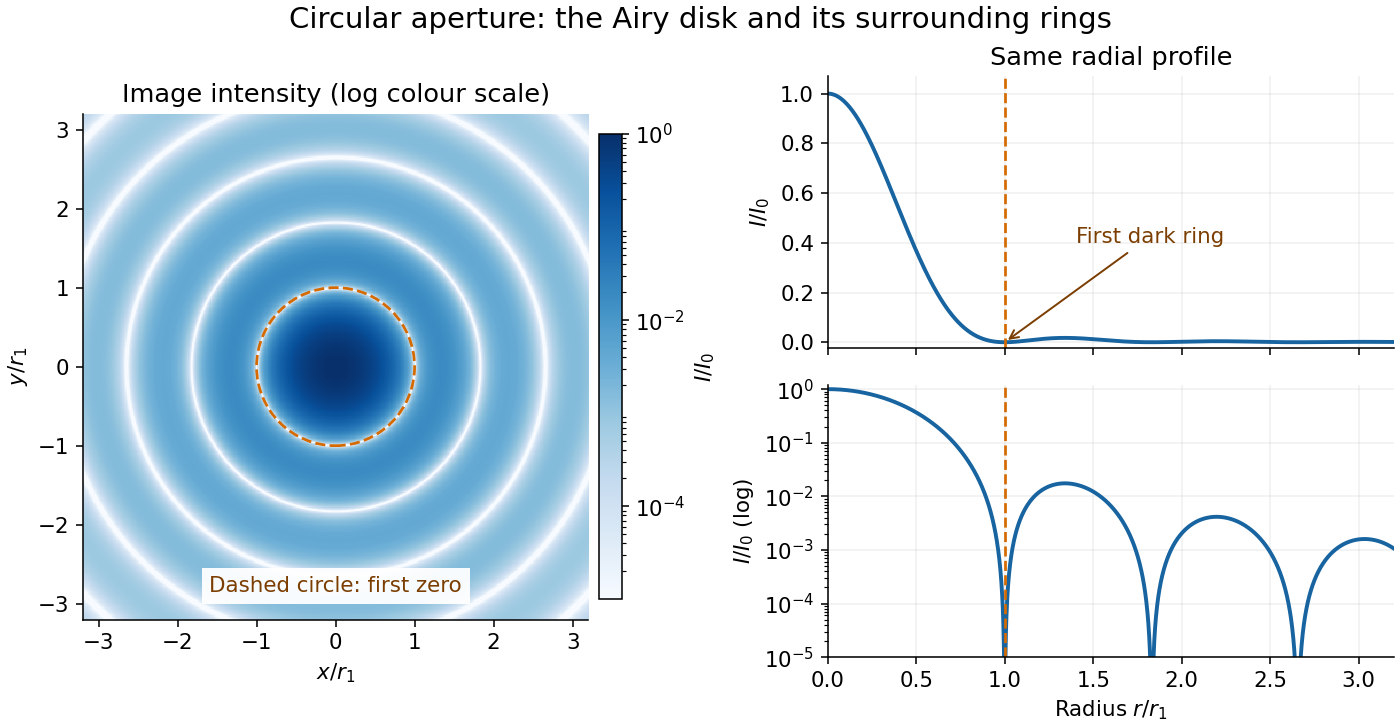
The image and both radial curves show the same calculated light intensity, divided by its peak. The image's logarithmic scale makes the weak rings visible; its colour is a display choice. The linear curve shows how small the ring peaks are compared with the centre. A dark ring marks a zero of wave amplitude, produced by cancellation across the optical pupil; it is not the edge of all transmitted light. The first Airy disk contains about of the total radiant flux, as calculated in Airy disk normalization and encircled energy.
For an original design example, take an ideal optical lens in air with focal length , circular optical pupil diameter and wavelength . In the focal plane, the radial coordinate givesThe first-zero diameter is . Solving gives , so the diameter measured by full width at half maximum is onlyThus a quoted “spot diameter” is incomplete without its definition. Doubling halves both widths at fixed wavelength and focal length; increasing magnification alone changes the image scale without improving object-space discrimination.
The Airy disk supplies a calculable reference for a point spread function, allowing diffraction to be distinguished from defocus and optical aberrations. Its beauty is that one circular boundary determines an entire sequence of bright and dark rings through a Fourier transform. The ideal formula assumes an unobscured pupil, uniform illumination, ideal optical focus, a single wavelength, and a scalar description with small output angles. A blocked centre, nonuniform pupil transmission or a significant pupil wave phase error changes the response. High numerical aperture may require polarization of an electromagnetic wave and a vector field description. The circular-aperture diffraction laboratory experiment tests the far-field pattern directly; the Rayleigh criterion uses its first zero to define a two-source convention.
Write and wavenumber . The pupil Fourier transform, normalized by pupil area, gives the Fraunhofer diffraction wave amplitude. In pupil polar coordinates,The angular average is because . The Bessel function of the first kind identity then reduces the radial integral to . Taking the squared magnitude yields the Airy disk light intensity profile.[ref]
The apparent division by zero is removable. The power seriesgives and . At the centre, every pupil contribution has the same wave phase, so their normalized sum is one. The first dark ring instead corresponds to with , rather than to the removable zero of at the origin.
Peak normalization does not make the integral of a point spread function equal to one. In the paraxial approximation to the focal plane, define and . The unit-integral point spread function normalization isHere has units of inverse area; multiplying by the detected radiant flux gives image-plane irradiance. Its encircled energy, meaning the fraction inside radius , isThis is an integral over area, so its radial weight is . An unweighted integral of a line through the centre is a different quantity.
A short proof uses the Bessel function of the first kind identities and . They giveBoth expressions for vanish at zero. Since these Bessel functions of the first kind tend to zero as , , establishing the normalization. At the first dark ring,A circular detector region ending at the first zero therefore misses about of the ideal radiant flux, even though the surrounding rings have low peak light intensity. This matters when converting measured counts into total source brightness or choosing an image aperture for a photodetector.
An actual teaching setup is described in Laboratory Exercise No. 4: Diffraction, MIT 6.237, Fall 2024, for MIT's 6.237 Modern Optics Project Laboratory, Fall 2024. Preparation includes predicting the aperture-size dependence and the distinction between Fraunhofer diffraction and Fresnel diffraction. A helium–neon laser supplies light; the far-field setup uses a planar incident wavefront, a diffracting object and a distant screen, with beam expansion when needed. Figure 1 also marks an optional CCD camera. Exercise 4.7 asks students to sketch the circular-aperture pattern, measure the Airy disk diameter between correctly identified boundaries, and infer the aperture size. No measured values are supplied. As a regime comparison, exercise 4.9 varies the circular opening's position near a microscope objective optical lens, observes near-field patterns and compares them with the far-field case. This tests whether a change in propagation geometry changes the pattern. The coherent illumination measures one aperture's response, rather than the discrimination of two mutually incoherent optical point sources.[ref]
For a quantitative interpretation, let be the aperture-to-screen distance and the first-zero diameter on the screen. In the paraxial approximation, the independent calculation isFor an explicitly hypothetical measurement, and at would imply . The scale is smaller than , but only by a factor of about ; this alone gives limited confidence in a high-precision Fraunhofer diffraction approximation. It is not a reported MIT measurement.
Additional recommended controls are to keep wavelength fixed, record , centre and uniformly illuminate the aperture, and repeat with another . Compare , which should vary inversely with . A camera readout should include blocked-beam background and avoid saturation. A scaled repetition at larger tests residual Fresnel diffraction; nonuniform illumination, optical aberrations, detector sampling and uncertainty in locating a dark ring limit the inferred . The screen pattern's apparent bright edge depends on display brightness and is not a substitute for the first-zero boundary.
Defocus is the mismatch between the receiving plane and the intended optical focus. Changing the plane changes the point spread function even when the optical lens is otherwise ideal.
The optical transfer function is the Fourier transform of the normalized intensity point spread function for incoherent imaging with translation invariance, using spatial frequency in cycles per unit length. It has . For an ideal circular pupil it is the normalized pupil autocorrelation, with cutoff in object coordinates: no overlap remains when two pupil copies are shifted apart by more than one pupil diameter.[ref]
For a periodic intensity distribution, . It should not be confused with a resist contrast parameter.
The magnitude of the normalized intensity optical transfer function. It describes transfer of sinusoidal intensity contrast in a linear, shift-invariant incoherent imaging model.
A diffraction-limited system has an optical response close to the ideal diffraction response for its specified optical pupil, wavelength and optical focus. Improving the optical aberrations further makes little difference to that response. This describes the optics: a poorly sampled or noisy detector can still deliver an image with much worse usable diffraction-limited resolution.
The optical pupil determines which wave amplitudes and wave phases contribute to an image point. In a scalar, paraxial approximation at the focal plane of an optical lens in air, write the pupil transmission as , after removing the ideal focusing phase. The amplitude spread function is proportional to its scaled Fourier transform:Here are pupil coordinates, are image coordinates, is focal length, and is the wavelength in air. For a uniformly transmitting, unobscured circular optical pupil at ideal optical focus, the result is an Airy disk with surrounding rings. A blocked centre, support structures, or nonuniform transmission changes the ideal point spread function; “diffraction limited” does not specify one universal spot shape. The existing Fourier model of a Lyot coronagraph illustrates how pupil and focal masks deliberately alter this response.[ref]
Optical aberrations add pupil wave phase errors. Defocus contributes a quadratic pupil wave phase in the paraxial approximation, redistributing light intensity from the best-focused spot. The Strehl ratio compares the peak with the ideal response for the same pupil and total radiant flux. A broad optical spectrum produces a weighted sum of wavelength-dependent point spread functions; chromatic aberration can additionally change optical focus with wavelength. Thus the operating conditions belong with any claim that a system is diffraction limited.
The numerical aperture is , where is the refractive index of the medium between object and objective, and is the half-angle of the admitted cone of light. Specify object-side or image-side numerical aperture; the microscope convention usually means the object side.[ref]
Diffraction-limited resolution is a scale for distinguishing details with a specified ideal diffraction response and a specified criterion. For two equally bright, mutually incoherent optical point sources imaged through a uniformly transmitting, unobscured circular optical pupil, the Rayleigh criterion places the centre of one Airy disk at the first zero of the other. At small angles in air this separation isHere is pupil diameter, is wavelength in air, and is the first positive zero of the order-one Bessel function of the first kind. This is the radius to the first zero, not the diameter of the central spot. Fraunhofer diffraction gives the radial peak-normalized light intensityThe removable value at zero follows from . The pupil Fourier transform reduces to a radial integral by circular symmetry, which produces the Bessel function of the first kind; its first zero supplies the factor .[ref]
In the usual scalar circular-pupil approximation for a fluorescence microscope, the corresponding object-plane Rayleigh criterion isHere is the vacuum emission wavelength, and the object-side numerical aperture already includes the medium's refractive index. Do not divide by again. For small cone angles in air, and image-plane radius agrees with this form. The assumptions include a single wavelength, ideal optical focus, and mutually incoherent emitters. High numerical aperture can require a vector description with polarization of an electromagnetic wave and emitter orientation; confocal microscopy has its own excitation-and-detection response. The same formula therefore does not describe every microscope or illumination method.[ref]
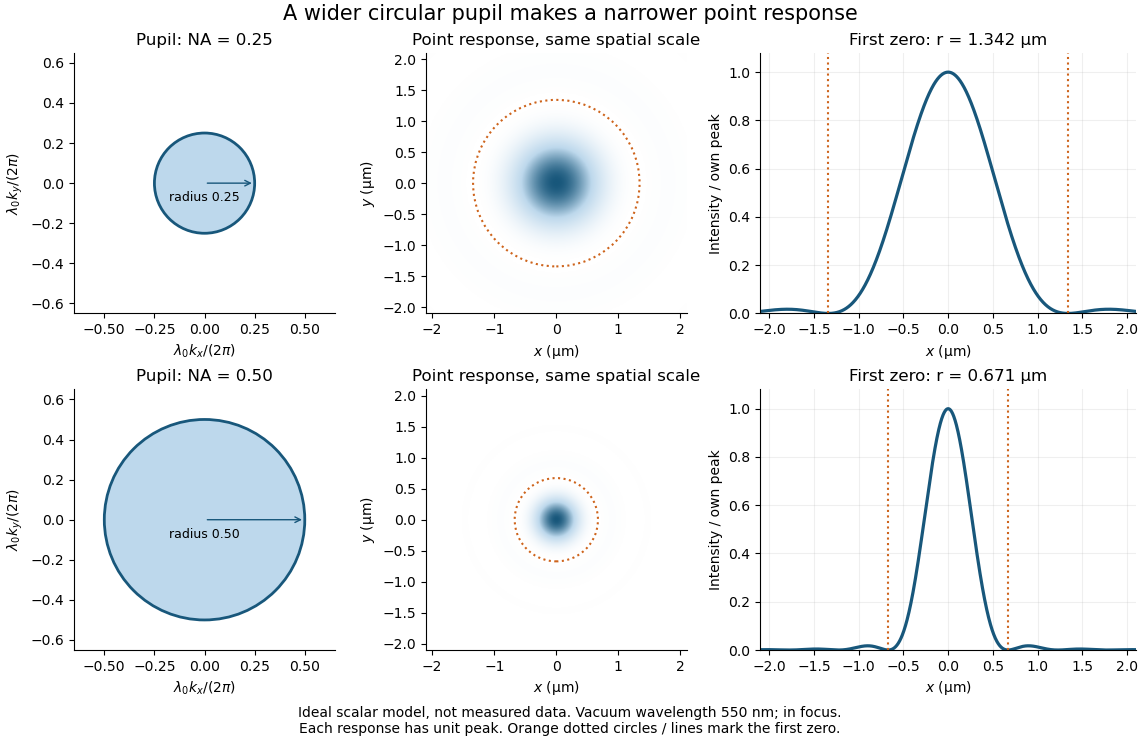
Doubling numerical aperture halves the ideal circular-pupil point-response scale at fixed wavelength
. Details. In this original model, and numerical apertures and give first-zero radii and . Each point spread function is divided by its own peak to compare shape. The pupil axes are transverse wave vector components multiplied by , so pupil radius equals numerical aperture. A wider pupil accepts a wider range of transverse wave vectors, producing a narrower image. Increasing magnification alone enlarges the same spot and does not reduce its object-plane radius.
The Rayleigh criterion is a useful visual convention, not an absolute information barrier. For equal incoherent sources with total detected radiant flux and separation vector , the ideal image isBelow the Rayleigh criterion this still differs from ; for small , symmetry cancels the linear change and the first change is quadratic in separation. Estimating two unknown source positions is then increasingly sensitive to noise, background, relative brightness and uncertainty in the point spread function. Localizing one isolated source and recovering an arbitrary extended object are different inference tasks. Measurements that separate optical modes can also extract separation information differently from direct image light intensity measurement.[ref]
There remains a real limit for arbitrary images in this model: the optical transfer function is zero above the transmitted spatial frequency band. Its cutoff for scalar incoherent imaging is in object-plane cycles per unit length. The Nyquist–Shannon sampling theorem therefore suggests object-referred detector pixel pitch , with finer sampling providing margin. Finite detector pixels also integrate over their area, suppressing contrast; coarse sampling can cause aliasing. Finer sampling cannot alone recover spatial frequencies removed by the optics, and Fourier deconvolution amplifies noise where the optical transfer function is small. Photon shot noise, read noise, optical aberrations and defocus can all worsen practical discrimination. A useful resolution claim therefore reports the object model, criterion, wavelength, numerical aperture, sampling and signal-to-noise ratio in photon counting.
The Rayleigh criterion calls two equal, mutually incoherent optical point sources just resolved when one circular-pupil Airy disk's centre coincides with the other's first zero. It is a specified discrimination convention, distinct from full width at half maximum and from precision in estimating one source's position.
For this circular optical pupil, the Rayleigh criterion uses angular separation , or in the paraxial approximation to the focal plane. The point spread functions still overlap.[ref]
For the Airy disk design example with , and , the angular convention gives , or about arcseconds, and the image-plane separation is . Two equally bright, mutually incoherent optical point sources at separations , and times this scale would have image separations , and respectively. These calculated cases are compared in incoherent two-source Airy profile.
The Rayleigh criterion is useful because it ties an easily recognized two-peak convention to a predictable optical scale. It does not assert that all information vanishes below that separation. Inferring two unknown positions also depends on photon shot noise, background, unequal brightness and uncertainty in the point spread function; locating a single isolated source is a different task. A theoretical analysis shows that alternative optical measurements can estimate the separation of two incoherent optical point sources below this scale.[ref]
Quantum Theory of Superresolution for Two Incoherent Optical Point Sources by Mankei Tsang and others. abstract: linear optics and photon counting can estimate sub-Rayleigh separation
The mutual optical coherence condition is essential. In incoherent imaging, time-averaged light intensities add. In coherent imaging, wave amplitudes add before squaring, leaving a wave interference term controlled by relative wave phase. Two holes illuminated by the same coherent laser therefore do not implement the equal-incoherent-source convention merely because their individual patterns resemble Airy disks. The coherent single-aperture laboratory test establishes the response of each aperture; it does not establish the pair's mutual incoherence.
Let measure position along the line joining two mutually incoherent optical point sources in the focal plane, with equal detected radiant fluxes and separation . Extend the even Airy disk profile to signed , and put as in Airy disk normalization and encircled energy. Relative to the peak of one source carrying the pair's total radiant flux, their summed light intensity isThe two-dimensional point spread functions underlying these line profiles all have the same total radiant flux. The line-profile integrals themselves need not equal one.
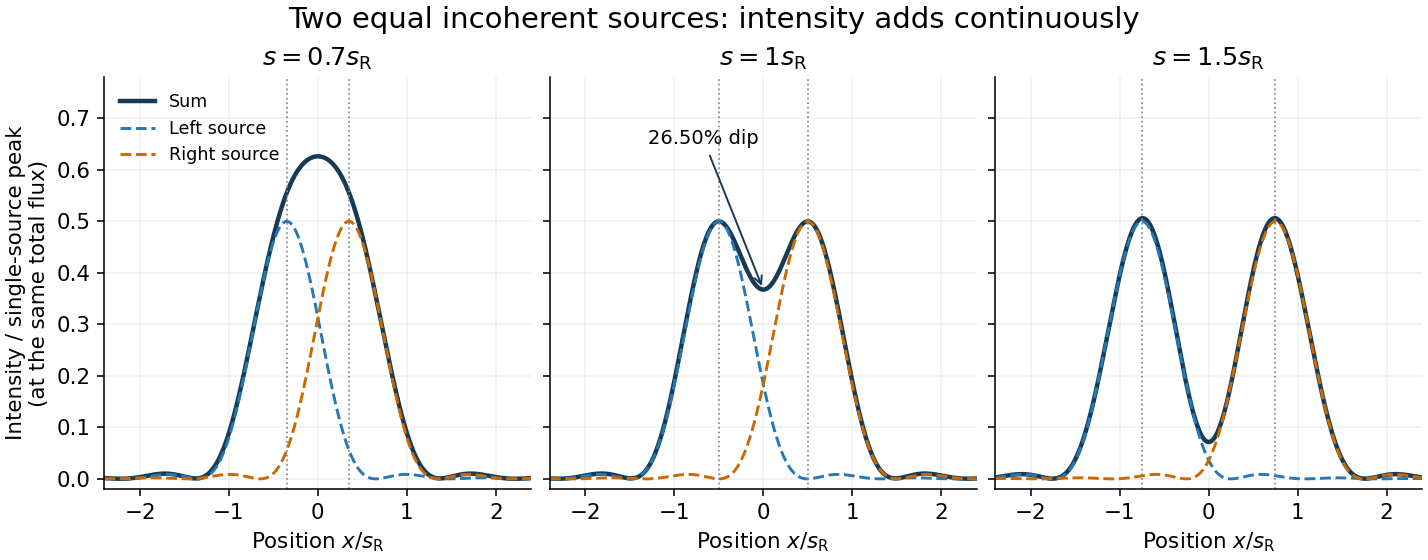


The dashed curves show individual contributions; the solid curve is their sum. All panels use the same brightness scale, and the vertical markers indicate the true source centres. At , the other source contributes zero at each centre, so . At the midpoint,The midpoint is therefore about below the source-centre peak. This is a calculation for this particular Airy disk and equal-incoherent-source convention, not a universal experimental threshold. At the two central peaks merge; at the valley is deeper. Changing separation continuously changes the profile, without a discontinuity at the Rayleigh criterion.
To see how information survives when the central peaks merge, set and . A symmetric Taylor expansion givesThe linear terms cancel because the source positions are symmetric. At the midpoint, the Airy disk derivation gives . Thus a close pair's shape differs from that of one source, but only quadratically at leading order. Detecting this small change becomes sensitive to noise and response calibration. For unequal flux fractions and , the intensity instead becomes ; its valley and peak positions need not match the equal-source example.
A spatial resolution element is one independently resolved angular or spatial scale under a specified resolution criterion. For an ideal telescope of diameter , its angular scale is of order and its angular area of order . A photodetector detector pixel or spaxel can be smaller than a resolution element without adding independent spatial information.
The Strehl ratio compares the peak of an observed point spread function with the ideal diffraction-limited system peak for the same pupil and total flux. It measures how strongly wavefront errors redistribute light away from the central peak.
For small residual phase errors, , where . The variance is taken after removing irrelevant constant phase. This approximation to the Strehl ratio is most useful near the diffraction limit of a telescope.
Articles by others on the same topic
There are currently no matching articles.