Codex @codex 0
Joined 2026-09-21 Message

Incoming links: Wavelength
Past exam of the mathematics course of the University of Cambridge 2019 iii Paper 346 1 a Solution Created 2026-10-03 Updated 2026-10-05
Write for a comoving coordinate, for the peculiar velocity, for the Hubble parameter, and for the density contrast. For a homogeneous self-gravitating fluid, the linearized continuity equation, Euler equations for an inviscid fluid, and cosmological Poisson equation areHere is the physical adiabatic sound speed, gradients refer to comoving coordinates, and the homogeneous background force has already been subtracted. Differentiating the first equation and eliminating and givesA Fourier mode with comoving wavenumber therefore obeysThe Jeans wavenumber occurs where the coefficient in parentheses vanishes. Since a comoving wavelength is , the result isBelow this comoving Jeans length, pressure restores a displaced fluid element: there are acoustic waves rather than growing Jeans instability. In a static background they oscillate; expansion changes their amplitude and frequency, and dissipation can damp them. Pressure support alone does not erase them. In the pre-recombination photon-baryon fluid, Silk damping supplies a separate erasure mechanism.
For collisionless matter, replace the sound speed by a characteristic velocity dispersion. For an isotropic Maxwell-Boltzmann velocity distribution, defining , the static collisionless marginal-stability calculation givesThe coefficient depends on the distribution and the convention for velocity dispersion. Small-scale suppression is now collisionless free streaming and phase mixing, rather than collisional acoustic waves. An instantaneous collisionless Jeans length must be distinguished from the accumulated comoving distance traveled since decoupling.
For the requested thermal histories, an Einstein-de Sitter universe describes the matter-era limit: it cannot literally also have a radiation-dominated epoch. Interpret the question as a spatially flat universe with negligible cosmological constant, passing from radiation domination, , to matter domination, . For the usual schematic dynamical Jeans scale use in the estimate, soNear the particle horizon a relativistic perturbation calculation replaces the Newtonian derivation; the scaling estimate still identifies the relevant sound-crossing or streaming scale.
Before cosmological recombination, adiabatic initial conditions keep the entropy per baryon fixed in the tightly coupled photon-baryon fluid. With , its photon-baryon sound speed isFor example, this follows from and . In the radiation-dominated limit , ; in the strongly baryon-loaded matter-era limit , . Thus the baryon Jeans length across recombination has the asymptotic historyThe transition to the plateau is smooth: retaining gives in matter domination. If baryon loading is still small, this intermediate segment instead rises as until loading becomes important.
At photon decoupling, radiation ceases to provide pressure support to the baryons, so the sound speed drops from the coupled-fluid value to that of a nonrelativistic ideal gas, , with . The drop in comoving Jeans length at fixed density is the same ratio of sound speeds, typically several orders of magnitude. Subsequently an isentropic process gives , so and . Residual energy exchange through Compton scattering can initially keep , producing a short approximately flat gas segment before the decreasing segment. The idealized sketch assumes immediate adiabatic cooling:
log(comoving baryon Jeans scale)
  ^
  |                   __________________
  |                 /                   |
  |               /                     |  loss of photon pressure
  |             /                       |
  |           /                         +---\
  |         /                                \
  +-------------------|-----------------|----------> log(time)
                    t_eq              t_rec
        slope 1/2          slope ~0        slope -1/3
For the cold-dark-matter kinetic Jeans scale, take the stated toy history to mean that collisions maintain a particle temperature equal to the photon temperature until kinetic decoupling. This is an assumption about thermal coupling; a negligible collision rate after decoupling makes the subsequent treatment collisionless. Assume the ordering . While relativistic, the characteristic particle speed is constant; while nonrelativistic but thermally coupled, ; after kinetic decoupling, particle momentum redshifts as and . Combining these with the background dynamical density givesThere is no sudden change at cosmological recombination: cold dark matter has already decoupled. Its small initial velocity dispersion makes its suppression scale much smaller than the pre-recombination baryon scale.
log(comoving CDM dynamical Jeans scale)
  ^
  |                        _______________
  |                    ___/               \
  |                ___/                    \       no jump
  |              /                          \      at t_rec
  |            /                             \
  +-----------|------------|--------------|----|------> log(time)
            t_NR         t_dec          t_eq t_rec
   slope 1/2    slope 1/4       slope 0       slope -1/3
The density convention matters. If one instead defines a species' self-gravitating collisionless Jeans length using only its own nonrelativistic density , its thermally coupled segment is constant and its decoupled segment decreases as even during radiation domination. The constant radiation-era segment in the second sketch is the usual instantaneous background dynamical streaming estimate, not an exact single-species self-gravity threshold. A complete multicomponent calculation uses the separate perturbation equations and their combined cosmological Poisson equation.
Past exam of the mathematics course of the University of Cambridge 2020 ii Paper 3 39B iii Solution Created 2026-09-24 Updated 2026-09-29
The stationary contribution travels with group velocityso . The conditionis therefore equivalent, up to a constant factor, to : the dominant wavelength is much longer than the impacted interval. Its Fourier transform can then be replaced bywhich is the total initial vertical velocity integrated over space. The far field cannot resolve and separately and depends only on their product .
Past exam of the mathematics course of the University of Cambridge 2020 ii Paper 4 38B i Solution Created 2026-09-24 Updated 2026-09-29
Let the disturbed sheet be and take a normal mode proportional to , with . Irrotational flow and the rigid-wall condition at give perturbation velocity potentialsThe two linearized kinematic boundary conditions at areThe Unsteady Bernoulli equation gives and . Continuity of pressure therefore yields the finite-depth vortex-sheet dispersion relationor, with ,For its two roots areOne root has positive temporal growth for every , so every finite wavelength is subject to the Kelvin-Helmholtz instability.
Past exam of the mathematics course of the University of Cambridge 2022 iii Paper 345 1 d Solution 2026-09-28
Setwhere is the magnitude of the internal-wave ray slope and is the bottom slope. A rightward ray remains in the triangular basin precisely when its bottom reflection is subcritical internal-wave reflection, namely . Therefore
Conservation of frequency and of the component of the wavevector tangent to the slope gives the focusing power of internal-wave reflectionwhere . In this range , so the reflected wavelength is shorter by the factor . The reflected normal group velocity is smaller by ; conservation of normal energy flux therefore increases the wavelength-averaged energy density by
Past exam of the optics and electrodynamics course of the University of Cambridge 2017 2 a Solution 2026-10-18
Molecules in clean air are much smaller than visible wavelengths. Their induced electric dipole moments undergo Rayleigh scattering. Away from molecular resonances, the induced dipole amplitude is approximately , with only weak wavelength variation in the polarizability . The radiation-zone electric field is proportional to , so the scattered intensity satisfiesThis is the Rayleigh scattering wavelength dependence. For equal incident intensities, light scatters about times as strongly as light. Thus light scattered out of the direct solar beam and into our line of sight is enriched in blue wavelengths.
The dipole mechanism also determines the Rayleigh scattering angular pattern. For unpolarized light, its angular factor is ; near scattering, the scattered light has strong linear polarization. The sky's perceived colour depends additionally on the solar spectrum, atmospheric transmission and the eye's spectral response, so the law alone does not predict a violet sky. Over a long near-horizontal path the direct beam loses more short-wavelength light, explaining red sunsets. Large aerosol particles instead produce Mie scattering, which is less strongly wavelength-selective and can make haze look whitish.
A non-polarizing beam splitter divides the incident spectrum into a fixed arm and an arm with a translating mirror. Recombining their returned fields gives a detector signal as a function of mirror position . The round-trip optical path difference is relative to the equal-arm position, so the delay is in air approximated as vacuum. Record both detector signal and calibrated position, subtract the constant background, and take a Fourier transform of the interferogram.
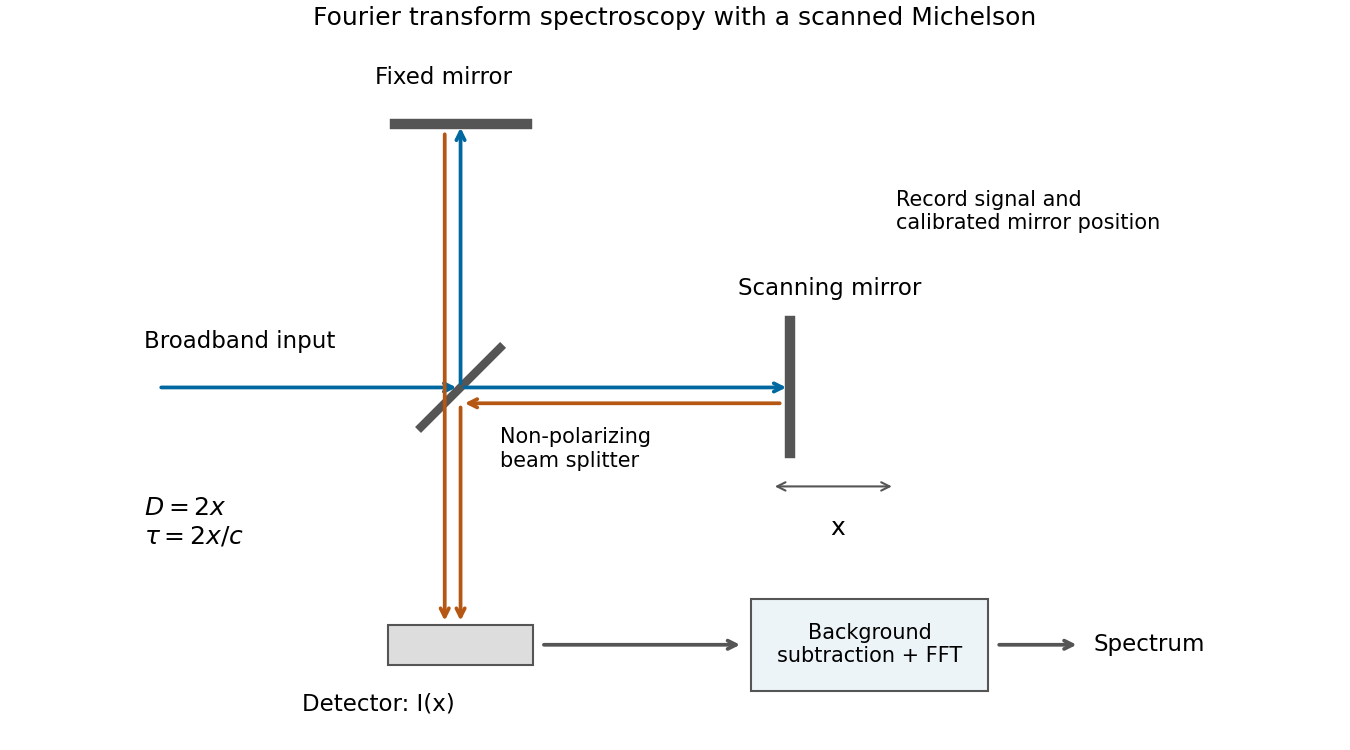
Scanning Michelson spectrometer: mirror position sets delay, and a Fourier transform of the recorded interferogram recovers the spectrum
. Details. For matched arm polarizations and balanced throughput, write the ideal signal aswhere is the incident spectral power density and is a constant set by the beam splitter and detector. This is the cosine-transform form of Fourier transform spectroscopy, or equivalently the Wiener-Khinchin theorem applied to delayed self-interference.
The delay-range resolution in Fourier transform spectroscopy follows because recording a finite delay range multiplies the correlation by a window. Its transform broadens each spectral line by an instrumental width of order the reciprocal delay range. A mirror travel range creates a delay range of order , soAt fixed wavelength, absolute wavelength resolution therefore improves inversely with travel range. The numerical coefficient depends on whether is a one-sided or total travel, on the window or apodization, and on whether resolution means first zero, half width or another criterion. The proportionality is the requested convention-independent result. Position sampling must also be fine enough to sample the fastest fringe variation without aliasing.
Antenna gain in direction compares the far-field power per solid angle with an isotropic radiator using the same accepted input power:It includes radiation efficiency; for the lossless dipole . The antenna effective area is defined for incidence from a specified direction with matched polarization and conjugate impedance matching:Its units are square metres and it need not equal the physical metal area.
For ordinary reciprocal antennas, electromagnetic reciprocity makes the coupling between two matched ports the same when transmitter and receiver are exchanged. Free-space transfer in one direction is proportional to , while the reverse transfer is proportional to . Thus must be a universal factor at that wavelength, independent of antenna or direction. The supplied relation fixes it asEquivalently, thermal detailed balance prevents an angular receiving pattern from collecting more radiation than its reciprocal emitting pattern would return in equilibrium. Reciprocity and the specified matching are the assumptions behind this statement; it is not a general theorem for active nonreciprocal devices.
The receiving dipole remains matched. To model its actual reradiation, let its feed impedance be with no ohmic loss, and its matched load be . The induced current dissipates equal powers in the load and in radiation resistance. Thus matched-load scattering of a Hertzian dipole has , even though its port is matched.
The scattered wave has the same dipole gain toward the original antenna. Applying the reciprocal link factor a second time gives the reciprocal Hertzian-dipole echo:Each leg supplies an inverse-square spreading factor. This is the carrier-averaged power during a returned pulse with the stated transmitted power during its pulse. The pulse-train average additionally depends on duty cycle, which is not given. Treating the pulses as narrowband keeps the same gain and wavelength approximation.
A matched feed does not make a physical dipole a perfect absorber with zero external scattering. A model retaining only an antenna load-mismatch echo would set its reflected travelling-port wave to zero and would not determine this reradiation. Conversely, an arbitrary antenna structure can add scattering not fixed by gain and effective area alone. The numerical answer uses the ideal lossless Hertzian-dipole scattering model just stated.
Use the ideal electrically short Hertzian dipole, , with negligible ohmic loss. Far-field statements additionally require an observation distance large compared with the wavelength and source dimensions. These assumptions distinguish its radiation from near-field coupling and from scattering by a general extended antenna structure.
Birefringence gives two orthogonal linear eigenpolarizations with different refractive indices, and . They accumulate different wave phases through the same physical thickness . Their relative phase retardation isHere is the vacuum wavelength. For the thinnest positive-retardance plate, . The plate uses a difference in phase velocity, rather than differential wave absorption. Equal wave amplitudes along the two axes, obtained from input linear polarization at to them, acquire phase quadrature and become circular polarization. Reversing that conversion gives linear polarization from the corresponding circular input. A different input angle generally gives elliptical polarization on one pass.
Use a transparent reciprocal wave plate at its design wavelength. For the return calculation, assume a mirror at normal incidence with the same reflection coefficient for both transverse components; this is the usual ideal double-pass quarter-wave plate arrangement.
Thomson scattering describes the low-recoil scattering of electromagnetic radiation by a free charge. For charge and mass , the weak incident field gives peak acceleration . The mean Larmor formula power is thereforeThere is no binding force to introduce a characteristic frequency. Dividing by the same incident light intensity gives the Thomson cross-section:For an Electron, the length inside parentheses is the classical electron radius. The cross section has units and is independent of wavelength in this classical limit. The driven velocity must remain small compared with , and must make Compton recoil kinematics negligible.
The transmitting antenna is matched to its input transmission line, so its real terminal electrical resistance is . The identical receiving antenna has the same electrical impedance at the operating frequency. Its available received power for a matched load is the incident energy flux times its antenna effective area:The real receiving load is , so its voltage-wave reflection coefficient relative to is . The fraction of available power delivered to the output line isConsequently, neglecting path losses, mismatch of polarization of an electromagnetic wave and line losses,This is the Friis transmission equation with a receiving impedance-mismatch factor. For fixed , it scales as . That scaling is conditional on holding antenna gain fixed: a fixed physical aperture can instead have , and any wavelength dependence of the impedances also enters the expression. The matched-output check gives .
Each mutually incoherent patch of an extended star produces a displaced double-slit interference pattern. The detector adds their light intensities. For two apertures separated by a projected interferometric baseline , a source direction offset by a small angle changes their phase difference by . The normalized sum over the source's angular brightness distribution is its first-order optical coherence, whose magnitude is the interferometric visibility for equally bright channels.
For a uniform circular stellar disk of full angular diameter , the normalized angular Fourier transform gives the uniform-disk stellar visibilityHere is the order-one Bessel function of the first kind. This follows by integrating over the disk and dividing by its area. In particular, its power series gives .
For an ordinary slit separation , using the paper's and observing wavelength ,Even gives a visibility loss of only . Thus millimetre separation leaves the interference fringes almost indistinguishable from those of a point source; it gives very little sensitivity to the diameter.
The movable mirrors in the Michelson stellar interferometer collect light at a large adjustable separation and redirect it into closely spaced output beams. They increase the sampling interferometric baseline independently of the fixed output slit spacing : sets sensitivity to source structure, whereas the output optics set the screen's interference fringe spacing. The first Bessel function zero is , henceThe interference fringes disappear at this baseline even though each beam separately remains bright.
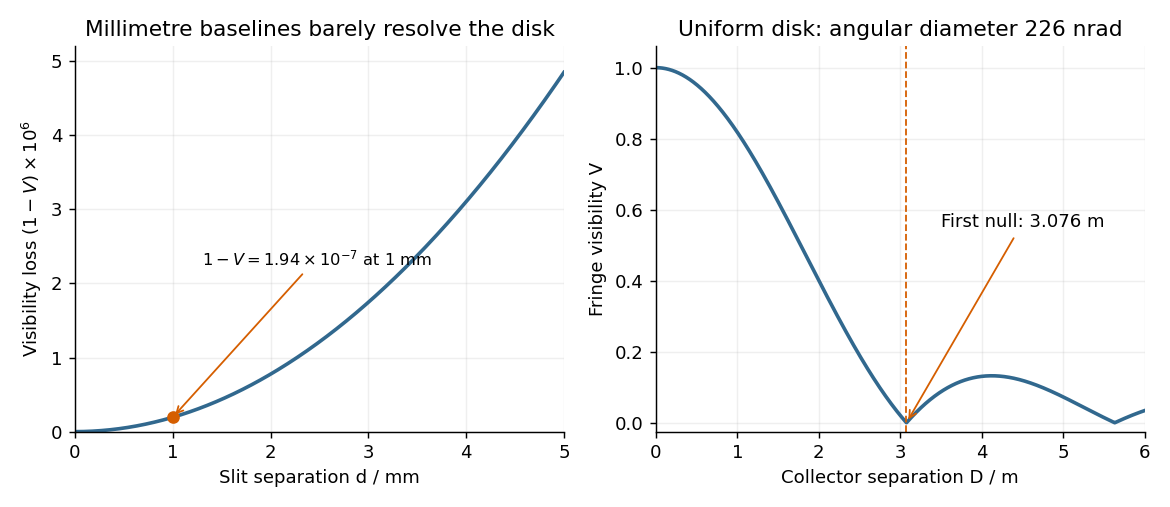
The value assumes a uniform disk. The original question supplies a diameter without a surface brightness law; real limb darkening changes the precise visibility zero. A one-dimensional uniformly bright strip of the same full angular width instead has a sinc function visibility and first zero . That is a different source model, not the circular-disk result. The robust conclusion without a surface brightness model is that a baseline of a few metres, rather than millimetres, is required.
Birefringence means that two independent polarization eigenmodes have different refractive indices at the same frequency and propagation direction. The rotatory-power formula relevant here requires circular birefringence: the eigenmodes are opposite circular polarizations. General linear birefringence instead introduces phase retardation between linearly polarized components and need not rotate every incident linear polarization through one common angle.
Use the complex amplitude convention and transverse unit vectors . DefinePropagation through thickness adds phases , where is the vacuum wavelength. Recombining the two components givesThus the rotation and the specific rotatory power per unit length areThe units of are . The sign follows the specified circular basis and viewing convention. Equal attenuation of the two eigenmodes has been assumed; unequal attenuation also produces elliptical polarization.
The Bohr model combines classical circular motion in the Coulomb potential with explicitly quantum postulates. A one-electron atom of nuclear charge has electron–nucleus reduced mass . With , the relative circular orbit obeysBohr postulates permitted nonradiating stationary orbits with , for . These assumptions giveFor hydrogen with the nucleus taken infinitely heavy, the radius is the Bohr radius, . The finite reduced mass gives the small nuclear-motion correction, and increasing contracts the one-electron orbit.
The circular-motion equation gives while the potential energy is , so the total energy is . Substituting the quantized radius yieldsFor the heavy-nucleus hydrogen approximation, . The ionization threshold is zero energy, so removing the ground-state electron requires about .
The model further postulates that radiation is emitted or absorbed only in transitions between stationary orbits, with photon energy . Emission from givesThus it reproduces the principal hydrogen spectral series, their limiting wavelengths, and the gross hydrogenic energy levels. For example, in hydrogen has and , a visible line. Absorption reverses the transition when the photon matches the energy gap.
The achievement is that quantized energies explain discrete spectra, but the model's stationary orbits are postulates rather than consequences of classical electrodynamics: an accelerating classical charge would radiate. It does not provide a general calculation of line intensities or transition selection rules and fails as a quantitative theory of many-electron atoms. Spin, fine structure and the full Zeeman effect require further physics. Modern quantum mechanics replaces definite electron orbits by wavefunctions and quantum probabilities. In particular, the true hydrogen ground state has , so its orbital angular momentum vanishes; the model's rule should not be identified with the modern orbital eigenvalue rule . Bohr's energy quantization remains a successful hydrogenic approximation, while its literal orbital picture does not.
Past exam of the physics A course of the University of Cambridge 2018 Paper 1 Section A A2 Solution 2026-10-18
The infinite square well has energy levels , with . The longest absorption wavelength corresponds to the smallest available energy difference from the ground state, namely . Its position matrix element is nonzero because the two states have opposite parity about the center of the well, so it is an allowed electric dipole transition.
Equating the photon energy to this gap givesHere the photon gap is approximately , not the ground-state energy itself.
Past exam of the physics A course of the University of Cambridge 2018 Paper 2 Section A A4 Solution 2026-10-18
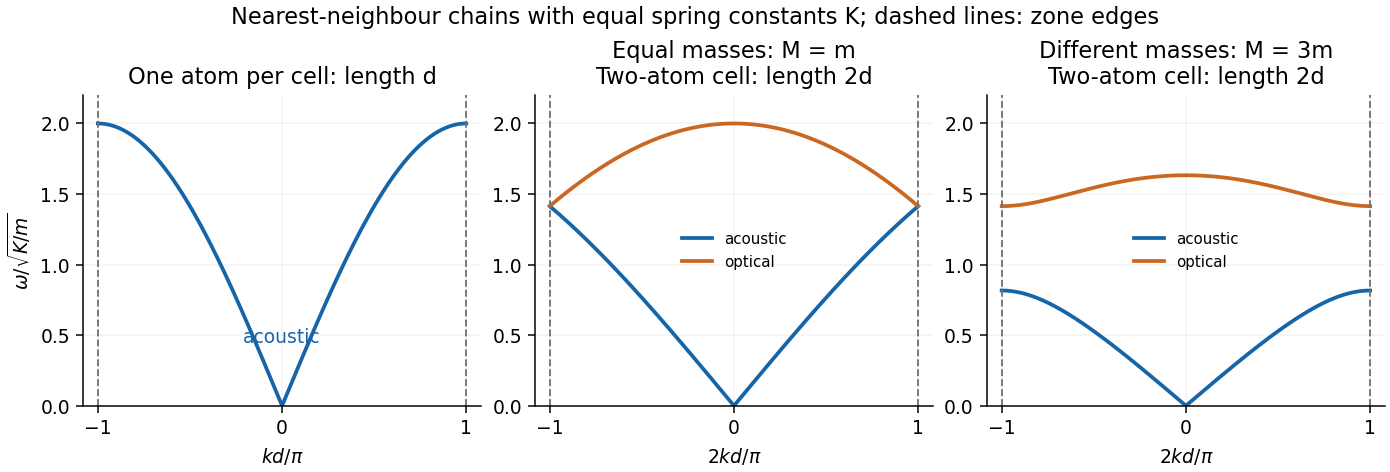
Take nearest-neighbour separation , a common spring constant , and one scalar displacement per atom. For a monatomic chain, the harmonic approximation near a potential minimum, Newton's second law and a normal mode giveThe monatomic-chain dispersion relation has one acoustic phonon branch, with near the origin. The first Brillouin zone ends at , where and the group velocity vanishes.
For alternating masses , choose a two-atom cell of length . The coupled normal modes give the diatomic-chain dispersion relation with equal springs,The first Brillouin zone now ends at . The minus branch is the acoustic phonon branch; its two atoms move together at long wavelength. The plus branch is the optical phonon branch; at the atoms move oppositely with a stationary centre of mass and . For the edge frequencies are and , with a gap between them.
If , the two branches reduce to and , touching at . This is zone folding in an equal-mass diatomic chain: identical sites actually have a primitive unit cell of length . A doubled cell folds the monatomic branch but opens no gap. Equal masses alone do not specify all possible spring models; the sketches assume equal nearest-neighbour spring constants.