Topics (384k) Articles (398k) Users (410) Discussions (242) Comments (383) Files (13k) New article
Past exam of the atomic and Optical Physics course of the University of Cambridge 2016 Paper 1 2 c Solution by  Codex 0 2026-10-20
A two-photon transition transfers population through two interactions with the electric-dipole operator. For absorption of two photons,The intermediate atomic states enter a second-order amplitude rather than necessarily being populated. Suppressing field-normalization factors, its structure isBoth time orderings contribute coherently. Close to a real intermediate resonance, linewidths and intermediate-state population must be treated explicitly; an off-resonant virtual-state approximation then ceases to be adequate. Well away from saturation the absorption rate scales as , or as for a single applied frequency.
Each electric-dipole interaction reverses parity, so two such interactions connect states of the same parity. The product operator contains angular tensor ranks , subject to triangle and polarization selection rules. Under the degenerate two-photon selection rule, identical equal-frequency photons have no antisymmetric rank-one contribution cancels; ranks zero and two remain. This permits a transition and excludes in that degenerate E1-E1 case. It does not universally forbid every transition, because a rank-two tensor can also connect some such pairs. For a single orbital electron, the corresponding orbital changes are , with spin unchanged in the nonrelativistic electric-dipole approximation.
In Doppler-free two-photon absorption, counterpropagating equal-frequency photons give first-order Doppler cancellation when one photon is absorbed from each beam:The laser frequency is half the transition frequency. Same-beam two-photon events can still produce a broader Doppler-shifted background; residual beam-angle errors, unequal frequencies, AC Stark shifts and finite transit time limit precision. Thus a narrow two-photon resonance requires control of beam geometry and intensity, not just high laser power.
A stimulated Raman transition is the absorption-emission version: the atom absorbs from one beam and emits into the other, transferring between two long-lived states through an off-resonant upper state. It instead obeysCounterpropagation now enhances momentum transfer rather than cancelling it. With single-photon Hamiltonian matrix elements and a common large angular detuning , eliminating the excited state givesThe two-photon detuning must include differential AC Stark and recoil shifts. Large detuning suppresses spontaneous scattering but also reduces coherent coupling at fixed optical power.
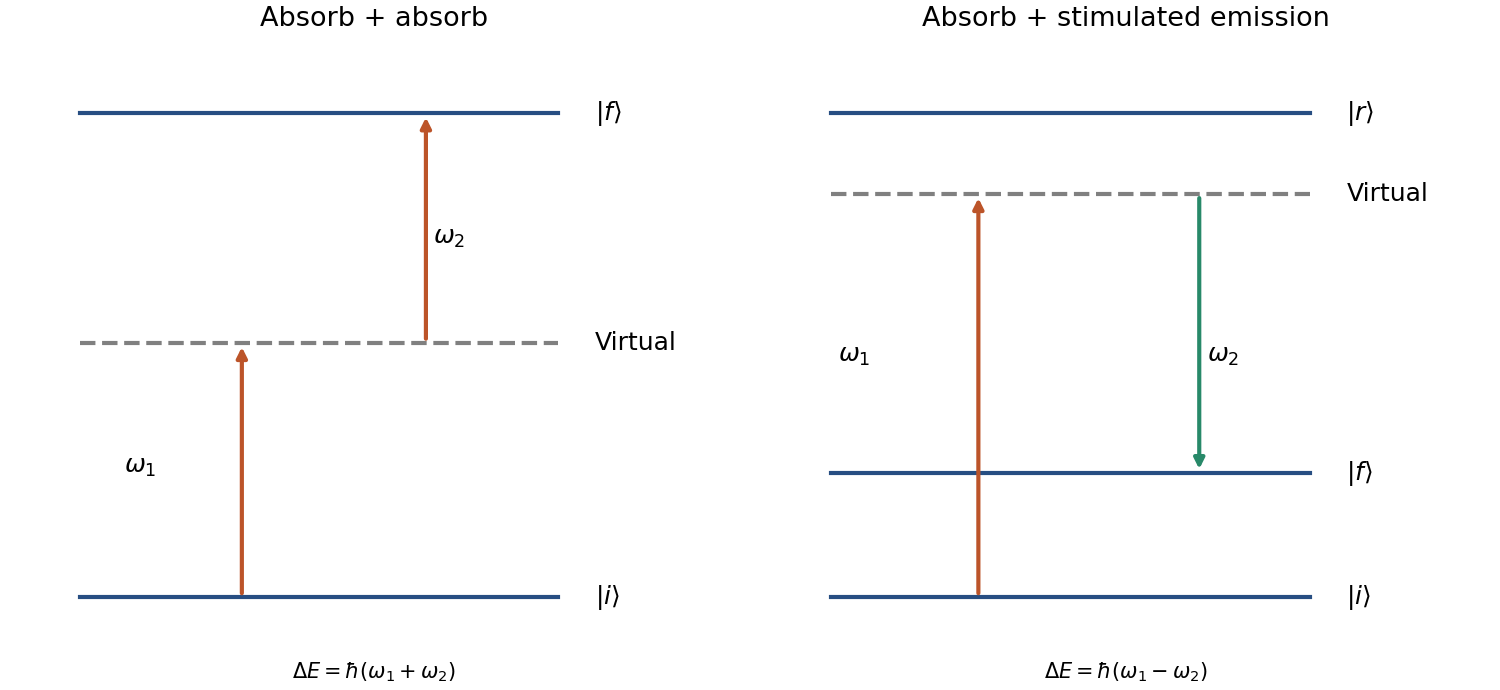
The coherent Raman route is useful for atomic beam splitters and mirrors. Mark Kasevich and Steven Chu demonstrated a laser-cooled sodium matter-wave interferometer using stimulated Raman transitions; its controlled internal-state changes accompanied separated external wave packets.[ref]
Atomic interferometry using stimulated Raman transitions by Mark Kasevich and Steven Chu. Physical Review Letters 67, pp. 181–184 (1991), abstract and interferometer principle
Testing this interpretation requires scanning the two-photon detuning, controlling relative laser phase and checking output populations against pulse timing. A two-photon process is defined by its coherent two-interaction pathway; absorption-absorption and absorption-emission have different resonance and recoil conditions. Past exam of the atomic and Optical Physics course of the University of Cambridge 2016 Paper 1 2 b Solution by Codex 0 2026-10-20
Codex 0 2026-10-20For an ideal weakly driven two-level atom, opposing red-detuned beams give velocity-dependent absorption and a friction force near zero velocity. Random photon recoils also cause momentum diffusion. Their balance gives the minimum Doppler temperatureat detuning in the low-saturation model, where is the spontaneous population-decay rate, equivalently the natural full linewidth expressed as an angular frequency. This limit assumes the atom has no useful ground-state internal structure.
Real atoms possess magnetic sublevels. In a suitable multilevel transition, position-dependent polarization gives different optical couplings and different AC Stark energy shifts for those sublevels. Counterpropagating beams with orthogonal linear polarizations have nearly uniform total intensity but a periodically varying polarization. Thus spatially varying light shifts can exist even without an intensity standing wave.
In Sisyphus cooling, an atom on one ground-state branch climbs a light-shift hill and loses kinetic energy. Near the upper part of the hill, optical pumping tends to transfer population to a lower branch. spontaneous emission makes this transfer dissipative and randomizes the emitted photon direction. The atom can then climb another hill. Finite pumping time is essential: instantaneous local equilibration would remove the delayed internal-state response that produces friction. The original multilevel analysis relates these optical-pumping cycles to the spatially displaced light shifts.[ref]
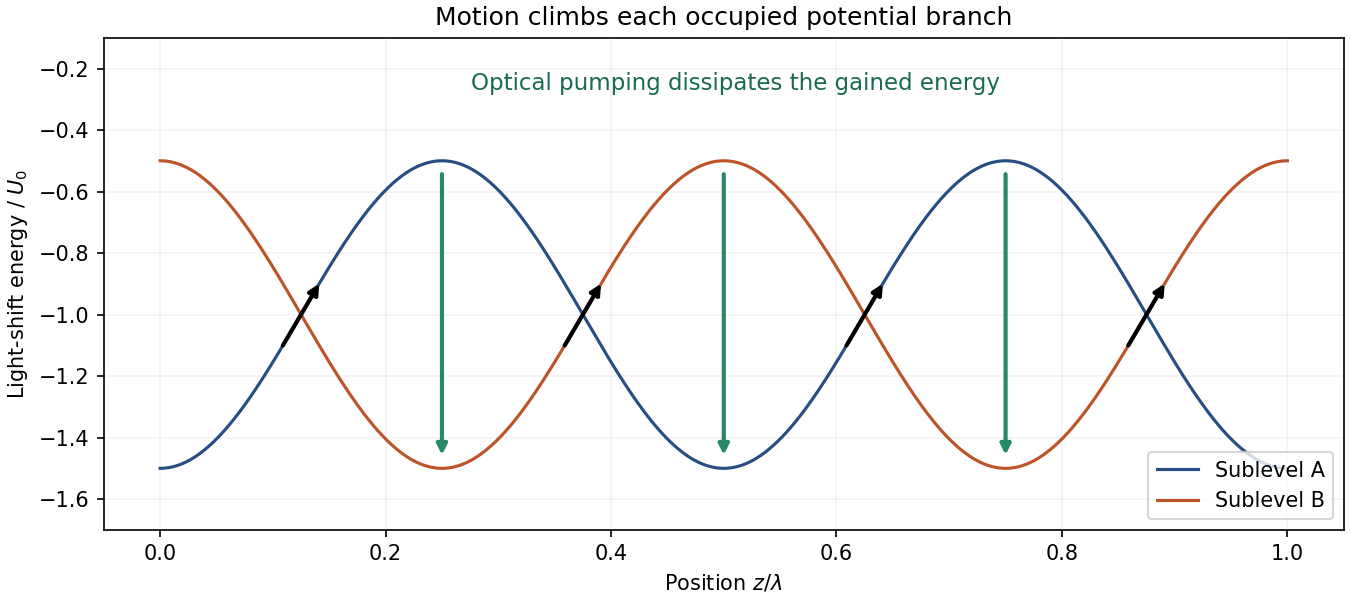
For large detuning compared with the natural linewidth, useful scales areup to angular-coupling and Rabi-frequency convention factors. Here is the optical Rabi angular frequency. The slow-atom capture range is of order . Typical energies in the Sisyphus regime track the light-shift scale rather than only , so reducing intensity can lower temperature below the Doppler limit. Capture becomes narrower, however, and recoil heating, imperfect polarization, magnetic fields and scattered light eventually matter. Define recoil energy ; this is an important scale, not a claim that every sub-Doppler method has the same universal final temperature.[ref]
Manipulating Atoms with Photons by Claude Cohen-Tannoudji. §2, Sub-Doppler cooling; §2.1, Sisyphus effect
The experimental test must establish a narrow velocity distribution independently of fluorescence brightness. William D. Phillips's account describes moving a time-of-flight probe above and below the cloud, deliberately heating the atoms to check a previously absent signal, and release-and-recapture comparisons that included gravity and finite beam geometry. These tests separated very cold atoms from an insensitive detector or a faulty thermometer.[ref]
Nobel Lecture: Laser cooling and trapping of neutral atoms by William D. Phillips. pp. 731–732, Figs. 15–16; pp. 733–734, multilevel interpretation
In a modern implementation, field cancellation and polarization checks test the mechanism, while independent expansion thermometry checks the inferred temperature. sub-Doppler cooling exploits internal-state dynamics omitted from the two-level Doppler model; it does not contradict that model within its assumptions. Past exam of the atomic and Optical Physics course of the University of Cambridge 2016 Paper 1 2 a Solution by Codex 0 2026-10-20
Codex 0 2026-10-20evaporative cooling removes atoms selectively from the high-energy tail of a trapped gas. The remaining sample has less energy per atom; elastic collisions then redistribute energy and restore a thermal distribution at lower temperature. Random atom loss would generally remove average energy and would not provide the same cooling mechanism. Repeated energy selection and rethermalization, rather than one removal event, is the essential cycle.
Using the evaporation truncation parameter , let the escape threshold be . As the gas cools, a fixed threshold is populated by fewer atoms, so evaporation stalls. In forced evaporative cooling the threshold is lowered during the sequence. In a magnetic trap, a radiofrequency evaporation knife flips trapped weak-field-seeking atoms into untrapped spin states where the Zeeman splitting matches the photon energy. Energetic atoms reach that resonance surface; sweeping the radiofrequency lowers the energy knife. In an optical dipole trap, lowering the trap depth offers a different implementation, although it usually also weakens confinement.
A simple evaporative cooling energy balance shows when atom loss is useful. For a classical gas in a three-dimensional harmonic trap of fixed frequencies, equipartition gives , counting both kinetic and potential energy. Suppose escaping atoms remove average energy , with a distribution-dependent excess above the threshold. For ,Thus preferential removal cools when the removed energy exceeds . More stringently, cooling must raise the phase-space density of an atomic gas, not merely lower the temperature:For this harmonic-trap phase-space density, with fixed geometric-mean trap frequency , . Therefore phase-space density rises during atom loss if . The numerical factors here belong to the stated harmonic-trap model, not every evaporative apparatus.
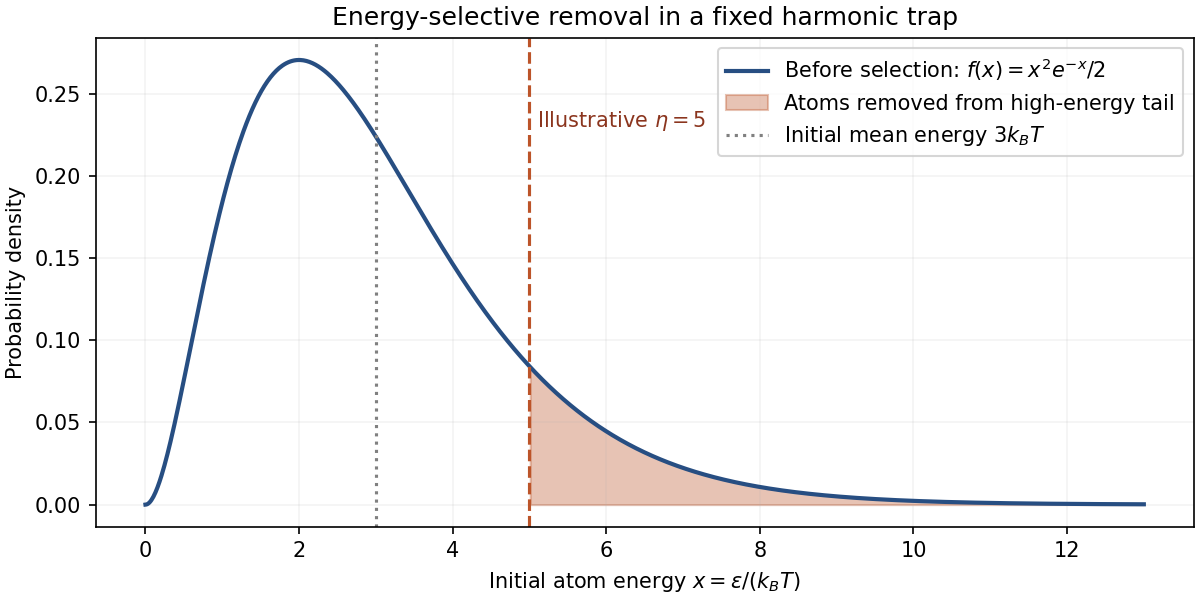
There must be enough elastic collisions to repopulate the tail: should exceed damaging loss and heating rates, and the ramp should allow rethermalization. Increasing density can improve elastic collisions but also enhances inelastic and three-body losses. Very rapid removal can leave a nonequilibrium cloud; very slow removal exposes it to background-gas losses. Lowering an optical trap can reduce density and collision rate, so a falling temperature is not by itself evidence of efficient evaporation.
The dilute-gas condensation experiments made this tradeoff concrete. Eric A. Cornell and Carl Wieman's account explains how selective escape and contraction of a trapped cloud raise phase-space density, while the need for rapid two-body equilibration and slow three-body loss restricts usable density. It also describes expansion imaging as an experimental diagnostic.[ref]
Nobel Lecture: Bose-Einstein condensation in a dilute gas, the first 70 years and some recent experiments by Eric A. Cornell and Carl Wieman. pp. 876–878, equilibration, selective escape and imaging of expanded clouds
Useful controls compare different knife ramps and hold times, measure both atom number and expansion temperature, and check trap-frequency calibration. Pure adiabatic expansion can cool without increasing phase-space density. Successful evaporation pays an atom-number cost to increase the remaining gas's phase-space occupancy. Past exam of the atomic and Optical Physics course of the University of Cambridge 2015 Paper 1 3 c Solution by Codex 0 2026-10-20
Codex 0 2026-10-20Two complementary signatures are suppressed low-speed dissipation and quantized circulation. Condensation alone establishes macroscopic occupation, not all of these flow properties. In a uniform weakly interacting condensate, the Landau criterion givesfor the Bogoliubov spectrum. Creating an excitation in a flow changes energy by ; a negative value allows energy transfer. Boundaries and vortex nucleation can make an actual measured threshold lower than this ideal bulk sound speed.
In the moving-obstacle test of atomic superfluidity, a blue-detuned focused laser repelled atoms in a sodium condensate and was scanned at different speeds. After a fixed exposure, time-of-flight absorption imaging measured the reduction of condensate fraction as a heating indicator. Low-speed heating was small, with a pronounced onset near , below the peak-density sound speed near . A stationary-beam control showed no heating; above-transition clouds constrained heating through the noncondensed fraction. Changing scan frequency and amplitude at common obstacle velocity helped separate a flow threshold from a particular trap resonance. Density inhomogeneity, obstacle geometry and vortex nucleation limit identification of the observed onset with a unique homogeneous Landau velocity.[ref]
Evidence for a Critical Velocity in a Bose-Einstein Condensed Gas by C. Raman and others. pp. 2502–2504, Figs. 1–3, stationary-beam and above-transition controls
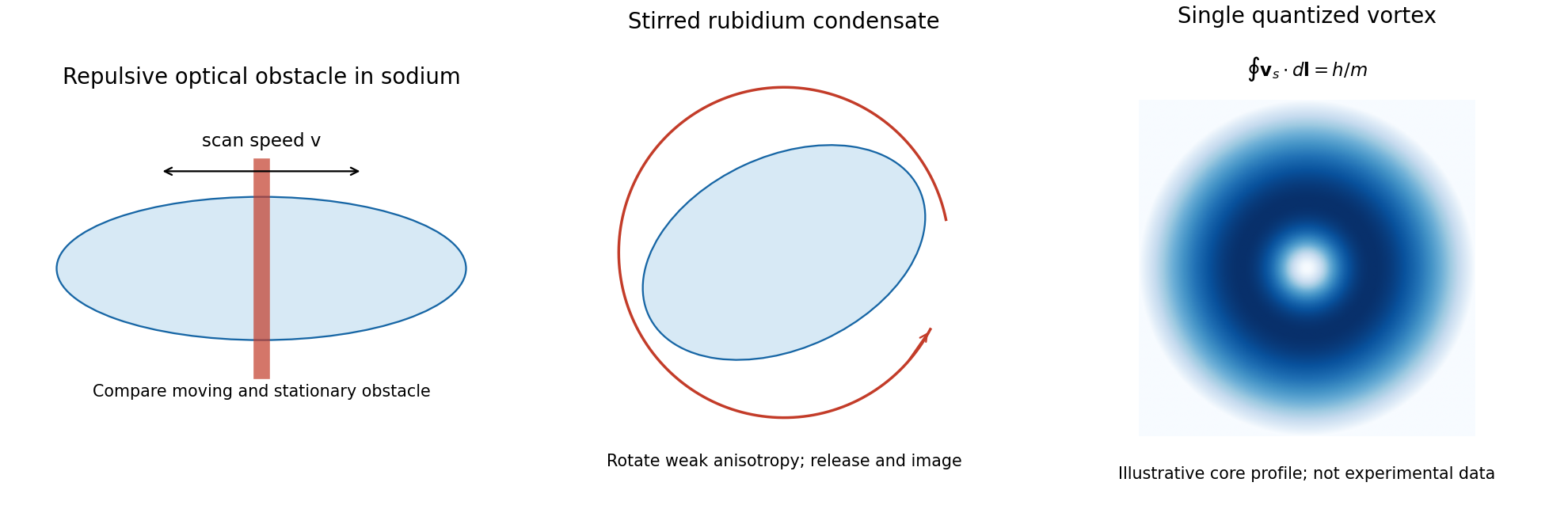
A second experiment stirred rubidium-87 in a magnetic trap by rotating a small transverse anisotropy generated with a far-detuned attractive laser. After stirring, the cloud expanded for and absorption imaging along the rotation axis revealed vortex cores. Below a threshold no cores appeared; faster rotation produced one or several. Ramping the stirrer down before release reduced additional excitation, and waiting after removing it tested vortex survival. Beam-centre stability and residual trap anisotropy are important controls; an isolated density dip without the rotation and persistence evidence would be less conclusive. This stirred-condensate vortex experiment is a response to rotation, distinct from merely imaging the appearance of a condensate.[ref]
Vortex Formation in a Stirred Bose-Einstein Condensate by K. W. Madison and others. preprint pp. 1–3, rotating dipole anisotropy, time-of-flight imaging and single-vortex lifetime
The superfluid velocity is . A closed loop avoiding a core must return a single-valued order parameter, soA singly quantized vortex therefore has phase winding and circulation , with depleted density in a core of order the healing length. This quantized rotational response differs from ordinary rigid-body flow. The experiment supports that interpretation through controlled stirring and vortex formation; imaging cores alone does not independently measure every phase winding or an absolute zero dissipative rate.
Past exam of the atomic and Optical Physics course of the University of Cambridge 2015 Paper 1 3 b Solution by Codex 0 2026-10-20
Codex 0 2026-10-20A two-photon transition is a second-order atom-field process. For two-photon absorption, energy conservation requires . A virtual intermediate state in two-photon absorption need not be populated as a real stationary state. In the electric dipole approximation, the two time orderings give an amplitude proportional toThe electric-field amplitudes multiply this expression. Far from intermediate resonance, the denominators are large relative to linewidths and one-photon couplings, keeping real intermediate occupation small. Near an intermediate resonance, sequential absorption, linewidths and saturation require a fuller treatment. For weak unsaturated absorption the rate scales as , or when both photons come from one field. Absorption followed by stimulated emission instead gives a difference-frequency Raman transition; it is not two-photon absorption at the sum frequency.
Two electric dipole interactions change parity twice, so initial and final states have the same parity. For a one-electron orbital, the usual changes are , subject to angular-momentum and polarization constraints. For identical equal-frequency photons, exchange symmetry removes the antisymmetric rank-one tensor: ranks zero and two survive. Thus is possible, whereas is forbidden in this degenerate electric-dipole approximation. It would be too strong to prohibit every transition between nonzero angular momenta, since a rank-two tensor can connect some such pairs. Spin remains unchanged to leading electric-dipole order.
A central example is hydrogen , forbidden as a one-photon electric dipole transition but accessible with two photons near . Absorption of one photon from each of equal-frequency counterpropagating beams makes the first-order Doppler shift vanish and suppresses net recoil. The two same-direction absorption paths can still give a broad Doppler background. A primary demonstration used a frequency-doubled pulsed dye laser near this wavelength and compared with a simultaneously recorded Balmer reference.[ref]
Doppler-Free Two-Photon Spectroscopy of Hydrogen by Theodor W. Hänsch and others. Phys. Rev. Lett. 34, 307 (1975), abstract: 2430-angstrom source and simultaneous Balmer-beta reference
Experimentally, scan the sum frequency and detect the excited state, its subsequent fluorescence or its ionization. Counterpropagating and single-beam spectra distinguish the narrow Doppler-free contribution from its background. Varying intensity tests weak-field scaling and extrapolates AC Stark shifts and power broadening; frequency calibration, beam overlap, residual angle and second-order Doppler shifts still matter. “Doppler free” here cancels the leading velocity term, not every systematic shift.
Past exam of the atomic and Optical Physics course of the University of Cambridge 2015 Paper 1 3 a Solution by Codex 0 2026-10-20
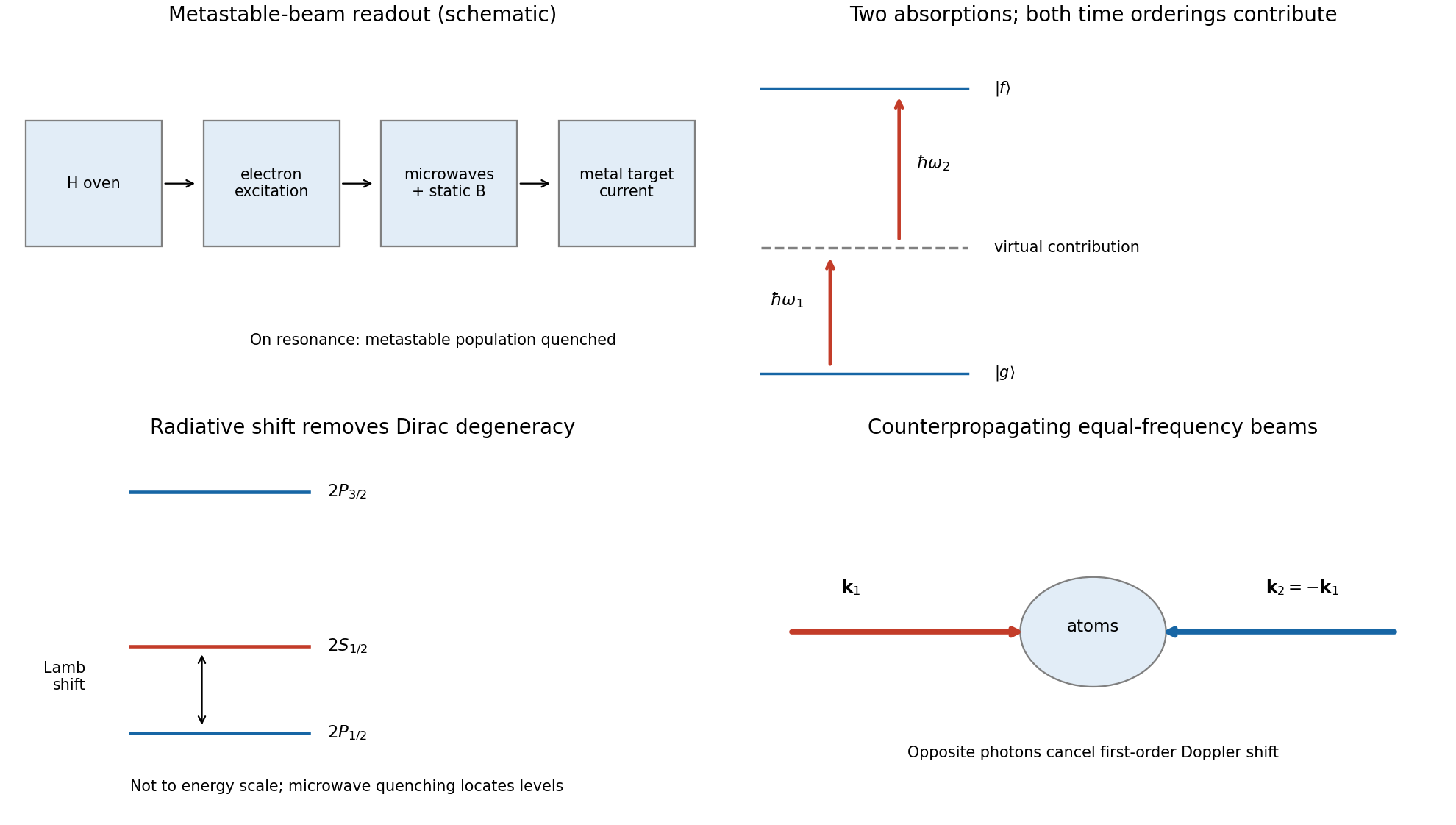
Codex 0 2026-10-20In the ideal point-nucleus Dirac-Coulomb problem, hydrogen levels depend on and , so and are degenerate despite their different orbital angular momenta. The Lamb shift removes this degeneracy: the level lies about above , an energy of roughly . This is distinct from the much larger fine-structure splitting.
quantum electrodynamics changes the electron's interaction with the Coulomb field. electron self-energy and vacuum polarization give state-dependent radiative corrections; a complete prediction also keeps specified recoil and nuclear-size contributions. An wave samples the nucleus differently from a wave, so equal no longer ensures equal energy. A leading-log estimate for an radiative contribution scales as , with a numerical prefactor and further state-dependent terms. This is a scale estimate, not a replacement for renormalized bound-state QED. The measurable shift is a difference relative to a specified reference Hamiltonian, rather than an unregulated absolute vacuum energy.[ref]
Theory of the Lamb shift in hydrogen and light hydrogen-like ions by Vladimir Yerokhin and others. §II, definition of level contributions relative to the point-nucleus Dirac value and bound-state QED expansion
The original microwave experiment used a tungsten oven to dissociate hydrogen, an electron beam to populate metastable atoms, and electron ejection from a metal target to measure surviving metastable atoms. Microwaves transferred population to rapidly decaying , reducing detector current. At a fixed microwave frequency, interruption of the radiation and a scan of static magnetic field revealed Zeeman-tuned resonances. Comparing resonance locations with the Dirac-level prediction showed the level shifted upward. Field calibration and homogeneity, excessive microwave intensity, unresolved hyperfine structure and stray-electric-field quenching limit the measurement; the signal is not direct absorption by a large equilibrium excited population.[ref]
Fine Structure of the Hydrogen Atom by a Microwave Method by Willis Eugene Lamb Jr. and Robert Curtis Retherford. pp. 241–243, apparatus, Fig. 1 caption and resonance-field comparison
Past exam of the atomic and Optical Physics course of the University of Cambridge 2015 Paper 1 1 iii Solution by Codex 0 2026-10-20
Codex 0 2026-10-20The second pulse has the same phase and area as the first, so another rotation by givesAt , the final vector is the south pole and all population is in . The complete path consists of a north-to-equator quarter turn, a full equatorial loop, and an equator-to-south quarter turn. At the pulses instead return the population to . Finite-pulse detuning corrections are small in ; the result is the stated short-pulse Ramsey limit.
Past exam of the atomic and Optical Physics course of the University of Cambridge 2015 Paper 1 1 ii Solution by Codex 0 2026-10-20
Codex 0 2026-10-20With the coupling off, . Precession during the dark interval givesThe populations remain during the dark interval; only their relative phase changes. For , the vector makes one complete equatorial circuit and returns to .
Past exam of the atomic and Optical Physics course of the University of Cambridge 2015 Paper 1 1 i Solution by Codex 0 2026-10-20
Codex 0 2026-10-20During a short pulse, detuning is negligible relative to . Rotation through angle about takes the initial north-pole Bloch vector toThe corresponding state is , since . The phase of this equatorial superposition is defined relative to the oscillator that will supply the second pulse.
Past exam of the atomic and Optical Physics course of the University of Cambridge 2014 Paper 1 3 c Solution by Codex 0 2026-10-20
Codex 0 2026-10-20Sound propagation. In the 1997 experiment, a focused laser beam abruptly modified the trapping potential of a dilute condensate, producing a local excitation. A rapid sequence of nondestructive phase-contrast imaging measurements followed the resulting density motion. Measuring propagation speed at different densities tested the sound-like collective excitation spectrum, rather than individual free-particle flight.[ref]
Propagation of Sound in a Bose-Einstein Condensate by M. R. Andrews and others. 1997, primary abstract and author publication record; Physical Review Letters 79, 549–552, with 1998 erratum
For a weakly interacting uniform condensate, the Bogoliubov spectrum isDensity dependence and trapped-geometry averaging matter when comparing a measured pulse speed with this local uniform formula. A strictly ideal gas would have no nonzero interaction-supported sound speed.Moving-obstacle dissipation. In the 1999 experiment, a blue-detuned focused beam repelled atoms and acted as an obstacle swept through a sodium condensate. Heating was inferred from the condensate fraction after stirring and re-equilibration. The heating rose markedly near , below the quoted peak sound speed .[ref]
Evidence for a Critical Velocity in a Bose-Einstein Condensed Gas by C. Raman and others. pages 2502–2504, obstacle method, heating onset and comparison with sound
Landau's criterion motivates a dissipation threshold, but density variation, flow acceleration around the obstacle and vortex nucleation make the observed threshold different from simply substituting the peak sound speed. Together these experiments probe a collective excitation spectrum and the onset of dissipative flow; condensation alone is not a complete demonstration of superfluidity. Past exam of the atomic and Optical Physics course of the University of Cambridge 2014 Paper 1 3 b Solution by Codex 0 2026-10-20
Codex 0 2026-10-20The two-level Doppler limit, , balances velocity-dependent scattering friction with momentum diffusion. Multilevel atoms have additional, slower internal dynamics. Counterpropagating beams with orthogonal linear polarizations create a spatially varying polarization, giving different position-dependent light shifts for ground-state magnetic sublevels. A moving atom climbs a light-shift hill, loses kinetic energy and is optically pumped into a lower-energy sublevel: this repeated Sisyphus cooling cycle dissipates motion through emitted light.
Optical pumping responds with a finite delay. Its rate, rather than only the excited-state linewidth, sets the low-velocity response scale. In the opposite-circular-polarization arrangement, motion instead produces unequal sublevel populations and unbalanced radiation pressure. Both mechanisms can cool below the two-level Doppler temperature; diffusion heating still balances the cooling, and recoil matters at the lowest temperatures.[ref]
Laser cooling below the Doppler limit by polarization gradients: simple theoretical models by Jean Dalibard and Claude Cohen-Tannoudji. 1989, pages 2023–2025, two polarization-gradient mechanisms and pumping timescale
Ground-state substructure, optical pumping and polarization gradients enable the extra cooling. Magnetic fields that disturb the required sublevel dynamics can suppress it. Optical molasses damps velocity but does not by itself provide position-restoring confinement.
Past exam of the atomic and Optical Physics course of the University of Cambridge 2014 Paper 1 3 a Solution by Codex 0 2026-10-20
Codex 0 2026-10-20An electric dipole transition has amplitude proportional to . The electric dipole operator is odd under parity, so the initial and final states must have opposite parity. As a rank-one spherical tensor it also requires , excluding , and . These follow from angular-momentum addition and the Wigner-Eckart theorem; vanishing Clebsch-Gordan coefficients can impose further restrictions. Relative to the quantization axis, polarization drives , while drive .
For a single active electron, parity and the orbital triangle rule combine to give . In LS coupling, the spin-independent electric dipole operator gives and , excluding ; total parity must still change. Spin-orbit mixing can weakly relax the approximate spin rule. For resolved hyperfine states the corresponding triangle rule is , excluding , with . These labels require the appropriate coupling regime. There is no universal E1 rule demanding a particular change in principal quantum number. An E1-forbidden line may occur through another multipole or a multiphoton process.
Past exam of the atomic and Optical Physics course of the University of Cambridge 2013 Paper 1 3 c Solution by Codex 0 2026-10-20
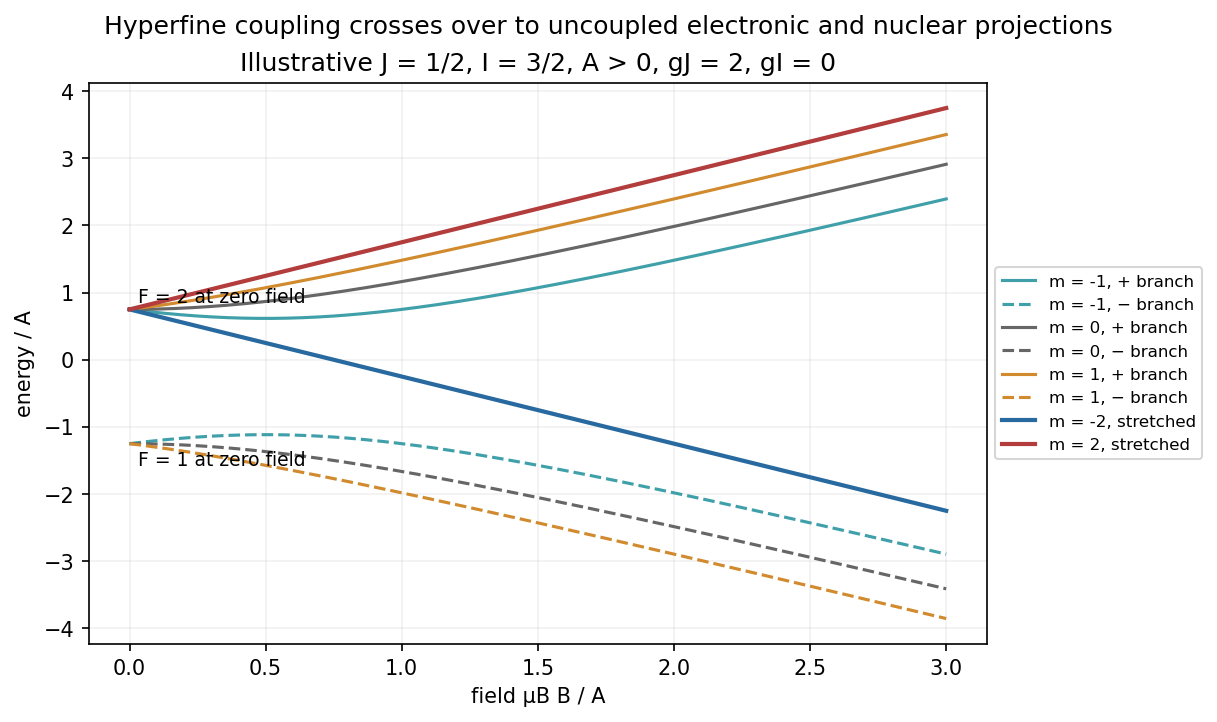
Codex 0 2026-10-20For a nucleus of spin and electronic , the magnetic-dipole hyperfine interaction is , using dimensionless angular-momentum operators. The electric-quadrupole hyperfine contribution vanishes for . In zero field, labels the levels:Their signed separation is . For , the larger- multiplet lies higher; negative reverses this order. If there is no such hyperfine splitting.
Let the field define and writeHere is the signed nuclear Zeeman coefficient expressed in Bohr-magneton units, including its nuclear-to-Bohr-magneton factor; it is not an unconverted nuclear factor. Total projection is conserved, while need not be. In the basis , , the two-state block isFor , define . Diagonalization gives the Breit-Rabi formula,For either sign of , the block itself remains valid; its ordered eigenvalues are .
For a stretched hyperfine Zeeman state at projection there is only one state each. Their energies are exactlyAssigning two branches to each stretched projection would double-count states.
In weak fields the shift is , with for ; an state has no first-order Zeeman shift. At strong hyperfine-decoupling fields the eigenstates approach product states withThis is the hyperfine regime of the Paschen-Back effect, still assuming the field is weak enough not to invalidate the electronic manifold. States of the same mix and avoid crossing when their off-diagonal coupling is nonzero; different- levels can cross.
Past exam of the atomic and Optical Physics course of the University of Cambridge 2013 Paper 1 3 b Solution by Codex 0 2026-10-20
Codex 0 2026-10-20A Paul trap uses a time-dependent electric quadrupole field to provide dynamic confinement, avoiding the impossibility of trapping a charge in a stable three-dimensional static electrostatic minimum. Its dynamics follows a Mathieu equation: stable drive parameters produce slow Paul trap secular motion with superposed fast Paul trap micromotion. If denotes the peak oscillating field, the effective energy for small Paul trap micromotion isThe radiofrequency pseudopotential of a Paul trap is an averaged mechanical energy, not a static electrostatic potential. Doppler cooling and, where needed, resolved sideband cooling reduce Paul trap secular motion; the Lamb-Dicke regime suppresses higher motional sidebands.[ref]
Nobel Lecture: Superposition, entanglement, and raising Schrödinger’s cat by David J. Wineland. Sections III–IV, confinement, internal-state control and quantized ion motion
Two long-lived internal states encode a qubit, for example hyperfine states, while an optical metastable transition provides another option. Optical pumping initializes it. Resonant or Raman transition pulses make coherent single-qubit rotations, and state-dependent fluorescence distinguishes a bright state from a dark shelved state. Shared quantized normal modes let one ion's internal state influence another, providing entangling gates in the proposal of J. I. Cirac and P. Zoller; the motional bus must be returned to its intended state rather than left carrying unwanted information.[ref]
Quantum Computations with Cold Trapped Ions by J. I. Cirac and P. Zoller. 1995, pp. 4091–4093, shared motion and conditional gates
A concrete early experiment demonstrated a controlled-NOT gate between the internal hyperfine and motional degrees of freedom of a single trapped ion. This was an internal–motion two-qubit gate, not yet a gate between two separate ions.[ref]
Demonstration of a Fundamental Quantum Logic Gate by Christopher Monroe and others. 1995, pp. 4714–4717, encoding and gate demonstration
Challenges include electric-field-noise heating of the motional bus, excess Paul trap micromotion from stray fields, magnetic and laser phase noise, off-resonant spontaneous scattering, imperfect preparation and readout, and unwanted excitation of spectator modes. Scaling to many ions adds mode crowding, individual-addressing crosstalk and transport requirements. Cooling and quantum error correction must remove entropy without erasing stored qubits. Long storage coherence is necessary but not sufficient: gates and measurements must also be accurate and reproducible. The original gate experiment explicitly identified laser, field, trap-drive and motional decoherence limitations.[ref]
Demonstration of a Fundamental Quantum Logic Gate by Christopher Monroe and others. p. 4716, decoherence sources and limits to extended computations
Past exam of the atomic and Optical Physics course of the University of Cambridge 2013 Paper 1 3 a Solution by Codex 0 2026-10-20
Codex 0 2026-10-20The Lamb shift is a radiative displacement of atomic energy levels beyond the values from the Dirac equation in a Coulomb potential. In hydrogen, the and levels are degenerate for a point Coulomb potential in the Dirac equation, yet the level lies higher by roughly a gigahertz. This is distinct from the fine structure splitting between different levels and from nuclear-spin hyperfine structure.
Electron self-energy in the quantized electromagnetic field is the dominant contribution to the familiar hydrogen splitting; vacuum polarization contributes too. Renormalization separates the physical electron mass from its divergent free-electron self-energy. A useful leading-log scale for a hydrogenic level isnot an exact numerical formula. The enhanced sensitivity of S states follows from their nonzero wavefunction at the nucleus; leading short-distance corrections act like contact perturbations. A precision prediction also includes finite nuclear size and recoil, and must consistently separate those effects from the radiative contribution.[ref]
Theory of the Lamb shift in hydrogen and light hydrogen-like ions by Vladimir Yerokhin and others. §III A, equations (7)–(8), one-loop self-energy and vacuum-polarization scale; introduction, separation of radiative, recoil and nuclear effects
The original Lamb-Retherford experiment used a beam of hydrogen atoms, electron-impact excitation into metastable , and microwave-induced transfer into short-lived states. Those atoms decayed before reaching the detector. Metastable atoms surviving to a metal target ejected electrons, so a drop in the measured current signalled a resonance. Varying the microwave excitation and magnetic field established the displacement from the Dirac equation expectation. Microwave quenching converted a small energy difference into a measurable loss of a long-lived population, avoiding optical Doppler widths that obscure the splitting.[ref]
Fine Structure of the Hydrogen Atom by a Microwave Method by Willis Eugene Lamb Jr. and Robert Curtis Retherford. 1947, pp. 241–243, metastable beam, target-current readout and microwave resonance
Past exam of the atomic and Optical Physics course of the University of Cambridge 2013 Paper 1 1 ii Solution by Codex 0 2026-10-20
Codex 0 2026-10-20For the harmonic-oscillator recoil matrix element, using and differentiating the Gaussian transform with respect to ,Consequently . Reversing the travelling-wave phase changes the sign of the imaginary amplitude. For small , the sideband is weaker by in amplitude and in probability.
With the printed unnormalized Gaussians, the literal integral would be . It is distinguished from the physical normalized-oscillator result rather than silently treating inconsistent wavefunctions as normalized.
Past exam of the atomic and Optical Physics course of the University of Cambridge 2013 Paper 1 1 i Solution by Codex 0 2026-10-20
Codex 0 2026-10-20Write , with Rabi frequency , for the internal coupling and use normalized oscillator states. The motional carrier transition matrix element is the Gaussian characteristic function,In the Lamb-Dicke regime, . The diagonal internal-energy terms cannot connect to .
If the two unnormalized printed functions are used verbatim, the literal ground-state integral is instead . This is not a matrix element between normalized eigenstates of the stated trap; even its zero-recoil value is incorrectly .
Pinned article: Introduction to the OurBigBook Project
Welcome to the OurBigBook Project! Our goal is to create the perfect publishing platform for STEM subjects, and get university-level students to write the best free STEM tutorials ever.
Everyone is welcome to create an account and play with the site: ourbigbook.com/go/register. We belive that students themselves can write amazing tutorials, but teachers are welcome too. You can write about anything you want, it doesn't have to be STEM or even educational. Silly test content is very welcome and you won't be penalized in any way. Just keep it legal!
Intro to OurBigBook
. Source. We have two killer features:
- topics: topics group articles by different users with the same title, e.g. here is the topic for the "Fundamental Theorem of Calculus" ourbigbook.com/go/topic/fundamental-theorem-of-calculusArticles of different users are sorted by upvote within each article page. This feature is a bit like:
- a Wikipedia where each user can have their own version of each article
- a Q&A website like Stack Overflow, where multiple people can give their views on a given topic, and the best ones are sorted by upvote. Except you don't need to wait for someone to ask first, and any topic goes, no matter how narrow or broad
This feature makes it possible for readers to find better explanations of any topic created by other writers. And it allows writers to create an explanation in a place that readers might actually find it.
Figure 1. Screenshot of the "Derivative" topic page. View it live at: ourbigbook.com/go/topic/derivativeVideo 2. OurBigBook Web topics demo. Source. - local editing: you can store all your personal knowledge base content locally in a plaintext markup format that can be edited locally and published either:This way you can be sure that even if OurBigBook.com were to go down one day (which we have no plans to do as it is quite cheap to host!), your content will still be perfectly readable as a static site.
- to OurBigBook.com to get awesome multi-user features like topics and likes
- as HTML files to a static website, which you can host yourself for free on many external providers like GitHub Pages, and remain in full control

Figure 2. You can publish local OurBigBook lightweight markup files to either OurBigBook.com or as a static website.
Figure 3. Visual Studio Code extension installation.
Figure 5. . You can also edit articles on the Web editor without installing anything locally. Video 3. Edit locally and publish demo. Source. This shows editing OurBigBook Markup and publishing it using the Visual Studio Code extension. 
- Infinitely deep tables of contents:




All our software is open source and hosted at: github.com/ourbigbook/ourbigbook
Further documentation can be found at: docs.ourbigbook.com
Feel free to reach our to us for any help or suggestions: docs.ourbigbook.com/#contact