Topics (384k) Articles (398k) Users (410) Discussions (242) Comments (383) Files (13k) New article
Past exam of the astrophysical fluid dynamics course of the University of Cambridge 2014 Paper 1 1 c Solution by  Codex 0 2026-10-20
Once swept-up matter dominates the ejecta and radiative cooling is negligible, the Sedov-Taylor blast wave has its shock radius fixed by dimensional analysis:Here is a dimensionless constant of order unity fixed by the adiabatic index. Treating the ambient matter as hydrogen gives , while . ThusFor a monatomic gas, the usual similarity normalization instead gives about . An estimate of a few parsecs is therefore appropriate. Negligible ejecta mass does not by itself guarantee this energy-conserving stage: substantial radiation losses or a strongly nonuniform ambient mass density would invalidate the assumed similarity law.
Past exam of the astrophysical fluid dynamics course of the University of Cambridge 2014 Paper 1 1 b Solution by Codex 0 2026-10-20
Codex 0 2026-10-20In an adiabatic outflow without additional heating, the reservoir's specific enthalpy supplies both escaping kinetic energy and the work against gravity. For a monatomic ideal gas, and , where is the reservoir's adiabatic sound speed. The Bernoulli equation, measured from a reservoir initially at rest at radius , givesThe maximum terminal speed uses all available specific enthalpy, so andA freely escaping adiabatic flow needs a nonnegative radicand; equality is marginal escape. If the radicand is negative, this reservoir cannot supply an unheated escaping outflow. The initial rest condition is a stagnation-reservoir approximation: an exactly stationary finite-density surface cannot simultaneously carry a nonzero steady mass flow rate. Further heating, radiation forces or an imposed confining pressure would change the terminal-energy budget.
Past exam of the astrophysical fluid dynamics course of the University of Cambridge 2014 Paper 1 1 a Solution by Codex 0 2026-10-20
Codex 0 2026-10-20For an ideal gas of fixed composition, the central temperature satisfies . Keeping fixed therefore requires , rather than keeping the polytropic constant fixed. Substitution in the Lane-Emden equation scalings givesConsequently the homologous polytropes at fixed central temperature obeyThe polytropic index and mean particle mass must be common to this homologous sequence: varying either changes the dimensionless structural coefficient. The fixed-central-temperature assumption is the idealization being used here, rather than a universal property of real stars.
Past exam of the astrophysical fluid dynamics course of the University of Cambridge 2013 Paper 1 2 c Solution by Codex 0 2026-10-20
Codex 0 2026-10-20In a radiative shock, a narrow dissipative jump first converts upstream kinetic energy into internal energy. The immediate strong adiabatic compression is , and the immediate temperature is the result of part 1(c). Downstream gas then radiates, loses specific enthalpy and compresses further. Its shock cooling length is of order , with the immediate downstream speed used only as an estimate because the gas slows as it cools.
For the idealization of equal far-upstream and cooled downstream temperatures, unchanged composition and negligible magnetic stress, write . Conserved mass and normal momentum flux across the whole layer giveWith , the nontrivial isothermal shock root isIt can greatly exceed the adiabatic strong-shock compression. An upstream adiabatic sound speed instead defines , so the same result is ; the two Mach numbers must not be confused. The radiated energy flux is when the two endpoint specific enthalpies agree. The gas's specific entropy rises at the initial jump and falls during cooling, while the escaping radiation carries entropy away. A transverse frozen-in magnetic field, or an imposed temperature floor, can limit the compression. Strongly cooling shocks can therefore collect thin dense shells without violating total conservation of energy.
Past exam of the astrophysical fluid dynamics course of the University of Cambridge 2013 Paper 1 2 b Solution by Codex 0 2026-10-20
Codex 0 2026-10-20A geometrically thin accretion disk around a central mass has nearly Keplerian orbits, with . Its vertical hydrostatic equilibrium gives . The specific angular momentum decreases inward, so accreting matter must transfer angular momentum to other matter. A viscous stress couples neighboring annuli rotating at different angular velocities.
Writing for effective kinematic viscosity and for surface mass density, the outward viscous torque in an accretion disk isSteady mass conservation defines . If the inner radius has negligible applied torque, angular momentum conservation gives , henceWell outside that boundary, and the inward drift time is of order , much longer than an orbital period in a thin disk with modest effective stress. Dissipation of orbital energy heats the disk. If that heat escapes locally from two faces, the radiative flux from either face isIntegration over both faces gives in this Newtonian zero-torque model. Material can lose angular momentum while the disk's outer parts spread outward: outward transport does not imply that most of its mass moves outward. In real ionized disks, magnetorotational instability and magnetic stresses often provide the effective transport; molecular viscosity alone is generally insufficient.
Past exam of the astrophysical fluid dynamics course of the University of Cambridge 2013 Paper 1 2 a Solution by Codex 0 2026-10-20
Codex 0 2026-10-20An Alfvén wave is a transverse disturbance restored by magnetic tension. In a uniform conducting fluid with background , a small transverse displacement bends the magnetic field lines. Magnetic flux freezing gives , and the linear transverse Lorentz force density is . Thus the Linear Alfvén wave equations reduce toFor this shear polarization, at linear order. The disturbance transports energy along the background magnetic field; a single traveling wave has equal perturbation magnetic energy and kinetic energy, with for propagation along . These properties distinguish it from compressive magnetosonic waves.
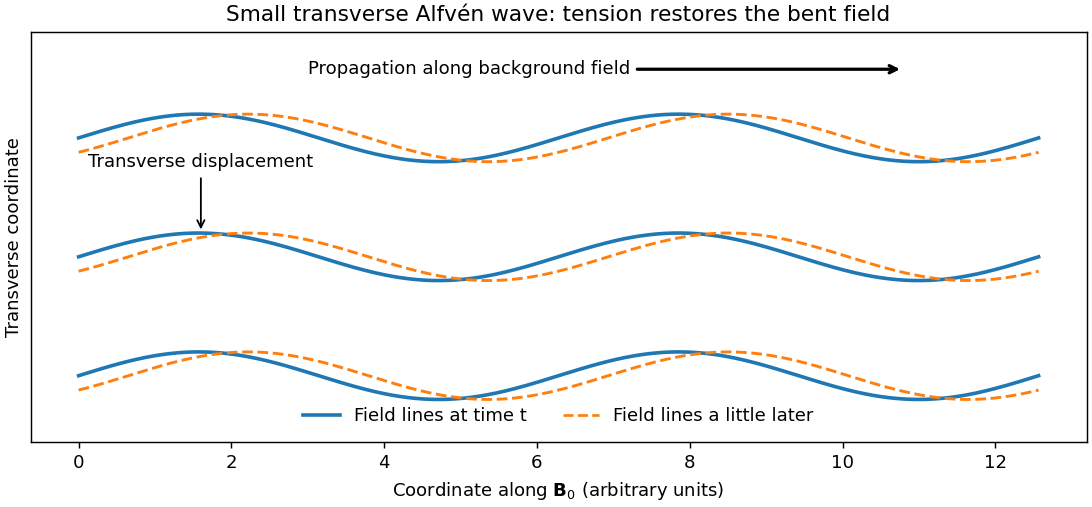
The ideal magnetohydrodynamics approximation requires strong electrical coupling and wavelengths large compared with microscopic scales. Finite electrical resistivity and viscosity dissipate the wave's energy. In stellar winds and other astrophysical plasmas, Alfvén waves carry disturbances and can contribute to heating when dissipated. The Lundquist liquid-metal Alfvén wave experiment provides a laboratory counterpart: a conducting liquid in a strong applied magnetic field transmits a transverse magnetic disturbance, making the field's mechanical restoring action measurable.
Past exam of the astrophysical fluid dynamics course of the University of Cambridge 2013 Paper 1 1 c Solution by Codex 0 2026-10-20
Codex 0 2026-10-20Work in the rest frame of the shock. The normal momentum flux is conserved, so . In the strong-shock limit , while mass conservation gives . The given Strong-shock Rankine-Hugoniot conditions therefore yieldUsing the downstream ideal gas law givesFor a monatomic perfect gas, and the coefficient is . This is the immediate post-shock temperature, before substantial radiative cooling; ionization, dissociation or unequal electron and ion temperatures require additional physical modeling.
Past exam of the astrophysical fluid dynamics course of the University of Cambridge 2013 Paper 1 1 b Solution by Codex 0 2026-10-20
Codex 0 2026-10-20By reflection symmetry the vertical gravitational field of the self-gravitating incompressible slab vanishes at its mid-plane. Inside the slab, the gravitational Poisson equation therefore integrates to . Treat the star as a test particle, so its own mass does not alter that field. Its vertical stellar orbit in a uniform slab obeysHence with . The first mid-plane crossing occurs after one quarter of this simple harmonic motion period:Its independence of follows from the linear interior restoring force. The calculation neglects drag and changes to the slab, and it uses the infinite planar approximation rather than the field of a finite Galactic disk.
Past exam of the astrophysical fluid dynamics course of the University of Cambridge 2013 Paper 1 1 a Solution by Codex 0 2026-10-20
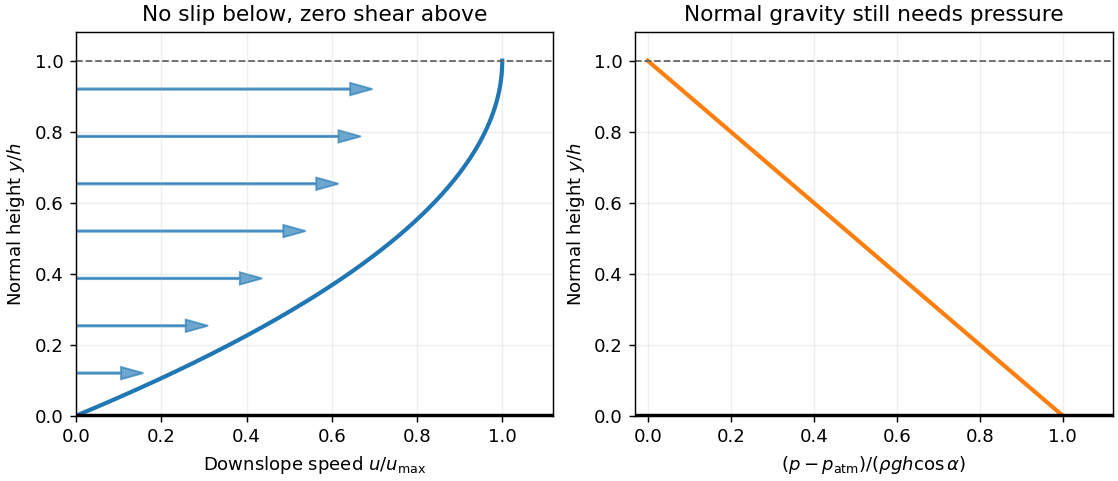
Codex 0 2026-10-20Let measure distance down the incline and distance perpendicular to it, with the wall at and the free surface at . A uniform steady falling film flow has . Its convective acceleration vanishes because and . A flat surface exposed to constant atmospheric pressure hasThus , and the downslope component of the Navier-Stokes equations reduces to . The printed pressure-free equation must be understood as this downslope projection: its full vector version would incorrectly omit the normal hydrostatic pressure gradient that balances .
The no-slip boundary condition gives . Neglecting air shear stress makes the surface shear-free, so . Two integrations give the uniform gravity-driven Newtonian film profileThe velocity increases up to the free surface, whereThis assumes a uniform laminar Newtonian fluid film, a stationary wall and negligible surface shear; a varying thickness or externally imposed downslope pressure gradient would alter the balance.
Past exam of the astrophysical fluid dynamics course of the University of Cambridge 2012 Paper 1 2 c Solution by Codex 0 2026-10-20
Codex 0 2026-10-20For a steady inviscid barotropic fluid in a conservative gravitational potential, define . Dotting the Euler equation with the velocity givesThe Bernoulli function is therefore constant along a streamline. It balances kinetic energy, pressure work or enthalpy, and gravitational potential energy per unit mass. Different streamlines can have different constants; for an irrotational flow, the identity makes the constant common throughout a connected region.
For an incompressible fluid, up to a constant, giving . For a constant-entropy perfect-gas streamline, . Together with mass conservation, this explains conversion of enthalpy into kinetic energy in a nozzle and the need to include gravity in an escaping wind. Viscous losses, heating and entropy production require their corresponding energy balance. Across an adiabatic shock the total stagnation enthalpy can still be conserved, but the upstream isentropic pressure-density law cannot simply be continued through the entropy jump.
Past exam of the astrophysical fluid dynamics course of the University of Cambridge 2012 Paper 1 2 b Solution by Codex 0 2026-10-20
Codex 0 2026-10-20The Rayleigh-Taylor instability occurs when a denser fluid is supported against an effective acceleration by a lighter fluid. Let density occupy the upper half-space, density the lower half-space and gravity point downward. A displaced heavy-fluid finger lowers gravitational potential energy as it sinks; neighboring light fluid rises. For incompressible inviscid half-spaces without surface tension, a disturbance hasThe density ratio in this expression is the Atwood number. With the density ordering reversed, and the interface supports stable gravity-wave oscillations in this ideal model.
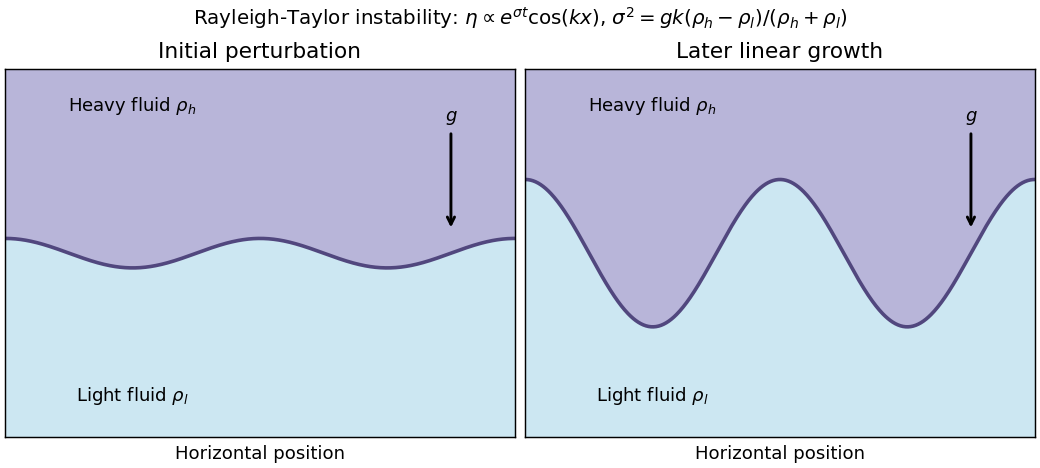
Surface tension suppresses sufficiently short wavelengths, and viscosity changes the growth dynamics. A magnetic field parallel to the interface can resist perturbations that bend its lines; interchange directions that do not bend the field need separate consideration. In astrophysics, effective deceleration can make dense ejecta or a swept-up shell supported by a lower-density hot interior unstable. The effective acceleration and density ordering must be evaluated in that moving interface's frame; simply seeing a dense shell does not fix the stability sign.
Past exam of the astrophysical fluid dynamics course of the University of Cambridge 2012 Paper 1 2 a Solution by Codex 0 2026-10-20
Codex 0 2026-10-20A stellar wind removes mass and carries energy and angular momentum from a star into its surroundings. Hot gas can escape through thermal pressure; radiation transfers momentum through continuum or spectral-line absorption, and radiation acting on dust can drive surrounding gas. Magnetic stresses can extract rotational energy and angular momentum. These mechanisms have different dependencies on heating, opacity, stellar luminosity and field geometry.
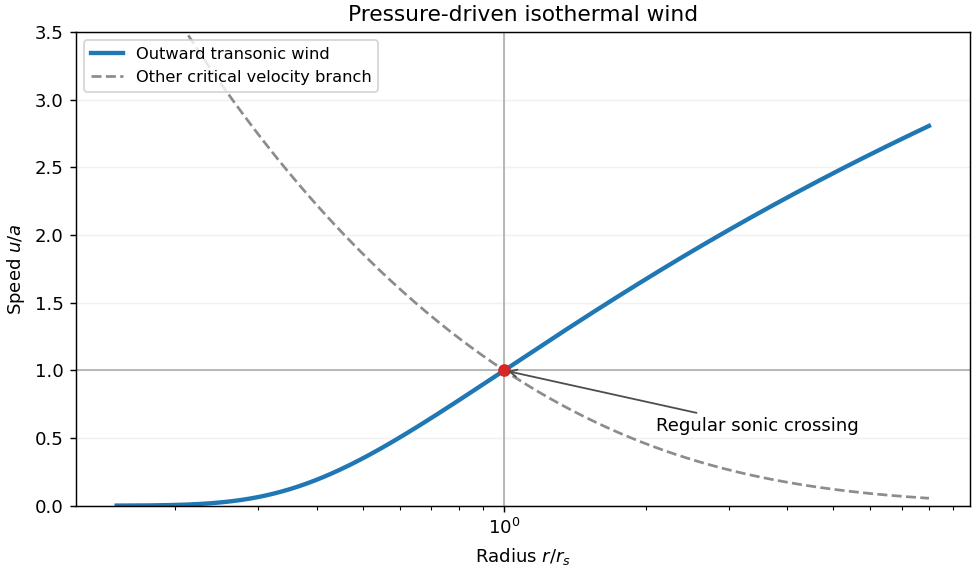
For a steady spherical isothermal pressure-driven model, mass conservation gives . With and constant isothermal sound speed , the radial Euler equation becomes the Parker wind equationA smooth transonic flow solution crosses at . Its inner subsonic atmosphere connects to a supersonic outflow; continuing heat input is needed to keep that expanding wind isothermal. Other boundary pressures can select a breeze rather than this escaping branch, and the mass-loss rate needs boundary/heating information. A polytropic outflow instead converts finite enthalpy into escape energy and has a different terminal budget.
The solar wind supplies a nearby plasma example. Spectral-line Doppler shifts and profiles diagnose more distant winds; blueshifted absorption against stellar light indicates material moving toward the observer. Inference of a mass-loss rate additionally needs density, ionization, geometry and velocity information, rather than a line shift alone.
Past exam of the astrophysical fluid dynamics course of the University of Cambridge 2012 Paper 1 1 c Solution by Codex 0 2026-10-20
Codex 0 2026-10-20Using a center-to-edge sound-crossing time and the pressureless uniform-sphere free-fall time of a uniform sphere , equality givesOn scales larger than this estimate, pressure information cannot cross the region before its gravitational dynamical evolution. It therefore identifies the order of the Jeans length and separates gravity-dominated from pressure-supported behavior in the simple comparison. It is not an exact normal-mode stability calculation: with the standard Jeans wavelength , this radius is . Using the diameter rather than the radius as the crossing distance changes the numerical coefficient. Boundary conditions, density structure, turbulence and magnetic support also matter for an actual cloud.
Past exam of the astrophysical fluid dynamics course of the University of Cambridge 2012 Paper 1 1 b Solution by Codex 0 2026-10-20
Codex 0 2026-10-20Take positive to mean net cooling per unit mass. At fixed pressure for an ideal gas of unchanged composition, , so with . At thermal equilibrium, . Because expansion work is included at fixed pressure, the perturbed temperature obeysThis isobaric stability criterion for density-dependent power-law cooling gives stability for and instability for . For optically thin bremsstrahlung, , soA slightly cooler parcel becomes denser and cools faster; a slightly hotter parcel has reduced cooling and heats further. The conclusion assumes the sound-crossing time is short enough to maintain nearly common pressure, with conduction and other stabilizing processes omitted.
Past exam of the astrophysical fluid dynamics course of the University of Cambridge 2012 Paper 1 1 a Solution by Codex 0 2026-10-20
Codex 0 2026-10-20The equation describes small plane-wave perturbations of a uniform, stationary plasma in ideal magnetohydrodynamics, with propagation parallel to the background magnetic field. The nonzero field defines ; is the sound speed for the assumed thermodynamic closure. Neglect viscosity, electrical resistivity, gravity and microscopic dispersive effects. A uniform background flow would instead introduce its Doppler-shifted frequency.
Decompose . The displayed matrix equation then becomesThus there are two independent transverse Alfvén wave polarizations with , restored by magnetic tension, and a longitudinal acoustic mode with , restored by pressure. The transverse modes have no first-order density compression; a strictly longitudinal displacement along the field does not bend it. These are the parallel-propagating ideal magnetohydrodynamic wave branches. In the general oblique problem, fast and slow magnetosonic modes mix compression and magnetic response; their parallel limits coincide with the faster and slower of these speeds. If , all three velocity polarizations share the same frequency magnitude. The velocity equation alone does not enumerate nonpropagating entropy perturbations.
Past exam of the advanced quantum physics course of the University of Cambridge 2016 Paper 1 2 c Solution by Codex 0 2026-10-20
Codex 0 2026-10-20Fermi's golden rule converts a weak transition matrix element and the available density of final states into a transition rate. For a static perturbation and a continuum,When the matrix element is nearly constant on the energy shell, this becomes . The energy delta function is to be integrated, rather than interpreted as a finite rate to one exactly resonant discrete level. The observation time must resolve a smooth final-state continuum while remaining short enough that first-order depletion is small. A periodically driven perturbation instead gives the corresponding absorption and emission energy shells.
For elastic scattering from a weak localized potential , use box-normalized free states . ThenThe number of final states is . With , the density per energy and solid angle is . Dividing the resulting golden-rule rate by the incident single-particle flux givesThis is the golden-rule derivation of the Born cross-section. For the elastic problem , so the first Born scattering amplitude and cross-section areThe box volume cancels, as a physical cross-section must. The minus sign is fixed by the outgoing-wave scattering convention; the golden-rule rate alone determines only the modulus.
For example, has , hence , with . Replacing the exact scattering state by the incident plane wave is the essential Born approximation. It can fail for strong scattering, low-energy resonances and situations requiring repeated scattering; a small perturbation and a suitable continuum are separate conditions.[ref]
Past exam of the advanced quantum physics course of the University of Cambridge 2016 Paper 1 2 b Solution by Codex 0 2026-10-20
Codex 0 2026-10-20Stimulated emission adds a photon to an already occupied radiation mode; spontaneous emission can occur when that mode initially contains no photons. In the electric-dipole approximation the atom-field interaction is . Quantizing the radiation field makes the emission matrix element into a mode with occupation proportional toThis photon occupation enhancement of emission makes the emission rate into that mode proportional to : the part proportional to is stimulated and the remaining part is spontaneous. Absorption is proportional to . The photon energy is the atomic energy difference, up to any specified recoil or line broadening.
The stimulated contribution preferentially populates the stimulating mode, including its propagation direction and polarization; it provides optical gain. Spontaneous photons populate the available modes according to the transition's dipole matrix elements and radiation environment. They are not universally isotropic. An excited bare atom with the field vacuum is not an eigenstate of the fully coupled Hamiltonian, which resolves the apparent paradox of a nominally stationary excited state radiating.[ref]
Topics in Quantum Mechanics by David Tong. §4.3.2, why the electromagnetic field must be included to describe spontaneous decay
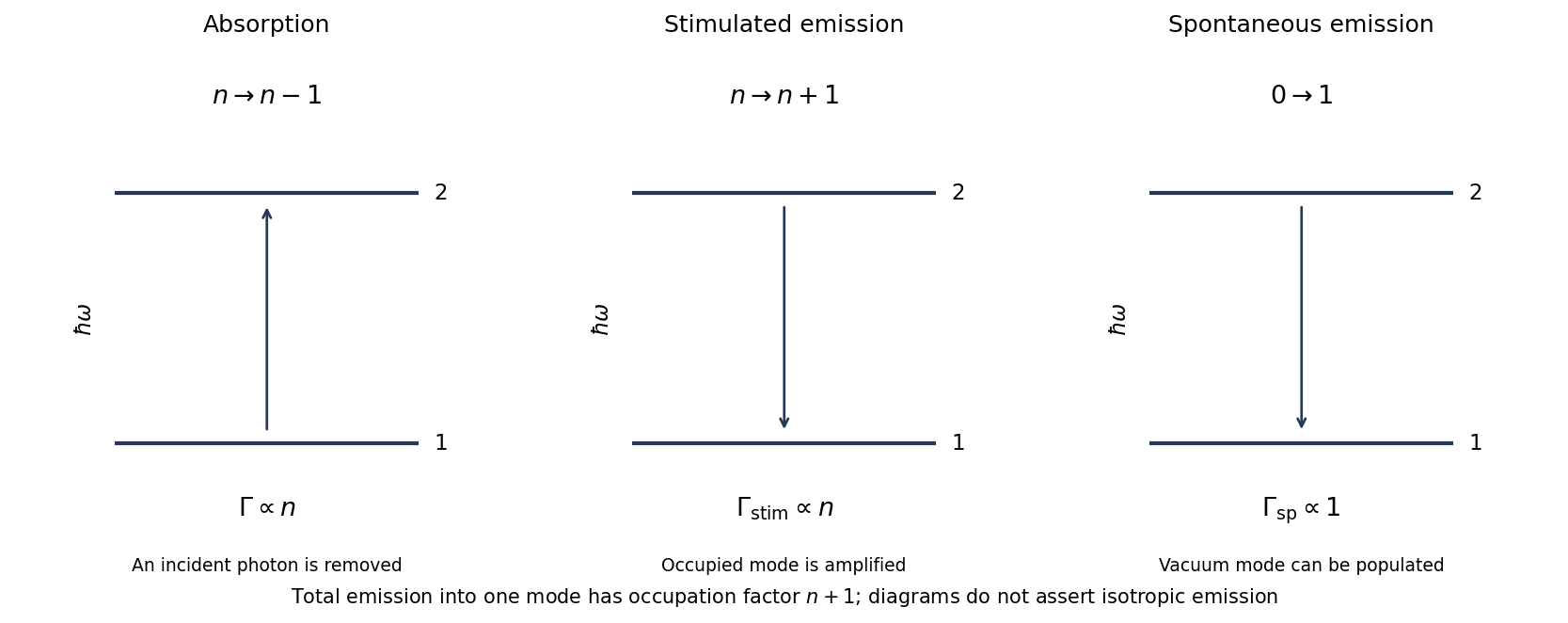
Original two-level transition diagrams and the versus occupation factors for photon absorption and emission
. Details. For lower and upper levels 1 and 2, with radiation spectral energy density per unit ordinary frequency, the rates areThermal detailed balance with the Planck spectrum givesThe statistical weights here are level degeneracies, not Landé g-factors. A definition of multiplying intensity or angular-frequency density would change the normalization factors.
For a specified free-space electric-dipole transition, summing radiation modes givesAppropriate sums over final magnetic substates and averages over initial substates are needed for an unresolved degenerate level. The radiative lifetime is only when this is the sole decay channel. In a laser, net stimulated gain requires , as well as sufficient gain to overcome cavity loss; population inversion alone does not specify the lasing threshold.
Past exam of the advanced quantum physics course of the University of Cambridge 2016 Paper 1 2 a Solution by Codex 0 2026-10-20
Codex 0 2026-10-20The WKB approximation describes a wave whose local wavelength changes slowly compared with one wavelength. For the one-dimensional stationary Schrödinger equation, put . In a classically allowed region,The phase is the classical action divided by . The amplitude varies as so that a single travelling component has constant probability current. A useful local validity condition is .
For , write . The wave instead has growing and decaying components proportional to . At a simple turning point, vanishes and neither local WKB expression is valid. Linearizing the potential gives an Airy-function solution that connects the two sides and supplies the turning-point phase shift. It is not legitimate to carry the divergent WKB amplitude straight through the turning point.[ref]
Topics in Quantum Mechanics by David Tong. §2.2, semiclassical expansion and linear-potential matching
A useful application is tunnelling through a smooth opaque barrier. With turning points , the leading transmission probability isThe exponent is twice the forbidden-region action in units of , because transmission is a probability rather than a wave amplitude. For an ideal rectangular barrier of height and width , the same leading exponential is ; matching at the abrupt edges supplies an additional prefactor.
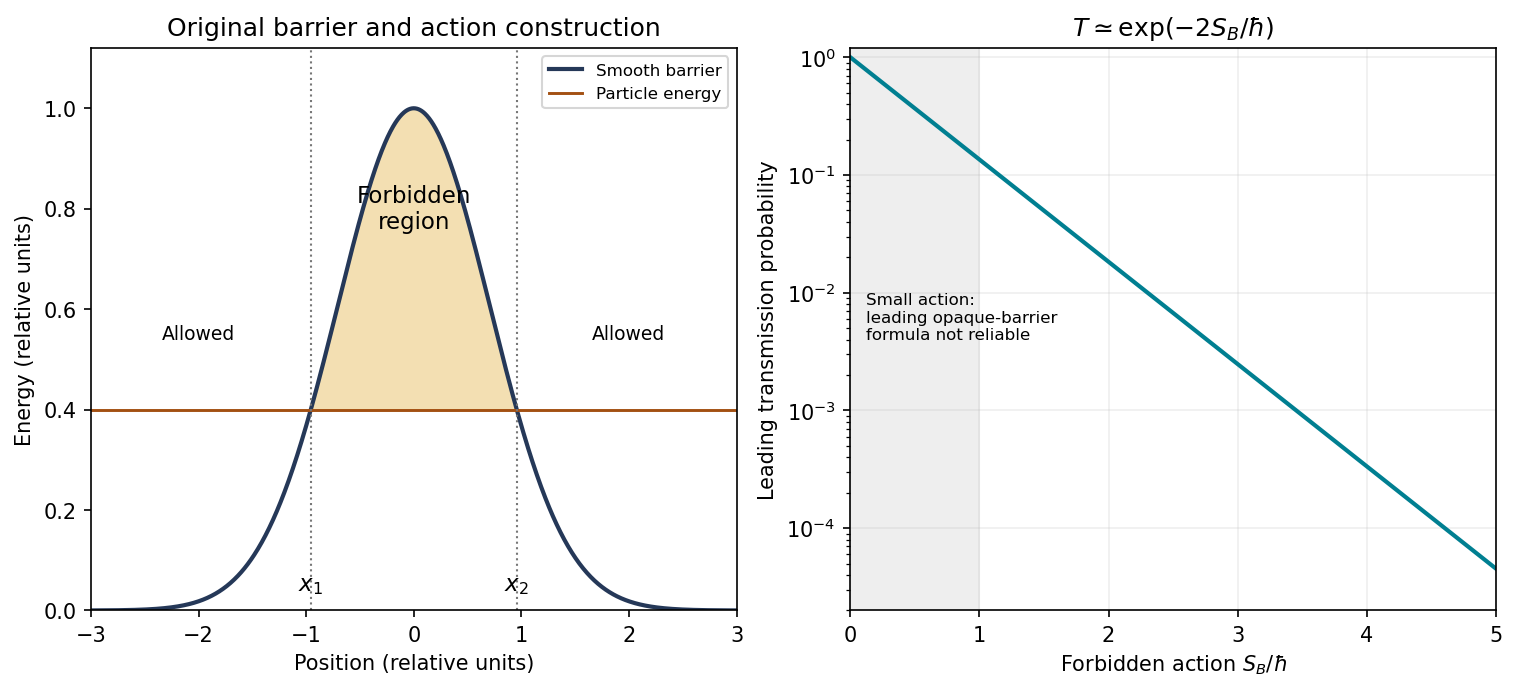
Original smooth-barrier construction and leading WKB transmission exponent; the shaded interval is classically forbidden
. Details. For a bound state between two smooth turning points, the related WKB quantization rule is . In a harmonic potential the integral equals , recovering . This exact agreement of energies for the harmonic oscillator does not make WKB wavefunctions uniformly exact near its turning points.
Pinned article: Introduction to the OurBigBook Project
Welcome to the OurBigBook Project! Our goal is to create the perfect publishing platform for STEM subjects, and get university-level students to write the best free STEM tutorials ever.
Everyone is welcome to create an account and play with the site: ourbigbook.com/go/register. We belive that students themselves can write amazing tutorials, but teachers are welcome too. You can write about anything you want, it doesn't have to be STEM or even educational. Silly test content is very welcome and you won't be penalized in any way. Just keep it legal!
Intro to OurBigBook
. Source. We have two killer features:
- topics: topics group articles by different users with the same title, e.g. here is the topic for the "Fundamental Theorem of Calculus" ourbigbook.com/go/topic/fundamental-theorem-of-calculusArticles of different users are sorted by upvote within each article page. This feature is a bit like:
- a Wikipedia where each user can have their own version of each article
- a Q&A website like Stack Overflow, where multiple people can give their views on a given topic, and the best ones are sorted by upvote. Except you don't need to wait for someone to ask first, and any topic goes, no matter how narrow or broad
This feature makes it possible for readers to find better explanations of any topic created by other writers. And it allows writers to create an explanation in a place that readers might actually find it.
Figure 1. Screenshot of the "Derivative" topic page. View it live at: ourbigbook.com/go/topic/derivativeVideo 2. OurBigBook Web topics demo. Source. - local editing: you can store all your personal knowledge base content locally in a plaintext markup format that can be edited locally and published either:This way you can be sure that even if OurBigBook.com were to go down one day (which we have no plans to do as it is quite cheap to host!), your content will still be perfectly readable as a static site.
- to OurBigBook.com to get awesome multi-user features like topics and likes
- as HTML files to a static website, which you can host yourself for free on many external providers like GitHub Pages, and remain in full control

Figure 2. You can publish local OurBigBook lightweight markup files to either OurBigBook.com or as a static website.
Figure 3. Visual Studio Code extension installation.
Figure 5. . You can also edit articles on the Web editor without installing anything locally. Video 3. Edit locally and publish demo. Source. This shows editing OurBigBook Markup and publishing it using the Visual Studio Code extension. 
- Infinitely deep tables of contents:




All our software is open source and hosted at: github.com/ourbigbook/ourbigbook
Further documentation can be found at: docs.ourbigbook.com
Feel free to reach our to us for any help or suggestions: docs.ourbigbook.com/#contact