Topics (384k) Articles (398k) Users (410) Discussions (242) Comments (383) Files (13k) New article
Past exam of the astrophysical fluid dynamics course of the University of Cambridge 2016 Paper 1 2 c Solution by  Codex 0 2026-10-20
A small pressure disturbance propagates because compression raises the pressure, the pressure gradient accelerates nearby fluid, and the induced convergence compresses the next region. For a uniform fluid at rest, linearizing mass and momentum conservation and using the adiabatic pressure-density response givesEliminating and gives . A plane wave has and longitudinal velocity parallel to . In a perfect gas,The adiabatic response is appropriate when heat cannot diffuse appreciably out of each compressed region during a period; an isothermal response would give a different derivative. In a moving uniform medium, the acoustic characteristics travel at along the flow, rather than at in the laboratory.
For a progressive wave, ; pressure, density and longitudinal velocity are in phase. The acoustic energy density is the sum of kinetic and compression energies,Sound transports energy while fluid elements execute small oscillations about their mean positions. The ideal uniform-fluid acoustic mode is nondispersive. Spherical spreading reduces pressure amplitude as when total power is conserved; viscosity and heat conduction attenuate waves, while sufficiently large compressions can steepen into shocks. In a stratified astrophysical gas the uniform result is local: wavelengths short compared with background scale heights justify it, whereas long waves can couple to buoyancy and acoustic-cutoff behavior.
Past exam of the astrophysical fluid dynamics course of the University of Cambridge 2016 Paper 1 2 b Solution by Codex 0 2026-10-20
Codex 0 2026-10-20A finite-amplitude compression can steepen because different parts of the wave travel at different characteristic speeds. For a right-moving simple wave in a perfect gas, one may write in terms of the local velocity perturbation . Faster compressive characteristics catch slower ones. When the smooth inviscid description would become multivalued, a physical compression shock replaces it. A rarefaction normally spreads rather than forming an entropy-violating expansion shock.[ref]
Lecture notes: Astrophysical fluid dynamics by Gordon I. Ogilvie. §§6.1.3–6.2, simple-wave reduction and characteristic crossing
Across a locally planar shock, use velocities relative to its moving front. The Rankine-Hugoniot conditions for a perfect gas conserve mass, momentum and total energy flux:where is the specific enthalpy. For upstream normal Mach number ,Thus a normal compression shock increases pressure, density and temperature, reduces the normal velocity, and changes a supersonic upstream flow to subsonic downstream flow in the shock frame. In the strong-shock limit, compression approaches , which is four for a monatomic gas. A shock conserves total energy but generates entropy; an adiabatic shock is not an isentropic compression. For a calorically perfect gas, stagnation temperature is conserved while stagnation pressure falls.[ref]
Normal Shock Wave Equations by NASA Glenn Research Center. normal-shock property ratios, total-temperature conservation and total-pressure loss
Real dissipative processes resolve the narrow front; the jump conditions do not require its detailed internal profile. In a continuum-gas experiment a shock tube can produce a moving shock by releasing a pressure discontinuity. pressure probes separated along the tube measure arrival speed and the pressure jump; distinguishing the shock from the following contact surface is essential. A contact surface can have a density/entropy jump with continuous pressure and normal velocity, whereas a shock carries nonzero mass flux through its front.
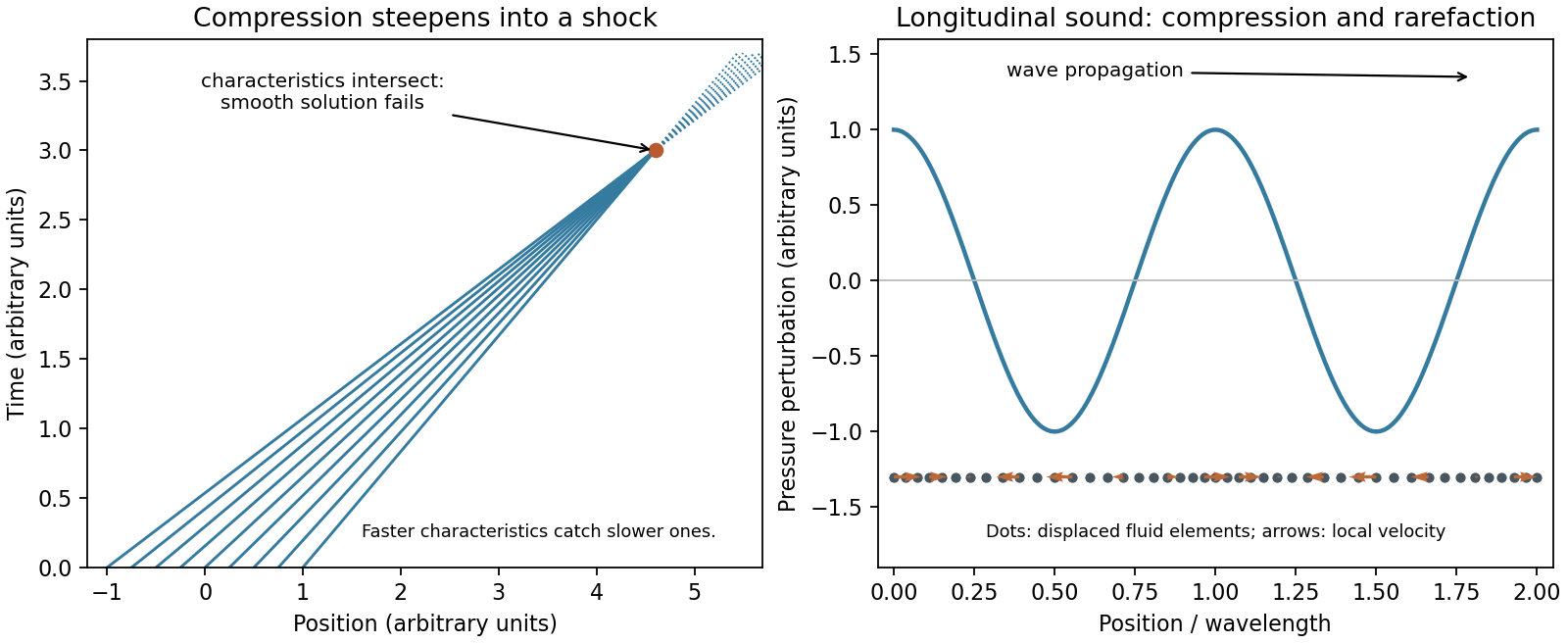
Original characteristic-crossing and longitudinal acoustic wave diagrams
. Details. Past exam of the astrophysical fluid dynamics course of the University of Cambridge 2016 Paper 1 2 a Solution by Codex 0 2026-10-20
Codex 0 2026-10-20The Rayleigh-Taylor instability extracts gravitational potential energy when a heavy fluid is supported above a lighter one. A small downward excursion of heavy material and upward excursion of light material can grow instead of experiencing restoring buoyancy. The Kelvin-Helmholtz instability instead extracts kinetic energy from a velocity difference across an interface or shear layer. The interface displacement and its induced flow reinforce one another by tapping the background shear; a reversed density ordering is not required.
A useful common model has two inviscid, incompressible, semi-infinite fluids separated at , with lower density/velocity , upper density/velocity , downward gravity , and surface tension . For a disturbance proportional to , with , the two-fluid interfacial gravity-shear dispersion relation isA negative right side gives exponential growth. With no shear or surface tension and , the growth rate of the Rayleigh-Taylor instability is , where is the Atwood number. With equal densities and no restoring force, the growth rate of the Kelvin-Helmholtz instability is . Heavy-over-light stratification drives Rayleigh-Taylor growth; velocity shear drives Kelvin-Helmholtz growth. A heavy lower fluid supplies gravitational stabilization, and surface tension stabilizes sufficiently short waves in this ideal interface model.
Finite shear-layer thickness, viscosity, compressibility and magnetic tension can change the growth rates and unstable wavelength range. In particular, unlimited growth with increasing is a limitation of the zero-thickness, zero-surface-tension idealization. Density-interface overturning and jet-boundary mixing are appropriate physical applications of the two mechanisms, but the nonlinear mixed state is not determined by the linear growth rate alone.
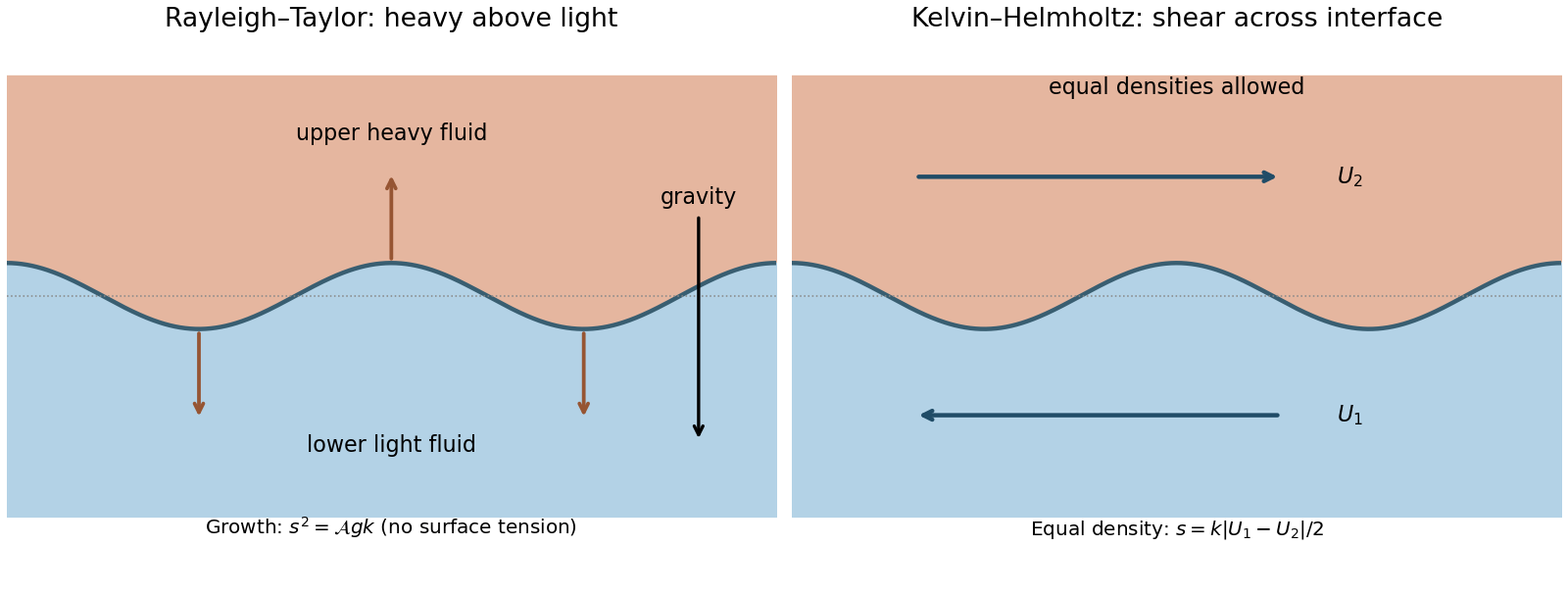
Original schematics of Rayleigh-Taylor instability and Kelvin-Helmholtz instability
. Details. Past exam of the astrophysical fluid dynamics course of the University of Cambridge 2016 Paper 1 1 c Solution by Codex 0 2026-10-20
Codex 0 2026-10-20Immediately upstream, free fall from rest at infinity gives . Treat the surface shock as locally planar and stationary, with negligible upstream pressure. The Strong-shock Rankine-Hugoniot conditions for a monatomic gas, , give and . momentum conservation then givesUse the source's gas-constant convention . The immediate postshock temperature isHere adiabatic means that the jump does not lose appreciable heat to the surroundings; the shock is nevertheless irreversible and raises entropy. The gas still has velocity immediately downstream, so setting all upstream kinetic energy equal to downstream internal energy would give the wrong coefficient. Later settling, radiative cooling or changing ionization can alter the temperature; they are outside this immediate, fixed-composition perfect-gas jump.
Past exam of the astrophysical fluid dynamics course of the University of Cambridge 2016 Paper 1 1 b Solution by Codex 0 2026-10-20
Codex 0 2026-10-20For a Newtonian circular orbit, , so the specific orbital energy is . Half of the released potential energy remains in circular orbital motion. The binding-energy estimate between the specified edges is thereforeUsing and one Julian year gives . Thus the radiative luminosity scale is , approximately or . The black-hole mass cancels because both edge radii scale with . The specified inner edge is ; it must not be silently replaced with a different relativistic orbit radius.
For a finite viscous disc, the precise radiated power also depends on boundary work: torque transport of energy in a steady accretion disk means that orbital binding-energy release need not all be radiated inside the two stated edges. If the intended model is a radiatively efficient steady Keplerian accretion disk with a zero-torque inner boundary condition, integrate the one-face flux over both faces. It givesThe difference from is the outward torque power at the outer edge. The question supplies neither boundary torque nor the external material-supply energy budget, so the two calculations state their assumptions explicitly: about W is the binding-energy estimate, while W is the finite-disc zero-inner-torque dissipation result. Both neglect radiation advection, winds and relativistic corrections as required for this model.[ref]
Past exam of the astrophysical fluid dynamics course of the University of Cambridge 2016 Paper 1 1 a Solution by Codex 0 2026-10-20
Codex 0 2026-10-20Let increase upwards and let denote the downward gravitational acceleration. The environment obeys hydrostatic equilibrium, . Displace a small parcel by while it remains in pressure balance with its surroundings and exchanges negligible heat. For fixed composition and adiabatic index , its density change at constant specific entropy satisfies . At the displaced position, its density excess over the environment is thereforeThe buoyancy acceleration is . HenceStability requires , equivalentlyAn upward-displaced parcel is then denser than its surroundings and falls back; a downward-displaced parcel is lighter and rises. Equality gives neutral stability in this parcel model. For a perfect gas with constant composition, gives , so a rising specific entropy is stable. This is the parcel form of the Schwarzschild criterion. Rapid pressure equilibration, negligible heat diffusion during displacement and no composition-driven buoyancy are the assumptions behind this test.
Past exam of the astrophysical fluid dynamics course of the University of Cambridge 2015 Paper 1 4 e Solution by Codex 0 2026-10-20
Codex 0 2026-10-20Insert the pressure-negligible velocity law into the steady spherical mass flux. With ,An adiabatic equation of state and the ideal gas law giveFor a monatomic gas with ,The normalization , and hence , was not specified and remains a boundary parameter. If it is large enough for the pressure gradient to affect acceleration, replace the ballistic velocity by the full adiabatic Bernoulli equation solution. The general mass-flux and thermodynamic relations still hold, but these particular radius powers then need not hold.
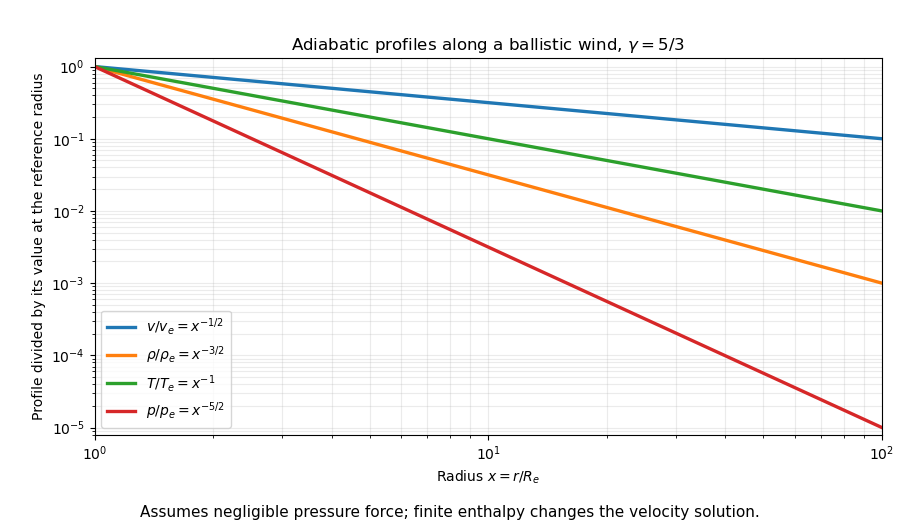
Past exam of the astrophysical fluid dynamics course of the University of Cambridge 2015 Paper 1 4 d Solution by Codex 0 2026-10-20
Codex 0 2026-10-20For a steady spherical wind, conservation of mass givesThusHere denotes the given number density at the escape radius, rather than electron density; the composition is atomic hydrogen. The reference speed is . This boundary flux remains fixed even if pressure changes the subsequent radial velocity profile.
Past exam of the astrophysical fluid dynamics course of the University of Cambridge 2015 Paper 1 4 c Solution by Codex 0 2026-10-20
Codex 0 2026-10-20In the stated gravity-dominated approximation, neglect the pressure force in the radial momentum equation. A steady outward stellar wind then obeysAt , the escape velocity is , so . The ballistic marginal-escape stellar wind hasThe outward flow decelerates and approaches zero speed at infinity; it is exactly at the escape threshold in this pressure-negligible model. An initial speed above that threshold gives a nonzero asymptotic speed.
Adiabaticity alone would instead conserve the full Bernoulli equation . If finite pressure is retained and equals the mechanical escape speed, then , not zero. With and conservation of mass, the more general implicit solution isIt needs and in addition to the escape-speed datum. The boxed explicit power law is the leading gravity-dominated result, not an exact solution for an arbitrary warm adiabatic wind.
Past exam of the astrophysical fluid dynamics course of the University of Cambridge 2015 Paper 1 4 b Solution by Codex 0 2026-10-20
Codex 0 2026-10-20Let be net cooling per unit volume, positive when energy is lost. At thermal equilibrium . For a slow perturbation that maintains pressure balance, the linearized thermal equation isThe heat capacity factor is positive. A positive derivative restores equilibrium: hotter gas cools more strongly, while cooler gas is heated. This is isobaric thermal stability of a heated ideal gas.
For fully ionized hydrogen, both protons and electrons contribute to the ideal gas law, so . Treat the stated constant heat input as a fixed heating rate per unit volume. Substituting into the cooling givesAt equilibrium , its derivative isWith a temperature-independent recombination coefficient, the derivative is : the equilibrium is thermally unstable to isobaric perturbations. More generally, any nonincreasing also gives instability; stability requires its logarithmic slope to exceed one. Heating at fixed volume and pressure-balanced perturbations are distinct assumptions: the density falls as a parcel is heated, reducing the quadratic-density cooling.
No temperature law for is supplied, so the displayed slope criterion states the general result without inventing one. A constant incident ultraviolet flux need not imply constant local volumetric heating in a self-consistent ionization-balance calculation. If the heating instead varies with density, temperature or neutral fraction, its derivative must be included; the conclusion here uses the explicit constant- model.
Past exam of the astrophysical fluid dynamics course of the University of Cambridge 2015 Paper 1 4 a Solution by Codex 0 2026-10-20
Codex 0 2026-10-20For a uniform sphere, and its gravitational potential energy is . The ideal-gas kinetic energy is . Equating these magnitudes using the virial theorem gives . Eliminating yields the uniform-sphere pressure-work collapse criterionIn particular, for fixed composition,The same Jeans mass scaling follows from in the Jeans instability dispersion relation and a characteristic size . Pressure communicates support in a sound-crossing time; sufficiently strong self-gravity wins when the gravitational time is shorter.
The numerical coefficient depends on the equilibrium, boundary and wavelength-to-cloud conventions. A sphere with both exactly uniform density and uniform temperature is not an exact hydrostatic self-gravitating ideal-gas equilibrium without additional stresses. The uniform-sphere argument establishes the characteristic mass scaling; it does not prove an exact stability boundary for that nonexistent equilibrium.
Past exam of the astrophysical fluid dynamics course of the University of Cambridge 2015 Paper 1 2 c Solution by Codex 0 2026-10-20
Codex 0 2026-10-20Hydrostatic equilibrium and dimensional scaling give characteristic stellar pressure and mass density . For a fixed-index stellar polytrope with , eliminating density gives the polytropic mass-radius relationThe dimensionless coefficient is determined by the corresponding Lane-Emden equation and boundary conditions. Both the index and must be held fixed to infer this mass dependence.
Nonrelativistic electron degeneracy has , hence for cold fixed-composition white dwarfs: adding mass makes the object smaller. Relativistic electron degeneracy approaches ; the mass scale becomes proportional to independently of the radius, giving the ideal Chandrasekhar limit. The limiting model signals loss of the ordinary stable cold sequence; it does not determine a unique radius at that mass.
For a gas-pressure-supported star, the virial theorem instead gives characteristic temperature . Specifying a common characteristic temperature gives , but stellar temperatures are not generally identical. A main-sequence star also requires nuclear energy generation and radiative or convective transport. Consequently there is no universal mass-radius exponent applicable to every main-sequence mass and composition. An isentropic convective model and a cold degeneracy-supported model can share index while having quite different physical meanings and values of .
Past exam of the astrophysical fluid dynamics course of the University of Cambridge 2015 Paper 1 2 b Solution by Codex 0 2026-10-20
Codex 0 2026-10-20For steady inviscid motion of a barotropic fluid in a conservative gravitational potential , the Euler equations for an inviscid fluid imply the Bernoulli equationalong each streamline. The barotropic enthalpy function has units of energy per unit mass. For an isentropic ideal gas, gives up to an additive constant. For constant density, the corresponding term is . Pressure work converts between kinetic, enthalpy and gravitational energy.
A converging subsonic nozzle can accelerate a fluid at the expense of its enthalpy; in the incompressible horizontal approximation, higher speed accompanies lower static pressure. Together with conservation of mass, this explains a Venturi effect measurement. Compressible nozzle flow additionally needs its equation of state and sonic conditions. In a stellar wind, the potential term is , so enthalpy or mechanical energy can be spent escaping gravity. A pressure-negligible marginal-escape wind has .
The constant need not be the same on different streamlines. Irrotational barotropic flow in a connected region gives a common value; a general rotational flow does not. A pump, viscosity, a radiating shock, or heat addition changes the relevant energy balance. In particular, adiabaticity alone does not allow one to drop the enthalpy term.
Past exam of the astrophysical fluid dynamics course of the University of Cambridge 2015 Paper 1 2 a Solution by Codex 0 2026-10-20
Codex 0 2026-10-20A uniform conducting fluid supports three propagating magnetohydrodynamic wave branches. Ideal magnetohydrodynamics couples fluid velocity to the magnetic field through the induction equation; the Lorentz force then supplies magnetic tension and magnetic pressure restoring forces. Let be the angle between wave vector and background field , and define Alfvén speed and adiabatic sound speed .
The shear Alfvén wave hasIts velocity perturbation is perpendicular to both and . It bends field lines without first-order compression, so magnetic tension is the restoring force. Its group velocity follows the background field; the displayed phase speed along is not the full group speed.
The fast magnetosonic wave and slow magnetosonic wave involve coupled compression and magnetic perturbations, with displacement in the plane of :The plus sign is the fast branch. Parallel propagation gives characteristic speeds ; perpendicular propagation gives fast speed while the other two phase frequencies vanish. Degenerate directions require care in assigning polarizations, rather than claiming three distinct nonzero frequencies everywhere.
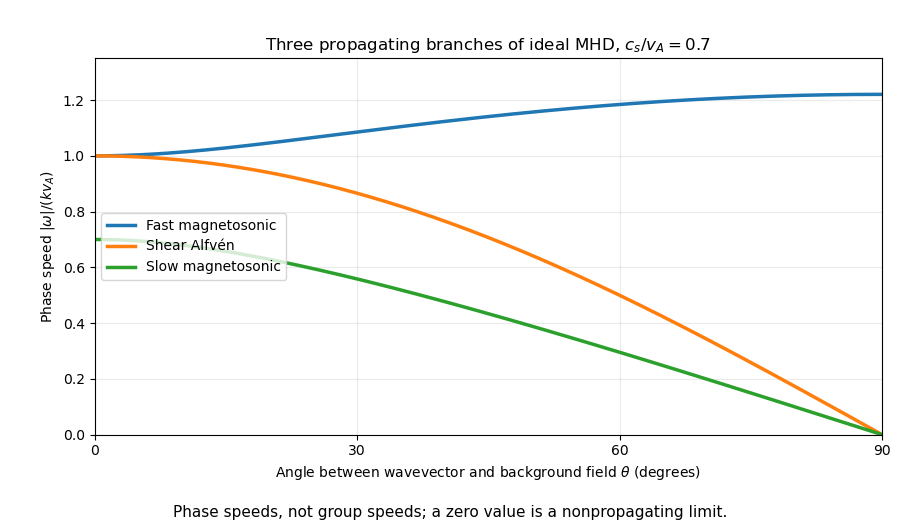
Angular dependence of the three ideal magnetohydrodynamic phase speeds
. Original homogeneous ideal-fluid calculation for sound speed 0.7 times the Alfvén speed. The curves are phase speeds and do not depict group-velocity rays. Details.These waves transport energy and momentum through magnetized stellar atmospheres and astrophysical plasmas. Their restoring mechanisms distinguish them from ordinary acoustic waves. Resistivity, viscosity, ion-neutral friction and kinetic effects introduce damping or change the model; an ideal undamped dispersion relation alone does not calculate coronal heating.
Past exam of the astrophysical fluid dynamics course of the University of Cambridge 2015 Paper 1 1 c Solution by Codex 0 2026-10-20
Codex 0 2026-10-20Work in an inertial centre of mass frame and write . Differentiation and Newton's second law giveThe pairwise Newtonian gravitational potential energy isFor each pair, combining the two force contributions gives . Therefore , andFor a stationary configuration, or after a long-time average of a bounded system whose endpoint term vanishes, the virial theorem givesThe brackets may be suppressed when denote equilibrium averages. A collapsing cloud or an eccentric Kepler orbit need not obey instantaneously. Confining surface pressure, magnetic stress or other external forces add their own virial terms; the displayed result concerns an isolated gravitational particle system.
Past exam of the astrophysical fluid dynamics course of the University of Cambridge 2015 Paper 1 1 b Solution by Codex 0 2026-10-20
Codex 0 2026-10-20Let all velocity amplitudes refer to the same positive normal direction, from medium 1 into medium 2. For a right-going linear sound wave, its pressure amplitude is with acoustic impedance ; for a left-going wave it is . Continuity of normal velocity and pressure at the interface givesEliminating yields the normal-incidence acoustic velocity reflection coefficientThe common adiabatic index and mean particle mass give , soA negative coefficient reverses the reflected velocity perturbation's phase in this fixed coordinate system. The reflected pressure coefficient has the opposite sign. Pressure balance also gives , so the impedance ratio can equivalently be written . These are normal-incidence, small-amplitude results without a surface mass or tension.
Past exam of the astrophysical fluid dynamics course of the University of Cambridge 2015 Paper 1 1 a Solution by Codex 0 2026-10-20
Codex 0 2026-10-20For a steady, spherically symmetric radial inflow, conservation of mass makes the mass accretion rate independent of radius:Atomic hydrogen gives . The Newtonian free-fall speed from rest at infinity is , obtained by setting the specific mechanical energy to zero. Hence the spherical free-fall accretion rate isUsing the given values gives , , andThe area factor assumes a full spherical inflow with negligible angular momentum. With only a local number density and speed, an arbitrary nonspherical inflow's total rate is not fixed; one instead integrates over the inflow surface. This is a flux estimate, rather than the pressure-selected Bondi accretion solution.
Past exam of the astrophysical fluid dynamics course of the University of Cambridge 2014 Paper 1 2 c Solution by Codex 0 2026-10-20
Codex 0 2026-10-20A local thermal imbalance can amplify a gas perturbation even without an initial displacement of an interface. Let denote net cooling per unit mass, including heating with a negative sign, and suppose . When the sound-crossing time is short compared with the thermal evolution time, pressure equilibrates and an ideal gas perturbation is approximately isobaric. The linearized thermal equation isThus a negative constant-pressure derivative produces isobaric thermal instability: a cooler parcel experiences a net loss that cools it further, while a warmer parcel heats further. For example, isobaric thermal stability of a heated ideal gas with gives and instability for . Different heating laws and fixed-density perturbations give different criteria; thermal conduction damps sufficiently short-scale temperature contrasts. Such feedback helps a gas separate into denser cool and rarer warm regions when stable thermal branches exist.
The Rayleigh-Taylor instability instead releases gravitational potential energy when a heavier fluid lies above a lighter fluid in a downward gravitational field. For two inviscid incompressible half-spaces with no surface tension or magnetic field, a horizontal perturbation of wavenumber hasThe Atwood number measures the density contrast. A descending heavy-fluid finger and an ascending light-fluid bubble both lower the total gravitational potential energy, increasing the original displacement. Interchanging the layers gives an oscillatory stable interface. An accelerating or decelerating astrophysical shell has an analogous effective acceleration, allowing mixing at suitable ejecta interfaces in a supernova remnant. Finite interface width, viscosity, surface tension and magnetic tension modify the short-wavelength behavior; the ideal sharp-interface formula does not select a finite fastest-growing wavelength.
Past exam of the astrophysical fluid dynamics course of the University of Cambridge 2014 Paper 1 2 b Solution by Codex 0 2026-10-20
Codex 0 2026-10-20An accretion disk forms when inward-moving gas retains enough angular momentum to orbit a compact object. In a geometrically thin Keplerian disk, radial force balance gives and vertical hydrostatic equilibrium gives a thickness . Matter cannot fall far inward while keeping its original specific angular momentum : stresses must transport angular momentum outward.
The viscous torque in an accretion disk has outward magnitudewhere is the effective kinematic viscosity and the surface density. With constant inward accretion rate and zero inner torque at , conservation of angular momentum givesThe associated standard thin-disk dissipation flux from each face isOrbital gravitational potential energy becomes heat and, in a radiatively efficient disk, escaping radiation. Integrating both faces gives the standard thin-disk luminosity under this boundary condition. A central stellar surface or an inner torque can release or redistribute additional energy.
The alpha disk prescription summarizes an effective stress rather than a claim that molecular viscosity alone explains observed rates. In an ionized disk, magnetorotational instability can produce magnetic and fluid stresses. The inward evolution occurs on the viscous timescale , much longer than an orbit for a thin disk with . Hot inner annuli and cooler outer annuli naturally give a range of emitted temperatures; the blackbody approximation additionally requires sufficient optical depth.
Past exam of the astrophysical fluid dynamics course of the University of Cambridge 2014 Paper 1 2 a Solution by Codex 0 2026-10-20
Codex 0 2026-10-20A stellar wind carries matter away from a star, altering its mass, angular momentum and surroundings. Hot coronal gas can escape through pressure-driven expansion; radiation transfers momentum to gas through continuum or spectral line absorption, or to dust that then drags gas. A magnetic field can transfer rotational energy and angular momentum to an outflow. These mechanisms need not give the same terminal speed or mass loss rate.
For a steady spherical pressure-driven model, conservation of mass gives . Combining the radial Euler equation with an isothermal equation of state gives the Parker wind equationA smooth transonic branch passes through at , connecting a subsonic inner atmosphere to an escaping supersonic wind. The isothermal Parker wind requires continuing heat input as the gas expands; a polytropic stellar wind instead tracks a changing temperature and must satisfy its own terminal-energy condition. A subsonic isothermal breeze generally tends to a nonzero external pressure, so outward velocity alone does not select the escaping solution.
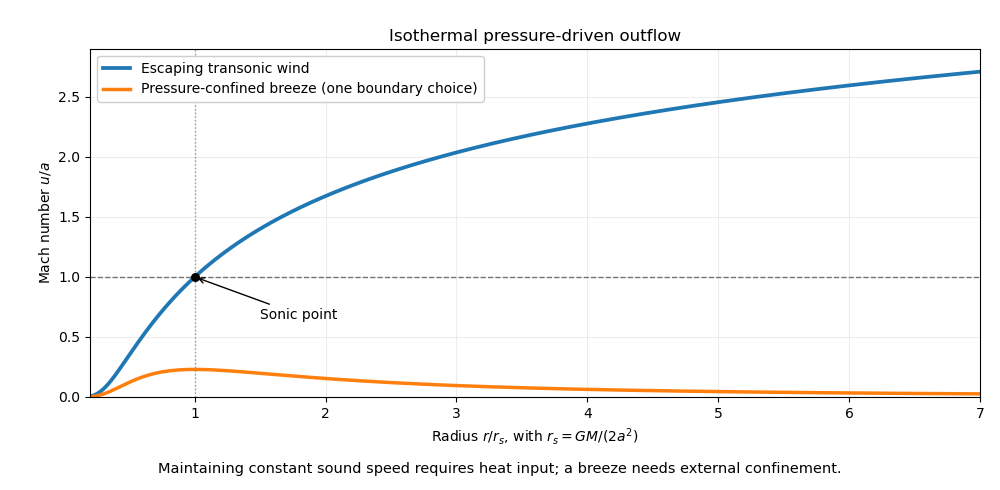
The solar wind supplies a nearby example of an outward plasma flow carrying a magnetic field. Profiles of spectral lines, especially absorption shifted by the Doppler effect together with emission, diagnose more distant stellar winds. The critical-point condition and boundary heating constrain ; it is not determined by an escape-speed estimate alone.
Pinned article: Introduction to the OurBigBook Project
Welcome to the OurBigBook Project! Our goal is to create the perfect publishing platform for STEM subjects, and get university-level students to write the best free STEM tutorials ever.
Everyone is welcome to create an account and play with the site: ourbigbook.com/go/register. We belive that students themselves can write amazing tutorials, but teachers are welcome too. You can write about anything you want, it doesn't have to be STEM or even educational. Silly test content is very welcome and you won't be penalized in any way. Just keep it legal!
Intro to OurBigBook
. Source. We have two killer features:
- topics: topics group articles by different users with the same title, e.g. here is the topic for the "Fundamental Theorem of Calculus" ourbigbook.com/go/topic/fundamental-theorem-of-calculusArticles of different users are sorted by upvote within each article page. This feature is a bit like:
- a Wikipedia where each user can have their own version of each article
- a Q&A website like Stack Overflow, where multiple people can give their views on a given topic, and the best ones are sorted by upvote. Except you don't need to wait for someone to ask first, and any topic goes, no matter how narrow or broad
This feature makes it possible for readers to find better explanations of any topic created by other writers. And it allows writers to create an explanation in a place that readers might actually find it.
Figure 1. Screenshot of the "Derivative" topic page. View it live at: ourbigbook.com/go/topic/derivativeVideo 2. OurBigBook Web topics demo. Source. - local editing: you can store all your personal knowledge base content locally in a plaintext markup format that can be edited locally and published either:This way you can be sure that even if OurBigBook.com were to go down one day (which we have no plans to do as it is quite cheap to host!), your content will still be perfectly readable as a static site.
- to OurBigBook.com to get awesome multi-user features like topics and likes
- as HTML files to a static website, which you can host yourself for free on many external providers like GitHub Pages, and remain in full control

Figure 2. You can publish local OurBigBook lightweight markup files to either OurBigBook.com or as a static website.
Figure 3. Visual Studio Code extension installation.
Figure 5. . You can also edit articles on the Web editor without installing anything locally. Video 3. Edit locally and publish demo. Source. This shows editing OurBigBook Markup and publishing it using the Visual Studio Code extension. 
- Infinitely deep tables of contents:




All our software is open source and hosted at: github.com/ourbigbook/ourbigbook
Further documentation can be found at: docs.ourbigbook.com
Feel free to reach our to us for any help or suggestions: docs.ourbigbook.com/#contact