Topics (384k) Articles (398k) Users (410) Discussions (242) Comments (383) Files (13k) New article
Let a group action of on a set be given, and let a function attach a colour label to each point. The colour-preserving subgroup of isIt is a subgroup: the identity map preserves all labels, compositions of two preserving maps preserve them, and replacing by shows that inverse maps preserve them too. Extra object data restrict the allowable transformations; the labels are now part of the object rather than bookkeeping for a drawing.
For a geometric square, take , of group order eight. If all four vertices have the same colour, all eight maps remain. If two adjacent vertices are red and the others blue, only the identity and one reflection remain. Putting the two red vertices opposite one another instead leaves four maps: the identity, a half-turn rotation, and the two diagonal reflections. Giving all four vertices distinct colours leaves only the identity.
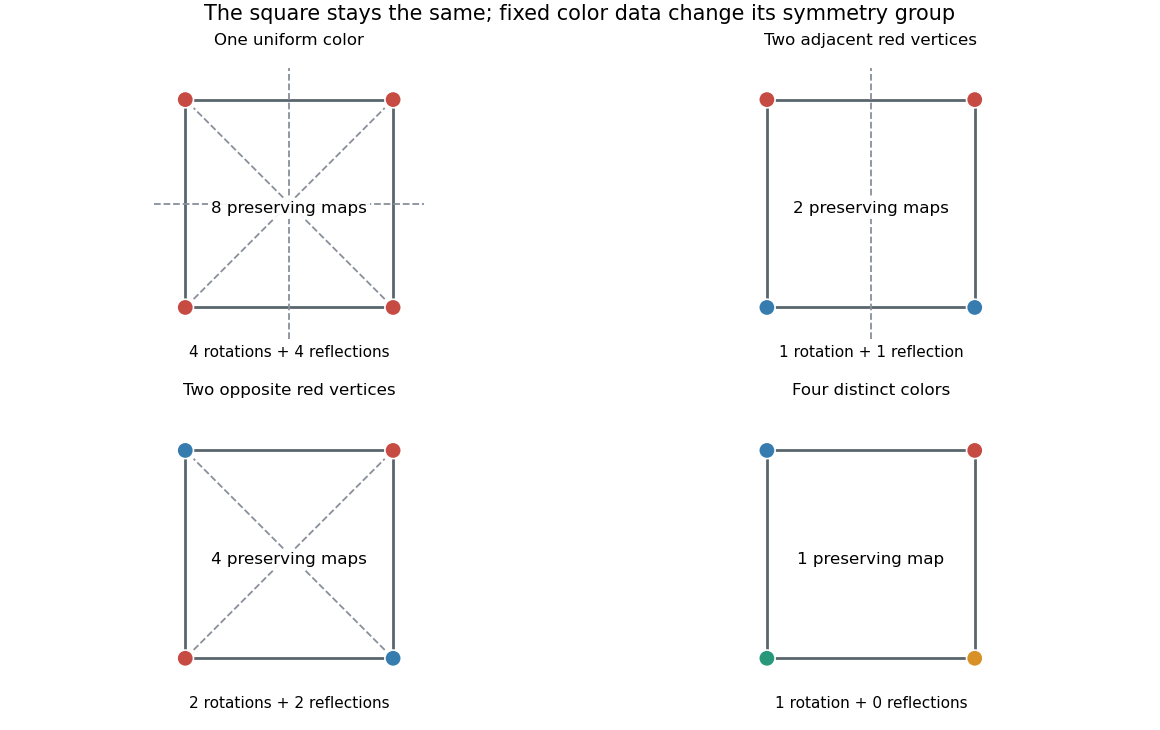
Fixed vertex colours restrict the geometric symmetry group
. Original computed examples. Counts refer to Euclidean motions of the square that preserve each vertex colour. Two adjacent red vertices and two opposite red vertices have the same colour counts but different symmetry groups. Dashed lines show surviving reflection axes; the rotation labels count surviving rotations including the identity. Details.The count alone does not specify the pattern. Both two-red examples have the same number of red and blue vertices, but their stabilizer subgroups differ. For a single red vertex, the orbit-stabilizer theorem gives a group orbit of size four and a stabilizer subgroup of group order two, agreeing with the existing group action illustration. Such counts identify equivalent placements without treating each placement as a new geometric case.
Take the four-point setthe vertices of a polygon of a rectangle whose side lengths are four and two. Three choices of structure give three different symmetry groups on these same points.
As an unstructured set, has all permutations as symmetries, forming the symmetric group . If Euclidean distance is part of the data, the allowed maps are only the identity, a half-turn rotation, and the reflections across the two coordinate axes. They form a Klein four-group of group order four. To see that nothing is missing, fix the image of one vertex of a polygon: its three other distances, , , and , are distinct, so they uniquely determine the images of the remaining vertices.
Preserving affine structure permits more. The affine mapcycles all four points of . It sends a horizontal side of length four to a vertical side of length two, so it is not an isometry. Yet it preserves the rectangle's vertex set and all affine combinations among those points.
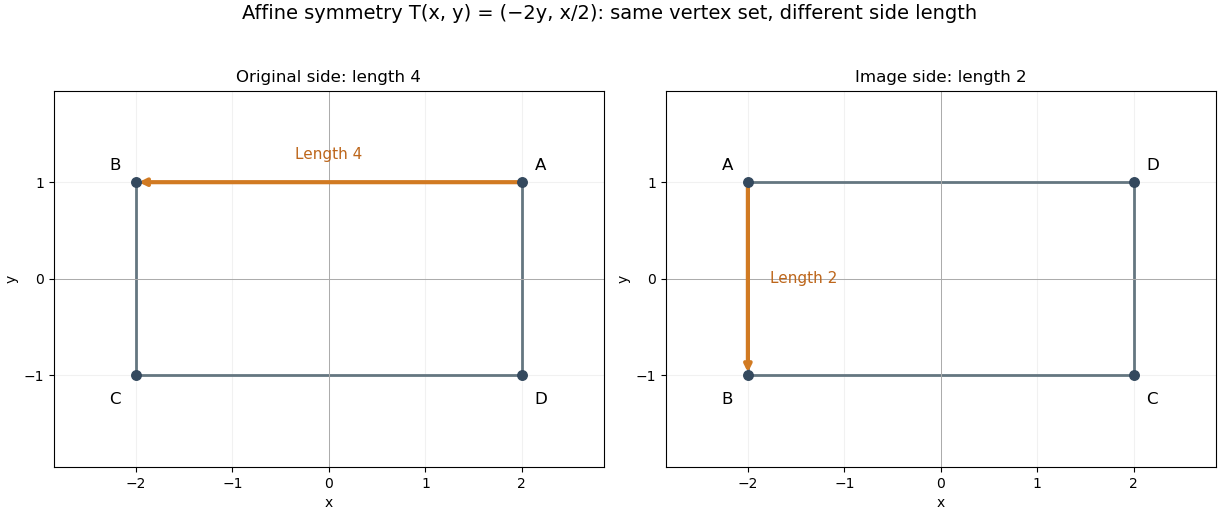
Let and let be the square's quarter-turn rotation. ThenConjugating every square symmetry by gives eight affine maps preserving . This group isomorphism makes the affine symmetry group a dihedral group, although some of its maps do not preserve the original Euclidean distances. There are no further affine symmetries: an affine map preserves the common midpoint of the diagonals, so it must preserve opposite pairs. The image of one vertex has four choices and the image of an adjacent vertex has two; those choices determine the map through three noncollinear points.
ThusAn arbitrary permutation need not be an affine map. For example, exchanging the two top vertices while fixing the two bottom vertices sends the common diagonal midpoint to two different points, which no single affine map can do. The phrase "the symmetry of these points" becomes unambiguous only after stating which structure matters.
A symmetry transformation is a bijection preserving the data that define the object's symmetry group. Its individual group elements are symmetry transformations; the group operation combines them by function composition.
For indentation , the common layer displacement is . The boundary layer stream function gives velocity and pressure . Substitution into the Prandtl boundary-layer equation yields the displayed equation, with and . This is a conditional similarity construction: the constant must permit a solution of the boundary value problem.
The symmetric closure of a binary relation is , where means . Every symmetric relation containing contains all these reversed pairs, proving minimality.
Consider the branch return mapwith , , and nonzero return coordinates. After one iterate, . On these two sign sheets, define . Then and , givingThis scalar equation describes the signed gluing-map reduction.
A negative scalar fixed point has , so and the next is unchanged. The two sign choices therefore lift it to two symmetry-related fixed points of the original return map. A positive scalar fixed point instead has ; both and change sign on each step, giving one period-two orbit.
The value zero needs separate interpretation. In the underlying homoclinic orbit model it is the separatrix limit, where the flow's return time diverges. A formal continuous extension of the scalar formula at zero does not supply an ordinary finite-period periodic orbit. All branch iterations used to model finite flow returns must remain in the valid nonzero local domain.
For a symmetric real saddle with one unstable direction and a strongly contracting transverse direction, composing the power-law local passage with a smooth global return gives this leading Poincaré return map, with and saddle index . It is undefined at the stable-manifold crossing . For , small fixed points on each branch are attracting for ; for an attracting alternating-sign period-two orbit satisfies , giving gluing of two one-lobe flow cycles into one two-lobe cycle. For and small , on , , the inverse branchesmap into and contract. Infinite branch choices define an invariant Cantor set with full two-symbol dynamics. In the two-dimensional return, transverse contraction turns this mechanism into a Smale horseshoe. An attracting Lorenz set additionally requires appropriate trapping and global-return properties.
A subgroup of the symmetric group of a set, acting faithfully by permutations. A finite permutation group specified by generators can be enumerated by repeatedly multiplying the elements already found by those generators until no new element appears. Its orbits and conjugacy classes can then be computed directly.
An automorphism preserving the transposition class is inner: commuting relations recover the vertex stars of the complete graph, with a small-case adjustment in degrees three and four. An involution class has the same size as the transposition class only in degree six, when triple transpositions also have size fifteen. Hence outer automorphism groups of symmetric groups are trivial outside degree six and have size at most two in degree six.
// Target: combinatorics.bigb
Two sets differ by finite symmetric difference when only finitely many points belong to exactly one of them. This is an equivalence relation, since .
For a field of characteristic different from two, the Witt group classifies nondegenerate symmetric bilinear forms after hyperbolic parts are discarded. Two forms represent the same class if adding suitable hyperbolic planes of a quadratic form makes them isometric. The group operation is orthogonal direct sum.
A metabolic bilinear form has a totally isotropic subspace of half its dimension. In this characteristic it is a sum of hyperbolic planes of a quadratic form and represents zero. The inverse element of the equivalence class of is represented by : in , the vectors form such a half-dimensional totally isotropic subspace.
Over the real numbers, Sylvester's law of inertia reduces a nonsingular form to positive squares and negative squares. A positive-negative pair is a hyperbolic plane of a quadratic form, so cancelling pairs leaves exactly the signature . Conversely, equal signatures leave the same remainder. Thusunder the signature. This records how much definite form remains after all positive-negative cancellation.[ref]
Over the complex numbers, every nonzero diagonal coefficient can be rescaled to one, since it has a square root. Two unit squares already form a hyperbolic plane of a quadratic form, using the independent isotropic vectors and . Pairs therefore cancel, and only the parity of the dimension remains:Odd dimension cannot disappear, because adjoining a hyperbolic plane of a quadratic form changes dimension by two. These are symmetric bilinear forms over the complex numbers, rather than Hermitian forms; confusing the two would give a different classification.[ref]
Bilinear Forms over a Field by Charles Weibel. Printed p. 2: diagonal classification over an algebraically closed field; the parity calculation is derived here
On real by matrices with , split into traceless symmetric matrices, skew-symmetric matrices and scalar matrices. These summands are orthogonal for the displayed symmetric bilinear form. The form is positive on the first summand, negative on the second and negative on the scalar identity direction. Its inertia of a bilinear form is , its rank is and its signature is . Indeed , and .
For a finite-dimensional symmetric algebra over any field, an indecomposable projective module has isomorphic simple head of a module and socle. A symmetrizing functional pairs with nondegenerately, identifying with the left dual module . Taking its socle gives . This dual of the right simple top and the left simple top belong to the same matrix block of the semisimple algebra , so they are isomorphic. The result does not require an algebraically closed ground field.
The Sylow theorems give either one or eight Sylow subgroups of order seven. In the first case that subgroup is normal. In the second, their six nonidentity elements are pairwise disjoint, accounting for 48 elements. Only eight elements remain, including the identity, and every Sylow subgroup of order eight lies entirely among them. Thus there is exactly one, and it is a normal subgroup.
Let with . The coefficient of in is modulo , because over the field of elements. Thus the number of subsets of size is not divisible by . Left translation of on those subsets has an orbit of index prime to . Its stabilizer acts freely on its subset, so its order divides , while its prime-to- index forces its order to be . This proves existence of a Sylow subgroup without an induction using Cauchy's theorem.
A Sylow basis consists of one Sylow subgroup for each prime dividing the group order, with any two of them permutable as subgroups. Permutable means , not elementwise commutation. Their product over any subset of primes is a Hall subgroup. Every finite soluble group has such a basis, and all bases are simultaneously conjugate. Induction over an elementary abelian minimal normal subgroup proves these facts using coprime splitting over an elementary abelian normal subgroup: lift the other-prime quotient basis into a complement, and lift the characteristic-prime Sylow subgroup by taking its full preimage.
In the mildly subcritical Swift–Hohenberg equation, set , and . The nonlinear and growth terms first balance at order , so . Quadratic detuning of the critical Fourier growth rate gives . At order , projection onto the kernel of the self-adjoint fast operator requires the resonant forcing to vanish. The cubic and quintic resonances have coefficients and , while the operator expansion gives . Thus .
Consider a long-wave film-rupture model whose strong-Marangoni stress asymptotic growth law isHere is the base film thickness, is dynamic viscosity, is the base surface tension, is the model's destabilizing interaction coefficient with dimensions of energy, and is dimensionless wavenumber. The precise relation of to a microscopic interaction depends on the chosen film model.
Set . Differentiating gives , so the unique unstable-band maximum isThe second derivative is negative. Since , the selected is consistent with the long-wave assumption. The growth timescale is not itself a rupture time or bubble lifetime: a perturbation starting at amplitude must grow to a specified nonlinear scale, giving an additional logarithmic dependence on the initial disturbance, and the base thickness may evolve before that happens.
Topology of disk tiles glued along disjoint boundary arcs by  Codex 0 Created 2026-10-14 Updated 2026-10-25
Consider a connected assembly of closed discs formed by identifying pairs of boundary arcs, each arc used once and all arcs in a given tile having disjoint endpoints. Its gluing graph has one vertex per tile and one edge per paired arc. A spanning tree joins the initial discs into a single closed disc; each of the remaining pairings attaches a band. This is a thickening of the gluing graph, so it is homotopy equivalent to that graph. Thus its Euler characteristic is and its fundamental group is the free group . If the gluing graph is a tree, the assembled surface is itself a closed disc.
Suppose each pairing preserves the positive boundary parameter of the reference discs. A global orientation must then assign opposite orientation signs to adjacent tiles, because their induced boundary orientations on an interior seam must oppose one another. Such signs exist exactly when the gluing graph is bipartite. An odd gluing cycle therefore proves that the assembly is a nonorientable surface. A Dirichlet boundary condition or a Neumann boundary condition on an unpaired arc has no effect on this topological calculation.
For an isolated rigid sphere of radius moving at velocity relative to a distant uniform Newtonian fluid, the drag force exerted by the fluid isThe assumptions are steady incompressible flow, constant dynamic viscosity , an unbounded surrounding fluid, the no-slip boundary condition, and a small diameter-based particle Reynolds number, . Integrating the surface traction in translating-sphere Stokes flow gives the factor : the disturbance pressure contributes to the drag magnitude and the viscous shear stress contributes . See Richard Fitzpatrick, Axisymmetric Stokes Flow Around a Solid Sphere, equations 10.120–10.129.
The result is linear drag: doubling doubles the drag force, and doubling at fixed also doubles it. The required power is , all supplied to viscous dissipation. Density enters the check of the particle Reynolds number, although it does not appear in the leading drag formula.
Nearby walls or other particles change the hydrodynamic resistance matrix and invalidate the isolated-sphere coefficient, even at very small Reynolds number. Finite Reynolds number introduces inertia corrections; the Oseen approximation resolves the distant region where the leading Stokes flow approximation ceases to be uniform. A clean gas bubble has tangential slip and instead obeys clean-bubble Stokes drag, with coefficient in its spherical, negligible-internal-viscosity limit. See H. K. Moffatt, Six Lectures on General Fluid Dynamics, section 3.4 for the sphere solution and its small-Reynolds number limitation. The continuum mechanics and boundary assumptions must also remain valid as the particle becomes very small.
Balancing this Stokes drag law against gravity and buoyancy gives the Stokes settling velocity of an isolated rigid sphere.
Pinned article: Introduction to the OurBigBook Project
Welcome to the OurBigBook Project! Our goal is to create the perfect publishing platform for STEM subjects, and get university-level students to write the best free STEM tutorials ever.
Everyone is welcome to create an account and play with the site: ourbigbook.com/go/register. We belive that students themselves can write amazing tutorials, but teachers are welcome too. You can write about anything you want, it doesn't have to be STEM or even educational. Silly test content is very welcome and you won't be penalized in any way. Just keep it legal!
Intro to OurBigBook
. Source. We have two killer features:
- topics: topics group articles by different users with the same title, e.g. here is the topic for the "Fundamental Theorem of Calculus" ourbigbook.com/go/topic/fundamental-theorem-of-calculusArticles of different users are sorted by upvote within each article page. This feature is a bit like:
- a Wikipedia where each user can have their own version of each article
- a Q&A website like Stack Overflow, where multiple people can give their views on a given topic, and the best ones are sorted by upvote. Except you don't need to wait for someone to ask first, and any topic goes, no matter how narrow or broad
This feature makes it possible for readers to find better explanations of any topic created by other writers. And it allows writers to create an explanation in a place that readers might actually find it.
Figure 1. Screenshot of the "Derivative" topic page. View it live at: ourbigbook.com/go/topic/derivativeVideo 2. OurBigBook Web topics demo. Source. - local editing: you can store all your personal knowledge base content locally in a plaintext markup format that can be edited locally and published either:This way you can be sure that even if OurBigBook.com were to go down one day (which we have no plans to do as it is quite cheap to host!), your content will still be perfectly readable as a static site.
- to OurBigBook.com to get awesome multi-user features like topics and likes
- as HTML files to a static website, which you can host yourself for free on many external providers like GitHub Pages, and remain in full control

Figure 2. You can publish local OurBigBook lightweight markup files to either OurBigBook.com or as a static website.
Figure 3. Visual Studio Code extension installation.
Figure 5. . You can also edit articles on the Web editor without installing anything locally. Video 3. Edit locally and publish demo. Source. This shows editing OurBigBook Markup and publishing it using the Visual Studio Code extension. 
- Infinitely deep tables of contents:




All our software is open source and hosted at: github.com/ourbigbook/ourbigbook
Further documentation can be found at: docs.ourbigbook.com
Feel free to reach our to us for any help or suggestions: docs.ourbigbook.com/#contact