
Fe-Cr giant magnetoresistance experiments Created 2026-10-18 Updated 2026-10-20
The 1988 study grew alternating iron/chromium layers by molecular beam epitaxy on gallium arsenide. Magnetization and torque measurements tested the magnetic configuration. An AC electrical resistance measurement passed electric current along the layers while the applied magnetic field changed. Comparing field directions and spacer thicknesses linked the resistance decrease to magnetic saturation. Electron microscopy and surface analysis checked layer formation, while leaving atomic-scale interface roughness unresolved.[ref]
Giant Magnetoresistance of (001)Fe⁄(001)Cr Magnetic Superlattices by Mário Norberto Baibich and others. pp.2472–2474, preparation, Figs.1–3 and interface limits
The independent Jülich study used four-terminal sensing on epitaxial Fe/Cr/Fe strips. A single iron film supplied an anisotropic magnetoresistance comparison. Magneto-optic Kerr effect signals and Brillouin light scattering from spin waves identified the layer alignments, rather than inferring them from resistance alone. Field scans along different magnetic axes connected the optical signatures to the resistance changes.[ref]
Enhanced magnetoresistance in layered magnetic structures with antiferromagnetic interlayer exchange by G. Binasch and others. pp.4828–4830, four-point method, reference film and Figs.1–2
Peter Andreas Grünberg's retrospective explains why the preceding interlayer exchange coupling measurements mattered: coupled spin wave modes supplied signatures of magnetic alignment before that alignment became an electrical signal.[ref]
Nobel Lecture: From spin waves to giant magnetoresistance and beyond by Peter Andreas Grünberg. pp.1533–1535, coupled modes and antiferromagnetic interlayer exchange
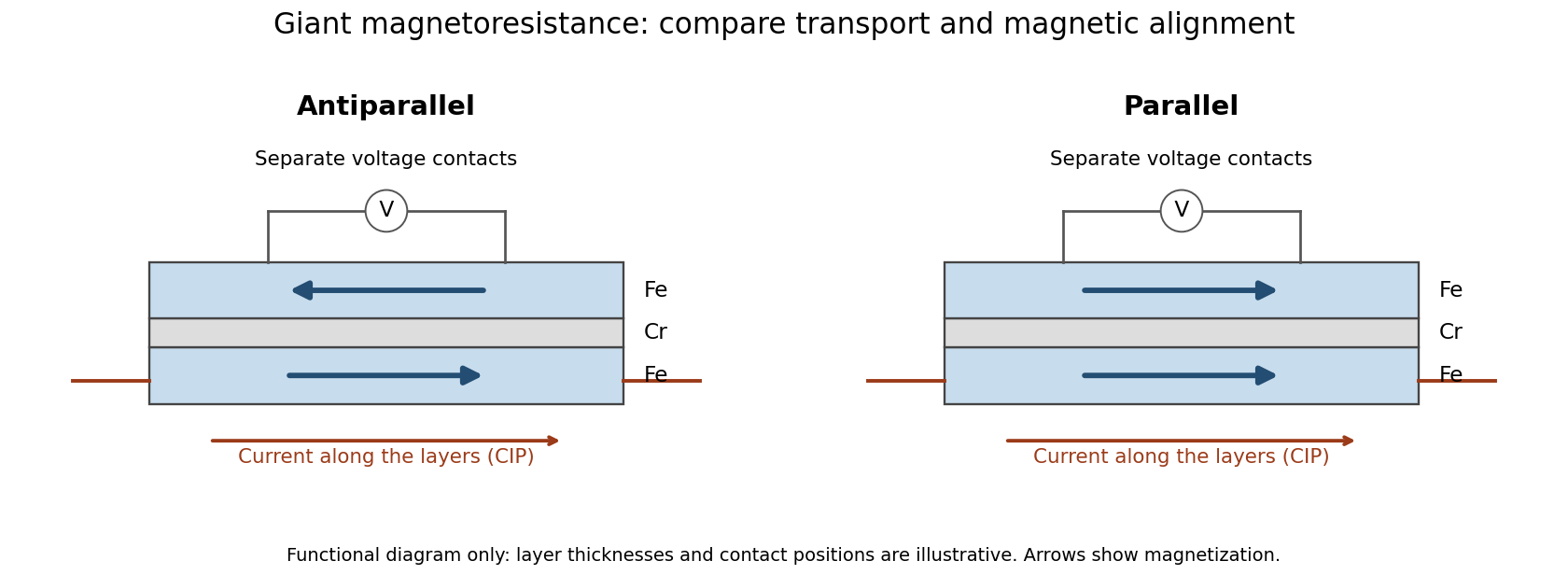
Current along a magnetic multilayer and an independent check of layer alignment
. Original functional illustration of current-in-plane transport and a generic four-terminal readout. Two idealized magnetic configurations are shown; dimensions, contact positions and layer count do not reconstruct either historical specimen. Optical probing supplies alignment information independently of the electrical signal. Source. Details.
A resistance curve alone does not reveal the microscopic direction of every magnetic layer. The optical measurements add a different observable, while the reference film tests an orientation-dependent response that can occur without a multilayer. Sample preparation and cross-checks therefore belong to the physical explanation.
Radial flux through a truncated unit sphere 2026-10-18
Let and let be the outward-oriented boundary of , . For a continuous function , the vector field has outward fluxOn the curved unit sphere, the outward unit normal is , so the normal component is . A horizontal spherical band has area , producing the first term. On the top disk, the outward unit normal is , the normal component is , and the area is , producing the second term.
For with a continuous first derivative, the fundamental theorem of calculus givesThis direct surface integral proof needs no second derivative of . For , it reduces to ; the divergence theorem identifies this with three times the enclosed volume.
For two identical fermions of mass in the same one-dimensional quantum harmonic oscillator, use center of mass and separation . The corresponding oscillator masses are and reduced mass , with the same frequency . If are their occupation numbers, the unperturbed energy is . The fermionic exchange symmetry requires even with a spin-one-half singlet state and odd with a spin-one-half triplet state.
For a delta potential the first-order shift is . Every odd relative wavefunction vanishes at contact, so these states remain exact unaffected eigenstates of the spatial problem. For the even relative ground state, the oscillator length is , where , and the shift is , independent of . This separates interaction-sensitive singlets from contact-insensitive triplets.
For well width , put and when the interaction is . The spin-dot-product eigenvalue gives exchange energies for the singlet state and for the triplet states. Identical fermions require symmetric spatial orbitals with the singlet and antisymmetric orbitals with the triplet. Two particles in the same orbital can therefore only be singlets.
For , the three lowest distinct energy levels are the orbital- singlet at , orbital- triplet at , and orbital- singlet at , with multiplicities . Distinguishable particles instead allow an orbital- triplet, making the lowest three levels , , and , with multiplicities . The sixfold level includes both orbital orderings. For negative , the spin-sector orderings reverse within each fixed orbital sum.
Two-electron states in the first two shells of an isotropic oscillator Created 2026-10-18 Updated 2026-10-20
The spatial ground orbital of a three-dimensional quantum harmonic oscillator has and energy ; its first excited shell has and energy . Two identical electrons both in the ground orbital must form the singlet state, giving one state at total energy .
At energy , one electron occupies each shell. There are two ground-shell spin orbitals and six first-excited-shell spin orbitals, hence twelve Slater determinants. Equivalently, gives ; symmetric spatial combinations with the singlet state give three states, while antisymmetric spatial combinations with the triplet states give nine. Distinct occupied orbitals allow both spatial exchange symmetries, so both spin sectors must be kept.
Electron-positron annihilation into W-boson pairs Created 2026-10-18 Updated 2026-10-20
At tree level in the Standard Model, the diagrams are s-channel photon, Z boson and Higgs boson exchange, and t-channel electron neutrino exchange. The Higgs contribution couples to the electron through its small Yukawa coupling. In a zero-electron-mass approximation that diagram vanishes, leaving the three gauge diagrams. The gauge contributions interfere; their sum has the high-energy behavior required by the electroweak gauge structure.
For acoustic modes , thermally active wavevectors have . When , a nearly elastic event on a spherical Fermi surface has , suppressing momentum relaxation. In the clean three-dimensional acoustic model, the thermal relaxation rate scales as while the electrical transport rate gains two extra powers and scales as . With electronic heat capacity proportional to , this gives and electrical resistivity proportional to in the phonon-limited regime. Residual elastic scattering cuts off these behaviours as temperature falls further.[ref]
https://home.itp.ac.ru/~grigorev/LectureSlides/MetalsLecture2.pdf. Low-temperature electron-phonon scattering: thermal lifetime versus transport lifetime
Electron-phonon Umklapp threshold Created 2026-10-18 Updated 2026-10-25
For a spherical Fermi surface of radius lying inside a zone with shortest reciprocal lattice vector magnitude , a translated neighbouring Fermi sphere is separated from it by . An electron-phonon Umklapp scattering process satisfying therefore needs a phonon wavevector of at least . For an approximately linear acoustic dispersion its activation scale isAt these phonons are sparsely occupied; once they become thermally available, momentum-relaxing scattering can grow rapidly. Normal small-angle scattering and residual disorder need not vanish below this scale, so it is a crossover estimate rather than a sharp universal conductivity threshold.
Conductivity tensor 2026-10-18
The tensor relating local current density to electric field. Its inverse, when it exists, is the electrical resistivity tensor; sheet conductivity uses surface current density instead.
Skin effect Created 2026-10-18 Updated 2026-10-20
An alternating electric current and its electromagnetic field concentrate near a conductor's surface. For a local isotropic good conductor with real electrical conductivity , magnetic permeability , and , the field penetrates over the skin depth .
Lossless two-channel thickness scattering model Created 2026-10-18 Updated 2026-10-20
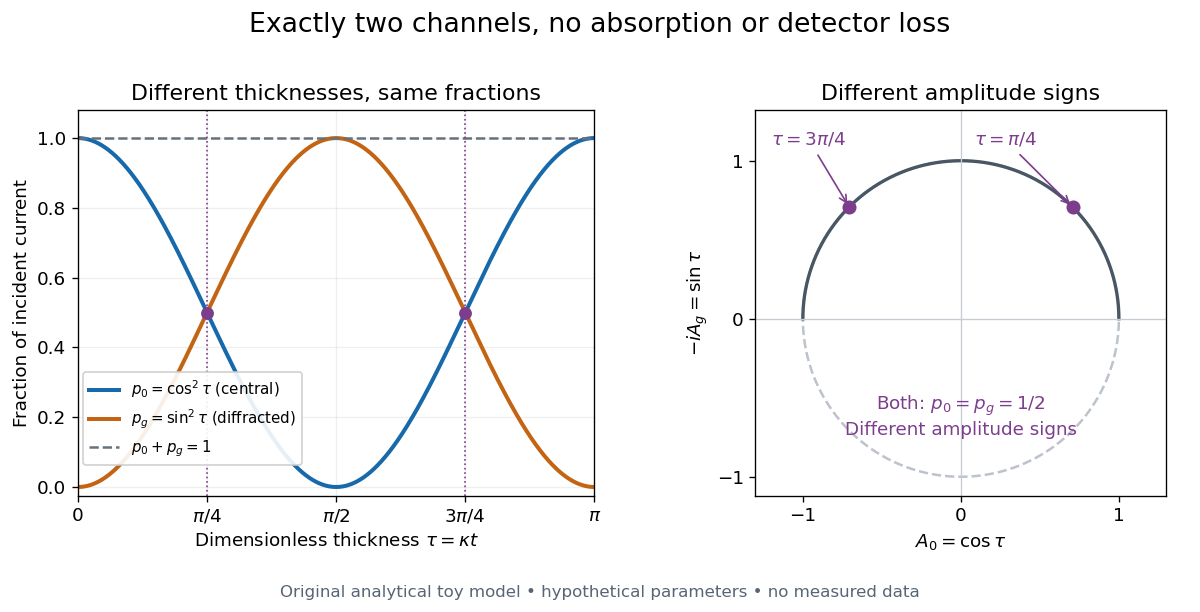
Consider an original illustrative model with exactly two outgoing scattering channels: a central beam and one diffracted beam . Let be specimen thickness and a constant coupling with units of inverse length. Normalize the probability amplitudes to incident probability current, assume equal longitudinal speeds, and specifyThese ordinary differential equations define a lossless toy model, not a fit to the silicon example or a complete theory of crystal scattering. Differentiating once more gives , soThe identity expresses conservation within these two scattering channels. Alternatively, substituting the ordinary differential equations into makes the two cross terms cancel. Here ideal bright-field transmission electron microscopy accepts fraction and rejects fraction ; ideal dark-field transmission electron microscopy accepts precisely the rejected channel. This complementarity requires the declared two-channel completeness and absence of loss.
Even with known , thickness is ambiguous: and both give . Near , ; extending that approximation through a full oscillation would erase the ambiguity incorrectly. The model isolates reversible transfer between probability amplitudes; it does not say that every thicker specimen must look darker.

Real dark-field transmission electron microscopy usually collects only a subset of the directions rejected in bright-field transmission electron microscopy. Other elastic scattering directions, inelastic scattering and detector losses prevent a general two-image conservation rule. To keep loss and background separate, extend the counting model explicitly. Let be the fraction absent from both recorded beam channels, describe the remaining fraction, be incident count per exposure, the detector efficiency and its mean additive background. Then the expected value of recorded count isFor separately acquired equal-illumination exposures with known , the two corrected mean counts sum to , not necessarily . Removal from these channels is not synonymous with physical absorption: an electron can leave the chosen acceptance or change kinetic energy without being stopped in the specimen. Background subtraction removes a mean offset, but its counting variance remains.
Long-wavelength inference of diatomic-chain parameters Created 2026-10-18 Updated 2026-11-05
For alternating masses , nearest-neighbour spacing and equal spring constants , the zone-centre optical angular frequency and acoustic group velocity obeyTherefore and . These infer effective model parameters from a measured intercept and initial slope of a phonon dispersion relation. Fitting a real polar crystal to a nearest-neighbour scalar model does not guarantee that every measured point or its structural spacing is reproduced exactly.
First three derivatives of an inverse function Created 2026-10-18 Updated 2026-10-31
Let a three-times continuously differentiable real function have . The inverse function theorem gives a local inverse . Writing , and , its derivatives areIndeed by the chain rule. Apply this operator successively to , and . Every forward derivative on the right is evaluated at the inverse image .
For a continuously differentiable vector field and a twice continuously differentiable parametric curve , the product rule and multivariable chain rule givewhere is the Jacobian matrix. Indeed, first differentiate the dot product to obtain , and then substitute .
The first term describes variation in the sampled vector field; the second records the changing velocity vector of the parametric curve. In three dimensions one may take for a sufficiently smooth vector field . The formula then involves first and second spatial partial derivatives of and the velocity and acceleration of the parametric curve. Omitting the second term would be valid only when its dot product vanishes, for example for a straight path with constant velocity.
Surface-electron and bulk-phonon heat-capacity crossover Created 2026-10-18 Updated 2026-11-05
A neutral two-dimensional linear electronic spectrum has heat capacity proportional to , while three-dimensional acoustic phonons have Debye heat capacity proportional to . Thus their ratio scales as . At fixed crystal composition and shape, for linear size , favoring the electronic surface contribution in smaller or colder specimens. The continuum laws require thermally populated wavelengths small compared with sample size; their formal low-temperature crossover need not lie inside that regime.
For a matrix , contraction of with proves the title identity, because . DefineExpansion shows that is the cofactor matrix. Equivalently, the determinant identity gives . Thus for invertible ,Differentiating the cubic determinant formula gives three equal terms, so . This is the entrywise derivative of the determinant and remains valid for singular through the cofactor expression. The inverse expression requires .
Pivot column 2026-10-18
A pivot column of a matrix is a column whose position contains a leading nonzero matrix entry in its row echelon form. The corresponding columns of the original matrix form a basis of its column space. The column positions survive row operations, although the column vectors themselves generally change.[ref]
Polar cap between a cardioid and a circle 2026-10-18
For and , consider the region in polar coordinates. It exists precisely for , where . The polar area element givesExpanding the square and integrating its even terms gives the title formula. This cap lies inside the cardioid and outside the concentric circle, so reversing the radial bounds would select the wrong region or a signed area.
Area and perimeter of a cardioid 2026-10-18
For , the cardioid traces its boundary once over . The polar area element givesThe polar arc length integrand is . Splitting at the cusp parameter gives perimeter . The powers of distinguish the scaling of area and length.
Brewster reflection from an ionospheric interface Created 2026-10-18 Updated 2026-11-05
In the sharp planar, nonmagnetic ionosphere model with frequency above the plasma frequency, the refractive index is . From air, the Brewster angle satisfies . At that angle the reflected p-polarized wave vanishes, while s polarization retains a nonzero reflected component. A ground-to-ground single reflection from height spans . This is below the critical angle for total internal reflection for total internal reflection, which reflects both polarizations in this lossless isotropic model. The distinction diagnoses ordinary Brewster reflection rather than total internal reflection.
There are unlisted articles, also show them or only show them.