
Release factor 2026-10-18
A release factor is a protein involved in terminating biological translation and releasing the completed polypeptide at a stop codon.[ref]
Biology 2e by Mary Ann Clark and others. §15.5, Translation, Elongation, and Termination, paragraph beginning “Termination of translation”
Let a closed oriented surface lose a patch , leaving . Assume a smooth vector field on the relevant surfaces and that its total curl flux through is zero. The Stokes theorem gives the title formula when the edge is oriented as the boundary of the remaining surface . The boundary of the removed patch , with its original normal, has the opposite direction and hence the opposite circulation.
For a cylindrical side of radius , if everywhere on the removed patch, the circulation around the boundary of the remaining surface is . This uses actual curved area, rather than its planar projection, and does not depend on the patch shape. For multiple boundary components, the formula concerns the sum with their induced orientations.
Cross-product form of Stokes theorem Created 2026-10-18 Updated 2026-10-25
For a continuously differentiable vector field on an oriented surface with compatibly oriented boundary, this vector identity follows by dotting both sides with an arbitrary constant vector and applying Stokes theorem to . The curl identity gives the surface integrand. In components, , with the derivatives acting on . For the position vector field , it equals ; hence the line integral is minus twice the oriented vector area.
Unit square Created 2026-10-18 Updated 2026-10-20
Composite statistics of neutral atoms Created 2026-10-18 Updated 2026-10-20
Exchanging two identical bound atoms exchanges their constituent fermions. An atom with mass number and atomic number contains nucleons and electrons, so its exchange sign is when its internal state is preserved. An odd count gives a composite fermion; an even count gives a composite boson. This is equivalently the integer-versus-half-integer total-spin distinction in the Spin-statistics theorem. For example, neutral lithium-6 has nine fermionic constituents and is a fermion, while neutral lithium-7 has ten and is a boson. Counting nucleons alone instead classifies the nucleus, not the neutral atom. This effective composite-particle description requires energies and separations where the bound atom remains intact.
Finite-acceptance dilution of beta asymmetry 2026-10-18
A detector collects a range of solid angles, not a single direction. If its nonnegative angular response is , defineIntegrating the polarized beta-decay angular distribution gives a count proportional to . For a uniform forward cone with half-angle , put . Direct integration givesThe opposite cone has mean cosine . A hemisphere gives ; a narrow cone tends to . Hence a spin-reversal cross-ratio for beta decay measures , and an acceptance correction is needed to obtain .
With unequal angular responses, let the two laboratory mean cosines be and , including their signs. Then the actual expectation iswhich reduces to the simple square only when . The cancellation of stable multiplicative detection efficiencies survives, but their angular shapes still matter. An energy-integrated response likewise averages with the accepted spectrum; a mean speed cannot in general be substituted independently of acceptance.
Additive backgrounds, unequal polarization magnitudes or detection efficiencies that change on reversal do not have the assumed factorization. For example, a reversal-dependent efficiency cross-ratio multiplies by . Background subtraction also creates statistical complications: positive expected signal counts are assumed in this derivation, whereas finite samples with Poisson distributions can contain zero counts. Taking square roots of negative background-subtracted counts is not a valid estimator. These limits explain why reversal and independent preparation checks belong together.
Spectral projection of a diagonalizable matrix Created 2026-10-18 Updated 2026-11-05
For a diagonalizable matrix with distinct eigenvalues , this polynomial is the projection operator onto the eigenspace for along the direct sum of the other eigenspaces. It is one on its own eigenspace and zero on the others. Consequently for different eigenvalues, and . These projections need not be orthogonal projections; that stronger property holds for a normal matrix. This is the polynomial interpolation form of the spectral decomposition.
Use natural units and the Minkowski metric with signs . In the ideal centre-of-momentum frame, assume a known initial four-momentum , no unaccounted radiation and exact visible reconstruction. DefineThe missing four-momentum in electron-positron collisions is a subtraction of measured quantities. It is not itself a particle detector hit. With , expansion gives the useful identityFor any collection of future-directed massless invisible four-momenta ,Thus a positive missing invariant mass excludes exactly one massless invisible particle under the stated assumptions. It does not exclude one massive invisible particle, identify a neutrino flavor, or determine the number of massless invisible particles beyond that lower bound. Several collinear massless particles can even have zero combined invariant mass. Detector resolution and unaccounted radiation invalidate a literal event-by-event interpretation of these ideal inequalities.
For an original exact example in natural units, choose total energy and visible massless four-momenta, in ,Two possible invisible massless four-momenta are and . Splitting either into two positive collinear parts gives a three-particle interpretation with identical recoil. Alternatively, one invisible particle of mass has that recoil. This example tests the ambiguity of the subtraction, without asserting any of these alternatives is a tau lepton decay.
In the modern weak charged current interpretation, one allowed assignment isThe electron antineutrino, tau neutrino, muon neutrino and antineutrino of the tau neutrino carry away energy and momentum. There are four undetected particles in this decay assignment. Interchanging which parent decays electronically gives the opposite electric charge assignment. Each parent conserves electric charge and, in this approximation, total lepton number; four-momentum conservation applies separately to production and to each particle decay.
If and denote the corresponding branching fractions, independent parent decays give an inclusive mixed-flavour fraction . The factor two counts the two assignments to opposite parent charges. For chosen , the mixed fraction is , before acceptance and detection efficiency. Correlations between the parents' spins can affect angular selection even when the fully inclusive branching fractions factorize.
The neutrinos in that equation are a physical interpretation to test. Neither a deficit in visible energy nor two unusual tracks alone establishes their identities or uniquely counts them. Even a compatible invariant mass and an angular distribution require particle identification, background checks and agreement across further particle decay channels. The direct detection milestone for the tau neutrino was in 2000, separate from the charged tau lepton discovery.
Collider luminosity Created 2026-10-18 Updated 2026-11-05
The beam-overlap factor relating a reaction's cross section to its ideal production rate . Integrated collider luminosity has units of inverse area and gives the expected production count when is constant.
Homestake experiment 2026-10-18
The Homestake experiment, led by Raymond Davis Jr., used electron neutrino capture on chlorine to produce argon subject to radioactive decay. The 1968 paper reported an upper limit, rather than a resolved positive signal.[ref]
Search for Neutrinos from the Sun by Raymond Davis Jr. and others. Abstract: chlorine reaction and upper-limit result
The underground target contained tetrachloroethylene. Circulated helium swept out argon, which was trapped on cooled charcoal, purified, and put into tiny proportional counters. Electron capture back to chlorine supplies the delayed readout. Added stable argon checked extraction recovery; background counting checked spurious pulses. The capture threshold is and the product's half-life is about 35 days. The chemical extraction retains neither the original neutrino's arrival time nor its direction.[ref]
Nobel Lecture: A half-century with solar neutrinos by Raymond Davis Jr.. pp. 986, 988–991; Figs. 9–14
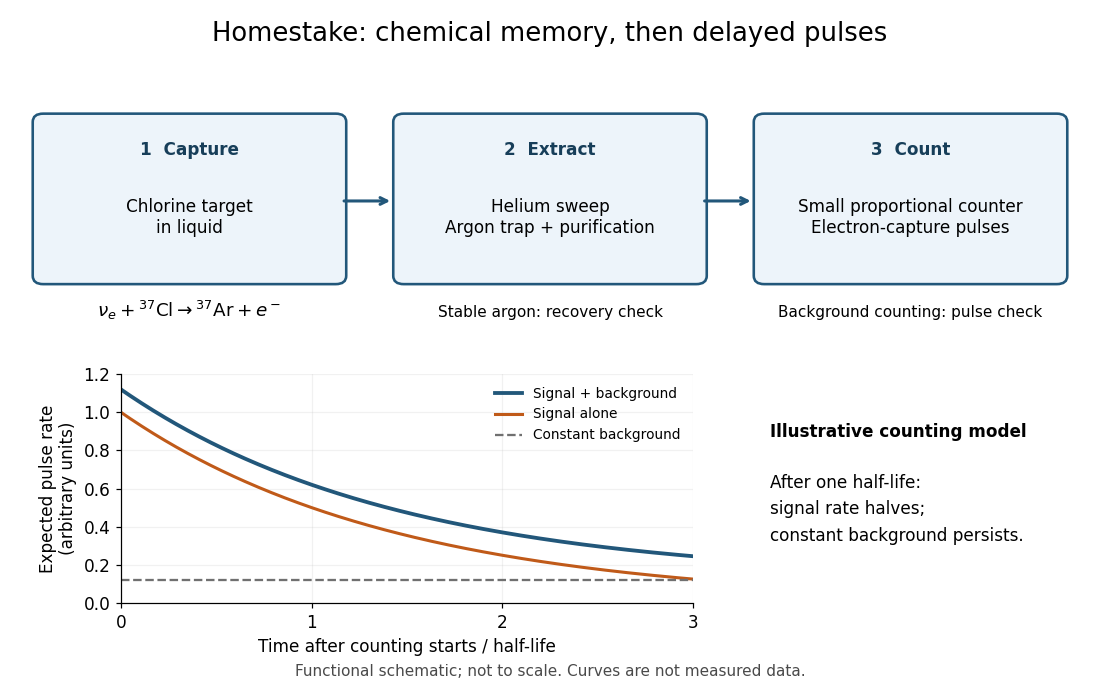

The reaction selects electron neutrinos, and its threshold excludes the lowest-energy part of the solar neutrino spectrum. A low count alone cannot distinguish a low source neutrino flux, a changed neutrino flavor mixture, or an underestimated loss in extraction or counting. This is why chemical recovery tests and an independent water Cherenkov neutrino reconstruction are scientifically valuable.
Planar shock compression of a finite slab 2026-10-18
A plane shock moving at speed through initially stationary gas has upstream speed and downstream speed in the shock frame, where is the shock compression ratio. Transforming back to the initial slab frame gives . At the breakout time , a uniform downstream slab has thickness . The strong monatomic limit has , hence and . This uses a maintained planar post-shock state; boundary rarefactions and variations of shock speed can change the actual thickness of a freely evolving finite cloud.
Define and, elsewhere,All first and second partial derivatives exist at the origin: and . Thus its Hessian matrix there is the positive-definite matrix . Nevertheless and for , so the origin is a saddle point of a scalar function. A valid second-derivative test needs a second-order Taylor expansion with a remainder ; continuous second partial derivatives in a neighborhood are a sufficient hypothesis. Existence of those derivatives at the point alone does not supply this hypothesis.
Uniqueness of reduced row echelon form 2026-10-18
Here is a short proof that uses only the row space. For a vector subspace , let be the dimension of its projection map onto the first coordinates, with . In any reduced row echelon form with row space , counts the pivot columns among those first columns: later-pivot rows project to zero, while earlier-pivot rows remain linearly independent. Thus the positions where determine all pivot positions from alone.
If those positions are , the map sending to is an isomorphism : the reduced nonzero rows map to the standard basis. Its th row is therefore the unique vector of with pivot-coordinate values equal to the th standard basis vector. Any other reduced row echelon form with that row space has identical nonzero rows in identical order. At a fixed matrix size, the remaining rows must be zero. Together with existence by Gaussian elimination, this proves uniqueness.
For row reduction with a parameterized right-hand side at , the nonzero reduced equations areColumn 3 has no pivot element, so is a free variable in a linear system. Taking gives every solution:There is no further restriction on . Independent substitution into the original linear system givesConversely, the two reduced equations force exactly these coordinate formulas, so no solutions have been omitted. The same computation with zero right-hand side gives the kernel . Its dimension is one. The rank-nullity theorem appears here as : two pivot columns and one freely chosen coordinate account for the three unknowns.[ref]
The Rank Theorem. Interactive Linear Algebra by Dan Margalit and others; §2.9, Rank Theorem and preceding pivot-column/free-variable count
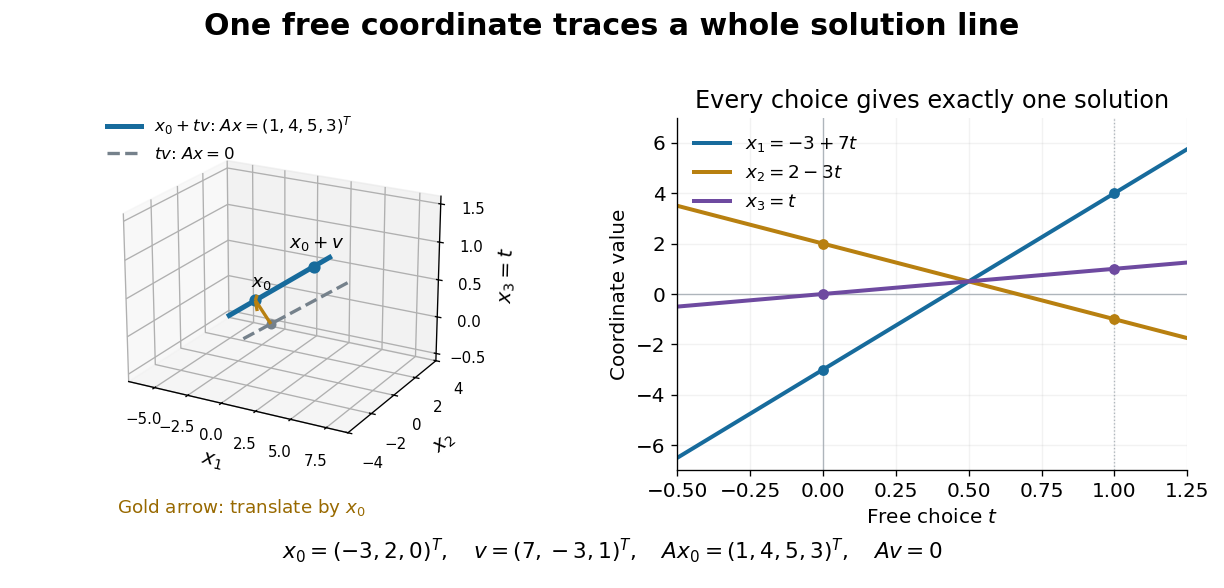
One free variable in a linear system traces an affine solution space of a linear equation parallel to its kernel
. Details. 
In general a consistent linear system has solution set . Subtracting from proves this description in both directions. The particular solution places the affine subspace, and the kernel supplies its directions.[ref]
Solution Sets. Interactive Linear Algebra by Dan Margalit and others; §2.4.2, Key Observation and its proof: translate homogeneous solutions by any particular solution
Over the real numbers this example is an entire line; over the rational numbers the same formula uses rational . A free variable in a linear system over a finite field instead has only finitely many choices.The pivot columns identify a different object: the original column space. Here they selectwhich form its basis, while . The corresponding reduced columns are and ; their linear span is a different plane. For example, every original output satisfies , but does not. Since is an invertible matrix, column linear relations survive even though the output vectors move. This is why choosing original columns at the reduced pivot positions works.
Reciprocal lattice change in a structural phase transition Created 2026-10-18 Updated 2026-10-20
The reciprocal lattice of a body-centered cubic lattice is face-centred cubic, and that of a face-centered cubic lattice is body-centred cubic. In both cases its conventional cubic side is if the direct conventional side is . Thus a direct BCC-to-FCC phase transition reverses the reciprocal lattice types. The reciprocal primitive cell volume is , so thermal expansion contracts reciprocal spacings, while a discontinuous change in direct primitive unit cell volume gives an inverse change in reciprocal cell volume.
A first-order structural transition need not continuously deform one perfect reciprocal array into another. Phase coexistence, new orientation variants, domains and loss of single-crystal alignment can produce two sets of diffraction peaks or many differently oriented sets. The two endpoint lattice types alone do not specify the transformation path or orientation relationship.
Radial random walk on a regular tree 2026-10-18
For a simple random walk on an infinite regular tree of degree , every vertex other than the chosen root has one neighbour closer to the root and farther away. The graph distance from the root is therefore a nearest-neighbour Markov chain on the nonnegative integers, with the displayed bulk transition probabilities and a certain outward step from zero. For shell probabilities ,Shell probabilities include all vertices at the given distance. They differ from single-vertex probabilities by the shell size, at the root and for .
Past-paper archive: www.sp.phy.cam.ac.uk/drp2/home. The archive lists papers for 2004–2018; worked solutions for these exams have not been verified. Lecture-problem solutions are not treated as past-exam solutions.
There are unlisted articles, also show them or only show them.