
Molar Van der Waals worked example 2026-10-18
Choose a hypothetical fluid with molar constants and , using . These stipulated constants are not a fit to carbon dioxide. The molar critical formulas giveAt and , first convert to . The repulsive-volume term and attractive correction areso . The ideal gas law would instead give . The excluded volume raises pressure relative to that ideal value, but attraction more than offsets the increase here. Neither correction alone describes this example.
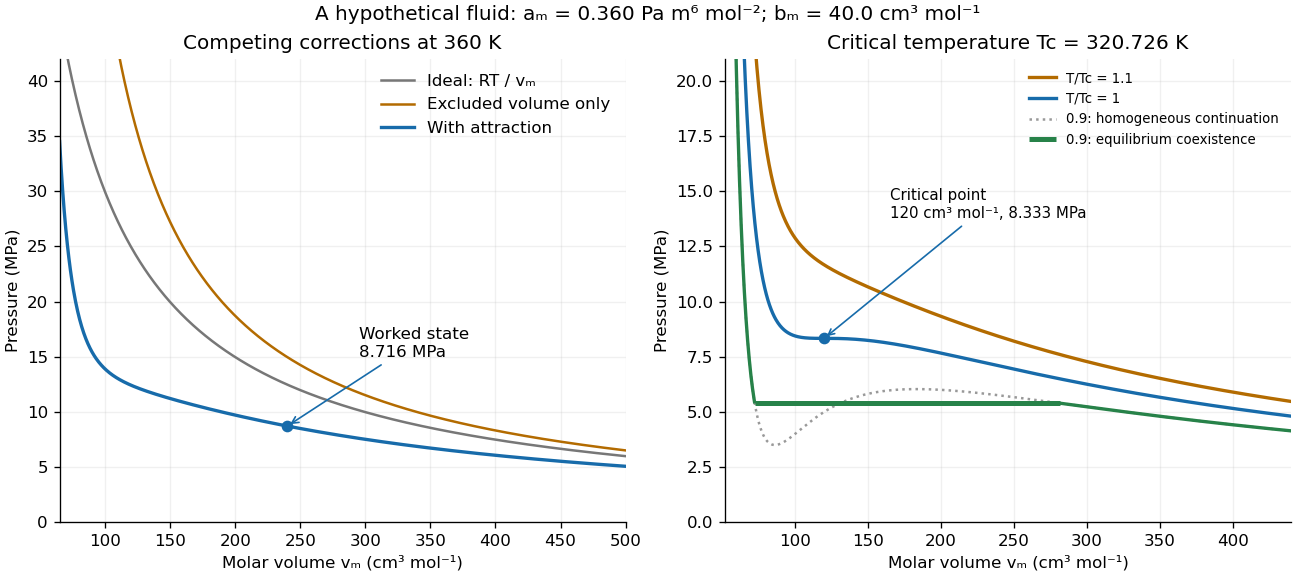
For , the same state occupies . The total-volume formula gives and the same . Halving the sample has halved both its physical volume and its excluded volume, while retaining its pressure. Conversely, if the two critical measurements are used to determine model constants, inversion givesAn independent critical molar volume then tests the prediction ; agreement with two fitted numbers does not ensure agreement with the third.
At , the Van der Waals liquid-gas coexistence example below becomes , , and . For a mean molar volume of , the lever rule gives gas mole fraction . Its volume fraction is instead : less than one quarter of the molecules occupy more than half the volume. The flat equilibrium pressure corresponds to changing these proportions. It does not describe a homogeneous sample sliding along the unstable loop.
Low-temperature liquid volume of a van der Waals gas Created 2026-10-18 Updated 2026-11-05
For one mole, liquid–vapour phase coexistence requires equal pressure and chemical potential. At , the saturation pressure is exponentially small. Neglecting it in the dense-phase equation of state gives . The root near the excluded volume isThis is an asymptotic low-temperature result, not an exact coexistence volume at every subcritical temperature. Away from that limit, solve equal pressure together with the Maxwell equal-area construction.
Rabi cycle 2026-10-18
A resonant drive can transfer a quantum state from one energy eigenstate to another and then bring its population back. This is unitary time evolution: the drive exchanges energy with the selected two-level system, while total probability stays one. One complete Rabi cycle has population period ; halfway through, a Rabi pi pulse transfers the whole population in the ideal model. This makes Rabi oscillations useful for calibrating resonant quantum control, preparing quantum superpositions and supplying the pulses of Ramsey interferometry.
For two equal-intensity mutually incoherent narrow spectral lines with wavenumbers , a Michelson interferometer with optical path difference has normalized intensity , where and . With mirror displacement , the fast period is ; successive interference visibility revivals are separated by . The first visibility zero is halfway to the first revival. A signed envelope has twice the period of its absolute value. Unequal line strengths prevent perfect zeros.
Constant-entropy magnetic cooling example 2026-10-18
Choose a fictional two-level refrigerant with , where the upright denotes tesla. This chosen moment is a convenient model parameter, not a fitted property of the historical salt. At bath temperature , raise from to . Then increases from to , soThe last equality assumes a reversible isothermal process of magnetization; negative means the refrigerant rejects heat. The bath gains of entropy, balancing the stage's loss in this reversible limit. An appreciable temperature difference during real heat transfer adds entropy production.
Now open the heat switch and reduce from to . Constant gives . Throughout this ideal cooling leg, , , and . Neither state becomes more probable. Field reduction shrinks the energy gap by ten while preserving the Boltzmann distribution's dimensionless ratio of gap to temperature.
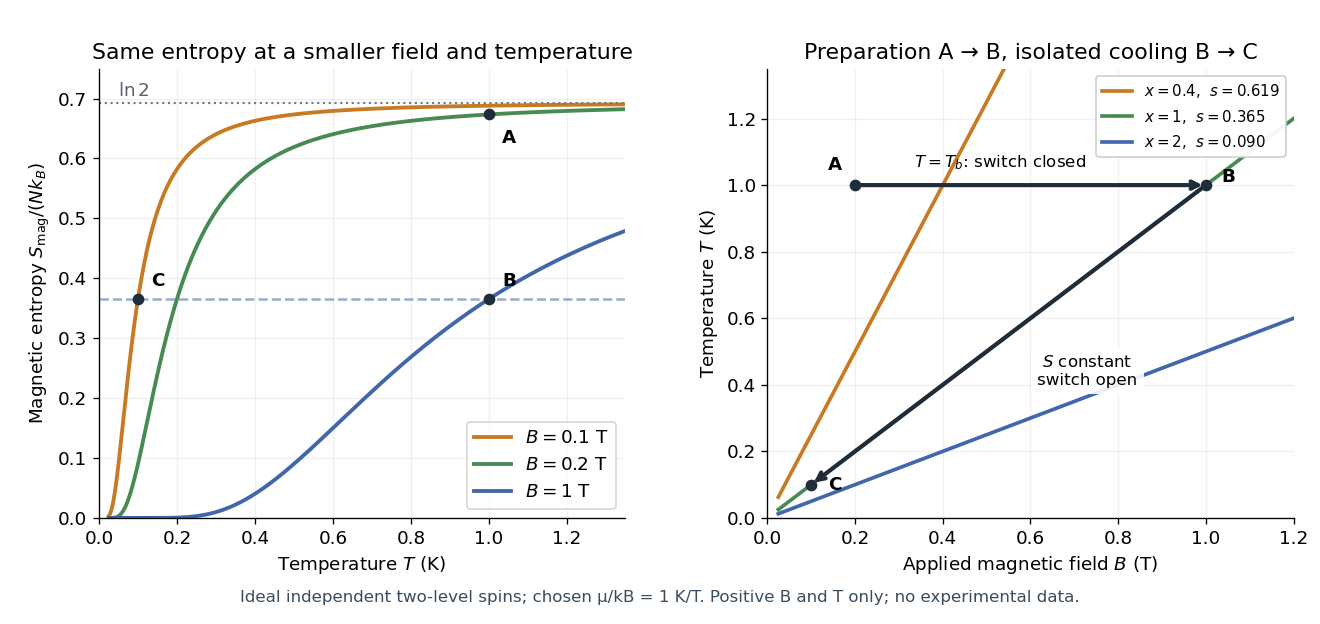
There is a subtle energy check. For the spin Hamiltonian convention used here, external-field interaction energy belongs to , so reversible work done on the spin subsystem is andOn the isolated leg, but increases from to , becoming less negative as the gap shrinks. Integrating at constant supplies exactly . Cooling therefore need not decrease this chosen spin internal energy. An account of work exchanged with a magnet circuit must specify where field interaction energy is assigned before comparing signs. The occupation ratio and temperature prediction do not depend on that bookkeeping choice.
For the isothermal preparation, direct integration gives . The endpoint internal energy difference is , equal to . This independently checks both the rejected heat and the magnetic-work sign in the chosen convention.
Diffraction contrast 2026-10-18
Diffraction contrast is image-intensity variation caused by spatially varying electron diffraction conditions. JEOL documents a silicon semiconductor-interconnect specimen at : its differently oriented crystals are imaged in bright-field transmission electron microscopy and same-area dark-field transmission electron microscopy, alongside an electron diffraction pattern. Selecting the marked diffracted beam makes the corresponding crystal bright after it was dark. The preparation route, thickness and exposure are not supplied. The changed objective aperture selection provides a comparison within one specimen; the readout supports orientation-dependent contrast rather than a map of surface height or chemical composition.[ref]
Diffraction contrast by JEOL. Definition and silicon example, panels a–c: 200 kV, same-area comparison and selected diffraction spot
This comparison is useful precisely because the material has not been replaced between the two images. It does not prove that thickness and chemical composition never influence transmission electron microscopy contrast. Instead, it supplies a concrete counterexample to assigning either quantity uniquely from brightness. A proposed extension is to repeat the first aperture setting after the second: recovery of the original contrast tests whether specimen motion or irradiation changed the comparison.
Objective aperture Created 2026-10-18 Updated 2026-10-20
An objective aperture selects outgoing electron directions in the objective lens's back focal plane. Passing the central transmitted beam gives bright-field transmission electron microscopy; selecting a separated diffracted beam gives dark-field transmission electron microscopy.[ref]
In a paraxial approximation, an outgoing angle maps approximately to position in this focal plane, where is the objective focal length. A centred opening of radius therefore admits . Selecting a direction selects a component of the outgoing wavefunction; the subsequent image still assigns intensity to specimen positions. The opening is not a hole cut into a real-space specimen image. Its angular selection must be distinguished from selecting a specimen region for electron diffraction.
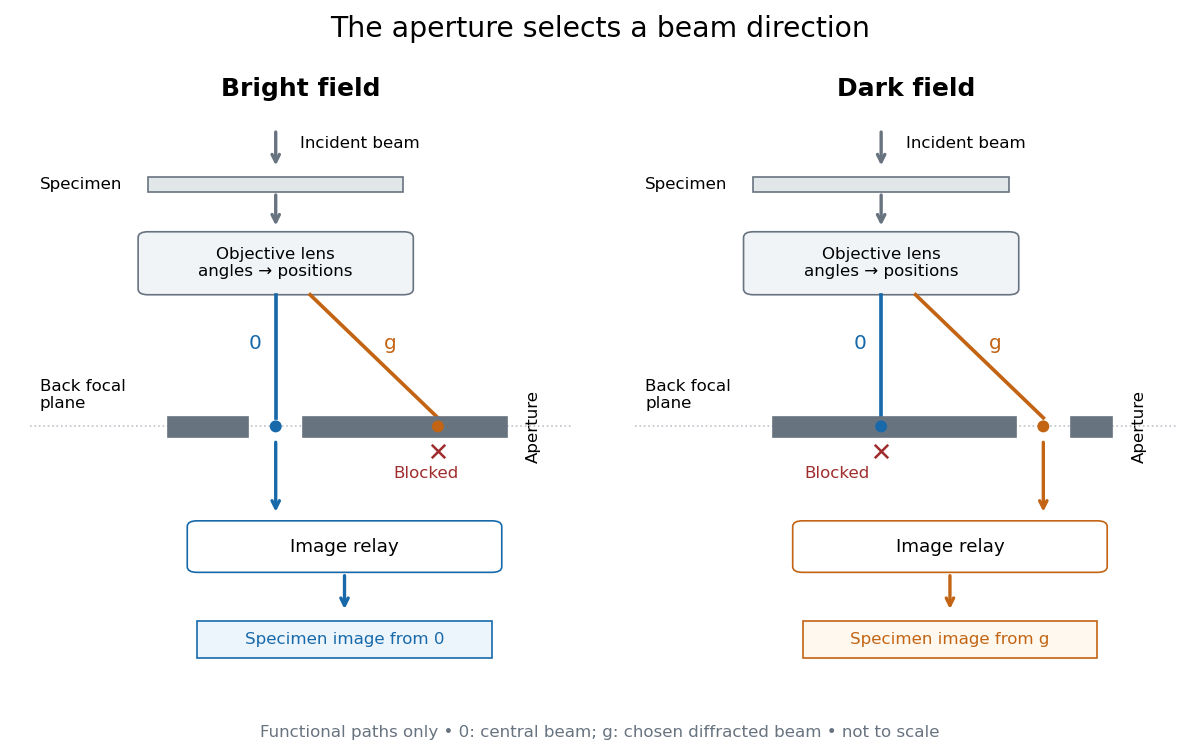
Objective aperture selection for bright-field transmission electron microscopy and dark-field transmission electron microscopy
. Original functional diagram. Lower relay boxes denote image formation, not literal ray paths. Scales and beam angles are illustrative. Source. Details. Torsion of a solid circular shaft Created 2026-10-18 Updated 2026-11-05
A circular shaft twisted uniformly through small end angle over length has local engineering shear strain at radius . Its shear stress is , so the integrated torque is , using the polar second moment of area. The restoring torque has the opposite sign to the imposed twist. The stored elastic energy is . The circular cross-section is important: general noncircular sections can warp and have a different torsion constant.
Neap tide 2026-10-18
Spring tide Created 2026-10-18 Updated 2026-10-20
A spring tide has an enhanced high-to-low tidal range because the Moon and Sun are approximately aligned as seen from the Earth, so their principal tidal contributions reinforce. Such alignments occur twice in a lunar phase cycle.
Superleak 2026-10-18
A superleak is a narrow or porous connection that strongly suppresses the viscous normal component of a superfluid while allowing appreciable superfluid flow. Treating is a regime assumption, not a perfect material filter for particular atoms. The thermomechanical effect uses that distinction to maintain a temperature difference during chemical equilibration. The idealization fails when normal leakage or dissipative quantum vortex motion becomes appreciable.
Wiedemann-Franz law Created 2026-10-18 Updated 2026-11-05
The Wiedemann-Franz law relates the electronic thermal conductivity of a normal degenerate metal to its electrical conductivity:An isotropic kinetic theory estimate gives . With electronic heat capacity density , and , the ratio is . Approximately elastic scattering with a smooth energy dependence gives equal heat and charge relaxation times. Inelastic electron-phonon scattering can make them different; the law also concerns the electronic contribution, not additional lattice heat conduction.[ref]
https://arxiv.org/abs/1810.05646. Abstract: acoustic-phonon violations at finite temperature and restoration when impurity scattering dominates
The 2022 paper is omitted because the released copy includes worked solutions. 2022 paper with solutions, PDF pages 448–455
Past papers and worked solutions: tqm.tripos.org/past-papers.html
Optical path delay in crossed-beam interference Created 2026-10-18 Updated 2026-11-05
For the right-angle geometry of temporal coherence from crossed beams, a physical arm-path delay gives , with the sign set by the delayed arm. A quarter-cycle optical phase delay requires ; it shifts the fringe pattern by a quarter of its period, . A path delay equal to that latter length is a different operation. Replacing the shifted correlation by a phase multiplier additionally requires the delay to be small compared with the envelope optical coherence time.
Flux of the position vector through a cone Created 2026-10-18 Updated 2026-10-20
Let a solid cone of volume have its planar base in a plane through the origin, and orient its curved surface outwards. The vector field has divergence three. Its flux through the base vanishes because the position vector lies in that plane and is orthogonal to its normal vector. The divergence theorem therefore gives the displayed curved-surface flux. For a circular base of radius and perpendicular height , this is .
Superheated liquid 2026-10-18
A liquid maintained above its equilibrium boiling temperature at the imposed pressure. A barrier to nucleation can delay its conversion into vapor, making this a metastable state.
Small normal sample mean confidence interval 2026-10-18
Under the studentized normal sample mean assumptions, let denote the quantile at cumulative probability of the Student's t-distribution. For , rearranging the event gives a Student t confidence interval for the unknown mean with exact coverage probability . [ref]
Choose the list as an original arithmetic example, not as reported measurements or a claim that these five numbers establish a normal distribution. If such values were obtained under the assumed independent and identically distributed normal distribution model with unknown , thenThere are four statistical degrees of freedom. For a 95% confidence interval, , soUsing the standard normal quantile with the same estimated standard error would give only . That underestimates the correct margin by about 29.4%. Indeed its actual coverage probability under this normal distribution model is , rather than 0.95.
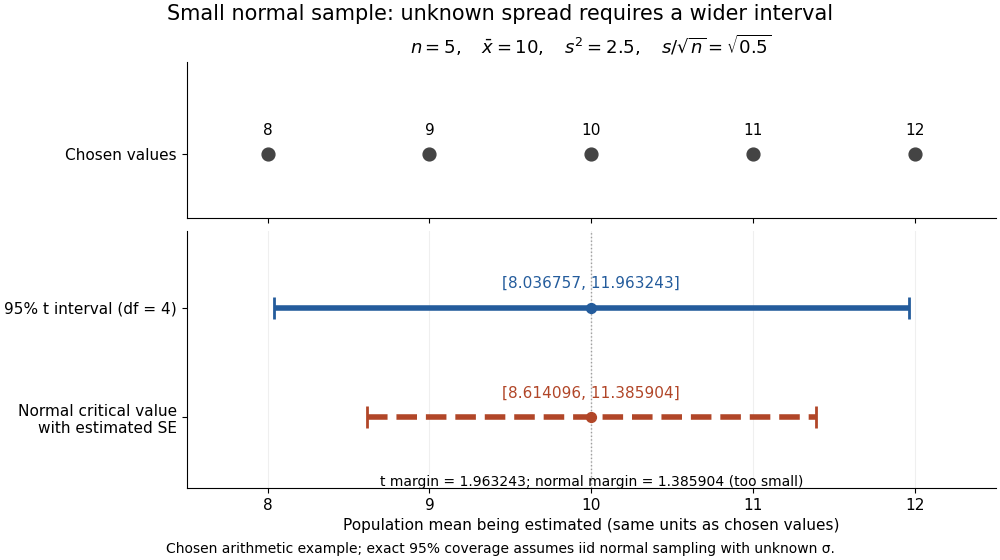


The observations, the sample mean and the confidence interval all have different meanings. The bar estimates the population mean; it is not an interval intended to contain 95% of individual observations. In repeated independent samples of size five from the assumed normal distribution, 95% of intervals constructed using the exact quantile cover the same fixed . This is not a 95% posterior probability that the fixed statistical parameter lies in this particular realized interval. Such a probability requires a separate Bayesian inference model.
For this four-degree case, the cumulative distribution function has an especially simple form:One can check the formula by differentiation: , with limits zero and one at the two ends of the real line. Solving the increasing equation by the bisection method gives the quantile used above.
There are unlisted articles, also show them or only show them.