A prion disease of cattle. A positive surveillance test is an observed diagnostic outcome, whose frequency need not equal true infection prevalence unless test performance and sampling are accounted for.
A human prion disease associated with exposure to the BSE agent. Exposure totals and clinical-onset totals measure different stages of the disease process; incubation periods and ascertainment affect their relationship.
Infinitely many primes congruent to minus one modulo six by  Codex 0 Created 2026-10-14 Updated 2026-11-05
For any finite list of such prime numbers, let be their product. The integer has no listed prime divisor, nor the divisors . Its remaining prime factors have residues modulo six, and at least one has residue because their product has that residue. Thus no finite list is exhaustive.
// Target: number-theory.bigb
Assume that with implies . For a finite list of primes in that residue class, let be their product. Every prime divisor of is greater than three and satisfies that quadratic modular congruence, hence has residue one modulo six. None is listed because modulo a listed prime.
// Target: combinatorics.bigb
The sieve of Eratosthenes finds all prime numbers at most an integer . Start with the integers marked as candidates. For each surviving candidate in increasing order, mark the multiples up to as composite numbers. Stop processing candidates once : the surviving candidates are exactly the prime numbers. Starting at saves work because any smaller proper multiple of already has a smaller prime factor. [ref]
https://web.stanford.edu/class/cs106aj/res/handouts/36-Section-6.pdf. Jerry Cain, Stanford CS106AJ, Section Handout 6, Problem 4: the sieve of Eratosthenes
.For a complete run with , the only prime numbers at most are , since . Exclude one before starting; it is not a prime number. The four marking passes are:
- : mark , removing 29 candidates.
- : mark . The nine newly removed candidates are ; the even integers were already marked.
- : mark . Only are newly removed.
- : mark . Only is newly removed.
There are surviving prime numbers:The next surviving candidate is , and , so no further marking pass is necessary. A prime number used for marking remains a candidate: starting at never marks itself.
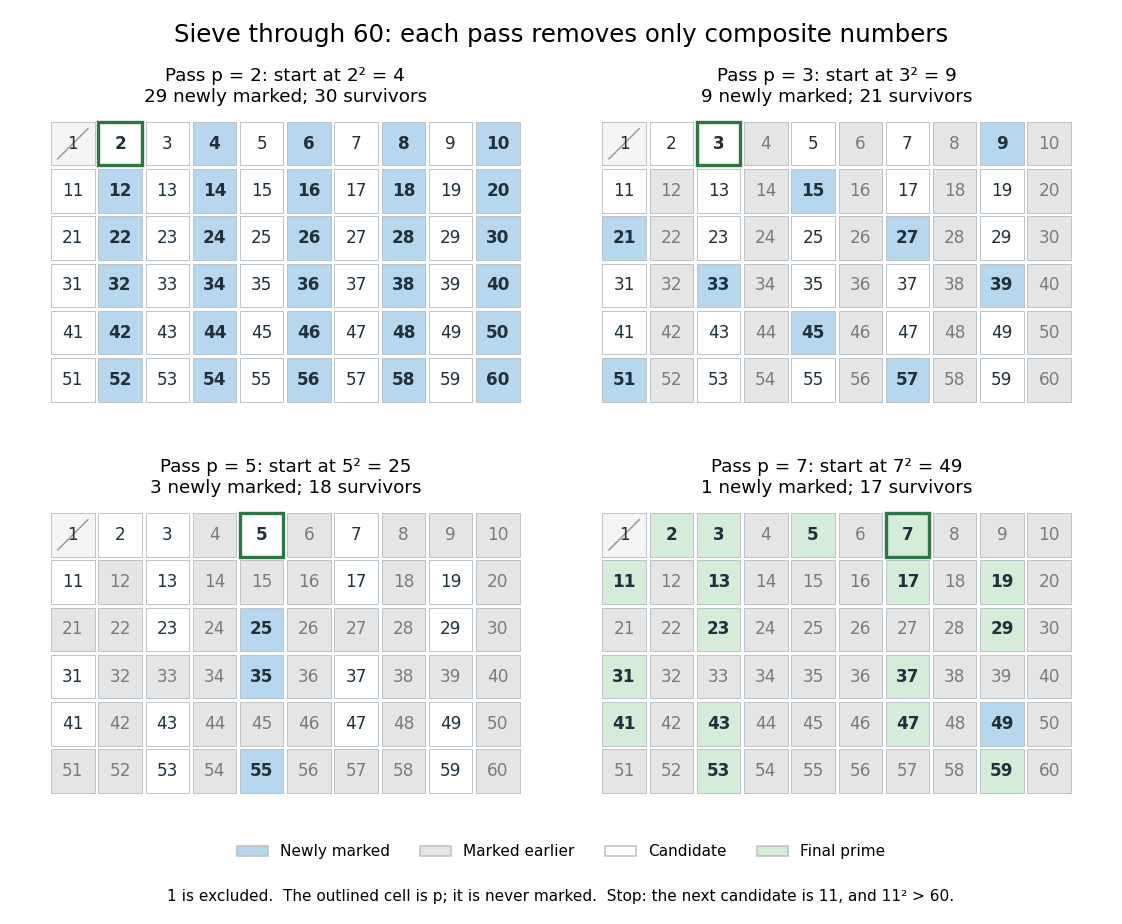
Four passes of the sieve of Eratosthenes through 60 leave seventeen prime numbers
. Blue cells are newly marked composite numbers; gray cells were removed earlier. White cells are candidates in the first three panels, and green cells are the final prime numbers. The outlined cell identifies the prime number used for that pass. One is excluded throughout. Details.
The saving from starting at is justified by the smaller multiplier: if with , then has a prime factor , so has already marked . For , the earlier multiples have already been marked using or . The first new possibility is .
For , only the prime numbers need marking passes. They remove all the composite numbers, leaving 25 prime numbers. The diagram colors each composite number by its smallest prime factor, so it shows which marking pass removes it first. The excluded integer one is shown separately.
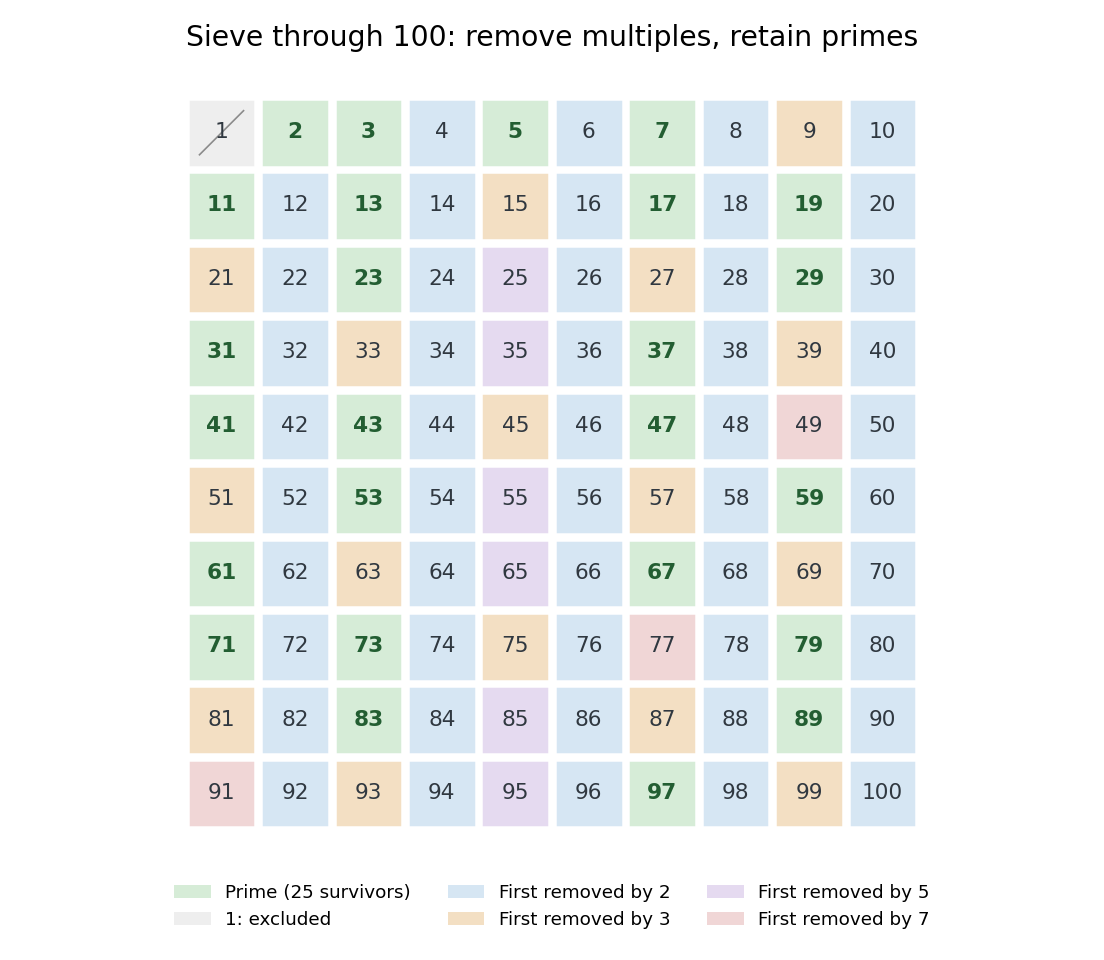

Why does the algorithm work? A surviving candidate cannot be a composite number, since its smaller prime factor would already have removed it. Conversely, marking proper multiples never removes a prime number. Every composite number at most has a prime factor at most , so no later pass is needed. The sieve of Eratosthenes is useful when an entire bounded list is wanted; primality testing of one large integer is a different computational task.
The historical name is supported by a surviving primary account: Nicomachus, in Book I, chapter 13 of Introduction to Arithmetic, names Eratosthenes and describes separating prime numbers from composite numbers by marking multiples among the odd integers beginning with three. That passage documents the sieve tradition; the bounded algorithm above and its starting rule are the formulation explained here, rather than instructions quoted from Euclid's Elements. [ref]
https://stoicheiamath.com/wp-content/uploads/2025/09/Nicomachus-Introduction-to-Arithmetic-Student-Edition.pdf#page=28. Nicomachus, Introduction to Arithmetic I.13.2–8, Martin Luther D'Ooge translation (1926), revised classroom edition by Nathanael Hahn (2025), pp. 24–25
Trial division searches for divisors of an integer by testing candidate divisions. For primality testing of an integer , testing the prime numbers up to suffices: any composite number has a prime factor in that range. After finding a prime factor, repeated division removes its prime power, and testing the remaining quotient gives an elementary integer factorization method. This is useful for small inputs, but the number of candidates can grow rapidly with the input's digit count.
Primality is the property of a positive integer being a prime number. Primality testing determines this property; integer factorization asks for factors and is a different computational task.
For an odd integer , write with odd. Choose a base uniformly from . It passes the Miller–Rabin test whenA nontrivial greatest common divisor of or failure certifies compositeness. Exponentiation by squaring computes ; at most further squarings test the other possibilities.
Every prime number passes: arithmetic modulo a prime number is a field, whose only square roots of one are and . The squaring chain ends at one by the Fermat little theorem; its first one is either the initial value or follows minus one.
For an odd composite number, at most one quarter of bases in the stated range pass. Thus independently sampled bases give false probable-prime probability at most , for each fixed composite input. A passing composite is a strong pseudoprime to that base.[ref]
Checking the zero and scale of a differential pressure transducer against equal port pressures and independently known pressure differences. The dynamic pressure measurement discussion gives a liquid-column check.
For a statistically homogeneous vector random field, its spectral tensor is the Fourier transform of the componentwise two-point correlation . It distributes cross-correlations between components over wavevectors. With , homogeneity gives , understood as an identity of distributions for an infinite stationary field.
A power-law distribution uses a power law for a probability mass function or a probability density on a specified range. For a continuous model with on and zero below it, the total integral is finite exactly when . Normalization then requires , giving a Pareto distribution with shape parameter . Discrete models instead normalize a sum. The support and normalizing coefficient are part of the model, and a power law for its tail probability uses a different exponent from its probability density.
A Dirichlet form on a real space is a densely defined closed nonnegative symmetric bilinear form with the Markov contraction property. In the real case, truncating to keeps it in the form domain and cannot increase . The Dirichlet form of a Markov chain is a discrete energy example; Laplacian energy on a region supplies a continuous example.
For unit channel width, incompressible flow towards a corner withdrawal point has on the lower wall and on the upper and left walls, with far downstream. For irrotational flow, separation of variables gives the displayed harmonic correction: the Fourier sine coefficients of are . Near the corner, and radial velocity is , whose integrated inward flux across a quarter-circle is .
For , a polynomial kernel is the positive-semidefinite kernel , where is a positive integer and . The case uses monomials of total degree ; also includes lower degrees. The feature map weights matter: listing each distinct monomial once with coefficient one generally gives a different inner product.[ref]
Gaussian Processes for Machine Learning by Carl Edward Rasmussen and Christopher K. I. Williams. Section 4.2.2, pp. 89–90, equations (4.23)–(4.24): polynomial kernels and weighted monomial features
For the homogeneous quadratic case in two dimensions, take the scaled quadratic feature mapThe inner product identity is explicit:The factor accounts for the two equal cross terms in the square. Thus an inner product of three derived coordinates can be obtained from an inner product of the two input coordinates followed by squaring. The kernel trick uses this equality inside an algorithm; the feature map explains which nonlinear functions the algorithm can represent.
Cell-cycle activation feedback is the reinforcement of Cdc2 activation through Cdc25 and suppression of Wee1. Its role is to help make transitions in the cell cycle decisive; the cell-cycle hysteresis experiment tests the resulting states rather than inferring them solely from circuit arrows.
Saturating positive feedback limits the reinforcing rate as activity increases. Here is an explicitly synthetic ordinary differential equation for normalized nonnegative input , response , and return strength :The return is an increasing, nonproportional function of , while removal is proportional to . Time and activities are dimensionless variables. At the vector field points into the nonnegative domain, and prevents unbounded growth there. This makes the toy useful for asking about a bounded switch; it supplies no molecular mechanism for the chosen rate law.
At an equilibrium point, . For a simple equilibrium point, the sign of the derivativedetermines local asymptotic stability. If , the maximum reinforcing slope is , so decreases strictly: every has one asymptotically stable equilibrium point despite positive feedback.
Three equilibrium points become possible only if the reinforcing slope exceeds removal's slope somewhere. Its maximum is , at . Consequently this toy requiresfor two distinct folds. This is a necessary threshold for a bistability interval in this toy, not a universal biochemical number. At a fold, both and , givingFor , the folds are at and . Between these input values there are two asymptotically stable equilibrium points separated by an unstable one. At , the three activities are approximately , and ; the low and high ones are stable.
A sufficiently slow increasing sweep follows the low branch to and then jumps upward. A decreasing sweep follows the high branch to and then jumps downward: hysteresis. These are limiting quasistatic thresholds, with relaxation between input changes and negligible perturbations that could cause earlier switching. Finite sweep rates and fluctuations can alter observed thresholds. A switchlike response with only one stable equilibrium point does not have this equilibrium hysteresis mechanism.
A generalized eigenstate of the position operator is labeled by its position eigenvalue. In a continuous position coordinate the normalization is distributional: and . Individual position eigenstates are not normalizable Hilbert-space vectors. The Dirac delta distribution normalization makes the integral kernel of a time-evolution operator, such as the free-particle propagator.
A porous medium is a solid framework containing connected voids in which a fluid can reside and flow. Its porosity is the void fraction; its permeability of a porous medium measures the ease of pressure-driven flow through the connected pores. The averaged Darcy flux is measured per total cross-sectional area, whereas the pore velocity is that flux divided by porosity. Not every material with voids has connected permeable pores.
A sharp advected temperature transition in a fluid-filled porous medium. If fluid and solid equilibrate locally in temperature, their effective heat capacity per total volume is , while the advected heat flux is with the Darcy velocity. Neglecting conduction gives , so the thermal front speed is with . The material pore velocity is , so thermal retardation relative to that speed is . Temperature-dependent viscosity couples thermal-front perturbations back to the Darcy flux.
There are unlisted articles, also show them or only show them.