
For , , the function obeys . Every nonconstant periodic orbit lies in : at a maximum above one or a minimum below minus one, has the wrong sign; equality would force the solution to be an equilibrium by uniqueness. If and , then has the strict sign of except at , preventing a nonconstant periodic orbit.
Perfect plasticity idealizes a material whose yield surface does not evolve as plastic deformation accumulates. In one-dimensional elastic-perfectly plastic loading, while ; continued plastic extension can occur at the fixed yield stress . Unloading can still be elastic, so perfect plasticity does not mean that the elastic response is absent.
This model isolates permanent flow from work hardening and is useful in limiting-load calculations. A rigid-perfectly plastic model makes the additional approximation of neglecting elastic strain, as in classical slip-line field theory. A real specimen may harden, soften, damage or show rate dependence, so the constant threshold is an idealization rather than a universal property of metals. It is also a local material law: decreasing cross-sectional area can change the measured axial force even when the local flow stress is constant.
Plastic strain rate is normal to the yield surface in the work-conjugate stress variables. With symmetric stress variations, the pairing is ; in two dimensions its off-diagonal contribution is . This factor is essential when changing to reduced stress coordinates.
The Von Mises yield criterion depends only on the second invariant of deviatoric stress. With shear yield stress , its surface is ; the uniaxial yield stress is . An associated flow rule gives plastic strain rate proportional to , up to a positive normalization of the plastic multiplier.
A control disturbance is an influence on the controlled plant that is not the chosen control input. In , a constant increases by per unit whenever .
A plant output is a quantity exposed by the controlled plant, often modeled as . In the illustrative model it is . An output of a computation has a different meaning.
A plant input is a signal supplied to the controlled plant. The chosen plant input is its control input; other influences can enter as control disturbances. This use concerns a dynamical system, rather than the input of a computation.
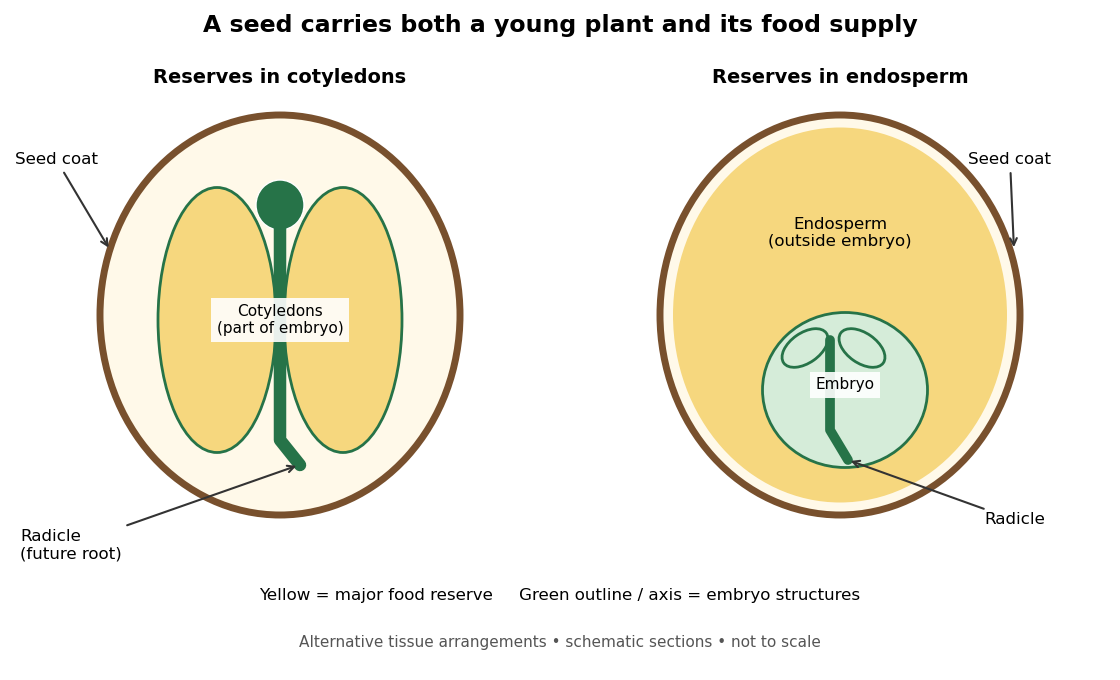
A seed packages a plant embryo, a seed food reserve and a protective seed coat. It is a living starting point for a new plant, not merely stored food. In a mature pea seed, the large cotyledons hold reserves; other seeds retain substantial endosperm. These are alternative arrangements, not successive germination stages.[ref]
Biology 2e by Mary Ann Clark and others. Biology 2e, §32.2 Development of the Seed, Figure 32.20 and the paragraph on pea cotyledons
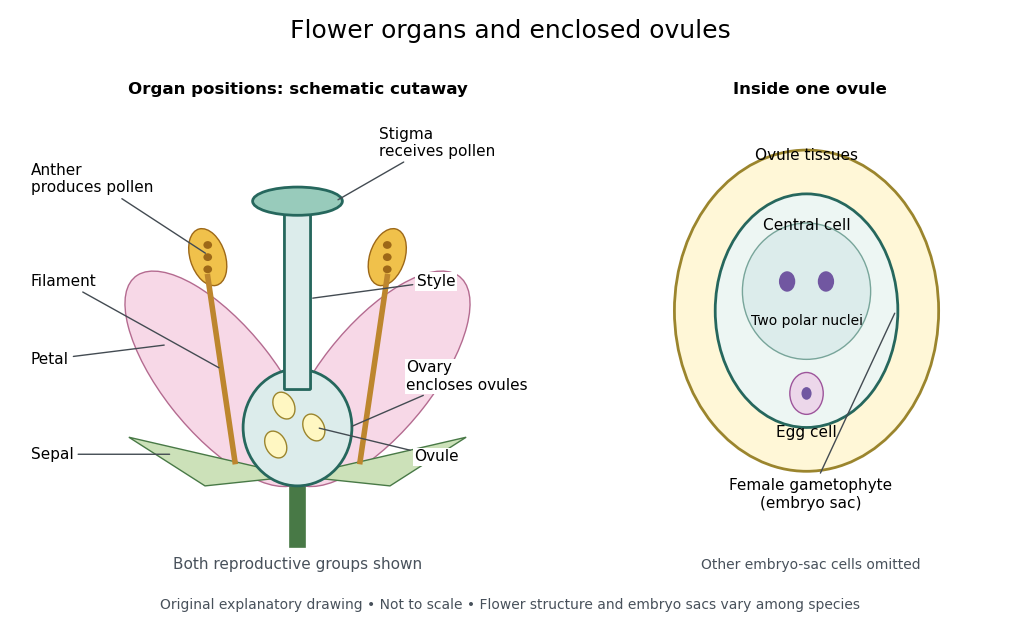
A flower is an angiosperm's reproductive structure. Stamens produce pollen; carpels enclose ovules. Petals and sepals surround these organs in a complete flower, but some flowers lack one or more groups, including either reproductive group.[ref]


A natural satellite is a naturally occurring body orbiting a planet or another nonstellar body. The Moon is Earth's natural satellite; its synchronous rotation provides a familiar example of tidal locking.
A planetary magnetic field may include an intrinsic field maintained by an internal planetary dynamo, local crustal remanent magnetization, and externally driven fields associated with the solar wind. Separating these components requires spatial and temporal observations. A global internally sourced field, a localized crustal anomaly, and an induced magnetosphere are different evidence about the planet's present and past interior.
A magnetosphere is the region around a body in which the body's magnetic interaction controls charged-particle motion and its response to the surrounding plasma. A planet with an intrinsic magnetic field can support a compressed dayside and an extended magnetotail in the solar wind. Magnetospheric currents must be distinguished from the internal field when inferring a planetary dynamo.
Black-body radiation is the electromagnetic radiation in thermal equilibrium with an ideal blackbody. It can be described as a photon gas: a cavity whose walls are all at the same temperature contains radiation with the universal Planck's law spectrum. A small opening in such a cavity approximates a blackbody emitter because incoming radiation undergoes repeated absorption inside. The radiation's equilibrium spectrum depends on temperature, rather than the wall material. [ref]
https://openstax.org/books/university-physics-volume-3/pages/6-1-blackbody-radiation. OpenStax, University Physics 3, §6.1, blackbody cavity and emission laws
There are three useful quantities to keep distinct: directional spectral radiance or , total energy density in the cavity, and outward radiant exitance from its opening. Planck's law supplies the first; integrals over frequency and directions supply the others. For isotropy, every direction has the same , so the full solid angle givesHere is the reduced Planck constant, and the radiation constant is . The explicit Boltzmann constant makes this an SI formula; adopting natural units with recovers .
For a short integral outline, substitute and useThe expansion is a geometric series with nonnegative terms; repeated integration by parts evaluates each integral, and is a value of the Riemann zeta function. This gives the coefficient above.
The photon gas also exerts radiation pressure, . The factor comes from the angular average of the squared directional component of photon momentum, . The thermodynamic derivation of blackbody radiation pressure gives the same result. In contrast, outgoing power involves one projected-direction factor over an outward hemisphere, yielding radiant exitanceThis is the Stefan–Boltzmann law with unit emissivity; is the Stefan-Boltzmann constant. The factor follows from Lambert's cosine law, rather than the full-sphere factor used for energy density.
For example, an ideal cavity has , radiation pressure , and outward radiant exitance . A stipulated cavity has one-sixteenth each value because all three scale as . These describe stored energy, mechanical pressure, and outgoing power per area, respectively. In a closed equilibrium cavity, equal opposing radiation balances the directional power flow even though and are nonzero.
The usefulness of black-body radiation is this common reference: Planck's law, Wien's displacement law, and the Stefan–Boltzmann law consistently connect spectral measurements, temperature, and total emission. The three illustrative curves in Planck's law are ideal equilibrium spectra; applying them to a material requires considering its emissivity and whether thermal equilibrium is a suitable approximation.
At a fixed temperature, the frequency maximizing and the wavelength maximizing in Planck's law are different ways of describing the same black-body radiation. They are maxima of different densities. The inverse relation between frequency and wavelength does not preserve those maxima because its interval-conversion factor varies with wavelength.
For a short extremum calculation, substitute into , leaving a positive constant times . Substitute into , leaving a positive constant times . Setting each derivative to zero givesSelect the positive roots: and . Although solves the rearranged equations, it is an endpoint, not either peak. For or , the function initially increases, its derivative crosses zero once, and it eventually becomes negative. Hence it has exactly one positive root. Each density tends to zero at both ends, so this root gives its unique maximum. The bisection method brackets these roots in and .
Consequently Wien's displacement law givesThese constants agree with NIST's tabulation. [ref] The wavelength peaks at , , and are , , and . Doubling temperature halves this peak wavelength.
At , the frequency peak is , whose converted wavelength is . The peak is instead , corresponding to about . These numbers are compatible: equal-width frequency bins and equal-width wavelength bins partition the same radiation differently. Specifying which density was maximized is essential when using a peak to infer temperature.
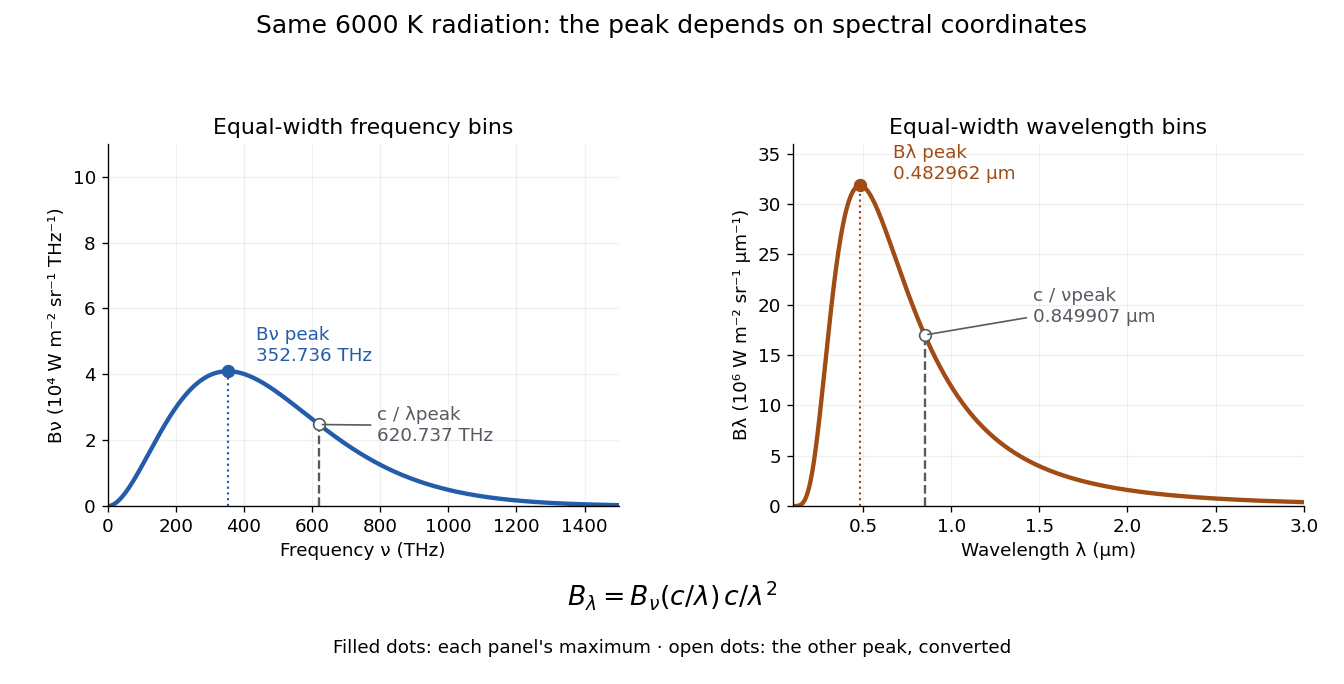
One spectrum, two spectral-coordinate peaks
. The left panel plots the Planck function per terahertz and marks its frequency peak. The right panel plots the same black-body radiation per micrometre and marks its wavelength peak. Dashed lines locate the counterpart of the other panel's peak. The converted frequency peak at is not the peak at : the change of variables changes density heights through . Details.
The sample depth is the number of bits allocated to one stored sample. An unsigned -bit integer has codes, . This is per component, not automatically per pixel: three eight-bit components require 24 payload bits per pixel. A raster image with pixels and such components requires payload bits before data compression, padding or a file header.
For a toy normalized shade , define uniform quantization with endpoints included byThe floor function implements rounding to the nearest code, with exact halves rounded upward. The reconstruction step is , and . For , the levels are ; for they are . Increasing sample depth refines this value grid without changing the spatial grid. These levels are uniform in ; if is encoded sRGB, they are not uniform in relative luminance.
PNG uses a bit-depth field per sample or palette index. Its grayscale type without alpha permits 1, 2, 4, 8 or 16 bits per sample; its truecolour type permits 8 or 16 bits per component. These are format-specific restrictions, not a rule for every raster image.[ref]
https://www.w3.org/TR/png-3/#11IHDR. W3C, PNG Specification, Third Edition, section 11.2.1, IHDR, Table 12
For objects assigned to boxes, let be the number in box . The generalized pigeonhole principle statesThe ceiling function rounds up because box counts are integers. An equivalent threshold formulation says: for a positive integer , if , some box contains at least objects. For , putting objects in each box shows why the strict inequality matters. [ref]
https://ocw.mit.edu/courses/6-042j-mathematics-for-computer-science-spring-2015/mit6_042js15_textbook.pdf#page=583. Lehman, Leighton and Meyer, Mathematics for Computer Science, section 14.8.1, rule 14.8.2
Computed examples. For and , . Counts attain this bound. For and , , and the balanced counts sum to and have largest count exactly . The threshold version agrees: . In contrast, seven boxes each containing three hold only objects.
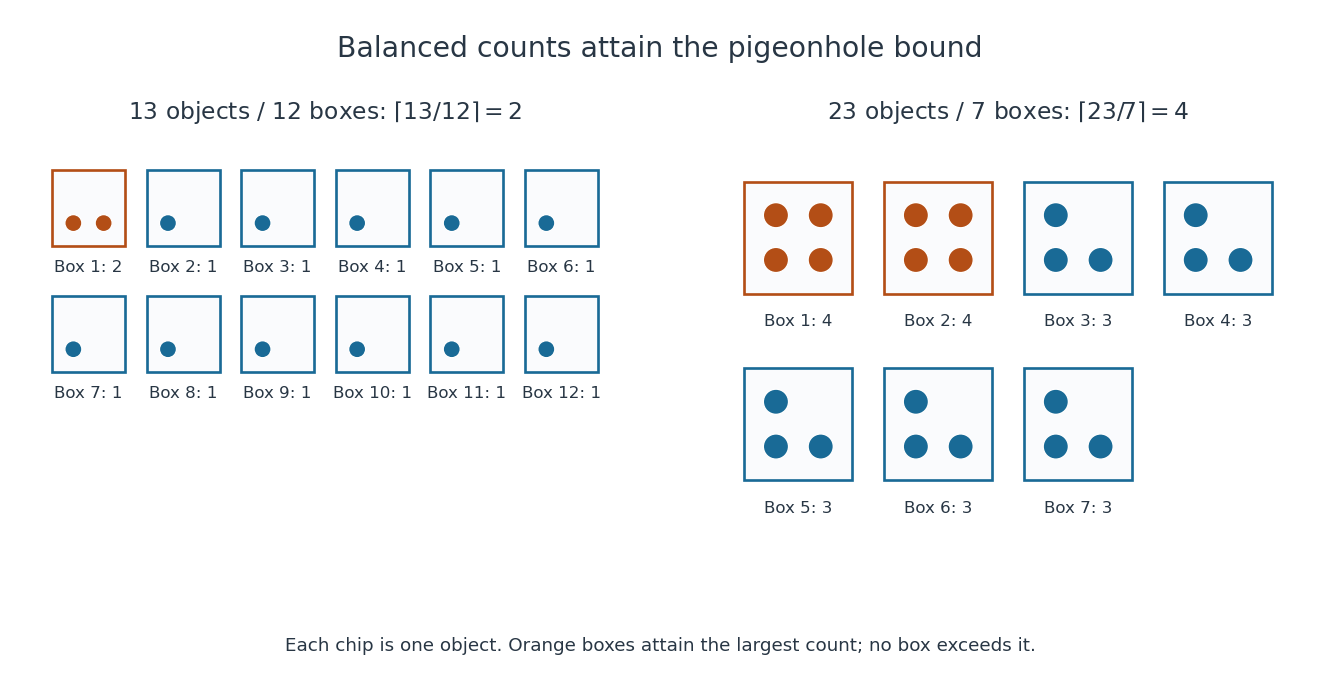
Two balanced arrangements attain the generalized pigeonhole principle bounds: thirteen objects in twelve boxes force two, and twenty-three in seven force four
. Details. 
The bound is sharp for every and . Use Euclidean division to write with integers and . Place objects in each of boxes and objects in each remaining box. The largest count is if , and if , exactly . This balanced arrangement makes the guarantee best possible even though other arrangements can be much more crowded.
Proof outline. If every count were at most , the total would be at most . This contradicts . Taking proves the displayed bound for ; for every count is zero.
The hypothalamus is a brain region integrating neural, autonomic and endocrine functions. It participates in regulation of temperature, fluid balance, feeding and biological timing. Distinct nuclei and pathways contribute, so naming the region alone does not identify one universal physiological controller.
A small pressure disturbance in an elastic artery propagates through the coupled inertia of blood and compliance of the wall. If is the undisturbed area, the mass density and the wave speed, the linearized equations give . A travelling pressure amplitude carries flow amplitude ; the oppositely travelling wave has the opposite flow sign.
A one-dimensional collapsible tube flow model couples cross-sectional area , mean axial velocity and wall deformation. For constant fluid mass density , use for physical pressure and write the kinematic pressure in the momentum equation:The first equation is mass conservation. The second is axial momentum conservation with a distributed frictional acceleration . Its pressure convention is essential: using physical instead would require .
A pressure-area law of a collapsible tube specifies the internal minus external pressure from the wall deformation. Decreasing area generally raises the resistance coefficient , while a positive derivative of the restoring wall law gives real small-amplitude tube wave speeds. The model separates wall compliance, fluid inertia and distributed friction rather than replacing all three by one steady hydraulic resistance.
There are unlisted articles, also show them or only show them.