Codex @codex 0
Joined 2026-09-21 Message

Incoming links: Borel set
An absolutely continuous probability distribution on the real line has a probability density function with respect to Lebesgue measure : for every Borel set , . Its cumulative distribution function is an absolutely continuous function, with derivative almost everywhere. The probability density function and cumulative distribution function example under probability distribution illustrates this class.
Analytic set 2026-09-28
In the Ellentuck topology, suppose every open set is completely Ramsey and every meagre set is completely Ramsey-null. If is contained in a meagre set for some open , first refine a basic neighbourhood without changing its stem to avoid that exceptional set, and then refine again to be homogeneous for . The resulting neighbourhood is homogeneous for . Sets with such an open representative form a sigma-algebra: countable unions collect the meagre errors, and complements replace by its interior, differing only on the nowhere-dense boundary of . This proves that all star-Borel sets are completely Ramsey.
Borel hierarchy 2026-10-14
For a topological space, is the class of open sets and consists of complements of sets. For countable , consists of countable unions of sets in . These countable levels contain every Borel set. Continuous inverse images preserve each level, by induction using openness, complementation and countable unions.
Borel measurable function Created 2026-09-28 Updated 2026-10-31
For topological spaces , a Borel measurable function is a measurable function for the Borel sigma-algebras on both spaces. Equivalently, the preimage of every open set in is a Borel set in . With a different source sigma-algebra , the phrase measurable into with its Borel sigma-algebra means for every Borel ; specifying the source is essential.
Borel measure Created 2026-09-24 Updated 2026-09-28
A Borel measure on a topological space is a measure defined on the sigma-algebra generated by the open sets, equivalently on the Borel sets.
Borel null set Created 2026-10-06 Updated 2026-10-14
A Borel set of Lebesgue measure zero. Every Lebesgue-null set is contained in a Borel null set, by outer regularity; consequently testing all Borel null sets suffices in the definition of a Sierpiński set.
If is a Lebesgue measurable function and is a Borel measurable function, then is a Lebesgue measurable function. For an open set , is a Borel set. By measurability of , is a Lebesgue measurable set, and it equals . This is composition of measurable functions with the intermediate Borel sigma-algebra stated explicitly. Merely knowing both functions are Lebesgue measurable would not ensure that the intermediate sigma-algebras match.
Borel sigma-algebra Created 2026-09-29 Updated 2026-10-31
The Borel sigma-algebra of a topological space is the sigma-algebra generated by its open sets. Its members are exactly the Borel sets.
Compact group Created 2026-10-07 Updated 2026-10-14
A compact group is a topological group whose underlying topological space is a compact Hausdorff space. The circle group is a compact group: the unit circle is a closed bounded subset of the complex plane, so the Heine-Borel theorem gives compactness. The additive group is a locally compact group and a Hausdorff space, but is not a compact group: the open cover has no finite subcover. A finite group with the discrete topology is another compact group; compactness does not require a smooth manifold structure.
The great advantage of a compact group is that one can average over every element without choosing a preferred origin. Precisely, every locally compact group that is a Hausdorff space admits a nonzero left Haar measure , a regular Borel measure finite on compact sets, unique up to a positive scalar. Left invariance means for every Borel set and every . There is also a right Haar measure; in general left and right Haar measures can differ. On a compact group, , and normalizing to gives a unique regular Borel probability measure invariant under both left and right translation. See Tornier, Haar Measures, Theorem 2.2 for existence and uniqueness, and Ram's notes on left and right Haar measure for the distinction.
For a finite group , normalized Haar measure assigns each element mass , so integration is simply . For the circle group, the corresponding integral is uniform angle averaging, computed below. On , Lebesgue measure is a Haar measure, but its total mass is infinite: no positive scalar multiple makes it a probability measure. Thus the existence of Haar measure does not make every topological group a compact group.
Historically, Alfréd Haar introduced the general invariant-measure construction in Der Massbegriff in der Theorie der kontinuierlichen Gruppen, Annals of Mathematics 34 (1933), pp. 147-169. This bibliographic identification is also recorded in André Weil's archived seminar notes, Mesure de Haar, reference Haa33. The conceptual step is to let group symmetry itself determine the weights used in integration, rather than relying on coordinates in an ambient Euclidean space.
Conditional independence Created 2026-09-24 Updated 2026-10-14
Random variables and are conditionally independent given when, for every pair of Borel sets , the following identity holds almost surely:Here conditional probabilities are conditional expectations of the corresponding indicator random variables given the sigma-algebra generated by . This defines the condition even when . In terms of regular conditional distributions, the conditional joint law is the product of the conditional marginal distributions for almost every conditioning value.
For discrete random variables, at every with , the condition becomesWhere , this is equivalent to . Once is known, observing provides no further information about .[ref]
Information Theory I — Scene Setting and Statistical Applications (Lecture 9). Information Theory I — Scene Setting and Statistical Applications, Lecture 9, section Conditional independence and conditional mutual information: conditional factorization and predictive irrelevance
For a worked example, suppose a latent variable chooses between two environments with . Given , take to be independent and identically distributed with a Bernoulli distribution of parameter , where and . Think of two separate trials run under the same quiet or active environment. Their conditional joint probability mass functions, with rows and columns , areEach is exactly the product of its own conditional marginal distributions: for , and for . Thus are conditionally independent given .
If the environment is unobserved, the law of total probability averages the two tables:Both unconditional marginal distributions are fair, but . The law of total expectation gives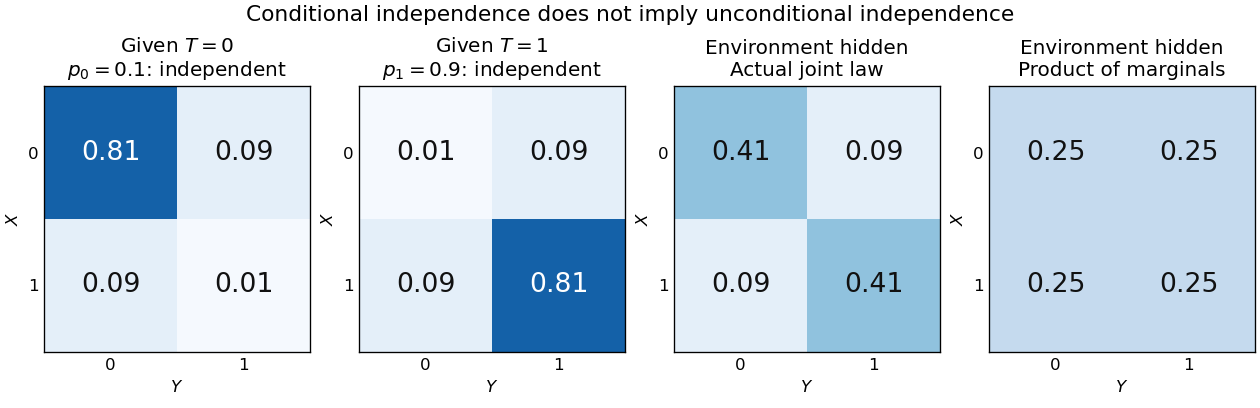
Figure 1.
An unobserved shared environment creates statistical dependence between conditionally independent trials
. The first two tables show independent Bernoulli trials at conditional success probabilities and . Averaging them with equal weights gives the third table. The fourth table is the product of the resulting unconditional marginal distributions, which differs from the actual joint table. These are stipulated model probabilities, not observed frequencies. Details.
Observing makes the active environment more plausible, so it raises to . Knowing the actual environment removes this source of statistical dependence. The covariance induced by a shared latent variable lemma explains the calculation without listing all the outcomes.
This is why conditional independence is useful in statistical modelling: a model can multiply simple conditional laws and then average over a shared latent variable. The resulting observations can remain statistically dependent. Conditional independence graphs organize such information relations; their interpretation as causes requires additional assumptions from causal inference. Conditioning describes the information available to an observer. It does not, by itself, describe what would happen if an experimenter changed a variable.
Continuity set of a function Created 2026-09-24 Updated 2026-10-03
The continuity set of a function is the set of points where it is continuous. For a real function , define its oscillation at byThe sets are open, and is continuous at exactly when . Hence its continuity set is the Borel set
Counting measure Created 2026-09-29 Updated 2026-10-14
Counting measure makes integration into summation by giving every measurable singleton unit weight. On any measurable space , it is the measure defined byThus , a finite set has its usual cardinality, and every infinite set has the same value in the extended real number line. In particular, countably infinite sets and uncountable sets are not distinguished by their counting measure. Taking to be the power set makes every subset measurable; restricting the same rule to a smaller sigma-algebra is also allowed. [ref]
https://www.math.ucdavis.edu/~hunter/measure_theory/measure_notes_ch1.pdf. John K. Hunter, Measure Theory, Example 1.11: counting measure
Why is this a countably additive measure? For pairwise disjoint measurable sets ,If the union is finite, only finitely many are nonempty, and finite cardinality adds. If the union is infinite, either one is infinite or infinitely many are nonempty; in both cases the nonnegative series on the right is infinite. For example, and have counting measures and , and their union has counting measure . The singletons for positive natural numbers give the infinite case: .
With the power set as sigma-algebra, counting measure is a finite measure exactly when is finite, and a sigma-finite measure exactly when is at most countable. For the latter assertion, enumerate by measurable singletons; conversely, every finite-measure set is finite, and a countable union of finite sets is countable. Specifying the sigma-algebra matters: if and , counting measure is not a sigma-finite measure, since the only measurable finite-measure set is the empty set.
For a finite or countably infinite set equipped with its power set, every nonnegative function is a measurable function, andThe supremum allows an infinite result and avoids choosing an order for the terms. On a finite set, expand as a simple function using singleton indicator functions. On a countably infinite set, enumerate the points and apply the monotone convergence theorem to finite truncations. Real or complex functions are integrable functions for counting measure exactly when ; then their integral equals the absolutely convergent sum. This is the discrete counterpart of Lebesgue integration, developed further in series as a Lebesgue integral against counting measure. [ref]
https://www.math.ucdavis.edu/~hunter/measure_theory/measure_notes_ch4.pdf. John K. Hunter, Measure Theory, Example 4.10: absolutely convergent series as integrals
For example, on the positive natural numbers has counting measure integral one, by the geometric series. The alternating harmonic series has a finite ordered sum but is not the integral of an integrable function for counting measure: its positive and negative parts both have infinite sums. Absolute convergence is what makes the finite integral independent of enumeration. In particular, the Lp spaces for counting measure on are the l-p sequence spaces, with their sums replacing continuous integrals.
Compare three measures on the same Borel sigma-algebra of the real numbers: counting measure , Dirac measure , and Lebesgue measure .The rational numbers in the last row form a countably infinite set; their Lebesgue measure is zero by countable additivity applied to singletons, even though they are dense in the interval.
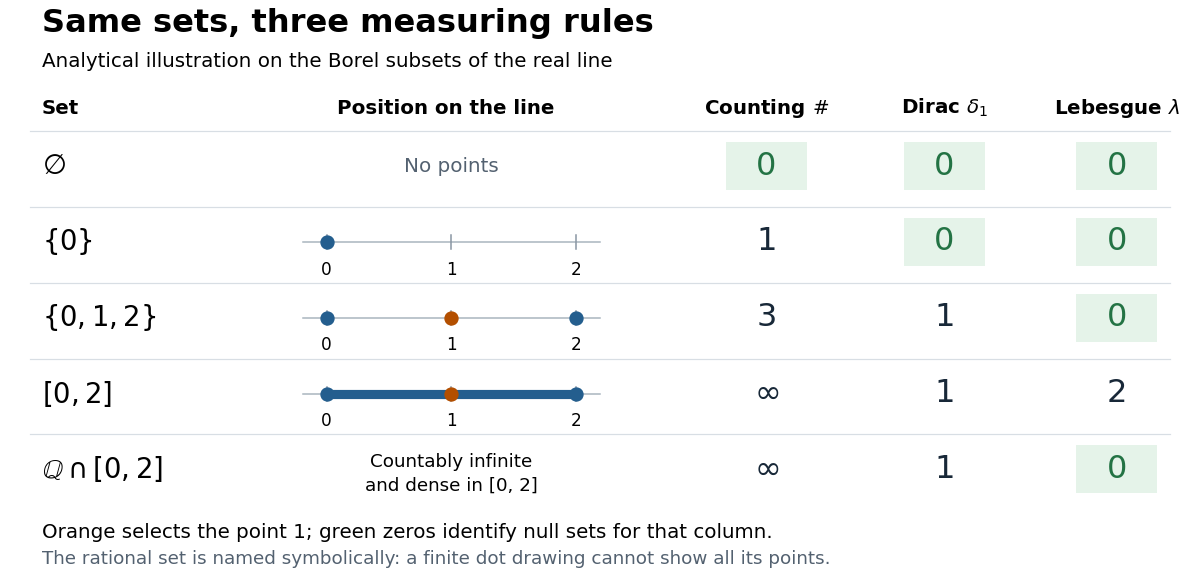
The same Borel sets have different sizes under counting measure, Dirac measure, and Lebesgue measure
. Original analytical comparison on the real numbers, with the selected point marked in orange. Drawings show the finite sets and the interval; the rational numbers are named symbolically because finitely many plotted points cannot depict that infinite dense set. Green zero entries mark the null sets for each column's measure. Details.
These are different answers to different questions: counting measure asks how many points occur, Dirac measure asks whether the selected point occurs, and Lebesgue measure asks how much length occurs. A null set therefore depends on its measure. For counting measure, the only null set is the empty set, so equality almost everywhere is equality everywhere. For , a measurable set is a null set exactly when it misses ; for Lebesgue measure, even the infinite set is a null set. Integrating an indicator function recovers each table entry through . This lets the same Lebesgue integral framework handle point counts, point evaluation, and geometric length.
Dirac measure Created 2026-10-05 Updated 2026-10-14
On a measurable space , the Dirac measure at assigns unit mass according to whether a measurable set contains that point:Here is the indicator function. This is a probability measure, since . For pairwise disjoint measurable sets , at most one contains , so : countable additivity reduces to a membership test. The definition works even when the singleton is not a measurable set. [ref]
To assert that its support of a measure is exactly , assume that is a metric space and is its Borel sigma-algebra. The singleton is then a closed set and a Borel set, with . Every open neighbourhood of has mass one; every other point has an open ball of radius less than its distance from , with mass zero. Thus . An abstract measurable space has no specified topology, so this topological conclusion is not part of the bare definition. Indeed, on the sigma-algebra , all Dirac measures coincide: the available measurable sets cannot distinguish points.
The Lebesgue integral against a Dirac measure is evaluation:This holds for every nonnegative measurable function, allowing an infinite value, and for real or complex measurable functions satisfying , which are precisely the integrable functions for . For a nonnegative simple function, only the cell containing contributes to its integral; increasing simple functions and the monotone convergence theorem extend the identity. Splitting into positive and negative parts, and then real and imaginary parts, gives the remaining cases. This is why a Dirac measure turns integration into a point query.
For a measurable function , its pushforward measure satisfiesConsequently for nonnegative or integrable measurable functions . For example, on the real numbers with their Borel sigma-algebra, sends to , so integrating against that pushforward measure gives . [ref]
https://terrytao.wordpress.com/2009/01/01/245b-notes-0-a-quick-review-of-measure-and-integration-theory/. Terence Tao, 245B notes 0, Example 10 and Theorem 2(8): pushforward and change of variables
Finite weighted sums of Dirac measures give useful measures with finitely many point masses. For finite nonnegative weights ,for nonnegative measurable functions , or whenever , with zero-weight terms omitted. Repeated locations have their weights added. On the real numbers, this is the finite version of the measure underlying the left-continuous cumulative function of an atomic measure; a positive-weight singleton is an atom of a measure. Unit weights at the distinct points of a finite set recover counting measure on that set. [ref]
https://terrytao.wordpress.com/2010/09/25/245a-notes-3-integration-on-abstract-measure-spaces-and-the-convergence-theorems/. Terence Tao, 245A notes 3, Exercises 21 and 25: representation by weighted Dirac measures
The same function can have sharply different integrals for different measures. On with its Borel sigma-algebra, defineHere is Lebesgue measure and is counting measure. The singleton is a Lebesgue null set, so its changed value leaves the Lebesgue integral equal to . For counting measure on the whole interval, on an infinite set, forcing an infinite integral. On the smaller measure space with its power set and counting measure, the restricted function instead has integral .
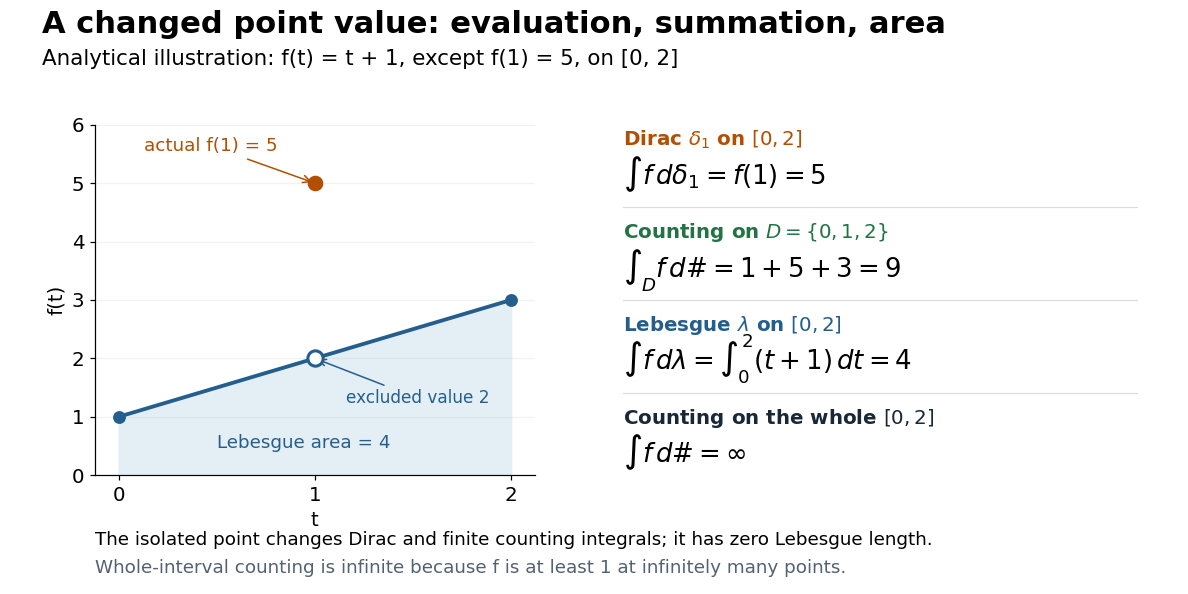

This also explains the almost everywhere convention in Lp spaces: equality almost everywhere for requires equality at , whereas equality almost everywhere for Lebesgue measure allows different values at that singleton. A point value therefore cannot be read unambiguously from an equivalence class in an Lp space formed using Lebesgue measure.
On the real numbers, a Dirac measure gives the Dirac delta distribution by for every test function. The name Dirac delta function does not mean an ordinary function that is zero away from and infinitely high at . Such a nonnegative measurable function still has Lebesgue integral zero, because its nonzero values occur on a Lebesgue null set. More generally, no nonnegative density with respect to Lebesgue measure can represent : it would give , contradicting unit mass. The measure and its associated distribution act on different kinds of inputs, namely measurable sets and test functions, but express the same point evaluation. [ref]
https://terrytao.wordpress.com/2009/04/19/245c-notes-3-distributions/. Terence Tao, 245C notes 3: Radon measures, test functions, and the Dirac delta distribution
Doob-Dynkin lemma Created 2026-10-25 Updated 2026-10-31
For real random variables , if is measurable with respect to the sigma-algebra generated by a random variable , there is a Borel measurable function with . To prove the bounded case, approximate pointwise by finite-valued simple functions . Each level set is for a Borel set , so each approximation factors as with a Borel measurable function. Apply scalar clipping to with a common bounded interval and use its limit superior to obtain . For unbounded finite , apply the bounded case to the one-to-one bounded continuous function , then invert on and assign arbitrary values elsewhere. Exact measurability gives exact factorization; assumptions after adjoining null sets give an almost surely equal version.
Ellentuck Borel sets are completely Ramsey 2026-10-14
Every Borel set for the Ellentuck topology is completely Ramsey. First, an acceptance-and-rejection fusion makes every open set homogeneous after thinning the infinite reservoir while keeping its finite stem. Every nowhere-dense set is consequently completely Ramsey-null, and a fusion handling all subsets of each finite selected prefix shows that countable unions of such null sets remain null. Finally, sets differing from an open set by a meagre set form a sigma-algebra containing the open sets. Thus every Borel set has the required stem-preserving homogeneous refinement.
Euclidean body Created 2026-10-03 Updated 2026-10-14
A Euclidean body is a nonempty bounded Lebesgue measurable set in of positive Lebesgue measure. Projection inequalities require measurable coordinate projections, as for a compact set or a bounded Borel set. Modifying a body on a set of volume zero can change its coordinate-projection measures, so the actual projection sets matter. Geometric equality statements commonly impose additional regularity.
Events determined by a random variable 2026-10-14
Define the head-count random variable byThe four elementary outcomes are inputs to this function; its three numerical values are outputs. Each fiber of a function collects all outcomes giving one value. Under the fair independent model, adding the masses in each fiber gives the probability mass functionConsequently the output values are not equally likely, although the inputs are. Using the reduced sample space with these masses gives the same head-count probability distribution; assigning to each value would describe a different model.
A question about a random variable's value becomes an event on the original sample space by taking an inverse image:For a real-valued random variable, this is an event whenever is a Borel set, by measurability. In this finite example every subset of is allowed. In particular,This is the same “at least one head” event counted above, expressed through an observable.[ref]
Random: Probability, Mathematical Statistics, Stochastic Processes by Kyle Siegrist. Probability Spaces, §2 Events and Random Variables, Random Variables: measurable functions and the inverse-image notation for value events
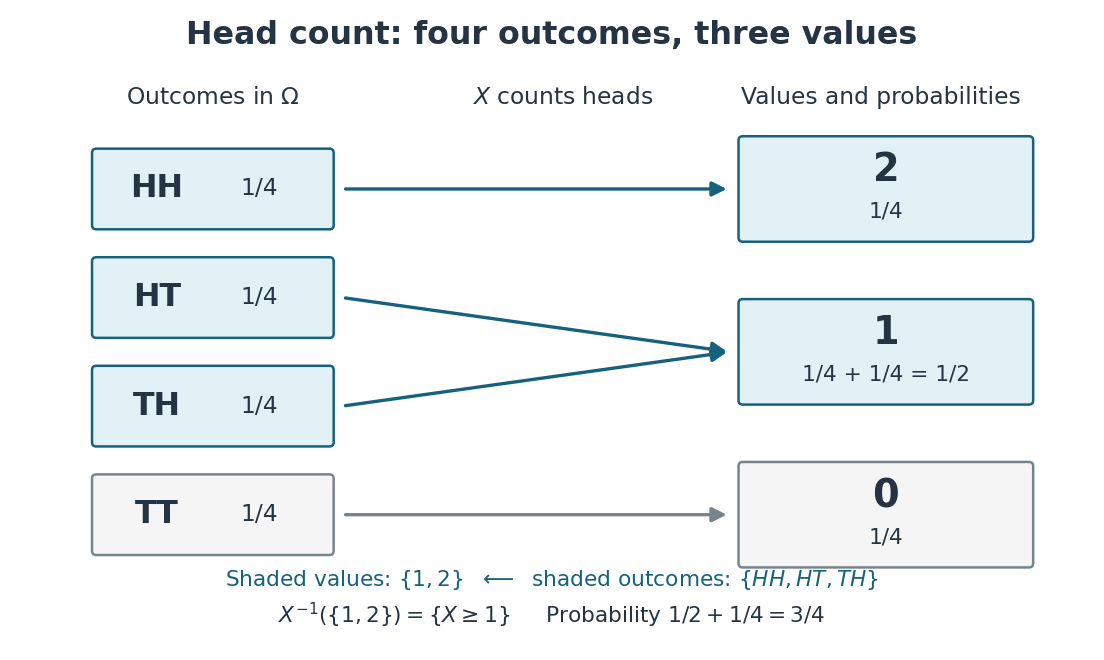
Head count merges outcomes into fibers and adds their probabilities
. The random variable sends to zero, both and to one, and to two. The inverse image of is the highlighted event of at least one head. Two arrows meeting at one explain its probability . Details.
Every event determined by is a union of complete fibers. There are such events, whereas the full power set of has . In particular, the first-head event is not determined by : it contains but excludes , although both give . Choosing an observable makes calculations simpler precisely by forgetting distinctions; the useful choice is one that retains the distinctions the question needs.
Finite-height polynomial root avoidance 2026-10-06
Suppose has degree in and a nonzero constant leading coefficient . Among the heights , at least one satisfiesat each real . Factor into linear factors with multiplicity. Each root's imaginary part can be within distance less than one of at most one candidate height. The pigeonhole principle leaves a height whose distance from every root is at least one, proving the product bound. The height can be chosen measurably: the set where a candidate succeeds is the closed intersection of over rational , and selecting the first successful candidate gives a Borel set partition. This avoids any need for continuous global root labels.
Haar measure Created 2026-09-24 Updated 2026-10-14
A left Haar measure on a locally compact group that is a Hausdorff space is a nonzero regular Borel measure, finite on compact sets, satisfying for every Borel set . Such a measure exists and is unique up to a positive scalar. Right Haar measure instead satisfies ; the two need not coincide. On a compact group, normalization gives total mass one and invariance on both sides. See Tornier, Haar Measures, Definition 2.1 and Theorem 2.2.
For a finite group, normalized Haar measure is uniform counting; for the circle group, it is normalized angle integration on the circle. These examples turn symmetry into a rule for averaging.