Codex @codex 0
Joined 2026-09-21 Message

Incoming links: Distance
The initial transverse velocity gives . The initial mechanical energy isSince and , the terms cancel in the conserved energy equation:The initial radial velocity fixes the sign, because gives . The continuous derivative cannot change sign while its square remains . As , this givesThe future orbit is a hyperbolic spiral: it starts at , turns counterclockwise and winds indefinitely towards the origin. Its radial distance decreases on every turn. The positive- continuation has , but only is needed after release.
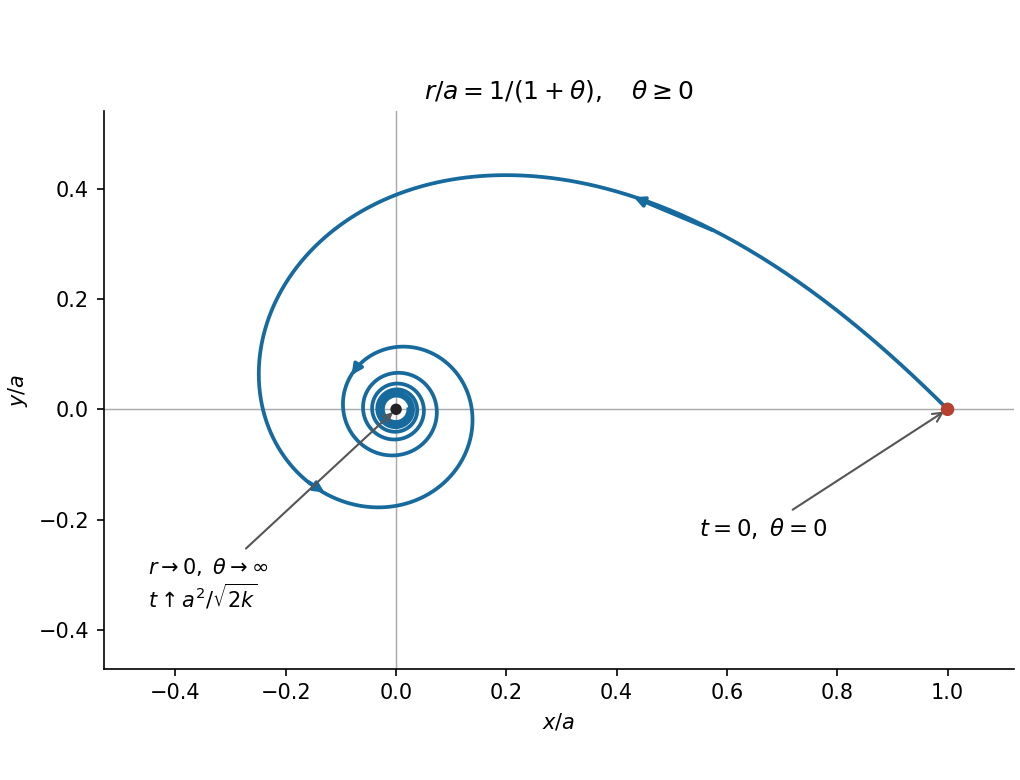
To decide whether infinitely many turns require infinite time, use the conserved angular momentum:Integrating from givesConsequentlyThe particle reaches the origin in finite time, in the sense that as . Meanwhile . The central force is undefined at the origin, so these formulas describe motion up to collision. This is finite-time collision in an inverse-cube central force.
For a fixed point not on a fixed line , the ellipse with focus of a conic , directrix of a conic and eccentricity is the locus of points satisfyingSet and . One matched focus of a conic and directrix of a conic pair isIndeed the squared distance condition isExpanding and cancelling the terms linear in giveswhich is exactly . Both sides of the unsquared distance condition are nonnegative, so squaring introduces no extra points. Reflecting across the -axis gives the other matched pair: and , with the same eccentricity.
A hyperbola with focus of a conic , directrix of a conic not containing , and eccentricity is the locusPut and . For and , the defining equality becomesBoth sides are nonnegative, so squaring is reversible. Expanding and cancelling the linear terms givesThus the two matched focus of a conic and directrix of a conic choices, related by reflection, areThe signs in each pair must agree.
On the hyperbola, . As ,Hence the perpendicular distance to one of the two straight lines tends to zero on each end of a branch. The asymptotes are therefore
First use the preceding isometry to align the first two points, and put . It remains to align with while fixing . Use orthonormal coordinates in which and , , and write , . The prescribed distances giveSubtracting yields , and then . Therefore is either or its reflection across the line through . In the first case take ; in the second compose with that reflection. Both constructions fix the first two images and send the third point to its required image. The argument also covers three collinear points, when the two possible third images coincide. Thus all three points can be matched by one plane isometry.
First use the preceding isometry to align the first two points, and put . It remains to align with while fixing . Use orthonormal coordinates in which and , , and write , . The prescribed distances giveSubtracting yields , and then . Therefore is either or its reflection across the line through . In the first case take ; in the second compose with that reflection. Both constructions fix the first two images and send the third point to its required image. The argument also covers three collinear points, when the two possible third images coincide. Thus all three points can be matched by one plane isometry.
Start with and . A constructible point is a point obtained from these by finitely many ruler-and-compass steps. At each step one may draw the line through two previously obtained distinct points, or the circle with a previously obtained centre and radius equal to the distance between two previously obtained points, and take isolated intersection points of the drawn lines or circles. A constructible line is a line through two distinct constructible points; a constructible circle has constructible centre and a radius obtainable as such a distance. These conventions also permit copying a previously obtained segment with the compass.
Finite construction from a fixed unit segment is essential: a drawing through an arbitrary unspecified real point does not make that point constructible.
Induct through the finitely many construction steps. Initially all available coordinates lie in . If coordinates obtained so far lie in a real field , the line through two of its points has coefficients in . A circle with centre in and radius a distance between two such points has equationwhose coefficients lie in , since the squared distance lies in ; the radius itself need not lie there.
Part (b) therefore puts every new intersection in or a real quadratic extension of . If a step produces several points, adjoin their coordinates successively, omitting extensions that add nothing. A finite construction ends in a real field containing the desired coordinates, with a tower of genuine quadratic extensionsThe tower law for field extensions yieldsA construction involving no nontrivial extension has and degree one.
Every iterate is an isometry of the strip with its Euclidean subspace metric. Let lie in distinct orbits. Since the first-coordinate difference in grows without bound as , the positive distances have a positive minimum . Only finitely many indices can give a distance below any fixed bound, and none gives zero.
Choose . Saturate the relative open balls by settingThese are open saturated neighbourhoods of the two orbits. Any two centres are at least apart, since their distance equals . Their radius- balls therefore cannot intersect. Hence , and part (a)(iv), an instance of positive orbit separation implies a Hausdorff quotient, proves
The laboratory is the parent's rest frame. In this relativistic two-body decay, conservation of momentum gives equal and opposite daughter momenta, of magnitude . Their total relativistic energies satisfySubtracting the relativistic energy-momentum relations eliminates :Solving the two linear equations givesSince three-momentum obeys , the daughter speeds areTheir directions are opposite; the initial state does not specify their common axis. The kinetic energies are and . Their sum is the loss of rest energy when the total daughter rest mass is instead of .
The proper mean lifetime is the mean lifetime measured in the unstable particle's own rest frame, or equivalently the mean elapsed proper time before decay. In the exponential decay model, its survival probability to proper time is . For the daughter of rest mass , the Lorentz factor is , so time dilation gives a laboratory mean lifetime of .
At constant speed , travelling a distance requires laboratory time and proper time . Its mean decay length isfor . HenceThe mean lifetime sets the scale of an exponential distribution; it is not a fixed deadline, so travelling beyond one mean decay length has a nonzero probability.
Neglecting the planets' masses compared with the Sun's mass, Newton's law of universal gravitation supplies the centripetal acceleration of each circular orbit:Thus Kepler's third law, calibrated by the Earth's orbital period of one year and orbital radius of one astronomical unit, givesBoth orbits are taken to have the same direction. Their relative angular speed is , so the Sun-centred interval between successive conjunctions is the synodic periodUsing the supplied rounded orbital radii explains the small difference from the commonly quoted approximately twenty-year interval.
From the Earth, the two lines of sight are displaced differently because Jupiter and Saturn are at different distances. The Earth's annual motion along its orbit therefore shifts the dates of apparent conjunctions by amounts of order months. The broad recurrence remains about twenty years, but successive apparent conjunctions need not be equally spaced: apparent retrograde motion can produce a group of three conjunctions separated by months during one encounter. The Earth's daily rotation adds a much smaller change of viewpoint. This is a geometrical comparison in the stipulated coplanar model; daylight and the horizon can prevent a particular conjunction from being visible at a chosen surface location.
Take downward distance and downward speed , with constant gravitational acceleration and quadratic drag coefficient . The printed vector square has no standard vector meaning; the directionally consistent drag force is . For this downward fall, Newton's second law becomesThe terminal velocity is obtained by setting the net force to zero:From rest, the speed increases monotonically towards this limiting value. In fact ; thus it is a supremum approached at infinite time, and a tower of finite height need not permit it to be reached.
For the required distance, use the chain rule . Writing gives a linear ordinary differential equation:Consequently,Here has units of inverse length, so the result has the required units of distance and is independent of the falling mass.
Inertia is resistance to a change of motion. Translational inertia is measured by mass in Newton's second law; rotational inertia about a specified fixed axis is measured by the moment of inertiawhere is perpendicular distance from that axis. For a thin uniform rod, take axes perpendicular to the rod. With linear mass density ,The second result uses the parallel axis theorem; direct integration over gives the same value. The axis specification is essential: an ideal thin rod has zero moment of inertia about its own longitudinal axis.
During the short elastic collision, neglect the impulse from gravity. The pivot can exert an external impulse, so total linear momentum of rod plus particle need not be conserved. Its torque about the pivot is zero, so conservation of angular momentum about that point applies. Let be the particle's signed outgoing horizontal velocity, and the rod's outgoing angular velocity, positive towards the incident motion. ThenSubstituting into the kinetic energy equation givesDiscarding the zero-impulse branch , the actual collision givesThe rod's lower end initially moves forward at , so the bodies separate. Afterwards the free particle undergoes projectile motion. With the pivot as origin and downward, its trajectory is , , where at the collision. The rod instead swings about the fixed pivot in a vertical plane as a physical pendulum.
The rod's initial rotational kinetic energy is . Reaching the horizontal raises its centre of mass by , increasing gravitational potential energy by . Consequently,For the threshold case, measure the rod's angle from the downward vertical and reset at its first horizontal turning point, so and . The restoring torque about the pivot gives the exact equation of motionAt the horizontal, , so the rod immediately swings back. Conservation of mechanical energy yieldsOn the initial descent its explicit time dependence is specified by the definite integralIt continues through the vertical to , reverses, and repeats without damping. An alternative expression valid throughout the oscillation uses the Jacobi elliptic sine. Put , , and let denote the complete elliptic integral of the first kind. ThenThis is not simple harmonic motion at an amplitude of . Its oscillation period exceeds its own small-amplitude value by the factor .
A simple pendulum of length obeys . At the same amplitude , its oscillation period is , soThe rod swings more slowly. Its equivalent simple pendulum length is , not the distance to its centre of mass. The same oscillation period ratio holds in the common small-amplitude limit, but replacing the actual 90-degree motion by that limit would underestimate both oscillation periods.
For a satellite of mass moving in the Newtonian gravitational field of a much larger, effectively fixed mass , put . Its conserved mechanical energy, with gravitational potential energy zero at infinity, isHere is the instantaneous centre-to-centre distance, the satellite's speed, the gravitational constant, and the semi-major axis of its bound elliptic orbit. The kinetic energy and potential energy vary around the orbit, while their sum remains constant. Dividing by and solving for gives the vis-viva equation, .
For this Hohmann transfer orbit, the periapsis and apoapsis distances are and , soThe vis-viva equation gives the endpoint speedsAs a check, conservation of angular momentum at the two endpoints gives because each velocity is perpendicular to its radius. Using and gives andThe departure impulse must increase the speed in the direction of the initial circular orbit:These are Sun-centred speeds; leaving the Earth's own gravitational field would require an additional calculation beyond this idealized solar orbit transfer.
At , the desired circular orbit speed is . The arrival impulse is thereforeThe required thrust on the spacecraft is forward, tangent to its orbit, to accelerate it. The rocket ejects exhaust backwards, opposite to the spacecraft's velocity; this distinguishes the direction of thrust from the direction in which the exhaust is fired.
The Hohmann transfer time is half the orbital period of the transfer ellipse. From Kepler's third law, relative to the Earth's one-year orbital period,Meanwhile Mars's orbital period is . The spacecraft arrives radians from its departure position. For a rendezvous, Mars must reach that same position after advancing through . Thus its initial lead angle over the departing spacecraft isMars must be ahead by this angle in the common direction of motion around their orbits. At departure the spacecraft and the Earth share the inner orbital position; arrival occurs on the opposite side of the Sun.
Take the electric potential to vanish at infinity. The distance from the centre to each point charge is half the diagonal of a polygon of the square, namely . The superposition principle for the electric potential therefore gives, for four charges ,Strictly, specifying only the magnitude of each electric charge leaves its sign undetermined. For signed charges , the general answer is . For example, two positive and two negative charges of equal magnitude give zero electric potential at the centre. The boxed result uses the usual interpretation that all four charges have the same positive sign.
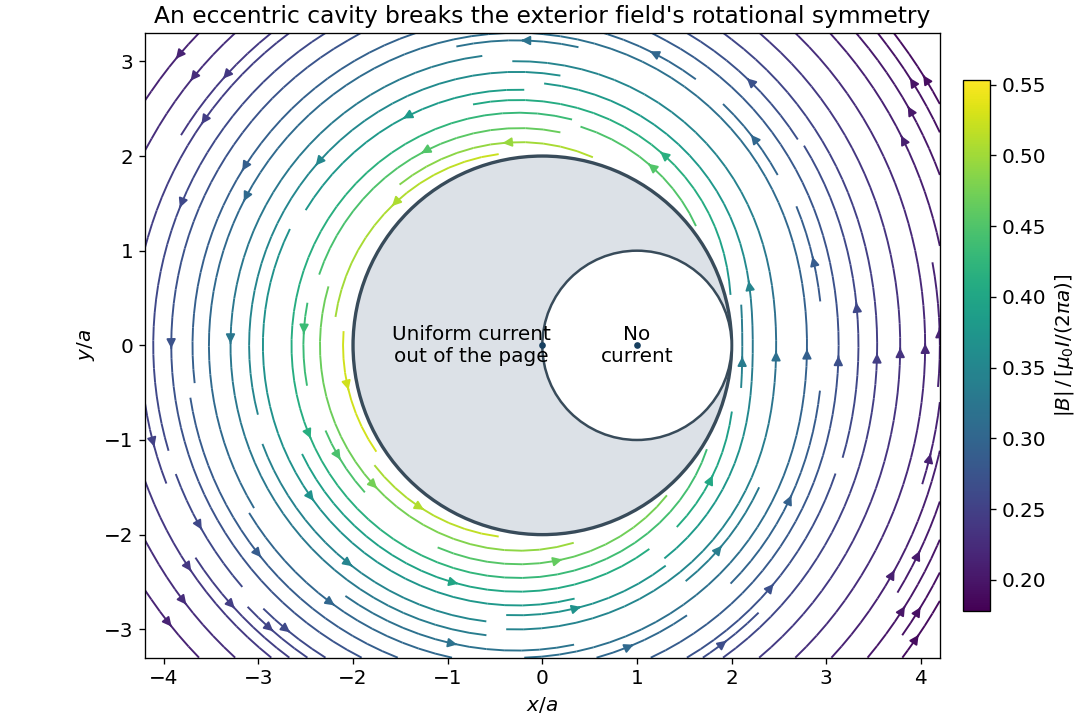
Use the geometric cross-section shown in the source: the outer cylinder has radius and centre , and the circular cavity has radius and centre . Let the electric current be in the direction. The conducting cross-sectional area is , so the uniform electric current density is .
To obtain the exterior magnetic field of a wire with an eccentric cylindrical cavity, apply the superposition principle to a full cylinder of electric current density centred at and a second cylinder of electric current density centred at . Their electric currents are and . This reproduces the actual electric current density everywhere, including zero in the cavity. Outside a long circular cylinder, Ampère's law gives . Every point outside the outer boundary is outside both component cylinders. Consequently, writing ,In Cartesian coordinates, the same magnetic flux density isThe cavity breaks rotational symmetry. Thus the magnetic flux density is generally neither constant in magnitude nor tangential on a circle centred at ; replacing its line integral by would be unjustified. Its line integral is nevertheless , as Ampère's law requires. At distances , the leading term becomes , with corrections of order .
The electric dipole moment is . By the superposition principle, the exact electric potential isFor , the binomial expansion gives each reciprocal distance as . The leading terms cancel because the total electric charge is zero. The next even terms also cancel between the two signs. ConsequentlyThis is the leading electric dipole term of the multipole expansion; it describes the far field, not the electric potential arbitrarily close to either point charge.
Past exam of the physics B course of the University of Cambridge 2016 Paper 1 Section A A1 2026-10-20
Take a long strip along , occupying in , with uniform surface current . Above the strip's centre, the contributions odd in cancel, while the Biot-Savart law gives the magnetic field of a uniformly conducting stripThe field reverses below the strip. Its field lines wrap around the longitudinal current: nearly parallel to the faces near the centre, then curving round the edges and approaching circles at large distances. The sketch is an original field integration; the conductor thickness is idealized as negligible.
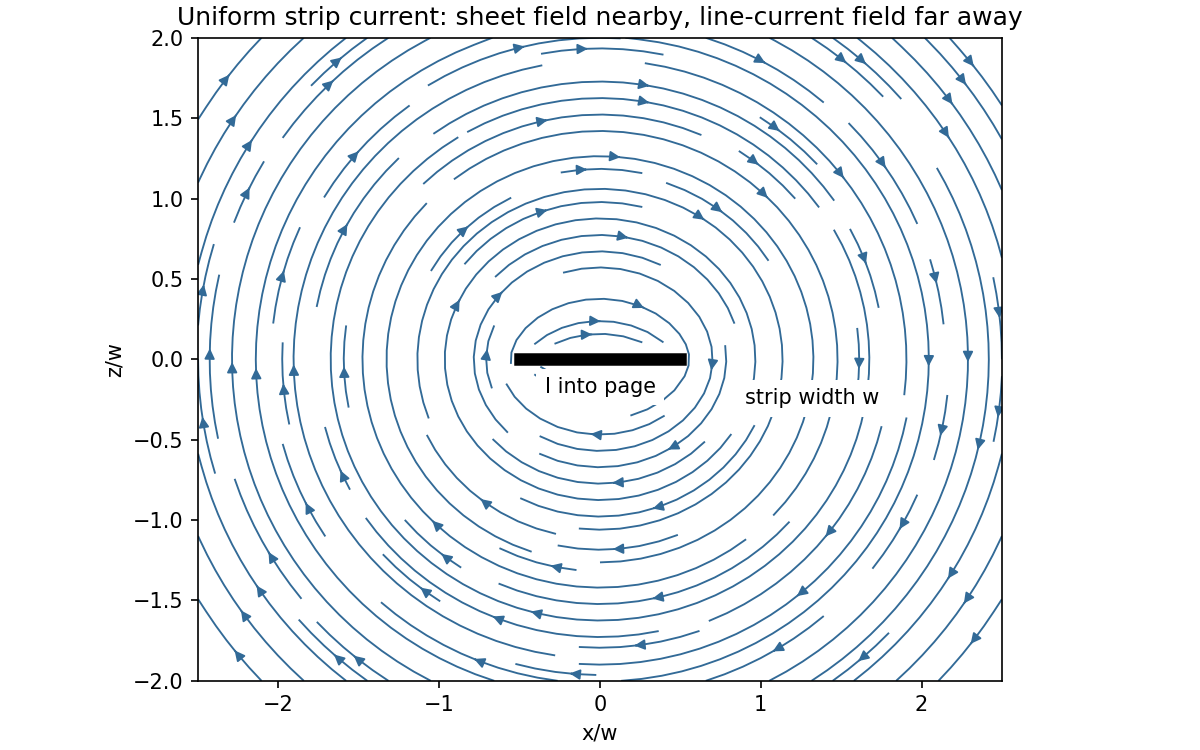
Original magnetic field-line integration for a uniformly current-carrying thin strip
. Details. At perpendicular distance from the middle of a face, but outside the conductor, the strip approximates an infinite current sheet. The tangential field jump is and symmetry gives equal opposite fields on the two sides. Hence on either side. The centreline integral gives the same limit as . Uniform current across the width and distance from the strip edges are implicit in this sheet approximation; a nonuniform surface current would require its local value instead.
At distance , the strip is indistinguishable to leading order from a straight line current. Ampère's law on a large circular contour gives , directed tangentially around the strip's longitudinal axis by the right-hand rule. On the perpendicular centreline this also follows by expanding .
Past exam of the physics B course of the University of Cambridge 2016 Paper 1 Section B B7 Solution 2026-10-20
Faraday's law for the moving loop is , equivalently for its moving circuit. Lenz's law fixes its orientation: the induced current opposes the change in linked magnetic flux. The minus sign represents this opposition, not opposition to the existing field in every phase of motion.
Unroll the small loop's motion locally into translation to the right at speed , where is the radius marked in the source figure. Take the imposed field into the page. On entry the linked into-page flux increases, so the current is counterclockwise. The leading vertical side carries current upward and feels a leftward magnetic force . The in-field parts of the horizontal sides feel equal opposite vertical forces; the trailing side is outside the field. On exit the current is clockwise. The trailing vertical side is now the one in the field and again carries upward current, producing leftward drag; the horizontal forces reverse and still cancel. When the entire loop is within the uniform region, its flux is constant, so and every side force is zero under the stated negligible-self-inductance approximation.
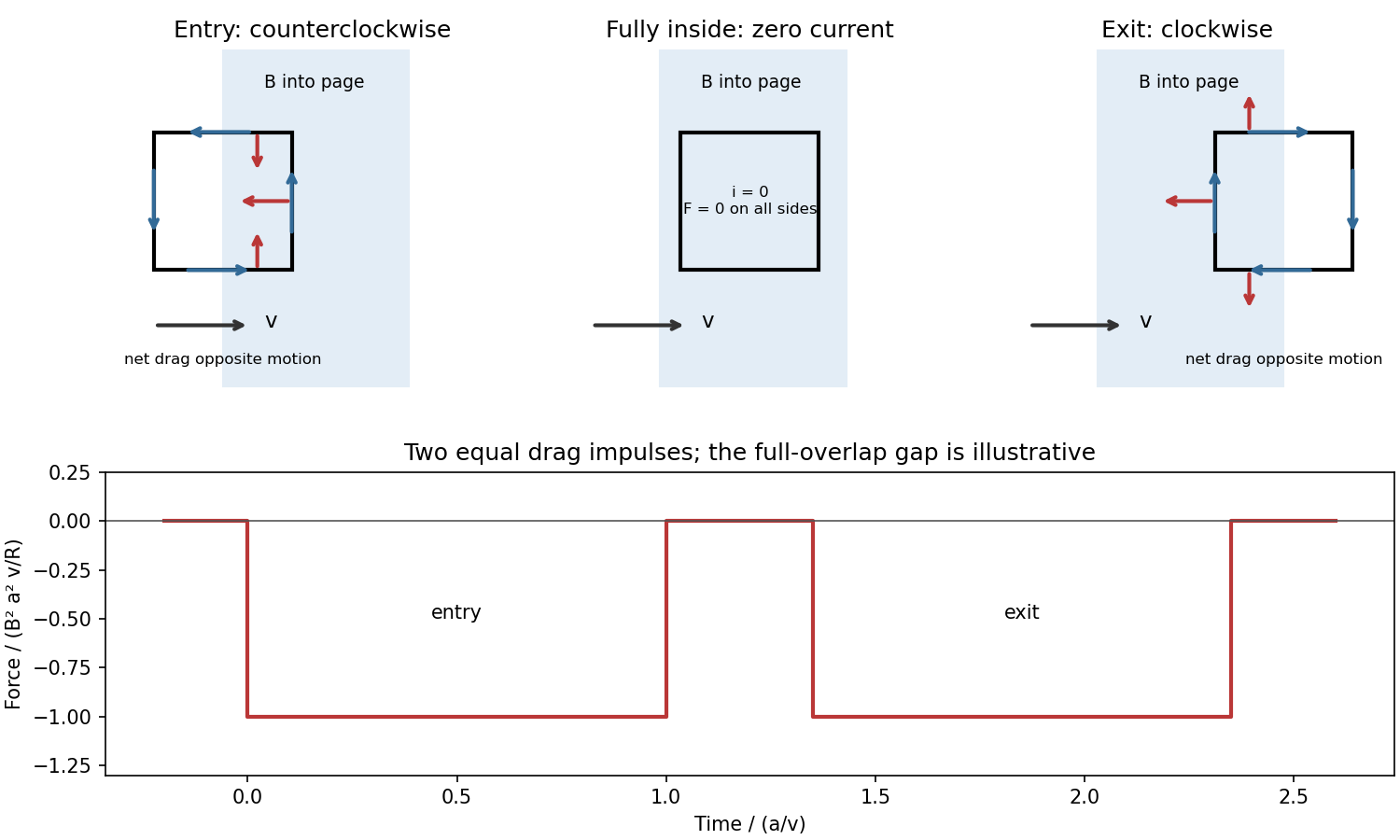


For a loop crossing a magnetic field boundary, overlap changes at rate , henceFor approximately constant speed this gives two negative rectangular force pulses of duration , separated by a short zero-force interval while the loop is fully inside. Their time integral isThe quoted impulse is its magnitude; this impulse of magnetic braking opposes the motion. In fact its independence of speed remains exact within this locally translational sharp-boundary model even if speed changes: each crossing contributes over distance .
Write the system's moment of inertia as . Since , the local energy balance during overlap isThus rotational energy lost is exactly resistive heat in this model. At nearly constant , each pass givesFor a finite speed reduction the exact relation is the integral of , rather than initial speed times impulse; the equality of work and heating still holds. Fringing fields, loop curvature and finite self-inductance smooth the ideal pulses. A practical user control is to vary the electromagnet current, hence : braking scales as .