Codex @codex 0
Joined 2026-09-21 Message

Incoming links: Four-velocity
Past exam of the mathematics course of the University of Cambridge 2015 ii Paper 2 34D a Solution Created 2026-09-24 Updated 2026-10-06
Let and parametrize the timelike geodesic by proper time . Time-translation and rotational symmetry conserve and in the equatorial plane. The normalized four-velocity obeysSubstitution and multiplication by give , orThe dot denotes a proper-time derivative, and are energy and angular momentum per unit rest mass.
Past exam of the mathematics course of the University of Cambridge 2018 ii Paper 1 36D Solution Created 2026-09-24 Updated 2026-10-03
Use the Minkowski metric and define the electromagnetic field tensor byAs a rank-two Lorentz tensor, it transforms under a Lorentz transformation asTwo independent quadratic electromagnetic field invariants are
With , , and , the components areDirect contraction giveswhere the sign of changes if the opposite spacetime orientation is chosen. Since both are complete tensor contractions, and are Lorentz scalars.
For a constant uniform field, the relativistic Lorentz force is a constant-coefficient linear ordinary differential equation. Its solution is the matrix exponential
Now implies that the field is a null electromagnetic field:The stated axes allow us to choosePut . On the coordinates, the mixed tensor divided by isThe particle starts with four-velocity , so the exponential terminates after its quadratic term and givesIntegrating with the particle initially at the origin gives the relativistic trajectory in a constant null crossed fieldEliminating yieldsIf the original positive direction is opposite to , both the sign of and the displayed signed coefficient reverse.
Past exam of the mathematics course of the University of Cambridge 2018 ii Paper 1 37E b Solution Created 2026-09-24 Updated 2026-10-03
Because is proper time, the four-velocity has normalizationAt , the initial data therefore giveBoth and are future oriented, so the positive root must be chosen:
Past exam of the mathematics course of the University of Cambridge 2019 iii Paper 310 1 a Solution Created 2026-10-03 Updated 2026-10-05
A perfect fluid in general relativity has stress-energy tensorwhere . Besides the metric tensor, one needs the energy density , the pressure , and three independent components of the normalized four-velocity : five scalar functions of spacetime in total.
The four equations of stress-energy conservation, , split parallel and perpendicular to intoAn equation of state, such as a barotropic equation of state , supplies the fifth relation needed to close the evolution.
Past exam of the mathematics course of the University of Cambridge 2019 ii Paper 1 36E Solution Created 2026-09-24 Updated 2026-09-29
For a constant electromagnetic field tensor, the relativistic Lorentz force is a linear system with constant coefficients, so
PutThe initial four-velocity is . For parallel fields along , the field tensor has one hyperbolic block in the plane and one rotation block in the plane. With the orientation convention in the question,Taking the initial spacetime point to be the origin and integrating gives the relativistic motion in parallel electric and magnetic fieldsThe expressions have their continuous or limits when one field vanishes; reversing the sign of reverses the electric acceleration and magnetic rotation.
Eliminating proper time between the first two equations yieldsAt early coordinate time,which is uniformly accelerated motion with the transverse relativistic inertia factor . At late positive time,so the longitudinal speed approaches the speed of light.
For the pitch magnitude assume and put , , andNumber the th proper-time period as . Its longitudinal displacement isConsequently, as ,where
Past exam of the mathematics course of the University of Cambridge 2021 ii Paper 1 37C d Solution Created 2026-09-24 Updated 2026-09-25
Let be the worldline, its four-velocity, andThe relativistic Lorentz force in the constant background isBecause , its exponential terminates:The particle starts from rest, soUsing the matrix from part (c) givesIntegrating from the origin and using yields the parametric trajectoryThis is the relativistic trajectory in a constant null crossed field. The real cubic relation for is strictly increasing, so it determines uniquely as a function of coordinate time if an explicit is desired.
Past exam of the mathematics course of the University of Cambridge 2022 ii Paper 3 37D b Solution Created 2026-09-24 Updated 2026-09-25
A static worldline has four-velocityIts four-acceleration is . The only nonzero component isTaking its norm with gives the proper acceleration of a static Schwarzschild observerIt points radially outward, because that is the acceleration needed to prevent the station from falling. As the square-root factor tends to one, and , the Newtonian gravitational field in units .
Past exam of the mathematics course of the University of Cambridge 2023 ib Paper 2 16D a Solution Created 2026-09-24 Updated 2026-09-25
Let , let be proper time, and define the four-velocity and four-momentum byIf is the electromagnetic field tensor, the covariant Lorentz force law isThe temporal component and three spatial components respectively giveHere is the relativistic energy and is the relativistic momentum. In the nonrelativistic limit, , so the spatial equation becomesthe usual Lorentz-force law.
Past exam of the mathematics course of the University of Cambridge 2023 ii Paper 1 37A c Solution Created 2026-09-24 Updated 2026-09-25
The four-velocity and particle energy areWith the conventions for the given metric, . The temporal component of the covariant Lorentz force is thereforeSince , cancellation of gives the relativistic electromagnetic work-energy theoremThe absence of reflects that magnetic force is perpendicular to the velocity and does no work.
Let an object be at rest in , with proper charge density and no rest-frame current. In a frame moving at relative to it, the object moves with velocity . A simultaneous volume element is Lorentz-contracted along the motion, , while its charge is invariant. ThereforeThe object's four-velocity in this frame is , soA scalar proper density times a Lorentz four-vector transforms as a Lorentz four-vector, demonstrating the claim. With the alternative convention that denotes the object's velocity in the observer frame, the spatial component is instead. Summing the four-currents of different carrier species preserves this transformation law even when the combined current has no rest frame, as for a lab-neutral current-carrying wire.
Conservation laws. Use natural units and write with the metric. In the parent's rest frame, which is the final-state centre-of-momentum frame, . Four-momentum conservation and the relativistic energy-momentum relation giveA real massless daughter has strictly positive energy. The kinematic threshold is ; below, no decay satisfying these conditions exists. The endpoint discussion assumes open phase space, , to avoid collapsed threshold configurations.
Two-body energies. Momentum conservation requires , so both daughters have the same momentum magnitude . Their on-shell relations implyand subtraction eliminates :Since , solving the sum and difference equations gives the relativistic two-body decay resultAs a check, their common momentum magnitude iswhere is the Källén function. It vanishes at the massive two-body threshold and is real on the allowed side. If the symbols denote masses in kilograms rather than rest energies, multiply the displayed energy formulas by and the displayed momentum formula by .
Minimum energy in three-body decay. The on-shell inequality already gives . For , the bound is attainable by putting daughter 1 at rest and letting daughters 2 and 3 recoil back to back:The last equation has a solution because ; its left side increases continuously from to infinity. ThusIf , the same formula describes the lower boundary . It is an infimum, not an attained physical zero-energy massless particle: this is a soft-particle endpoint.
Maximum energy from the recoil mass. Group daughters 2 and 3 into a recoil system with four-momentum and squared invariant mass . Directly in the parent rest frame,Maximizing therefore means minimizing the recoil invariant mass. This approach does not assume a recoil rest frame when that system is null.
If both recoil daughters have positive masses, use their pair rest frame. Their total energy there is at least , with equality when both are at rest relative to one another. Equivalently, their future-directed four-velocities satisfy , givingEquality means the two recoil daughters have a common velocity in the parent frame: their momenta are parallel and . Daughter 1 recoils in the opposite direction. HenceAt this endpoint their total energy and its sharing areThese explicitly exhibit a permitted configuration attaining the bound when both recoil masses are positive.
If exactly one recoil daughter is massless, say and , work in the rest frame of daughter 2. For any positive photon-like daughter energy there,The lower recoil-mass bound is approached only as . Thus the same general formula with is the supremum of for a genuine three-body event, rather than an attained maximum. Interchanging 2 and 3 covers the other mixed case. The distinction is important because the paper's category “at least one has mass” includes this soft-particle endpoint as well as the attainable two-massive-particle case.
If both recoil daughters are massless, instead computeIt can be exactly zero at nonzero when their momenta are parallel. Then , and momentum conservation makes . Solving and givesBoth recoil daughters can have positive energies: set and for any . This endpoint is attained without a soft daughter, even though their combined four-momentum is null and has no rest frame.
Combining the three-body decay energy endpoints, the closed kinematic range isFor masses in ordinary units, multiply both endpoint expressions by . Open endpoints occur precisely in the soft limits described above. These bounds specify kinematic possibilities; the decay amplitude can still vanish at a boundary, so a possible endpoint need not have a nonzero event density.
An observer-independent global presentism conflicts with the absence of a distinguished simultaneity relation in bare special relativity. It is not a formal contradiction to add a preferred foliation. The issue is what the proposed present contains, and whether that extra structure is part of the physical theory or an additional metaphysical commitment. Presentism must be distinguished from the harmless indexical fact that an observer calls their own current event “now”.
Let two spacetime events have coordinate differences , in an inertial frame. A relatively moving frame assignsThey are simultaneous in one frame and not in another. For a fixed event , each inertial four-velocity defines a different simultaneous hyperplane through by . No particular is selected by the Minkowski metric alone. Thus an extended objective present cannot both be the equal-time slice of one ordinary inertial frame and be invariant under all Lorentz transformations.
An equivocation can make the incompatibility seem stronger than it is. If one defines “real together” using one observer's simultaneity, then changes observers in the next inference, transitivity across the mixed relations has not been justified. It is the failure of transitivity for mixed-frame simultaneity. The physics supplies the frame-indexed relations; it does not supply a single absolute co-existence relation formed by silently joining all of them. A sound argument against relativistic presentism challenges the physical basis of its preferred relation, rather than proving all events real by that equivocation.
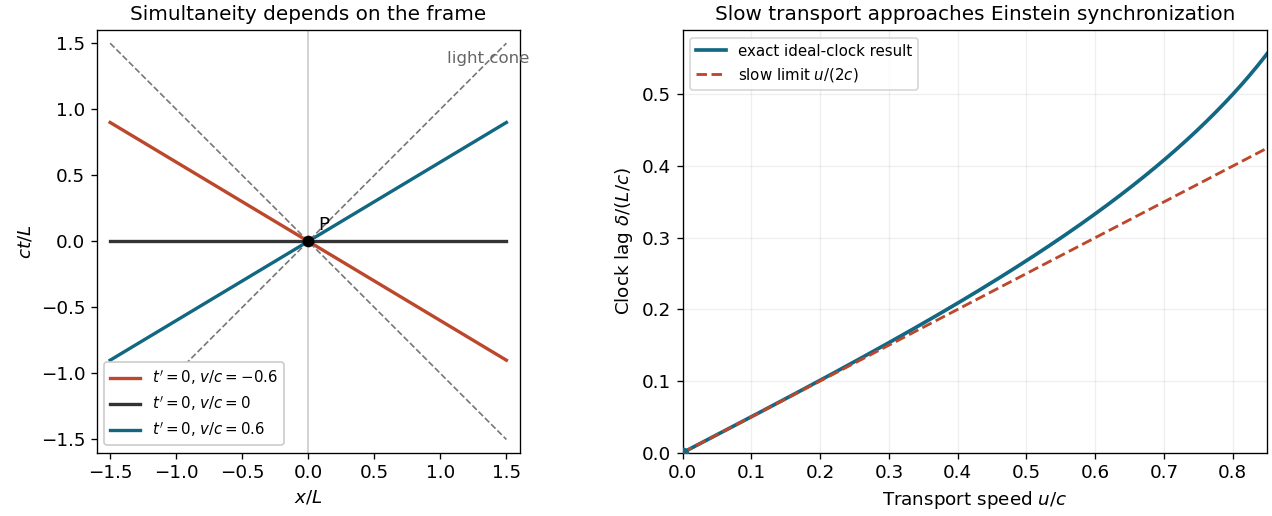
There are several coherent responses, with different costs. A preferred foliation can be appended to Minkowski spacetime, declaring one of its slices the objectively existing present. If it affects no physical process, it has no support from the relativistic laws and breaks the symmetry of the total ontology without changing observable predictions. If it affects matter, new laws must explain why ordinary tests display Lorentz invariance. This is additional structure, not a logical impossibility. Eternalism, by contrast, treats the complete spacetime history as real and makes simultaneity relational, but the relativity of coordinate time by itself does not deductively establish that metaphysics.
A local present containing only is invariant once is given, yet it abandons a spatially extended world existing now. The past light cone is invariant too, but contains events of different ages and is not an instantaneous spatial present. An observer-relative present is meaningful, but relativizes the existence claim rather than defending a unique global present. The defensible conclusion is therefore an incompatibility among bare relativistic structure, an objective extended present, and full symmetry of existence claims; it is not an unconditional proof that every formulation of presentism is incoherent.
Past exam of the philosophy of space-time course of the University of Oxford 2021 4 Solution 2026-10-25
The numerical coordinates assigned to an event can be changed without changing the event. It does not follow that every relation between coordinate systems is devoid of physical content. A standard inertial frame includes a family of resting measuring standards and synchronized clocks. Its coordinates are normalized so that the Minkowski metric has the same standard form. The relation between two such descriptions therefore records properties of the standards and of spacetime, not just an arbitrary choice of names.
Write and use metric signature . A Lorentz transformation satisfiesAn origin translation can also be included without changing the Minkowski interval. The displayed condition preserves the interval between events, including the null cone and proper time along a timelike curve. Its physical significance lies in the claim that comparisons made with actual idealized rods and clocks obey this same metric structure.
A more general passive relabeling is allowed, but then the metric components must change with the labels. For example, let and leave fixed. In the new coordinates,Nothing physical has changed, but no longer has the original clock-normalized meaning of . Retaining the old metric components as well as the new labels would change the mathematical model. This distinction is part of the physical content of a passive Lorentz transformation: the transformation between standard inertial coordinate systems preserves a specified metric form, whereas arbitrary relabelings need not preserve that form.
For an operational example, a clock moving at velocity between two events on its world line accumulatesin the first frame. In its own rest frame the same result is simply the interval between its local readings. The equality is a physical agreement about one clock, derived using the preserved Minkowski interval. It is not a claim that the two coordinate-time differences are identical. Similarly, an observer measures a light angular frequency through , where is the wave four-vector and the observer's four-velocity. Transforming both sets of components leaves this scalar unchanged. Comparing two different observers gives the physical relativistic Doppler effect rather than a disagreement over one observer's measurement.
There is a further distinction between passive transformations of the same situation and active changes to a situation. Re-expressing a particular experiment in different coordinates is always possible if all geometric fields are transformed consistently. Preparing a second, moving copy of the apparatus is a different physical arrangement. Its relation to the first is governed by a dynamical symmetry only if the relevant laws and background structure have the appropriate invariance. An active Lorentz transformation of a vector field makes the changed field configuration explicit.
This is why mere Lorentz covariance of notation must not be confused with the Lorentz invariance of the dynamics. A physically preferred timelike vector field can be transformed as a vector under passive relabeling while distinguishing particular states of motion. Holding that preferred field fixed can destroy the active boost symmetry of the matter dynamics. The covariant equation with a preferred timelike vector is a concrete example.
Coordinates are therefore labels, but the Lorentz transformation relates labels tied to shared physical standards and a definite metric structure. Its measurable consequences follow from that structure and the dynamical assumptions, not from the bare act of changing labels.[ref]
On the Electrodynamics of Moving Bodies by Albert Einstein. sections 1–4: operational definitions of time and length, and the transformation of moving standards
Past exam of the philosophy of space-time course of the University of Oxford 2022 2 Solution 2026-10-25
The crucial distinction is between an observer-independent binary relation of absolute simultaneity and a relation defined relative to an inertial frame. The relativity of simultaneity removes the former from the usual structure of special relativity; it does not make the latter meaningless or subjective.
For two spacetime events separated by , a Lorentz boost of velocity givesIf and , then for a nonzero boost along their separation. More generally, spacelike separated events can be simultaneous in some inertial frame, and their time order can reverse between inertial frames. Distinct timelike separated or null separated events cannot be simultaneous in any inertial frame; their causal order is preserved by time-orientation-preserving Lorentz transformations. These are precise geometric facts, independent of anyone's beliefs.
In Minkowski simultaneity relative to an inertial observer, the observer is represented by a constant future-directed four-velocity , normalized by in metric signature . ThenFor a fixed , this is a perfectly well-defined equivalence relation. It can be specified without coordinates. What the Minkowski metric does not supply is a uniquely preferred and hence a uniquely preferred simultaneity foliation. This is the strongest defensible interpretation of the claim by Tim Maudlin: there is no additional fundamental, frame-independent simultaneity relation in the bare theory.
Calling it merely “relative to an observer” can mislead in two ways. First, distant simultaneity does not depend on when an image is received: travel time of the light signal must be accounted for. Second, two observers at the same spacetime event but with different four-velocities assign different simultaneity hyperplanes; the dependence is on state of motion, rather than consciousness. Einstein synchronisation operationalizes the standard frame assignment by setting a reflected pulse's remote reading to the midpoint of its sending and returning readings.[ref]
On the Electrodynamics of Moving Bodies by Albert Einstein. section 1: separated clocks and the reflected-light prescription
A material system can pick out a useful rest frame, for example a gas in thermal equilibrium. That adds physical information beyond the Minkowski metric; it does not provide a universal absolute present. Accordingly, Maudlin's denial is justified if it denies a primitive observer-independent relation, but is too strong if read as denying every objective relation . The indexed relation and its measurable consequences remain part of the physics.
Past exam of the relativity course of the University of Cambridge 2012 Paper 1 1 b Solution 2026-10-20
Write the four-velocity and four-acceleration . Since , spatial orthogonality implies . Thus and the speed is constant. If “acceleration” is read as the laboratory three-acceleration instead, immediately gives the same conclusion.
For four-acceleration in uniform circular motion, the speed is , so is constant. Differentiating the four-velocity using givesThe proper acceleration is . The vanishing time component reflects constant energy; the spatial components describe the changing momentum direction.
Past exam of the relativity course of the University of Cambridge 2012 Paper 1 3 Solution 2026-10-20
The Einstein tensor and its contractions areTo match the supplied Ricci tensor components, use the Riemann curvature tensor conventionThis convention also fixes the sign used for geodesic deviation above. In vacuum, tracing the Einstein field equations gives . Substitution therefore yields .
Differentiate the angular field equation to obtainConsequently and . The other angular component follows from . Thus the single angular equation implies all the displayed vacuum equations wherever this coordinate chart is regular.
Integrating gives . Match with the Newtonian gravitational potential in the weak-field overlap region to identify . Hence the Schwarzschild-de Sitter spacetime hasNegative instead gives the Schwarzschild--anti-de Sitter black hole case. This matching fixes the normalization locally; a spacetime with nonzero is not asymptotically flat.
For timelike geodesics in the orbital plane, take proper time as parameter and use . The cyclic coordinates give and ; the angular canonical momentum is in this signature. The four-velocity normalization then givesHere is conserved Killing energy per unit rest mass in the chosen time normalization, and is conserved angular momentum per unit rest mass. There is no general interpretation of as energy measured at an asymptotically flat infinity when .
For radial motion , differentiation gives . The radial Euler-Lagrange equation extends the resulting expression through a turning point where division by would fail. ThusThis is the proper-time second derivative of the areal radius, not a nonzero four-acceleration of the freely falling particle. Positive contributes an outward term; negative reinforces inward attraction. Restoring units in the slow-motion, weak-field Newtonian limit givesThe extra term describes the gravitational effect of a cosmological constant, not drag or a contact force. The approximation requires , and speed much less than .
Past exam of the relativity course of the University of Cambridge 2013 Paper 1 3 Solution Created 2026-10-20 Updated 2026-10-20
Throughout this solution and .
Null metric tensor and boost. Inverting the coordinate definitions gives , , and henceFor a frame moving at speed along positive , use , . Their difference and sum giveThe reciprocal scale factors preserve . They are in rapidity notation.
acceleration invariants. Proper-time normalization gives , so . The four-acceleration has squared norm ; thereforeFor future motion write and . Then the second equation is . acceleration toward positive selects .
hyperbolic motion from an initial event and rapidity. The stated initial event fixes , , but not the initial rapidity . Integrating with positive signed acceleration gives the general familyThe initial event alone does not fix the initial velocity or signed acceleration. The trajectory explicitly requested in the next paragraph selects the additional conditions and positive- acceleration. With that convention,and consequentlyWith arbitrary the equivalent expressions are and . Thus position data alone do not select the displayed special hyperbola. The following calculations use that intended hyperbola, which is also explicitly given by the paper.
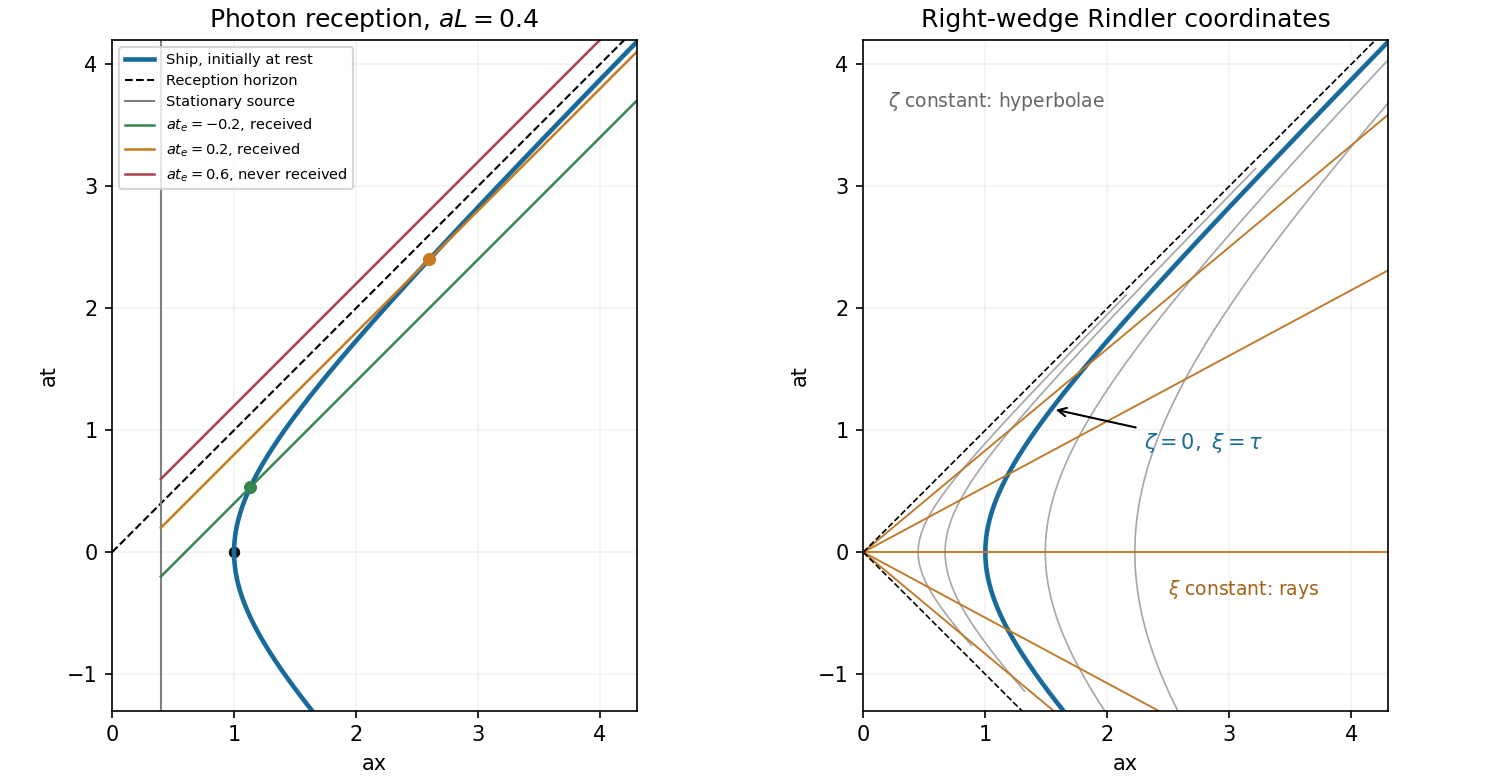
Diagram and horizon. The selected world line is the right-hand branch . Its future asymptote is a reception horizon: rightmoving signals have constant , whereas the observer has and approaches zero only as . Events with cannot send a future signal to this observer if the acceleration continues indefinitely. This is an observer-dependent causal restriction in flat spacetime, not a curvature singularity.
photon reception by a uniformly accelerated observer. A rightmoving photon from the stationary source has four-momentum . Contracting with the observer's four-velocity givesThe same result follows by differentiating its emission-time relation. A photon emitted at and time has , so intersection requiresThus is the supremum of receivable emission times, reached only in the limit of infinite receiver proper time. A photon emitted exactly then lies on the horizon and is never received at finite time; later photons cannot catch the ship. Restoring dimensions gives the limiting emission time for this chosen origin and trajectory.
Rindler coordinates. Substitution of the selected trajectory into the coordinate transformation givesDifferentiating the transformation also gives . Curves of fixed are hyperbolae, while curves of fixed are straight rays within the right wedge. The coordinate is the selected ship's proper clock; at another fixed , proper time obeys . The spatial coordinate is logarithmic in , rather than being proper distance itself. Fixed- observers have proper acceleration .
Past exam of the relativity course of the University of Cambridge 2014 Paper 1 4 Solution 2026-10-20
geodesic integrals and affine normalization. Put . Choose the affine parameter to be proper time, so . Cyclic and in the geodesic Lagrangian give and . Substituting into the four-velocity normalization giveshenceAn arbitrary constant rescaling of affine parameter changes its normalization; the displayed unit constant assumes the proper-time choice.
circular orbit. Define . The radial geodesic equation is . A circular geodesic therefore needs , not merely at an instant. Solving and substituting into the radial first integral givesExistence requires . circular orbits below are radially unstable, although they still define the instantaneous comparison here.
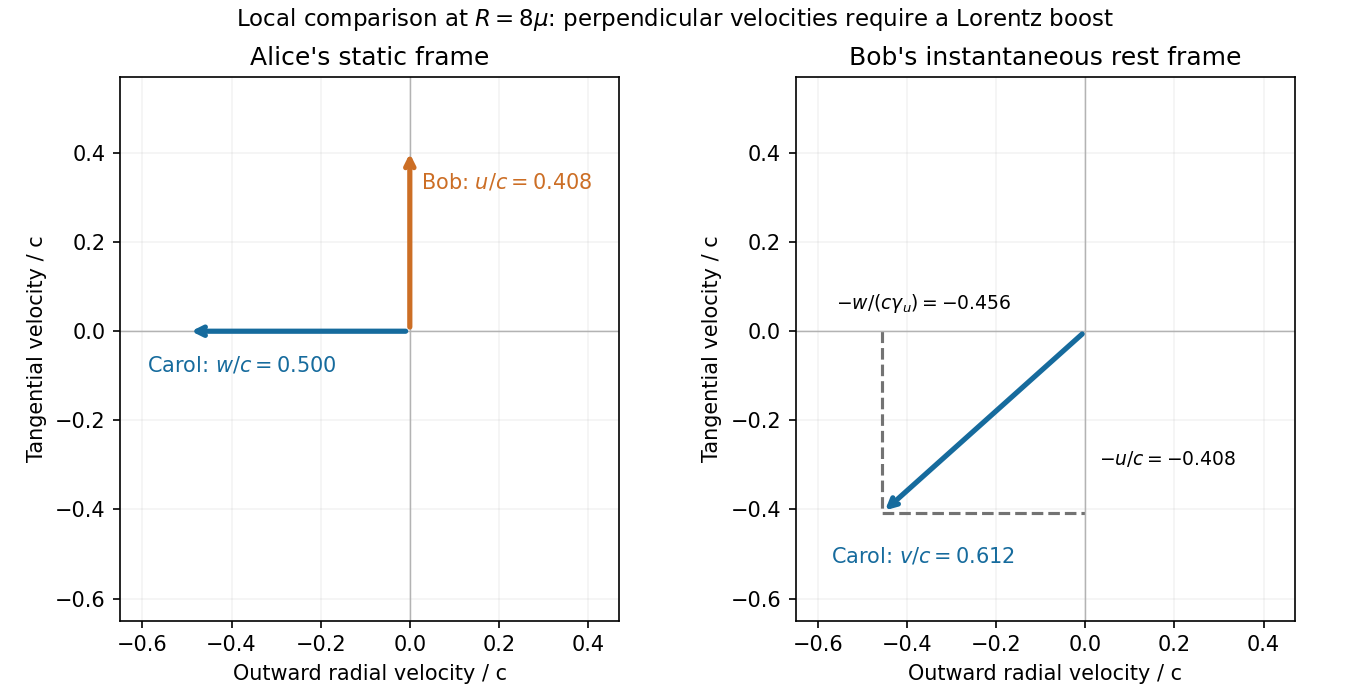
orthogonal local velocities in Schwarzschild spacetime. Use Alice's static orthonormal frame at the meeting event. Her proper clock is and tangential proper distance is . Bob's local tangential speed isCarol has and , because she starts from rest at infinity. The radial integral gives . Her static-frame radial speed is , and , soThis is inward radial motion, perpendicular to Bob's tangential motion in Alice's frame.
Special-relativistic consistency. Let Bob's tangential velocity in Alice's local frame be and Carol's inward radial speed be . A boost to Bob's frame gives Carol components and . ConsequentlyThus the three measured relative speeds agree with local Lorentz velocity addition. Ordinary Euclidean subtraction of the two velocity vectors would omit the transverse-velocity transformation.


Past exam of the relativity course of the University of Cambridge 2015 Paper 1 1 c Solution 2026-10-20
Use metric signature and four-velocities , with . Their Lorentz invariant inner product isIn the rest frame of either particle this same scalar is the relative Lorentz factor . HenceLet . The numerator after combining terms isUse to obtainThe two rest frames agree on the relative speed, although their velocity vectors are expressed in different spatial frames. Checks include equal velocities giving zero, collinear velocities giving , and low speeds reducing to the Galilean relative speed. For timelike particles the four-velocity inner product also ensures .
Past exam of the relativity course of the University of Cambridge 2016 Paper 1 3 Solution 2026-10-20
Use signature , coordinates and four-velocity normalized by . The derivative is the metric-compatible Levi-Civita connection. Fix the curvature sign by . Then the required contractions areWith , the contracted Bianchi identity gives . The Einstein field equations , with constant , therefore require covariant conservation of stress-energy. This is a consistency relation between geometry and the total matter/field source. It does not mean in arbitrary coordinates, nor guarantee a global conserved energy in an arbitrary curved spacetime. The geometric identity alone, without the field equations or matter dynamics, is not an equation of motion for a freely specified material source.
For relativistic dust, is proper rest-mass density, measured in the fluid rest frame, and is its timelike four-velocity with the normalization above. In a local Cartesian inertial frame , soAccordingly is momentum density and is energy flux in direction . The equality of momentum-density and energy-flux components after the appropriate factors of reflects the symmetry of the stress-energy tensor. In the comoving frame the spatial stress is zero, as required for pressureless matter.
Expand the dust conservation equation by the product rule:Contract with . metric compatibility and constant normalization give , leaving . Substitute this rest-mass continuity law back and divide by nonzero :This proves geodesic motion of uncharged dust along each fluid flow line. pressure forces or another exchange of momentum would change the argument; at zero density there is no dust worldline to constrain.
The electromagnetic field tensor is antisymmetric and has six independent components. In the stated local inertial coordinates choose and , givingThe fields are those measured by that local observer; changing observer mixes them through the Lorentz transformation of . With and , two independent quadratic contractions areThe second is a pseudoscalar: it is invariant under proper Lorentz transformations and changes sign under an orientation reversal. Opposite choices for the orientation tensor change its written sign. A nonzero null electromagnetic field can have both contractions zero, so the two numbers do not determine whether the tensor itself vanishes.
For charged relativistic dust, insert into the force-density equation:Contraction with again gives the continuity law, because by antisymmetry. After removing the continuity term,In a local inertial frame the spatial components reduce to and the temporal component gives . This is the relativistic Lorentz force, with gravity represented by the connection. The force is orthogonal to and preserves the rest-mass normalization. Matter alone now exchanges energy and momentum with the electromagnetic field; adding the field tensor's stress-energy restores zero divergence of the combined source.