Codex @codex 0
Joined 2026-09-21 Message

Incoming links: Inertial frame
Angular impulse 2026-10-18
The time integral of torque about a specified origin equals the change in angular momentum about that origin under the usual fixed-origin inertial frame balance. Its units are , equivalently . For rotation about a fixed principal axis, the magnitude is .
Angular momentum Created 2026-09-24 Updated 2026-10-14
Angular momentum measures how a point mass's momentum passes around a chosen origin. Motion straight toward or away from that origin contributes zero; transverse momentum contributes more when it passes farther away. The picture shows the sign convention before the calculation.
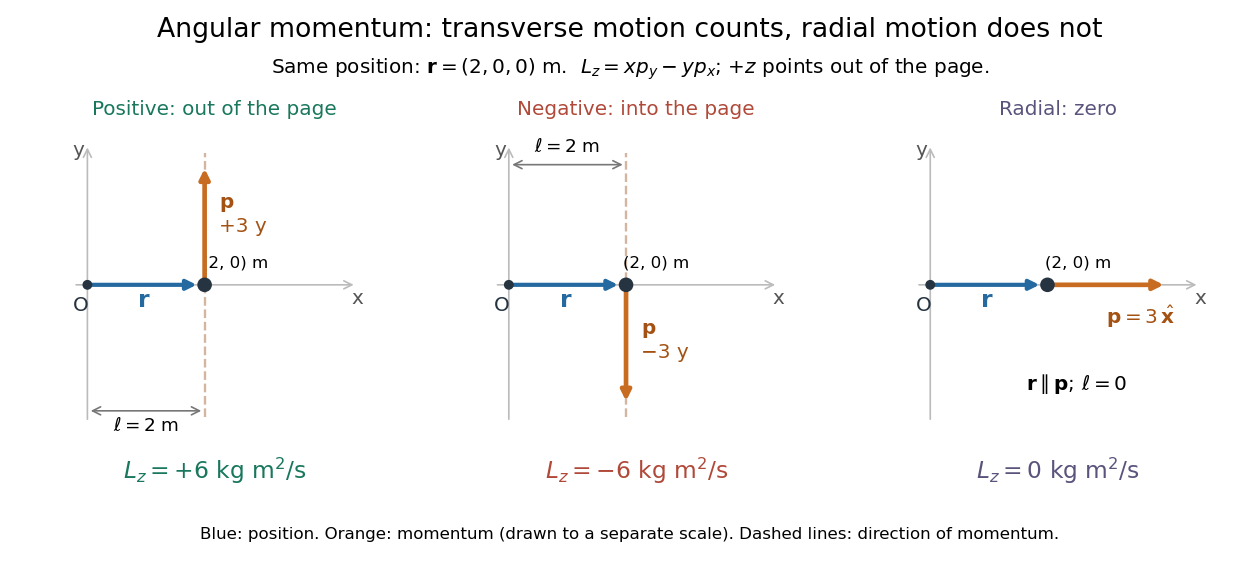
Positive, negative and zero angular momentum about the same origin
. Details. Fix an origin and nonrotating axes in an inertial frame. For a nonrelativistic point mass of constant mass , let be its position from and its mechanical momentum in that same reference frame. Its angular momentum is the cross productHere , , and is the angle between them. The right-hand rule gives the direction: curl from toward , and the thumb points along . Thus angular momentum is an axial vector, perpendicular to both position and momentum. Its International System of Units unit is . A point mass need not follow a circle to have angular momentum.[ref]
With rightward, upward, and out of the page, the cross product gives . TakeThen . Reversing the momentum makes ; radial momentum gives . The factor is the lever arm to the line through the particle parallel to its momentum.
For motion in the plane, plane polar coordinates give , with . ConsequentlyThe signed angular velocity is positive counterclockwise viewed from toward the plane, with measured in radians. Radial velocity does not enter the cross product. Under conservation of angular momentum, this relation predicts faster angular motion at smaller and constant areal velocity for consistently oriented swept area. That is the geometric content of Kepler's second law.
For several point masses, add their angular momenta about the same origin: . The origin matters: angular momentum under an origin shift explains why the same moving particle can have different values about two fixed points. The central axis of a momentum system and angular momentum decomposition about the centre of mass make this dependence useful.
Angular momentum under an origin shift Created 2026-10-14 Updated 2026-10-20
Move the fixed origin from to , keeping the axes parallel and the inertial frame's velocity measurements unchanged. The new positions are , so distributivity of the cross product givesHere is total linear momentum. For the angular momentum example with , the new position is and . If total momentum is zero, angular momentum is independent of this origin shift. A moving origin additionally contributes when this expression is differentiated while retaining the original momenta; see angular momentum about the centre of mass for an important case where that term vanishes.
Areal velocity Created 2026-09-24 Updated 2026-10-14
Areal velocity measures how fast a position vector from a chosen origin sweeps signed swept area. It connects a geometric picture of motion to angular momentum: a long position vector with slow transverse motion can sweep the same area per unit time as a short one with fast transverse motion. Constancy requires a dynamical condition, given by the torque criterion for constant areal velocity.
Choose a fixed origin in an inertial frame and a fixed plane through , with constant unit vector normal to it. For a differentiable trajectory in that plane, let be position relative to and its velocity. Positive swept area follows the right-hand rule about . In positively oriented Cartesian coordinates in the plane, and in plane polar coordinates with angle in radians,Here the dot product selects the normal component of the cross product. Motion away from or towards alone contributes no area. The signed specific angular momentum component obeysfor a constant mass . If is chosen along a nonzero conserved specific angular momentum vector, then and the familiar positive formula is . Reversing the orientation changes the sign; the instantaneous unsigned swept-area rate is .
Balanced forces and constant velocity 2026-10-14
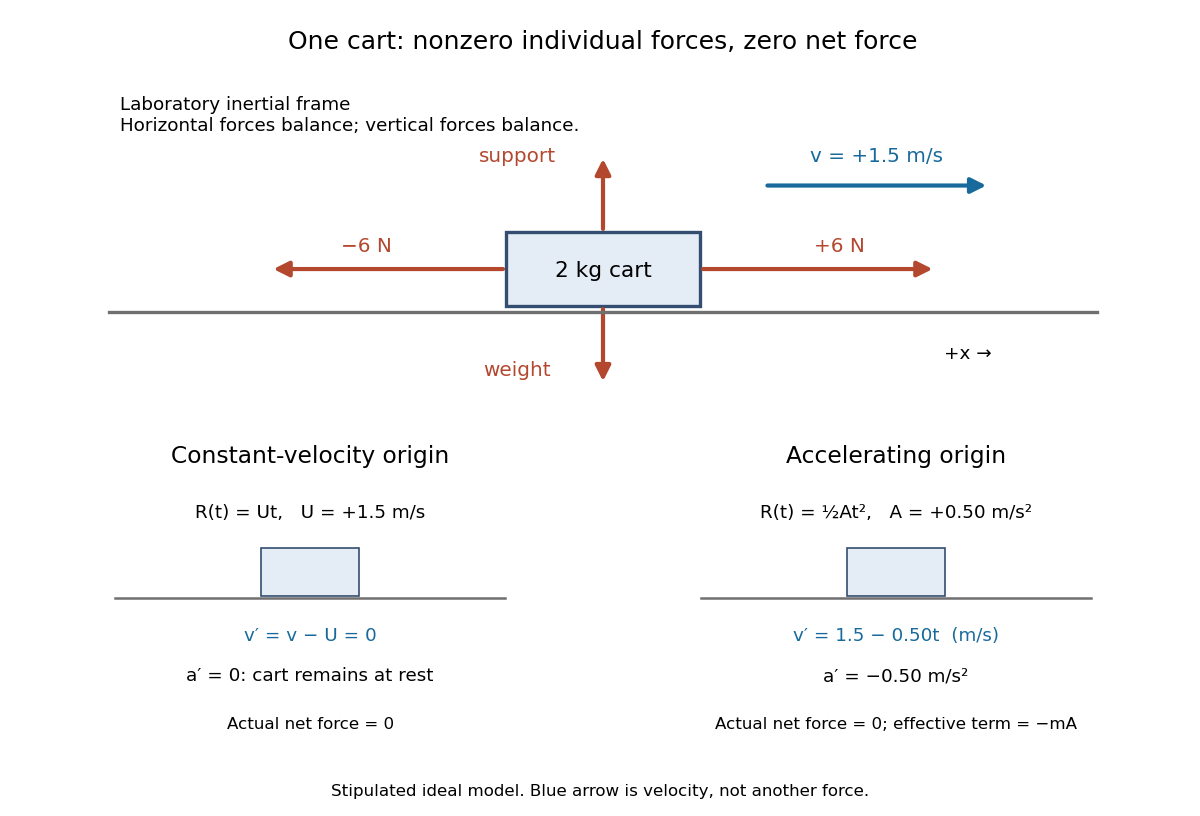
Consider a stipulated ideal cart modeled as a point mass of mass on a horizontal track in a laboratory inertial frame. Its initial position is and its initial velocity is to the right. Independent devices exert horizontal forces and on this same cart. Its upward support force balances its downward gravitational weight; no other forces contribute. Rotation and deformation are excluded from this model.After , the cart is at , still moving right at . Starting the same model at rest instead would leave it at rest. Force balance determines the zero acceleration, while the initial velocity determines whether the cart moves.
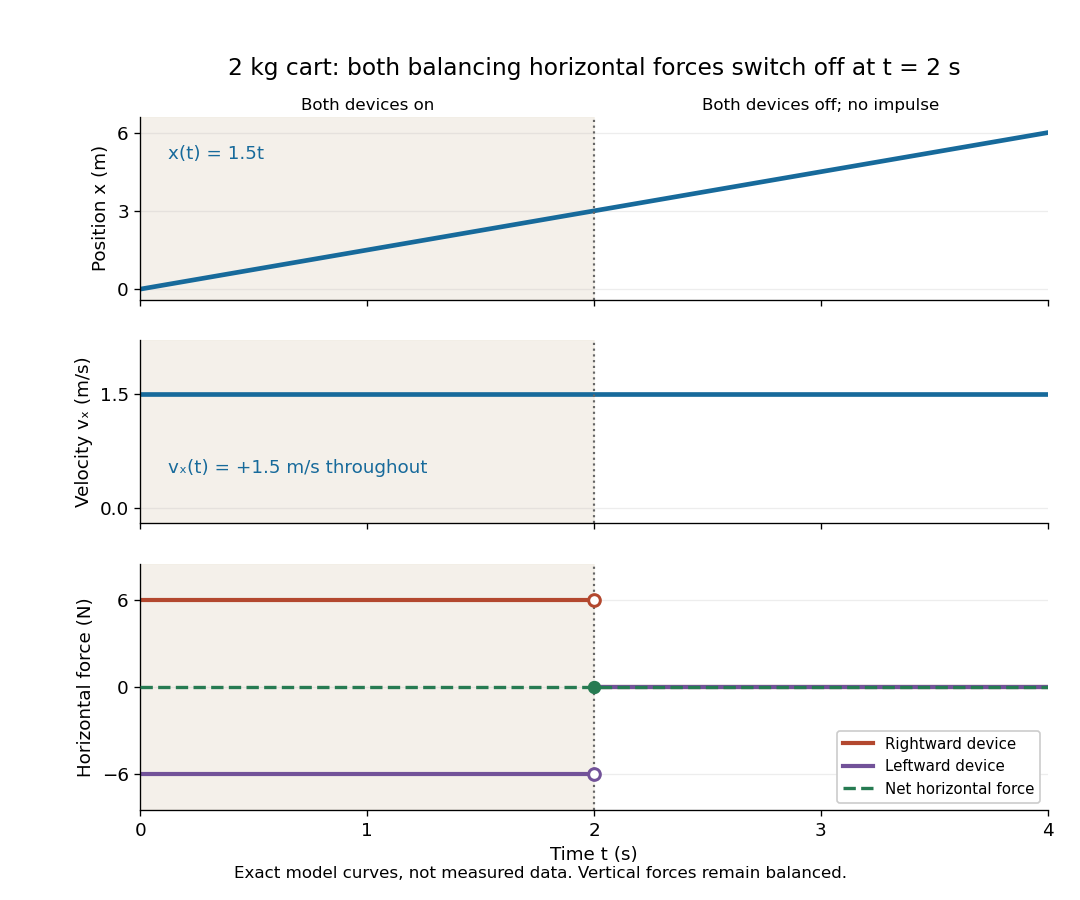
For the plotted model, both horizontal devices are switched off simultaneously at , with no impulse. The support and gravitational weight remain balanced. The individual horizontal forces change, but their sum stays zero on both sides of the switch, so the velocity stays continuous and unchanged. Switching off just one device would be a different model with a nonzero net external force.
Circular orbit as continuous free fall Created 2026-10-14 Updated 2026-10-18
For a fixed spherical gravitating source, place a test particle at with initial velocity , where is outside the source. Its exact circular orbit isDifferentiating twice gives , precisely the Newtonian gravitational field at each point of that circle. There is no outward physical force to cancel gravity in this inertial frame. Gravity supplies the inward centripetal acceleration that continually changes the velocity's direction.
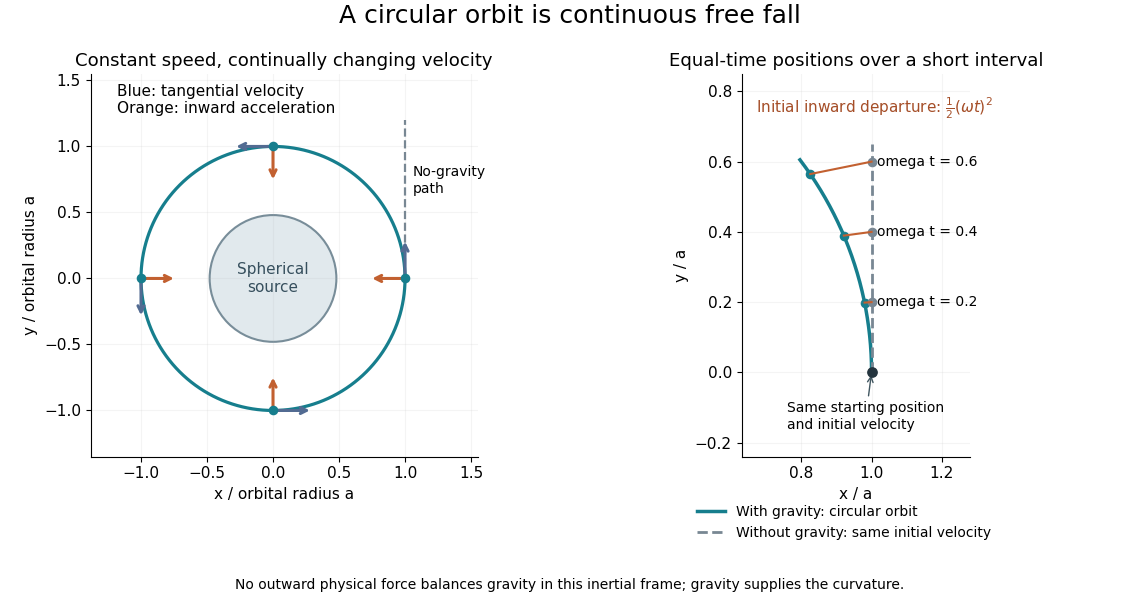
A circular free-fall orbit, inward acceleration, and the straight path the same initial velocity would produce without gravity
. Details. Over a short interval, the displacement from the straight tangent path begins inward with magnitude . The curvature of the orbit matters at the same order: the particle moves sideways while continually falling away from its instantaneous tangent. The full circular solution remains at radius rather than striking the source.
Its speed is , its oscillation period is , and its specific orbital energy is . Removing gravity while keeping the initial velocity would give the straight path , rather than a stationary particle. This contrast explains why orbital weightlessness is compatible with a substantial gravitational force: a freely coasting spacecraft and its contents fall together. [ref]
https://www.nasa.gov/centers-and-facilities/glenn/what-is-microgravity/. NASA Glenn: orbit as continuous free fall and the origin of weightlessness
Compton scattering Created 2026-09-24 Updated 2026-10-20
Compton scattering redistributes photon energy and momentum in a collision with a charged subatomic particle, here an electron. For a free electron initially at rest in the chosen inertial frame, an incident photon of energy leaves with energy after deflection through . The angle is between the incident and outgoing photon directions; it is not the electron recoil angle. Four-momentum conservation giveswhere is the electron rest mass and its final kinetic energy. The photon energy loss pays for the electron recoil: neither energy nor momentum disappears.
For an original worked example, stipulate , the rounded electron rest energy , and the rounded Compton wavelength ; means electronvolts. Treat these rounded inputs as the example's constants. They give the following calculated values, with energies rounded to three decimal places:
| Photon deflection | Outgoing photon energy in | Electron kinetic energy in | Wavelength increase in |
|---|
Since , every outgoing photon has and . At zero deflection there is no recoil; backscattering transfers the most energy. At fixed , the absolute wavelength increase is independent of incident energy, while the fractional energy loss grows with . This makes Compton scattering useful for inferring energy transfers from directions in photon detectors.
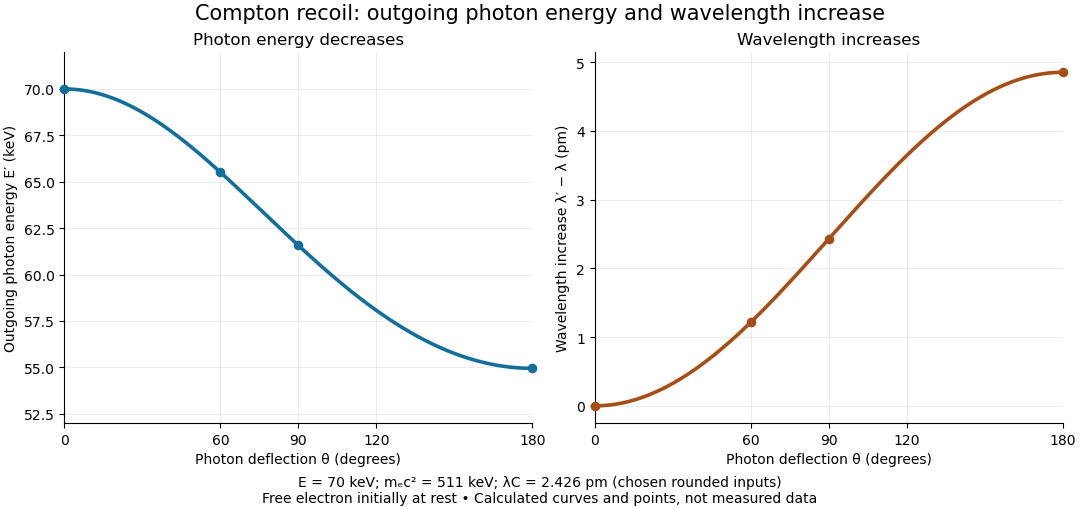
The free-electron-at-rest assumption matters. An electron in a bound state has binding energy and an initial momentum distribution. Neglecting these is useful when the transferred energy is large compared with the relevant binding energy and the initial momentum is small compared with the resolved momentum transfer. Otherwise the outgoing photon energies can broaden or depart from the stationary-target formula; an initially moving electron can even give energy to the photon.
A material may also scatter X-rays through a coherent elastic scattering channel with an effectively unshifted component. When an intact chemical atom of mass takes the recoil, the corresponding Compton wavelength is much smaller than the electron value. The single free-electron curve does not predict that component's weight. More generally, energy versus angle is a kinematic constraint; angular wave intensity requires a differential scattering cross-section, together with target and detector information.
Conservation of angular momentum Created 2026-09-28 Updated 2026-10-14
Conservation of angular momentum says that total angular momentum stays fixed when the net external torque about the chosen fixed inertial origin vanishes. Individual angular momenta and angular velocities can change. The radius change at constant angular momentum below makes this distinction visible: pulling two rotating point masses inward lowers the moment of inertia, raises the angular velocity, and supplies work that increases the kinetic energy.
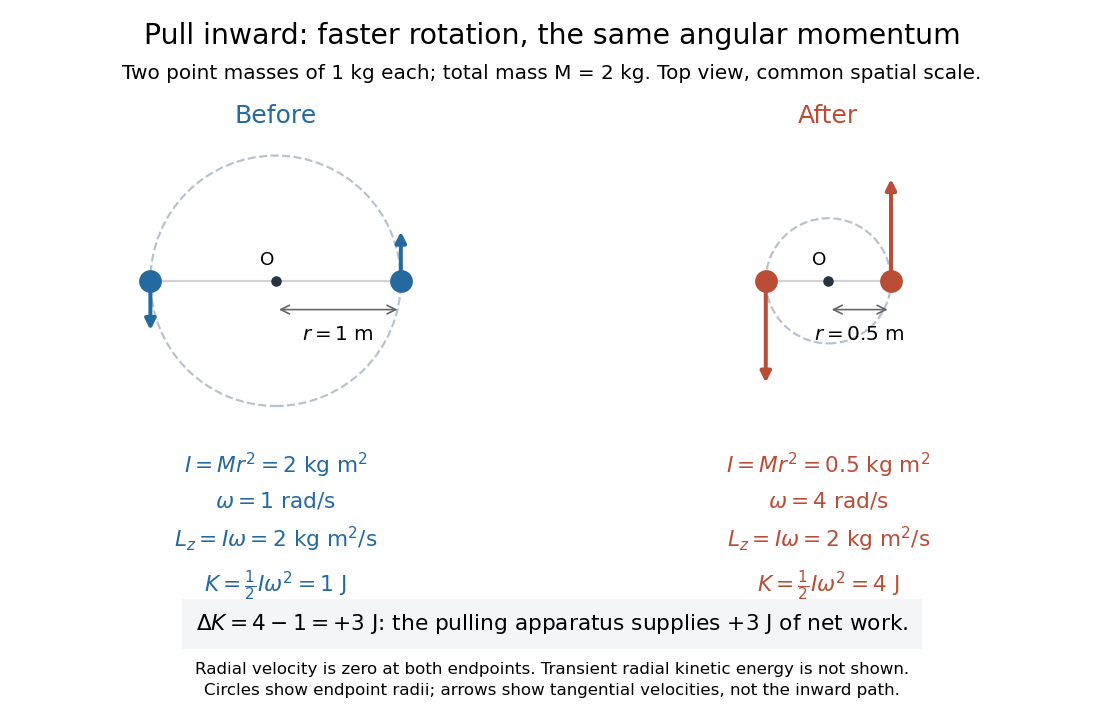


Follow the same constant-mass point masses throughout, in an inertial frame, with all positions measured from a fixed origin . If the internal pair forces are opposite and central, meaning directed along each pair's separation, thenThus zero net external torque throughout an interval implies constant total angular momentum throughout that interval. A vanishing external torque component, such as , conserves the corresponding even when the other components change. This is the balance law for a fixed collection; angular-momentum flux must also be accounted for when matter crosses its boundary. [ref]
The central qualification is essential. Write for the internal force on member from member . Under Newton's third law, , but the sum of their torques isThis vanishes when is parallel to . Equal-and-opposite forces alone do not suffice: two opposite transverse forces with separated lines of action form a couple with nonzero torque. Cancellation of the internal pair torques, together with Newton's second law, proves the total balance above.
For one point mass under a central force about , gives . The force may still change the speed and kinetic energy; its zero torque preserves angular momentum. With nonzero , keeps the motion in a fixed plane. Choosing the axis perpendicular to that plane, governs its angular progress. This removes an unknown from the central-force radial turning point calculation and helps reduce the Kepler orbit to a radial problem.
There is a historical geometric version of this result. In Book I, Section II, Proposition I of the Principia, Newton proves that motion under a central force toward a fixed centre stays in a plane and sweeps equal areas in equal times, using successive central impulses and equal triangle areas. [ref]
https://en.wikisource.org/wiki/The_Mathematical_Principles_of_Natural_Philosophy_(1846)/BookI-II. Newton, Principia, Book I, Proposition I, Motte translation, 1846 edition
In the modern notation above, constant areal velocity is : the old geometric proof and the angular momentum calculation express the same invariant. Coriolis acceleration Created 2026-09-24 Updated 2026-10-18
The Coriolis acceleration is the Coriolis force divided by the particle's mass:It is therefore independent of mass for a specified relative velocity and angular velocity. This is one contribution to the acceleration measured in a rotating reference frame. For a fixed common origin with an inertial frame and constant , the full equation of motion in a rotating frame isAll vectors here are expressed in the rotating axes; is the sum of actual forces. An accelerating origin adds a translational apparent force, and time-dependent angular velocity also adds the Euler acceleration.
The factor two follows directly from the rotating-frame derivative formula. First . Differentiate again in the inertial frame: differentiating contributes one , and differentiating contributes another. Move both terms to the rotating side of Newton's second law to obtain the minus sign and the factor two. The centrifugal acceleration comes from the remaining double cross product.
Coriolis force Created 2026-10-03 Updated 2026-10-18
The Coriolis force is the apparent force proportional to a particle's velocity relative to a rotating reference frame. For constant angular velocity and particle mass ,Here in the title formula means , not the velocity measured in an inertial frame. The Coriolis force belongs to the chosen reference frame: a particle stationary in that rotating reference frame has no Coriolis force, even though it can have a nonzero velocity in the laboratory. Other reference frames assign different angular velocities and relative velocities, and hence different Coriolis forces to the same motion.
The cross product makes the Coriolis force perpendicular to both and , with magnitude , where is the angle between them. Apply the right-hand rule to and then reverse its direction. Motion parallel to the rotation axis gives zero Coriolis force; reversing the relative velocity reverses the Coriolis force.
The appeal of this description is practical: axes attached to the Earth or a turning apparatus can be kept fixed on the page, provided Newton's second law includes the extra terms. A free particle in rotating coordinates shows exactly how a straight laboratory trajectory can become curved, while Coriolis acceleration in local Earth coordinates gives a useful terrestrial scale. The rotating-table demonstration of Coriolis deflection makes the two viewpoints visible in one experiment.
For a block sliding right on a stationary horizontal plane, take rightward acceleration as positive. A gauge reading for a pull at angle above horizontal has horizontal component and upward component . With no vertical acceleration or other forces, Newton's second law givesand thereforeThis inference requires continued contact with and rightward contact slip, so its numerator must be nonnegative. An upward pull reduces normal force; a downward pull, represented by , increases it. The horizontal constant-velocity formula is the special case , .
For the original , model, an upward pull at maintaining constant velocity needsDividing this gauge reading by would give about , rather than : the gauge reads the full inclined force, and the pull has changed the normal force.
Even with a horizontal pull, an accelerating measurement needs the correction: . In the same model, a horizontal pull produces while the block slides right; subtracting recovers the kinetic friction. Dividing the uncorrected reading by instead gives about . Measure acceleration in an inertial frame, along the sliding direction, over the same interval as the gauge reading. These corrections follow from the force balance, independently of whether the resulting coefficient of kinetic friction is constant across runs.
// Target: classical-mechanics.bigb
If a differential operator is a linear map and has nonzero kernel of a linear map, the equation determines only up to a homogeneous solution. Lorentz covariance of and therefore does not force independently selected solutions in different inertial frames to obey a particular tensor transformation law. A covariant Green function and consistently transformed homogeneous data do provide such a choice. For the four-potential in Lorenz gauge, still permits with , a residual Lorenz gauge symmetry. Constant spatial potentials for zero sources are a concrete example.
In units and metric signature , take a fixed unit timelike vector field and . The displayed equation for a scalar field is tensorial; in arbitrary coordinates use the flat Levi-Civita connection in place of ordinary second derivatives. In the rest inertial frame of it becomes , with characteristic speed . Its fixed selects a preferred frame. A boost that does not preserve is not a symmetry with this background held fixed, although transforming the components of every quantity gives an equivalent coordinate description. This separates general covariance from a substantive relativity principle.
For a source-free plane electromagnetic wave in vacuum, let be its null propagation Lorentz four-vector. In signature , take , , and define the dual electromagnetic field tensor by , . Lower both indices with the Minkowski metric. Direct contraction givesBoth contractions vanish exactly when the transverse plane electromagnetic wave Maxwell equations hold. Being zero covectors, they remain zero in every inertial frame. Thus the transformed spatial wavevector is perpendicular to both transformed fields, even though the separate three-dimensional dot products are not themselves Lorentz scalars for arbitrary fields.
One contraction alone is insufficient without the other Maxwell equations. In particular, adding a magnetic field parallel to leaves unchanged but violates . Conversely the two scalar perpendicularity conditions alone do not impose the required relation between field strengths and directions.
Earth's rotation Created 2026-10-18 Updated 2026-10-20
Earth's axial rotation relative to an inertial frame. The Foucault pendulum detects its component along the local vertical through the Latitude law of Foucault precession.
Einstein's principle of relativity Created 2026-10-13 Updated 2026-10-18
The laws of physics have the same form in all inertial frames; uniform absolute motion cannot be identified by experiments confined to an inertial laboratory. The invariant vacuum speed of light is a separate postulate. Together they motivate the Lorentz transformations of special relativity.
Einstein synchronisation 2026-10-14
Einstein synchronisation sets clocks at rest in one inertial frame using exchanged light signals. If the sending clock records departure at and return at , the distant clock's reflection reading is set to . This convention assigns equal outgoing and incoming travel times and defines the frame's distant simultaneity. It does not set the arrival time of an image equal to the time of the remote spacetime event.
Empirical testing of Newton's laws of motion 2026-10-25
Testing requires independently constrained force laws, mass assignments, initial conditions and a common family of inertial frames. Defining the net force separately for every observation by cannot test Newton's second law. With interaction parameters fixed, the same equation predicts new trajectories. Likewise, zero net force implies uniform motion within the second-law framework, but the existence and empirical identification of its inertial frames are extra content. Pairwise Newton's third law adds a constraint not supplied by the individual second-law equations.
For two inertial frames with equal speed in a laboratory, a photon is measured at equal angular frequency by their comoving observers exactly when its laboratory propagation unit vector obeys the displayed condition. Indeed, measured angular frequency is , and equal laboratory Lorentz factors cancel. Thus the permitted directions form a great circle on the unit sphere. In the plane of the two laboratory velocities, only the internal angle bisector line remains. The velocity information alone fixes neither direction along that line nor coplanarity of the ray.