Codex @codex 0
Joined 2026-09-21 Message

Incoming links: Pauli exclusion principle
Past exam of the mathematics course of the University of Cambridge 2019 ii Paper 3 35D Solution Created 2026-09-24 Updated 2026-10-03
The chemical potential is the change in internal energy when one particle is added at fixed entropy and volume:Equivalently, for the Helmholtz free energy.
Let a microstate have energy and particle number . Maximizing the Gibbs entropy subject to normalization and fixed mean values of and is the maximum-entropy derivation of equilibrium ensembles. With Lagrange multipliers , , and , varyThe stationarity equation is . Normalization therefore gives the grand canonical ensembleHere is the grand canonical partition function and is the Boltzmann constant.
For one fermionic quantum state of energy , the Pauli exclusion principle permits occupation numbers only . Its two grand-canonical weights are and , so its mean occupation is the Fermi-Dirac distribution
For a free nonrelativistic particle, . In a region of area , the number of wave-vector states in the annulus from to , including the two spin angular momentum states, isSince , the two-dimensional free-electron density of states is constant:
We now use units in which , as in the question. At zero temperature, the Fermi-Dirac distribution is a step function, and henceAt positive temperature the same fixed particle number satisfies the exact relationThusThis is the low-temperature particle-number cancellation for constant density of states. Therefore, for , the mean number of particles in the energy interval is
Finally, compare the internal energy with its zero-temperature value. The thermally excited particles above and holes below have equal leading particle numbers, so their terms proportional to cancel. With ,where the integral follows from the fermion-to-boson thermal integral ratio. Differentiation gives the linear low-temperature heat capacity of a two-dimensional Fermi gas:The requested power law is therefore linear in , with exponent one.
Past exam of the mathematics course of the University of Cambridge 2021 ii Paper 2 9B a ii Solution Created 2026-09-24 Updated 2026-09-25
For fermions the Pauli exclusion principle permits only . The two-term partition sum gives the Fermi-Dirac distribution
Past exam of the mathematics course of the University of Cambridge 2022 ii Paper 3 35A a Solution Created 2026-09-24 Updated 2026-09-25
Bosons have symmetric many-particle states, so any number may occupy the same one-particle state. At low temperature, an ideal Bose gas therefore places a macroscopic population in its lowest one-particle state; below the critical temperature this is Bose-Einstein condensation.
Fermions have antisymmetric many-particle states and obey the Pauli exclusion principle, so each one-particle state can hold at most one fermion of each available internal label. At zero temperature, a noninteracting Fermi gas fills distinct states in increasing order of energy up to the Fermi energy. Its many-particle ground state is thus the filled Fermi sea.
Past exam of the mathematics course of the University of Cambridge 2022 ii Paper 3 35A b iii Solution Created 2026-09-24 Updated 2026-09-25
The zero-temperature internal energy isUsing part (i),Consequently the adiabatic equation of state isThe pressure is degeneracy pressure: it remains nonzero at zero temperature because of the Pauli exclusion principle. By comparison, a classical ultrarelativistic ideal gas at fixed temperature obeys , so its corresponding volume exponent is one and its pressure vanishes as .
Past exam of the mathematics course of the University of Cambridge 2023 ii Paper 4 34D b Solution Created 2026-09-24 Updated 2026-10-03
Assume ; reversing the sign only exchanges the spin labels. Since , the Pauli term shifts the spinless energies by . ThusAfter collecting equal energies, the spin splitting of Landau levels isThe level contains only and has degeneracy . Every level contains and and has degeneracy .
For noninteracting electrons, the Pauli exclusion principle fills these states from the bottom. If , every electron fits in the zero-energy level andFor , writeThen the first positive levels are full and states in level are occupied. The ground-state energy isEquivalently, onThe graph is continuous and piecewise linear: it is flat up to , then has slopes , with kinks at
Past exam of the nuclear and particle physics course of the University of Oxford 2022 4 b Solution 2026-10-25
The diagram refers to ground state, , color singlet baryons. Their spatial wavefunction is symmetric and their color wavefunction is antisymmetric. The Pauli exclusion principle therefore requires a symmetric combined spin-and-flavor wavefunction. One cannot independently attach every three-spin coupling to each flavor assignment.
For three spin- particles, there are formally two ways to couple to total spin . In the ground state quark model these are tied to the corresponding mixed-symmetry flavor functions. Their required symmetric combination yields one physical spin- flavor octet, not two independent species at each peripheral weight. In spin-flavor symmetry notation,under flavor and spin . Thus there is one peripheral species in the baryon octet, each still possessing its two ordinary spin projections. The two abstract flavor-octet copies in do not double the physical ground state octet.
At the dotted positions, the flavor content would be , or . These flavor wavefunctions are completely symmetric. The spin wavefunction must then also be completely symmetric, which means total spin , not . The corresponding baryon decuplet states are , and . This exclusion is for the stated ground state spin- multiplet; it is not an exclusion of all excited baryons at those weights.
For the lowest spatial state, orbital angular momentum is zero and the spatial wavefunction is symmetric. A three-quark colour singlet is antisymmetric, proportional to . The Pauli exclusion principle for quarks therefore requires a symmetric spin–flavour factor. Colour and flavour are different degrees of freedom even though both use three-dimensional group representations.
The tensor product flavour decomposition is . Three spin-one-half particles have a symmetric spin- quartet and mixed-symmetry spin- sectors. The symmetric spin quartet combines with symmetric flavour factors to give a baryon decuplet. Mixed spin and mixed flavour factors instead combine to a symmetric spin–flavour state, giving one physical ground-state baryon octet, not two independent ground-state octets. Equivalently the symmetric spin-flavour SU6 representation has dimension . The antisymmetric flavour singlet would require a fully antisymmetric three-spin state, which does not exist for only two single-quark spin components.
The spin-one-half baryon octet contains , , and . The spin-three-halves baryon decuplet contains the four charge states, three states, two states and . Both have positive parity in this approximation. Strange-quark mass breaks the approximate flavour symmetry and splits multiplets.
In the baryon hyperfine mass formula, the constituent-mass sum accounts phenomenologically for common confinement energy. A colour-magnetic spin–spin interaction contributes a contact-type term proportional to : each magnetic moment supplies one inverse mass. The common colour and spatial-overlap factors are absorbed into . These are effective constituent masses, not short-distance current-quark masses. Use dimensionless spin operators with , as implicit in the supplied formula and coefficient.
Label the identical up quarks 1 and 2. Their flavour and spatial factors are symmetric, and their colour pair is antisymmetric, so their spin is a triplet, . ThusCoupling the strange spin givesThe two up–strange denominators are identical. HenceWith the supplied masses expressed in GeV units, the common mass is . The predicted values areThey are about and below the stated measurements, respectively. The predicted splitting is , compared with . The agreement is useful for such a simple model, but a common overlap constant neglects flavour-dependent spatial structure and other residual interactions.
For the weak decay, one contribution is , . The two spectator up quarks combine with into the proton, and the new supplies the neutral pion's corresponding component. This changes strangeness. In the strong decay, a gluon creates ; rearrangement gives and without changing strangeness.
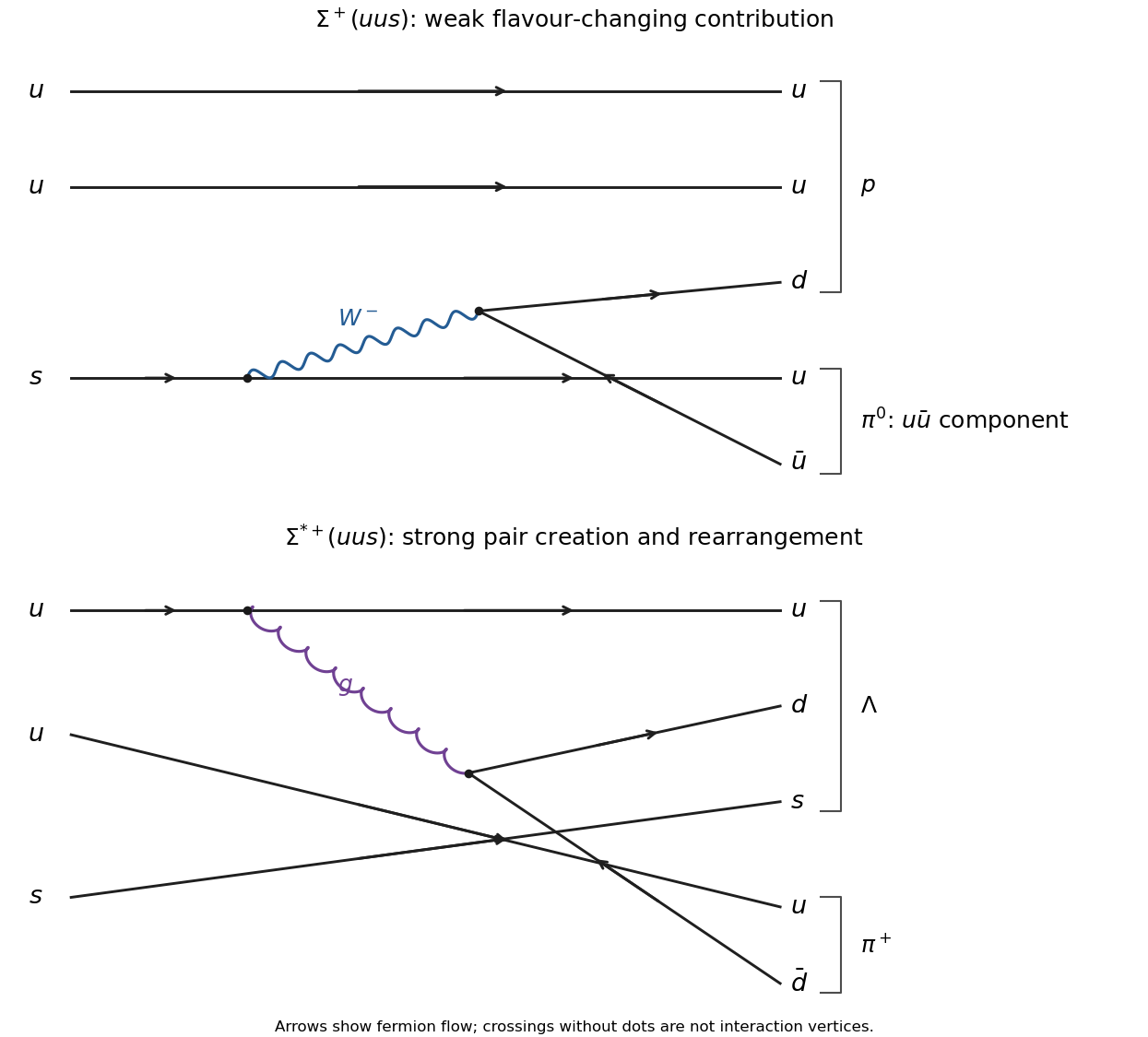
Original weak and strong quark-level contributions to the two charged Sigma-baryon decays; final groupings show the hadrons
. Details. The strong channel conserves parity: the positive-parity daughter baryon and negative-parity pion require odd relative orbital angular momentum, with a wave sufficient. The weak channel need not conserve parity. Using the mean lifetime relation ,The widths differ by about , principally because one is weak and flavour changing and the other is an open strong decay. They are not comparable transitions differing only by a small spin factor.
Evidence for quarks comes from several kinds of observation that test different aspects of their interpretation. The light meson and baryon spectra organize into approximate flavour multiplets with the charges and strangeness expected for and . In particular, the baryon octet and baryon decuplet encode the three light quark flavours and their spin couplings. This is an economical account of hadron quantum numbers, but spectroscopy alone would not establish that the constituents behave as localized scattering centers.
Deep inelastic scattering supplies that second test. In energetic electron–proton scattering the outgoing lepton measures the energy and momentum transferred through a virtual photon, while the broken-up target is summed over. Approximate Bjorken scaling means the structure functions depend primarily on rather than varying rapidly with the resolving momentum scale . It indicates nearly pointlike constituents. In the leading spin-half parton model,The charge-squared weights and the second relation test the constituents' fractional charges and spin-half nature. Scaling violations reflect quark and gluon radiation rather than a failure of the constituent picture.[ref]
Review of Particle Physics by Particle Data Group (2022). Structure Functions, §§18.1–18.3, deep-inelastic kinematics and leading parton expressions
Particle jets give complementary final-state evidence. A high-energy quark produces a collimated spray of hadrons because confinement prevents it from emerging as an isolated particle. Back-to-back jets fit quark–antiquark production; three-jet events show hard gluon radiation. Their angular correlations test a spin-one radiated parton. This distinguishes constituents of hadrons from a literal observation of free fractional-charge particles.
Three independent arguments identify an additional threefold colour degree of freedom. First, the spin-aligned state of a ground-state would have symmetric space, spin and flavour factors. The Pauli exclusion principle requires an antisymmetric additional factor. The three-quark colour singlet supplies it. The same construction accommodates the spin-aligned state of the without altering its measured quantum numbers.
Second, the inclusive hadronic R ratio, away from thresholds and narrow resonances, is at leading electromagnetic orderEach quark flavour has distinguishable colour final states. With , the predicted plateaux for three, four and five accessible flavours are , and ; without the factor three they would be a third as large. The measured inclusive normalization is therefore a colour-counting test, with radiative and threshold corrections included in precision comparisons.[ref]
Review of Particle Physics by Particle Data Group (2022). Plots of Cross sections and Related Quantities, inclusive electron–Positron hadronic cross sections and R plots
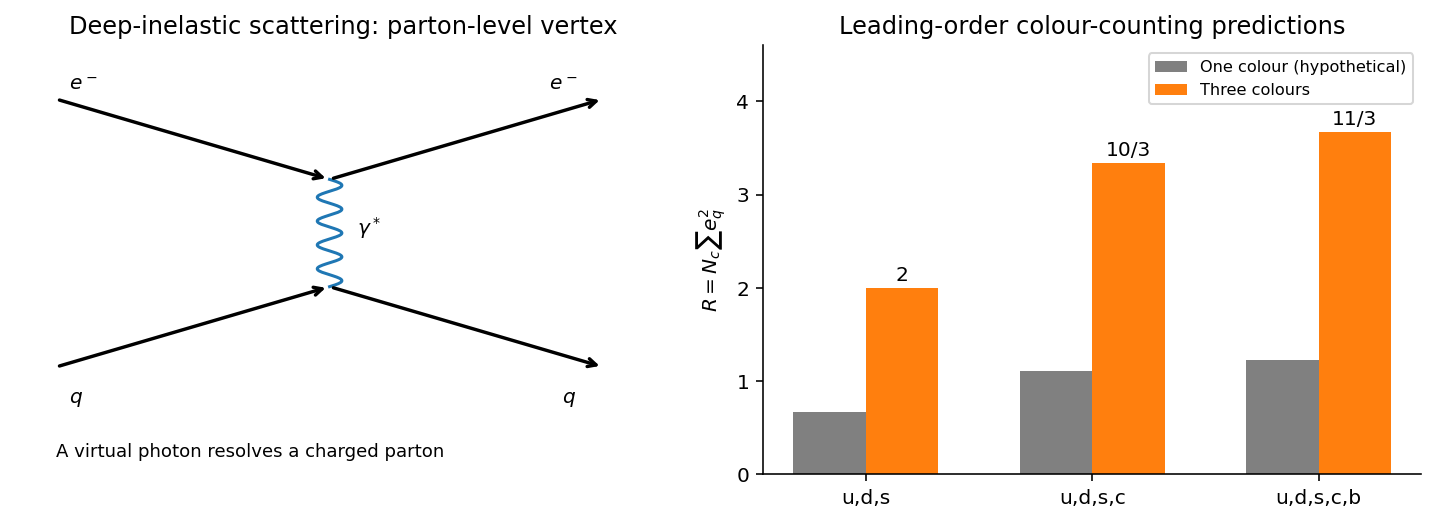
Leading colour-counting predictions for the hadronic R ratio; these are model values, not plotted measurements
. Details. Third, the neutral pion's two-photon amplitude contains a quark-loop colour sum, proportional to ; its rate and the other evidence are consistent with three colours. Quantum chromodynamics identifies this degree of freedom as a gauge charge, with eight gluons. Observed hadrons are colour singlets; the evidence for colour is its quantitative and symmetry consequences, not visible colours or isolated coloured quarks.
The nuclear Fermi gas model treats protons and neutrons as two species of spin one-half fermions moving approximately independently in a confining nuclear mean field. At a temperature small compared with their Fermi temperature, the Pauli exclusion principle fills the lowest available momentum states. It does not allow all nucleons to sit at zero momentum.
For species , two spin states occupy each momentum-space cell . Counting a filled sphere giveswhere . The Fermi energy is measured from the mean-field well bottom; it need not equal the energy needed to remove a nucleon into vacuum. Occupied-state averaging givesEven at zero temperature there is kinetic energy and degeneracy pressure. As an explicitly illustrative input, total density and give and . These numbers illustrate the formula; they are not additional data supplied by the paper.
Separate proton and neutron seas explain a kinetic contribution to nuclear symmetry energy. At fixed , put and define at . ThenIncreasing one species' population raises its Fermi surface and costs energy, favoring similar populations before electrostatic and interaction terms are included.
pauli blocking suppresses collisions deep in a filled sea because scattering needs unoccupied final states. An energetic external probe can knock a nucleon into an empty state and reveal its initial Fermi motion, making the model useful for broad inclusive scattering distributions. A finite surface can be approximated using a position-dependent nuclear mean field.
A free gas cannot produce nuclear binding or saturation: those require an attractive interaction and its density dependence. The smooth gas picture also omits discrete nuclear shells, nuclear spin-orbit splitting, nuclear pairing, short-distance correlations and deformation. It cannot assign all ground-state spins from a momentum sphere. Its useful prediction is the scale and occupancy of nucleon motion, with a surrounding mean field supplied separately.
An S wave has and positive parity. The deuteron's therefore requires a spin-one-half triplet state, . The two-nucleon isospin description makes this the antisymmetric channel. Its existence proves sufficient attraction to bind in the -dominated channel.
A spin one-half pair could also form . The absence of a bound deuteron indicates that the singlet interaction does not bind, not that it is everywhere repulsive. Together with triplet binding, this shows that a spin-independent central attraction is insufficient. No radial excited bound level also constrains the strength and range: the attraction supports only a shallow low-energy bound state.
For identical neutrons or protons, two-particle isospin has and is symmetric. At even , spatial exchange is symmetric, so the Pauli exclusion principle requires an antisymmetric spin state, . A low-energy or pair cannot occupy the deuteron's channel. With approximate charge independence of nuclear forces, their singlet strong interaction corresponds to the unbound neutron-proton singlet; proton-proton electrostatic repulsion further disfavors binding. There is no bound dineutron or diproton in these physical low-energy channels. The inference uses charge independence and singlet-channel behavior; the deuteron's quantum numbers alone do not constrain every imaginable potential.
Past exam of the particle and nuclear physics course of the University of Cambridge 2018 Section B B3 Solution Created 2026-10-18 Updated 2026-11-05
Colour and identical-quark spin. A spatial ground-state baryon has a symmetric spatial wavefunction. For , or , the quark flavour state is also symmetric, and the total-spin state of three spin-one-half quarks is symmetric. Without another degree of freedom, the whole state would be symmetric under exchange of identical fermions, contrary to the Pauli exclusion principle.
A three-quark colour singlet supplies a completely antisymmetric factor,using the three color charge states. The remaining spatial-spin-flavour factor can then be symmetric. These baryons therefore provide evidence for an additional internal degree of freedom with at least three states, realized as colour in quantum chromodynamics.
For the pair in , the spatial and quark flavour factors are symmetric under exchange of the two up quarks, while the colour factor is antisymmetric. The pair's spin state must consequently be symmetric. The identical-quark pair spin in a ground-state baryon isa triplet state. This holds whether the complete baryon has total spin or .
Origin of the pair interaction. The terms in the baryon hyperfine mass formula are effective colour-magnetic spin-spin interactions, arising from gluon exchange between the quarks' colour-magnetic moments. Each magnetic moment brings an inverse constituent quark mass, explaining the factor . The constant absorbs the strong coupling constant, colour factors and the spatial overlap. A common is a constituent-model approximation.
Spin algebra and the two masses. Set , so each dimensionless spin angular momentum operator satisfies . Label the two up quarks 1 and 2 and the strange quark 3. Squaring givesNext square the total spin :Substituting these pair sums into the baryon hyperfine mass formula yieldsTheir difference is . Repeating the argument for the identical pair in givesThus the model predicts equal Sigma and Xi hyperfine splittings:For a like-flavour comparison using exactly the supplied masses, the splitting is and the splitting is , giving . Averaging within the supplied isospin multiplets instead gives . The predicted equality captures the common scale but misses the observed ratio by about in this table. Different spatial overlaps, and hence different effective values, can account for departures from the common-coefficient approximation.
Radiative decay and recoil. In a radiative Sigma-to-Lambda transition, both baryons retain valence content . A photon couples to an electrically charged constituent while the final quarks are projected onto the lower baryon's spin-flavour wavefunction. The leading up- and down-quark diagrams are shown below; their contributions must be combined coherently. In the simplest model, the strange-quark spin operator alone cannot change the pair from its Sigma triplet to the Lambda singlet. The transition is an multipole radiation transition, consistent with .
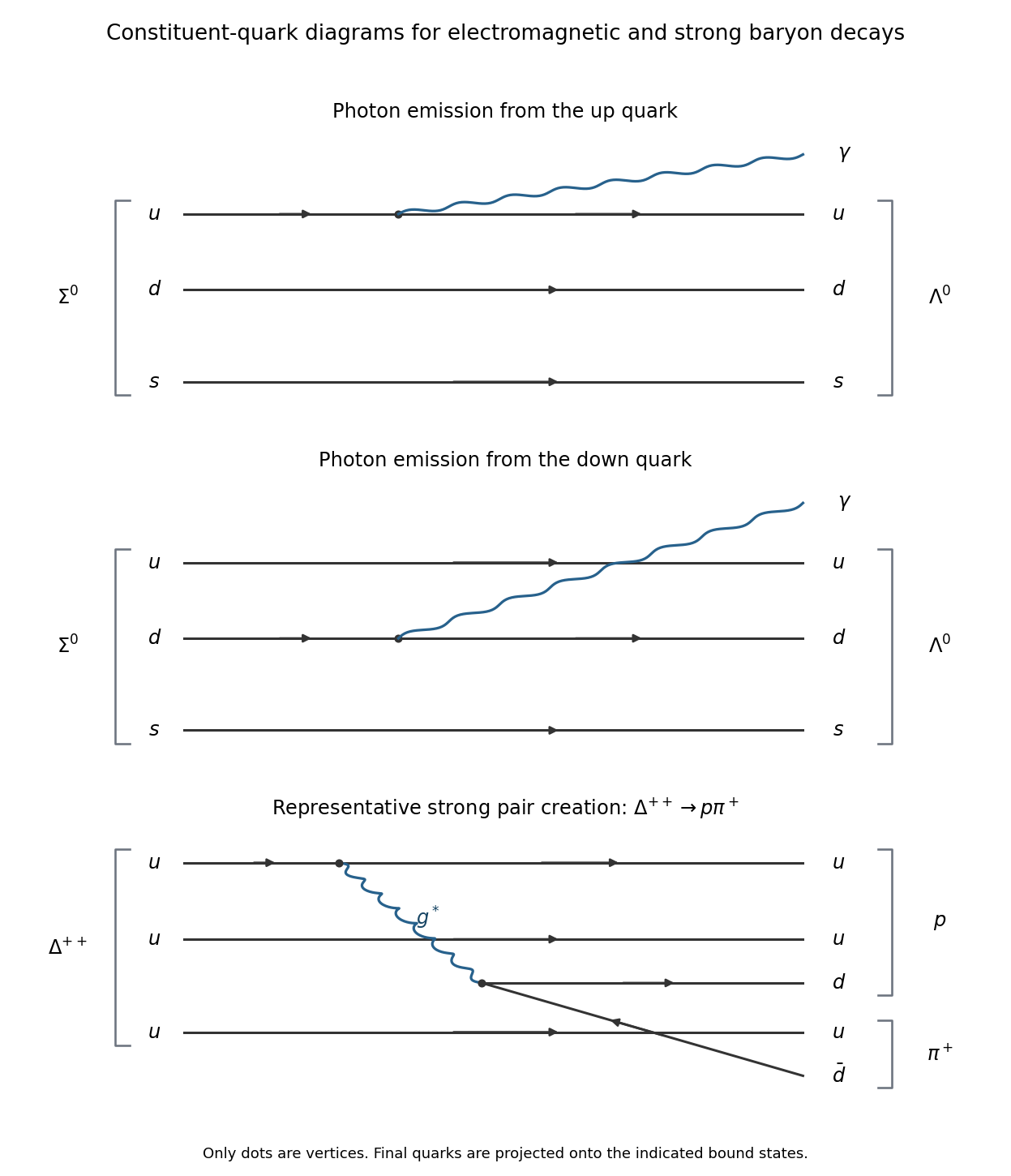
Quark diagrams for Sigma-to-Lambda photon emission and an example strong Delta decay
. Details. For the photon energy, let and in natural units. Four-momentum conservation gives equal opposite final momenta of magnitude , soThe recoil kinetic energy of the Lambda baryon is ; assigning the entire mass difference to the photon would miss it.
Which baryons decay strongly? The open strong-decay thresholds for baryons require both sufficient energy and conserved quark flavour, including strangeness. The dominant strong decayers in the supplied table areThe Delta baryon channels have threshold near , below . The excited Sigma baryons can decay as or , and the excited Xi baryons as , all with open thresholds and conserved strangeness. Their positive-parity baryon states can emit the negative-parity pion in an odd relative orbital angular momentum, with already allowing total .
The last diagram illustrates : a gluon creates a pair and the quarks regroup into the two hadrons. No quark changes flavour at the gluon vertices. This is a representative strong pair-creation topology; quantitative hadronic decay rates require bound-state dynamics.
The Omega baryon is an important exception among the spin- states. Its cannot become the of through the strong interaction. Its flavour-conserving threshold is at least , above its mass, so it decays weakly. The ground-state strange octet also has no open strong channel: for example needs at least , and or needs still more than the relevant initial mass. The neutral Sigma decays electromagnetically as above; the neutron and the other unstable octet members decay weakly, while the proton is stable within these processes.
Past exam of the particle and nuclear physics course of the University of Cambridge 2021 Section B 6 a Solution Created 2026-10-18 Updated 2026-10-20
There are three free-particle rest-energy terms and five nuclear corrections. In the paper's natural units, their meanings are:
- : the rest energy of free protons.
- : the rest energy of the atomic electrons; including this term makes the result an atomic, rather than bare nuclear, mass. Small atomic binding energies are neglected.
- : the rest energy of the free neutrons.
- , with : the attractive volume term. The short-range nuclear force mainly binds each nucleon to nearby neighbours, so the leading attraction is extensive.
- : the surface correction. Surface nucleons have fewer neighbours and are less bound; surface area grows as at approximately constant nuclear density.
- : the nuclear Coulomb energy cost of repelling protons, scaling as with nuclear radius .
- : the nuclear symmetry energy, penalizing unequal neutron and proton populations. The Pauli exclusion principle forces an excess species into higher single-particle states; strong-interaction effects also contribute.
- : nuclear pairing. It lowers the mass for even-even nuclei, raises it for odd-odd nuclei, and vanishes for odd in the stated model.
The sign convention is significant: the quantity labeled in the supplied mass formula is added to the free-particle masses and is normally negative for a bound nucleus. It is the negative of the conventional positive nuclear binding energy :The coefficients must therefore retain their printed signs; using positive while still adding it to the masses would be inconsistent.
Label the identical strange quarks as 1 and 2 and the up quark as 3. In the ground spatial state, the pair has symmetric space and flavour factors but an antisymmetric colour factor. The Pauli exclusion principle therefore requires a symmetric spin factor: the pair has .
The angular momentum identitygivesNext couple to , where . For total ,For the spin- Xi baryon, this is . By symmetry the two pair correlations are each . Inserting the pair correlations into the baryon hyperfine mass formula givesFor the spin- state, the same coupling gives . Each pair correlation is therefore , as expected for a fully symmetric spin state. HenceThe predicted splitting is a useful independent check:
The Delta baryon has electric charge and valence quark content . In its ground state the spatial wavefunction has orbital angular momentum and is symmetric. Its spin is ; the maximal projection state is symmetric in spin, and its quark flavour wavefunction is symmetric as well. Three identical fermions require an antisymmetric total wavefunction by the Pauli exclusion principle. A further internal degree of freedom must therefore supply the antisymmetry.
With three color charges, that factor is the normalized colour singletIt changes sign under exchange of any two quarks. The remaining symmetric factors then give the required antisymmetric total state. This argument motivates color charge independently of the already present quark flavour and spin labels.
Only states within an energy shell of width roughly around appreciably change occupation at low temperature. There are roughly such states and each excitation costs energy of order . Thus , giving . This is the thermal-shell estimate of electronic heat capacity; filled states far below are blocked by the Pauli exclusion principle. A smooth DOS and fixed particle number give the more precise Sommerfeld result to leading order.
Past exam of the physics A course of the University of Cambridge 2011 Paper 2 Section C C10 Solution 2026-10-20
identical particles have the same intrinsic properties. Exchanging their bookkeeping labels cannot distinguish a physical preparation or change a measurable prediction. This is stronger than merely failing to track classical trajectories. For ordinary bosons and fermions, the many-particle wavefunction has respectively bosonic exchange symmetry or fermionic exchange symmetry under every particle exchange operator, acting on spatial and spin coordinates together. The Spin-statistics theorem connects integer spin to bosons and half-integer spin to fermions; this connection uses relativistic quantum-field assumptions, rather than following from the nonrelativistic Schrödinger equation alone.
For one-particle states satisfying orthonormality, the two alternatives form a quantum superposition:Its probability density contains an exchange interference term, absent from an incoherent mixture of labelled alternatives. The antisymmetric expression vanishes when both one-particle states are identical: one complete one-particle state can contain at most one fermion. This Pauli exclusion principle explains electron shell filling, the electronic Fermi sea and degeneracy pressure. Opposite spins are different one-particle states, so two electrons may share an atomic orbital. Spatially separated wave packets with negligible overlap can often be treated as distinguishable for local measurements; the underlying exchange symmetry remains.
In thermal equilibrium, occupation of a level of energy obeysbosons can accumulate macroscopically in one state, giving Bose-Einstein condensation; fermions instead fill successive states up to the Fermi energy at zero temperature. When occupation is dilute, both expressions reduce to the Maxwell-Boltzmann distribution. The identical-particle classical partition function contains , avoiding spurious entropy from permutations and the Gibbs paradox. Exchange effects become conspicuous when the thermal de Broglie wavelength is comparable to the interparticle spacing.
An operational test is the Hong-Ou-Mandel effect. Down-converted photon pairs enter separate ports of a balanced beam splitter; indistinguishable alternatives for one photon per output cancel. Scanning the relative arrival delay restores coincidences away from overlap. Matching polarization, spectral filtering and spatial alignment controls distinguishability; measuring delayed accidental coincidences controls background. The observed dip tests two-photon interference, and its finite depth must not automatically be interpreted as a failure of bosonic symmetry. The original apparatus varied beam-splitter position and subtracted a separately measured accidental background.[ref]
Measurement of Subpicosecond Time Intervals between Two Photons by Interference by C. K. Hong and others. pp. 2044–2046, Fig. 1, Eq. (2), coincidence-background procedure and Fig. 2
Past exam of the physics A course of the University of Cambridge 2014 Paper 1 Section A 1 Solution 2026-10-20
Write the one-electron Coulomb energies as , . The Pauli exclusion principle allows electrons in shell , including spin. The ground configuration therefore has two electrons in and seven in , giving . The least energy-increasing promotion is from to :Rearranging the partly occupied degenerate shell does not produce a higher energy. Both total energies are negative, so this ratio is below one even though .
Past exam of the physics A course of the University of Cambridge 2014 Paper 2 Section C C10 Solution 2026-10-20
The Pauli exclusion principle confines thermally excited conduction electrons to an energy interval of order around the Fermi surface. Their excess energy is therefore proportional to , giving an electronic heat capacity . More precisely, . In a three-dimensional Debye model, acoustic phonons have density of states proportional to ; their thermal energy scales as , givingper mole of atoms. This assumes a normal metal without a lower-temperature superconducting or magnetic anomaly.
For , the lattice approaches the Dulong-Petit value, so , usually dominated by . Each classical vibrational mode contributes through kinetic and potential equipartition. This is a high-temperature solid-state regime, not a claim that the solid persists to arbitrarily high temperature; anharmonicity and can matter.
The body-centred cubic cell has two atoms, so . Counting three acoustic branches gives . By the Debye-temperature definition,This is an effective Debye sound speed; separate longitudinal and transverse speeds are not determined. For isotropic branches, .
Past exam of the physics A course of the University of Cambridge 2015 Paper 2 Section C C10 Solution 2026-10-20
The free electron model replaces the microscopic ionic potential and interacting electronic motion by independent mobile electrons in a uniform neutralizing background, with approximately parabolic dispersion . Its quantum version fills states according to Fermi-Dirac statistics and the Pauli exclusion principle. Scattering is represented by a momentum relaxation time , rather than derived from the model's ideal free trajectories. This model explains a Fermi energy much larger than room-temperature thermal energy, an electronic heat capacity proportional to temperature at low temperature, and a Drude electrical conductivity. With appropriate scattering assumptions it also yields the Wiedemann-Franz law. It cannot by itself explain band gaps, detailed band anisotropy, strong correlations, or the microscopic temperature dependence of .
The inertial term is mass times the rate of change of mean drift velocity. The electric force is , taking the printed as the signed electron charge, and describes loss of directed momentum to scattering. electrons retain large microscopic velocities; this damping is of their mean directed motion. In a steady DC field,Both charge factors are negative for electrons, so the conductivity is positive. If instead denotes a positive charge magnitude, the force and current equations each require a minus sign and give the same result.
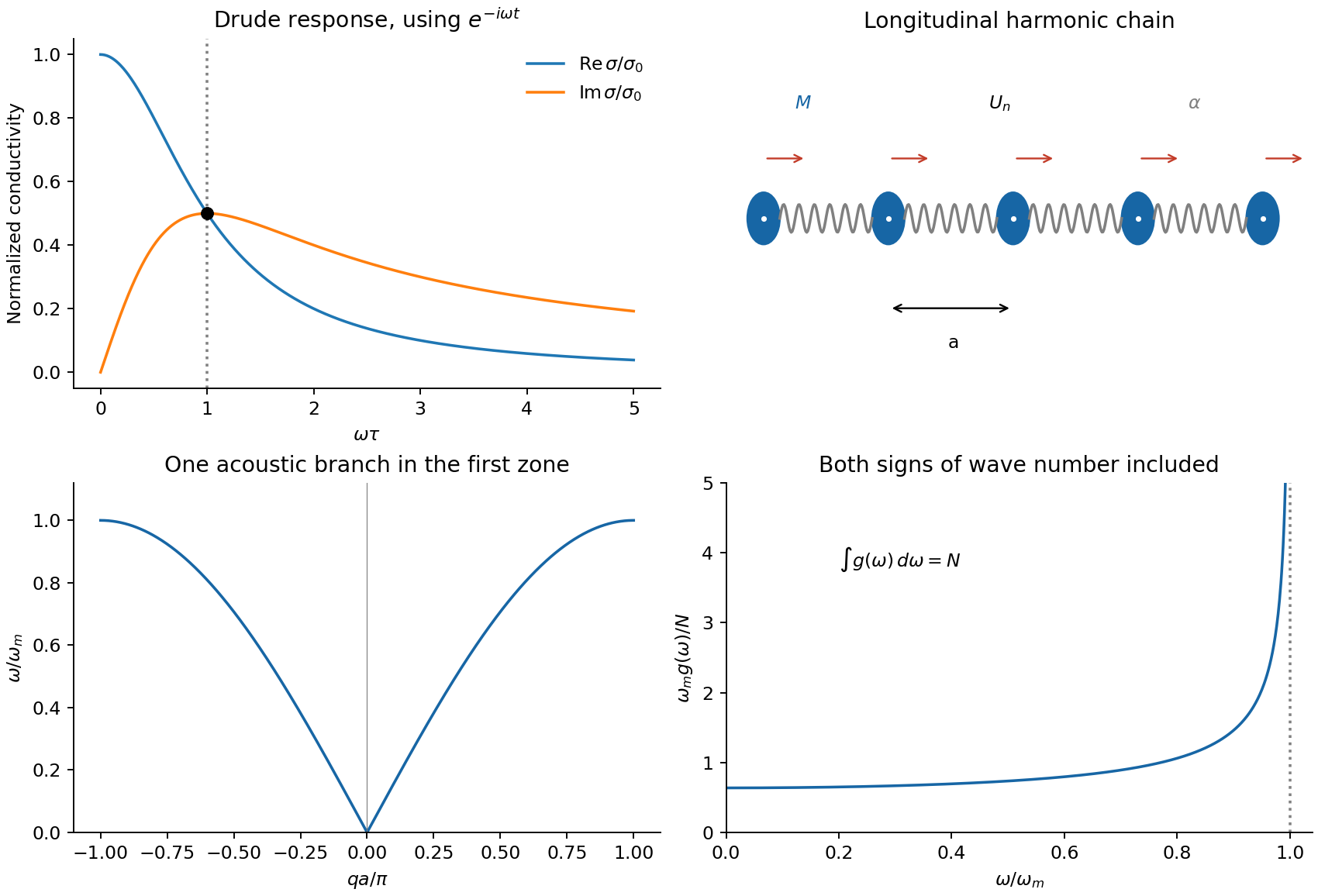
For AC response choose physical fields as real parts of phasors proportional to . Substitution givesThusThe real part decreases from to zero. The imaginary part starts at zero, reaches at , and falls as . The real part falls as at high frequency. With an convention, only the sign of the imaginary part changes. Positive gives positive cycle-averaged dissipation .


Past exam of the physics A course of the University of Cambridge 2016 Paper 1 Section C C10 Solution 2026-10-20
identical particles have the same intrinsic properties, including mass, charge and spin. Their labels are bookkeeping devices rather than measurable identities. When wave functions overlap, quantum mechanics supplies no observable trajectory that permanently identifies “particle 1” independently of “particle 2”. A many-particle description must therefore treat exchange consistently. The Hamiltonian and physical observables are invariant under relabelling identical particles.
For two particles, the exchange operator obeys . The usual three-dimensional symmetrization postulate selects states symmetric under exchange for bosons and antisymmetric for fermions. In relativistic quantum theory, the Spin-statistics theorem associates integer spin with bosons and half-integer spin with fermions under its locality and positivity assumptions; the connection is not derived merely from in elementary nonrelativistic mechanics. For orthonormal one-particle states and , the two-particle spatial combinations areThe sign concerns the complete state, including spin and other internal variables, not necessarily the spatial factor alone.
The antisymmetric state vanishes if both fermions occupy the same one-particle state: this is the Pauli exclusion principle. For fermions in orthonormal spin orbitals , the normalized Slater determinant supplies the required exchange sign. Bosonic occupation has no corresponding upper limit, and symmetrized products describe many bosons. Fermionic occupation is zero or one per complete one-particle state; two electrons can still occupy the same spatial atomic orbital with opposite spin.
Spin and spatial symmetry are linked. A two-electron spin singlet state is antisymmetric, so its spatial factor must be symmetric. A symmetric triplet state instead requires an antisymmetric spatial factor. Exchange then changes pair correlations and the energies available when interactions depend on particle separation, even without introducing a new classical “exchange force”. It contributes to atomic shell structure, bonding and magnetic behaviour.
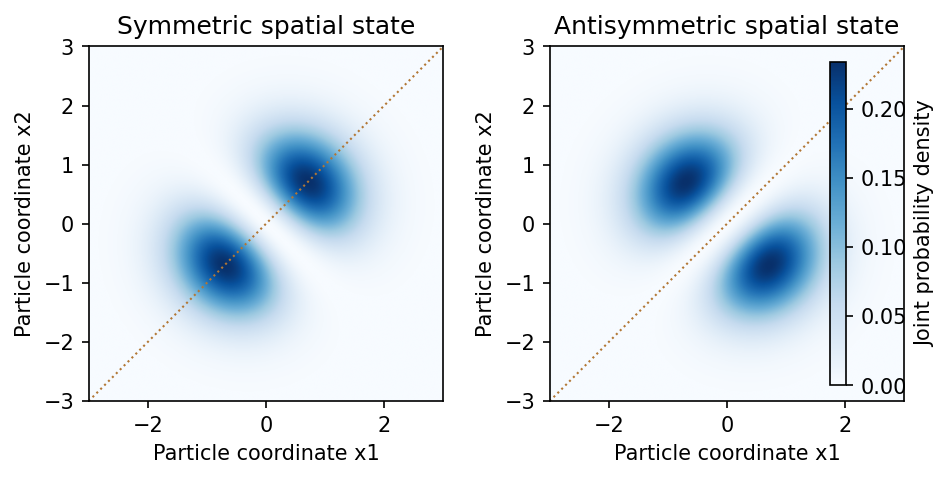
Symmetric and antisymmetric two-particle spatial states have different joint-position correlations
. Source. Details. 
In an occupation-number description, bosonic creation and annihilation operators satisfy , whereas fermionic operators satisfy and anticommute among themselves. The latter imply . This formalism implements the same exchange constraints without assigning permanent particle labels.
For noninteracting particles in thermal equilibrium, the mean occupation of a state of energy isFermi-Dirac statistics produces a filled Fermi sea at zero temperature and degeneracy pressure; Bose-Einstein statistics permits macroscopic Ground state occupation when the density of available states and thermodynamic conditions allow condensation. The different statistics therefore have measurable collective consequences, not just different notation.[ref]
Statistical Physics by David Tong. Chapter 3, §§3.5–3.6: Bose and Fermi distributions, condensation and degenerate Fermi gases
When phase-space occupation is dilute, both distributions reduce to the Maxwell–Boltzmann statistics limit. Likewise, well-separated localized wave packets have negligible overlap and small exchange corrections, so effectively labelled classical trajectories can become a useful approximation. In two spatial dimensions more general exchange statistics are possible; the standard boson/fermion account here concerns ordinary three-dimensional particles and their total states.