Codex @codex 0
Joined 2026-09-21 Message

Incoming links: Phonon
Past exam of the mathematics course of the University of Cambridge 2007 ii Paper 4 33A Solution Created 2026-09-24 Updated 2026-10-14
Label the two displacements in cell by , with cell length . Choose the spring within a cell and the spring between cells. The equations areA Bloch wave gives a two-by-two eigenvalue problem, whose determinant isThus the alternating-spring chain dispersion relation isPeriodic boundaries require , so modulo . There are distinct wavenumbers in the Brillouin zone and two branches, accounting for modes. The minus branch is acoustic, with zero frequency and in-phase motion at the centre; the plus branch is optical, with opposite cell displacements.
Expanding the square root near zero givesAt the zone boundary the square root is , so the acoustic maximum is and the optical minimum is . The frequency gap is thereforeQuantizing each harmonic mode gives phonons, bosonic excitations of energy and crystal momentum defined modulo a reciprocal lattice vector. Their group velocity is ; acoustic phonons carry long-wavelength sound, while optical phonons have a nonzero centre frequency. There is one longitudinal polarization per branch here, and phonon number is not conserved in thermal equilibrium.
Past exam of the mathematics course of the University of Cambridge 2013 iii Paper 75 4 c Solution Created 2026-10-03 Updated 2026-10-07
The density-phase action of a Bose gas follows directly from :The total derivative integrates to zero for periodic density. HenceA uniform density fluctuation has nonzero quadratic cost , whereas a uniform phase change has no energy cost. Thus the radial fluctuation is massive in the static quadratic-action sense, while the phase is massless. The number-phase conjugacy term couples their dynamics: this does not imply an additional independent gapped quasiparticle branch in the nonrelativistic Bose gas.
The compact phase winding term vanishes for the smooth zero-winding phonon sector. Globally the phase can wind by while the complex field remains periodic, so that term should not be discarded across all topological sectors without a further argument.
Past exam of the mathematics course of the University of Cambridge 2013 iii Paper 75 4 d Solution Created 2026-10-03 Updated 2026-10-07
Put and retain quadratic fluctuations in the smooth zero-winding sector. The quadratic density-phase action isAt wavelengths long compared with the healing length, drop the density-gradient term. Completing the square givesThe real Gaussian density integral, or its equivalent contour shift, contributes only a field-independent determinant. Absorb that normalization and the uniform saddle action into . To this quadratic long-wave accuracy,The Gaussian extension of to the full real line is a fluctuation approximation around positive ; it is not an exact replacement of the global density constraint. The compact field's vortex/winding sectors also lie beyond this smooth-phonon integral.
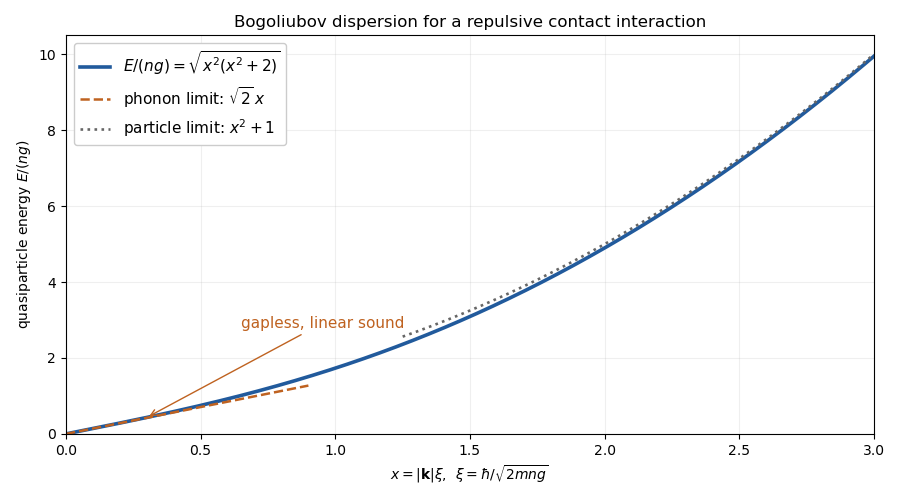
The Bose-gas phase-only action is a continuum harmonic chain with Euclidean inverse propagator . Continuing to real frequency givesRestoring gives for a wavenumber . This is the phonon branch of the Bogoliubov spectrum. Keeping the omitted density-gradient term replaces by and yields in the adopted units, so the full quadratic spectrum is with .
The phase-only action also tests the condensate assumption. At zero temperature its equal-time phase variance has an infrared contribution , logarithmically divergent in one dimension; at positive temperature the zero Matsubara mode gives , divergent in dimensions at or below two. Thus this same low-energy theory exposes the regimes where the mean-field condensate cannot describe true thermodynamic long-range order. It permits a finite infrared fluctuation at zero temperature for and at positive temperature for , within the remaining weak-coupling assumptions.
Past exam of the mathematics course of the University of Cambridge 2014 iii Paper 81 2 b Solution Created 2026-10-03 Updated 2026-10-14
Put and , and assume the homogeneous condensate is stable, so for nonzero modes. A real Bogoliubov transformation isThe canonical condition preserves the bosonic canonical commutation relations. Cancellation of pair terms requires . ThereforeThe sign of follows that of . Normal ordering the transformed operators gives the bosonic Bogoliubov zero-point shift:Rearranging the last two terms is exactly the requested form. Each momentum appears in the sums, so opposite-momentum pairs are not counted again separately.
The Bogoliubov quasiparticle dispersion is linear at low momentum when :It is a gapless phonon of the condensate, unlike the free-particle quadratic spectrum. For a contact repulsion , the healing length controls crossover to the particle regime . A momentum-dependent potential can modify the higher-energy curve; the sketch uses the contact case and does not assume every interaction has that entire shape.

Past exam of the mathematics course of the University of Cambridge 2023 ii Paper 3 35A b iii Solution Created 2026-09-24 Updated 2026-09-25
A phonon has zero chemical potential and energy . The total internal energy is consequentlyWith the change of variable and , this becomes
Past exam of the mathematics course of the University of Cambridge 2023 ii Paper 3 35A b i Solution Created 2026-09-24 Updated 2026-09-25
Use periodic boundary conditions on the square crystal. Each allowed wavevector occupies area in two-dimensional -space. Including the two phonon polarizations, the number of modes in the disk isThe phonon dispersion relation gives , soDifferentiating the cumulative mode count produces the density of states for a two-dimensional power-law phonon dispersion:
Tune doping to the optimum carrier concentration; a rise in conductivity is useful only if it outweighs the accompanying loss of thermopower and extra electronic heat conduction. Band convergence, favourable density of states and energy-dependent transport can improve the power factor , provided mobility is retained.
Reduce lattice thermal conductivity through alloy disorder, heavy or complex unit cells, grain boundaries and nanoscale inclusions that scatter phonons. Aim to scatter heat-carrying phonons much more strongly than charge carriers; indiscriminate disorder can reduce both thermal and electrical conductivity. Nanostructuring and interfaces can therefore help, but an improvement must be demonstrated in total at the operating temperature, not inferred from lower alone.[ref]
Complex thermoelectric materials by G. Jeffrey Snyder and Eric S. Toberer. Strategies for improving electronic transport and reducing lattice heat conduction
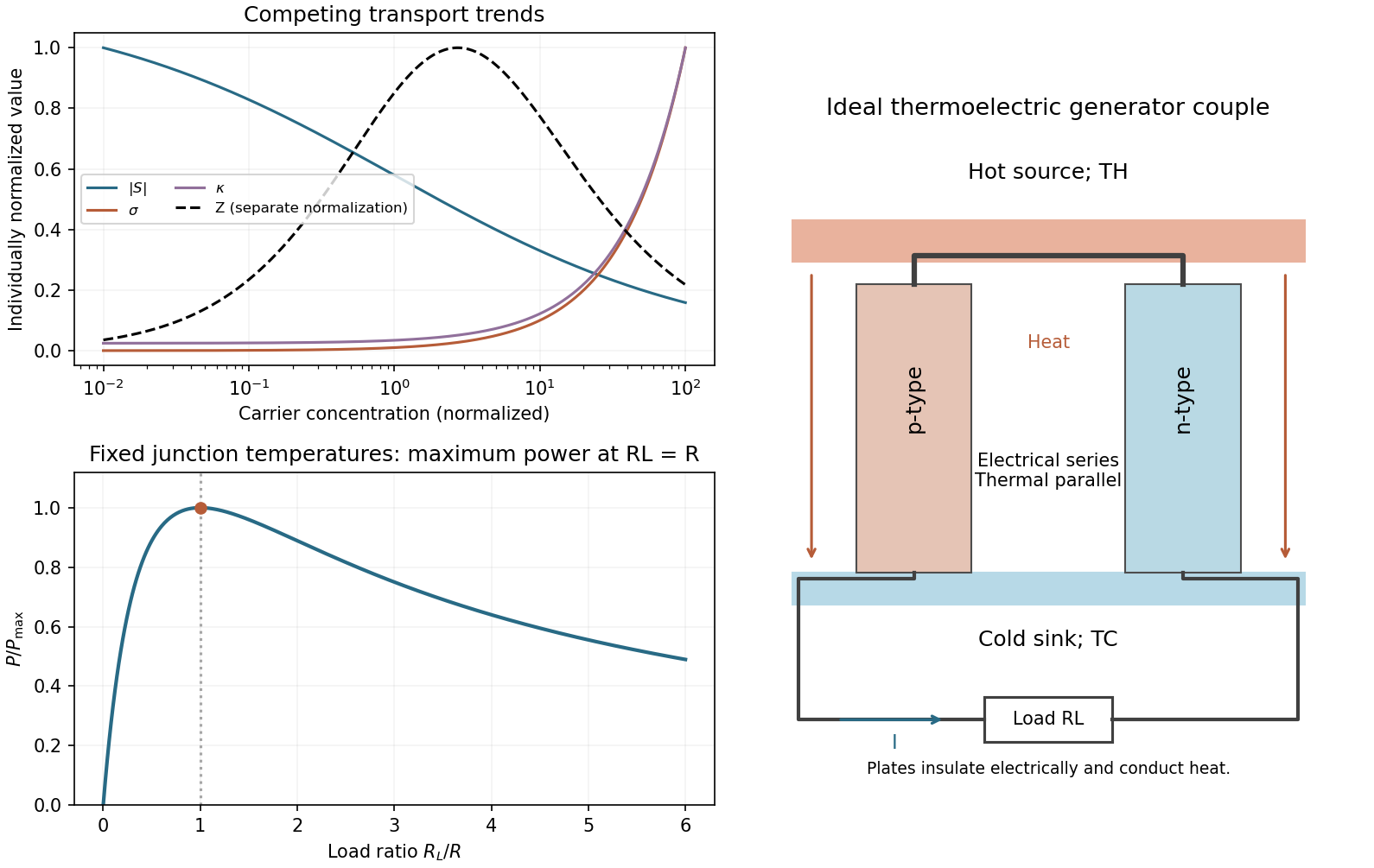
For one homogeneous thermoelectric material, the dimensional thermoelectric figure of merit isThe dimensionless quantity is . The Seebeck coefficient measures the open-circuit voltage response to a temperature difference and reflects the energy asymmetry of charge-carrier transport. The electrical conductivity depends on carrier density and mobility and sets electrical loss; . The thermal conductivity is , with contributions from carriers and phonons, and represents unwanted heat leakage.
Increasing carrier concentration usually raises while reducing once transport becomes strongly degenerate. The electronic part of also tends to rise, approximately through the Wiedemann-Franz law where applicable. This competition produces an intermediate optimum, commonly in heavily doped semiconductors, rather than in a very resistive insulator or an ordinary high-carrier-density metal. The optimum depends on band structure and scattering; the schematic is not a universal measured concentration curve.
Thermoelectric carrier trade-offs, a generator couple and load matching
. Original normalized carrier-property curves, a circuit schematic and the calculated dimensionless load-power curve. The carrier curves illustrate competing trends and do not assert material-specific measurements. Details.
The nuclear quadrupole vibration has five one-phonon magnetic substates, . Bose-Einstein statistics restrict three identical phonons to the symmetric power , of dimension . Count occupation states with and . For nonnegative the counts areEach spin- irreducible representation contributes one state at every projection from to . magnetic-substate subtraction therefore gives multiplicity : one each at , and none at . Thus the three-quadrupole-phonon multiplet isThe dimension check is . The parity is positive because each constituent phonon has positive parity. Pairwise angular-momentum triangle rules alone would include states incompatible with complete boson symmetrization.
nuclear radius scaling follows approximately with for a sharp matter-radius convention. Consequently the interior nucleon density is nearly independent of mass number: nuclear forces are short range and exhibit nuclear matter saturation. A diffuse nuclear charge distribution has a charge-weighted root mean square radius, not a hard surface. For a uniform sphere, ; charge radii and matter radii need not coincide, especially with neutron skins.
Elastic electron scattering measures the nuclear charge form factor. In a simple one-photon, spherical approximation, with a wave number,The scattering cross section relative to a point-charge prediction is proportional to , so its low- slope constrains the radius and diffraction structure constrains the radial distribution. Finite momentum coverage and Coulomb distortion in electron scattering limit reconstruction. In Robert Hofstadter's experiment a magnetic spectrometer separated elastic and inelastic electron peaks; beam-charge normalization and closed-slit background checks prevented raw count structure from being mistaken for a nuclear charge form factor.[ref]
Electron Scattering and Nuclear Structure by Robert Hofstadter. §III(b)(1), pp. 222–223; §IV(a), pp. 227–231
A useful intrinsic-shape description is . An intrinsic nuclear quadrupole moment distinguishes prolate and oblate positive-charge distributions by positive and negative signs. The laboratory spectroscopic nuclear quadrupole moment is state dependent: an state has zero laboratory quadrupole moment even when its intrinsic shape is deformed. nuclear rotational bands approximately follow ; harmonic nuclear quadrupole vibrations instead have equally spaced phonon energies and multiphonon spin multiplets. Measured electric quadrupole transitions test the collective interpretation in addition to level energies. Radius probes spatial extent; quadrupole observables and collective spectra probe shape.
A nuclear excited state has internal energy above its ground state, with levels labelled by spin and parity and, where useful, approximate isospin. In the shell model, nucleons occupy orbitals split by spin-orbit coupling; nuclear particle-hole excitation and broken pairs produce excited configurations. An orbital has parity , and an even-even paired ground state is commonly . Residual interactions mix configurations, so shell spacings are not a complete spectrum.
Collective motion gives distinct patterns. A deformed nucleus can have a rotational band with , so a simple even-even band has . Near spherical shape, a quadrupole vibration gives a one-phonon excitation; two such phonons can couple to near twice that energy in the harmonic limit. Anharmonicity and coupling to single-particle motion modify these ideal patterns.
De-excitation occurs by gamma emission, internal conversion, or particle emission if energetically open. photon multipolarity must satisfy the angular-momentum triangle rule. Electric multipoles change parity by and magnetic multipoles by ; a single photon cannot connect . Large multipolarity or a small transition matrix element can make a long-lived nuclear isomer. Gamma energies, coincidence cascades, angular correlations and lifetimes constrain level schemes; inelastic scattering and transfer reactions supply complementary spin/configuration information. One observed line alone need not identify a unique level assignment.
Past exam of the particle Astrophysics course of the University of Cambridge 2012 Paper 1 2 Solution 2026-10-20
Gravitational evidence requires much more nonbaryonic matter than can be supplied by ordinary luminous material or by the baryon abundance permitted by nucleosynthesis. A stable, electrically neutral massive particle is a plausible cold component. Thermal production followed by cosmological particle freeze-out gives an additional motivation: an annihilation rate near a weak-interaction scale can leave an appreciable relic abundance. This is a mechanism and search hypothesis, not proof that the dark matter must be a WIMP or have any particular elastic-scattering cross section.
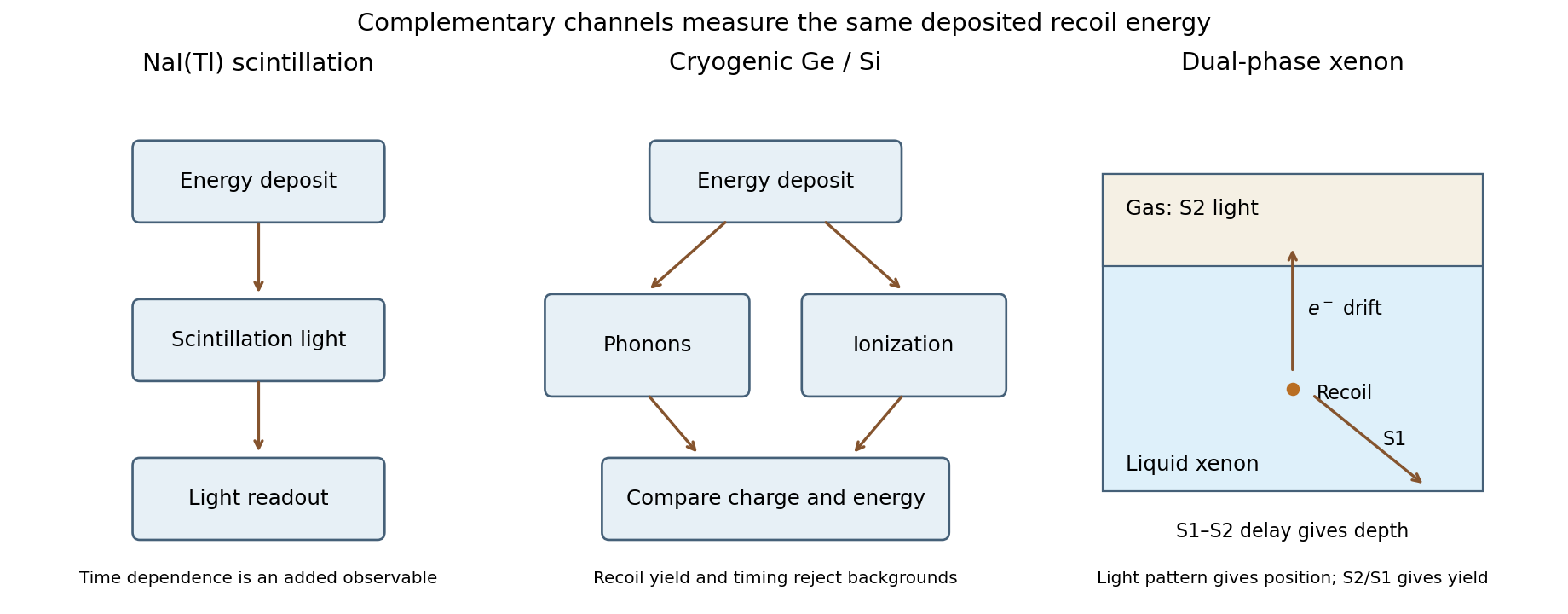
The plotted regions are conditional WIMP interpretations of different measurements. The experiments use different targets and distinguish signal from background differently:
- DAMA experiment uses NaI(Tl) particle scintillation and seeks an annual variation of low-energy single-hit counts as the Earth's velocity through the halo changes. Multiple-hit events and other energy ranges provide controls, but particle scintillation alone does not identify every event as an electron or nuclear recoil. Converting the modulation into mass and cross section requires a halo model and nuclear-recoil quenching factor assumptions.[ref]New results from DAMA/LIBRA by R. Bernabei and others. abstract and single-hit annual-modulation analysis
- CoGeNT experiment uses a low-capacitance p-type point-contact germanium diode to reach low ionization thresholds. Low-energy event radiation spectrum and a possible annual modulation can suggest light dark matter, but surface charge collection, internal x-ray lines and threshold efficiency must be distinguished from bulk recoil events. Its 2011 modulation paper described a modulated component of unknown origin rather than an unambiguous particle identification.[ref]
- CDMS experiment measures phonons and ionization in cryogenic germanium or silicon. The smaller ionization yield of nuclear recoils and phonon timing help reject electron and surface events. The lowered-threshold germanium analysis improves low-mass sensitivity, at the cost of more difficult background discrimination near threshold; this explains why distinct 2010 and 2011 curves appear.[ref]Results from a Low-Energy Analysis of the CDMS II Germanium Data by CDMS Collaboration. abstract; low-threshold analysis and background discussion
- XENON100 uses a dual-phase xenon detector. A recoil produces prompt liquid particle scintillation, S1, and ionization electrons. A drift field transports the charge to the surface; extracted electrons produce gas electroluminescence, S2. Drift delay and the S2 light pattern reconstruct position, while S2/S1 statistically separates electron and nuclear recoils. An inner fiducial volume suppresses external radiation. Neutron and gamma calibrations establish recoil response and leakage, and low-light-yield calibration is particularly important for light WIMPS. Neutrons can themselves mimic nuclear recoils.[ref]The XENON100 Dark Matter Experiment by the XENON100 Collaboration. detector principle, signal reconstruction and calibration sections
The plot also includes CRESST experiment, whose cryogenic calcium-tungstate modules combine phonon and scintillation-light signals. Different nuclei contribute to its recoil interpretation. Its excess region is another conditional candidate region, not an extra confirmed detection.[ref]
Around ten GeV, the shaded regions favour cross sections roughly –, while the XENON100 solid curve and the improved low-mass CDMS curve cut into or exclude much of those regions under the common elastic, spin-independent WIMP-nucleus scattering interpretation expressed per nucleon. There is tension within that shared model; the plot does not show mutually confirmed discoveries. electron backgrounds, threshold response, nuclear-recoil quenching factors, channeling assumptions and the halo velocity distribution can shift interpretations. Changing the interaction model can also alter target comparisons, but cannot establish a WIMP by assertion. The 100-live-day XENON100 result itself reported candidates compatible with estimated background.[ref]
Dark Matter Results from 100 Live Days of XENON100 Data by XENON100 Collaboration. abstract; background-compatible candidates and elastic spin-independent limit
For a rough dimensional event estimate, givesIf a collider production cross section had this value, that small yield, before acceptance and backgrounds, would not support a likely discovery. The plotted nuclear-scattering cross section is not the LHC production cross section, however. Converting between them needs a mediator, couplings, parton distributions and production kinematics; a light stable WIMP would normally be inferred from missing transverse momentum with a visible recoil object, not a visible WIMP track. The mass makes pair production kinematically accessible, but the plot and integrated collider luminosity alone do not decide discovery probability.
For the relic estimate, define and . The sharp-freeze-out relic dilution model givesAssume stable particles, no subsequent annihilation, and . Conserved comoving particle number then givesThe present rest-energy density and its critical fraction areThus the supplied toy model yields a cosmologically substantial density, of the right broad scale to motivate a dark-matter candidate. It is not an independent precision prediction: is imposed and the abundance depends exponentially on it. If entropy degrees of freedom change, entropy conservation instead gives an extra factor in when using the photon temperature. The species content needed to evaluate that correction is not supplied. A realistic calculation also follows residual annihilations with the abundance Boltzmann equation rather than stopping exactly at equilibrium freeze-out.
Complementary nuclear-recoil signals
. Details. 
Past exam of the physics A course of the University of Cambridge 2010 Paper 1 Section A 5 Solution 2026-10-20
For a classical ideal monatomic gas, and . Treat copper as having one conduction electron per atom. Its degenerate-electron contribution isConsequently the electron-only estimates at5K areThe constant-pressure gas versus electronic metal heat capacity convention makes the second numerator appropriate to a constant-pressure gas measurement. For the solid, the low-temperature difference between and is usually small, but its phonon contribution is not fixed by . In a Debye model,The supplied alone therefore does not determine the ratio to copper's total heat capacity; the electronic-only result is conditional.[ref]
Statistical Physics by David Tong. Chapter3, §3.3.1, Debye lattice heat capacity; printedpp.96–97, distinct electronic-linear and phonon-cubic contributions in copper
An estimate using additional material data is possible: the specific-heat fit in Material Properties: OFHC Copper by National Institute of Standards and Technology gives . Using copper's rounded molar mass gives , and henceThis supplementary estimate includes copper's lattice contribution and retains the ideal-gas approximation for helium. The NIST fit reports a 10% deviation from its source data below 15 K; neither that fit nor the stated pressure alone supplies helium nonideality corrections.[ref]Material Properties: OFHC Copper by National Institute of Standards and Technology. Specific heat: 4–300 K fit, coefficient column a–i, base-ten logarithmic polynomial; stated 10% fit deviation for temperatures below 15 K
Lattice energy is transported by phonons; long-wavelength acoustic modes usually dominate low-temperature conduction. Their speed is set by elastic wave propagation. In the Debye model their volumetric heat capacity grows as at low temperature and approaches the classical lattice limit at high temperature. With boundary-limited mean free path, this gives a low-temperature conductivity; increasing phonon scattering can instead produce a peak and a declining high-temperature trend.
In metals, electrons near the Fermi surface carry both heat and charge. Their heat capacity is linear in T and their typical transport speed is the Fermi velocity, not a classical gas thermal speed. Degeneracy restricts the active thermal fraction but the large speed and long mean free path can make electronic heat conduction dominant. Insulators have few mobile electrons, so phonon conduction usually dominates. The approximate parallel-channel sum is ; which channel dominates is material- and temperature-dependent. [ref]
A solid's atoms do not travel freely through it, but its phonons and mobile electronic quasiparticles carry energy between scattering events. In a near-equilibrium isotropic diffusive regime, their transport can therefore use a kinetic thermal-conductivity approximation. Carriers moving along the local temperature gradient sample energies characteristic of their last scattering position. Linearizing that temperature difference and averaging squared directional cosines givesHere C is the contributing carrier heat capacity per unit volume, c its group speed and ell a transport mean free path. More accurately, the formula is a mode/energy-weighted sum of heat capacities times , not a product of arbitrary separately averaged values. Anisotropic crystals require a tensor, and ballistic samples or strongly nonquasiparticle regimes need a different description.
For annihilation of a phonon ,For phonon creation,The signs follow whether the neutron gains or loses the phonon's energy and crystal momentum. These are one-phonon coherent inelastic neutron scattering conditions, with accounting for lattice periodicity.
Past exam of the physics A course of the University of Cambridge 2011 Paper 1 Section C C10 Solution 2026-10-20
For this calculation define the net wavevector gained by the neutron as , the opposite of a common sample-transfer convention. Since ,The perpendicular neutron recoil and phonon absorption condition therefore requires . In the supplied periodic dispersion, interpret its as this transfer in the extended-zone representation of a phonon dispersion. Put and . Nonzero intersections obeyThere is no root in : there and . On the ratio increases strictly from to infinity, so exactly one root occurs. Nor can there be a higher root: gives , with strict inequality at the possible boundary. For , use ; throughout this short interval, since its minimum there is . Thus the only nonzero magnitude satisfiesSolving the exact dispersion, which is permitted instead of the linear approximation, givesA straight chord between the zone edge and the next zone centre gives . Its intersection solves , yielding and as a less accurate estimate.
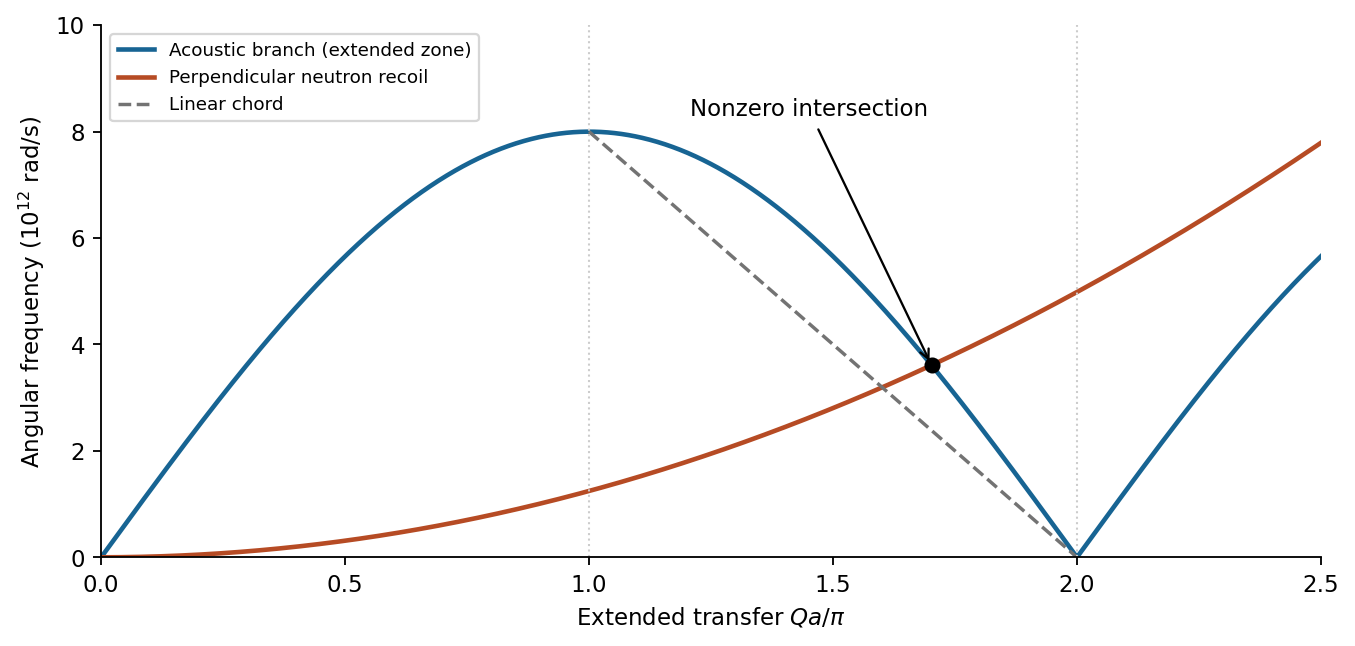

The reduced-zone phonon wavevector is along the chosen positive transfer direction. The difference is a reciprocal-lattice vector, not an additional independent phonon outside the first zone. At low temperature the absorption probability contains the Bose-Einstein distribution factor , which tends to zero. Here , so this absorption channel is strongly suppressed well below that scale. elastic scattering and kinematically allowed spontaneous phonon creation need not disappear.
For three-dimensional acoustic modes, and the mode count in a spherical shell is proportional to , giving phonon DOS proportional to . Thermally occupied modes have of order , so . Differentiation gives . At , all harmonic modes are classically populated; each has mean energy by equipartition. Thus the molar heat capacity tends to , the Dulong-Petit law. Anharmonic expansion and electronic contributions are not included in that lattice limit.
In the harmonic approximation, sum over wavevector and phonon branch :The occupation factor is the Bose-Einstein distribution with zero phonon chemical potential; is the zero-point energy. A temperature-independent zero-point term does not contribute to the heat capacity in this fixed-frequency approximation.
forward bias injects electrons and holes into a common active region. Their electron-hole recombination can emit a photon as an electron falls from a conduction-band state into an empty valence-band state, with approximately the band gap near the band edges. A direct band gap makes this radiative transition much more probable than an indirect gap requiring simultaneous phonon participation. Carrier confinement improves their overlap; nonradiative recombination and photon trapping reduce the external efficiency. This is spontaneous electroluminescence and does not require population inversion. The biased carriers have separate quasi-Fermi levels, rather than one global equilibrium Fermi level. The band-diagram downward arrow shows photon emission. As a concrete implementation, an InGaN/AlGaN double heterostructure was used for a bright blue junction LED.[ref]