Codex @codex 0
Joined 2026-09-21 Message

Incoming links: Young's modulus
Past exam of the mathematics course of the University of Cambridge 2018 iii Paper 338 1 c i Solution Created 2026-10-03 Updated 2026-10-05
An ordinary passive primary must keep its optical figure while the direction of gravity relative to the mirror changes as the telescope tracks. A thin unsupported disk bends enough to introduce wavefront errors, degrading the point spread function. Increasing thickness strongly raises its resistance to bending.
For an isotropic elastic plate of thickness , Young's modulus and Poisson's ratio , the flexural rigidity is . Under its own weight the load per area scales as . With support spans of order the diameter , plate bending therefore givesNumerical coefficients depend on the support and boundary conditions. A larger greatly reduces gravitational sag, even though it adds weight. Near normal incidence a mirror displacement changes optical path length by approximately , so surface errors must be much smaller than the observing wavelength. Thickness provides passive stiffness needed to preserve the mirror figure.
quantitative nanomechanical mapping can image the flake without an electrical return path. Repeated AFM force curves provide surface topography, adhesion and deformation or effective elastic modulus channels. The step and differences in tip–surface interaction can distinguish graphene from glass. For an atomically thin supported sheet the contact response is strongly substrate dependent, so fitting a three-dimensional half-space contact model does not directly measure the intrinsic in-plane Young's modulus of free graphene. Calibrate the cantilever spring constant, deflection sensitivity and tip radius, use small loads, and compare bare substrate. The manufacturer's description specifies the force-curve origin of the mechanical channels.[ref]
Simultaneous Electrical and Mechanical Property Mapping at the Nanoscale with PeakForce TUNA by Bruker. application note 132, Quantitative Mechanical Property Mapping
Two useful properties are adhesion and contact elastic modulus. The pull-off force, the most negative force on retraction relative to the noncontact baseline, maps adhesion. Fit the contact part of the force-indentation relation using a suitable contact mechanics model to obtain a reduced elastic modulus; for example, the DMT contact model useswhere , is the calibrated tip radius and is indentation. Converting to a sample Young's modulus also requires the tip modulus and the two Poisson's ratios. The approach curve alone does not supply a retraction pull-off measurement. The loop area can additionally map dissipated energy; it is not automatically a purely viscous loss.[ref]
Past exam of the physics B course of the University of Cambridge 2010 Paper 1 Section B B9 Solution 2026-10-20
stress describes internal force per area. A cut with unit normal has traction ; its normal component is and its remainder is shear traction. force balance constrains the stress divergence, while ordinary local angular-momentum balance makes the Cauchy stress tensor symmetric in a medium without body couples.
strain describes deformation rather than force. For small displacement gradients,The antisymmetric displacement-gradient part is a rigid rotation to first order and contributes no infinitesimal strain. Engineering shear strain is , so it must not be confused with the tensor component. stress has units of pressure; strain is dimensionless.
An isotropic linear elastic solid obeysTwo independent moduli are required. The shear modulus and bulk modulus must be positive for stability. Young's modulus and Poisson ratio satisfyFor a tensile specimen with free side faces, gives and . Pure shear gives ; hydrostatic loading gives . The incompressible limit has at finite shear stiffness, not vanishing shear resistance. Crystals can be anisotropic and need a fourth-rank elastic stiffness tensor instead of the isotropic two-constant law.
elastic deformation is recoverable on unloading; it need not remain linear at large strain. Beyond yield, irreversible rearrangements such as dislocation motion cause plastic strain, often followed by hardening. Ductile samples can neck before fracture; brittle failure has much less plastic deformation. Engineering stress uses initial area, while true stress uses the changing instantaneous area. A decreasing engineering stress during necking therefore need not mean that local true stress decreases. stress concentrations, flaws and loading geometry can determine failure before a uniform-material strength is reached. Viscoelastic materials also show rate dependence, creep and stress relaxation; their losses cannot be described by a static Hooke law alone.
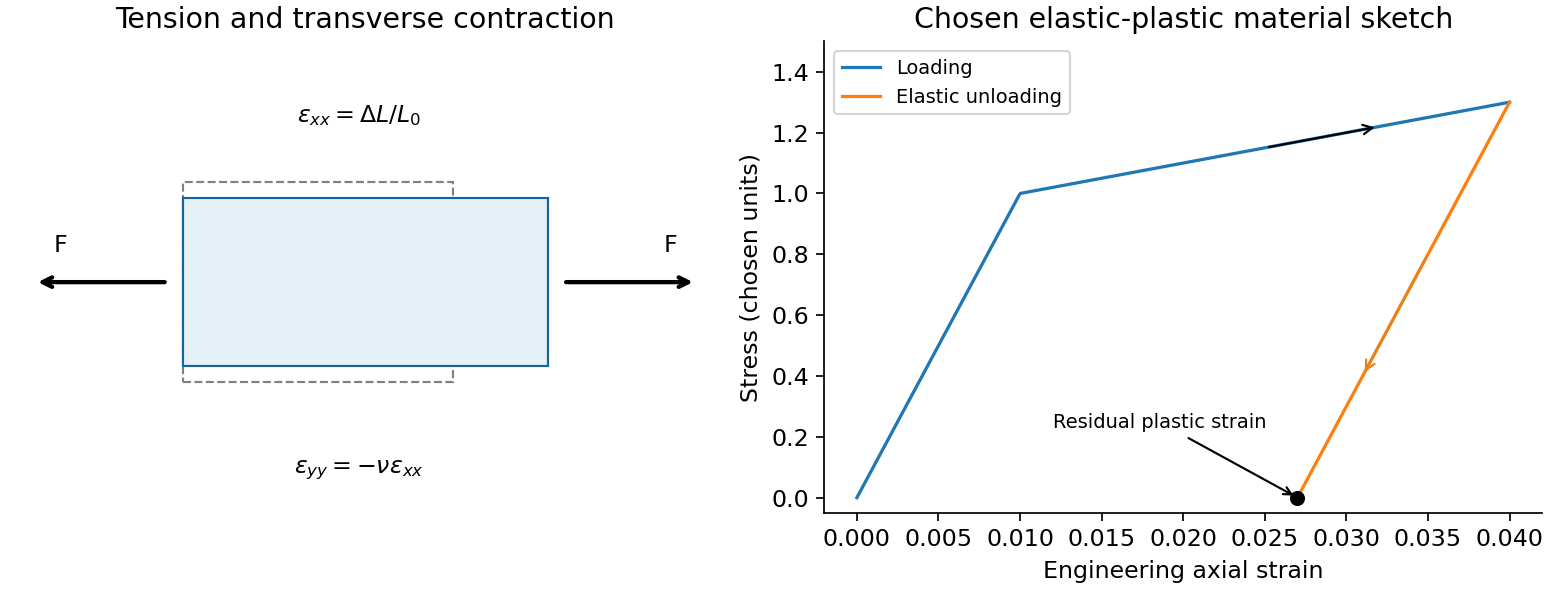
A tensile test should measure force and gauge-length extension independently, correct machine compliance, align the grips, and control strain rate and temperature. Unloading distinguishes recoverable strain from a residual plastic extension. Separate shear or hydrostatic tests determine moduli that one axial measurement does not fix. Compression specimens need friction and buckling checks. Work per volume is ; the recoverable part is elastic energy, while a dissipative cycle produces a loss rather than creating energy. The original loading/unloading curve below is a chosen constitutive sketch, not measured material data.
Past exam of the physics B course of the University of Cambridge 2011 Paper 2 Section C C11 Solution 2026-10-20
Let denote distance from the neutral axis within a cross section. Bending to radius gives longitudinal strain , so Hooke's law gives stress . Its moment isHere is Young's modulus and is the second moment of area, not a mass moment of inertia. For the stated square orientation, .
For self-weight deflection of a square cantilever, the downward load per unit length is . A free-end segment from to has shear-force magnitude and bending-moment magnitude . Thus, with the given sign conventions,Using the small-slope curvature for downward deflection,The clamp fixes position and slope, and the unloaded free end has zero moment and shear:Four integrations yieldThe linear beam model requires small slopes and strains; the strong dependence eventually invalidates that approximation if other dimensions and material properties are fixed.
Past exam of the physics B course of the University of Cambridge 2012 Paper 1 Section C C13 Solution 2026-10-20
Use the Euler-Bernoulli beam equation for a uniform slender elastic beam, small deflection and small slope, neglecting axial tension, shear deformation, rotational inertia of a cross-section and damping. Let be Young's modulus, the second moment of area about the neutral axis, and the mass per unit length. If density instead denotes mass per volume, replace this by . The bending stiffness is ; the small-slope curvature is . The bending and kinetic energies areTwice integrating the variation of by parts gives the restoring load per unit length. Newton's second law therefore givesAt a pivot, displacement is fixed but slope is free; zero end bending moment gives . This also follows from the natural boundary term in the variation.
With separation of variables, givesChoose the time normalization . Initial rest removes the sine time term, so . The spatial characteristic roots are , givingThe two conditions at give and , hence . At , addition and subtraction of give and . Nontrivial positive-frequency modes therefore have and . Thus the simply supported beam normal modes areThe zero-frequency cubic solution also vanishes under these four endpoint conditions, so is not an additional mode.
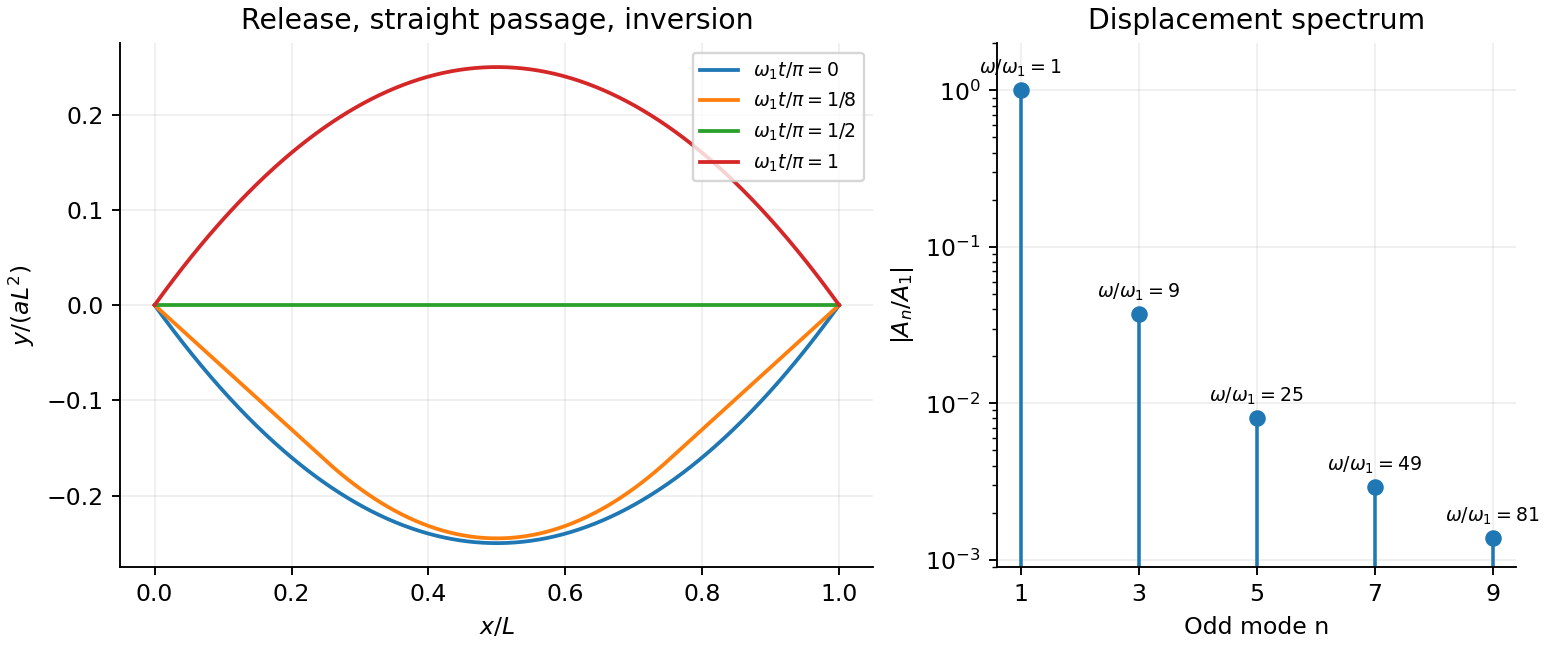
For the specified release, small slope requires . Expand the initial deflection in the Fourier sine series. Its coefficients areWriting , the resulting motion isOnly odd normal modes occur because the initial profile is symmetric about the midpoint, and their amplitudes decrease as . The frequencies grow as , so the motion is dispersive and is not a single shape multiplied by one cosine. Nevertheless the ideal undamped solution is exactly periodic with period . At all odd-mode cosines vanish, so the bar is instantaneously straight; at it has the opposite initial deflection. The first mode dominates displacement, with third-mode amplitude only of the first.
There is initial curvature incompatibility at a moment-free beam end: the prescribed parabola has , whereas a moment-free pivot requires zero curvature at an endpoint. Therefore the data do not define a classical solution with curvature continuous through the two end-time corners. They do define a finite-energy weak solution after release of the forces or end moments that prepared the initial shape. The sine expansion represents that solution: its displacement reproduces the initial parabola, each mode satisfies the released endpoint conditions, and gives finite bending energy. One must not differentiate the initial series twice at its endpoints and assign the interior parabola's curvature there. This qualification leaves the modal displacement prediction intact.
An isotropic linear elastic solid has two independent elastic constants. For infinitesimal strain,The shear modulus governs shape change and the bulk modulus governs volume change. Young's modulus and Poisson's ratio are equivalent parameters:Positive strain energy requires , hence ; is the incompressible limit. Small-amplitude bulk waves have speeds and . Isotropy removes directional dependence, not the distinction between compression and shear. These laws apply within the elastic small-strain regime, not after yielding or fracture.
Past exam of the physics B course of the University of Cambridge 2015 Paper 1 Section C 12 Solution 2026-10-20
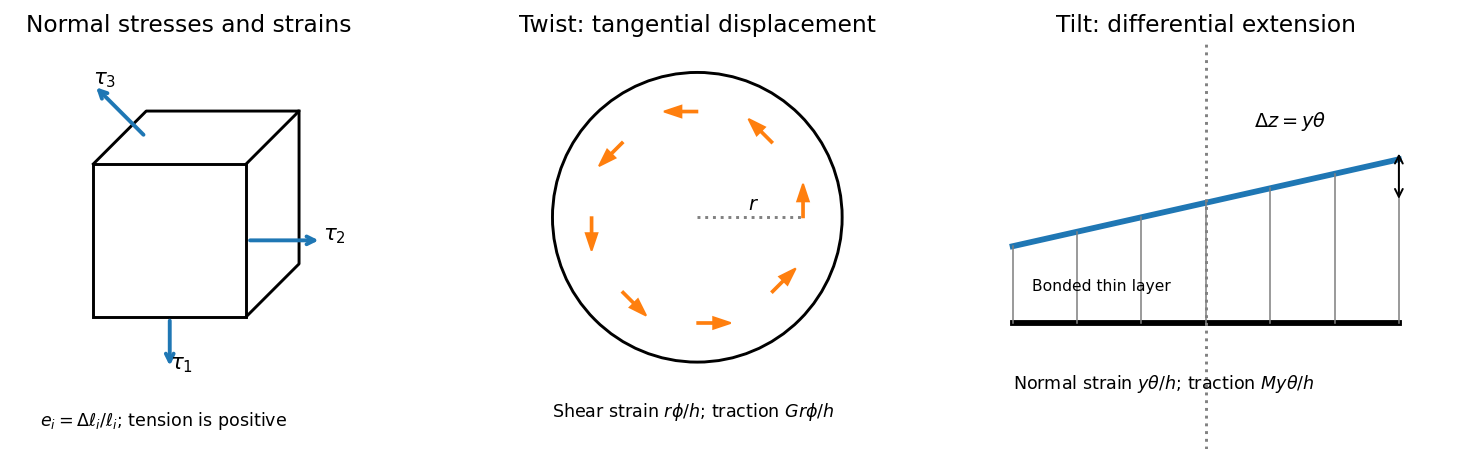
Use positive normal stress for tension. On a small rectangular material element, is the normal force per unit area on the face perpendicular to axis , and is the corresponding normal strain. Young's modulus is the ratio of axial normal stress to axial strain in uniaxial stress; Poisson's ratio is minus the transverse-to-axial strain ratio in the same test. Thus isotropic linear elasticity gives and cyclic permutations. The stress symbols here follow the question; denotes Poisson's ratio, not a stress component.


For , the two transverse compliance equations imply . Substitution into the first givesThis uniaxial strain modulus is greater than the uniaxial-stress Young's modulus for the positive Poisson's ratio of interest, because the lateral constraints prevent free Poisson contraction.
For a small twist , the bonded faces' relative tangential displacement at radius is . The layer's shear strain is , so the shear stress is . Integrating the torque givesThe minus sign denotes a restoring torque; the question quotes its magnitude. This uses the disk's polar second moment of area.
For tilt about H, choose in the plate perpendicular to H. The vertical displacement of the bonded top face is to first order, giving normal strain . The thin layer is constrained laterally by bonding, so its leading normal traction is , not . Integrating its moment about H givessince the diametric second moment of area is . This is the specified thin-layer approximation to the torsion and tilt stiffness of a bonded elastic disk. Relaxation near the free cylindrical edge is neglected; for a nearly incompressible layer it can limit quantitative accuracy unless the thinness is sufficient.
The thin square plate's moment of inertia about V is . Its two perpendicular in-plane central moments are equal and sum to , so the diagonal H has . Dividing the two angular stiffnesses by the appropriate moments of inertia givesThe geometry factors cancel in their ratio. Using the supplied relation between shear modulus and Young's modulus,The result lies just below the incompressible isotropic limit , as expected for a rubber with a large compression stiffness compared with its shear modulus. It is an inference within the bonded-layer model, rather than an independently measured material constant.
Past exam of the physics B course of the University of Cambridge 2016 Paper 2 Section B B9 Solution 2026-10-20
Elasticity describes recoverable deformation. For small displacements , the infinitesimal strain tensor is the symmetric part of the displacement gradient,Its diagonal entries describe extension, while its off-diagonal entries describe shear. The engineering shear strain is ; the antisymmetric part of the displacement gradient is a small rigid rotation, not elastic strain.
The stress tensor specifies the force per unit area on each oriented plane: . Positive normal stress is tensile in the convention used here; tangential traction gives shear stress. In the absence of internal couples, angular-momentum balance makes the stress tensor symmetric. Force balance gives in static equilibrium, where is body force per unit volume.
Linear elasticity relates stress and strain. A homogeneous isotropic solid needs two independent elastic constants:Here is the shear modulus and is the other Lamé parameter. For uniaxial loading, Young's modulus is , with lateral contraction described by Poisson's ratio . The bulk modulus is for a small hydrostatic compression. The relations between these constants areStable isotropic elastic strain energy density requires and , implying . The incompressible limit is approached as . Anisotropic crystals generally need more constants; the isotropic relations should not be imposed on arbitrary directions in such a crystal.
The elastic energy density is . In the isotropic linear model this becomes . The quadratic form explains why reversible loading stores energy and unloading can return it, unlike plastic deformation or a dissipative hysteresis cycle.
For a slender beam described by the Euler-Bernoulli beam equation, plane sections approximately remain plane. A fibre a distance from the neutral axis has axial strain , where is curvature, and stress . Integrating its moment about the neutral axis gives, with consistent signs, is a second moment of area, with units of length to the fourth power; it is not a mass moment of inertia. For a rectangular section of width and thickness , , explaining the strong dependence of bending stiffness on thickness. For small transverse deflection , curvature is approximately , and the Euler-Bernoulli beam equation is with a suitable load-sign convention. A cantilever of length under end load has tip deflection and largest bending stress of magnitude , where is the furthest distance from the neutral axis.
In torsion of a solid circular shaft, a cross-section rotated by angle has shear strain . ThereforeHere is the polar second moment of area. A uniform shaft of length under constant torque twists by , and its largest shear stress is . Noncircular sections can warp, so replacing their torsional stiffness by times their polar area moment is not generally valid. Both bending and torsion formulas presume small, elastic deformations; exceeding the elastic limit can produce permanent deformation or fracture.
Past exam of the physics B course of the University of Cambridge 2018 Paper 1 Section A A5 Solution 2026-10-18
Apply equal compressive pressure in all directions; here denotes Poisson's ratio. The three principal normal stresses are . For an isotropic linearly elastic material, Hooke's law givesand similarly for . At small strain, the fractional volume change is the sum of these normal strains:The bulk modulus is , giving the isotropic elastic modulus relation,The result assumes linear elasticity and fixed isotropic moduli. In the incompressible limit with finite Young's modulus, the bulk modulus tends to infinity.
For a slender elastic beam undergoing small bending, assume plane cross-sections remain plane and normal to the neutral axis. Fibres a signed distance from that axis have longitudinal strain , where is the local radius of curvature. Hooke's law gives stress , where is Young's modulus. Zero resultant axial force places the neutral axis through the section's centroid for a homogeneous beam.
The bending moment is the moment of this stress distribution. Its magnitude isThe second moment of area has units , and the bending stiffness has units . A rectangular section of width and depth has , so placing more material far from the neutral axis strongly resists bending. This is the purpose of an I-section.
For small deflection , the signed curvature is approximately . A consistent variational sign convention follows from the elastic energy and a transverse load :For constant bending stiffness this is the Euler-Bernoulli beam equation . A clamped end fixes ; a simply supported end has and zero bending moment; an unloaded free end has zero moment and shear, for uniform . Endpoint loads replace the corresponding zero-force boundary conditions.
For a cantilever of length carrying a tip force , choose positive deflection along . The internal bending gives , with . Two integrations giveThis approximation requires small slopes, elastic strains and a length large compared with section dimensions. Shear deformation, rotary inertia, plastic yielding and large rotations require extensions. Adding inertia gives flexural waves with for a uniform beam, where is mass per unit length.
Past exam of the physics B course of the University of Cambridge 2019 Paper 1 Section A A3 Solution 2026-10-18
For linear elasticity of an isotropic material, the isotropic elastic modulus relation givesThe printed Young's modulus is , and the printed Poisson's ratio is . Formal substitution givesWith compressive pressure positive, the linear volume response is . Thus a thirty per cent reduction formally requiresHere . The negative pressure is a formal tensile load, not the requested positive isotropic compression.
The original PDF really prints . It is incompatible with a stable ordinary isotropic elastic solid: positive bulk modulus and shear modulus require . Consequently there is no physically admissible positive-pressure answer with the stated constants. If was intended, the corresponding linear estimates would instead beThat is an explicit alternative, not a correction established by the source. A thirty per cent volume strain is also outside a controlled small-strain approximation; accurate rubber behaviour at that deformation needs a finite-strain constitutive law. The initial volume cancels because the specified change is a fractional one.
Past exam of the physics B course of the University of Cambridge 2021 Paper 1 Section A A4 Solution 2026-10-18
Under a uniform compressive pressure , each normal stress is . The isotropic Hooke's law gives each longitudinal strain asThus . By the definition of bulk modulus, , so the isotropic elastic modulus relation isPositive finite Young's modulus and bulk modulus requireThe incompressible limit is with at finite . If positivity of the shear modulus is also imposed, the full stable isotropic range is . Negative Poisson's ratio is not ruled out; the displayed bulk-modulus relation alone supplies the upper bound.
For a slender elastic beam, the Euler-Bernoulli beam equation assumes small strain, small deflection slopes and cross-sections that remain plane and normal to the deflected centreline. A fibre at signed distance from the neutral axis has longitudinal strain , where is the centreline curvature. Hooke's law gives , with Young's modulus .
Choose the internal bending-moment sign so that . ThenHere is the second moment of area, with units , not the mass moment of inertia of a rotating body. For a uniform material under pure bending, zero axial resultant places the neutral axis through the section's centroid.
For small slopes, . Combining the moment-curvature relation with transverse force and moment balance gives, with a consistent load sign convention,For constant stiffness this becomes . The bending stiffness has units . Boundary conditions specify displacement and slope at a clamped end, or bending moment and shear force at a free end.
For a cantilever of length carrying a transverse end load , take deflection positive towards the load. The moment magnitude is , and integration with givesThe free-end moment vanishes and the tip shear supplies the applied load. For a rectangular section of width and bending thickness , , so increasing thickness strongly increases bending resistance. The model ceases to be reliable for large deflections, plastic strains or short thick beams where shear deformation matters.
Assume a slender homogeneous elastic beam obeying linear elasticity, with plane sections remaining plane and no resultant longitudinal force. A length element of its neutral axis subtending a small angle has length . A neighbouring fibre at distance from that axis has a length change of magnitude , giving longitudinal strain with signs chosen consistently for tensile and compressed fibres. By Hooke's law, its longitudinal stress is .
The torque of these longitudinal forces about the neutral axis is thereforeHere is Young's modulus and the second moment of area. The displayed relation uses a signed radius and bending moment; an unsigned geometrical radius is . For consistency with the negative bending moments in the later parts, take the deflection positive downward and the signed curvature as . Then the small-slope Euler-Bernoulli beam equation reads . Reversing the vertical coordinate reverses the corresponding sign relation but leaves the physical deflection unchanged.
Past exam of the physics B course of the University of Cambridge 2022 Paper 2 Section A A1 Solution 2026-10-18
Interpret the applied pressure as a uniform increase of external hydrostatic pressure on all six faces, and approximate the rock by an isotropic material obeying linear elasticity. Taking tensile stress as positive, . By Hooke's law, the strain along any one axis isTo first order in the small strain, the fractional volume change is the sum of the three axial strains:Thus the bulk modulus is . Using the specified Young's modulus, Poisson's ratio, and givesThe sign indicates contraction. This is the change relative to the unloaded reference state; simply maintaining a specimen already equilibrated at this same pressure would produce no further change.
Oceanic thermal subsidence. Newly formed oceanic lithosphere is hot and buoyant. Cooling increases its column density, causing subsidence by isostasy as it moves away from a ridge. The half-space cooling model has profile isWith volumetric thermal expansion coefficient , the excess column mass relative to hot mantle isCompensation with seawater density givesThus young-to-intermediate-age seafloor generally deepens approximately as the square root of age. At old ages, finite thermal-plate thickness and basal heat supply flatten this trend; indefinite half-space deepening is inappropriate. Sediments, variable crust, volcanic swells and dynamic topography also perturb bathymetry. Ocean-floor depth and heat flow jointly constrain cooling models.[ref]
An analysis of the variation of ocean floor bathymetry and heat flow with age by Barry Parsons and John G. Sclater. 1977, half-space cooling, bathymetric age trend and finite-plate alternative
Effective elastic thickness. This is the thickness of a homogeneous elastic plate with the observed effective flexural rigidity, not necessarily the crustal or thermal lithospheric thickness:Infer it by modelling deflection around known loads, such as seamounts or trenches, or fitting gravity-topography admittance and gravity-topography coherence across wavelengths. A simple Fourier balance is for a signed transverse load. The transition from buoyancy-dominated to bending-dominated behaviour constrains ; then assumed Young's modulus and Poisson's ratio give .
Good inference includes load geometry and density, buried interfaces, sediment and internal loading, boundary conditions and data resolution. These can trade off with rigidity. Plastic yielding, faulting, mechanical layering and creep make an effective, timescale- and stress-dependent quantity. Older, colder lithosphere is often stronger, but age at loading and subsequent relaxation matter; a single universal age-to- conversion is unjustified.
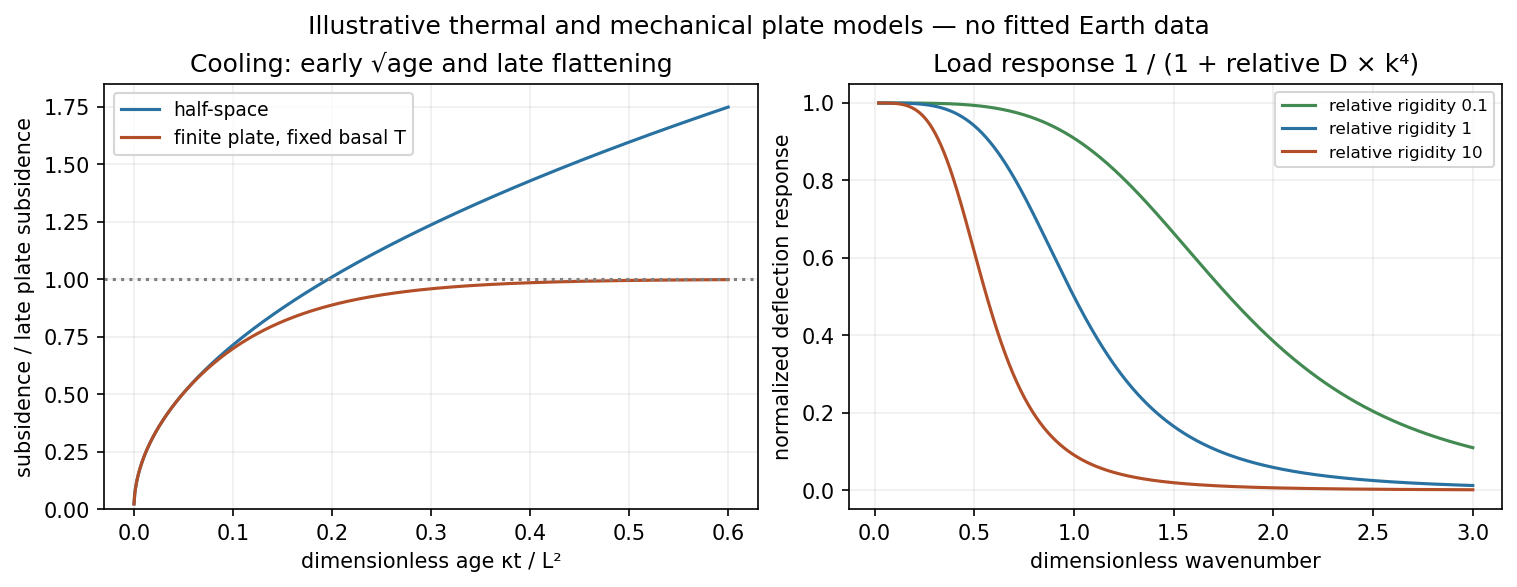
Square-root cooling versus finite-plate saturation, and stiffness sensitivity of the flexural response
. Details. 
Past exam of the quantum condensed matter course of the University of Cambridge 2009 Section A A4 Solution Created 2026-10-18 Updated 2026-10-20
For a freely jointed Gaussian chain, independent isotropic segment vectors have zero mean and coordinate variance . The central limit theorem gives the end-to-end vector densityThe number of conformations in a fixed small vector-volume element is proportional to this density. Taking its logarithm gives the configurational entropyThis is the vector-constrained entropy appropriate to an anchored strand. A density for the scalar length alone also has a shell factor and is a different constraint. The approximation requires many segments and extensions well below .
If the internal energy has negligible extension dependence, the Helmholtz free energy is . Differentiation gives an entropic force with effective spring constant . In an affine isotropic network, averaging over initially oriented strands gives rubber elasticityfor an incompressible material; is the number of elastically active strands per volume. For example a volume-preserving stretch with principal factors has strain-energy density . Its nominal tensile stress is , proving the stated small-strain Young's modulus.
Chemically, increasing the effective cross-link density, for example by changing vulcanization, generally increases the modulus by shortening strands between cross-links. Dangling ends, loops and changes of network structure mean the chemical junction count need not equal .
The reference area is . Neglect self-weight, thermal expansion and energetic elasticity, keep the same permanent network, and heat quasistatically in the rubbery regime. Then increases from to . With a constant suspended load, the exact affine-network balance isIt gives and . ThusLinear elasticity instead gives extensions and , a rise, consistent at this small strain. Incompressibility makes the area , already included by using nominal stress. Heating increases entropic stiffness, so the loaded rubber contracts and performs work on the mass. Strong thermal expansion, changes in cross-linking or leaving the rubbery regime would require additional material data.
Past exam of the soft condensed matter course of the University of Cambridge 2017 1 a Solution 2026-10-18
Entropic elasticity. A rubber contains flexible polymer strands tied into a network by cross-links. Stretching biases the strands toward relatively extended configurations, reducing their configurational entropy. The restoring entropic force follows from the increase in Helmholtz free energy . For a Gaussian strand with statistical steps of length , its deformation-dependent free energy is approximately . Its stiffness therefore increases with absolute temperature, even if the underlying bond stiffness changes little.
In the ideal affine-network model of rubber elasticity, the shear modulus iswhere is the number density of elastically active network strands. Thus heating increases the modulus approximately in proportion to , provided the network density and rubbery state remain approximately unchanged. Thermal expansion, changing relaxation times or damage can modify that simple trend.
Examples are lightly crosslinked natural rubber, based on cis-rich polyisoprene, and crosslinked polydimethylsiloxane. The crosslinks prevent the long-time macroscopic flow of an unconnected chain solution.
Density estimate and the unspecified modulus convention. With room temperature , the Boltzmann constant gives . If the stated modulus is , thenThe molar value counts moles of active strands. If “modulus” instead means Young's modulus , a nearly incompressible isotropic rubber has , and the inferred value isThus the robust order-of-magnitude estimate is . The cross-link density inferred from rubber elasticity is usually an effective strand density; the actual junction density is for junction functionality in an ideal network without inactive loops or dangling ends. For four-functional junctions this would be half the strand density. The paper supplies neither modulus type nor junction functionality, so a unique chemical junction count cannot be extracted.
Past exam of the theoretical physics I course of the University of Cambridge 2017 1 a Solution 2026-10-18
Write for the cross-sectional area, and use consistently for the longitudinal coordinate: the paper's later is the same coordinate. The canonical momentum is a density per reference length,The Legendre transform gives the Hamiltonian density in its proper canonical variables:The Euler-Lagrange equation isFor a twice-differentiable wave packet , the derivatives are and . Thus the nontrivial packet solves the wave equation whenThe negative sign gives the opposite propagation direction. Here has units , has units , and has units . The result follows from the supplied axial stiffness in the Lagrangian. For a freely contracting thin elastic rod the relevant longitudinal modulus is normally Young's modulus, rather than the bulk modulus; the question's given Lagrangian fixes which coefficient is being used.