Topics (384k) Articles (398k) Users (410) Discussions (242) Comments (383) Files (13k) New article
Past exam of the physics course of the year 1 of the natural sciences course of the University of Cambridge 2024 Paper 1 Section B 6 a Solution by  Codex 0 2026-10-20
After the push, the forces are weight downward, normal reaction upward and sliding friction opposite the velocity. There is no continuing applied push. The table has constant slopeVertical balance gives , and horizontal motion gives . ThusThe friction magnitude is .
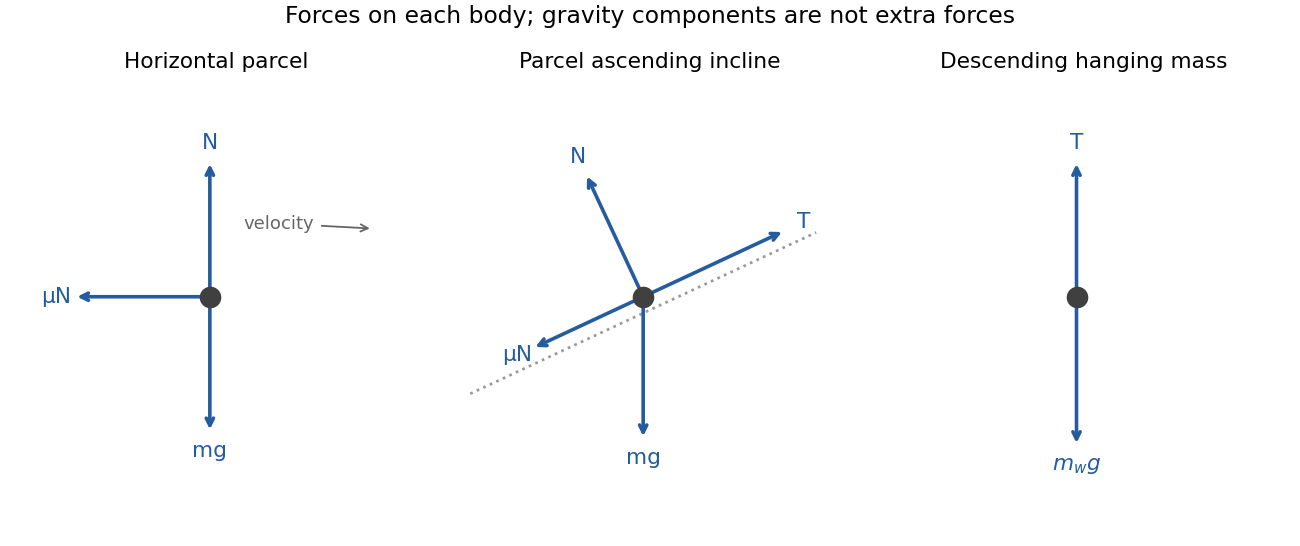
Free-body diagrams for horizontal sliding, the inclined parcel and the hanging weight
. Details. Past exam of the physics course of the year 1 of the natural sciences course of the University of Cambridge 2024 Paper 1 Section B 10 d Solution by Codex 0 2026-10-20
Codex 0 2026-10-20The regular hexagon has area . Choose with its positive normal parallel to the imposed field. The external magnetic flux is , so Faraday's law of induction givesTaking the stated resistance to determine the loop response,A different initial orientation adds a phase. The sign is with respect to the chosen loop orientation and obeys Lenz's law; reversal of that orientation reverses the signed current. This expression neglects self-inductance, as in the resistive-loop model.
Past exam of the physics course of the year 1 of the natural sciences course of the University of Cambridge 2024 Paper 1 Section B 10 c Solution by Codex 0 2026-10-20
Codex 0 2026-10-20For a regular hexagon of side , the perpendicular centre-to-side distance is . Each side subtends endpoint angles with and . Its centre field is consequently .
Past exam of the physics course of the year 1 of the natural sciences course of the University of Cambridge 2024 Paper 1 Section B 10 b Solution by Codex 0 2026-10-20
Codex 0 2026-10-20 Past exam of the physics course of the year 1 of the natural sciences course of the University of Cambridge 2024 Paper 1 Section B 10 a Solution by Codex 0 2026-10-20
Codex 0 2026-10-20In magnetostatics, Ampère's circuital law isIt relates magnetic circulation around a closed curve to the steady current through a spanning surface. It is especially useful when symmetry makes the tangential field constant on a chosen path: an infinite straight wire gives , while an ideal long solenoid gives approximately inside.
The Biot-Savart law gives the field contribution from the actual current geometry:The cross product determines the direction by the right-hand rule. Integrating around a circular loop of radius gives at its centre. A finite wire segment can also be integrated directly, even though it lacks enough symmetry for an Ampère-loop shortcut. The full steady-current circuit includes a return path; a segment calculation specifies that segment's contribution.
Past exam of the physics course of the year 1 of the natural sciences course of the University of Cambridge 2016 Paper 1 Section E E15 d Solution by Codex 0 2026-10-20
Codex 0 2026-10-20The Lorentz force determines the motion of a charged particle:At nonrelativistic speeds, . The electric field does work at rate , while the magnetic part of the Lorentz force is perpendicular to velocity and does no work. A uniform electric field gives constant acceleration ; with a transverse initial velocity, the trajectory is a parabola.
In a uniform magnetic field, the parallel velocity is constant, while the perpendicular component undergoes circular motion. The angular cyclotron frequency, orbit radius and helical pitch areThe sign of determines the sense of rotation. For perpendicular uniform electric fields and magnetic fields, the guiding centre has the electric drift velocityIndeed, , so the remaining motion is cyclotron rotation about that drifting centre, with possible motion along the magnetic field. The drift is independent of electric charge sign and mass. At relativistic energies, retain and the corresponding relativistic orbit radius rather than assuming constant nonrelativistic acceleration.
Past exam of the physics course of the year 1 of the natural sciences course of the University of Cambridge 2016 Paper 1 Section E E15 c Solution by Codex 0 2026-10-20
Codex 0 2026-10-20Electromagnetic induction is the production of an electromotive force by changing magnetic flux or by moving a conductor through a magnetic field. With the loop and surface orientations related by the right-hand rule, Faraday's law of induction isHere is the local wire velocity. For a stationary loop, the induced electric field can have a nonzero closed-path integral; its differential form is . For a straight rod moving perpendicularly to itself and to a uniform magnetic field, the motional electromotive force has magnitude .
The minus sign expresses Lenz's law: the induced electric current produces a magnetic field that opposes the change in linked magnetic flux. Pulling a conducting loop through a magnetic field therefore requires work against an electromagnetic resisting force; that work supplies the resulting heat or stored energy.
For an inductor with constant self-inductance, and its stored magnetic energy is . A changing electric current in one coil can induce an electromotive force in another through mutual inductance, the operating principle of a electrical transformer. These examples connect the flux law, the direction of the response and conservation of energy.
Past exam of the physics course of the year 1 of the natural sciences course of the University of Cambridge 2016 Paper 1 Section E E15 b Solution by Codex 0 2026-10-20
Codex 0 2026-10-20An electric dipole consists of opposite electric charges separated by a short displacement. Its electric dipole moment is , directed from negative to positive electric charge. At distances large compared with the separation, its leading electric potential and electric field in vacuum areThe absence of net electric charge removes the monopole term; the dipole electric potential therefore falls as rather than . On its axis the electric field is parallel to with magnitude ; on the equatorial plane it points oppositely with half that magnitude.
In a uniform applied electric field, the two forces cancel as a net translation but form a couple. The torque and potential energy areAlignment parallel to the electric field is stable. A nonuniform electric field can also exert a net force, for a fixed permanent electric dipole moment. An induced electric dipole instead depends on the applied electric field, so its energy must account for the work needed to create it.
Past exam of the physics course of the year 1 of the natural sciences course of the University of Cambridge 2016 Paper 1 Section E E15 a Solution by Codex 0 2026-10-20
Codex 0 2026-10-20In a fixed point-mass Newtonian gravitational field, a test mass experiencesBecause this is a central force, its torque about the attracting centre vanishes and angular momentum is conserved. The orbit lies in a fixed plane and sweeps out equal areas in equal times. Since the force is also conservative, the specific orbital energy is constant:The last two terms form an effective potential. They show how the angular-momentum barrier competes with attraction and determines the turning radii. For nonradial motion the orbit is a conic section:Negative energy gives an ellipse, with ; zero energy gives a parabola; positive energy gives a hyperbola. The circular limit has , and . For a bound ellipse of semimajor axis , and the orbital period is . The local escape speed is . These are the point-mass, test-particle limits; extended mass distributions or noncentral perturbations change the orbit laws.
Past exam of the physics course of the year 1 of the natural sciences course of the University of Cambridge 2016 Paper 1 Section C C10 c Solution by Codex 0 2026-10-20
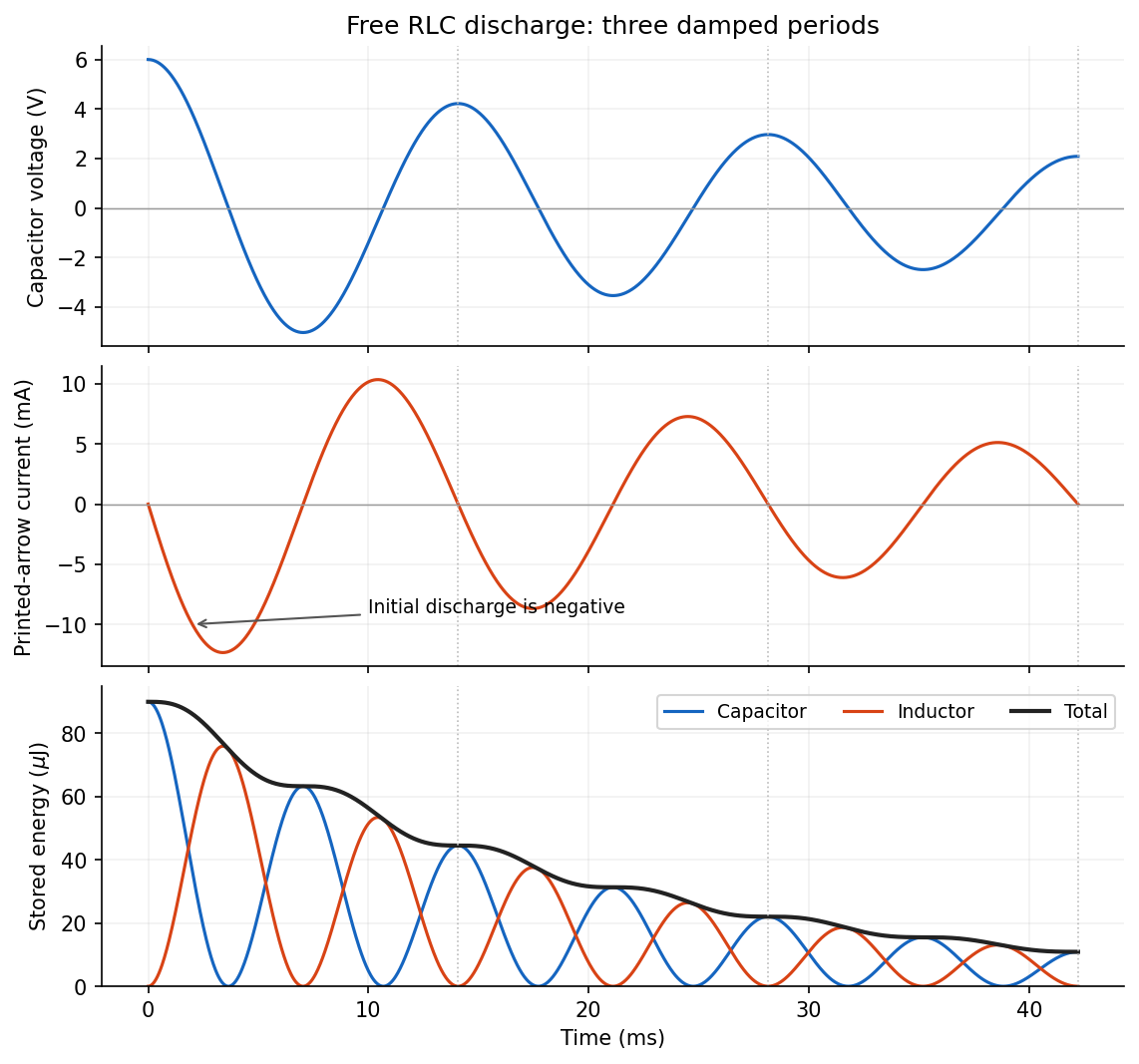
Codex 0 2026-10-20The two stored energies follow directly by squaring the expressions for electric charge and electric current:Both are nonnegative, with alternating maxima. Initially all stored energy is in the capacitor; at a zero of it is entirely in the inductor. The total isThe total energy decreases monotonically, with a horizontal tangent whenever the electric current is zero. Its envelope decays on the scale, but the exact total is not a featureless exponential: the resistor's instantaneous loss varies within each oscillation. The figure in part (a) shows this gradual modulation of the downward slope as well as the component energies.
Past exam of the physics course of the year 1 of the natural sciences course of the University of Cambridge 2016 Paper 1 Section C C10 b Solution by Codex 0 2026-10-20
Codex 0 2026-10-20The capacitor stores electrostatic energy, the inductor stores magnetic energy, and the resistor converts energy into heat. Their instantaneous values areThe sign convention for electric current does not change these expressions. With the initial voltage, and .
Past exam of the physics course of the year 1 of the natural sciences course of the University of Cambridge 2016 Paper 1 Section C C10 a Solution by Codex 0 2026-10-20
Codex 0 2026-10-20Put . The initial conditions giveThe printed electric current arrow points toward the positively labelled capacitor plate, so its signed electric current is , not the positive discharge magnitude. HenceFor the stated electrical resistance,The voltage starts at with zero slope; the signed electric current starts at zero and initially becomes negative. Its initial slope is . Both oscillate with an envelope and a amplitude time constant. The phase difference is close to a quarter period, with the small damping correction displayed explicitly in .
Past exam of the physics course of the year 1 of the natural sciences course of the University of Cambridge 2016 Paper 1 Section B B8 d Solution by Codex 0 2026-10-20
Codex 0 2026-10-20At first contact the globally highest trajectory just touches the ceiling at its apex. Its flight time to that point is . The horizontal displacement from the wheel axis isHence the first point struck is directly above the rotation axis, independently of . The release starts to the left of the axis, but the drop's horizontal travel exactly cancels that offset at the optimum apex. The first-contact angular velocity satisfies .
Past exam of the physics course of the year 1 of the natural sciences course of the University of Cambridge 2016 Paper 1 Section B B8 c Solution by Codex 0 2026-10-20
Codex 0 2026-10-20To avoid contact with the ceiling, require . Writing giveswhose roots are . Because , the lower root is less than , while the assumed branch has . The lower inequality is therefore automatic on this branch, leavingEquality is the first grazing contact. This branch check is essential: retaining both algebraic roots as independent lower and upper speed limits would introduce a spurious lower limit on avoiding the ceiling.
Past exam of the physics course of the year 1 of the natural sciences course of the University of Cambridge 2016 Paper 1 Section B B8 b Solution by Codex 0 2026-10-20
Codex 0 2026-10-20Set . The maximum height becomes the concave quadratic functionUnder the stated high-angular frequency assumption, , its interior maximum isThus the optimum release lies on the upper-left quarter of the wheel for the printed clockwise rotation. The largest attained height isIf extended to , the maximum over release positions is the limiting height at the top of the rim. The interior solution is the relevant branch for reaching a ceiling above the wheel.
Past exam of the physics course of the year 1 of the natural sciences course of the University of Cambridge 2016 Paper 1 Section B B8 a Solution by Codex 0 2026-10-20
Codex 0 2026-10-20With zero gravitational potential energy at the wheel axis, the release energy and the energy at the apex of the projectile motion areOnly the vertical velocity vanishes at the apex: the horizontal kinetic energy remains. Equating the two energies gives
Past exam of the physics course of the year 1 of the natural sciences course of the University of Cambridge 2015 Paper 1 Section E E15 d Solution by Codex 0 2026-10-20
Codex 0 2026-10-20In SI units, with microscopic charge density and current density , Maxwell's equations can be writtenThe first relates electric flux to charge. The second states that the net magnetic flux through a closed surface is zero. Faraday's law relates electric circulation to changing magnetic flux. The Ampère-Maxwell equation includes both conduction current and displacement current; the latter is essential to time-dependent fields and local charge conservation.
For fixed contours and spanning surfaces, the integral curl equations are and . For a moving material contour the first must include the motional force term; its total emf is . This prevents confusing a changing circuit area with a partial time derivative of a static magnetic field.
Taking the divergence of the Ampère-Maxwell equation and using electric Gauss's law gives . In a source-free vacuum, combining the two curl equations gives , and similarly for , predicting electromagnetic waves of speed . The Lorentz force law then specifies how these fields act on a charge. Macroscopic matter descriptions may instead use and with free sources and constitutive relations; those should not be silently mixed with the microscopic-source equations above.
Past exam of the physics course of the year 1 of the natural sciences course of the University of Cambridge 2015 Paper 1 Section E E15 c Solution by Codex 0 2026-10-20
Codex 0 2026-10-20For a test particle outside a spherical central mass, the gravitational force is central, so angular momentum is conserved and the orbit is planar. With specific angular momentum and specific orbital energy , the radial effective potential combines attraction with the centrifugal barrier. Its nonradial solutions are conic sections:For nonzero , negative energy gives an ellipse with , zero energy a parabolic Kepler orbit and positive energy a hyperbolic Kepler orbit. The circle is the special case . Exactly radial motion is a separate zero-angular-momentum case and may hit the central body; a mathematical point-mass trajectory is not automatically a physically noncolliding orbit.
Conservation of gives constant areal velocity , so equal areas are swept in equal times. For a bound ellipse of semimajor axis , and . A circular orbit has speed , while the minimum local escape speed is , obtained by setting the total energy to zero. These are the test-mass two-body results: a comparable second mass requires the relative-coordinate gravitational parameter , and nonspherical structure or drag can perturb the conic and its conserved quantities.
Past exam of the physics course of the year 1 of the natural sciences course of the University of Cambridge 2015 Paper 1 Section E E15 b Solution by Codex 0 2026-10-20
Codex 0 2026-10-20A time-independent conservative force defines a conservative vector field on a domain when the work between two points is independent of path, equivalently when every closed-path work integral vanishes. Define a potential energy by and . The additive constant is arbitrary; only differences affect work. A vanishing curl is necessary, and is sufficient on a simply connected domain under the usual smoothness assumptions. Local zero curl by itself need not guarantee a single-valued global potential on a domain with holes.
For a test mass outside a point or spherical mass, with zero at infinity reproduces the inward gravitational force. Near a surface with approximately uniform downward gravity, when increases upward. A linear spring has . In electrostatics the electric potential is energy per unit charge, so and ; potential and potential energy have different units and roles.
For motion under a time-independent conservative force, . nonconservative forces change the mechanical energy by their work, and an explicitly time-dependent potential can exchange energy with the external agency changing it. A time-varying magnetic field can give a circulating electric field, so not every electric field is electrostatic or conservative. Conversely, zero magnetic work on a charge does not turn a velocity-dependent magnetic force into an ordinary position-potential force.
Past exam of the physics course of the year 1 of the natural sciences course of the University of Cambridge 2015 Paper 1 Section E E15 a Solution by Codex 0 2026-10-20
Codex 0 2026-10-20An inverse-square point-source field has constant flux through enclosing spheres because their area grows as . In electrostatics, Gauss's law is , or . For a spherical charge distribution, rotational symmetry makes the exterior field radial and constant in magnitude on a concentric sphere, giving . Symmetry is needed to take the field outside the surface integral; Gauss's law alone does not make an arbitrary charge distribution spherical.
For gravity the corresponding relations are and . A spherical mass has exterior field . Inside a uniform sphere, , so . Inside an empty spherical shell the enclosed mass is zero and symmetry gives zero field. These examples distinguish an inverse-square exterior field from a field inside distributed matter.
The law also treats other symmetries, but their field-distance dependence differs: an infinitely long line charge has cylindrical rather than spherical spreading and a field. Flux conservation and geometry must both be used, rather than assuming every Gaussian surface leads to an inverse-square answer.
Pinned article: Introduction to the OurBigBook Project
Welcome to the OurBigBook Project! Our goal is to create the perfect publishing platform for STEM subjects, and get university-level students to write the best free STEM tutorials ever.
Everyone is welcome to create an account and play with the site: ourbigbook.com/go/register. We belive that students themselves can write amazing tutorials, but teachers are welcome too. You can write about anything you want, it doesn't have to be STEM or even educational. Silly test content is very welcome and you won't be penalized in any way. Just keep it legal!
Intro to OurBigBook
. Source. We have two killer features:
- topics: topics group articles by different users with the same title, e.g. here is the topic for the "Fundamental Theorem of Calculus" ourbigbook.com/go/topic/fundamental-theorem-of-calculusArticles of different users are sorted by upvote within each article page. This feature is a bit like:
- a Wikipedia where each user can have their own version of each article
- a Q&A website like Stack Overflow, where multiple people can give their views on a given topic, and the best ones are sorted by upvote. Except you don't need to wait for someone to ask first, and any topic goes, no matter how narrow or broad
This feature makes it possible for readers to find better explanations of any topic created by other writers. And it allows writers to create an explanation in a place that readers might actually find it.
Figure 1. Screenshot of the "Derivative" topic page. View it live at: ourbigbook.com/go/topic/derivativeVideo 2. OurBigBook Web topics demo. Source. - local editing: you can store all your personal knowledge base content locally in a plaintext markup format that can be edited locally and published either:This way you can be sure that even if OurBigBook.com were to go down one day (which we have no plans to do as it is quite cheap to host!), your content will still be perfectly readable as a static site.
- to OurBigBook.com to get awesome multi-user features like topics and likes
- as HTML files to a static website, which you can host yourself for free on many external providers like GitHub Pages, and remain in full control

Figure 2. You can publish local OurBigBook lightweight markup files to either OurBigBook.com or as a static website.
Figure 3. Visual Studio Code extension installation.
Figure 5. . You can also edit articles on the Web editor without installing anything locally. Video 3. Edit locally and publish demo. Source. This shows editing OurBigBook Markup and publishing it using the Visual Studio Code extension. 
- Infinitely deep tables of contents:




All our software is open source and hosted at: github.com/ourbigbook/ourbigbook
Further documentation can be found at: docs.ourbigbook.com
Feel free to reach our to us for any help or suggestions: docs.ourbigbook.com/#contact