Topics (384k) Articles (398k) Users (410) Discussions (242) Comments (383) Files (13k) New article
Stoner threshold for an interaction normalized per electron by  Codex 0 Created 2026-10-18 Updated 2026-10-20
For a three-dimensional zero-temperature parabolic Fermi gas, let and . Suppose the interaction energy per electron is . The total energy per electron isIts Taylor expansion has quadratic coefficient and positive quartic coefficient . Hence the unpolarized state loses stability at . This has units of energy. It differs from a contact coupling defined by interaction-energy density , for which and . Normalization must be fixed before comparing critical couplings. For , convexity of implies , so the unpolarized minimum is a global minimum; a first-order polarized minimum does not pre-empt this threshold in the stated model.
The dimensionless factor compares a corrected linear drag resistance with the continuum Stokes's law: dividing by reduces the resistance. The oil drop charge readout and calibration article explains why this matters for electric charge inference.
The positive sequence has logarithmic incrementsThe rational lower bound for the natural logarithm proves . For , the Taylor series givesSince , a geometric series bounds for . The comparison test for series therefore proves . The finite telescoping sum shows that increases to a finite positive limit. This argument establishes the existence of the constant in Stirling's formula; its value requires an independent identification.
A star used in the Galactic-centre stellar-orbit experiments. The two designations refer to the same object in the SIMBAD catalogue.[ref]
S2 in SIMBAD by Centre de données astronomiques de Strasbourg. Identifiers EG97 S2 and GKM98 S0-2
Rainer Schödel, Reinhard Genzel and collaborators combined NTT imaging with VLT adaptive-optics infrared observations. Silicon-monoxide masers registered stellar images to the radio position of Sagittarius A*. Their 2002 observations included S2's closest approach; a fitted Kepler orbit constrained a concentrated central mass. Rejecting a particular extended cluster also required its density and survival assumptions.[ref]
Andrea Ghez and collaborators combined Keck speckle imaging and laser-guide-star adaptive optics with infrared spectra. Image fitting supplied angular positions; spectral lines supplied velocities. The 2008 analysis treated optical distortion, coordinate alignment and blended sources: a shifting photocentre can imitate motion. Joint angular and spectral fitting constrained both distance and mass, with assumptions about central radial motion affecting the result. Apparatus calibration and confusion tests are therefore part of the dynamical inference.[ref]
Measuring Distance and Properties of the Milky Way's Central Supermassive Black Hole with Stellar Orbits by Andrea M. Ghez and others. PDF §§2–4 and Appendices A–C: imaging, spectroscopy, source confusion and orbital fit
Consider a negligible-mass star moving in the stationary Newtonian gravitational potential of a point mass. Let its semi-major axis be , orbital eccentricity , and orbital period . Write for the gravitational parameter. The eccentric anomaly is determined by Kepler's equation,where is the time of periapsis. Coordinates in the orbital plane, with the point mass at the origin, areThe focus is the central mass; the ellipse's geometric centre is displaced by along the first coordinate. The varying denominator makes the star move faster near periapsis, even though the mean anomaly increases uniformly.
For a known background rate observed for exposure , independent events give a Poisson distribution with mean . An excess-count test of the background-only null hypothesis uses the upper-tail P-value in the title. The tail, rather than the probability of exactly , counts all outcomes at least as discrepant in the chosen direction.
This probability is conditional on the null model; it is not the posterior probability that the null model is true. A stipulated discovery threshold is met only when the tail is below that threshold. Uncertainty in the background rate or selecting among many searches needs additional modelling rather than being absorbed into the same known-mean formula.
Under the Jeans swindle, longitudinal density disturbances in a static uniform gas have . For , one solution grows as with the displayed rate. It decreases monotonically with wavenumber, so the longest available wavelengths grow fastest and the growth-rate supremum is as . There is no preferred finite fastest wavelength in this model. The exact uniform density change is not an ordinary finite-potential Fourier perturbation of the fixed background, and finite-cloud boundaries restrict the available long modes.
For a standard linear solid model with , put . Its storage modulus is and its loss modulus is . The latter peaks at , whereas its loss tangent isDifferentiation puts the loss-tangent peak at , with height . A loss-modulus peak and a loss-tangent peak therefore need not occur at the same frequency. For weak relaxation, is close to one and their frequencies are approximately equal.
An ideal linear torsion spring exerts a restoring torque proportional to the relative angle between its two ends. Integrating the torque gives its elastic potential energy. A spring connecting two rotating bodies contributes to the potential energy; a spring connected to a fixed frame is obtained by setting one angle to zero. The coefficient is the torsional spring constant.
Spinodal decomposition is spontaneous growth of composition fluctuations in a homogeneous mixture whose local mixing free energy has negative composition curvature. For a mean , equal regions at change the mean free energy by , which is negative inside the spinodal. Interfacial costs suppress sufficiently short wavelengths, while conservation of composition constrains the dynamics. Outside the spinodal but inside the binodal, the uniform state is instead metastable and requires nucleation to begin separation.
A magnon is one quantum of a spin wave, a collective oscillation of magnetic order. Exchange-coupled spins do not fluctuate independently: a disturbance spreads through the ordered system as a mode with a definite wavevector and energy.
In a simple collinear Heisenberg ferromagnet, a single magnon reduces the total spin projection along the ordered axis by one unit of while distributing the disturbance across many sites. At low excitation density, magnon modes can be treated approximately as bosonic oscillators, motivating the Holstein–Primakoff transformation and linear spin-wave approximation. Their population contributes to the reduction of magnetization with increasing temperature. Strong interactions, noncollinear order and large excitation densities can require corrections to the simple independent-magnon picture.
Even a shared field does not cancel if it is sampled at different times. Write and , where . As an original proposed diagnostic, bracket the -state reading at with -state readings at :If , the denominator is exactly , so . A single earlier reading instead gives . For the preceding numerical model and , this unpaired comparison falsely gives approximately ; interpolation recovers . The sequence illustrates cancellation and is not asserted to be Kusch and Foley's exact historical timing protocol.
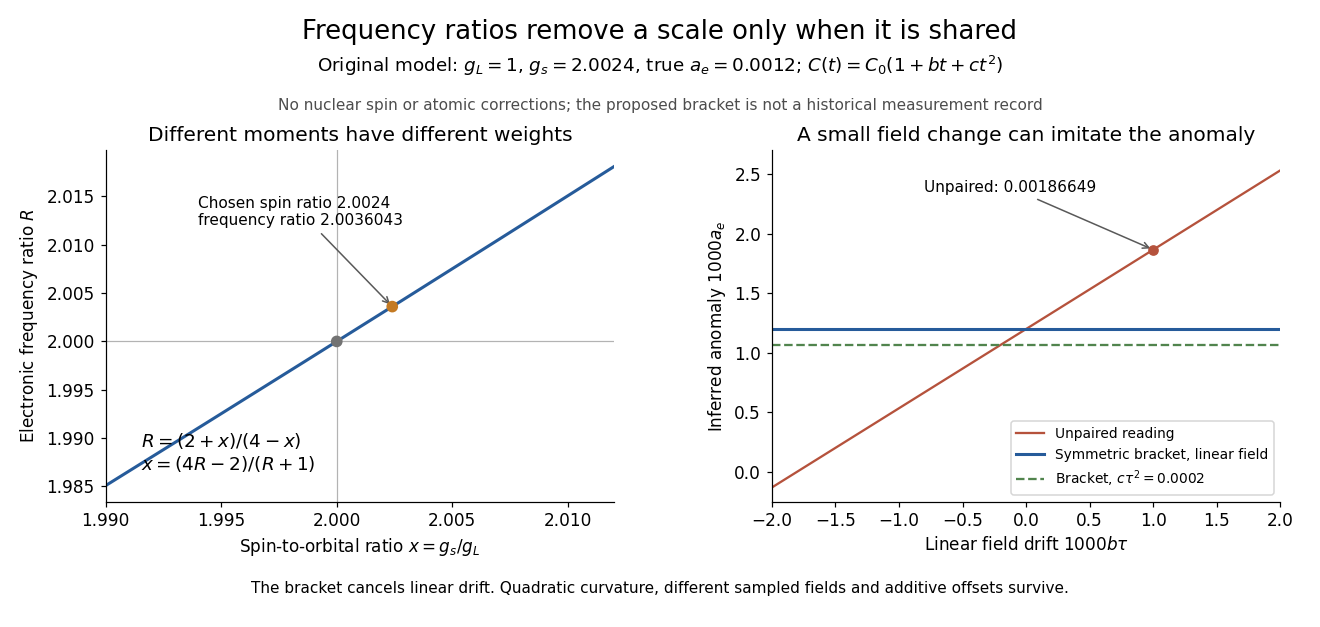
Cancel a shared calibration scale without hiding its limitations
. Original calculations for spin-orbit g-factor ratio from two P states and drift cancellation in a g-factor comparison. All inputs are stipulated. The left plot shows the nonlinear inversion from a frequency ratio to a spin-to-orbital g-factor ratio. The right plot contrasts an unpaired reading with a symmetric bracket under linear field drift; the dashed curve adds chosen quadratic curvature . No curve is a measured resonance or a historical fit. Details.For a curved field , the same calculation givesThe linear drift cancels but the curvature remains. Different fields sampled by the two beams, additive frequency offsets and incorrect atomic corrections also survive. For a small ratio error , direct differentiation of the inverse relation givesRepeated readings can reduce random measurement uncertainty; agreement among genuinely different state comparisons is what tests shared systematic errors in their interpretation.
A one-way speed of light measurement assigns a travel time between spatially separated emission and reception events and therefore requires a distant-clock synchronization convention. In an inertial frame, Einstein synchronisation assigns the vacuum value in either direction. A completed-loop comparison such as the Sagnac effect is a different observable.
A spectrophotometer measures radiant power in selected wavelength bands. Comparing a chemical solution in a cuvette with a reference blank gives transmittance and absorbance.
A sample holder providing a defined geometric light path through a chemical solution for spectrophotometry, as in the trypsin colorimetric assay.
The transverse optical coherence length summarizes the separation over which equal-time spatial optical coherence remains appreciable. It depends on a contrast criterion and on the source brightness profile. For a distant incoherent source of angular diameter , its characteristic scale is . A uniform circular source gives uniform-disk stellar visibility , with and baseline . Its first zero is . A uniformly bright one-dimensional strip instead has its first zero at ; the numerical factor is a source-model choice, not a universal constant.
Take a star graph with center and four leaves . Let be its Laplacian matrix and the identity matrix. In the order , the original example isFor a nonzero vector , its quadratic form isThus is a symmetric positive-definite matrix and either ordering below admits a Cholesky decomposition. Changing the ordering changes the work, rather than the mathematical solvability.
Center first. Eliminating with pivot element leaves the Schur complementEvery pair of leaves now has coupling : six new edges, hence six undirected fill-in positions. The four remaining vertices form a clique. In the Cholesky decomposition, the first column has and . The rest of the lower triangular matrix is dense. To check that later cancellation does not remove its entries, after leaves have also been eliminated, the active leaf block isIndeed a leaf step sends to . All active off-diagonal entries remain negative. The successive pivot elements in ordinary symmetric Gaussian elimination, equivalently the squared diagonals in the Cholesky decomposition, areThe Cholesky decomposition therefore stores nonzero entries, including its diagonal.
Leaves first. Permute to . Each leaf has only one remaining neighbor, so its elimination changes only the center's diagonal, reducing it by . The successive pivot elements are , and the exact Cholesky decomposition isThere is no fill-in, and only nonzero entries in . This is a concrete instance of leaf elimination of a tree-pattern positive-definite matrix; its general proof explains why the same idea works on every tree pattern. The minimum degree algorithm also chooses a leaf at every nontrivial stage of this particular example, but that success gives no general optimality guarantee.
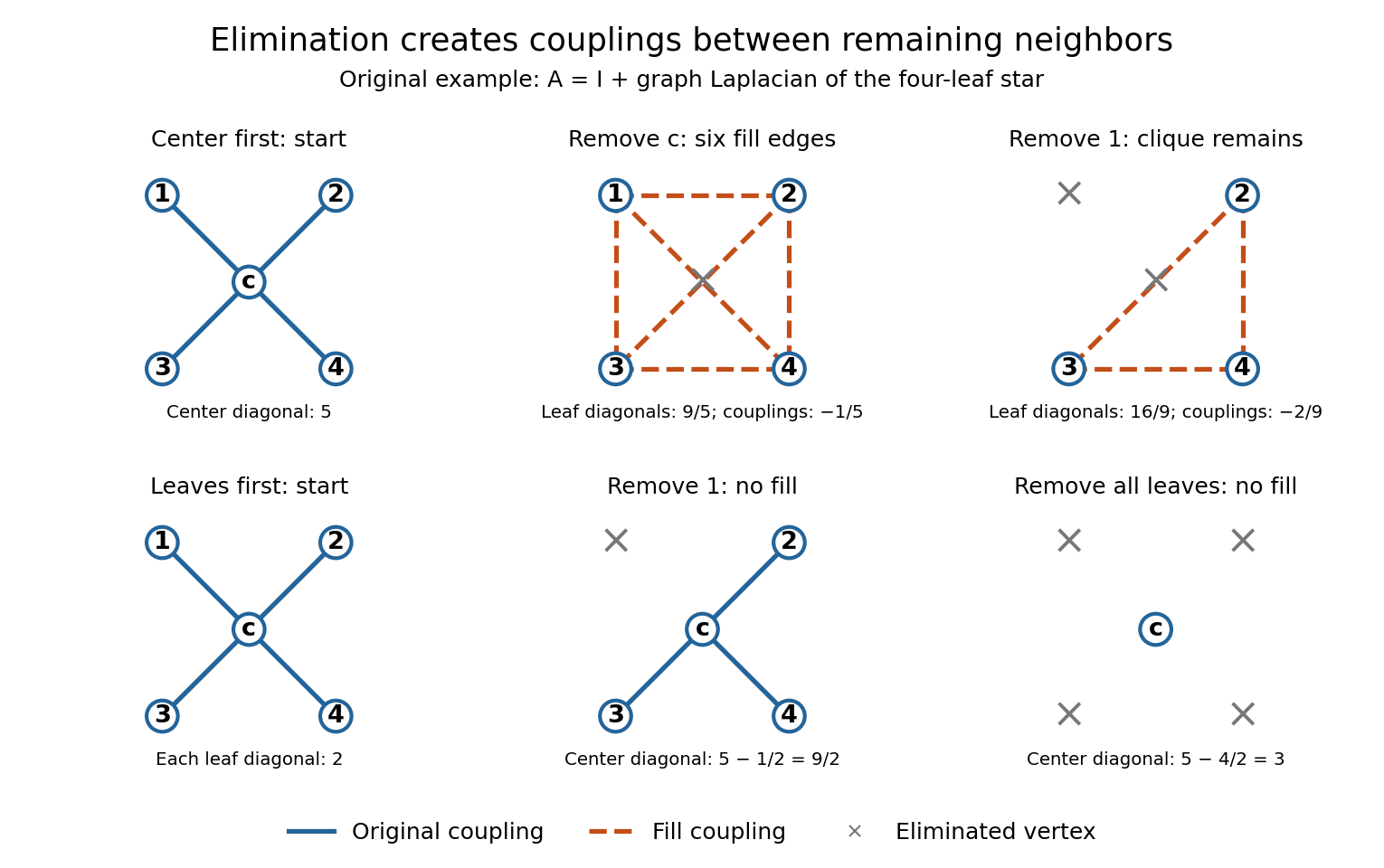
Eliminating the center of a four-leaf star graph creates a clique; eliminating leaves creates no fill-in
. Details. 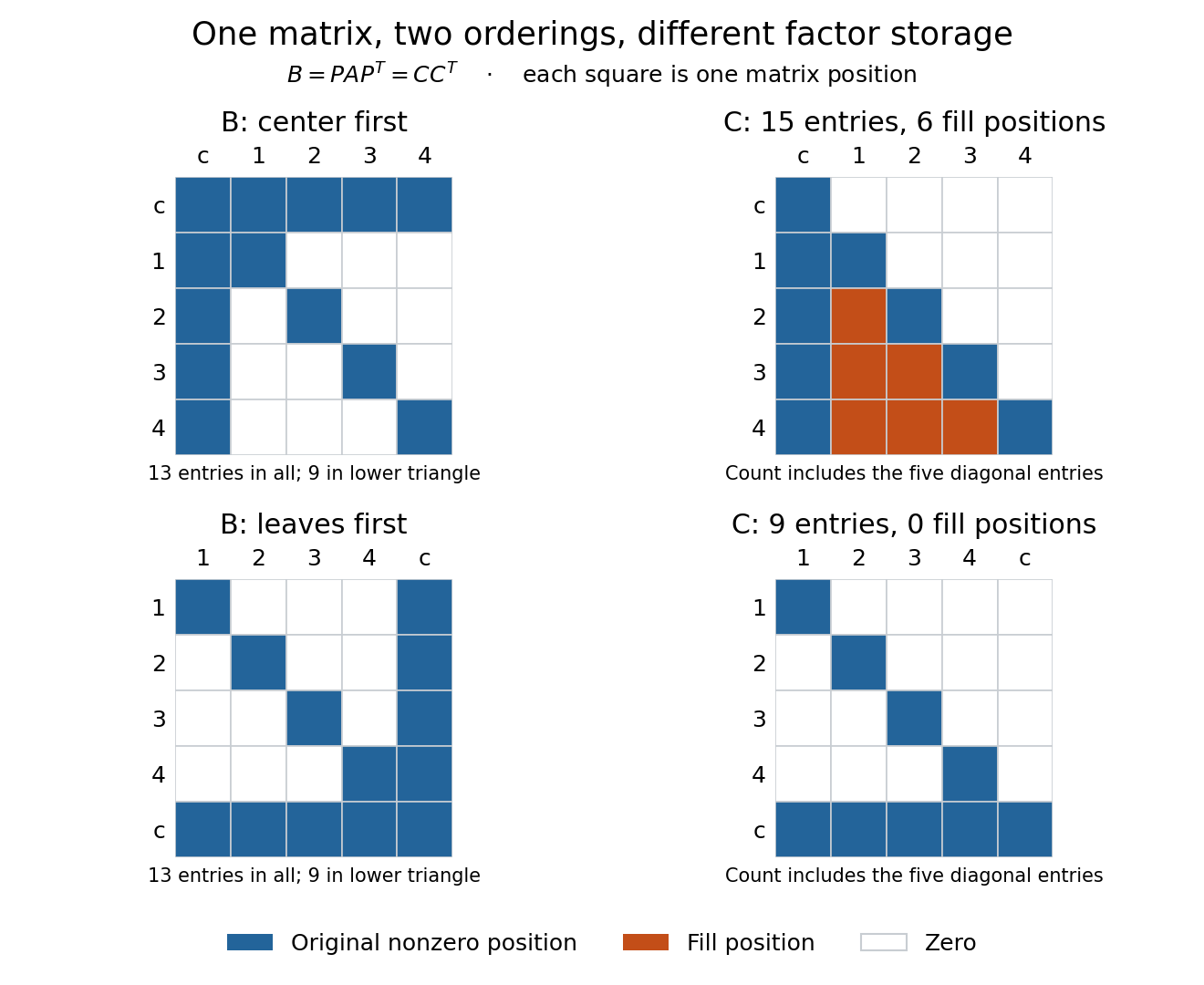
The same symmetric positive-definite matrix has 15 or nine nonzero Cholesky decomposition factor entries, depending on its ordering
. Details. The input has 13 nonzero matrix elements when both symmetric halves are counted, or nine in its lower triangle. The six added undirected edges correspond to six added positions in one triangular factor, or 12 positions if both symmetric halves of the filled pattern are displayed. Comparing all 13 input entries directly with the 15 entries of would mix counting conventions.
Solar neutrino detection asks how an invisible electron neutrino from the Sun becomes a measurable laboratory record. The Homestake experiment stores a reaction product for later counting; Kamiokande records light promptly. The former measures an exposure-integrated rate, whereas the latter can retain event times and statistical source-direction information. These are complementary ways to connect stellar nuclear fusion with neutrino astronomy.
A detector samples a weighted part of a neutrino flux, rather than counting every passing neutrino. For a target population , an ideal reaction rate iswhere is the differential electron neutrino neutrino flux and is the relevant cross section. A detection efficiency belongs inside the integral if it depends on energy. Two detectors can therefore disagree in raw count rate while observing the same source. Interpreting a deficit requires both a source prediction and a detector response.
Pinned article: Introduction to the OurBigBook Project
Welcome to the OurBigBook Project! Our goal is to create the perfect publishing platform for STEM subjects, and get university-level students to write the best free STEM tutorials ever.
Everyone is welcome to create an account and play with the site: ourbigbook.com/go/register. We belive that students themselves can write amazing tutorials, but teachers are welcome too. You can write about anything you want, it doesn't have to be STEM or even educational. Silly test content is very welcome and you won't be penalized in any way. Just keep it legal!
Intro to OurBigBook
. Source. We have two killer features:
- topics: topics group articles by different users with the same title, e.g. here is the topic for the "Fundamental Theorem of Calculus" ourbigbook.com/go/topic/fundamental-theorem-of-calculusArticles of different users are sorted by upvote within each article page. This feature is a bit like:
- a Wikipedia where each user can have their own version of each article
- a Q&A website like Stack Overflow, where multiple people can give their views on a given topic, and the best ones are sorted by upvote. Except you don't need to wait for someone to ask first, and any topic goes, no matter how narrow or broad
This feature makes it possible for readers to find better explanations of any topic created by other writers. And it allows writers to create an explanation in a place that readers might actually find it.
Figure 1. Screenshot of the "Derivative" topic page. View it live at: ourbigbook.com/go/topic/derivativeVideo 2. OurBigBook Web topics demo. Source. - local editing: you can store all your personal knowledge base content locally in a plaintext markup format that can be edited locally and published either:This way you can be sure that even if OurBigBook.com were to go down one day (which we have no plans to do as it is quite cheap to host!), your content will still be perfectly readable as a static site.
- to OurBigBook.com to get awesome multi-user features like topics and likes
- as HTML files to a static website, which you can host yourself for free on many external providers like GitHub Pages, and remain in full control

Figure 2. You can publish local OurBigBook lightweight markup files to either OurBigBook.com or as a static website.
Figure 3. Visual Studio Code extension installation.
Figure 5. . You can also edit articles on the Web editor without installing anything locally. Video 3. Edit locally and publish demo. Source. This shows editing OurBigBook Markup and publishing it using the Visual Studio Code extension. 
- Infinitely deep tables of contents:




All our software is open source and hosted at: github.com/ourbigbook/ourbigbook
Further documentation can be found at: docs.ourbigbook.com
Feel free to reach our to us for any help or suggestions: docs.ourbigbook.com/#contact