
Roton Created 2026-10-18 Updated 2026-10-20
A roton is an excitation near a local minimum of a superfluid's dispersion relation at nonzero momentum . The displayed local approximation defines a positive energy gap and positive curvature effective mass ; it is not a free helium atom or a macroscopic quantum vortex.[ref]
On the Theory of Superfluidity of Helium II by Lev Davidovich Landau. Landau, On the Theory of Superfluidity of Helium II (1947), p.91, Fig.1
In the stipulated plot, these correspond to , and . The plot illustrates how a low energy at appreciable momentum can lower the Landau criterion below the speed of sound, without assigning any measured parameter to real helium.For with , put and . The Floquet discriminant of the delta-comb Kronig-Penney model is . Extended Bloch states require . Since , there is a positive lower band edge; a repulsive potential does not support negative-energy states in this energy convention.
The th positive-energy band ends at . Its lower edge lies in and solves . A finite periodic ring selects only the discrete allowed values of crystal momentum within these bands. Nonzero band gaps do not by themselves imply an insulator: the band filling must also place the Fermi energy in a gap.
Real bounded Fourier modes of the Klein-Gordon equation Created 2026-10-18 Updated 2026-10-20
With inverse-time convention , the half-line Klein-Gordon equation has spatial normal modes , where above threshold and below it. For the branch even in , reality above threshold requires . Below threshold boundedness eliminates , and reality requires . At threshold the spatial differential equation instead has the basis ; boundedness retains only the constant mode. A spectral integral with ordinary integrable functions as amplitudes ignores the isolated threshold points, while distribution amplitudes can represent the surviving monochromatic constant-spatial modes.
Let the Klein four-group have generators and , with and . For every real , the matricesdefine a group representation. Indeed, , and commutes with every matrix, so the group relations hold.
Set . A direct change of basis givesConsequently all these representations are isomorphic representations, with character values on . Each is a direct sum of the two one-dimensional representations whose values on are and whose values on are and . A group representation need not be orthogonal; nonzero changes the basis rather than the represented group.
Group generated by sign reversal and reciprocation Created 2026-10-18 Updated 2026-11-05
On the nonzero real numbers, sign reversal and reciprocation are commuting involutions. Their function composition generates exactly , , and . The relations and identify the group with , the Klein four-group. Its subgroups are the trivial group, its three order-two cyclic subgroups and itself. Excluding zero from the domain is necessary for all four transformations to be defined and invertible.
A flat circular contact of radius carrying total normal force has uniform pressure . In steady relative rotation, a ring of radius and thickness experiences tangential kinetic friction . Its resisting torque is . Integration from zero to gives . A different pressure distribution changes the result; for an axisymmetric distribution use .
Pressure-driven cork ejection 2026-10-18
A cylindrical plug of radius , length and density is pushed outward by gauge pressure . If its remaining contact length is and its constant radial contact pressure is , the resisting kinetic friction is . At the marginal initial condition , the net outward force becomes . With mass ,Thus the exit speed at tends to as . Exactly leaves the marginal configuration stationary, and the exit time diverges in that limit. An attached extra mass changes the acceleration but not the pressure-minus-friction work, if the contact geometry is unchanged.
Water Cherenkov neutrino reconstruction Created 2026-10-18 Updated 2026-10-20
Water Cherenkov neutrino reconstruction infers a vertex, time and charged particle direction from photomultiplier pulses. The 1987 analysis recorded charge and timing, calibrated with decaying muons and source-produced gamma rays, and rejected outer-detector activity and events following muons.[ref]
Observation of a Neutrino Burst from the Supernova SN1987A by K. Hirata and others. pp. 1490–1491; Fig. 1 and event-selection criteria
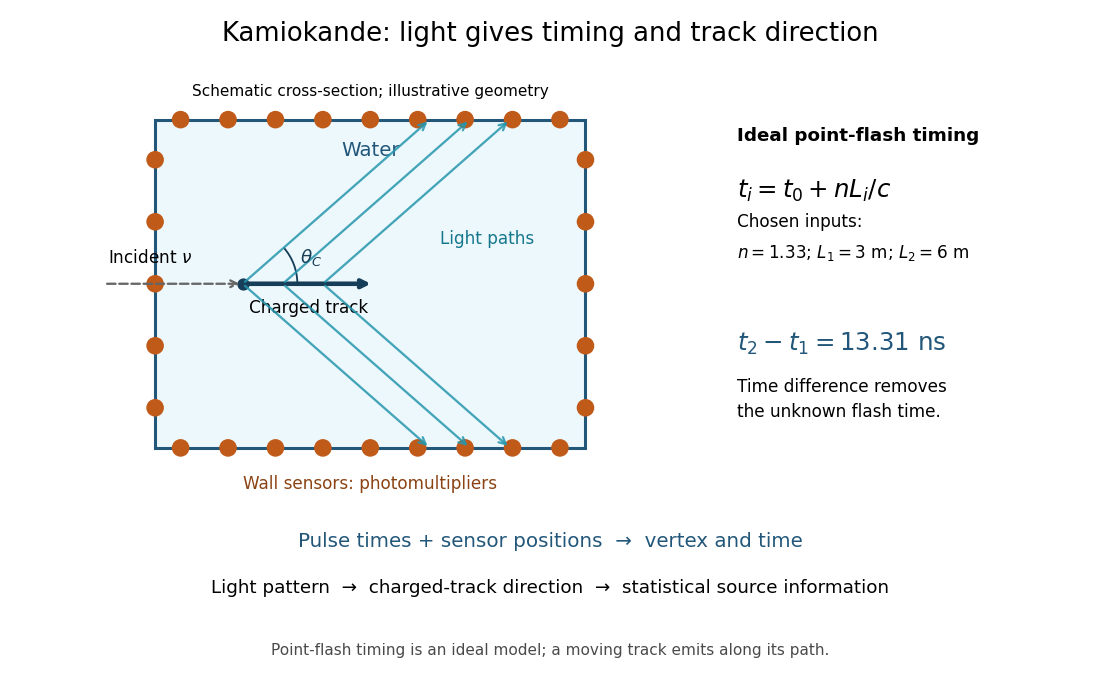

In an ideal point-flash approximation, a light source at and time gives the displayed travel-time relation at sensor in a medium of refractive index . Subtracting two times eliminates . With a chosen constant and path lengths and , the arrival-time difference is . These are synthetic inputs, not detector measurements. Several sensors constrain the vertex; an extended moving track requires the light-emission position and time along that track as well.
For a charged particle moving at , the Cherenkov cone angle satisfies when . With and the illustrative , . The geometrical cone carries track-direction information; electron deflections and the spread of emission positions broaden the observed pattern. The neutrino itself does not draw the light cone.
A Cherenkov radiation threshold and an analysis threshold are different constraints. For a fixed , an electron must exceed . With and the chosen , this gives about . Recording and selecting a useful event requires much more light: the 1987 detector's trigger accepted electrons with 50% efficiency.[ref]
Observation of a Neutrino Burst from the Supernova SN1987A by K. Hirata and others. p. 1491: trigger acceptance
For , with independent of , an affine parameter makes and the tangent norm constant. The four-dimensional interval satisfiesConsequently the formula assumes the additional normalization ; affine parametrization alone does not set this value. With base metric signature and , the projected curve is timelike only for . The normalized case gives . The positive fibre term and the base together have two positive directions; the same sign convention must be retained when interpreting the reduction.
Take with constant. The Euler-Lagrange equation for isThus, with ,Reversing the explicit derivative order while retaining this metric and the same definition of changes the equation rather than merely changing a field-tensor naming convention. More generally, a fibre term , , gives ; its conserved canonical fibre momentum is .
In the normalized positive-fibre case with , four-dimensional proper time gives . This has the Lorentz force form. The scale relating the geometrical to a physical electromagnetic four-potential fixes the conversion to an SI charge-to-mass ratio.
Work by K. Sreekumaran Nair 2026-10-18
Jupiter mass Created 2026-10-18 Updated 2026-10-25
A mass unit based on Jupiter, conventionally written ; numerical calculations must state the adopted value or gravitational parameter.
AC Josephson effect 2026-10-18
For constant nonzero voltage , direct integration givesA constant electric potential difference therefore produces an oscillating pair electric current. The average of this ideal sinusoid over a complete cycle is zero; a measured nonzero steady electric current can include single-electron superconducting tunneling. Josephson's lecture explicitly separates the ordinary quasiparticle term from the phase-dependent term. [ref]
The Discovery of Tunnelling Supercurrents by Brian D. Josephson. Josephson, Nobel lecture, discussion of I₀(V), the phase-dependent term and Fig. 2
DC Josephson effect 2026-10-18
At zero electric potential difference, permits a nonzero constant quantum phase and hence a steady pair electric current. Under an imposed electric current with , a static solution satisfies . The low-energy branch has . For example, a stipulated gives modulo ; it does not require a voltage drop. In the ideal current-biased energy , the positive second derivative on that branch explains its local stability.
The superconducting critical current is a maximum available static pair electric current, not the inevitable electric current under a voltage bias. At the initial state and circuit select a phase and a current. Above this sinusoidal model has no static phase solution, but its two relations alone do not predict the complete resistive current-voltage characteristic, switching dynamics or hysteresis. Those require the circuit and dissipative channels.
Josephson coupling energy 2026-10-18
The ideal Josephson junction has a phase-dependent energyDifferentiating and using the voltage–phase relation yieldsThus the ideal pair element stores and returns energy. At it carries a static electric current without electrical power loss. Under a nonzero periodic drive its instantaneous power need not vanish, but its energy returns after a full phase cycle. Real junctions also have a capacitance, quasiparticle transport and an external circuit; their total losses cannot be inferred from this conservative pair term alone.
Gauge-invariant Josephson phase 2026-10-18
Write the superconducting order parameters as , using a field of pair electric charge . For a specified path across the superconducting weak link, defineHere is the magnetic vector potential. To check electromagnetic gauge invariance, use a scalar function and transformThe change of is , exactly cancelled by the change of the line integral. Thus is unchanged although each local quantum phase changes. This is the same charge/sign bookkeeping discussed in gauge-coupling sign in Ginzburg-Landau superconductivity. Different physical paths can enclose magnetic flux, so fixing the path matters.
For stationary reservoirs with equal internal pair chemical potentials and a time-independent vector potential, the local Schrödinger equation gives after dropping the common internal term. With electric potentials and , subtraction gives . For a general circuit, denotes the corresponding measured electrochemical voltage and the electromagnetic contribution must be treated consistently. A bare difference of phases without the vector potential term is insufficient in an arbitrary gauge.
SQUID 2026-10-18
A SQUID uses Josephson junctions in a loop made from a superconductor to detect changes in magnetic flux.
Two-site Jordan-Wigner normalization and signs Created 2026-10-18 Updated 2026-11-05
With occupied fermion sites representing up-spins, use , and . The canonical anticommutation relations imply , and . Consequently the two sites commute as spin operators, while . This normalization is essential: the unscaled combinations are twice .
The two-spin XY Hamiltonian becomesIn particular, and fix the hopping signs. The modes and preserve the canonical anticommutation relations and give .
Work by John G. Wood 2026-10-18
Uniform-sphere pressure-work collapse criterion Created 2026-10-18 Updated 2026-10-20
For a uniform ideal gas sphere, set , and . Building the sphere by concentric shells gives gravitational potential energy . During a small homologous contraction, released gravitational energy balances the work against gas pressure when , or . Eliminating gives the displayed mass. At the same initial mass density and temperature, larger masses have stronger gravitational contraction than pressure support in this estimate. Its numerical coefficient belongs to the uniform-sphere pressure-work model; the infinite-medium Jeans instability and a pressure-confined isothermal sphere use different equilibrium and boundary assumptions.
There are unlisted articles, also show them or only show them.