
Hadronization time 2026-10-18
A characteristic proper timescale for strong bound-state formation, estimated by dimensional analysis from the QCD scale. A scale of a few tenths of a GeV corresponds to a few . It is an order-of-magnitude guide rather than a universal sharply defined formation time.
Gyrocompass 2026-10-18
A gyrocompass uses a spinning gyroscope and Earth's rotation to identify geographical north. In an ideal model whose axle is constrained to the local horizontal plane but free to turn about the vertical, the northward direction of the spin angular momentum is stable away from the poles; the opposite spin direction is unstable. A real settling instrument also requires damping. This is different from merely preserving an initial inertial orientation with a freely mounted gyroscope.
Gyroscopic roll torque in a turning vehicle 2026-10-18
A flywheel's spin angular momentum must turn with the vehicle. The vehicle supplies torque to maintain this precession, and experiences the opposite reaction torque. With right-handed axes forward, left and up, a left turn has . A transverse flywheel with then produces body torque , opposing outward roll. Its magnitude is for turn radius . Reversing the flywheel reverses the effect.
Group axioms from two-sided local inverse identities Created 2026-10-18 Updated 2026-10-25
Suppose a nonempty semigroup has, for each , elements satisfying and for every . Then it is a group. For any fixed , the element is a right identity element, and is a left identity element. Since , they coincide in a two-sided identity . For each , putting in the two assumed identities gives and . Associativity then yields , a two-sided inverse element. Thus the usual group axioms follow without an assumed identity or cancellation law.
For a deep-water gravity-capillary wave, for . Differentiation gives the unique minimum at , or wavelength . At this point the gravitational and capillary contributions are equal and . Since , the group velocity equals the phase velocity at this minimum, despite their usual difference in a dispersive wave.
Grazing impact parameter in gravitational focusing Created 2026-10-18 Updated 2026-10-20
For a point projectile approaching an absorbing spherical body of radius in a prescribed exterior inverse-square force, conservation of energy and angular momentum give . This is increasing in the periapsis radius , so gives the collision threshold displayed above. The gravitational scattering angle obeys . On the grazing family its deflection approaches zero at high asymptotic speed and as . Strict noncollision requires ; the equality is the tangency limit.
Positive definiteness of a Gram matrix Created 2026-10-18 Updated 2026-11-05
For real vectors in a Euclidean space, their Gram matrix satisfiesThus is a positive semidefinite matrix. It is a positive-definite matrix exactly when the vectors are linearly independent: the squared norm vanishes precisely when the indicated linear combination vanishes.
For complex vectors, specify the convention. With the inner product conjugate-linear in its first argument, the same definition givesIf the inner product is instead linear in its first argument, this definition of gives . The positive definiteness criterion is unchanged, but the coefficient formula must respect the convention.
Radial and angular masses of a phase-invariant scalar potential Created 2026-10-18 Updated 2026-11-05
For a complex scalar field with canonical kinetic term and potential , take a broken-symmetry minimum , where . Writing gives quadratic potential . Hence the canonical squared masses are and . Coupling gives gauge-boson squared mass ; the factor of two depends on defining as the complex field's vacuum value rather than its canonically normalized real component.
Glutamate 2026-10-18
Glutamate is an anionic form of glutamic acid, with one fewer proton. The acid and anion are different chemical species.
Work by Gerald Maurice Edelman Created 2026-10-18 Updated 2026-10-25
In the upper half-plane , the hyperbolic length element is . The function has gradient and norm . The Cauchy-Schwarz inequality gives for any oriented path from to . Equality holds along a semicircle traversed with increasing , because its tangent is parallel to that gradient. This is a calibration proof of global minimality, beyond the stationary-path conclusion of the Beltrami identity. Translating gives the analogous proof for semicircles with other boundary centers.
Nirenberg and Matthaei experiment 2026-10-18
In 1961, Marshall Warren Nirenberg and J. Heinrich Matthaei ground washed Escherichia coli and used centrifugation to prepare a cell-free extract. Reactions at combined ribosomes, soluble components, ATP regeneration and phenylalanine carrying a isotope label, with or without polyuridylic acid, an RNA containing only U. After incubation, trichloroacetic acid precipitation, washing and counting radioactive decay detected label in insoluble material. Added polyuridylic acid strongly increased incorporation; removing ribosomes or ATP regeneration suppressed it. Product characterization supported a phenylalanine polypeptide.[ref]
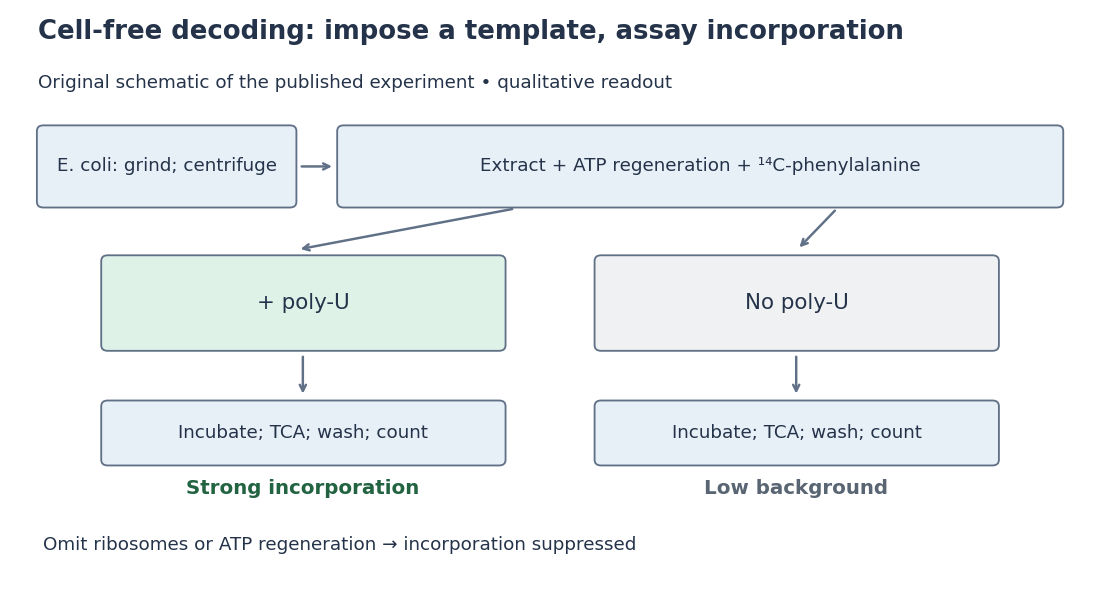
Nirenberg and Matthaei experiment: preparation, comparison and readout
. Original schematic; readout summarizes qualitative published observations. Details.
The inference connects an imposed RNA template to a specific amino acid product. Yet repeated U alone cannot distinguish one-, two- or three-letter coding units: every possible group still contains only U. Neither triplet length nor the complete genetic code follows.[ref]
The dependence of cell-free protein synthesis in E. coli upon naturally occurring or synthetic polyribonucleotides by Marshall Warren Nirenberg and J. Heinrich Matthaei. p. 1601, Discussion and Note added in proof: coding-unit length not established
Degeneracy of the genetic code 2026-10-18
Degeneracy of the genetic code means that distinct codons can specify the same amino acid. For example, UUU and UUC both specify phenylalanine in the standard genetic code.[ref] In the original AUG GCU UUC UGA example, changing UUC to UUU preserves the predicted amino acid order. This illustrates redundancy of assignment, not equality of every possible effect on gene expression.
Degeneracy of the genetic code differs from ambiguity: multiple inputs share one output, whereas an ambiguous assignment would give a single codon more than one meaning in the same specified decoding context. The standard genetic code table has one listed assignment per triplet. Alternative genetic codes, including those used in some mitochondria, and engineered decoding contexts must be specified separately; the standard table is not a universal statement about all organelles or synthetic systems.
For three collinear masses , with , , connected consecutively by two springs of stiffness and with free ends, let denote displacements from an equilibrium. The kinetic energy and potential energy are , , whereThe generalized eigenvalue problem for small oscillations hasDirect substitution verifies each pair; the three distinct eigenvalues exhaust the three-dimensional problem. The zero normal mode translates the complete system without extending either spring. The second holds the middle mass fixed while the end masses move oppositely. The third moves the end masses together and the middle mass oppositely, leaving the centre of mass fixed.
For mass-matrix orthogonality of normal modes, the squared norms are respectively , and . Dividing each shape by its corresponding square root gives . The general motion is a linear combination of the two oscillatory modes and ; the latter describes free translation with constant velocity.
Let three equal masses move vertically, with one spring of stiffness attaching mass 1 to a fixed support and two further springs of the same stiffness attaching masses 2 and 3 separately to mass 1. For absolute downward displacements from equilibrium, the small-oscillation mass and stiffness matrices areThe normal modes haveExchange symmetry of the two lower masses gives the antisymmetric mode with mass 1 stationary. In the symmetric sector, put ; the reduced equations give , producing the remaining two frequencies. The lower mode moves all masses in phase; in the higher mode the lower pair moves against the upper mass.
Using individual rope-length changes instead gives . In those generalized coordinates and . Mode amplitudes must therefore be identified as physical displacements or rope-length changes before interpreting them. The model assumes taut elastic elements and small vertical motion; gravity shifts the equilibrium extensions.
A horizontal bar of mass hangs from a spring of incremental stiffness , and two equal masses hang separately from the bar through springs of stiffness . The bar remains horizontal and all motion is vertical. For physical displacements from the loaded equilibrium, the kinetic energy and quadratic potential energy areGravity determines the static extensions; its linear terms cancel at equilibrium. Exchange of the lower masses splits the normal modes into the antisymmetric mode with , and two symmetric modes . The latter obey and . Their determinant gives the title quadratic in , and . For , their squared angular frequencies are , with displacement ratios respectively. The lower symmetric mode moves all masses in phase; the higher one moves the lower pair against the bar.
Normal modes of an equilateral spring triangle Created 2026-10-18 Updated 2026-10-20
Three equal point masses move in a plane and are connected pairwise by ideal springs of equal positive stiffness . At an unstretched equilateral triangle equilibrium, let be the vertex positions relative to the centre, and let be small displacements. If , the quadratic potential energy is , and the kinetic energy is .
There are three independent zero-frequency motions: two common translations and the infinitesimal rigid rotation , where . The uniform radial motion is the breathing normal mode, with . The two shear modes are and , each with .
For a compact proof of the spectrum, form the matrix taking the six displacement components to the three first-order spring extensions, orienting the three edges cyclically. Its row norms squared are two, and every pair of rows has inner product . Thus , with eigenvalues . The nonzero eigenvalues of are the same, so the stiffness matrix has the three positive values in the title and a three-dimensional kernel of a linear map. The three rigid motions span that kernel. A zero mode has time factor rather than a nonconstant periodic oscillation.
Gaussian elimination with a row swap Created 2026-10-18 Updated 2026-10-20
Consider this original linear system and its augmented matrix:The first diagonal entry is zero, so it cannot serve as a pivot element. Interchange and to obtain a pivot element of one:This chooses a convenient nonzero entry for exact arithmetic; partial pivoting would instead interchange and , selecting the largest absolute value, two. For our chosen ordering, the first-column elimination multipliers are and . The elementary row operation givesThe next pivot element is two and the next elimination multiplier is . Applying gives the upper triangular matrix systemEvery operation also changed the right-hand side. Back substitution now givesChecking the original equations, rather than only the reduced ones, verifies the answer by matrix multiplication:Thus a zero first diagonal entry was a row-order obstruction, not a singular matrix. Indeed, the diagonal product of the final upper triangular matrix is ; the single row interchange makes , since the two row additions preserve the determinant.
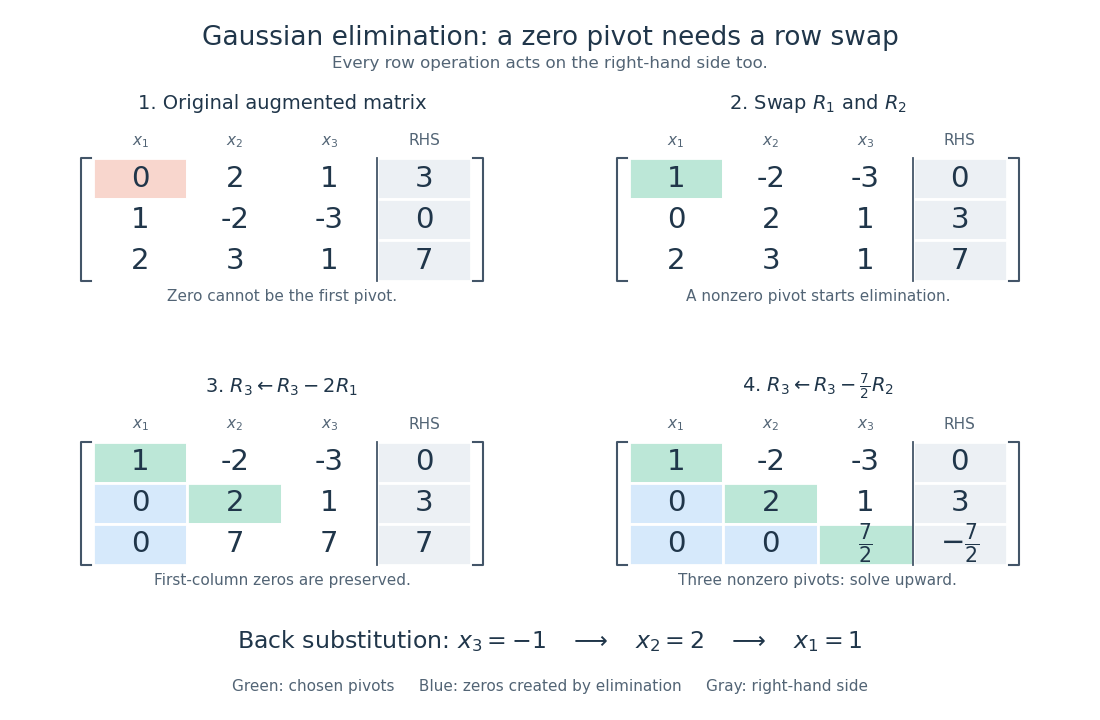
A row interchange supplies the first pivot element; successive elementary row operations create zeros, then back substitution gives
. Details. 
Curvature of a two-dimensional warped metric 2026-10-18
For positive twice differentiable , the only nonzero Christoffel symbols are and . In the convention , substitution gives . Dividing by gives the Gaussian curvature . Thus gives the flat metric in polar coordinates away from its axis, gives unit positive curvature, and gives unit negative curvature.
Hypergeometric Frobenius recurrence 2026-10-18
For the Gauss hypergeometric equation with parameters , a Frobenius solution , , has indicial roots and . Matching each successive power gives the displayed undivided recurrence. The usual ratio formula is valid only when its left coefficient is nonzero. At integer-separated roots, a zero coefficient requires a compatibility check as in an undetermined coefficient at Frobenius resonance; otherwise a logarithmic companion may be necessary. For example, gives at , obstructing that exponent-zero series when .
There are unlisted articles, also show them or only show them.