
Two-mass three-spring normal modes 2026-10-18
Two positive masses linked in series between fixed walls by three identical springs of spring constant have equations of motion and . A normal mode exists when , giving the displayed angular frequencies. Its amplitude ratio is : positive for the lower angular frequency, negative for the higher one. Equal masses give amplitude ratios and squared angular frequencies .
Place equal masses at the six vertices of a regular octahedron and identical unstressed axial springs on its twelve edges. For the invariant axial displacement family , the quadratic potential and kinetic energies areHence . The breathing vector has squared frequency , while every traceless axial vector with has squared frequency . Orthogonal projection onto these subspaces solves any initial condition in this family without an eighteen-dimensional characteristic polynomial.
Two equal simple pendulums have small horizontal displacements , with their support separation and connecting spring along . If the spring is unstretched at equilibrium, its first-order extension is ; transverse differences change its length only at second order. The quadratic potential is . There is one higher antisymmetric longitudinal normal mode and a three-dimensional eigenspace at : the symmetric longitudinal mode and two independent transverse motions. Pre-tension would lift this transverse degeneracy.
For three equal simple pendulums in a straight open chain with springs only between neighbours, the spring stiffness matrix in displacement coordinates is . Its eigenvectors , and have respective dimensionless eigenvalues . Adding the gravitational restoring term yields the displayed squared eigenfrequencies. These are free spring ends: fixed wall springs would change the matrix and mode shapes.
Even and odd pendulum-ring modes 2026-10-18
For a large ring of equal pendulums with tangential displacements and nearest-neighbour spring coupling, cyclic translation symmetry gives Fourier modes . The locally straight-chain approximation gives the displayed spectrum. The lowest mode is uniform. For even , the single highest mode alternates signs and has . For odd , perfect alternation cannot close; the highest pair is degenerate and has . For an exact finite regular polygon with straight chord springs, multiply the spring contribution by ; it tends to one in the stated large- limit.
Degeneracy of normal modes 2026-10-18
Distinct linearly independent normal modes are degenerate if they have the same eigenfrequency. For , their eigenvectors span a common eigenspace; linear combinations in that space are also modes with the same frequency. A symmetry preserving both quadratic energies maps this space into itself. Higher-dimensional irreducible symmetry representations can enforce degeneracy, while perturbations breaking that symmetry can split it. Degeneracies can also occur accidentally without such symmetry protection.
Take equal point masses on a massless string, with fixed ends, equal horizontal spacing and constant tension . Small transverse displacements obey , with . The normal modes arewith the displayed positive frequencies. Substitution uses . The endpoint conditions quantize . These are the discrete sine transform modes and form an orthogonal basis, so each initial displacement and velocity decomposes into independent harmonic oscillations. For three masses, convenient relative shapes are , and , with respectively.
Initial-data decomposition into two normal modes Created 2026-10-18 Updated 2026-10-20
Suppose a two-coordinate linear oscillator has independent normal modes as displayed, with positive angular frequencies . For initial displacement and velocity , its solution iswhereThese formulas follow by inverting the two-by-two matrix with columns . Each coefficient evolves by its own scalar harmonic-oscillator equation, and substituting recovers both prescribed vectors. Euclidean orthogonality of the mode shapes is unnecessary; with unequal masses, the natural orthogonality is in the mass inner product of the generalized eigenvalue problem for small oscillations.
Two-fluid model of superfluidity 2026-10-18
The two-fluid model of superfluidity gives the normal component of a superfluid and the superfluid independent velocities.
An elementary uniform-flow example makes the distinction operational. Write the mass flux per unit area and the ideal entropy flux asHere is specific entropy, in , and are response mass densities. The mass density used here gives the three-dimensional phase stiffness coefficient when is substituted into the kinetic energy density . For a stipulated , and along a channel, zero net mass flux requires . Yet is positive. Opposing velocities can therefore transport entropy while transporting no net mass.
This example explains why excellent apparent heat transport need not be ordinary diffusion of heat through a stationary liquid. In the ideal zero-net-mass-flux limit, the heat flux associated with this entropy transport is . Viscous losses, quantum vortices and external heat exchange require additional terms. The model also supports second sound.
For the displayed nonlinear diffusion equation, a quadratic ansatz reduces the partial differential equation exactly toIndeed , and equality of the constant and quadratic coefficients proves the reduction. For nonzero curvature, integration gives . On , the remaining linear ordinary differential equation is , whose integrating factor is . Thus, including spatial translation,All three constants are arbitrary, on a domain with . When the quadratic coefficient vanishes, the more general affine ansatz gives .
A narrower ansatz fixes two coefficients together and permits exactly or . The zero value of is a valid spatially constant branch, not an algebraic exception to discard. These finite-parameter families are exact solutions; they are not the complete general solution of the nonlinear partial differential equation, and their sums need not be solutions.
Receiver noise temperature 2026-10-18
The receiver noise temperature represents noise added by the receiver as an equivalent noise temperature referred to its input. Separating it from the antenna temperature prevents internal receiver noise from being mistaken for radiation from the sky.
System noise temperature 2026-10-18
The system noise temperature includes all noise contributions referred to a specified receiver input. In a simple additive model with negligible intervening losses, , where is the antenna temperature and the receiver noise temperature.
Newtonian gravitational potential of a uniform solid sphere Created 2026-10-18 Updated 2026-10-20
For radius , constant mass density and , normalize the Newtonian gravitational potential to zero at infinity. ThenBy the spherical shell theorem, each spherical shell contributes the potential of a point mass outside it and a constant inside it. Summing inner and outer shells gives inside. Equivalently, angular integration of the free-space Green function of the Laplacian gives . The resulting radial integral has the same value.
The potential and its first radial derivative are continuous at . The interior gravitational acceleration is , and . At the centre while its gradient vanishes.
Neutron activation 2026-10-18
Neutron activation is the production of radioactivity by irradiating a material with neutrons. One route is neutron capture producing an unstable isotope; other nuclear reactions can also produce unstable atomic nuclei. A specimen's later radioactive decay provides a way to detect that a transformation occurred during irradiation. It does not by itself identify the product or reconstruct the incoming neutron energy distribution.
This makes neutron activation a useful bridge between an invisible radiation field and a delayed measurement. The neutron flux and collision cross-section determine production; radioactive decay and detection efficiency determine what remains observable later. Neutron activation buildup and decay keeps these stages separate.
Slow neutron 2026-10-18
A slow neutron has low kinetic energy relative to the fast neutrons commonly emitted in nuclear reactions. The term covers an energy range, rather than a single speed. A neutron moderator transfers kinetic energy to surrounding matter through collisions. Slowing a neutron can increase its chance of causing particular neutron capture reactions, even though each collision has reduced its kinetic energy. The Fermi slow-neutron activation experiment made this surprising distinction experimentally visible.
Neutron detection by proton recoil 2026-10-18
In neutron detection by proton recoil, a neutron strikes a hydrogen atomic nucleus, namely a proton, and the moving proton produces detectable ionization. Paraffin wax provides many hydrogen targets. There are two distinct questions: how much kinetic energy can a collision transfer, and how often does it occur? Elastic collision kinematics answers the first. It does not determine a collision cross-section or a detector's efficiency.
For the following derivations the target is initially at rest in the laboratory but is free to recoil. Its mass is finite. In particular a proton must not be treated as an immovable target. All massive particles are nonrelativistic particles, their translational kinetic energies are , and the collision changes no internal state. Target binding and thermal motion are neglected relative to the incident kinetic energy. These assumptions suit an introductory description of fast-neutron elastic collisions; they do not cover every neutron capture or other nuclear reaction.
Chadwick neutron discovery experiment 2026-10-18
Walther Bothe and Herbert Becker observed penetrating radiation from beryllium struck by alpha particles before James Chadwick's interpretation.[ref]
The Existence of a Neutron by James Chadwick. Section 1, page 692: Bothe and Becker
Irène Joliot-Curie and Frédéric Joliot found that adding material containing hydrogen increased ionization, interpreting the ejected protons as Compton scattering recoils from extremely energetic gamma rays. James Chadwick tested this interpretation against nuclear recoils in other elements.[ref]
Possible Existence of a Neutron by James Chadwick. Page 312, opening paragraphs: Joliot-Curie observation and counter
The counter coupled a small ionization chamber to an amplifier and oscillograph: charged particles produced ions, and the electrical signal gave a deflection. With Norman Feather, James Chadwick also observed nitrogen recoil tracks in a cloud chamber.[ref]
Possible Existence of a Neutron by James Chadwick. Page 312: valve counter and Feather's expansion-chamber observations
The apparatus used polonium on silver facing beryllium inside an evacuable vessel. Paraffin wax before the aluminium counter window supplied recoil protons; intervening aluminium screens measured their particle range. Deflections were photographed on bromide paper. The first counter contained air; later fillings included hydrogen, helium, nitrogen, oxygen and argon. Counts with wax absent included gas recoils; wax insertion added entering protons. Thick lead between source and counter hardly changed the initial counts, testing penetration against the low background.[ref]
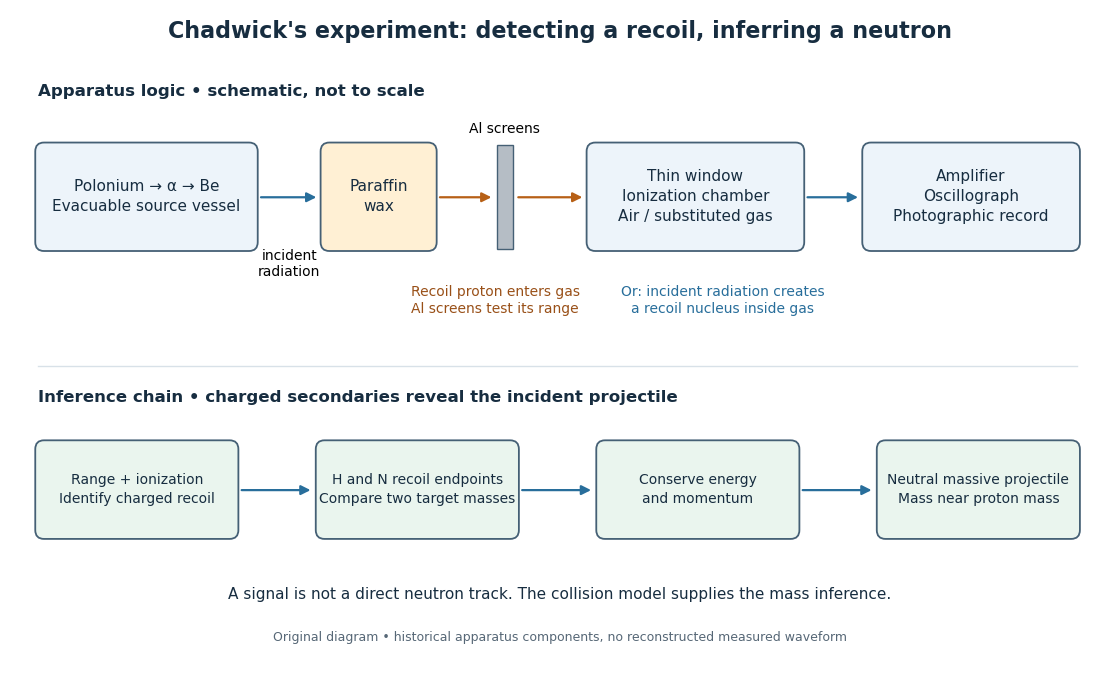

The diagram separates two routes to a signal: a proton entering from the wax and a nuclear recoil created inside the chamber gas. Its lower row is a logical summary, rather than a reconstructed experimental trace. In either route the observed ionization belongs to a charged secondary particle; identifying the incident radiation requires an additional collision model.
In the February letter, a photon interpretation requiring about for the protons predicted only about for nitrogen recoils, below the observed ionization. Here electronvolts. James Chadwick proposed a neutral particle near the proton mass and the nuclear reactionThese are the letter's approximate historical values, not a modern mass determination.[ref]
Possible Existence of a Neutron by James Chadwick. Page 312: photon/nitrogen discrepancy and proposed reaction
Why compare two materials? A gamma ray is a photon, so its incident momentum is , where is the speed of light. A slow massive projectile instead has momentum and kinetic energy . The relationship between incoming momentum and energy therefore changes. An elastic collision model must explain the recoil endpoints for both target masses with the same incident projectile population. Calling the radiation neutral supplies no such agreement by itself.
The original measurements depended on particle range calibration, material in the path, detector response and whether a recoil was fully stopped in the sensitive gas. Large deflections alone need not specify a complete recoil energy. The calculations below expose the ideal collision assumptions behind the inference; applying them to a measured spectrum requires checking those assumptions.
Neutron scattering Created 2026-10-18 Updated 2026-10-20
Neutron scattering measures how a specimen changes the directions and kinetic energies of incident neutrons. Neutron diffraction uses the elastic scattering pattern to investigate crystal structure and magnetic order; inelastic neutron scattering uses energy transfer to investigate excitations such as phonons and magnons. The two measurements ask complementary questions: what arrangement repeats in space, and what disturbances can propagate through it?
The 1994 Nobel Prize in Physics recognized Clifford Glenwood Shull's diffraction work and Bertram Neville Brockhouse's spectroscopy.[ref]
Nuclear scattering couples to atomic nuclei; magnetic scattering couples the neutron's magnetic moment to electronic magnetic moments. The latter underlies both magnetic neutron diffraction and magnon spectroscopy. An atomic number is not a nuclear neutron scattering weight: the relevant coefficient in the elementary coherent model is the nuclear neutron scattering length.
Kaon CP eigenstates Created 2026-10-18 Updated 2026-10-25
The CP eigenstates of neutral kaons depend on a flavor-state phase convention. Using , set and . They are respectively CP even and odd. Reversing the flavor-exchange sign reverses which written sum is even; it does not change the CP eigenvalues. With CP violation, the physical short- and long-lived states need not equal these CP eigenstates; kaon CP mixing parameter and neutral-kaon CP impurity and two-pion decay describe the mixtures.
Muon-neutrino electron recoil spectrum Created 2026-10-18 Updated 2026-10-20
For an especially simple neutral current example, scatter a muon neutrino elastically from an initially stationary unpolarized electron:Here is the final electron kinetic energy, is the incident neutrino energy, and is the Weinberg angle. These are electron chiral couplings in the vertex convention of neutral-current vector and axial couplings. The chosen muon neutrino elastic channel has no additional W boson exchange amplitude; the electron-neutrino elastic channel would have one. Other charged-current final states can become kinematically accessible at sufficiently high incident energies and are not part of this elastic model.
Use natural units , retain only tree-level Feynman diagrams, and take the contact limit with . Neglect electron-mass terms relative to , radiative corrections and detector response. Then is the Fermi constant. The approximate endpoint replaces the exact elastic endpoint . The omitted leading mass-dependent interference term in is . Thus the approximation is not appropriate for arbitrarily soft neutrinos.
The shape follows from the two chiral contributions to the massless scattering amplitude. The spin sum gives terms proportional to and in Mandelstam variables; in this limit , giving the square . The two electron chiralities do not interfere when the relevant mass corrections are dropped. Replacing the neutrino by its antineutrino exchanges which coupling multiplies each kinematic term. This is the same chiral angular weighting that appears in neutrino scattering on an antiquark, now with a target whose couplings are particularly simple.
Integrating the two elementary terms givesFor an original teaching example choose , so and . This is a stipulated parameter, not a measurement of the Weinberg angle. ThenThe normalized probability density function is , not the unnormalized differential cross section. Its endpoints have ratio two, and the fraction with is . The antineutrino spectrum happens to coincide at this chosen parameter because ; this equality is not a general prediction for arbitrary Weinberg angles.
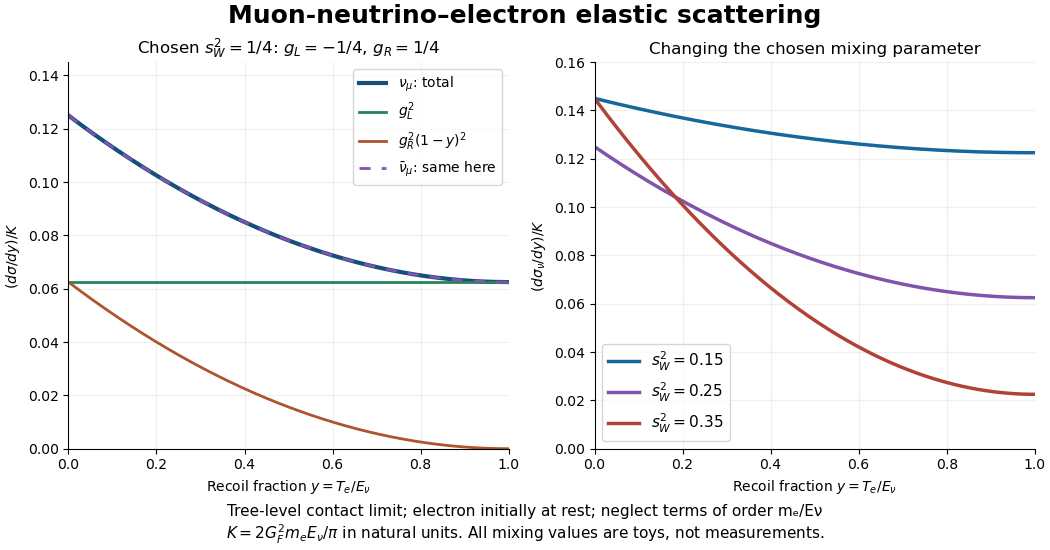

Unlike a visible electron recoil, the scattered neutrino is unrecorded. A measured recoil spectrum must therefore be compared with incident neutrino flux, energy distribution, acceptance, detection efficiency and backgrounds. A shape or rate tests a specified theoretical model only after these experimental ingredients have been supplied.
There are unlisted articles, also show them or only show them.